User login
Patient adjustments needed for closed-loop insulin delivery
TORONTO – Closed-loop insulin delivery is expected to become the standard of care in type 1 diabetes mellitus (T1DM), but there are multiple barriers that patients need to overcome.
“Many people who are potentially going to be using closed-loop systems are enthusiastic but have unrealistic expectations of how the systems are going to perform, and there are many barriers to uptake and optimal use that we still haven’t quite figured out,” said Korey K. Hood, PhD, a professor in the departments of pediatrics and psychiatry & behavioral sciences at Stanford (Calif.) University.
In a session dedicated to all aspects of closed-loop automated insulin delivery at the Pediatric Academic Societies annual meeting, Dr. Hood offered comments on patient and family factors important to the uptake and use of closed-loop technologies. His research at Stanford is focused on understanding the psychosocial aspects of diabetes management and how these factors contribute to disease outcomes.
Closed-loop insulin delivery refers to technologies that combine automated glucose monitoring (AGM) with an algorithm to determine insulin needs and an insulin delivery device. Sometimes called an “artificial pancreas” or “bionic pancreas,” closed-loop insulin delivery is considered a significant advance in the management of T1DM, relegating daily finger sticks and nighttime hypoglycemia to things of the past.
In a recent meta-analysis of randomized clinical trials, use of any automated device added nearly 2.5 hours of time in near normoglycemia over 24 hours in patients with TIDM, compared with any other type of insulin-based treatment (BMJ. 2018. doi: 10.1136/bmj.k1310). The benefit was primarily based on better glucose control in the overnight period.
In September 2016, the Food and Drug Administration approved the MiniMed 670G Insulin Pump System (Medtronic), the first hybrid automated insulin delivery device for T1DM and the only one approved in the United States. The system is intended for subcutaneous continuous glucose monitoring (CGM) and continuous delivery of basal insulin and administration of insulin for the management of T1DM in persons 14 years of age and older.
Barriers from different perspectives
Barriers to uptake and use are common for the devices that are components of closed-loop systems. In a survey of 1,503 adults with TIDM, Dr. Hood’s group found a wide range of barriers to adoption of CGM or insulin pumps that could potentially also impact use of closed-loop systems (Diabetes Care. 2017;40:181-7). Some were nonmodifiable, like costs, but most were modifiable.
“Many people talk about the hassle of wearing devices. They don’t like having multiple devices on their bodies. They don’t always like the way that they look, and so these are things that we can have some kind of impact on and need to be paying attention to,” he said.
“The younger participants indicated a lot more barriers to using devices, and as they got older, they indicated fewer barriers. But what was also interesting is that the younger participants also indicated a lot more diabetes distress. As time went on, that was less of a factor in whether or not people were using diabetes devices,” reported Dr. Hood.
Not surprisingly, he added, was that younger participants had more favorable views of technology in general. “But they had less favorable views of diabetes technology [than older participants], so they’re really not crazy about using these devices.”
Dr. Hood’s group has also studied whether patient-reported barriers to CGM use align with what clinicians perceive to be patient-related barriers (Diabetes Sci Technol. 2017;11[3]484-92). Similar to the patients, clinicians most frequently endorsed the perception that patients dislike having the device on their body. However, other things they felt their patients worried about were the alarms on the device and the difficulty in understanding its features, neither of which patients considered a primary barrier to CGM or insulin pump adoption.
“So, we need to be cautious and mindful as we move forward that there are mismatches between the patient-reported and clinician-reported barriers,” said Dr. Hood. “Our response, often, is to teach and to provide some kind of education, when that’s not necessarily what the patient is asking for.”
Would you use it?
In 2017, a group of investigators conducted a qualitative study of 284 participants, ranging in age from 8 to 86 years, with T1DM. The researchers used structured interviews or focus groups to explore expectations, desired features, potential benefits, and perceived burdens of automated insulin delivery systems (Diabetes Care. 2017;40[11]:1453-61).
“We were interested in children, adolescents, and adults with type 1, and then also the partners of the adults and the parents of the youth,” he explained.
“The findings revealed three themes identified as pressing for the uptake of automated insulin delivery: considerations of trust and control, system features, and concerns and barriers to adoption.
“For children, the areas of most concern revolved around specific social situations. Adolescents, on the other hand, were more concerned about the physical features of the device, the wearability, the discreetness of using it, and the comfort,” said Dr. Hood.
Adults and parents were much more interested in device accuracy, safety, adaptability, and algorithm quality. “For the kids and teens, not surprisingly, this wasn’t high on their list,” he added.
A clear indication of the unrealistic expectations surrounding this technology came from a 2018 study of almost 200 family members, which found that “reducing the constant concerns about diabetes, relieving family stress, and improving overall family relationships” were the three major areas the participants hoped would be helped with automated insulin delivery (Diabetes Technol Ther. 2018;20[3]:222-8).
“If we come up with a device that does this, then I think we will have fixed everything!” Dr. Hood said, adding that it really highlights the “very high hopes and expectations” of what closed-loop systems should deliver.
Device readiness is another area researchers have studied in the run-up to closed-loop systems. “The idea that everybody’s going to be ready to start in the same way, I think, is going to set us up for some failures,” he noted, adding that, in general, parents are much more enthusiastic about this than pediatric patients.
“Individuals who had been using diabetes devices – and some had already been in closed-loop studies – They had more realistic expectations of what these systems are going to be, because they knew that it wasn’t going to be a complete fix. Whereas others with more limited experience with component devices and these systems had much higher expectations and reported a fair amount of dissatisfaction at the end of the study because it didn’t do everything that they wanted it to do.”
Waves of uptake
“Ultimately, a closed-loop system is going to be judged by whether it can increase time on target and reduce cognitive burden,” said Dr. Hood. He finished his talk with some projections about the future of closed-loop systems. “I think we’re going to probably to have different waves, or types, of closed-loop users.”
The first wave will be the group that’s already “sold” on the idea, which might encompass about 15% of patients. The second wave, which might represent about 30% of the relevant patient population, will be those who are sold on the idea and will likely use it but will have high expectations of the system’s ease of use and effectiveness and thus are highly likely to discontinue its use if those expectations are not met.
“The third wave will be those who might use a closed-loop system but might be unaware of them currently and will need a fair amount of education.” And, finally, the fourth group are unlikely to ever use closed-loop insulin delivery. “They are a group that feels burned by previous generations of systems, and I think that they may not perceive benefit,” Dr. Hood suggested.
“But all of this is to say that I do think that a tailored experience, and one that is focused on different profiles, can optimize both the uptake and the use of these systems.”
Dr. Hood reported receiving grant/research support from Dexcom and being a consultant for Lilly Innovation Center, J&J Diabetes Institute, and Bigfoot Biomedical.
TORONTO – Closed-loop insulin delivery is expected to become the standard of care in type 1 diabetes mellitus (T1DM), but there are multiple barriers that patients need to overcome.
“Many people who are potentially going to be using closed-loop systems are enthusiastic but have unrealistic expectations of how the systems are going to perform, and there are many barriers to uptake and optimal use that we still haven’t quite figured out,” said Korey K. Hood, PhD, a professor in the departments of pediatrics and psychiatry & behavioral sciences at Stanford (Calif.) University.
In a session dedicated to all aspects of closed-loop automated insulin delivery at the Pediatric Academic Societies annual meeting, Dr. Hood offered comments on patient and family factors important to the uptake and use of closed-loop technologies. His research at Stanford is focused on understanding the psychosocial aspects of diabetes management and how these factors contribute to disease outcomes.
Closed-loop insulin delivery refers to technologies that combine automated glucose monitoring (AGM) with an algorithm to determine insulin needs and an insulin delivery device. Sometimes called an “artificial pancreas” or “bionic pancreas,” closed-loop insulin delivery is considered a significant advance in the management of T1DM, relegating daily finger sticks and nighttime hypoglycemia to things of the past.
In a recent meta-analysis of randomized clinical trials, use of any automated device added nearly 2.5 hours of time in near normoglycemia over 24 hours in patients with TIDM, compared with any other type of insulin-based treatment (BMJ. 2018. doi: 10.1136/bmj.k1310). The benefit was primarily based on better glucose control in the overnight period.
In September 2016, the Food and Drug Administration approved the MiniMed 670G Insulin Pump System (Medtronic), the first hybrid automated insulin delivery device for T1DM and the only one approved in the United States. The system is intended for subcutaneous continuous glucose monitoring (CGM) and continuous delivery of basal insulin and administration of insulin for the management of T1DM in persons 14 years of age and older.
Barriers from different perspectives
Barriers to uptake and use are common for the devices that are components of closed-loop systems. In a survey of 1,503 adults with TIDM, Dr. Hood’s group found a wide range of barriers to adoption of CGM or insulin pumps that could potentially also impact use of closed-loop systems (Diabetes Care. 2017;40:181-7). Some were nonmodifiable, like costs, but most were modifiable.
“Many people talk about the hassle of wearing devices. They don’t like having multiple devices on their bodies. They don’t always like the way that they look, and so these are things that we can have some kind of impact on and need to be paying attention to,” he said.
“The younger participants indicated a lot more barriers to using devices, and as they got older, they indicated fewer barriers. But what was also interesting is that the younger participants also indicated a lot more diabetes distress. As time went on, that was less of a factor in whether or not people were using diabetes devices,” reported Dr. Hood.
Not surprisingly, he added, was that younger participants had more favorable views of technology in general. “But they had less favorable views of diabetes technology [than older participants], so they’re really not crazy about using these devices.”
Dr. Hood’s group has also studied whether patient-reported barriers to CGM use align with what clinicians perceive to be patient-related barriers (Diabetes Sci Technol. 2017;11[3]484-92). Similar to the patients, clinicians most frequently endorsed the perception that patients dislike having the device on their body. However, other things they felt their patients worried about were the alarms on the device and the difficulty in understanding its features, neither of which patients considered a primary barrier to CGM or insulin pump adoption.
“So, we need to be cautious and mindful as we move forward that there are mismatches between the patient-reported and clinician-reported barriers,” said Dr. Hood. “Our response, often, is to teach and to provide some kind of education, when that’s not necessarily what the patient is asking for.”
Would you use it?
In 2017, a group of investigators conducted a qualitative study of 284 participants, ranging in age from 8 to 86 years, with T1DM. The researchers used structured interviews or focus groups to explore expectations, desired features, potential benefits, and perceived burdens of automated insulin delivery systems (Diabetes Care. 2017;40[11]:1453-61).
“We were interested in children, adolescents, and adults with type 1, and then also the partners of the adults and the parents of the youth,” he explained.
“The findings revealed three themes identified as pressing for the uptake of automated insulin delivery: considerations of trust and control, system features, and concerns and barriers to adoption.
“For children, the areas of most concern revolved around specific social situations. Adolescents, on the other hand, were more concerned about the physical features of the device, the wearability, the discreetness of using it, and the comfort,” said Dr. Hood.
Adults and parents were much more interested in device accuracy, safety, adaptability, and algorithm quality. “For the kids and teens, not surprisingly, this wasn’t high on their list,” he added.
A clear indication of the unrealistic expectations surrounding this technology came from a 2018 study of almost 200 family members, which found that “reducing the constant concerns about diabetes, relieving family stress, and improving overall family relationships” were the three major areas the participants hoped would be helped with automated insulin delivery (Diabetes Technol Ther. 2018;20[3]:222-8).
“If we come up with a device that does this, then I think we will have fixed everything!” Dr. Hood said, adding that it really highlights the “very high hopes and expectations” of what closed-loop systems should deliver.
Device readiness is another area researchers have studied in the run-up to closed-loop systems. “The idea that everybody’s going to be ready to start in the same way, I think, is going to set us up for some failures,” he noted, adding that, in general, parents are much more enthusiastic about this than pediatric patients.
“Individuals who had been using diabetes devices – and some had already been in closed-loop studies – They had more realistic expectations of what these systems are going to be, because they knew that it wasn’t going to be a complete fix. Whereas others with more limited experience with component devices and these systems had much higher expectations and reported a fair amount of dissatisfaction at the end of the study because it didn’t do everything that they wanted it to do.”
Waves of uptake
“Ultimately, a closed-loop system is going to be judged by whether it can increase time on target and reduce cognitive burden,” said Dr. Hood. He finished his talk with some projections about the future of closed-loop systems. “I think we’re going to probably to have different waves, or types, of closed-loop users.”
The first wave will be the group that’s already “sold” on the idea, which might encompass about 15% of patients. The second wave, which might represent about 30% of the relevant patient population, will be those who are sold on the idea and will likely use it but will have high expectations of the system’s ease of use and effectiveness and thus are highly likely to discontinue its use if those expectations are not met.
“The third wave will be those who might use a closed-loop system but might be unaware of them currently and will need a fair amount of education.” And, finally, the fourth group are unlikely to ever use closed-loop insulin delivery. “They are a group that feels burned by previous generations of systems, and I think that they may not perceive benefit,” Dr. Hood suggested.
“But all of this is to say that I do think that a tailored experience, and one that is focused on different profiles, can optimize both the uptake and the use of these systems.”
Dr. Hood reported receiving grant/research support from Dexcom and being a consultant for Lilly Innovation Center, J&J Diabetes Institute, and Bigfoot Biomedical.
TORONTO – Closed-loop insulin delivery is expected to become the standard of care in type 1 diabetes mellitus (T1DM), but there are multiple barriers that patients need to overcome.
“Many people who are potentially going to be using closed-loop systems are enthusiastic but have unrealistic expectations of how the systems are going to perform, and there are many barriers to uptake and optimal use that we still haven’t quite figured out,” said Korey K. Hood, PhD, a professor in the departments of pediatrics and psychiatry & behavioral sciences at Stanford (Calif.) University.
In a session dedicated to all aspects of closed-loop automated insulin delivery at the Pediatric Academic Societies annual meeting, Dr. Hood offered comments on patient and family factors important to the uptake and use of closed-loop technologies. His research at Stanford is focused on understanding the psychosocial aspects of diabetes management and how these factors contribute to disease outcomes.
Closed-loop insulin delivery refers to technologies that combine automated glucose monitoring (AGM) with an algorithm to determine insulin needs and an insulin delivery device. Sometimes called an “artificial pancreas” or “bionic pancreas,” closed-loop insulin delivery is considered a significant advance in the management of T1DM, relegating daily finger sticks and nighttime hypoglycemia to things of the past.
In a recent meta-analysis of randomized clinical trials, use of any automated device added nearly 2.5 hours of time in near normoglycemia over 24 hours in patients with TIDM, compared with any other type of insulin-based treatment (BMJ. 2018. doi: 10.1136/bmj.k1310). The benefit was primarily based on better glucose control in the overnight period.
In September 2016, the Food and Drug Administration approved the MiniMed 670G Insulin Pump System (Medtronic), the first hybrid automated insulin delivery device for T1DM and the only one approved in the United States. The system is intended for subcutaneous continuous glucose monitoring (CGM) and continuous delivery of basal insulin and administration of insulin for the management of T1DM in persons 14 years of age and older.
Barriers from different perspectives
Barriers to uptake and use are common for the devices that are components of closed-loop systems. In a survey of 1,503 adults with TIDM, Dr. Hood’s group found a wide range of barriers to adoption of CGM or insulin pumps that could potentially also impact use of closed-loop systems (Diabetes Care. 2017;40:181-7). Some were nonmodifiable, like costs, but most were modifiable.
“Many people talk about the hassle of wearing devices. They don’t like having multiple devices on their bodies. They don’t always like the way that they look, and so these are things that we can have some kind of impact on and need to be paying attention to,” he said.
“The younger participants indicated a lot more barriers to using devices, and as they got older, they indicated fewer barriers. But what was also interesting is that the younger participants also indicated a lot more diabetes distress. As time went on, that was less of a factor in whether or not people were using diabetes devices,” reported Dr. Hood.
Not surprisingly, he added, was that younger participants had more favorable views of technology in general. “But they had less favorable views of diabetes technology [than older participants], so they’re really not crazy about using these devices.”
Dr. Hood’s group has also studied whether patient-reported barriers to CGM use align with what clinicians perceive to be patient-related barriers (Diabetes Sci Technol. 2017;11[3]484-92). Similar to the patients, clinicians most frequently endorsed the perception that patients dislike having the device on their body. However, other things they felt their patients worried about were the alarms on the device and the difficulty in understanding its features, neither of which patients considered a primary barrier to CGM or insulin pump adoption.
“So, we need to be cautious and mindful as we move forward that there are mismatches between the patient-reported and clinician-reported barriers,” said Dr. Hood. “Our response, often, is to teach and to provide some kind of education, when that’s not necessarily what the patient is asking for.”
Would you use it?
In 2017, a group of investigators conducted a qualitative study of 284 participants, ranging in age from 8 to 86 years, with T1DM. The researchers used structured interviews or focus groups to explore expectations, desired features, potential benefits, and perceived burdens of automated insulin delivery systems (Diabetes Care. 2017;40[11]:1453-61).
“We were interested in children, adolescents, and adults with type 1, and then also the partners of the adults and the parents of the youth,” he explained.
“The findings revealed three themes identified as pressing for the uptake of automated insulin delivery: considerations of trust and control, system features, and concerns and barriers to adoption.
“For children, the areas of most concern revolved around specific social situations. Adolescents, on the other hand, were more concerned about the physical features of the device, the wearability, the discreetness of using it, and the comfort,” said Dr. Hood.
Adults and parents were much more interested in device accuracy, safety, adaptability, and algorithm quality. “For the kids and teens, not surprisingly, this wasn’t high on their list,” he added.
A clear indication of the unrealistic expectations surrounding this technology came from a 2018 study of almost 200 family members, which found that “reducing the constant concerns about diabetes, relieving family stress, and improving overall family relationships” were the three major areas the participants hoped would be helped with automated insulin delivery (Diabetes Technol Ther. 2018;20[3]:222-8).
“If we come up with a device that does this, then I think we will have fixed everything!” Dr. Hood said, adding that it really highlights the “very high hopes and expectations” of what closed-loop systems should deliver.
Device readiness is another area researchers have studied in the run-up to closed-loop systems. “The idea that everybody’s going to be ready to start in the same way, I think, is going to set us up for some failures,” he noted, adding that, in general, parents are much more enthusiastic about this than pediatric patients.
“Individuals who had been using diabetes devices – and some had already been in closed-loop studies – They had more realistic expectations of what these systems are going to be, because they knew that it wasn’t going to be a complete fix. Whereas others with more limited experience with component devices and these systems had much higher expectations and reported a fair amount of dissatisfaction at the end of the study because it didn’t do everything that they wanted it to do.”
Waves of uptake
“Ultimately, a closed-loop system is going to be judged by whether it can increase time on target and reduce cognitive burden,” said Dr. Hood. He finished his talk with some projections about the future of closed-loop systems. “I think we’re going to probably to have different waves, or types, of closed-loop users.”
The first wave will be the group that’s already “sold” on the idea, which might encompass about 15% of patients. The second wave, which might represent about 30% of the relevant patient population, will be those who are sold on the idea and will likely use it but will have high expectations of the system’s ease of use and effectiveness and thus are highly likely to discontinue its use if those expectations are not met.
“The third wave will be those who might use a closed-loop system but might be unaware of them currently and will need a fair amount of education.” And, finally, the fourth group are unlikely to ever use closed-loop insulin delivery. “They are a group that feels burned by previous generations of systems, and I think that they may not perceive benefit,” Dr. Hood suggested.
“But all of this is to say that I do think that a tailored experience, and one that is focused on different profiles, can optimize both the uptake and the use of these systems.”
Dr. Hood reported receiving grant/research support from Dexcom and being a consultant for Lilly Innovation Center, J&J Diabetes Institute, and Bigfoot Biomedical.
EXPERT ANALYSIS FROM PAS 2018
Emergency contraception ... and our duty to inform
In 2013, the emergency contraception containing levonorgestrel, most commonly known as Plan B, became available for purchase without prescription or age restriction. Yet, 5 years later, many adolescents and teens remain misinformed or uninformed completely. For the scope of this article, only levonorgestrel will be discussed, acknowledging that ulipristal acetate (Ella) is also an emergency contraception by prescription.
As providers we all recognize the challenges of engaging a teen patient long enough to have a meaningful conversation on health and wellness. There are even greater challenges when it comes to discussing sexual activity and sexually transmitted diseases. So the thought of discussing prevention of unwanted pregnancy may be daunting for most of us.
This topic has many layers. First and foremost, it touches on a hotly debated topic of where life begins, and emergency contraception may be thought to cross that line. Awareness of the option of emergency contraception is thought to give a free pass to promiscuous behavior. Some just feel there is not enough research to support the safe use of these products in adolescents. As with most things, taking the time to educate ourselves on the facts usually alleviates the conflicts.
Understanding levonorgestrel mechanism of action is important in clarifying its position in the prolife debate. The International Consortium for Emergency Contraception and the International Federation of Gynecologists and Obstetrics consider that inhibition or delay of ovulation is levonorgestrel’s mechanism of action, and that it does not prevent implantation of a fertilized egg. If taken after ovulation has occurred, it is ineffective in preventing pregnancy.1,2
Levonorgestrel emergency contraception was first approved by the Food and Drug Administration in 1999 under the brand name Plan B by Teva Women’s Health, then later Next Choice (Watson Pharma) was released. Initially, it was prescribed to be taken as a 0.75-mg tab within 72 hours of unprotected intercourse and repeated in 12 hours. Further studies revealed taking a 1.5-mg tab once was just as effective with no significant increase in adverse effects and Plan B One-Step was released.3
The Catholic Health Association presented a paper clarifying that levonorgestrel is not a postfertilization contraceptive (abortifacient), hopefully preventing delay of its use in victims of sexual assault seen in Catholic health care facilities.4
Safety for this product since its release has shown no deaths or serious complications.2 The most common side effect is nausea, usually without vomiting.2 Antinausea medication given 1 hour before can be helpful but is not routinely used. The length of menstrual cycle is shorter if given early in cycle but it may be lengthened by 2 days if taken post ovulation. It is not intended for repeated use, but 11 studies showed no adverse effects when it was used repeatedly in the same ovulatory cycle, and it was shown to be safe.2
For women whose emergency contraception failed, one study of 332 pregnant women who had used levonorgestrel found no teratogenic effect or risk of birth defects.5 Although it is not contraindicated in breastfeeding mothers, it was recommended that patients discontinue breastfeeding for 8 hours post ingestion. Recognized contraindications to oral contraceptives do not apply to levonorgestrel, given the temporary and relative low exposure to the hormone.3
As for efficacy, timing is of the essence. As stated previously, if not taken before ovulation has occurred, it is ineffective. If taken within 72 hours of unprotected intercourse, one study showed levonorgestrel would prevent 85% of pregnancies that otherwise might have occurred.3 Although the package insert says it must taken within 72 hours, studies have shown protection up to 120 hours post coitus, but that efficacy declines with every hour. Body mass index also may play a role in effectiveness, but the studies have been varied and more research is required before a determination is made.2

The annual well visit is the opportune time to educate parents and teens about abstinence, sex, sexually transmitted infections, and emergency contraception. Parents need to know the statistics of teen pregnancy and rates of STIs so they can be informed and further these conversations at home. should they find themselves in this dilemma. The websites not-2-late.com and bedsider.org are excellent sources of information on emergency contraception.
Keep in mind that 10% of all unintended pregnancies occur from nonconsensual intercourse so knowing what options are available is critical. Whether you give a handout with the information or undertake a more in-depth conversation during well visits, this is vital information that can change a person’s life.
Dr. Pearce is a pediatrician in Frankfort, Ill. She said she had no relevant financial disclosures. Email her at pdnews@mdedge.com.
References
1. “Emergency Contraception: Questions And Answers For Decision-Makers,” International Consortium for Emergency Contraception, 2013.
2. Clin Obstet Gynecol. 2014 Dec;57(4):741-50.
3. Pediatrics 2012;130:1174-82.
4. Health Progress. 2010 Jan-Feb. 59-61.
5. Hum Reprod. 2009 Jul;24(7):1605-11.
6. Contraception. 2016 Feb;93(2):145-52.
In 2013, the emergency contraception containing levonorgestrel, most commonly known as Plan B, became available for purchase without prescription or age restriction. Yet, 5 years later, many adolescents and teens remain misinformed or uninformed completely. For the scope of this article, only levonorgestrel will be discussed, acknowledging that ulipristal acetate (Ella) is also an emergency contraception by prescription.
As providers we all recognize the challenges of engaging a teen patient long enough to have a meaningful conversation on health and wellness. There are even greater challenges when it comes to discussing sexual activity and sexually transmitted diseases. So the thought of discussing prevention of unwanted pregnancy may be daunting for most of us.
This topic has many layers. First and foremost, it touches on a hotly debated topic of where life begins, and emergency contraception may be thought to cross that line. Awareness of the option of emergency contraception is thought to give a free pass to promiscuous behavior. Some just feel there is not enough research to support the safe use of these products in adolescents. As with most things, taking the time to educate ourselves on the facts usually alleviates the conflicts.
Understanding levonorgestrel mechanism of action is important in clarifying its position in the prolife debate. The International Consortium for Emergency Contraception and the International Federation of Gynecologists and Obstetrics consider that inhibition or delay of ovulation is levonorgestrel’s mechanism of action, and that it does not prevent implantation of a fertilized egg. If taken after ovulation has occurred, it is ineffective in preventing pregnancy.1,2
Levonorgestrel emergency contraception was first approved by the Food and Drug Administration in 1999 under the brand name Plan B by Teva Women’s Health, then later Next Choice (Watson Pharma) was released. Initially, it was prescribed to be taken as a 0.75-mg tab within 72 hours of unprotected intercourse and repeated in 12 hours. Further studies revealed taking a 1.5-mg tab once was just as effective with no significant increase in adverse effects and Plan B One-Step was released.3
The Catholic Health Association presented a paper clarifying that levonorgestrel is not a postfertilization contraceptive (abortifacient), hopefully preventing delay of its use in victims of sexual assault seen in Catholic health care facilities.4
Safety for this product since its release has shown no deaths or serious complications.2 The most common side effect is nausea, usually without vomiting.2 Antinausea medication given 1 hour before can be helpful but is not routinely used. The length of menstrual cycle is shorter if given early in cycle but it may be lengthened by 2 days if taken post ovulation. It is not intended for repeated use, but 11 studies showed no adverse effects when it was used repeatedly in the same ovulatory cycle, and it was shown to be safe.2
For women whose emergency contraception failed, one study of 332 pregnant women who had used levonorgestrel found no teratogenic effect or risk of birth defects.5 Although it is not contraindicated in breastfeeding mothers, it was recommended that patients discontinue breastfeeding for 8 hours post ingestion. Recognized contraindications to oral contraceptives do not apply to levonorgestrel, given the temporary and relative low exposure to the hormone.3
As for efficacy, timing is of the essence. As stated previously, if not taken before ovulation has occurred, it is ineffective. If taken within 72 hours of unprotected intercourse, one study showed levonorgestrel would prevent 85% of pregnancies that otherwise might have occurred.3 Although the package insert says it must taken within 72 hours, studies have shown protection up to 120 hours post coitus, but that efficacy declines with every hour. Body mass index also may play a role in effectiveness, but the studies have been varied and more research is required before a determination is made.2
The annual well visit is the opportune time to educate parents and teens about abstinence, sex, sexually transmitted infections, and emergency contraception. Parents need to know the statistics of teen pregnancy and rates of STIs so they can be informed and further these conversations at home. should they find themselves in this dilemma. The websites not-2-late.com and bedsider.org are excellent sources of information on emergency contraception.
Keep in mind that 10% of all unintended pregnancies occur from nonconsensual intercourse so knowing what options are available is critical. Whether you give a handout with the information or undertake a more in-depth conversation during well visits, this is vital information that can change a person’s life.
Dr. Pearce is a pediatrician in Frankfort, Ill. She said she had no relevant financial disclosures. Email her at pdnews@mdedge.com.
References
1. “Emergency Contraception: Questions And Answers For Decision-Makers,” International Consortium for Emergency Contraception, 2013.
2. Clin Obstet Gynecol. 2014 Dec;57(4):741-50.
3. Pediatrics 2012;130:1174-82.
4. Health Progress. 2010 Jan-Feb. 59-61.
5. Hum Reprod. 2009 Jul;24(7):1605-11.
6. Contraception. 2016 Feb;93(2):145-52.
In 2013, the emergency contraception containing levonorgestrel, most commonly known as Plan B, became available for purchase without prescription or age restriction. Yet, 5 years later, many adolescents and teens remain misinformed or uninformed completely. For the scope of this article, only levonorgestrel will be discussed, acknowledging that ulipristal acetate (Ella) is also an emergency contraception by prescription.
As providers we all recognize the challenges of engaging a teen patient long enough to have a meaningful conversation on health and wellness. There are even greater challenges when it comes to discussing sexual activity and sexually transmitted diseases. So the thought of discussing prevention of unwanted pregnancy may be daunting for most of us.
This topic has many layers. First and foremost, it touches on a hotly debated topic of where life begins, and emergency contraception may be thought to cross that line. Awareness of the option of emergency contraception is thought to give a free pass to promiscuous behavior. Some just feel there is not enough research to support the safe use of these products in adolescents. As with most things, taking the time to educate ourselves on the facts usually alleviates the conflicts.
Understanding levonorgestrel mechanism of action is important in clarifying its position in the prolife debate. The International Consortium for Emergency Contraception and the International Federation of Gynecologists and Obstetrics consider that inhibition or delay of ovulation is levonorgestrel’s mechanism of action, and that it does not prevent implantation of a fertilized egg. If taken after ovulation has occurred, it is ineffective in preventing pregnancy.1,2
Levonorgestrel emergency contraception was first approved by the Food and Drug Administration in 1999 under the brand name Plan B by Teva Women’s Health, then later Next Choice (Watson Pharma) was released. Initially, it was prescribed to be taken as a 0.75-mg tab within 72 hours of unprotected intercourse and repeated in 12 hours. Further studies revealed taking a 1.5-mg tab once was just as effective with no significant increase in adverse effects and Plan B One-Step was released.3
The Catholic Health Association presented a paper clarifying that levonorgestrel is not a postfertilization contraceptive (abortifacient), hopefully preventing delay of its use in victims of sexual assault seen in Catholic health care facilities.4
Safety for this product since its release has shown no deaths or serious complications.2 The most common side effect is nausea, usually without vomiting.2 Antinausea medication given 1 hour before can be helpful but is not routinely used. The length of menstrual cycle is shorter if given early in cycle but it may be lengthened by 2 days if taken post ovulation. It is not intended for repeated use, but 11 studies showed no adverse effects when it was used repeatedly in the same ovulatory cycle, and it was shown to be safe.2
For women whose emergency contraception failed, one study of 332 pregnant women who had used levonorgestrel found no teratogenic effect or risk of birth defects.5 Although it is not contraindicated in breastfeeding mothers, it was recommended that patients discontinue breastfeeding for 8 hours post ingestion. Recognized contraindications to oral contraceptives do not apply to levonorgestrel, given the temporary and relative low exposure to the hormone.3
As for efficacy, timing is of the essence. As stated previously, if not taken before ovulation has occurred, it is ineffective. If taken within 72 hours of unprotected intercourse, one study showed levonorgestrel would prevent 85% of pregnancies that otherwise might have occurred.3 Although the package insert says it must taken within 72 hours, studies have shown protection up to 120 hours post coitus, but that efficacy declines with every hour. Body mass index also may play a role in effectiveness, but the studies have been varied and more research is required before a determination is made.2
The annual well visit is the opportune time to educate parents and teens about abstinence, sex, sexually transmitted infections, and emergency contraception. Parents need to know the statistics of teen pregnancy and rates of STIs so they can be informed and further these conversations at home. should they find themselves in this dilemma. The websites not-2-late.com and bedsider.org are excellent sources of information on emergency contraception.
Keep in mind that 10% of all unintended pregnancies occur from nonconsensual intercourse so knowing what options are available is critical. Whether you give a handout with the information or undertake a more in-depth conversation during well visits, this is vital information that can change a person’s life.
Dr. Pearce is a pediatrician in Frankfort, Ill. She said she had no relevant financial disclosures. Email her at pdnews@mdedge.com.
References
1. “Emergency Contraception: Questions And Answers For Decision-Makers,” International Consortium for Emergency Contraception, 2013.
2. Clin Obstet Gynecol. 2014 Dec;57(4):741-50.
3. Pediatrics 2012;130:1174-82.
4. Health Progress. 2010 Jan-Feb. 59-61.
5. Hum Reprod. 2009 Jul;24(7):1605-11.
6. Contraception. 2016 Feb;93(2):145-52.
Large dark discoloration on the back
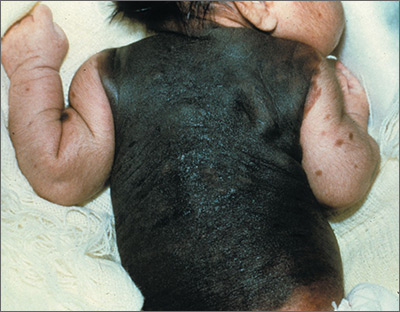
The FP recognized that this child had a large bathing trunk nevus with multiple small melanocytic satellite lesions on her arms.
He explained to the worried parents that their daughter had a bathing trunk nevus and that a local expert was needed. The FP consulted a local dermatologist, who subsequently explained to the parents that there was a significant risk of cutaneous melanoma if nothing was done about this large congenital nevus. The dermatologist indicated that while removal could decrease that risk, the process would require multiple large surgeries by a plastic surgeon. She also explained that a magnetic resonance imaging scan of the brain would be needed at about 6 months to look for neurocutaneous melanosis, which can cause seizures, hydrocephalus, and a central nervous system melanoma.
The parents were conflicted about whether to put their child through a series of massive surgeries or to accept the higher risk of melanoma and proceed with careful monitoring by the dermatologist. (No additional details on how this case resolved are available—Editor.)
Photos and text for Photo Rounds Friday courtesy of Richard P. Usatine, MD. This case was adapted from: Smith, M. Congenital nevi. In: Usatine R, Smith M, Mayeaux EJ, et al. Color Atlas of Family Medicine. 2nd ed. New York, NY: McGraw-Hill; 2013:953-957.
To learn more about the Color Atlas of Family Medicine, see: www.amazon.com/Color-Family-Medicine-Richard-Usatine/dp/0071769641/.
You can now get the second edition of the Color Atlas of Family Medicine as an app by clicking on this link: usatinemedia.com.
The FP recognized that this child had a large bathing trunk nevus with multiple small melanocytic satellite lesions on her arms.
He explained to the worried parents that their daughter had a bathing trunk nevus and that a local expert was needed. The FP consulted a local dermatologist, who subsequently explained to the parents that there was a significant risk of cutaneous melanoma if nothing was done about this large congenital nevus. The dermatologist indicated that while removal could decrease that risk, the process would require multiple large surgeries by a plastic surgeon. She also explained that a magnetic resonance imaging scan of the brain would be needed at about 6 months to look for neurocutaneous melanosis, which can cause seizures, hydrocephalus, and a central nervous system melanoma.
The parents were conflicted about whether to put their child through a series of massive surgeries or to accept the higher risk of melanoma and proceed with careful monitoring by the dermatologist. (No additional details on how this case resolved are available—Editor.)
Photos and text for Photo Rounds Friday courtesy of Richard P. Usatine, MD. This case was adapted from: Smith, M. Congenital nevi. In: Usatine R, Smith M, Mayeaux EJ, et al. Color Atlas of Family Medicine. 2nd ed. New York, NY: McGraw-Hill; 2013:953-957.
To learn more about the Color Atlas of Family Medicine, see: www.amazon.com/Color-Family-Medicine-Richard-Usatine/dp/0071769641/.
You can now get the second edition of the Color Atlas of Family Medicine as an app by clicking on this link: usatinemedia.com.
The FP recognized that this child had a large bathing trunk nevus with multiple small melanocytic satellite lesions on her arms.
He explained to the worried parents that their daughter had a bathing trunk nevus and that a local expert was needed. The FP consulted a local dermatologist, who subsequently explained to the parents that there was a significant risk of cutaneous melanoma if nothing was done about this large congenital nevus. The dermatologist indicated that while removal could decrease that risk, the process would require multiple large surgeries by a plastic surgeon. She also explained that a magnetic resonance imaging scan of the brain would be needed at about 6 months to look for neurocutaneous melanosis, which can cause seizures, hydrocephalus, and a central nervous system melanoma.
The parents were conflicted about whether to put their child through a series of massive surgeries or to accept the higher risk of melanoma and proceed with careful monitoring by the dermatologist. (No additional details on how this case resolved are available—Editor.)
Photos and text for Photo Rounds Friday courtesy of Richard P. Usatine, MD. This case was adapted from: Smith, M. Congenital nevi. In: Usatine R, Smith M, Mayeaux EJ, et al. Color Atlas of Family Medicine. 2nd ed. New York, NY: McGraw-Hill; 2013:953-957.
To learn more about the Color Atlas of Family Medicine, see: www.amazon.com/Color-Family-Medicine-Richard-Usatine/dp/0071769641/.
You can now get the second edition of the Color Atlas of Family Medicine as an app by clicking on this link: usatinemedia.com.
Early infection could prevent ALL, doc says

Childhood acute lymphoblastic leukemia (ALL) may be preventable, according to a researcher.
Mel Greaves, PhD, of The Institute of Cancer Research in London, UK, reviewed more than 30 years of research and concluded that ALL develops in 2 steps—genetic mutation before birth and further genetic change after birth triggered by infection.
The evidence suggests that infection early in life is beneficial to prime the immune system, but later infection without earlier priming can trigger ALL.
So priming the immune system in the first year of life could potentially prevent childhood ALL, according to Dr Greaves.
He outlined this theory in Nature Reviews Cancer.
Dr Greaves compiled more than 30 years of research into genetics, cell biology, immunology, epidemiology, and animal modelling of ALL.
The evidence led him to conclude that ALL begins with a genetic mutation that occurs before birth and predisposes a child to leukemia.
The disease is triggered later, in childhood, by exposure to one or more common infections. This primarily occurs in children who experienced “clean” childhoods in their first year of life, without much interaction with other infants or older children.
Dr Greaves challenged previous reports of possible environmental causes for ALL, such as ionizing radiation, electromagnetic waves, or man-made chemicals. He argued that none of these reports are supported by robust evidence.
Instead, he believes there is strong evidence suggesting that infection later in childhood, in the absence of earlier priming, can trigger ALL.
Dr Greaves’ studies of identical twins with ALL showed that 2 mutations were required for ALL development. The first arises in one twin in the womb but produces a population of pre-malignant cells that spread to the other twin via their shared blood supply. The second mutation arises after birth and is different in the twins.
Population studies and animal experiments suggest this second genetic hit can be triggered by infection, probably by a range of common viruses and bacteria. In one unique cluster of cases investigated by Dr Greaves and his colleagues, all cases were infected with flu virus.
In other work, researchers engineered mice with an active leukemia-initiating gene. When the team moved the mice from an ultra-clean, germ-free environment to one that had common microbes, the mice developed ALL.
Population studies have indicated that early exposure to infection in infancy, such as via day care attendance and breast feeding, can protect against ALL, probably by priming the immune system. This suggests childhood ALL may be preventable.
Dr Greaves is now investigating whether earlier exposure to harmless microbes could prevent leukemia in mice.
“I have spent more than 40 years researching childhood leukemia, and, over that time, there has been huge progress in our understanding of its biology and its treatment . . . ,” Dr Greaves said. “But it has always struck me that something big was missing, a gap in our knowledge [that failed to explain] why or how otherwise healthy children develop leukemia and whether this cancer is preventable.”
“This body of research is a culmination of decades of work and at last provides a credible explanation for how the major type of childhood leukemia develops. The research strongly suggests that ALL has a clear biological cause and is triggered by a variety of infections in predisposed children whose immune systems have not been properly primed. It also busts some persistent myths about the causes of leukemia, such as the damaging but unsubstantiated claims that the disease is commonly caused by exposure to electro-magnetic waves or pollution.”
“I hope this research will have a real impact on the lives of children. The most important implication is that most cases of childhood leukemia are likely to be preventable. It might be done in the same way that is currently under consideration for autoimmune disease or allergies, perhaps with simple and safe interventions to expose infants to a variety of common and harmless ‘bugs.’”
Childhood acute lymphoblastic leukemia (ALL) may be preventable, according to a researcher.
Mel Greaves, PhD, of The Institute of Cancer Research in London, UK, reviewed more than 30 years of research and concluded that ALL develops in 2 steps—genetic mutation before birth and further genetic change after birth triggered by infection.
The evidence suggests that infection early in life is beneficial to prime the immune system, but later infection without earlier priming can trigger ALL.
So priming the immune system in the first year of life could potentially prevent childhood ALL, according to Dr Greaves.
He outlined this theory in Nature Reviews Cancer.
Dr Greaves compiled more than 30 years of research into genetics, cell biology, immunology, epidemiology, and animal modelling of ALL.
The evidence led him to conclude that ALL begins with a genetic mutation that occurs before birth and predisposes a child to leukemia.
The disease is triggered later, in childhood, by exposure to one or more common infections. This primarily occurs in children who experienced “clean” childhoods in their first year of life, without much interaction with other infants or older children.
Dr Greaves challenged previous reports of possible environmental causes for ALL, such as ionizing radiation, electromagnetic waves, or man-made chemicals. He argued that none of these reports are supported by robust evidence.
Instead, he believes there is strong evidence suggesting that infection later in childhood, in the absence of earlier priming, can trigger ALL.
Dr Greaves’ studies of identical twins with ALL showed that 2 mutations were required for ALL development. The first arises in one twin in the womb but produces a population of pre-malignant cells that spread to the other twin via their shared blood supply. The second mutation arises after birth and is different in the twins.
Population studies and animal experiments suggest this second genetic hit can be triggered by infection, probably by a range of common viruses and bacteria. In one unique cluster of cases investigated by Dr Greaves and his colleagues, all cases were infected with flu virus.
In other work, researchers engineered mice with an active leukemia-initiating gene. When the team moved the mice from an ultra-clean, germ-free environment to one that had common microbes, the mice developed ALL.
Population studies have indicated that early exposure to infection in infancy, such as via day care attendance and breast feeding, can protect against ALL, probably by priming the immune system. This suggests childhood ALL may be preventable.
Dr Greaves is now investigating whether earlier exposure to harmless microbes could prevent leukemia in mice.
“I have spent more than 40 years researching childhood leukemia, and, over that time, there has been huge progress in our understanding of its biology and its treatment . . . ,” Dr Greaves said. “But it has always struck me that something big was missing, a gap in our knowledge [that failed to explain] why or how otherwise healthy children develop leukemia and whether this cancer is preventable.”
“This body of research is a culmination of decades of work and at last provides a credible explanation for how the major type of childhood leukemia develops. The research strongly suggests that ALL has a clear biological cause and is triggered by a variety of infections in predisposed children whose immune systems have not been properly primed. It also busts some persistent myths about the causes of leukemia, such as the damaging but unsubstantiated claims that the disease is commonly caused by exposure to electro-magnetic waves or pollution.”
“I hope this research will have a real impact on the lives of children. The most important implication is that most cases of childhood leukemia are likely to be preventable. It might be done in the same way that is currently under consideration for autoimmune disease or allergies, perhaps with simple and safe interventions to expose infants to a variety of common and harmless ‘bugs.’”
Childhood acute lymphoblastic leukemia (ALL) may be preventable, according to a researcher.
Mel Greaves, PhD, of The Institute of Cancer Research in London, UK, reviewed more than 30 years of research and concluded that ALL develops in 2 steps—genetic mutation before birth and further genetic change after birth triggered by infection.
The evidence suggests that infection early in life is beneficial to prime the immune system, but later infection without earlier priming can trigger ALL.
So priming the immune system in the first year of life could potentially prevent childhood ALL, according to Dr Greaves.
He outlined this theory in Nature Reviews Cancer.
Dr Greaves compiled more than 30 years of research into genetics, cell biology, immunology, epidemiology, and animal modelling of ALL.
The evidence led him to conclude that ALL begins with a genetic mutation that occurs before birth and predisposes a child to leukemia.
The disease is triggered later, in childhood, by exposure to one or more common infections. This primarily occurs in children who experienced “clean” childhoods in their first year of life, without much interaction with other infants or older children.
Dr Greaves challenged previous reports of possible environmental causes for ALL, such as ionizing radiation, electromagnetic waves, or man-made chemicals. He argued that none of these reports are supported by robust evidence.
Instead, he believes there is strong evidence suggesting that infection later in childhood, in the absence of earlier priming, can trigger ALL.
Dr Greaves’ studies of identical twins with ALL showed that 2 mutations were required for ALL development. The first arises in one twin in the womb but produces a population of pre-malignant cells that spread to the other twin via their shared blood supply. The second mutation arises after birth and is different in the twins.
Population studies and animal experiments suggest this second genetic hit can be triggered by infection, probably by a range of common viruses and bacteria. In one unique cluster of cases investigated by Dr Greaves and his colleagues, all cases were infected with flu virus.
In other work, researchers engineered mice with an active leukemia-initiating gene. When the team moved the mice from an ultra-clean, germ-free environment to one that had common microbes, the mice developed ALL.
Population studies have indicated that early exposure to infection in infancy, such as via day care attendance and breast feeding, can protect against ALL, probably by priming the immune system. This suggests childhood ALL may be preventable.
Dr Greaves is now investigating whether earlier exposure to harmless microbes could prevent leukemia in mice.
“I have spent more than 40 years researching childhood leukemia, and, over that time, there has been huge progress in our understanding of its biology and its treatment . . . ,” Dr Greaves said. “But it has always struck me that something big was missing, a gap in our knowledge [that failed to explain] why or how otherwise healthy children develop leukemia and whether this cancer is preventable.”
“This body of research is a culmination of decades of work and at last provides a credible explanation for how the major type of childhood leukemia develops. The research strongly suggests that ALL has a clear biological cause and is triggered by a variety of infections in predisposed children whose immune systems have not been properly primed. It also busts some persistent myths about the causes of leukemia, such as the damaging but unsubstantiated claims that the disease is commonly caused by exposure to electro-magnetic waves or pollution.”
“I hope this research will have a real impact on the lives of children. The most important implication is that most cases of childhood leukemia are likely to be preventable. It might be done in the same way that is currently under consideration for autoimmune disease or allergies, perhaps with simple and safe interventions to expose infants to a variety of common and harmless ‘bugs.’”
Atopic dermatitis severity reduced by topical microbiome treatment
The Beginning Assessment of Cutaneous Treatment Efficacy of Roseomonas in Atopic Dermatitis trial; BACTERiAD I/II study, an open-label phase I/II trial, first looked at the therapeutic use of R. mucosa in 10 adults aged 18 years or older. Three sucrose mixtures with increasing doses of live R. mucosa bacteria were topically applied to two body areas – the antecubital fossae and a body surface of their choice – twice per week for 2 weeks per dose. At 6 weeks, the patients stopped using the mixtures and followed a 4-week washout phase.
Treatment was found to reduce mean antecubital SCORAD (SCORing Atopic Dermatitis) scores by 59.8%. Reduction in pruritus was even more pronounced, with a mean decrease of 78.5%. Treating the hands did not improve disease severity, even in patients whose symptoms improved in other body areas. One explanation may be the increased exposure of the hands to topical antimicrobials and environmental exposures, the researchers noted.
With the success in the adult cohort, the researchers enrolled five children aged 7-17 years in the study. These patients were treated twice weekly for 16 weeks. The pediatric patients experienced a mean decrease of 70.3% in their SCORAD scores. The mean decrease in pruritis was 78.8%.
All adults who responded continued to report improved symptoms after the washout period. The pediatric patients are now being evaluated in a washout period.
Four patients did not respond; three of them had a family history of AD persisting into adulthood. “The association between these complex medical histories and the lack of clinical response suggests that differences in heritable host and/or microbial factors may impact treatment responses,” wrote Ian A. Myles, MD, and his colleagues.
“Overall, our findings suggest the safety of topical R. mucosa therapy and justify continuation of our ongoing trial to assess safety and activity in a pediatric cohort of patients with AD. These studies will additionally assess changes in host serum markers, skin metabolomics, and the skin microbiota by culture and genomic methods.”
The researchers noted that expanding to the pediatric population will deepen understanding of topical microbiome transplantation and lay the foundation for placebo-controlled trials to assess efficacy.
This work was supported by the Intramural Research Program of the National Institutes of Allergy and Infectious Diseases and the National Institutes of Health. The researchers had no disclosures.
SOURCE: Myles IA et al. JCI Insight. 2018 May 3. doi: 10.1172/jci.insight.120608.
The Beginning Assessment of Cutaneous Treatment Efficacy of Roseomonas in Atopic Dermatitis trial; BACTERiAD I/II study, an open-label phase I/II trial, first looked at the therapeutic use of R. mucosa in 10 adults aged 18 years or older. Three sucrose mixtures with increasing doses of live R. mucosa bacteria were topically applied to two body areas – the antecubital fossae and a body surface of their choice – twice per week for 2 weeks per dose. At 6 weeks, the patients stopped using the mixtures and followed a 4-week washout phase.
Treatment was found to reduce mean antecubital SCORAD (SCORing Atopic Dermatitis) scores by 59.8%. Reduction in pruritus was even more pronounced, with a mean decrease of 78.5%. Treating the hands did not improve disease severity, even in patients whose symptoms improved in other body areas. One explanation may be the increased exposure of the hands to topical antimicrobials and environmental exposures, the researchers noted.
With the success in the adult cohort, the researchers enrolled five children aged 7-17 years in the study. These patients were treated twice weekly for 16 weeks. The pediatric patients experienced a mean decrease of 70.3% in their SCORAD scores. The mean decrease in pruritis was 78.8%.
All adults who responded continued to report improved symptoms after the washout period. The pediatric patients are now being evaluated in a washout period.
Four patients did not respond; three of them had a family history of AD persisting into adulthood. “The association between these complex medical histories and the lack of clinical response suggests that differences in heritable host and/or microbial factors may impact treatment responses,” wrote Ian A. Myles, MD, and his colleagues.
“Overall, our findings suggest the safety of topical R. mucosa therapy and justify continuation of our ongoing trial to assess safety and activity in a pediatric cohort of patients with AD. These studies will additionally assess changes in host serum markers, skin metabolomics, and the skin microbiota by culture and genomic methods.”
The researchers noted that expanding to the pediatric population will deepen understanding of topical microbiome transplantation and lay the foundation for placebo-controlled trials to assess efficacy.
This work was supported by the Intramural Research Program of the National Institutes of Allergy and Infectious Diseases and the National Institutes of Health. The researchers had no disclosures.
SOURCE: Myles IA et al. JCI Insight. 2018 May 3. doi: 10.1172/jci.insight.120608.
The Beginning Assessment of Cutaneous Treatment Efficacy of Roseomonas in Atopic Dermatitis trial; BACTERiAD I/II study, an open-label phase I/II trial, first looked at the therapeutic use of R. mucosa in 10 adults aged 18 years or older. Three sucrose mixtures with increasing doses of live R. mucosa bacteria were topically applied to two body areas – the antecubital fossae and a body surface of their choice – twice per week for 2 weeks per dose. At 6 weeks, the patients stopped using the mixtures and followed a 4-week washout phase.
Treatment was found to reduce mean antecubital SCORAD (SCORing Atopic Dermatitis) scores by 59.8%. Reduction in pruritus was even more pronounced, with a mean decrease of 78.5%. Treating the hands did not improve disease severity, even in patients whose symptoms improved in other body areas. One explanation may be the increased exposure of the hands to topical antimicrobials and environmental exposures, the researchers noted.
With the success in the adult cohort, the researchers enrolled five children aged 7-17 years in the study. These patients were treated twice weekly for 16 weeks. The pediatric patients experienced a mean decrease of 70.3% in their SCORAD scores. The mean decrease in pruritis was 78.8%.
All adults who responded continued to report improved symptoms after the washout period. The pediatric patients are now being evaluated in a washout period.
Four patients did not respond; three of them had a family history of AD persisting into adulthood. “The association between these complex medical histories and the lack of clinical response suggests that differences in heritable host and/or microbial factors may impact treatment responses,” wrote Ian A. Myles, MD, and his colleagues.
“Overall, our findings suggest the safety of topical R. mucosa therapy and justify continuation of our ongoing trial to assess safety and activity in a pediatric cohort of patients with AD. These studies will additionally assess changes in host serum markers, skin metabolomics, and the skin microbiota by culture and genomic methods.”
The researchers noted that expanding to the pediatric population will deepen understanding of topical microbiome transplantation and lay the foundation for placebo-controlled trials to assess efficacy.
This work was supported by the Intramural Research Program of the National Institutes of Allergy and Infectious Diseases and the National Institutes of Health. The researchers had no disclosures.
SOURCE: Myles IA et al. JCI Insight. 2018 May 3. doi: 10.1172/jci.insight.120608.
FROM JCI INSIGHT
Key clinical point: Roseomonas mucosa reduces disease severity.
Major finding: There were reductions in SCORAD scores of 78.5% and 70.3% in the adult and pediatric cohorts, respectively.
Study details: Case study of 10 adult and 5 pediatric patients with atopic dermatitis.
Disclosures: No relevant financial disclosures were reported.
Source: Myles IA et al. JCI Insight. 2018 May 3. doi: 10.1172/jci.insight.120608.
8-Isoprostane levels predict OSA in children
The oxidative stress biomarker 8-isoprostane (8-IsoP) predicted obstructive sleep apnea (OSA) and disease severity in children better than the fractional concentration of exhaled nitric oxide (FENO), according to results published in Sleep Medicine.
In an analysis of 46 patients with sleep-disordered breathing and 20 controls, 8-IsoP values were also correlated with apnea hypopnea index (AHI) (r, 0.40; P = .003) and oxygen saturation, also known as SaO2, (r, –0.50; P = .001), reported Dr. Mario Berreto of the Pediatric Unit at Sant’Andrea Hospital in Rome and his coauthors.
The investigators studied 66 children aged 4.5-15.1 years, of whom 46 had sleep-disordered breathing (SDB) and were enrolled in the hospital’s Pediatric Sleep Center. The 20 healthy controls had no history of sleep problems, including snoring, apneas, and restless sleep. Exclusion criteria included acute respiratory infections in the 4 weeks preceding the study, chronic respiratory comorbidities, and therapy with corticosteroids or other anti-inflammatory drugs for at least 3 weeks.
Patients with SDB had a medical examination followed by overnight standard polysomnography (PSG), and EBC 8-IsoP and FENO measurements were collected the next morning upon waking. The SDB group also had spirometry and skin prick testing for common allergens. The children in the control group had the same tests and measurements done, except for PSG, Dr. Berreto and his colleagues wrote.
Central, obstructive, and mixed apnea events were counted according to American Academy of Sleep Medicine (AASM) criteria. AHI was defined as the average number of apnea and hypopnea events per hour of sleep. OSA was diagnosed with an AHI of one episode per hour and confirmed by the presence of SDB symptoms with AHI of one episode per hour.
Children with snoring and an AHI of less than one episode per hour were diagnosed with primary snoring (PS). Patients with an AHI greater than one episode per hour and less than five episodes per hour were diagnosed with mild OSA. Children with an AHI of greater than five episodes per hour were diagnosed with moderate to severe OSA, the authors said.
While 8-IsoP concentrations correlated with OSA severity for AHI and SaO2, FENO did not, Dr. Berreto and colleagues reported.
The difference in 8-IsoP concentrations for children with SDB and controls (mean, 39.6; P = .006) was increased when adjusted using multiple linear regression (mean, 43.2; P = .007), and the difference was even more pronounced when adjusted for all potential confounding variables (mean, 53.1; P = .008). The difference in FENO levels between SDB patients and controls was not statistically significant (mean, 1.67; P = .358) and did not change significantly when adjusted for confounding variables.
High area under the curve values were observed for 8-IsoP as a predictor of OSA (.839; 95% confidence interval, .744-.933, P = .000). The sensitivity and specificity of cutoff values of 8-IsoP concentrations above the 50th percentile were 76.5% and 78.1%, respectively.
“[It] seems that biomarkers of oxidative stress reflect OSA severity in children more closely than biomarkers of atopic-eosinophilic airway inflammation,” the authors concluded.
No disclosures or conflicts of interest were reported.
SOURCE: Barreto M et al. Sleep Medicine. 2018. doi: 10.1016/j.sleep.2018.01.011.
The oxidative stress biomarker 8-isoprostane (8-IsoP) predicted obstructive sleep apnea (OSA) and disease severity in children better than the fractional concentration of exhaled nitric oxide (FENO), according to results published in Sleep Medicine.
In an analysis of 46 patients with sleep-disordered breathing and 20 controls, 8-IsoP values were also correlated with apnea hypopnea index (AHI) (r, 0.40; P = .003) and oxygen saturation, also known as SaO2, (r, –0.50; P = .001), reported Dr. Mario Berreto of the Pediatric Unit at Sant’Andrea Hospital in Rome and his coauthors.
The investigators studied 66 children aged 4.5-15.1 years, of whom 46 had sleep-disordered breathing (SDB) and were enrolled in the hospital’s Pediatric Sleep Center. The 20 healthy controls had no history of sleep problems, including snoring, apneas, and restless sleep. Exclusion criteria included acute respiratory infections in the 4 weeks preceding the study, chronic respiratory comorbidities, and therapy with corticosteroids or other anti-inflammatory drugs for at least 3 weeks.
Patients with SDB had a medical examination followed by overnight standard polysomnography (PSG), and EBC 8-IsoP and FENO measurements were collected the next morning upon waking. The SDB group also had spirometry and skin prick testing for common allergens. The children in the control group had the same tests and measurements done, except for PSG, Dr. Berreto and his colleagues wrote.
Central, obstructive, and mixed apnea events were counted according to American Academy of Sleep Medicine (AASM) criteria. AHI was defined as the average number of apnea and hypopnea events per hour of sleep. OSA was diagnosed with an AHI of one episode per hour and confirmed by the presence of SDB symptoms with AHI of one episode per hour.
Children with snoring and an AHI of less than one episode per hour were diagnosed with primary snoring (PS). Patients with an AHI greater than one episode per hour and less than five episodes per hour were diagnosed with mild OSA. Children with an AHI of greater than five episodes per hour were diagnosed with moderate to severe OSA, the authors said.
While 8-IsoP concentrations correlated with OSA severity for AHI and SaO2, FENO did not, Dr. Berreto and colleagues reported.
The difference in 8-IsoP concentrations for children with SDB and controls (mean, 39.6; P = .006) was increased when adjusted using multiple linear regression (mean, 43.2; P = .007), and the difference was even more pronounced when adjusted for all potential confounding variables (mean, 53.1; P = .008). The difference in FENO levels between SDB patients and controls was not statistically significant (mean, 1.67; P = .358) and did not change significantly when adjusted for confounding variables.
High area under the curve values were observed for 8-IsoP as a predictor of OSA (.839; 95% confidence interval, .744-.933, P = .000). The sensitivity and specificity of cutoff values of 8-IsoP concentrations above the 50th percentile were 76.5% and 78.1%, respectively.
“[It] seems that biomarkers of oxidative stress reflect OSA severity in children more closely than biomarkers of atopic-eosinophilic airway inflammation,” the authors concluded.
No disclosures or conflicts of interest were reported.
SOURCE: Barreto M et al. Sleep Medicine. 2018. doi: 10.1016/j.sleep.2018.01.011.
The oxidative stress biomarker 8-isoprostane (8-IsoP) predicted obstructive sleep apnea (OSA) and disease severity in children better than the fractional concentration of exhaled nitric oxide (FENO), according to results published in Sleep Medicine.
In an analysis of 46 patients with sleep-disordered breathing and 20 controls, 8-IsoP values were also correlated with apnea hypopnea index (AHI) (r, 0.40; P = .003) and oxygen saturation, also known as SaO2, (r, –0.50; P = .001), reported Dr. Mario Berreto of the Pediatric Unit at Sant’Andrea Hospital in Rome and his coauthors.
The investigators studied 66 children aged 4.5-15.1 years, of whom 46 had sleep-disordered breathing (SDB) and were enrolled in the hospital’s Pediatric Sleep Center. The 20 healthy controls had no history of sleep problems, including snoring, apneas, and restless sleep. Exclusion criteria included acute respiratory infections in the 4 weeks preceding the study, chronic respiratory comorbidities, and therapy with corticosteroids or other anti-inflammatory drugs for at least 3 weeks.
Patients with SDB had a medical examination followed by overnight standard polysomnography (PSG), and EBC 8-IsoP and FENO measurements were collected the next morning upon waking. The SDB group also had spirometry and skin prick testing for common allergens. The children in the control group had the same tests and measurements done, except for PSG, Dr. Berreto and his colleagues wrote.
Central, obstructive, and mixed apnea events were counted according to American Academy of Sleep Medicine (AASM) criteria. AHI was defined as the average number of apnea and hypopnea events per hour of sleep. OSA was diagnosed with an AHI of one episode per hour and confirmed by the presence of SDB symptoms with AHI of one episode per hour.
Children with snoring and an AHI of less than one episode per hour were diagnosed with primary snoring (PS). Patients with an AHI greater than one episode per hour and less than five episodes per hour were diagnosed with mild OSA. Children with an AHI of greater than five episodes per hour were diagnosed with moderate to severe OSA, the authors said.
While 8-IsoP concentrations correlated with OSA severity for AHI and SaO2, FENO did not, Dr. Berreto and colleagues reported.
The difference in 8-IsoP concentrations for children with SDB and controls (mean, 39.6; P = .006) was increased when adjusted using multiple linear regression (mean, 43.2; P = .007), and the difference was even more pronounced when adjusted for all potential confounding variables (mean, 53.1; P = .008). The difference in FENO levels between SDB patients and controls was not statistically significant (mean, 1.67; P = .358) and did not change significantly when adjusted for confounding variables.
High area under the curve values were observed for 8-IsoP as a predictor of OSA (.839; 95% confidence interval, .744-.933, P = .000). The sensitivity and specificity of cutoff values of 8-IsoP concentrations above the 50th percentile were 76.5% and 78.1%, respectively.
“[It] seems that biomarkers of oxidative stress reflect OSA severity in children more closely than biomarkers of atopic-eosinophilic airway inflammation,” the authors concluded.
No disclosures or conflicts of interest were reported.
SOURCE: Barreto M et al. Sleep Medicine. 2018. doi: 10.1016/j.sleep.2018.01.011.
FROM SLEEP MEDICINE
Key clinical point: The biomarker 8-isoprostane predicted OSA and correlated with disease severity in children.
Major finding: Children with OSA had higher levels of 8-IsoP than patients with primary snoring (PS) and controls; 8-IsoP values were also correlated with apnea hypopnea index (r, 0.40; P = .003).
Study details: A single-center, cross-sectional observational study of 46 children with sleep-disordered breathing and 20 healthy controls.
Disclosures: No disclosures or conflicts of interest were reported.
Source: Barreto M et al. Sleep Medicine. 2018. doi: https://doi.org/10.1016/j.sleep.2018.01.011.
Autism screening tests fall short
Children whose autism was not detected by the Modified Checklist for Autism in Toddlers (M-CHAT) at 18 months old were more likely to have delays in social, communication, and fine and gross motor skills at the time of the screen, compared with other children who had negative results, according to findings from a retrospective analysis of 68,197 screen-negative cases in the Norwegian Mother and Child Cohort Study.
Parents of children with false-negative M-CHAT results rated their children’s gross and fine motor skills and social and communication skills at 18 months as less developed than did parents of children with true-negative screens. For girls who had false-negative results and were later diagnosed with autism, the delays were more pronounced, compared with girls with true-negative results. Also, girls later diagnosed with autism were rated as less shy than girls with true-negative scores. Shyness was more common in boys later diagnosed with autism than in boys with true-negative scores.
“When trying to determine if a young child is exhibiting autism symptoms, clinicians should not rely solely on a single instrument but consider parental concerns and draw on other developmental surveillance instruments, as well as their clinical judgment. ... The clinicians also need to be particularly wary about discounting symptoms of social difficulties in girls because they may be masked by limited shyness or social inhibition,” wrote Roald A. Øien, MA, of the University of Tromsø (Norway) and Yale University in New Haven, Conn., and his associates in Pediatrics.
The researchers noted that the study was based on use of a previous M-CHAT version. The findings may not be relevant to the updated M-CHAT-R/F, which has 20 questions, new cutoffs, and a recommended follow-up interview.
Of the Norwegian children who were at least 40 months old at the time of the study, 67,969 had true-negative M-CHAT screens, and 228 had false-negative screens based on later diagnoses reported in the Autism Birth Cohort, a substudy of the Norwegian Mother and Child Cohort Study.
The 18-month-olds had been assessed with the M-CHAT, selected items from the Ages and Stages Questionnaire and the Emotionality Activity Sociability Temperament Survey. Of the 23 pass-fail M-CHAT items, 6 are highly predictive of a later ASD diagnosis; a positive screen is failure of at least 2 of those 6 items.
Both boys and girls with false negatives were less social and had lower communication and gross motor skills, compared with their true-negative counterparts, but these differences were greater between false-negative and true-negative girls. Fine motor skills were also significantly lower in those with false negatives than in those with true negatives, but the magnitude was no different between girls and boys.
Overall, boys had more advanced gross motor skills and higher activity levels than girls, independent of true- or false-negative status.
In post hoc analyses, boys with false-negative results were rated as more shy than boys with true-negative results. Girls with false negatives were rated as less shy than girls with true negatives and boys with false negatives. Ratings of emotionality and activity did not differ among the children with true or false negatives.
The authors speculated that girls with false negatives may have “somewhat lower levels of social fearfulness or lower inhibitory control, compared with boys.”
The authors also suggested possible reasons for the false negatives, including parents’ difficulty in matching behaviors described in the M-CHAT with their children’s behaviors and the lack of graded responses on the M-CHAT, which may influence parents’ responses.
By comparison, the Ages and Stages Questionnaire “gives parents the opportunity to express that the children exhibit skills occasionally albeit inconsistently, which may allow them to express their concerns and perceptions in a more graded manner,” the authors wrote.
Another possible reason for false negatives, the authors suggested, is that symptoms in those with autism spectrum disorder may manifest differently in early childhood, partly depending on the level of the child’s verbal and nonverbal skills.
“We believe that our results contribute, at a fundamental level, to our understanding of early screening for ASD, and we highlight the discrepancy between hard cutoff criteria for autism and the social-communicative, developmental, and temperamental signatures of emerging or subthreshold autism phenotypes,” the authors wrote. They noted a need for screens that take into account temperament and verbal and nonverbal skill levels.
The research was funded by the Norwegian Ministry of Health and Care Services, the Norwegian Ministry of Education and Research, the Research Council of Norway and Functional Genomics in Norway, the National Institute of Neurological Disorders and Stroke and the National Institute of Environmental Health Sciences. Dr Hornig coinvented an intestinal microbiome biomarker for autism which has patents assigned to Columbia University.
SOURCE: Øien RA et al. Pediatrics. 2018;141(6):e20173596.
The investigators’ conclusions that more sensitive autism spectrum disorders (ASD) screening tools are needed may need to be tempered.
The study authors conclude that, even among children who screen negative on the M-CHAT, those with ASD frequently display early signs and symptoms that, with more sensitive screening instruments, may enhance early detection.
While such a conclusion is logical, the study data indicate that the M-CHAT had a sensitivity of 23% in this population, which is dramatically lower than the sensitivity reported in other studies. If the sensitivity of the updated M-CHAT-R screening tool is truly 91%, as has been claimed, it is hard to argue that more sensitive screening tools are needed.
As the M-CHAT-R was developed to improve usability and decrease the false-positive rate of the M-CHAT, the difference in screening tools is unlikely to account for the low sensitivity of the M-CHAT in this population. Possibilities that may factor into the low sensitivity include timing (the M-CHATs were evaluated only at 18 months), differential follow-up across false- and true-negative screens, or population differences in the Norwegian study and previous work.
These criticisms withstanding, the current study does send a clear warning that the M-CHAT likely does not equally identify all manifestations, or clinical phenotypes, of ASD. The findings lend credence to the concern of the USPSTF (U.S. Preventive Services Task Force) that “clinical and convenience samples do not adequately demonstrate the psychometric properties of screeners in practice.” In this study, the researchers reinforce the notion that screened and clinical populations may be systematically different and that more research is needed to understand such differences.
This commentary is edited from an accompanying editorial in Pediatrics (2018;141[6]:e20180965) by Sarabeth Broder-Fingert, MD, MPH; Emily Feinberg, ScD; and Michael Silverstein, MD, MPH, of the Boston University/Boston Medical Center. Dr Silverstein is a member of the U.S. Preventive Services Task Force but speaks here for himself alone.
The investigators’ conclusions that more sensitive autism spectrum disorders (ASD) screening tools are needed may need to be tempered.
The study authors conclude that, even among children who screen negative on the M-CHAT, those with ASD frequently display early signs and symptoms that, with more sensitive screening instruments, may enhance early detection.
While such a conclusion is logical, the study data indicate that the M-CHAT had a sensitivity of 23% in this population, which is dramatically lower than the sensitivity reported in other studies. If the sensitivity of the updated M-CHAT-R screening tool is truly 91%, as has been claimed, it is hard to argue that more sensitive screening tools are needed.
As the M-CHAT-R was developed to improve usability and decrease the false-positive rate of the M-CHAT, the difference in screening tools is unlikely to account for the low sensitivity of the M-CHAT in this population. Possibilities that may factor into the low sensitivity include timing (the M-CHATs were evaluated only at 18 months), differential follow-up across false- and true-negative screens, or population differences in the Norwegian study and previous work.
These criticisms withstanding, the current study does send a clear warning that the M-CHAT likely does not equally identify all manifestations, or clinical phenotypes, of ASD. The findings lend credence to the concern of the USPSTF (U.S. Preventive Services Task Force) that “clinical and convenience samples do not adequately demonstrate the psychometric properties of screeners in practice.” In this study, the researchers reinforce the notion that screened and clinical populations may be systematically different and that more research is needed to understand such differences.
This commentary is edited from an accompanying editorial in Pediatrics (2018;141[6]:e20180965) by Sarabeth Broder-Fingert, MD, MPH; Emily Feinberg, ScD; and Michael Silverstein, MD, MPH, of the Boston University/Boston Medical Center. Dr Silverstein is a member of the U.S. Preventive Services Task Force but speaks here for himself alone.
The investigators’ conclusions that more sensitive autism spectrum disorders (ASD) screening tools are needed may need to be tempered.
The study authors conclude that, even among children who screen negative on the M-CHAT, those with ASD frequently display early signs and symptoms that, with more sensitive screening instruments, may enhance early detection.
While such a conclusion is logical, the study data indicate that the M-CHAT had a sensitivity of 23% in this population, which is dramatically lower than the sensitivity reported in other studies. If the sensitivity of the updated M-CHAT-R screening tool is truly 91%, as has been claimed, it is hard to argue that more sensitive screening tools are needed.
As the M-CHAT-R was developed to improve usability and decrease the false-positive rate of the M-CHAT, the difference in screening tools is unlikely to account for the low sensitivity of the M-CHAT in this population. Possibilities that may factor into the low sensitivity include timing (the M-CHATs were evaluated only at 18 months), differential follow-up across false- and true-negative screens, or population differences in the Norwegian study and previous work.
These criticisms withstanding, the current study does send a clear warning that the M-CHAT likely does not equally identify all manifestations, or clinical phenotypes, of ASD. The findings lend credence to the concern of the USPSTF (U.S. Preventive Services Task Force) that “clinical and convenience samples do not adequately demonstrate the psychometric properties of screeners in practice.” In this study, the researchers reinforce the notion that screened and clinical populations may be systematically different and that more research is needed to understand such differences.
This commentary is edited from an accompanying editorial in Pediatrics (2018;141[6]:e20180965) by Sarabeth Broder-Fingert, MD, MPH; Emily Feinberg, ScD; and Michael Silverstein, MD, MPH, of the Boston University/Boston Medical Center. Dr Silverstein is a member of the U.S. Preventive Services Task Force but speaks here for himself alone.
Children whose autism was not detected by the Modified Checklist for Autism in Toddlers (M-CHAT) at 18 months old were more likely to have delays in social, communication, and fine and gross motor skills at the time of the screen, compared with other children who had negative results, according to findings from a retrospective analysis of 68,197 screen-negative cases in the Norwegian Mother and Child Cohort Study.
Parents of children with false-negative M-CHAT results rated their children’s gross and fine motor skills and social and communication skills at 18 months as less developed than did parents of children with true-negative screens. For girls who had false-negative results and were later diagnosed with autism, the delays were more pronounced, compared with girls with true-negative results. Also, girls later diagnosed with autism were rated as less shy than girls with true-negative scores. Shyness was more common in boys later diagnosed with autism than in boys with true-negative scores.
“When trying to determine if a young child is exhibiting autism symptoms, clinicians should not rely solely on a single instrument but consider parental concerns and draw on other developmental surveillance instruments, as well as their clinical judgment. ... The clinicians also need to be particularly wary about discounting symptoms of social difficulties in girls because they may be masked by limited shyness or social inhibition,” wrote Roald A. Øien, MA, of the University of Tromsø (Norway) and Yale University in New Haven, Conn., and his associates in Pediatrics.
The researchers noted that the study was based on use of a previous M-CHAT version. The findings may not be relevant to the updated M-CHAT-R/F, which has 20 questions, new cutoffs, and a recommended follow-up interview.
Of the Norwegian children who were at least 40 months old at the time of the study, 67,969 had true-negative M-CHAT screens, and 228 had false-negative screens based on later diagnoses reported in the Autism Birth Cohort, a substudy of the Norwegian Mother and Child Cohort Study.
The 18-month-olds had been assessed with the M-CHAT, selected items from the Ages and Stages Questionnaire and the Emotionality Activity Sociability Temperament Survey. Of the 23 pass-fail M-CHAT items, 6 are highly predictive of a later ASD diagnosis; a positive screen is failure of at least 2 of those 6 items.
Both boys and girls with false negatives were less social and had lower communication and gross motor skills, compared with their true-negative counterparts, but these differences were greater between false-negative and true-negative girls. Fine motor skills were also significantly lower in those with false negatives than in those with true negatives, but the magnitude was no different between girls and boys.
Overall, boys had more advanced gross motor skills and higher activity levels than girls, independent of true- or false-negative status.
In post hoc analyses, boys with false-negative results were rated as more shy than boys with true-negative results. Girls with false negatives were rated as less shy than girls with true negatives and boys with false negatives. Ratings of emotionality and activity did not differ among the children with true or false negatives.
The authors speculated that girls with false negatives may have “somewhat lower levels of social fearfulness or lower inhibitory control, compared with boys.”
The authors also suggested possible reasons for the false negatives, including parents’ difficulty in matching behaviors described in the M-CHAT with their children’s behaviors and the lack of graded responses on the M-CHAT, which may influence parents’ responses.
By comparison, the Ages and Stages Questionnaire “gives parents the opportunity to express that the children exhibit skills occasionally albeit inconsistently, which may allow them to express their concerns and perceptions in a more graded manner,” the authors wrote.
Another possible reason for false negatives, the authors suggested, is that symptoms in those with autism spectrum disorder may manifest differently in early childhood, partly depending on the level of the child’s verbal and nonverbal skills.
“We believe that our results contribute, at a fundamental level, to our understanding of early screening for ASD, and we highlight the discrepancy between hard cutoff criteria for autism and the social-communicative, developmental, and temperamental signatures of emerging or subthreshold autism phenotypes,” the authors wrote. They noted a need for screens that take into account temperament and verbal and nonverbal skill levels.
The research was funded by the Norwegian Ministry of Health and Care Services, the Norwegian Ministry of Education and Research, the Research Council of Norway and Functional Genomics in Norway, the National Institute of Neurological Disorders and Stroke and the National Institute of Environmental Health Sciences. Dr Hornig coinvented an intestinal microbiome biomarker for autism which has patents assigned to Columbia University.
SOURCE: Øien RA et al. Pediatrics. 2018;141(6):e20173596.
Children whose autism was not detected by the Modified Checklist for Autism in Toddlers (M-CHAT) at 18 months old were more likely to have delays in social, communication, and fine and gross motor skills at the time of the screen, compared with other children who had negative results, according to findings from a retrospective analysis of 68,197 screen-negative cases in the Norwegian Mother and Child Cohort Study.
Parents of children with false-negative M-CHAT results rated their children’s gross and fine motor skills and social and communication skills at 18 months as less developed than did parents of children with true-negative screens. For girls who had false-negative results and were later diagnosed with autism, the delays were more pronounced, compared with girls with true-negative results. Also, girls later diagnosed with autism were rated as less shy than girls with true-negative scores. Shyness was more common in boys later diagnosed with autism than in boys with true-negative scores.
“When trying to determine if a young child is exhibiting autism symptoms, clinicians should not rely solely on a single instrument but consider parental concerns and draw on other developmental surveillance instruments, as well as their clinical judgment. ... The clinicians also need to be particularly wary about discounting symptoms of social difficulties in girls because they may be masked by limited shyness or social inhibition,” wrote Roald A. Øien, MA, of the University of Tromsø (Norway) and Yale University in New Haven, Conn., and his associates in Pediatrics.
The researchers noted that the study was based on use of a previous M-CHAT version. The findings may not be relevant to the updated M-CHAT-R/F, which has 20 questions, new cutoffs, and a recommended follow-up interview.
Of the Norwegian children who were at least 40 months old at the time of the study, 67,969 had true-negative M-CHAT screens, and 228 had false-negative screens based on later diagnoses reported in the Autism Birth Cohort, a substudy of the Norwegian Mother and Child Cohort Study.
The 18-month-olds had been assessed with the M-CHAT, selected items from the Ages and Stages Questionnaire and the Emotionality Activity Sociability Temperament Survey. Of the 23 pass-fail M-CHAT items, 6 are highly predictive of a later ASD diagnosis; a positive screen is failure of at least 2 of those 6 items.
Both boys and girls with false negatives were less social and had lower communication and gross motor skills, compared with their true-negative counterparts, but these differences were greater between false-negative and true-negative girls. Fine motor skills were also significantly lower in those with false negatives than in those with true negatives, but the magnitude was no different between girls and boys.
Overall, boys had more advanced gross motor skills and higher activity levels than girls, independent of true- or false-negative status.
In post hoc analyses, boys with false-negative results were rated as more shy than boys with true-negative results. Girls with false negatives were rated as less shy than girls with true negatives and boys with false negatives. Ratings of emotionality and activity did not differ among the children with true or false negatives.
The authors speculated that girls with false negatives may have “somewhat lower levels of social fearfulness or lower inhibitory control, compared with boys.”
The authors also suggested possible reasons for the false negatives, including parents’ difficulty in matching behaviors described in the M-CHAT with their children’s behaviors and the lack of graded responses on the M-CHAT, which may influence parents’ responses.
By comparison, the Ages and Stages Questionnaire “gives parents the opportunity to express that the children exhibit skills occasionally albeit inconsistently, which may allow them to express their concerns and perceptions in a more graded manner,” the authors wrote.
Another possible reason for false negatives, the authors suggested, is that symptoms in those with autism spectrum disorder may manifest differently in early childhood, partly depending on the level of the child’s verbal and nonverbal skills.
“We believe that our results contribute, at a fundamental level, to our understanding of early screening for ASD, and we highlight the discrepancy between hard cutoff criteria for autism and the social-communicative, developmental, and temperamental signatures of emerging or subthreshold autism phenotypes,” the authors wrote. They noted a need for screens that take into account temperament and verbal and nonverbal skill levels.
The research was funded by the Norwegian Ministry of Health and Care Services, the Norwegian Ministry of Education and Research, the Research Council of Norway and Functional Genomics in Norway, the National Institute of Neurological Disorders and Stroke and the National Institute of Environmental Health Sciences. Dr Hornig coinvented an intestinal microbiome biomarker for autism which has patents assigned to Columbia University.
SOURCE: Øien RA et al. Pediatrics. 2018;141(6):e20173596.
FROM PEDIATRICS
Key clinical point: Despite false negatives on the M-CHAT autism screen, 18-month-olds showed delays in multiple domains.
Major finding: Children with autism screening false negatives had lower social, communication and motor skills at 18 months old than children with true negatives, particularly among girls.
Data source: The findings are based on a retrospective analysis of 68,197 of negative screens on the M-CHAT among Norwegian 18-month-olds.
Disclosures: The research was funded by the Norwegian Ministry of Health and Care Services, the Norwegian Ministry of Education and Research, the Research Council of Norway, Functional Genomics in Norway, the National Institute of Neurological Disorders and Stroke, and the National Institute of Environmental Health Sciences. Dr. Hornig coinvented an intestinal microbiome biomarker test for autism which has patents assigned to Columbia University, New York.
Source: Øien RA et al. Pediatrics. 2018;141(6):e20173596.
Sulforaphane for autism? Maybe
LOS ANGELES –
Sulforaphane is a compound in cruciferous vegetables, especially 3-day-old broccoli sprouts. It’s sold widely online and in stores, often as broccoli sprout extract, for anticancer and other effects.
The idea of using it for autism came about after investigators noticed that, in the lab, it induced some of the cellular changes associated with fever, including upregulation of heat shock proteins, according to Kanwaljit Singh, MD, a pediatrics instructor at the University of Massachusetts, Worcester.
Fever has been reported to improve autism symptoms. So, several years ago, “we decided to do a pilot study with sulforaphane” to see if it had a similar effect, Dr. Singh said at the annual meeting of the American Academy of Neurology.
At 18 weeks, 29 young autistic men randomized to the supplement outperformed 15 randomized to placebo on the Aberrant Behavior Checklist and other measures. It was the first study of sulforaphane for autism, and it got a good deal of press attention when it was published in 2014; Dr. Singh was the lead author (Proc Natl Acad Sci U S A. 2014 Oct 28;111[43]:15550-5).
“Because we had a very good signal in our pilot study, we decided to do a slightly larger, slightly more complex clinical trial, which is ongoing right now,” he said. The results aren’t due until the second half of 2018, but he gave an interim report at the meeting.
There are 50 children with autism in the new study, aged 3-12 years. Half are randomized to sulforaphane, half to placebo, for the first 15 weeks, then all are switched to open-label sulforaphane for 15 weeks more, followed by a 6-week washout period.
The randomized portion is still blinded. But so far, 31% have responded positively at 15 weeks, meaning a much or very much improved score in at least two domains on the Ohio Autism Clinical Global Impressions Scale; domains cover social interaction, violent behavior, communication, and other areas.
Among the patients who have completed the study, the response rate at week 30 almost doubled, to 56%. “We don’t know which patients were on sulforaphane and which were on placebo” in the randomized phase, Dr. Singh said. “But we think because the response doubled” when the second half of the children were switched to sulforaphane, “there should probably not be a very large placebo effect here.”
Meanwhile, after the washout period, “some patients still do well, but many more [go] back to baseline,” added Dr. Singh, the senior investigator in the new trial.
The most common side effects are insomnia (28%), vomiting (19%), flatulence (17%), diarrhea (15%), and constipation (13%). A few patients have dropped out because of insomnia and diarrhea; more have dropped out because they simply didn’t want to take the pills – 125 mg of broccoli seed powder three to eight times a day, depending on weight.
Other groups are looking into sulforaphane, too – not just for autism, but also for schizophrenia, prostate cancer, and other indications.
The U.S. Department of Defense is funding the research. The investigators said they have no relevant disclosures.
SOURCE: Zimmerman A et al. Neurology. 2018 Apr 22; 90(15 Suppl.):N1.002.
LOS ANGELES –
Sulforaphane is a compound in cruciferous vegetables, especially 3-day-old broccoli sprouts. It’s sold widely online and in stores, often as broccoli sprout extract, for anticancer and other effects.
The idea of using it for autism came about after investigators noticed that, in the lab, it induced some of the cellular changes associated with fever, including upregulation of heat shock proteins, according to Kanwaljit Singh, MD, a pediatrics instructor at the University of Massachusetts, Worcester.
Fever has been reported to improve autism symptoms. So, several years ago, “we decided to do a pilot study with sulforaphane” to see if it had a similar effect, Dr. Singh said at the annual meeting of the American Academy of Neurology.
At 18 weeks, 29 young autistic men randomized to the supplement outperformed 15 randomized to placebo on the Aberrant Behavior Checklist and other measures. It was the first study of sulforaphane for autism, and it got a good deal of press attention when it was published in 2014; Dr. Singh was the lead author (Proc Natl Acad Sci U S A. 2014 Oct 28;111[43]:15550-5).
“Because we had a very good signal in our pilot study, we decided to do a slightly larger, slightly more complex clinical trial, which is ongoing right now,” he said. The results aren’t due until the second half of 2018, but he gave an interim report at the meeting.
There are 50 children with autism in the new study, aged 3-12 years. Half are randomized to sulforaphane, half to placebo, for the first 15 weeks, then all are switched to open-label sulforaphane for 15 weeks more, followed by a 6-week washout period.
The randomized portion is still blinded. But so far, 31% have responded positively at 15 weeks, meaning a much or very much improved score in at least two domains on the Ohio Autism Clinical Global Impressions Scale; domains cover social interaction, violent behavior, communication, and other areas.
Among the patients who have completed the study, the response rate at week 30 almost doubled, to 56%. “We don’t know which patients were on sulforaphane and which were on placebo” in the randomized phase, Dr. Singh said. “But we think because the response doubled” when the second half of the children were switched to sulforaphane, “there should probably not be a very large placebo effect here.”
Meanwhile, after the washout period, “some patients still do well, but many more [go] back to baseline,” added Dr. Singh, the senior investigator in the new trial.
The most common side effects are insomnia (28%), vomiting (19%), flatulence (17%), diarrhea (15%), and constipation (13%). A few patients have dropped out because of insomnia and diarrhea; more have dropped out because they simply didn’t want to take the pills – 125 mg of broccoli seed powder three to eight times a day, depending on weight.
Other groups are looking into sulforaphane, too – not just for autism, but also for schizophrenia, prostate cancer, and other indications.
The U.S. Department of Defense is funding the research. The investigators said they have no relevant disclosures.
SOURCE: Zimmerman A et al. Neurology. 2018 Apr 22; 90(15 Suppl.):N1.002.
LOS ANGELES –
Sulforaphane is a compound in cruciferous vegetables, especially 3-day-old broccoli sprouts. It’s sold widely online and in stores, often as broccoli sprout extract, for anticancer and other effects.
The idea of using it for autism came about after investigators noticed that, in the lab, it induced some of the cellular changes associated with fever, including upregulation of heat shock proteins, according to Kanwaljit Singh, MD, a pediatrics instructor at the University of Massachusetts, Worcester.
Fever has been reported to improve autism symptoms. So, several years ago, “we decided to do a pilot study with sulforaphane” to see if it had a similar effect, Dr. Singh said at the annual meeting of the American Academy of Neurology.
At 18 weeks, 29 young autistic men randomized to the supplement outperformed 15 randomized to placebo on the Aberrant Behavior Checklist and other measures. It was the first study of sulforaphane for autism, and it got a good deal of press attention when it was published in 2014; Dr. Singh was the lead author (Proc Natl Acad Sci U S A. 2014 Oct 28;111[43]:15550-5).
“Because we had a very good signal in our pilot study, we decided to do a slightly larger, slightly more complex clinical trial, which is ongoing right now,” he said. The results aren’t due until the second half of 2018, but he gave an interim report at the meeting.
There are 50 children with autism in the new study, aged 3-12 years. Half are randomized to sulforaphane, half to placebo, for the first 15 weeks, then all are switched to open-label sulforaphane for 15 weeks more, followed by a 6-week washout period.
The randomized portion is still blinded. But so far, 31% have responded positively at 15 weeks, meaning a much or very much improved score in at least two domains on the Ohio Autism Clinical Global Impressions Scale; domains cover social interaction, violent behavior, communication, and other areas.
Among the patients who have completed the study, the response rate at week 30 almost doubled, to 56%. “We don’t know which patients were on sulforaphane and which were on placebo” in the randomized phase, Dr. Singh said. “But we think because the response doubled” when the second half of the children were switched to sulforaphane, “there should probably not be a very large placebo effect here.”
Meanwhile, after the washout period, “some patients still do well, but many more [go] back to baseline,” added Dr. Singh, the senior investigator in the new trial.
The most common side effects are insomnia (28%), vomiting (19%), flatulence (17%), diarrhea (15%), and constipation (13%). A few patients have dropped out because of insomnia and diarrhea; more have dropped out because they simply didn’t want to take the pills – 125 mg of broccoli seed powder three to eight times a day, depending on weight.
Other groups are looking into sulforaphane, too – not just for autism, but also for schizophrenia, prostate cancer, and other indications.
The U.S. Department of Defense is funding the research. The investigators said they have no relevant disclosures.
SOURCE: Zimmerman A et al. Neurology. 2018 Apr 22; 90(15 Suppl.):N1.002.
REPORTING FROM AAN 2018
Key clinical point: The dietary supplement is showing benefit in an ongoing trial, but there are a lot of pills.
Major finding: The response rate at 30 weeks was 56%.
Study details: A randomized trial involving 50 children with autism.
Disclosures: The U.S. Department of Defense is funding the research. The investigators said they have no relevant disclosures.
Source: Zimmerman A et al. Neurology. 2018 Apr;90(15 Suppl.):N1.002.
New regimens for youth with T-cell malignancies yield best outcomes yet
A set of novel chemotherapy regimens yield excellent outcomes—the best yet—among pediatric and young adult patients with T-cell malignancies, finds a phase 3 randomized controlled trial conducted by the Children’s Oncology Group (ALL0434).
“Despite very intense and complex chemotherapy, 20% of children and adolescents enrolled in Children’s Oncology Group T-cell leukemia trials between 2000 and 2005 did not survive. New drugs were needed to improve survival rates for T-cell malignancies,” lead study author Kimberly P. Dunsmore, MD, a professor at Virginia Tech, Roanoke, said in a press briefing leading up to the annual meeting of the American Society of Clinical Oncology.
The ALL0434 trial tested the addition of methotrexate (Trexall) and/or nelarabine (Arranon), a T cell–specific drug known to be efficacious in relapsed disease, to standard chemotherapy, with tailoring of the regimen to recurrence risk. Analyses were based on 1,545 patients with T-cell acute lymphoblastic leukemia (T-ALL) or T-cell lymphoblastic lymphoma (T-LL).
Results for all patients with T-ALL showed that, with addition of either or both drugs, more than 90% were alive at 4 years and more than 80% were leukemia free. Adding nelarabine to standard chemotherapy improved disease-free survival among the subset having intermediate- or high-risk disease, and the best outcomes were seen with addition of both nelarabine and an escalating dose of methotrexate.
Although patients with T-LL did not see benefit from addition of nelarabine, they still had an 85% rate of overall survival at 4 years.
“ALL0434 is the largest trial for children and young adults with T-cell malignancy ever conducted. It has the best-ever survival data,” Dr. Dunsmore commented.
“Our next steps will be to examine what implications and benefits may accrue when using nelarabine in protocols without cranial irradiation. This is to decrease long-term neurologic side effects, and we think it may be possible since nelarabine also reduces CNS relapses,” she said.
“This trial highlights how effective our pediatric and young adult oncologists are at accruing: This is a rare disease, and they were able to put more than 1,500 patients on trial with this rare disease over the course of time,” commented ASCO President Bruce E. Johnson, MD, FASCO.
The new combination regimens are noteworthy in that they improved survival by an absolute 10% without minimal increase in toxicity, he maintained.
“This is part of the paradigm where nelarabine had been approved [by the FDA] for relapsed or recurrent disease, and in this particular setting, it has been moved upfront, closer to the initial treatment, improving the outcomes for those patients,” elaborated Dr. Johnson, who is also a professor of medicine at the Dana-Farber Cancer Institute and a leader of the Dana-Farber/Harvard Cancer Center Lung Cancer Program, both in Boston.
Study details
The ALL0434 trial enrolled patients aged 1-30 years with newly diagnosed T-ALL or T-LL. After induction chemotherapy, all patients received standard chemotherapy, the Children’s Oncology Group augmented Berlin-Frankfurt-Munster regimen (N Engl J Med. 1998;338:1663-71), and depending on recurrence risk, cranial irradiation.
In addition to that regimen, they were randomly assigned to four arms, according to methotrexate dosing (high dose with leucovorin rescue in the inpatient setting vs. escalating dose in the outpatient setting) and nelarabine therapy (receipt vs. nonreceipt).
Among patients with T-ALL, those with low-risk disease were ineligible for nelarabine and did not receive cranial irradiation, whereas those with intermediate- and high-risk disease were randomized to all four arms, Dr. Dunsmore explained. In addition, those who did not achieve remission on induction chemotherapy were nonrandomly assigned to the high-dose methotrexate plus nelarabine arm.
Patients with T-LL were ineligible for high-dose methotrexate and were randomized to escalating-dose methotrexate with or without nelarabine.
Among all patients with T-ALL, the 4-year rate of overall survival was 90.2%, and the 4-year rate of disease-free survival was 84.1%, Dr. Dunsmore reported.
Disease-free survival was better with escalating-dose methotrexate than with high-dose methotrexate (89.8% vs. 78%).
Addition of nelarabine for patients with T-ALL having intermediate- or high-risk disease improved disease-free survival, from 83% without the drug to 88% with the drug (P = .0450), and reduced the rate of CNS relapse. Disease-free survival was highest, at 91%, among those who received both escalating-dose methotrexate and nelarabine.
Among the patients who did not achieve remission from induction chemotherapy, the 4-year rate of overall survival was 54%. “This is important because it’s more than double the past survival rates,” Dr. Dunsmore noted.
Patients with T-LL fared similarly well whether they received nelarabine or not; fully 85% overall were still alive at 4 years.
In terms of adverse effects of nelarabine therapy, the rate of peripheral neuropathy (motor or sensory), one of the more problematic adverse effects of the drug, was 8% in the trial population overall and did not exceed 9% in any treatment arm, she reported.
Dr. Dunsmore disclosed that an immediate family member is an employee of and has a leadership role with TypeZero Technologies; that she receives travel, accommodations, and/or expenses from Novo Nordisk; and that an immediate family member receives travel, accommodations, and/or expenses from Tandem Diabetes Care. The study received funding from the Cancer Therapy Evaluation Program within the National Cancer Institute/National Institutes of Health and received support from the St. Baldrick’s Foundation.
SOURCE: Dunsmore KP et al. ASCO 2018, Abstract 10500.
A set of novel chemotherapy regimens yield excellent outcomes—the best yet—among pediatric and young adult patients with T-cell malignancies, finds a phase 3 randomized controlled trial conducted by the Children’s Oncology Group (ALL0434).
“Despite very intense and complex chemotherapy, 20% of children and adolescents enrolled in Children’s Oncology Group T-cell leukemia trials between 2000 and 2005 did not survive. New drugs were needed to improve survival rates for T-cell malignancies,” lead study author Kimberly P. Dunsmore, MD, a professor at Virginia Tech, Roanoke, said in a press briefing leading up to the annual meeting of the American Society of Clinical Oncology.
The ALL0434 trial tested the addition of methotrexate (Trexall) and/or nelarabine (Arranon), a T cell–specific drug known to be efficacious in relapsed disease, to standard chemotherapy, with tailoring of the regimen to recurrence risk. Analyses were based on 1,545 patients with T-cell acute lymphoblastic leukemia (T-ALL) or T-cell lymphoblastic lymphoma (T-LL).
Results for all patients with T-ALL showed that, with addition of either or both drugs, more than 90% were alive at 4 years and more than 80% were leukemia free. Adding nelarabine to standard chemotherapy improved disease-free survival among the subset having intermediate- or high-risk disease, and the best outcomes were seen with addition of both nelarabine and an escalating dose of methotrexate.
Although patients with T-LL did not see benefit from addition of nelarabine, they still had an 85% rate of overall survival at 4 years.
“ALL0434 is the largest trial for children and young adults with T-cell malignancy ever conducted. It has the best-ever survival data,” Dr. Dunsmore commented.
“Our next steps will be to examine what implications and benefits may accrue when using nelarabine in protocols without cranial irradiation. This is to decrease long-term neurologic side effects, and we think it may be possible since nelarabine also reduces CNS relapses,” she said.
“This trial highlights how effective our pediatric and young adult oncologists are at accruing: This is a rare disease, and they were able to put more than 1,500 patients on trial with this rare disease over the course of time,” commented ASCO President Bruce E. Johnson, MD, FASCO.
The new combination regimens are noteworthy in that they improved survival by an absolute 10% without minimal increase in toxicity, he maintained.
“This is part of the paradigm where nelarabine had been approved [by the FDA] for relapsed or recurrent disease, and in this particular setting, it has been moved upfront, closer to the initial treatment, improving the outcomes for those patients,” elaborated Dr. Johnson, who is also a professor of medicine at the Dana-Farber Cancer Institute and a leader of the Dana-Farber/Harvard Cancer Center Lung Cancer Program, both in Boston.
Study details
The ALL0434 trial enrolled patients aged 1-30 years with newly diagnosed T-ALL or T-LL. After induction chemotherapy, all patients received standard chemotherapy, the Children’s Oncology Group augmented Berlin-Frankfurt-Munster regimen (N Engl J Med. 1998;338:1663-71), and depending on recurrence risk, cranial irradiation.
In addition to that regimen, they were randomly assigned to four arms, according to methotrexate dosing (high dose with leucovorin rescue in the inpatient setting vs. escalating dose in the outpatient setting) and nelarabine therapy (receipt vs. nonreceipt).
Among patients with T-ALL, those with low-risk disease were ineligible for nelarabine and did not receive cranial irradiation, whereas those with intermediate- and high-risk disease were randomized to all four arms, Dr. Dunsmore explained. In addition, those who did not achieve remission on induction chemotherapy were nonrandomly assigned to the high-dose methotrexate plus nelarabine arm.
Patients with T-LL were ineligible for high-dose methotrexate and were randomized to escalating-dose methotrexate with or without nelarabine.
Among all patients with T-ALL, the 4-year rate of overall survival was 90.2%, and the 4-year rate of disease-free survival was 84.1%, Dr. Dunsmore reported.
Disease-free survival was better with escalating-dose methotrexate than with high-dose methotrexate (89.8% vs. 78%).
Addition of nelarabine for patients with T-ALL having intermediate- or high-risk disease improved disease-free survival, from 83% without the drug to 88% with the drug (P = .0450), and reduced the rate of CNS relapse. Disease-free survival was highest, at 91%, among those who received both escalating-dose methotrexate and nelarabine.
Among the patients who did not achieve remission from induction chemotherapy, the 4-year rate of overall survival was 54%. “This is important because it’s more than double the past survival rates,” Dr. Dunsmore noted.
Patients with T-LL fared similarly well whether they received nelarabine or not; fully 85% overall were still alive at 4 years.
In terms of adverse effects of nelarabine therapy, the rate of peripheral neuropathy (motor or sensory), one of the more problematic adverse effects of the drug, was 8% in the trial population overall and did not exceed 9% in any treatment arm, she reported.
Dr. Dunsmore disclosed that an immediate family member is an employee of and has a leadership role with TypeZero Technologies; that she receives travel, accommodations, and/or expenses from Novo Nordisk; and that an immediate family member receives travel, accommodations, and/or expenses from Tandem Diabetes Care. The study received funding from the Cancer Therapy Evaluation Program within the National Cancer Institute/National Institutes of Health and received support from the St. Baldrick’s Foundation.
SOURCE: Dunsmore KP et al. ASCO 2018, Abstract 10500.
A set of novel chemotherapy regimens yield excellent outcomes—the best yet—among pediatric and young adult patients with T-cell malignancies, finds a phase 3 randomized controlled trial conducted by the Children’s Oncology Group (ALL0434).
“Despite very intense and complex chemotherapy, 20% of children and adolescents enrolled in Children’s Oncology Group T-cell leukemia trials between 2000 and 2005 did not survive. New drugs were needed to improve survival rates for T-cell malignancies,” lead study author Kimberly P. Dunsmore, MD, a professor at Virginia Tech, Roanoke, said in a press briefing leading up to the annual meeting of the American Society of Clinical Oncology.
The ALL0434 trial tested the addition of methotrexate (Trexall) and/or nelarabine (Arranon), a T cell–specific drug known to be efficacious in relapsed disease, to standard chemotherapy, with tailoring of the regimen to recurrence risk. Analyses were based on 1,545 patients with T-cell acute lymphoblastic leukemia (T-ALL) or T-cell lymphoblastic lymphoma (T-LL).
Results for all patients with T-ALL showed that, with addition of either or both drugs, more than 90% were alive at 4 years and more than 80% were leukemia free. Adding nelarabine to standard chemotherapy improved disease-free survival among the subset having intermediate- or high-risk disease, and the best outcomes were seen with addition of both nelarabine and an escalating dose of methotrexate.
Although patients with T-LL did not see benefit from addition of nelarabine, they still had an 85% rate of overall survival at 4 years.
“ALL0434 is the largest trial for children and young adults with T-cell malignancy ever conducted. It has the best-ever survival data,” Dr. Dunsmore commented.
“Our next steps will be to examine what implications and benefits may accrue when using nelarabine in protocols without cranial irradiation. This is to decrease long-term neurologic side effects, and we think it may be possible since nelarabine also reduces CNS relapses,” she said.
“This trial highlights how effective our pediatric and young adult oncologists are at accruing: This is a rare disease, and they were able to put more than 1,500 patients on trial with this rare disease over the course of time,” commented ASCO President Bruce E. Johnson, MD, FASCO.
The new combination regimens are noteworthy in that they improved survival by an absolute 10% without minimal increase in toxicity, he maintained.
“This is part of the paradigm where nelarabine had been approved [by the FDA] for relapsed or recurrent disease, and in this particular setting, it has been moved upfront, closer to the initial treatment, improving the outcomes for those patients,” elaborated Dr. Johnson, who is also a professor of medicine at the Dana-Farber Cancer Institute and a leader of the Dana-Farber/Harvard Cancer Center Lung Cancer Program, both in Boston.
Study details
The ALL0434 trial enrolled patients aged 1-30 years with newly diagnosed T-ALL or T-LL. After induction chemotherapy, all patients received standard chemotherapy, the Children’s Oncology Group augmented Berlin-Frankfurt-Munster regimen (N Engl J Med. 1998;338:1663-71), and depending on recurrence risk, cranial irradiation.
In addition to that regimen, they were randomly assigned to four arms, according to methotrexate dosing (high dose with leucovorin rescue in the inpatient setting vs. escalating dose in the outpatient setting) and nelarabine therapy (receipt vs. nonreceipt).
Among patients with T-ALL, those with low-risk disease were ineligible for nelarabine and did not receive cranial irradiation, whereas those with intermediate- and high-risk disease were randomized to all four arms, Dr. Dunsmore explained. In addition, those who did not achieve remission on induction chemotherapy were nonrandomly assigned to the high-dose methotrexate plus nelarabine arm.
Patients with T-LL were ineligible for high-dose methotrexate and were randomized to escalating-dose methotrexate with or without nelarabine.
Among all patients with T-ALL, the 4-year rate of overall survival was 90.2%, and the 4-year rate of disease-free survival was 84.1%, Dr. Dunsmore reported.
Disease-free survival was better with escalating-dose methotrexate than with high-dose methotrexate (89.8% vs. 78%).
Addition of nelarabine for patients with T-ALL having intermediate- or high-risk disease improved disease-free survival, from 83% without the drug to 88% with the drug (P = .0450), and reduced the rate of CNS relapse. Disease-free survival was highest, at 91%, among those who received both escalating-dose methotrexate and nelarabine.
Among the patients who did not achieve remission from induction chemotherapy, the 4-year rate of overall survival was 54%. “This is important because it’s more than double the past survival rates,” Dr. Dunsmore noted.
Patients with T-LL fared similarly well whether they received nelarabine or not; fully 85% overall were still alive at 4 years.
In terms of adverse effects of nelarabine therapy, the rate of peripheral neuropathy (motor or sensory), one of the more problematic adverse effects of the drug, was 8% in the trial population overall and did not exceed 9% in any treatment arm, she reported.
Dr. Dunsmore disclosed that an immediate family member is an employee of and has a leadership role with TypeZero Technologies; that she receives travel, accommodations, and/or expenses from Novo Nordisk; and that an immediate family member receives travel, accommodations, and/or expenses from Tandem Diabetes Care. The study received funding from the Cancer Therapy Evaluation Program within the National Cancer Institute/National Institutes of Health and received support from the St. Baldrick’s Foundation.
SOURCE: Dunsmore KP et al. ASCO 2018, Abstract 10500.
REPORTING FROM ASCO 2018
Key clinical point:
Major finding: Patients with T-ALL had a 4-year rate of overall survival of 90.2% and disease-free survival of 84.1%; patients with T-LL had a 4-year rate of overall survival of 85%.
Study details: Phase 3 randomized controlled trial among 1,545 youth with T-ALL or T-LL testing various regimens of methotrexate and/or nelarabine with standard chemotherapy (ALL0434).
Disclosures: Dr. Dunsmore disclosed that an immediate family member is an employee of and has a leadership role with TypeZero; that she receives travel, accommodations, and/or expenses from Novo Nordisk; and that an immediate family member receives travel, accommodations, and/or expenses from Tandem Diabetes Care. The study received funding from the Cancer Therapy Evaluation Program within the National Cancer Institute/National Institutes of Health and received support from the St. Baldrick’s Foundation.
Source: Dunsmore KP et al. ASCO 2018, Abstract 10500.
HBV birth dose predicts vaccine adherence
TORONTO – Infants who do not receive the hepatitis B vaccine birth dose are less likely to be up-to-date recipients of recommended vaccines by 19 months, based on results from a retrospective study of more than 9,000 infants.
“As pediatricians, we should be mindful of that when we are meeting families after the birth hospitalization and start a conversation at that point around vaccines,” one of the study authors, Annika M. Hofstetter, MD, PhD, said in an interview at the Pediatric Academic Societies meeting.
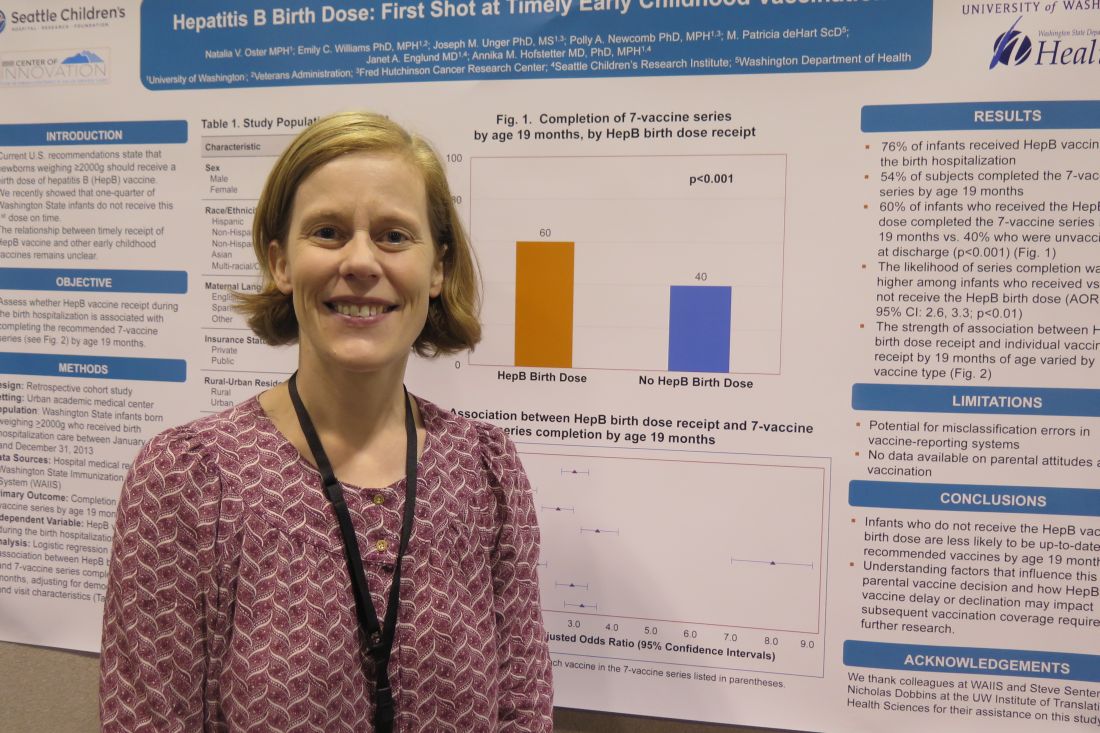
Of the 9,080 infants, 51% were male, 49% were non-Hispanic white, 56% were covered by public health insurance, and 47% stayed in the hospital for 48 hours or longer. The researchers reported that 76% infants received the HBV during the birth hospitalization, and 54% of subjects completed the seven-vaccine series by age 19 months. They also found that (P less than .001). Infants who received the HBV birth dose were 2.9 times more likely to complete the seven-vaccine series by age 19 months, compared with those who did not receive the HBV birth dose.
“Parents are making their first vaccine decision during that birth hospitalization,” said Dr. Hofstetter, who also conducts immunization research studies at Seattle Children’s Research Institute. “It’s unclear what underlies this decision, such as specific parent concerns or the way in which we as providers in the hospital are communicating vaccine information to the families. It’s telling, and it will be interesting to further explore the factors that are determining whether a family gets the vaccine during the birth hospitalization or not, and how we as a pediatric community can start having effective vaccine conversations earlier.”
She acknowledged certain limitations of the study, including the potential for misclassification errors in vaccine reporting systems and the fact that no data were available on parental attitudes about vaccination. The researchers reported having no financial disclosures.
TORONTO – Infants who do not receive the hepatitis B vaccine birth dose are less likely to be up-to-date recipients of recommended vaccines by 19 months, based on results from a retrospective study of more than 9,000 infants.
“As pediatricians, we should be mindful of that when we are meeting families after the birth hospitalization and start a conversation at that point around vaccines,” one of the study authors, Annika M. Hofstetter, MD, PhD, said in an interview at the Pediatric Academic Societies meeting.
Of the 9,080 infants, 51% were male, 49% were non-Hispanic white, 56% were covered by public health insurance, and 47% stayed in the hospital for 48 hours or longer. The researchers reported that 76% infants received the HBV during the birth hospitalization, and 54% of subjects completed the seven-vaccine series by age 19 months. They also found that (P less than .001). Infants who received the HBV birth dose were 2.9 times more likely to complete the seven-vaccine series by age 19 months, compared with those who did not receive the HBV birth dose.
“Parents are making their first vaccine decision during that birth hospitalization,” said Dr. Hofstetter, who also conducts immunization research studies at Seattle Children’s Research Institute. “It’s unclear what underlies this decision, such as specific parent concerns or the way in which we as providers in the hospital are communicating vaccine information to the families. It’s telling, and it will be interesting to further explore the factors that are determining whether a family gets the vaccine during the birth hospitalization or not, and how we as a pediatric community can start having effective vaccine conversations earlier.”
She acknowledged certain limitations of the study, including the potential for misclassification errors in vaccine reporting systems and the fact that no data were available on parental attitudes about vaccination. The researchers reported having no financial disclosures.
TORONTO – Infants who do not receive the hepatitis B vaccine birth dose are less likely to be up-to-date recipients of recommended vaccines by 19 months, based on results from a retrospective study of more than 9,000 infants.
“As pediatricians, we should be mindful of that when we are meeting families after the birth hospitalization and start a conversation at that point around vaccines,” one of the study authors, Annika M. Hofstetter, MD, PhD, said in an interview at the Pediatric Academic Societies meeting.
Of the 9,080 infants, 51% were male, 49% were non-Hispanic white, 56% were covered by public health insurance, and 47% stayed in the hospital for 48 hours or longer. The researchers reported that 76% infants received the HBV during the birth hospitalization, and 54% of subjects completed the seven-vaccine series by age 19 months. They also found that (P less than .001). Infants who received the HBV birth dose were 2.9 times more likely to complete the seven-vaccine series by age 19 months, compared with those who did not receive the HBV birth dose.
“Parents are making their first vaccine decision during that birth hospitalization,” said Dr. Hofstetter, who also conducts immunization research studies at Seattle Children’s Research Institute. “It’s unclear what underlies this decision, such as specific parent concerns or the way in which we as providers in the hospital are communicating vaccine information to the families. It’s telling, and it will be interesting to further explore the factors that are determining whether a family gets the vaccine during the birth hospitalization or not, and how we as a pediatric community can start having effective vaccine conversations earlier.”
She acknowledged certain limitations of the study, including the potential for misclassification errors in vaccine reporting systems and the fact that no data were available on parental attitudes about vaccination. The researchers reported having no financial disclosures.
AT PAS 2018
Key clinical point: Likelihood of completing the 7-vaccine series at 19 months was higher among infants who received the HBV birth dose.
Major finding: Infants who received the HBV birth dose were 2.9 times more likely to complete the 7-vaccine series by age 19 months, compared with those who did not receive the HBV birth dose.
Study details: A retrospective review of 9,080 infants born weighing at least 2,000 grams who received hospitalization care between January 1, 2008 and December 31, 2013.
Disclosures: The researchers reported having no financial disclosures.