User login
Hedgehog inhibitor alternative dosing advantageous for BCC
in a successful effort to maintain efficacy while reducing treatment discontinuation caused by unacceptable side effects, Vishal Patel, MD, said at Innovations in Dermatology: Virtual Spring Conference 2021.
“It’s the tolerability issues that make these drugs very difficult to prescribe and use regularly. What we’ve seen in the last few years is that a lot of alternative dosing regimens have been published that have been both effective at treating the tumor and keeping the tumor clear and at bay while lowering the side-effect profile,” explained Dr. Patel, a Mohs surgeon and director of the cutaneous oncology program at the George Washington University Cancer Center in Washington, D.C.
Product labeling for the two available hedgehog pathway inhibitors, vismodegib (Erivedge) and sonidegib (Odomzo), calls for once-daily therapy until disease progression or unacceptable toxicity. Studies show that, when used in this way, these agents achieve objective response rates in the 40% range for patients with locally advanced BCC and 15%-33% for those with metastatic BCC.
“The critical thing in these patients is not that the drugs work – although they can work in quite remarkable ways – but rather it’s that nearly all patients experience at least one side effect. And grade 3 or 4 adverse effects that can lead to cessation of drug occur in about 25% of patients,” he said at the conference sponsored by MedscapeLIVE! and the producers of the Hawaii Dermatology Seminar and Caribbean Dermatology Symposium.
The classic side effects of the hedgehog pathway inhibitors are muscle spasms, hair loss, fatigue, loss of taste, diarrhea, and weight loss.
Among the alternative dosing regimens that have been published with good results, mostly in single-center retrospective case series, are a weekdays-on/weekends-off strategy at the Cleveland Clinic and an Italian approach entailing an initial 3-4 months of daily therapy followed by a switch to alternate-day therapy.
But Dr. Patel favors a different off-label regimen in lieu of Food and Drug Administration–recommended daily dosing indefinitely. It takes advantage of the fact that most patients don’t begin to get the classic side effects until about the 3-month mark.
“What we’ve begun to recommend as a much better option for patients who need to be on the drug potentially forever is that the drug is dosed daily for 3 months to shrink the tumor and get the optimal effect, and then at that point we taper the dose down to every other day, then every third day, or even up to a week as long as the tumor continues to stay at bay. If there’s any sign of recurrence or a scouting biopsy shows tumor, we reinstitute the daily medicine,” the dermatologist said.
This strategy requires careful monitoring for emergence of the typical side effects. Also, an important caveat regarding sonidegib is that it shouldn’t be given concomitantly with medications that are moderate or strong inhibitors of CYP3A, so it’s essential to get a complete medical history when giving this drug, Dr. Patel noted.
He reported having no financial conflicts regarding his presentation.
MedscapeLIVE! and this news organization are owned by the same parent company.
in a successful effort to maintain efficacy while reducing treatment discontinuation caused by unacceptable side effects, Vishal Patel, MD, said at Innovations in Dermatology: Virtual Spring Conference 2021.
“It’s the tolerability issues that make these drugs very difficult to prescribe and use regularly. What we’ve seen in the last few years is that a lot of alternative dosing regimens have been published that have been both effective at treating the tumor and keeping the tumor clear and at bay while lowering the side-effect profile,” explained Dr. Patel, a Mohs surgeon and director of the cutaneous oncology program at the George Washington University Cancer Center in Washington, D.C.
Product labeling for the two available hedgehog pathway inhibitors, vismodegib (Erivedge) and sonidegib (Odomzo), calls for once-daily therapy until disease progression or unacceptable toxicity. Studies show that, when used in this way, these agents achieve objective response rates in the 40% range for patients with locally advanced BCC and 15%-33% for those with metastatic BCC.
“The critical thing in these patients is not that the drugs work – although they can work in quite remarkable ways – but rather it’s that nearly all patients experience at least one side effect. And grade 3 or 4 adverse effects that can lead to cessation of drug occur in about 25% of patients,” he said at the conference sponsored by MedscapeLIVE! and the producers of the Hawaii Dermatology Seminar and Caribbean Dermatology Symposium.
The classic side effects of the hedgehog pathway inhibitors are muscle spasms, hair loss, fatigue, loss of taste, diarrhea, and weight loss.
Among the alternative dosing regimens that have been published with good results, mostly in single-center retrospective case series, are a weekdays-on/weekends-off strategy at the Cleveland Clinic and an Italian approach entailing an initial 3-4 months of daily therapy followed by a switch to alternate-day therapy.
But Dr. Patel favors a different off-label regimen in lieu of Food and Drug Administration–recommended daily dosing indefinitely. It takes advantage of the fact that most patients don’t begin to get the classic side effects until about the 3-month mark.
“What we’ve begun to recommend as a much better option for patients who need to be on the drug potentially forever is that the drug is dosed daily for 3 months to shrink the tumor and get the optimal effect, and then at that point we taper the dose down to every other day, then every third day, or even up to a week as long as the tumor continues to stay at bay. If there’s any sign of recurrence or a scouting biopsy shows tumor, we reinstitute the daily medicine,” the dermatologist said.
This strategy requires careful monitoring for emergence of the typical side effects. Also, an important caveat regarding sonidegib is that it shouldn’t be given concomitantly with medications that are moderate or strong inhibitors of CYP3A, so it’s essential to get a complete medical history when giving this drug, Dr. Patel noted.
He reported having no financial conflicts regarding his presentation.
MedscapeLIVE! and this news organization are owned by the same parent company.
in a successful effort to maintain efficacy while reducing treatment discontinuation caused by unacceptable side effects, Vishal Patel, MD, said at Innovations in Dermatology: Virtual Spring Conference 2021.
“It’s the tolerability issues that make these drugs very difficult to prescribe and use regularly. What we’ve seen in the last few years is that a lot of alternative dosing regimens have been published that have been both effective at treating the tumor and keeping the tumor clear and at bay while lowering the side-effect profile,” explained Dr. Patel, a Mohs surgeon and director of the cutaneous oncology program at the George Washington University Cancer Center in Washington, D.C.
Product labeling for the two available hedgehog pathway inhibitors, vismodegib (Erivedge) and sonidegib (Odomzo), calls for once-daily therapy until disease progression or unacceptable toxicity. Studies show that, when used in this way, these agents achieve objective response rates in the 40% range for patients with locally advanced BCC and 15%-33% for those with metastatic BCC.
“The critical thing in these patients is not that the drugs work – although they can work in quite remarkable ways – but rather it’s that nearly all patients experience at least one side effect. And grade 3 or 4 adverse effects that can lead to cessation of drug occur in about 25% of patients,” he said at the conference sponsored by MedscapeLIVE! and the producers of the Hawaii Dermatology Seminar and Caribbean Dermatology Symposium.
The classic side effects of the hedgehog pathway inhibitors are muscle spasms, hair loss, fatigue, loss of taste, diarrhea, and weight loss.
Among the alternative dosing regimens that have been published with good results, mostly in single-center retrospective case series, are a weekdays-on/weekends-off strategy at the Cleveland Clinic and an Italian approach entailing an initial 3-4 months of daily therapy followed by a switch to alternate-day therapy.
But Dr. Patel favors a different off-label regimen in lieu of Food and Drug Administration–recommended daily dosing indefinitely. It takes advantage of the fact that most patients don’t begin to get the classic side effects until about the 3-month mark.
“What we’ve begun to recommend as a much better option for patients who need to be on the drug potentially forever is that the drug is dosed daily for 3 months to shrink the tumor and get the optimal effect, and then at that point we taper the dose down to every other day, then every third day, or even up to a week as long as the tumor continues to stay at bay. If there’s any sign of recurrence or a scouting biopsy shows tumor, we reinstitute the daily medicine,” the dermatologist said.
This strategy requires careful monitoring for emergence of the typical side effects. Also, an important caveat regarding sonidegib is that it shouldn’t be given concomitantly with medications that are moderate or strong inhibitors of CYP3A, so it’s essential to get a complete medical history when giving this drug, Dr. Patel noted.
He reported having no financial conflicts regarding his presentation.
MedscapeLIVE! and this news organization are owned by the same parent company.
FROM INNOVATIONS IN DERMATOLOGY
Quality of life and health state utility in patients with CML in real-life setting
Key clinical point: Even after effective treatment with tyrosine kinase inhibitors, patients with chronic myeloid leukemia (CML) had notably altered global quality of life (QoL) and health utility scores.
Major finding: Compared with the general population, patients with CML had notably affected QoL in terms of social, role, and cognitive functioning with a mean difference of −16.0, −13.1, and −11.7, respectively. The utility score had a deviation from the reference norm of −0.15 on an average (standard deviation, 0.25) compared with the general population.
Study details: Findings are from a prospective web-based survey that assessed QoL and health utility scores in 383 patients with CML (92% in chronic-phase) in France.
Disclosures: This study was funded by the French National Agency for Research and the French Institute for Public Health Research. The authors declared no conflicts of interest.
Source: Foulon S et al. Qual Life Res. 2021 Mar 2. doi: 10.1007/s11136-021-02794-5.
Key clinical point: Even after effective treatment with tyrosine kinase inhibitors, patients with chronic myeloid leukemia (CML) had notably altered global quality of life (QoL) and health utility scores.
Major finding: Compared with the general population, patients with CML had notably affected QoL in terms of social, role, and cognitive functioning with a mean difference of −16.0, −13.1, and −11.7, respectively. The utility score had a deviation from the reference norm of −0.15 on an average (standard deviation, 0.25) compared with the general population.
Study details: Findings are from a prospective web-based survey that assessed QoL and health utility scores in 383 patients with CML (92% in chronic-phase) in France.
Disclosures: This study was funded by the French National Agency for Research and the French Institute for Public Health Research. The authors declared no conflicts of interest.
Source: Foulon S et al. Qual Life Res. 2021 Mar 2. doi: 10.1007/s11136-021-02794-5.
Key clinical point: Even after effective treatment with tyrosine kinase inhibitors, patients with chronic myeloid leukemia (CML) had notably altered global quality of life (QoL) and health utility scores.
Major finding: Compared with the general population, patients with CML had notably affected QoL in terms of social, role, and cognitive functioning with a mean difference of −16.0, −13.1, and −11.7, respectively. The utility score had a deviation from the reference norm of −0.15 on an average (standard deviation, 0.25) compared with the general population.
Study details: Findings are from a prospective web-based survey that assessed QoL and health utility scores in 383 patients with CML (92% in chronic-phase) in France.
Disclosures: This study was funded by the French National Agency for Research and the French Institute for Public Health Research. The authors declared no conflicts of interest.
Source: Foulon S et al. Qual Life Res. 2021 Mar 2. doi: 10.1007/s11136-021-02794-5.
Dasatinib/nivolumab combo safe but shows no meaningful activity in previously treated CML
Key clinical point: Combination of dasatinib and nivolumab was safe but did not show any clinical activity in patients with difficult-to-treat chronic myeloid leukemia (CML) in chronic phase (CP) or accelerated phase (AP) who received at least 2 prior tyrosine kinase inhibitors (TKIs).
Major finding: No drug limiting toxicities were observed even with the maximum dose of both drugs. The most common grade 3 or higher adverse event (AE) of any cause was diarrhea (13%), of which only 3% were considered drug related. Serious AEs occurred in 48% of patients; however, only 2 were considered drug related. The overall response rate was low with none being durable.
Study details: Findings are from a phase 1b dose-escalation study involving 31 patients with CML in CP (n=24) or AP (n=7) who received 2 or more prior TKIs and showed progression, resistance, suboptimal response, or intolerance to the most recent therapy.
Disclosures: This trial was funded by Bristol Myers Squibb, Princeton, NJ, USA. The lead author along with other authors declared receiving grants, advisory boards, honoraria, and/or research funding from various pharmaceutical companies including Bristol Myers Squibb. R Swanink and PM Regueira were employees of Bristol Myers Squibb.
Source: Martínez-López J et al. Leuk Lymphoma. 2021 Mar 2. doi: 10.1080/10428194.2021.1889536.
Key clinical point: Combination of dasatinib and nivolumab was safe but did not show any clinical activity in patients with difficult-to-treat chronic myeloid leukemia (CML) in chronic phase (CP) or accelerated phase (AP) who received at least 2 prior tyrosine kinase inhibitors (TKIs).
Major finding: No drug limiting toxicities were observed even with the maximum dose of both drugs. The most common grade 3 or higher adverse event (AE) of any cause was diarrhea (13%), of which only 3% were considered drug related. Serious AEs occurred in 48% of patients; however, only 2 were considered drug related. The overall response rate was low with none being durable.
Study details: Findings are from a phase 1b dose-escalation study involving 31 patients with CML in CP (n=24) or AP (n=7) who received 2 or more prior TKIs and showed progression, resistance, suboptimal response, or intolerance to the most recent therapy.
Disclosures: This trial was funded by Bristol Myers Squibb, Princeton, NJ, USA. The lead author along with other authors declared receiving grants, advisory boards, honoraria, and/or research funding from various pharmaceutical companies including Bristol Myers Squibb. R Swanink and PM Regueira were employees of Bristol Myers Squibb.
Source: Martínez-López J et al. Leuk Lymphoma. 2021 Mar 2. doi: 10.1080/10428194.2021.1889536.
Key clinical point: Combination of dasatinib and nivolumab was safe but did not show any clinical activity in patients with difficult-to-treat chronic myeloid leukemia (CML) in chronic phase (CP) or accelerated phase (AP) who received at least 2 prior tyrosine kinase inhibitors (TKIs).
Major finding: No drug limiting toxicities were observed even with the maximum dose of both drugs. The most common grade 3 or higher adverse event (AE) of any cause was diarrhea (13%), of which only 3% were considered drug related. Serious AEs occurred in 48% of patients; however, only 2 were considered drug related. The overall response rate was low with none being durable.
Study details: Findings are from a phase 1b dose-escalation study involving 31 patients with CML in CP (n=24) or AP (n=7) who received 2 or more prior TKIs and showed progression, resistance, suboptimal response, or intolerance to the most recent therapy.
Disclosures: This trial was funded by Bristol Myers Squibb, Princeton, NJ, USA. The lead author along with other authors declared receiving grants, advisory boards, honoraria, and/or research funding from various pharmaceutical companies including Bristol Myers Squibb. R Swanink and PM Regueira were employees of Bristol Myers Squibb.
Source: Martínez-López J et al. Leuk Lymphoma. 2021 Mar 2. doi: 10.1080/10428194.2021.1889536.
CML-CP: Imatinib shows long-term efficacy after interferon therapy failure
Key clinical point: Imatinib treatment following interferon-α failure showed long-term efficacy in a real-life setting of patients with late chronic-phase chronic myeloid leukemia (CML-CP).
Major finding: After a median of 4.5 months of therapy initiation, 84% of patients achieved complete cytogenic response as their best cytogenetic response. The estimated 18-year overall survival, event-free survival, and progression-free survival were 64.8%, 69%, and 64.4%, respectively. Imatinib discontinuation and CML-related deaths occurred in 36% and 34% of patients, respectively, and 86% of patients were in treatment-free remission at the last follow-up.
Study details: Findings are from a retrospective analysis of 139 patients with late CML-CP treated with imatinib following interferon-α therapy failure followed up for a median of 16.6 years.
Disclosures: No specific funding source was identified. The authors declared no conflicts of interest.
Source: Pepe S et al. Leuk Lymphoma. 2021 Mar 16. doi: 10.1080/10428194.2021.1901094.
Key clinical point: Imatinib treatment following interferon-α failure showed long-term efficacy in a real-life setting of patients with late chronic-phase chronic myeloid leukemia (CML-CP).
Major finding: After a median of 4.5 months of therapy initiation, 84% of patients achieved complete cytogenic response as their best cytogenetic response. The estimated 18-year overall survival, event-free survival, and progression-free survival were 64.8%, 69%, and 64.4%, respectively. Imatinib discontinuation and CML-related deaths occurred in 36% and 34% of patients, respectively, and 86% of patients were in treatment-free remission at the last follow-up.
Study details: Findings are from a retrospective analysis of 139 patients with late CML-CP treated with imatinib following interferon-α therapy failure followed up for a median of 16.6 years.
Disclosures: No specific funding source was identified. The authors declared no conflicts of interest.
Source: Pepe S et al. Leuk Lymphoma. 2021 Mar 16. doi: 10.1080/10428194.2021.1901094.
Key clinical point: Imatinib treatment following interferon-α failure showed long-term efficacy in a real-life setting of patients with late chronic-phase chronic myeloid leukemia (CML-CP).
Major finding: After a median of 4.5 months of therapy initiation, 84% of patients achieved complete cytogenic response as their best cytogenetic response. The estimated 18-year overall survival, event-free survival, and progression-free survival were 64.8%, 69%, and 64.4%, respectively. Imatinib discontinuation and CML-related deaths occurred in 36% and 34% of patients, respectively, and 86% of patients were in treatment-free remission at the last follow-up.
Study details: Findings are from a retrospective analysis of 139 patients with late CML-CP treated with imatinib following interferon-α therapy failure followed up for a median of 16.6 years.
Disclosures: No specific funding source was identified. The authors declared no conflicts of interest.
Source: Pepe S et al. Leuk Lymphoma. 2021 Mar 16. doi: 10.1080/10428194.2021.1901094.
Dasatinib vs nilotinib as second-line therapy for CML-CP in real-life setting
Key clinical point: Dasatinib and nilotinib as second-line treatments were equally effective, with a high molecular response (MR) and a tolerable safety profile in real-life patients with chronic-phase chronic myeloid leukemia (CML-CP).
Major finding: At 12 months, 47% and 38% of patients had a major MR and 18.2% and 16.6% had a deep MR in the dasatinib and nilotinib groups, respectively (P = .481). Grade 3-4 adverse events were more frequent in dasatinib vs. nilotinib groups (P = .003) with no effect on MR.
Study details: Findings are from a retrospective analysis of 131 patients with CML-CP who switched to second-line treatment with either dasatinib (n=72) or nilotinib (n=59) after frontline imatinib intolerance/resistance.
Disclosures: The authors did not declare any source of funding. M Breccia, M Martelli, and F Efficace reported receiving honoraria, personal fees, and grants from and being on the advisory board for various pharmaceutical companies. Other authors had no disclosures.
Source: Scalzulli E et al. Ann Hematol. 2021 Mar 7. doi: 10.1007/s00277-021-04477-0.
Key clinical point: Dasatinib and nilotinib as second-line treatments were equally effective, with a high molecular response (MR) and a tolerable safety profile in real-life patients with chronic-phase chronic myeloid leukemia (CML-CP).
Major finding: At 12 months, 47% and 38% of patients had a major MR and 18.2% and 16.6% had a deep MR in the dasatinib and nilotinib groups, respectively (P = .481). Grade 3-4 adverse events were more frequent in dasatinib vs. nilotinib groups (P = .003) with no effect on MR.
Study details: Findings are from a retrospective analysis of 131 patients with CML-CP who switched to second-line treatment with either dasatinib (n=72) or nilotinib (n=59) after frontline imatinib intolerance/resistance.
Disclosures: The authors did not declare any source of funding. M Breccia, M Martelli, and F Efficace reported receiving honoraria, personal fees, and grants from and being on the advisory board for various pharmaceutical companies. Other authors had no disclosures.
Source: Scalzulli E et al. Ann Hematol. 2021 Mar 7. doi: 10.1007/s00277-021-04477-0.
Key clinical point: Dasatinib and nilotinib as second-line treatments were equally effective, with a high molecular response (MR) and a tolerable safety profile in real-life patients with chronic-phase chronic myeloid leukemia (CML-CP).
Major finding: At 12 months, 47% and 38% of patients had a major MR and 18.2% and 16.6% had a deep MR in the dasatinib and nilotinib groups, respectively (P = .481). Grade 3-4 adverse events were more frequent in dasatinib vs. nilotinib groups (P = .003) with no effect on MR.
Study details: Findings are from a retrospective analysis of 131 patients with CML-CP who switched to second-line treatment with either dasatinib (n=72) or nilotinib (n=59) after frontline imatinib intolerance/resistance.
Disclosures: The authors did not declare any source of funding. M Breccia, M Martelli, and F Efficace reported receiving honoraria, personal fees, and grants from and being on the advisory board for various pharmaceutical companies. Other authors had no disclosures.
Source: Scalzulli E et al. Ann Hematol. 2021 Mar 7. doi: 10.1007/s00277-021-04477-0.
CML-CP: Sustained long-term high treatment-free remission rates following frontline nilotinib
Key clinical point: More than 3 years of frontline nilotinib treatment was effective with sustained long-term high treatment-free remission (TFR) rates and manageable safety in patients with Philadelphia chromosome-positive (Ph+) chronic-phase chronic myeloid leukemia (CML-CP).
Major finding: Among patients who entered TFR, 41.6% remained in major molecular response (MMR), with 40.0% in MR4.5, whereas 98.9% of patients who lost MMR regained after treatment reinitiation. No disease progression or CML-related deaths were observed, and the adverse event profile was consistent with that reported previously.
Study details: Findings are from a 5-year follow-up of phase 2 ENESTfreedom trial including 190 adult patients with Ph+ CML-CP who received at least 2 years of frontline nilotinib treatment, achieved MR4.5, and attempted TFR after undergoing a 1-year nilotinib treatment consolidation phase.
Disclosures: This study was funded by Novartis Pharmaceuticals. The lead author along with other authors reported ties with various pharmaceutical companies including Novartis. P Aimone, S Li, and K Titorenko reported being employees of Novartis.
Source: Radich JP et al. Leukemia. 2021 Mar 11. doi: 10.1038/s41375-021-01205-5.
Key clinical point: More than 3 years of frontline nilotinib treatment was effective with sustained long-term high treatment-free remission (TFR) rates and manageable safety in patients with Philadelphia chromosome-positive (Ph+) chronic-phase chronic myeloid leukemia (CML-CP).
Major finding: Among patients who entered TFR, 41.6% remained in major molecular response (MMR), with 40.0% in MR4.5, whereas 98.9% of patients who lost MMR regained after treatment reinitiation. No disease progression or CML-related deaths were observed, and the adverse event profile was consistent with that reported previously.
Study details: Findings are from a 5-year follow-up of phase 2 ENESTfreedom trial including 190 adult patients with Ph+ CML-CP who received at least 2 years of frontline nilotinib treatment, achieved MR4.5, and attempted TFR after undergoing a 1-year nilotinib treatment consolidation phase.
Disclosures: This study was funded by Novartis Pharmaceuticals. The lead author along with other authors reported ties with various pharmaceutical companies including Novartis. P Aimone, S Li, and K Titorenko reported being employees of Novartis.
Source: Radich JP et al. Leukemia. 2021 Mar 11. doi: 10.1038/s41375-021-01205-5.
Key clinical point: More than 3 years of frontline nilotinib treatment was effective with sustained long-term high treatment-free remission (TFR) rates and manageable safety in patients with Philadelphia chromosome-positive (Ph+) chronic-phase chronic myeloid leukemia (CML-CP).
Major finding: Among patients who entered TFR, 41.6% remained in major molecular response (MMR), with 40.0% in MR4.5, whereas 98.9% of patients who lost MMR regained after treatment reinitiation. No disease progression or CML-related deaths were observed, and the adverse event profile was consistent with that reported previously.
Study details: Findings are from a 5-year follow-up of phase 2 ENESTfreedom trial including 190 adult patients with Ph+ CML-CP who received at least 2 years of frontline nilotinib treatment, achieved MR4.5, and attempted TFR after undergoing a 1-year nilotinib treatment consolidation phase.
Disclosures: This study was funded by Novartis Pharmaceuticals. The lead author along with other authors reported ties with various pharmaceutical companies including Novartis. P Aimone, S Li, and K Titorenko reported being employees of Novartis.
Source: Radich JP et al. Leukemia. 2021 Mar 11. doi: 10.1038/s41375-021-01205-5.
Cardiovascular disease remains leading cause of type 2 diabetes mortality
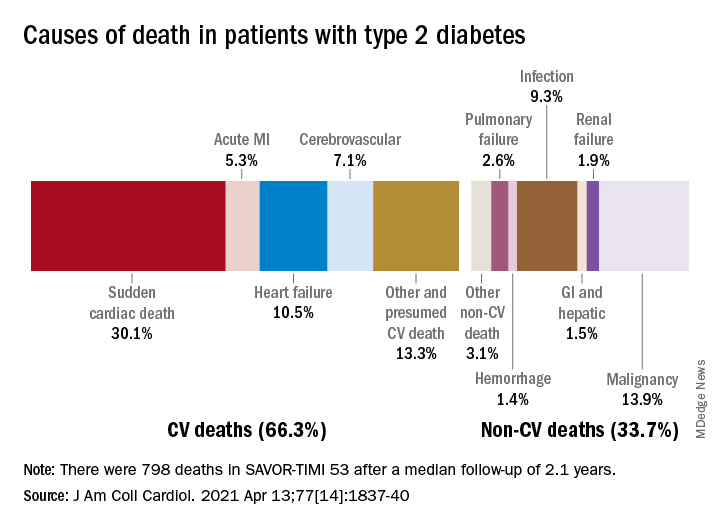
Two-thirds (66.3%) of all 798 deaths after a median 2.1 years of follow-up were caused by one of five cardiovascular (CV) conditions, with sudden cardiac death accounting for the largest share (30.1%) of the total, Ilaria Cavallari, MD, PhD, and associates said in the Journal of the American College of Cardiology.
Most common among the non-CV causes was malignancy at 13.9% of all deaths in a T2DM population at high/very high risk for CV disease (n = 16,492), followed by infection (9.3%), the members of the TIMI Study Group noted.
After variables independently associated with overall mortality were identified, a subdistribution of competing risks was constructed using a competing-risk analysis based on the proportional hazards model, they explained.
Prior heart failure was the clinical variable most associated with CV death and could, along with older age, worse glycemic control, prior CV events, peripheral artery disease, and kidney complications, “identify a subgroup of T2DM patients at high risk of mortality who are likely to achieve the greatest benefit from aggressive management of modifiable risk factors and newer glucose-lowering agents,” the investigators wrote.
It was a pair of laboratory measurements, however, that had the largest subdistribution hazard ratios. “Interestingly, the magnitude of associations of abnormal N-terminal pro–B-type natriuretic peptide [sHR, 2.82] and high-sensitivity troponin T [sHR, 2.46] measured in a stable population were greater than clinical variables in the prediction of all causes of death,” Dr. Cavallari and associates said.
Two-thirds (66.3%) of all 798 deaths after a median 2.1 years of follow-up were caused by one of five cardiovascular (CV) conditions, with sudden cardiac death accounting for the largest share (30.1%) of the total, Ilaria Cavallari, MD, PhD, and associates said in the Journal of the American College of Cardiology.
Most common among the non-CV causes was malignancy at 13.9% of all deaths in a T2DM population at high/very high risk for CV disease (n = 16,492), followed by infection (9.3%), the members of the TIMI Study Group noted.
After variables independently associated with overall mortality were identified, a subdistribution of competing risks was constructed using a competing-risk analysis based on the proportional hazards model, they explained.
Prior heart failure was the clinical variable most associated with CV death and could, along with older age, worse glycemic control, prior CV events, peripheral artery disease, and kidney complications, “identify a subgroup of T2DM patients at high risk of mortality who are likely to achieve the greatest benefit from aggressive management of modifiable risk factors and newer glucose-lowering agents,” the investigators wrote.
It was a pair of laboratory measurements, however, that had the largest subdistribution hazard ratios. “Interestingly, the magnitude of associations of abnormal N-terminal pro–B-type natriuretic peptide [sHR, 2.82] and high-sensitivity troponin T [sHR, 2.46] measured in a stable population were greater than clinical variables in the prediction of all causes of death,” Dr. Cavallari and associates said.
Two-thirds (66.3%) of all 798 deaths after a median 2.1 years of follow-up were caused by one of five cardiovascular (CV) conditions, with sudden cardiac death accounting for the largest share (30.1%) of the total, Ilaria Cavallari, MD, PhD, and associates said in the Journal of the American College of Cardiology.
Most common among the non-CV causes was malignancy at 13.9% of all deaths in a T2DM population at high/very high risk for CV disease (n = 16,492), followed by infection (9.3%), the members of the TIMI Study Group noted.
After variables independently associated with overall mortality were identified, a subdistribution of competing risks was constructed using a competing-risk analysis based on the proportional hazards model, they explained.
Prior heart failure was the clinical variable most associated with CV death and could, along with older age, worse glycemic control, prior CV events, peripheral artery disease, and kidney complications, “identify a subgroup of T2DM patients at high risk of mortality who are likely to achieve the greatest benefit from aggressive management of modifiable risk factors and newer glucose-lowering agents,” the investigators wrote.
It was a pair of laboratory measurements, however, that had the largest subdistribution hazard ratios. “Interestingly, the magnitude of associations of abnormal N-terminal pro–B-type natriuretic peptide [sHR, 2.82] and high-sensitivity troponin T [sHR, 2.46] measured in a stable population were greater than clinical variables in the prediction of all causes of death,” Dr. Cavallari and associates said.
FROM THE JOURNAL OF THE AMERICAN COLLEGE OF CARDIOLOGY
Early BCR-ABL1 kinetics predicts subsequent TFR achievement in CML-CP
Key clinical point: Initial rate of BCR-ABL1 decline, measured as halving time, was a strong predictor of sustained treatment-free remission (TFR) post-tyrosine kinase inhibitor (TKI) cessation in patients with chronic-phase chronic myeloid leukemia (CML-CP) treated with firstline TKI therapies.
Major finding: Patients with a sustained TFR had a shorter BCR-ABL1 halving time vs. those with molecular relapse (10.1 vs. 21.7 days; P less than .001). The probability of sustained TFR was 80% vs. 4% among patients with halving time less than 9.35 days vs. more than 21.85 days (P less than .001).
Study details: Findings are from a retrospective analysis of 115 adult patients with CML-CP who attempted TFR and were followed up for at least 12 months post-TKI discontinuation.
Disclosures: The authors did not declare any source of funding. Some of the investigators including the lead author reported receiving honoraria and travel and accommodation expenses; being on the advisory board; and receiving research funding from various pharmaceutical companies.
Source: Shanmuganathan N et al. Blood. 2021 Mar 4. doi: 10.1182/blood.2020005514.
Key clinical point: Initial rate of BCR-ABL1 decline, measured as halving time, was a strong predictor of sustained treatment-free remission (TFR) post-tyrosine kinase inhibitor (TKI) cessation in patients with chronic-phase chronic myeloid leukemia (CML-CP) treated with firstline TKI therapies.
Major finding: Patients with a sustained TFR had a shorter BCR-ABL1 halving time vs. those with molecular relapse (10.1 vs. 21.7 days; P less than .001). The probability of sustained TFR was 80% vs. 4% among patients with halving time less than 9.35 days vs. more than 21.85 days (P less than .001).
Study details: Findings are from a retrospective analysis of 115 adult patients with CML-CP who attempted TFR and were followed up for at least 12 months post-TKI discontinuation.
Disclosures: The authors did not declare any source of funding. Some of the investigators including the lead author reported receiving honoraria and travel and accommodation expenses; being on the advisory board; and receiving research funding from various pharmaceutical companies.
Source: Shanmuganathan N et al. Blood. 2021 Mar 4. doi: 10.1182/blood.2020005514.
Key clinical point: Initial rate of BCR-ABL1 decline, measured as halving time, was a strong predictor of sustained treatment-free remission (TFR) post-tyrosine kinase inhibitor (TKI) cessation in patients with chronic-phase chronic myeloid leukemia (CML-CP) treated with firstline TKI therapies.
Major finding: Patients with a sustained TFR had a shorter BCR-ABL1 halving time vs. those with molecular relapse (10.1 vs. 21.7 days; P less than .001). The probability of sustained TFR was 80% vs. 4% among patients with halving time less than 9.35 days vs. more than 21.85 days (P less than .001).
Study details: Findings are from a retrospective analysis of 115 adult patients with CML-CP who attempted TFR and were followed up for at least 12 months post-TKI discontinuation.
Disclosures: The authors did not declare any source of funding. Some of the investigators including the lead author reported receiving honoraria and travel and accommodation expenses; being on the advisory board; and receiving research funding from various pharmaceutical companies.
Source: Shanmuganathan N et al. Blood. 2021 Mar 4. doi: 10.1182/blood.2020005514.
CML-CP: High red blood cell distribution width predicts poor outcomes in TKI-treated patients
Key clinical point: High red blood cell distribution width (RDW) at diagnosis was associated with poor prognosis and treatment response in patients with chronic-phase chronic myeloid leukemia (CML-CP) treated with tyrosine kinase inhibitors (TKIs).
Major finding: High RDW was a significant predictor of poor overall survival (hazard ratio, [HR], 9.741; P = .005) and progression-free survival (HR, 16.74; P = .009). Patients with high RDW had worse treatment responses at 3 months (P = .03) and 6 months (P = .02).
Study details: Findings are from a retrospective analysis of 93 patients with newly diagnosed CML-CP and treated with TKIs. Patients were categorized into low (18.65% or lesser; n=58) and high (more than 18.65%; n=35) RDW groups.
Disclosures: No funding source was reported. The authors declared no conflicts of interest.
Source: Mao XL et al. Medicine. 2021 Mar 12. doi: 10.1097/MD.0000000000024003.
Key clinical point: High red blood cell distribution width (RDW) at diagnosis was associated with poor prognosis and treatment response in patients with chronic-phase chronic myeloid leukemia (CML-CP) treated with tyrosine kinase inhibitors (TKIs).
Major finding: High RDW was a significant predictor of poor overall survival (hazard ratio, [HR], 9.741; P = .005) and progression-free survival (HR, 16.74; P = .009). Patients with high RDW had worse treatment responses at 3 months (P = .03) and 6 months (P = .02).
Study details: Findings are from a retrospective analysis of 93 patients with newly diagnosed CML-CP and treated with TKIs. Patients were categorized into low (18.65% or lesser; n=58) and high (more than 18.65%; n=35) RDW groups.
Disclosures: No funding source was reported. The authors declared no conflicts of interest.
Source: Mao XL et al. Medicine. 2021 Mar 12. doi: 10.1097/MD.0000000000024003.
Key clinical point: High red blood cell distribution width (RDW) at diagnosis was associated with poor prognosis and treatment response in patients with chronic-phase chronic myeloid leukemia (CML-CP) treated with tyrosine kinase inhibitors (TKIs).
Major finding: High RDW was a significant predictor of poor overall survival (hazard ratio, [HR], 9.741; P = .005) and progression-free survival (HR, 16.74; P = .009). Patients with high RDW had worse treatment responses at 3 months (P = .03) and 6 months (P = .02).
Study details: Findings are from a retrospective analysis of 93 patients with newly diagnosed CML-CP and treated with TKIs. Patients were categorized into low (18.65% or lesser; n=58) and high (more than 18.65%; n=35) RDW groups.
Disclosures: No funding source was reported. The authors declared no conflicts of interest.
Source: Mao XL et al. Medicine. 2021 Mar 12. doi: 10.1097/MD.0000000000024003.
Reflections on George Floyd, Derek Chauvin, and racism in America
Exhaustion, numbness, dissociation, and most notably, anger are my emotional response when viewing the video of George Floyd’s death. The homicide trial of former Minneapolis police officer Derek Chauvin activates the shared stress of those who experienced intergenerational trauma and the legacy of racism in the United States of America.

On May 25, 2020, Mr. Floyd died after Derek Chauvin used a lethal maneuver and placed his knee on Mr. Floyd’s neck for 9 minutes and 29 seconds. Mr. Floyd has died physically, but his death is replayed through high-definition social media daily, if not hourly, as I write this article and think of the generational legacy of trauma that African Americans must cope with on an everyday basis. I struggle daily to explain this legacy to my daughters, students, residents, and colleagues. I hope to share with you some of my perspectives on the current trial and give you some insight as to how my training and personal life experience have affected my views on police brutality and the use of lethal force toward African American men.
My earliest recollection of public video-recorded images of police brutality occurred when Rodney King was beaten and assaulted by the Los Angeles Police Department on March 3, 1991. At that time, I was a senior in high school, and the world was different. My clear expectation was that any attempt to resist police arrest would be met with overwhelming and potentially lethal force. This was simply a matter of my daily reality, so, while witnessing the assault of Mr. King, the 17-year-old child didn’t expect much, if any, real change to come about in regard to police brutality. At that time, my mother kept me focused on one singular goal – becoming a physician – and protected me as best she could from the effects of intergenerational trauma woven into the African American experience.
The issue of police brutality and police-involved deaths has been recognized as a significant public health concern for some time. Over the 3 decades since the assault on Mr. King, several researchers have examined these issues. A review of all the research is beyond the scope of this opinion piece. Still, I will highlight a study that I believe illustrates some conclusions scholars have come to regarding police use of lethal force and subsequent mortality in African American men. A recent study by Frank Edwards, PhD, and colleagues, published in the Proceedings of the National Academy of Sciences, showed that Black men were 2.5 times more likely to be killed by police over their life course than White men.
The researchers also developed predictive models that about 1 in 1,000 Black men and boys will be killed by police over their life course, and that among all age groups Black men and boys face the highest lifetime risk. The authors concluded that “Our analysis shows that the risk of being killed by police is jointly patterned by one’s race, gender, and age. Police violence is a leading cause of death for young men, and young men of color face an exceptionally high risk of being killed by police. Inequalities in risk are pronounced throughout the life course. This study reinforces calls to treat police violence as a public health issue.”
Research such as this helps validate on a visceral level what I already was taught: “As a Black male, encounters with police can quickly become deadly, and you must remain calm, or you could die.” This thought process informed much of my thinking whenever I heard about a Black male being fatally shot by police. My first response was to ask, “Was he resisting arrest?” At this time, my naive impression was that “if you don’t resist or conflict, you’ll live.” It wasn’t until my training in psychiatry that I realized that the duty to calm, support, and most importantly, protect was the responsibility of the person who is given the trust of the public. As a psychiatrist, I am humbled by the trust the public places in physicians to restrain patients and take part in their involuntary hospitalizations. Over the years, I learned from my attending physicians, colleagues in security, social work, nursing, assertive community treatment (ACT) teams, and many other allied health professions that the responsibility to show restraint, calm, and compassion lies with those who have the power and trust of the public.
Mostly, I learned from my patients. They taught me to meet distress with compassion and humanity and not simply with force. With those lessons in mind, I now fast forward to July 17, 2014, and the death of Eric Garner. On July 17, New York Police Department officers approached Mr. Garner on the suspicion that he was selling loose cigarettes. Amid this encounter, Mr. Garner was subjected to a chokehold, and his face was pinned to the ground while he can be heard saying, “I can’t breathe.” At this time in my professional career, I had just become a dean of student affairs at the George Washington School of Medicine and Health Sciences. I can still remember the response of my minority students, and the sense of pain and anguish they felt watching the video of a chokehold being used on a man stating, “I can’t breathe.” At this point, my training would not allow me to see this as anything other than an unnecessary use of lethal force that would subsequently be ruled a homicide. I hoped that we as a nation had reached a “reckoning “ because of Mr. Garner’s death and Michael Brown Jr.’s subsequent death in Ferguson, Mo., in St. Louis County, on Aug. 9, 2014. I hoped we were ready to finally address police brutality and excessive use of force that had disproportionately affected Black men. I was utterly wrong. Black men such as Alton Sterling, Jamar Clark, and many others would die in fatal police encounters. So would Tamir Rice, who was 12 years old when he was shot and killed by a police officer.
This brings me back to the death of Mr. Floyd. As I listened to the witnesses’ testimony, it triggered an emotional response from sadness, fear, shock, but mostly anger. Some would consider it progress that the Minneapolis Police Department’s top homicide detective testified that kneeling on Mr. Floyd’s neck after he had been restrained was “unnecessary.” The officer stated, “If your knee is on someone’s neck, that could kill him.” While I acknowledge this is a form of progress, we must ultimately address the other “substantial causal factor of death” for Mr. Floyd. Namely, the systemic racism present in a criminal justice system in the form of policies and procedures that allow for continued racial disparities and inequities.
There will be coverage of the court proceedings and a detailed dissection of the legal arguments. Questions regarding Mr. Floyd’s physical health and struggle with opiate use disorder will be raised by the defense. The debate about the substantial causal factor will be played out in the court and the media. Ultimately, we, as health professionals, need to ask ourselves, “Who has the power and the duty to do no harm?”
Dr. Norris is associate dean of student affairs and administration at George Washington University, Washington. He has no disclosures.
Exhaustion, numbness, dissociation, and most notably, anger are my emotional response when viewing the video of George Floyd’s death. The homicide trial of former Minneapolis police officer Derek Chauvin activates the shared stress of those who experienced intergenerational trauma and the legacy of racism in the United States of America.
On May 25, 2020, Mr. Floyd died after Derek Chauvin used a lethal maneuver and placed his knee on Mr. Floyd’s neck for 9 minutes and 29 seconds. Mr. Floyd has died physically, but his death is replayed through high-definition social media daily, if not hourly, as I write this article and think of the generational legacy of trauma that African Americans must cope with on an everyday basis. I struggle daily to explain this legacy to my daughters, students, residents, and colleagues. I hope to share with you some of my perspectives on the current trial and give you some insight as to how my training and personal life experience have affected my views on police brutality and the use of lethal force toward African American men.
My earliest recollection of public video-recorded images of police brutality occurred when Rodney King was beaten and assaulted by the Los Angeles Police Department on March 3, 1991. At that time, I was a senior in high school, and the world was different. My clear expectation was that any attempt to resist police arrest would be met with overwhelming and potentially lethal force. This was simply a matter of my daily reality, so, while witnessing the assault of Mr. King, the 17-year-old child didn’t expect much, if any, real change to come about in regard to police brutality. At that time, my mother kept me focused on one singular goal – becoming a physician – and protected me as best she could from the effects of intergenerational trauma woven into the African American experience.
The issue of police brutality and police-involved deaths has been recognized as a significant public health concern for some time. Over the 3 decades since the assault on Mr. King, several researchers have examined these issues. A review of all the research is beyond the scope of this opinion piece. Still, I will highlight a study that I believe illustrates some conclusions scholars have come to regarding police use of lethal force and subsequent mortality in African American men. A recent study by Frank Edwards, PhD, and colleagues, published in the Proceedings of the National Academy of Sciences, showed that Black men were 2.5 times more likely to be killed by police over their life course than White men.
The researchers also developed predictive models that about 1 in 1,000 Black men and boys will be killed by police over their life course, and that among all age groups Black men and boys face the highest lifetime risk. The authors concluded that “Our analysis shows that the risk of being killed by police is jointly patterned by one’s race, gender, and age. Police violence is a leading cause of death for young men, and young men of color face an exceptionally high risk of being killed by police. Inequalities in risk are pronounced throughout the life course. This study reinforces calls to treat police violence as a public health issue.”
Research such as this helps validate on a visceral level what I already was taught: “As a Black male, encounters with police can quickly become deadly, and you must remain calm, or you could die.” This thought process informed much of my thinking whenever I heard about a Black male being fatally shot by police. My first response was to ask, “Was he resisting arrest?” At this time, my naive impression was that “if you don’t resist or conflict, you’ll live.” It wasn’t until my training in psychiatry that I realized that the duty to calm, support, and most importantly, protect was the responsibility of the person who is given the trust of the public. As a psychiatrist, I am humbled by the trust the public places in physicians to restrain patients and take part in their involuntary hospitalizations. Over the years, I learned from my attending physicians, colleagues in security, social work, nursing, assertive community treatment (ACT) teams, and many other allied health professions that the responsibility to show restraint, calm, and compassion lies with those who have the power and trust of the public.
Mostly, I learned from my patients. They taught me to meet distress with compassion and humanity and not simply with force. With those lessons in mind, I now fast forward to July 17, 2014, and the death of Eric Garner. On July 17, New York Police Department officers approached Mr. Garner on the suspicion that he was selling loose cigarettes. Amid this encounter, Mr. Garner was subjected to a chokehold, and his face was pinned to the ground while he can be heard saying, “I can’t breathe.” At this time in my professional career, I had just become a dean of student affairs at the George Washington School of Medicine and Health Sciences. I can still remember the response of my minority students, and the sense of pain and anguish they felt watching the video of a chokehold being used on a man stating, “I can’t breathe.” At this point, my training would not allow me to see this as anything other than an unnecessary use of lethal force that would subsequently be ruled a homicide. I hoped that we as a nation had reached a “reckoning “ because of Mr. Garner’s death and Michael Brown Jr.’s subsequent death in Ferguson, Mo., in St. Louis County, on Aug. 9, 2014. I hoped we were ready to finally address police brutality and excessive use of force that had disproportionately affected Black men. I was utterly wrong. Black men such as Alton Sterling, Jamar Clark, and many others would die in fatal police encounters. So would Tamir Rice, who was 12 years old when he was shot and killed by a police officer.
This brings me back to the death of Mr. Floyd. As I listened to the witnesses’ testimony, it triggered an emotional response from sadness, fear, shock, but mostly anger. Some would consider it progress that the Minneapolis Police Department’s top homicide detective testified that kneeling on Mr. Floyd’s neck after he had been restrained was “unnecessary.” The officer stated, “If your knee is on someone’s neck, that could kill him.” While I acknowledge this is a form of progress, we must ultimately address the other “substantial causal factor of death” for Mr. Floyd. Namely, the systemic racism present in a criminal justice system in the form of policies and procedures that allow for continued racial disparities and inequities.
There will be coverage of the court proceedings and a detailed dissection of the legal arguments. Questions regarding Mr. Floyd’s physical health and struggle with opiate use disorder will be raised by the defense. The debate about the substantial causal factor will be played out in the court and the media. Ultimately, we, as health professionals, need to ask ourselves, “Who has the power and the duty to do no harm?”
Dr. Norris is associate dean of student affairs and administration at George Washington University, Washington. He has no disclosures.
Exhaustion, numbness, dissociation, and most notably, anger are my emotional response when viewing the video of George Floyd’s death. The homicide trial of former Minneapolis police officer Derek Chauvin activates the shared stress of those who experienced intergenerational trauma and the legacy of racism in the United States of America.
On May 25, 2020, Mr. Floyd died after Derek Chauvin used a lethal maneuver and placed his knee on Mr. Floyd’s neck for 9 minutes and 29 seconds. Mr. Floyd has died physically, but his death is replayed through high-definition social media daily, if not hourly, as I write this article and think of the generational legacy of trauma that African Americans must cope with on an everyday basis. I struggle daily to explain this legacy to my daughters, students, residents, and colleagues. I hope to share with you some of my perspectives on the current trial and give you some insight as to how my training and personal life experience have affected my views on police brutality and the use of lethal force toward African American men.
My earliest recollection of public video-recorded images of police brutality occurred when Rodney King was beaten and assaulted by the Los Angeles Police Department on March 3, 1991. At that time, I was a senior in high school, and the world was different. My clear expectation was that any attempt to resist police arrest would be met with overwhelming and potentially lethal force. This was simply a matter of my daily reality, so, while witnessing the assault of Mr. King, the 17-year-old child didn’t expect much, if any, real change to come about in regard to police brutality. At that time, my mother kept me focused on one singular goal – becoming a physician – and protected me as best she could from the effects of intergenerational trauma woven into the African American experience.
The issue of police brutality and police-involved deaths has been recognized as a significant public health concern for some time. Over the 3 decades since the assault on Mr. King, several researchers have examined these issues. A review of all the research is beyond the scope of this opinion piece. Still, I will highlight a study that I believe illustrates some conclusions scholars have come to regarding police use of lethal force and subsequent mortality in African American men. A recent study by Frank Edwards, PhD, and colleagues, published in the Proceedings of the National Academy of Sciences, showed that Black men were 2.5 times more likely to be killed by police over their life course than White men.
The researchers also developed predictive models that about 1 in 1,000 Black men and boys will be killed by police over their life course, and that among all age groups Black men and boys face the highest lifetime risk. The authors concluded that “Our analysis shows that the risk of being killed by police is jointly patterned by one’s race, gender, and age. Police violence is a leading cause of death for young men, and young men of color face an exceptionally high risk of being killed by police. Inequalities in risk are pronounced throughout the life course. This study reinforces calls to treat police violence as a public health issue.”
Research such as this helps validate on a visceral level what I already was taught: “As a Black male, encounters with police can quickly become deadly, and you must remain calm, or you could die.” This thought process informed much of my thinking whenever I heard about a Black male being fatally shot by police. My first response was to ask, “Was he resisting arrest?” At this time, my naive impression was that “if you don’t resist or conflict, you’ll live.” It wasn’t until my training in psychiatry that I realized that the duty to calm, support, and most importantly, protect was the responsibility of the person who is given the trust of the public. As a psychiatrist, I am humbled by the trust the public places in physicians to restrain patients and take part in their involuntary hospitalizations. Over the years, I learned from my attending physicians, colleagues in security, social work, nursing, assertive community treatment (ACT) teams, and many other allied health professions that the responsibility to show restraint, calm, and compassion lies with those who have the power and trust of the public.
Mostly, I learned from my patients. They taught me to meet distress with compassion and humanity and not simply with force. With those lessons in mind, I now fast forward to July 17, 2014, and the death of Eric Garner. On July 17, New York Police Department officers approached Mr. Garner on the suspicion that he was selling loose cigarettes. Amid this encounter, Mr. Garner was subjected to a chokehold, and his face was pinned to the ground while he can be heard saying, “I can’t breathe.” At this time in my professional career, I had just become a dean of student affairs at the George Washington School of Medicine and Health Sciences. I can still remember the response of my minority students, and the sense of pain and anguish they felt watching the video of a chokehold being used on a man stating, “I can’t breathe.” At this point, my training would not allow me to see this as anything other than an unnecessary use of lethal force that would subsequently be ruled a homicide. I hoped that we as a nation had reached a “reckoning “ because of Mr. Garner’s death and Michael Brown Jr.’s subsequent death in Ferguson, Mo., in St. Louis County, on Aug. 9, 2014. I hoped we were ready to finally address police brutality and excessive use of force that had disproportionately affected Black men. I was utterly wrong. Black men such as Alton Sterling, Jamar Clark, and many others would die in fatal police encounters. So would Tamir Rice, who was 12 years old when he was shot and killed by a police officer.
This brings me back to the death of Mr. Floyd. As I listened to the witnesses’ testimony, it triggered an emotional response from sadness, fear, shock, but mostly anger. Some would consider it progress that the Minneapolis Police Department’s top homicide detective testified that kneeling on Mr. Floyd’s neck after he had been restrained was “unnecessary.” The officer stated, “If your knee is on someone’s neck, that could kill him.” While I acknowledge this is a form of progress, we must ultimately address the other “substantial causal factor of death” for Mr. Floyd. Namely, the systemic racism present in a criminal justice system in the form of policies and procedures that allow for continued racial disparities and inequities.
There will be coverage of the court proceedings and a detailed dissection of the legal arguments. Questions regarding Mr. Floyd’s physical health and struggle with opiate use disorder will be raised by the defense. The debate about the substantial causal factor will be played out in the court and the media. Ultimately, we, as health professionals, need to ask ourselves, “Who has the power and the duty to do no harm?”
Dr. Norris is associate dean of student affairs and administration at George Washington University, Washington. He has no disclosures.