User login
Preventing ASCVD Events: Using Coronary Artery Calcification Scores to Personalize Risk and Guide Statin Therapy
Lung cancer is the most common cause of cancer mortality, and cigarette smoking is the most significant risk factor. Several randomized clinical trials have shown that lung cancer screening (LCS) with nonelectrocardiogram (ECG)-gated low-dose computed tomography (LDCT) reduces both lung cancer and all-cause mortality.1,2 Hence, the US Preventive Screening Task Force (USPSTF) recommends annual screening with LDCT in adults aged 50 to 80 years who have a 20-pack-year smoking history and currently smoke or have quit within the past 15 years.3
Smoking is also an independent risk factor for atherosclerotic cardiovascular disease (ASCVD), and LCS clinical trials acknowledge that mortality from ASCVD events exceeds that of lung cancer.4,5 In an analysis of asymptomatic individuals from the Framingham Heart Offspring study who were eligible for LCS, the ASCVD event rate during a median (IQR) follow-up of 11.4 (9.7-12.0) years was 12.6%.6 However, despite the high rate of ASCVD events in this population, primary prevention strategies are consistently underused. In a study of 5495 individuals who underwent LCS with LDCT, only 40% of those eligible for statins had one prescribed, underscoring the missed opportunity for preventing ASCVD events during LCS.7 Yet the interactions for shared decision making and the availability of coronary artery calcification (CAC) scores from the LDCT provide an ideal window for intervening and preventing ASCVD events during LCS.
CAC is a hallmark of atherosclerotic plaque development and is proportional to plaque burden and ASCVD risk.8 Because of the relationship between CAC, subclinical atherosclerosis, and ASCVD risk, there is an opportunity to use CAC detected by LDCT to predict ASCVD risk and guide recommendations for statin treatment in individuals enrolled in LCS. Traditionally, CAC has been visualized by ECG-gated noncontrast CT scans with imaging protocols specifically designed to visualize the coronary arteries, minimize motion artifacts, and reduce signal noise. These scans are specifically done for primary prevention risk assessment and report an Agatston score, a summed measure based on calcified plaque area and maximal density.9 Results are reported as an overall CAC score and an age-, sex-, and race-adjusted percentile of CAC. Currently, a CAC score ≥ 100 or above the 75th percentile for age, sex, and race is considered abnormal.
High-quality evidence supports CAC scores as a strong predictor of ASCVD risk independent of age, sex, race, and other traditional risk factors.10-12 In asymptomatic individuals, a CAC score of 0 is a strong, negative risk factor associated with very low annualized mortality rates and cardiovascular (CV) events, so intermediate-risk individuals can be reclassified to a lower risk group avoiding or delaying statin therapy.13 As a result, current primary prevention guidelines allow for CAC scoring in asymptomatic, intermediate-risk adults where the clinical benefits of statin therapy are uncertain, knowing the CAC score will aid in the clinical decision to delay or initiate statin therapy.
Unlike traditional ECG-gated CAC scoring, LDCT imaging protocols are non–ECG-gated and performed at variable energy and slice thickness to optimize the detection of lung nodules. Early studies suggested that CAC detected by LDCT could be used in lieu of traditional CAC scoring to personalize risk.14,15 Recently, multiple studies have validated the accuracy and reproducibility of LDCT to detect and quantify CAC. In both the NELSON and the National Lung Screening Trial (NLST) LCS trials, higher visual and quantitative measures of CAC were independently and incrementally associated with ASCVD risk.16,17 A subsequent review and meta-analysis of 6 LCS trials confirmed CAC detected by LDCT to be an independent predictor of ASCVD events regardless of the method used to measure CAC.18
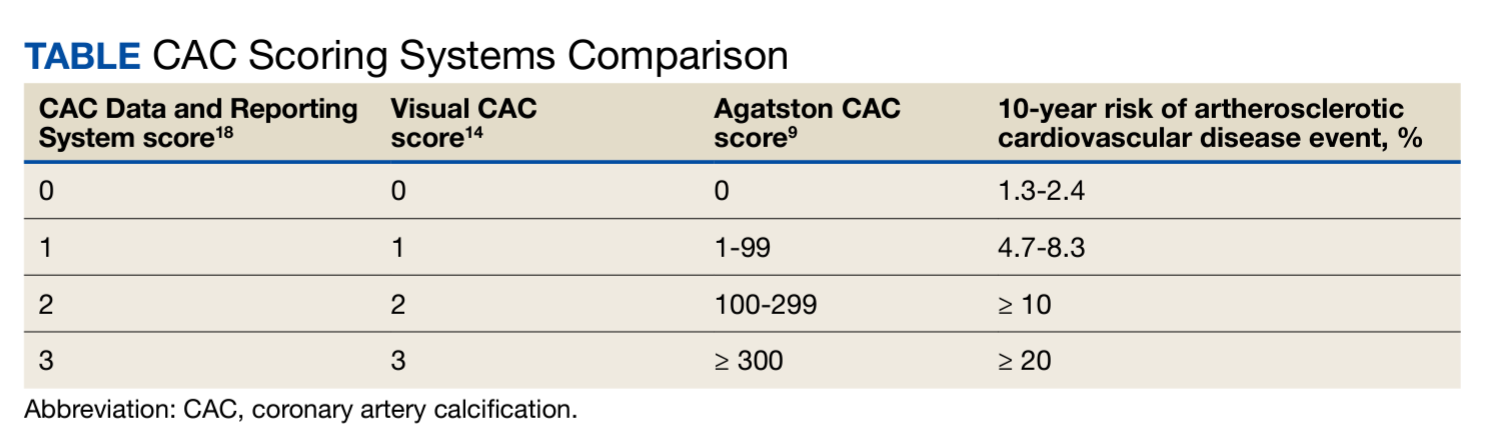
There is now consensus that either an Agatston score or a visual estimate of CAC be reported on all noncontrast, noncardiac chest CT scans irrespective of the indication or technique, including LDCT scans for LCS using a uniform reporting system known as the Coronary Artery Calcium Data and Reporting System (CAC-DRS).19 The CAC-DRS simplifies reporting and adds modifiers indicating if the reported score is visual (V) or Agatston (A) and number of vessels involved. For example, CAC-DRS A0 or CAC-DRS V0 would indicate an Agatston score of 0 or a visual score of 0. CAC-DRS A1/N2 would indicate a total Agatston score of 1-99 in 2 coronary arteries. The currently agreed-on CAC-DRS risk groups are listed in the Table, along with their corresponding visual score or Agatston score and anticipated 10-year event rate, irrespective of other risk factors.20
As LCS efforts increase, primary care practitioners will receive LDCT reports that now incorporate an estimation of CAC (visual or quantitative). Thus, it will be increasingly important to know how to interpret and use these scores to guide clinical decisions regarding the initiation of statin therapy, referral for additional testing, and when to seek specialty cardiology care. For instance, does the absence of CAC (CAC = 0) on LDCT predict a low enough risk for statin therapy to be delayed or withdrawn? Does increasing CAC scores on follow-up LDCT in individuals on statin therapy represent treatment failure? When should CAC scores trigger additional testing, such as a stress test or referral to cardiology specialty care?
Primary Prevention in LCS
The initial approach to primary prevention in LCS is no different from that recommended by the 2018 multisociety guidelines on the management of blood cholesterol, the 2019 American College of Cardiology/American Heart Association (ACC/AHA) guideline on primary prevention, or the 2022 USPTSF recommendations on statin use for primary prevention of CV disease in adults.21-23 For a baseline low-density lipoprotein cholesterol (LDL-C) ≥ 190 mg/dL, high-intensity statin therapy is recommended without further risk stratification. Individuals with diabetes also are at higher-than-average risk, and moderate-intensity statin therapy is recommended.
For individuals not in either group, a validated ASCVD risk assessment tool is recommended to estimate baseline risk. The most validated tool for estimating risk in the US population is the 2013 ACC/AHA Pooled Cohort Equation (PCE) which provides an estimate of the 10-year risk for fatal and myocardial infarction and fatal and nonfatal stroke.24 The PCE risk calculator uses age, presence of diabetes, sex, smoking history, total cholesterol, high-density lipoprotein cholesterol, systolic blood pressure, and treatment for hypertension to place individuals into 1 of 4 risk groups: low (< 5%), borderline (5% to < 7.5%), intermediate (≥ 7.5% to < 20%), and high (≥ 20%). Clinicians should be aware that the PCE only considers current smoking history and not prior smoking history or cumulative pack-year history. This differs from eligibility for LCS where recent smoking plays a larger role. All these risk factors are important to consider when evaluating risk and discussing risk-reducing strategies like statin therapy.
The 2018 multisociety guidelines and the 2019 primary prevention guidelines set the threshold for considering initiation of statin therapy at intermediate risk ≥ 7.5%.21,22 The 2020 US Department of Veterans Affairs/Department of Defense guidelines set the threshold for considering statin therapy at an estimated 10-year event rate of 12%, whereas the 2022 UPSTF recommendations set the threshold at 10% with additional risk factors as the threshold for statin therapy.23,25 The reasons for these differences are beyond the scope of this review, but all these guidelines use the PCE to estimate baseline risk as the starting point for clinical decision making.
The PCE was originally derived and validated in population studies dating to the 1960s when the importance of diet, exercise, and smoking cessation in reducing ASCVD events was not well appreciated. The application of the PCE in more contemporary populations shows that it overestimates risk, especially in older individuals and women.26,27 Overestimation of risk has the potential to result in the initiation of statin therapy in individuals in whom the actual clinical benefit would otherwise be small.
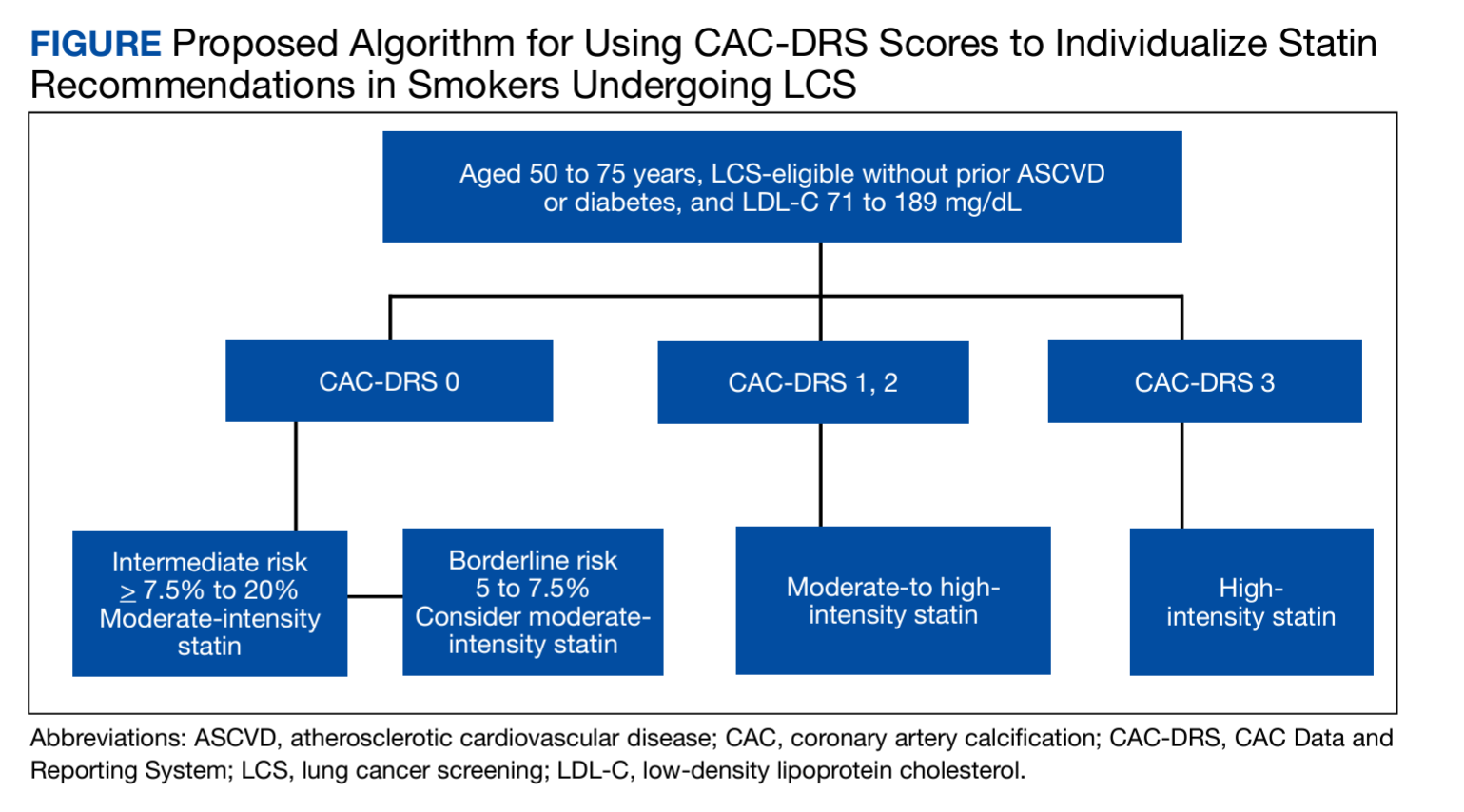
To address this issue, current guidelines allow the use of CAC scoring to refine risk in individuals who are classified as intermediate risk and who otherwise desire to avoid lifelong statin therapy. Using current recommendations, we make suggestions on how to use CAC scores from LDCT to aid in clinical decision making for individuals in LCS (Figure).
No Coronary Artery Calcification
Between 25% and 30% of LDCT done for LCS will show no CAC.14,16 In general population studies, a CAC score of 0 is a strong negative predictor when there are no other risk factors.13,28 In contrast, the negative predictive ability of a CAC score of 0 in individuals with a smoking history who are eligible for LCS is unproven. In multivariate modeling, a CAC score of 0 did not reduce the significant hazard of all-cause mortality in patients with diabetes or smokers.29 In an analysis of 44,042 individuals without known heart disease referred for CAC scoring, the frequency of a CAC score of 0 was only modestly lower in smokers (38%) compared with nonsmokers (42%), yet the all-cause mortality rate was significantly higher.30 In addition, Multi-Ethnic Study of Atherosclerosis (MESA) participants who were current smokers or eligible for LCS and had a CAC score of 0 had an observed 11-year ASCVD event rate of 13.4% and 20.8%, respectively, leading to the conclusion that a CAC score of 0 may not be predictive of minimal risk in smokers and those eligible for LCS.31 Additionally, in LCS-eligible individuals, the PCE underestimated event rates and incorporation of CAC scores did not significantly improve risk estimation. Finally, data from the NLST screening trial showed that the absence of CAC on LDCT was not associated with better survival or lower CV mortality compared with individuals with low CAC scores.32
The question of whether individuals undergoing LCS with LDCT who have no detectable CAC can avoid statin therapy is an unresolved issue; no contemporary studies have looked specifically at the relationship between estimated risk, a CAC score of 0, and ASCVD outcomes in individuals participating in LCS. For these reasons, we recommend moderate-intensity statin therapy when the estimated risk is intermediate because it is unclear that either an Agatston score of 0 reclassifies intermediate-risk LCS-eligible individuals to a lower risk group.
For the few borderline risk (estimated risk, 5% to < 7.5%) LCS-eligible individuals, a CAC score of 0 might confer low short-term risk but the long-term benefit of statin therapy on reducing subsequent risk, the presence of other risk factors, and the willingness to stop smoking should all be considered. For these individuals who elect to avoid statin therapy, annual re-estimation of risk at the time of repeat LDCT is recommended. In these circumstances, referral for traditional Agatston scoring is not likely to change decision making because the sensitivity of the 2 techniques is very similar.
Agatston Score of 1-99 or CAC-DRS or Visual Score of 1
In general population studies, these scores correspond to borderline risk and an estimated 10-year event rate of just under 7.5%.20 In both the NELSON and NLST LCS trials, even low amounts of CAC regardless of the scoring method were associated with higher observed ASCVD mortality when adjusted for other baseline risk factors.32 Thus, in patients undergoing LCS with intermediate and borderline risk, a CAC score between 1 and 99 or a visual estimate of 1 indicates the presence of subclinical atherosclerosis, and moderate-intensity statin therapy is reasonable.
Agatston Score of 100-299 or CAC-DRS or Visual Score of 2
Across all ages, races, and sexes, CAC scores between 100 to 299 are associated with an event rate of about 15% over 10 years.20 In the NELSON LCS trial, the adjusted hazard ratio for ASCVD events with a nontraditional Agatston score of 101 to 400 was 6.58.33 Thus, in patients undergoing LCS with a CAC score of 100 to 299, regardless of the baseline risk estimate, the projected absolute event rate at 10 years would be about 20%. Moderate-intensity statin therapy is recommended to reduce the baseline LDL-C by 30% to 49%.
Agatston Score of > 300 or CAC-DRS or Visual Score of 3
Agatston CAC scores > 300 are consistent with a 10-year incidence of ASCVD events of > 15% regardless of age, sex, or race and ethnicity.20 In the Calcium Consortium, a CAC > 400 was correlated with an event rate of 13.6 events/1000 person-years.12 In a Walter Reed Military Medical Center study, a CAC score > 400 projected a cumulative incidence of ASCVD events of nearly 20% at 10 years.34 In smokers eligible for LCS, a CAC score > 300 projected a 10-year ASCVD event rate of 25%.29 In these patients, moderate-intensity statin therapy is recommended, although high-intensity statin therapy can be considered if there are other risk factors.
Agatston Score ≥ 1000
The 2018 consensus statement on CAC reporting categorizes all CAC scores > 300 into a single risk group because the recommended treatment options do not differ.19 However, recent data suggest this might not be the case since individuals with very high CAC scores experience high rates of events that might justify more aggressive intervention. In an analysis of individuals who participated in the CAC Consortium with a CAC score ≥ 1000, the all-cause mortality rate was 18.8 per 1000 person-years with a CV mortality rate of 8 per 1000 person-years.35 Individuals with very high levels of CAC > 1000 also have a greater number of diseased coronary arteries, higher involvement of the left main coronary artery, and significantly higher event rates compared with those with a CAC of 400 to 999.36 In an analysis of individuals from the NLST trial, nontraditionally measured Agatston score > 1000 was associated with a hazard ratio for coronary artery disease (CAD) mortality of 3.66 in men and 5.81 in women.17 These observed and projected levels of risk are like that seen in secondary prevention trials, and some experts have recommended the use of high-intensity statin therapy to reduce LDL-C to < 70 mg/dL.37
Primary Prevention in Individuals aged 76 to 80 years
LCS can continue through age 80 years, while the PCE and primary prevention guidelines are truncated at age 75 years. Because age is a major contributor to risk, many of these individuals will already be in the intermediate- to high-risk group. However, the net clinical benefit of statin therapy for primary prevention in this age group is not well established, and the few primary prevention trials in this group have not demonstrated net clinical benefit.38 As a result, current guidelines do not provide specific treatment recommendations for individuals aged > 75 years but recognize the value of shared decision making considering associated comorbidities, age-related risks of statin therapy, and the desires of the individual to avoid ASCVD-related events even if the net clinical benefit is low.
Older individuals with elevated CAC scores should be informed about the risk of ASCVD events and the potential but unproven benefit of moderate-intensity statin therapy. Older individuals with a CAC score of 0 likely have low short-term risk of ASCVD events and withholding statin therapy is not unreasonable.
CAC Scores on Annual LDCT Scans
Because LCS requires annual LDCT scans, primary care practitioners and patients need to understand the significance of changing CAC scores over time. For individuals not on statin therapy, increasing calcification is a marker of progression of subclinical atherosclerosis. Patients undergoing LCS not on statin who have progressive increases in their CAC should consider initiating statin therapy. Individuals who opted not to initiate statin therapy who subsequently develop CAC should be re-engaged in a discussion about the significance of the finding and the clinically proven benefits of statin therapy in individuals with subclinical atherosclerosis. These considerations do not apply to individuals already on statin therapy. Statins convert lipid-rich plaques to lipid-depleted plaques, resulting in increasing calcification. As a result, CAC scores do not decrease and may increase with statin therapy.39 Individuals participating in annual LCS should be informed of this possibility. Also, in these individuals, referral to specialty care as a treatment failure is not supported by the literature.
Furthermore, serial CAC scoring to titrate the intensity of statin therapy is not currently recommended. The goal with moderate-intensity statin therapy is a 30% to 49% reduction from baseline LDL-C. If this milestone is not achieved, the statin dose can be escalated. For high-intensity statin therapy, the goal is a > 50% reduction. If this milestone is not achieved, then additional lipid-lowering agents, such as ezetimibe, can be added.
Further ASCVD Testing
LCS with LDCT is associated with improved health outcomes, and LDCT is the preferred imaging modality. The ability of LDCT to detect and quantify CAC is sufficient for clinical decision making. Therefore, obtaining a traditional CAC score increases radiation exposure without additional clinical benefits.
Furthermore, although referral for additional testing in those with nonzero CAC scores is common, current evidence does not support this practice in asymptomatic individuals. Indeed, the risks of LCS include overdiagnosis, excessive testing, and overtreatment secondary to the discovery of other findings, such as benign pulmonary nodules and CAC. With respect to CAD, randomized controlled trials do not support a strategy of coronary angiography and intervention in asymptomatic individuals, even with moderate-to-severe ischemia on functional testing.40 As a result, routine stress tests to diagnose CAD or to confirm the results of CAC scores in asymptomatic individuals are not recommended. The only potential exception would be in select cases where the CAC score is > 1000 and when calcium is predominately located in the left main coronary artery.
Conclusions
LCS provides smokers at risk for lung cancer with the best probability to survive that diagnosis, and coincidentally LCS may also provide the best opportunity to prevent ASCVD events and mortality. Before initiating LCS, clinicians should initiate a shared decision making conversation about the benefits and risks of LDCT scans. In addition to relevant education about smoking, during shared decision making, the initial ASCVD risk estimate should be done using the PCE and when appropriate the benefits of statin therapy discussed. Individuals also should be informed of the potential for identifying CAC and counseled on its significance and how it might influence the decision to recommend statin therapy.
In patients undergoing LCS with an estimated risk of ≥ 7.5% to < 20%, moderate-intensity statin therapy is indicated. In this setting, a CAC score > 0 indicates subclinical atherosclerosis and should be used to help direct patients toward initiating statin therapy. Unfortunately, in patients undergoing LCS a CAC score of 0 might not provide protection against ASCVD, and until there is more information to the contrary, these individuals should at least participate in shared decision making about the long-term benefits of statin therapy in reducing ASCVD risk. Because LDCT scanning is done annually, there are opportunities to review the importance of prevention and to adjust therapy as needed to achieve the greatest reduction in ASCVD. Reported elevated CAC scores on LDCT provide an opportunity to re-engage the patient in the discussion about the benefits of statin therapy if they are not already on a statin, or consideration for high-intensity statin if the CAC score is > 1000 or reduction in baseline LDL-C is < 30% on the current statin dose.
1. de Koning HJ, van der Aalst CM, Oudkerk M. Lung-cancer screening and the NELSON Trial. Reply. N Engl J Med. 2020;382(22):2165-2166. doi:10.1056/NEJMc2004224
2. Aberle T, Adams DR, Berg AM, et al. National Lung Screening Trial Research Team. Reduced lung-cancer mortality with low-dose computed tomographic screening. N Engl J Med. 2011;365(5):396-409. doi:10.1056/NEJMoa1102873
3. Krist AH, Davidson KW, Mangione CM, et al. US Preventive Services Task Force. Screening for lung cancer: US Preventive Services Task Force recommendation statement. JAMA. 2021;25(10):962-970. doi:10.1001/jama.2021.1117
4. Jha P, Ramasundarahettige C, Landsman V. 21st-century hazards of smoking and benefits of cessation in the United States. N Engl J Med. 2013;368(4):341-350. doi:10.1056/NEJMsa1211128
5. Khan SS, Ning H, Sinha A, et al. Cigarette smoking and competing risks for fatal and nonfatal cardiovascular disease subtypes across the life course. J Am Heart Assoc. 2021;10(23):e021751. doi:10.1161/JAHA.121.021751
6. Lu MT, Onuma OK, Massaro JM, et al. Lung cancer screening eligibility in the community: cardiovascular risk factors, coronary artery calcification, and cardiovascular events. Circulation. 2016;134(12):897-899. doi:10.1161/CIRCULATIONAHA.116.023957
7. Tailor TD, Chiles C, Yeboah J, et al. Cardiovascular risk in the lung cancer screening population: a multicenter study evaluating the association between coronary artery calcification and preventive statin prescription. J Am Coll Radiol. 2021;18(9):1258-1266. doi:10.1016/j.jacr.2021.01.015
8. Mori H, Torii S, Kutyna M, et al. Coronary artery calcification and its progression: what does it really mean? JACC Cardiovasc Imaging. 2018;11(1):127-142. doi:10.1016/j.jcmg.2017.10.012
10. Nasir K, Bittencourt MS, Blaha MJ, et al. Implications of coronary artery calcium testing among statin candidates according to American College of Cardiology/American Heart Association cholesterol management guidelines: MESA (Multi-Ethnic Study of Atherosclerosis). J Am Coll Cardiol. 2015;66(15): 1657-1668. doi:10.1016/j.jacc.2015.07.066
11. Detrano R, Guerci AD, Carr JJ, et al. Coronary calcium as a predictor of coronary events in four racial or ethnic groups. N Engl J Med. 2008;358(13):1336-1345. doi:10.1056/NEJMoa072100
12. Grandhi GR, Mirbolouk M, Dardari ZA. Interplay of coronary artery calcium and risk factors for predicting CVD/CHD Mortality: the CAC Consortium. JACC Cardiovasc Imaging. 2020;13(5):1175-1186. doi:10.1016/j.jcmg.2019.08.024
13. Blaha M, Budoff MJ, Shaw J. Absence of coronary artery calcification and all-cause mortality. JACC Cardiovasc Imaging. 2009;2(6):692-700. doi:10.1016/j.jcmg.2009.03.009
14. Shemesh J, Henschke CI, Farooqi A, et al. Frequency of coronary artery calcification on low-dose computed tomography screening for lung cancer. Clin Imaging. 2006;30(3):181-185. doi:10.1016/j.clinimag.2005.11.002
15. Shemesh J, Henschke C, Shaham D, et al. Ordinal scoring of coronary artery calcifications on low-dose CT scans of the chest is predictive of death from cardiovascular disease. Radiology. 2010;257:541-548. doi:10.1148/radiol.10100383
16. Jacobs PC, Gondrie MJ, van der Graaf Y, et al. Coronary artery calcium can predict all-cause mortality and cardiovascular events on low-dose CT screening for lung cancer. AJR Am J Roentgenol. 2012;198(3):505-511. doi:10.2214/AJR.10.5577
17. Lessmann N, de Jong PA, Celeng C, et al. Sex differences in coronary artery and thoracic aorta calcification and their association with cardiovascular mortality in heavy smokers. JACC Cardiovasc Imaging. 2019;12(9):1808-1817. doi:10.1016/j.jcmg.2018.10.026
18. Gendarme S, Goussault H, Assie JB, et al. Impact on all-cause and cardiovascular mortality rates of coronary artery calcifications detected during organized, low-dose, computed-tomography screening for lung cancer: systematic literature review and meta-analysis. Cancers (Basel). 2021;13(7):1553. doi:10.3390/cancers13071553
19. Hecht HS, Blaha MJ, Kazerooni EA, et al. CAC-DRS: coronary artery calcium data and reporting system. An expert consensus document of the Society of Cardiovascular Computed Tomography (SCCT). J Cardiovasc Comput Tomogr. 2018;12(3):185-191. doi:10.1016/j.jcct.2018.03.008
20. Budoff MJ, Young R, Burke G, et al. Ten-year association of coronary artery calcium with atherosclerotic cardiovascular disease (ASCVD) events: the multi-ethnic study of atherosclerosis (MESA). Eur Heart J. 2018;39(25):2401-2408. doi:10.1093/eurheartj/ehy217
21. Grundy SM, Stone NJ, Bailey AL, et al. 2018 AHA/ACC/AACVPR/AAPA/ABC/ACPM/ADA/AGS/APhA/ASPC/NLA/PCNA guideline on the management of blood cholesterol: executive summary: a report of the American College of Cardiology/American Heart Association Task Force on Clinical Practice Guidelines. Circulation. 2019;139(25):e1046-e1081. doi:10.1161/CIR.0000000000000624
22. Arnett DK, Blumenthal RS, Albert MA, et al. 2019 ACC/AHA guideline on the primary prevention of cardiovascular disease: a report of the American College of Cardiology/American Heart Association Task Force on Clinical Practice Guidelines. Circulation. 2019;140(11):e596-e646. doi:10.1161/CIR.0000000000000678
23. Mangione CM, Barry MJ, Nicholson WK, et al. US Preventive Services Task Force. Statin use for the primary prevention of cardiovascular disease in adults: US Preventive Services Task Force recommendation statement. JAMA. 2022;328(8):746-753. doi:10.1001/jama.2022.13044
24. Stone NJ, Robinson JG, Lichtenstein AH, et al. American College of Cardiology/American Heart Association Task Force on Practice. 2013 ACC/AHA guideline on the treatment of blood cholesterol to reduce atherosclerotic cardiovascular risk in adults: a report of the American College of Cardiology/American Heart Association Task Force on Practice Guidelines. J Am Coll Cardiol. 2014;63(25 pt B):2889-2934. doi:10.1016/j.jacc.2013.11.002
 25. US Department of Veterans Affairs, Department of Defense. VA/DoD clinical practice guideline. Updated August 25, 2021. Accessed November 3, 2023. https://www.healthquality.va.gov/guidelines/cd/lipids
26. DeFilippis AP, Young, R, Carrubba CJ, et al. An analysis of calibration and discrimination among multiple cardiovascular risk scores in a modern multiethnic cohort. Ann Intern Med. 2015;162(4):266-275. doi:10.7326/M14-1281
27. Rana JS, Tabada GH, Solomon, MD, et al. Accuracy of the atherosclerotic cardiovascular risk equation in a large contemporary, multiethnic population. J Am Coll Cardiol. 2016;67(18):2118-2130. doi:10.1016/j.jacc.2016.02.055
28. Sarwar A, Shaw LJ, Shapiro MD, et al. Diagnostic and prognostic value of absence of coronary artery calcification. JACC Cardiovasc Imaging. 2009;2(6):675-688. doi:10.1016/j.jcmg.2008.12.031
29. McEvoy JW, Blaha MJ, Rivera JJ, et al. Mortality rates in smokers and nonsmokers in the presence or absence of coronary artery calcification. JACC Cardiovasc Imaging. 2012;5(10):1037-1045. doi:10.1016/j.jcmg.2012.02.017
30. Leigh A, McEvoy JW, Garg P, et al. Coronary artery calcium scores and atherosclerotic cardiovascular disease risk stratification in smokers. JACC Cardiovasc Imaging. 2019;12(5):852-861. doi:10.1016/j.jcmg.2017.12.017
31. Garg PK, Jorgensen NW, McClelland RL, et al. Use of coronary artery calcium testing to improve coronary heart disease risk assessment in lung cancer screening population: The Multi-Ethnic Study of Atherosclerosis (MESA). J Cardiovasc Comput Tomagr. 2018;12(6):439-400.
32. Chiles C, Duan F, Gladish GW, et al. Association of coronary artery calcification and mortality in the national lung screening trial: a comparison of three scoring methods. Radiology. 2015;276(1):82-90. doi:10.1148/radiol.15142062
33. Takx RA, Isgum I, Willemink MJ, et al. Quantification of coronary artery calcium in nongated CT to predict cardiovascular events in male lung cancer screening participants: results of the NELSON study. J Cardiovasc Comput Tomogr. 2015;9(1):50-57. doi:10.1016/j.jcct.2014.11.006
34. Mitchell JD, Paisley R, Moon P, et al. Coronary artery calcium and long-term risk of death, myocardial infarction, and stroke: The Walter Reed Cohort Study. JACC Cardiovasc Imaging. 2018;11(12):1799-1806. doi:10.1016/j.jcmg.2017.09.003
35. Peng AW, Mirbolouk M, Orimoloye OA, et al. Long-term all-cause and cause-specific mortality in asymptomatic patients with CAC >/=1,000: results from the CAC Consortium. JACC Cardiovasc Imaging. 2019;13(1, pt 1):83-93. doi:10.1016/j.jcmg.2019.02.005
36. Peng AW, Dardari ZA. Blumenthal RS, et al. Very high coronary artery calcium (>/=1000) and association with cardiovascular disease events, non-cardiovascular disease outcomes, and mortality: results from MESA. Circulation. 2021;143(16):1571-1583. doi:10.1161/CIRCULATIONAHA.120.050545
37. Orringer CE, Blaha MJ, Blankstein R, et al. The National Lipid Association scientific statement on coronary artery calcium scoring to guide preventive strategies for ASCVD risk reduction. J Clin Lipidol. 2021;15(1):33-60. doi:10.1016/j.jacl.2020.12.005
38. Sheperd J, Blauw GJ, Murphy MB, et al. PROSPER study group. PROspective Study of Pravastatin in the Elderly at Risk. Pravastatin in elderly individuals at risk of vascular disease. (PROSPER): a randomized controlled trial. Lancet. 2002;360:1623-1630. doi:10.1016/s0140-6736(02)11600-x
39. Puri R, Nicholls SJ, Shao M, et al. Impact of statins on serial coronary calcification during atheroma progression and regression. J Am Coll Cardiol. 2015;65(13):1273-1282. doi:10.1016/j.jacc.2015.01.036
40. Maron D.J, Hochman J S, Reynolds HR, et al. ISCHEMIA Research Group. Initial invasive or conservative strategy for stable coronary disease. N Engl J Med. 2020;382(15):1395-1407. doi:10.1056/NEJMoa1915922
Lung cancer is the most common cause of cancer mortality, and cigarette smoking is the most significant risk factor. Several randomized clinical trials have shown that lung cancer screening (LCS) with nonelectrocardiogram (ECG)-gated low-dose computed tomography (LDCT) reduces both lung cancer and all-cause mortality.1,2 Hence, the US Preventive Screening Task Force (USPSTF) recommends annual screening with LDCT in adults aged 50 to 80 years who have a 20-pack-year smoking history and currently smoke or have quit within the past 15 years.3
Smoking is also an independent risk factor for atherosclerotic cardiovascular disease (ASCVD), and LCS clinical trials acknowledge that mortality from ASCVD events exceeds that of lung cancer.4,5 In an analysis of asymptomatic individuals from the Framingham Heart Offspring study who were eligible for LCS, the ASCVD event rate during a median (IQR) follow-up of 11.4 (9.7-12.0) years was 12.6%.6 However, despite the high rate of ASCVD events in this population, primary prevention strategies are consistently underused. In a study of 5495 individuals who underwent LCS with LDCT, only 40% of those eligible for statins had one prescribed, underscoring the missed opportunity for preventing ASCVD events during LCS.7 Yet the interactions for shared decision making and the availability of coronary artery calcification (CAC) scores from the LDCT provide an ideal window for intervening and preventing ASCVD events during LCS.
CAC is a hallmark of atherosclerotic plaque development and is proportional to plaque burden and ASCVD risk.8 Because of the relationship between CAC, subclinical atherosclerosis, and ASCVD risk, there is an opportunity to use CAC detected by LDCT to predict ASCVD risk and guide recommendations for statin treatment in individuals enrolled in LCS. Traditionally, CAC has been visualized by ECG-gated noncontrast CT scans with imaging protocols specifically designed to visualize the coronary arteries, minimize motion artifacts, and reduce signal noise. These scans are specifically done for primary prevention risk assessment and report an Agatston score, a summed measure based on calcified plaque area and maximal density.9 Results are reported as an overall CAC score and an age-, sex-, and race-adjusted percentile of CAC. Currently, a CAC score ≥ 100 or above the 75th percentile for age, sex, and race is considered abnormal.
High-quality evidence supports CAC scores as a strong predictor of ASCVD risk independent of age, sex, race, and other traditional risk factors.10-12 In asymptomatic individuals, a CAC score of 0 is a strong, negative risk factor associated with very low annualized mortality rates and cardiovascular (CV) events, so intermediate-risk individuals can be reclassified to a lower risk group avoiding or delaying statin therapy.13 As a result, current primary prevention guidelines allow for CAC scoring in asymptomatic, intermediate-risk adults where the clinical benefits of statin therapy are uncertain, knowing the CAC score will aid in the clinical decision to delay or initiate statin therapy.
Unlike traditional ECG-gated CAC scoring, LDCT imaging protocols are non–ECG-gated and performed at variable energy and slice thickness to optimize the detection of lung nodules. Early studies suggested that CAC detected by LDCT could be used in lieu of traditional CAC scoring to personalize risk.14,15 Recently, multiple studies have validated the accuracy and reproducibility of LDCT to detect and quantify CAC. In both the NELSON and the National Lung Screening Trial (NLST) LCS trials, higher visual and quantitative measures of CAC were independently and incrementally associated with ASCVD risk.16,17 A subsequent review and meta-analysis of 6 LCS trials confirmed CAC detected by LDCT to be an independent predictor of ASCVD events regardless of the method used to measure CAC.18
There is now consensus that either an Agatston score or a visual estimate of CAC be reported on all noncontrast, noncardiac chest CT scans irrespective of the indication or technique, including LDCT scans for LCS using a uniform reporting system known as the Coronary Artery Calcium Data and Reporting System (CAC-DRS).19 The CAC-DRS simplifies reporting and adds modifiers indicating if the reported score is visual (V) or Agatston (A) and number of vessels involved. For example, CAC-DRS A0 or CAC-DRS V0 would indicate an Agatston score of 0 or a visual score of 0. CAC-DRS A1/N2 would indicate a total Agatston score of 1-99 in 2 coronary arteries. The currently agreed-on CAC-DRS risk groups are listed in the Table, along with their corresponding visual score or Agatston score and anticipated 10-year event rate, irrespective of other risk factors.20
As LCS efforts increase, primary care practitioners will receive LDCT reports that now incorporate an estimation of CAC (visual or quantitative). Thus, it will be increasingly important to know how to interpret and use these scores to guide clinical decisions regarding the initiation of statin therapy, referral for additional testing, and when to seek specialty cardiology care. For instance, does the absence of CAC (CAC = 0) on LDCT predict a low enough risk for statin therapy to be delayed or withdrawn? Does increasing CAC scores on follow-up LDCT in individuals on statin therapy represent treatment failure? When should CAC scores trigger additional testing, such as a stress test or referral to cardiology specialty care?
Primary Prevention in LCS
The initial approach to primary prevention in LCS is no different from that recommended by the 2018 multisociety guidelines on the management of blood cholesterol, the 2019 American College of Cardiology/American Heart Association (ACC/AHA) guideline on primary prevention, or the 2022 USPTSF recommendations on statin use for primary prevention of CV disease in adults.21-23 For a baseline low-density lipoprotein cholesterol (LDL-C) ≥ 190 mg/dL, high-intensity statin therapy is recommended without further risk stratification. Individuals with diabetes also are at higher-than-average risk, and moderate-intensity statin therapy is recommended.
For individuals not in either group, a validated ASCVD risk assessment tool is recommended to estimate baseline risk. The most validated tool for estimating risk in the US population is the 2013 ACC/AHA Pooled Cohort Equation (PCE) which provides an estimate of the 10-year risk for fatal and myocardial infarction and fatal and nonfatal stroke.24 The PCE risk calculator uses age, presence of diabetes, sex, smoking history, total cholesterol, high-density lipoprotein cholesterol, systolic blood pressure, and treatment for hypertension to place individuals into 1 of 4 risk groups: low (< 5%), borderline (5% to < 7.5%), intermediate (≥ 7.5% to < 20%), and high (≥ 20%). Clinicians should be aware that the PCE only considers current smoking history and not prior smoking history or cumulative pack-year history. This differs from eligibility for LCS where recent smoking plays a larger role. All these risk factors are important to consider when evaluating risk and discussing risk-reducing strategies like statin therapy.
The 2018 multisociety guidelines and the 2019 primary prevention guidelines set the threshold for considering initiation of statin therapy at intermediate risk ≥ 7.5%.21,22 The 2020 US Department of Veterans Affairs/Department of Defense guidelines set the threshold for considering statin therapy at an estimated 10-year event rate of 12%, whereas the 2022 UPSTF recommendations set the threshold at 10% with additional risk factors as the threshold for statin therapy.23,25 The reasons for these differences are beyond the scope of this review, but all these guidelines use the PCE to estimate baseline risk as the starting point for clinical decision making.
The PCE was originally derived and validated in population studies dating to the 1960s when the importance of diet, exercise, and smoking cessation in reducing ASCVD events was not well appreciated. The application of the PCE in more contemporary populations shows that it overestimates risk, especially in older individuals and women.26,27 Overestimation of risk has the potential to result in the initiation of statin therapy in individuals in whom the actual clinical benefit would otherwise be small.
To address this issue, current guidelines allow the use of CAC scoring to refine risk in individuals who are classified as intermediate risk and who otherwise desire to avoid lifelong statin therapy. Using current recommendations, we make suggestions on how to use CAC scores from LDCT to aid in clinical decision making for individuals in LCS (Figure).
No Coronary Artery Calcification
Between 25% and 30% of LDCT done for LCS will show no CAC.14,16 In general population studies, a CAC score of 0 is a strong negative predictor when there are no other risk factors.13,28 In contrast, the negative predictive ability of a CAC score of 0 in individuals with a smoking history who are eligible for LCS is unproven. In multivariate modeling, a CAC score of 0 did not reduce the significant hazard of all-cause mortality in patients with diabetes or smokers.29 In an analysis of 44,042 individuals without known heart disease referred for CAC scoring, the frequency of a CAC score of 0 was only modestly lower in smokers (38%) compared with nonsmokers (42%), yet the all-cause mortality rate was significantly higher.30 In addition, Multi-Ethnic Study of Atherosclerosis (MESA) participants who were current smokers or eligible for LCS and had a CAC score of 0 had an observed 11-year ASCVD event rate of 13.4% and 20.8%, respectively, leading to the conclusion that a CAC score of 0 may not be predictive of minimal risk in smokers and those eligible for LCS.31 Additionally, in LCS-eligible individuals, the PCE underestimated event rates and incorporation of CAC scores did not significantly improve risk estimation. Finally, data from the NLST screening trial showed that the absence of CAC on LDCT was not associated with better survival or lower CV mortality compared with individuals with low CAC scores.32
The question of whether individuals undergoing LCS with LDCT who have no detectable CAC can avoid statin therapy is an unresolved issue; no contemporary studies have looked specifically at the relationship between estimated risk, a CAC score of 0, and ASCVD outcomes in individuals participating in LCS. For these reasons, we recommend moderate-intensity statin therapy when the estimated risk is intermediate because it is unclear that either an Agatston score of 0 reclassifies intermediate-risk LCS-eligible individuals to a lower risk group.
For the few borderline risk (estimated risk, 5% to < 7.5%) LCS-eligible individuals, a CAC score of 0 might confer low short-term risk but the long-term benefit of statin therapy on reducing subsequent risk, the presence of other risk factors, and the willingness to stop smoking should all be considered. For these individuals who elect to avoid statin therapy, annual re-estimation of risk at the time of repeat LDCT is recommended. In these circumstances, referral for traditional Agatston scoring is not likely to change decision making because the sensitivity of the 2 techniques is very similar.
Agatston Score of 1-99 or CAC-DRS or Visual Score of 1
In general population studies, these scores correspond to borderline risk and an estimated 10-year event rate of just under 7.5%.20 In both the NELSON and NLST LCS trials, even low amounts of CAC regardless of the scoring method were associated with higher observed ASCVD mortality when adjusted for other baseline risk factors.32 Thus, in patients undergoing LCS with intermediate and borderline risk, a CAC score between 1 and 99 or a visual estimate of 1 indicates the presence of subclinical atherosclerosis, and moderate-intensity statin therapy is reasonable.
Agatston Score of 100-299 or CAC-DRS or Visual Score of 2
Across all ages, races, and sexes, CAC scores between 100 to 299 are associated with an event rate of about 15% over 10 years.20 In the NELSON LCS trial, the adjusted hazard ratio for ASCVD events with a nontraditional Agatston score of 101 to 400 was 6.58.33 Thus, in patients undergoing LCS with a CAC score of 100 to 299, regardless of the baseline risk estimate, the projected absolute event rate at 10 years would be about 20%. Moderate-intensity statin therapy is recommended to reduce the baseline LDL-C by 30% to 49%.
Agatston Score of > 300 or CAC-DRS or Visual Score of 3
Agatston CAC scores > 300 are consistent with a 10-year incidence of ASCVD events of > 15% regardless of age, sex, or race and ethnicity.20 In the Calcium Consortium, a CAC > 400 was correlated with an event rate of 13.6 events/1000 person-years.12 In a Walter Reed Military Medical Center study, a CAC score > 400 projected a cumulative incidence of ASCVD events of nearly 20% at 10 years.34 In smokers eligible for LCS, a CAC score > 300 projected a 10-year ASCVD event rate of 25%.29 In these patients, moderate-intensity statin therapy is recommended, although high-intensity statin therapy can be considered if there are other risk factors.
Agatston Score ≥ 1000
The 2018 consensus statement on CAC reporting categorizes all CAC scores > 300 into a single risk group because the recommended treatment options do not differ.19 However, recent data suggest this might not be the case since individuals with very high CAC scores experience high rates of events that might justify more aggressive intervention. In an analysis of individuals who participated in the CAC Consortium with a CAC score ≥ 1000, the all-cause mortality rate was 18.8 per 1000 person-years with a CV mortality rate of 8 per 1000 person-years.35 Individuals with very high levels of CAC > 1000 also have a greater number of diseased coronary arteries, higher involvement of the left main coronary artery, and significantly higher event rates compared with those with a CAC of 400 to 999.36 In an analysis of individuals from the NLST trial, nontraditionally measured Agatston score > 1000 was associated with a hazard ratio for coronary artery disease (CAD) mortality of 3.66 in men and 5.81 in women.17 These observed and projected levels of risk are like that seen in secondary prevention trials, and some experts have recommended the use of high-intensity statin therapy to reduce LDL-C to < 70 mg/dL.37
Primary Prevention in Individuals aged 76 to 80 years
LCS can continue through age 80 years, while the PCE and primary prevention guidelines are truncated at age 75 years. Because age is a major contributor to risk, many of these individuals will already be in the intermediate- to high-risk group. However, the net clinical benefit of statin therapy for primary prevention in this age group is not well established, and the few primary prevention trials in this group have not demonstrated net clinical benefit.38 As a result, current guidelines do not provide specific treatment recommendations for individuals aged > 75 years but recognize the value of shared decision making considering associated comorbidities, age-related risks of statin therapy, and the desires of the individual to avoid ASCVD-related events even if the net clinical benefit is low.
Older individuals with elevated CAC scores should be informed about the risk of ASCVD events and the potential but unproven benefit of moderate-intensity statin therapy. Older individuals with a CAC score of 0 likely have low short-term risk of ASCVD events and withholding statin therapy is not unreasonable.
CAC Scores on Annual LDCT Scans
Because LCS requires annual LDCT scans, primary care practitioners and patients need to understand the significance of changing CAC scores over time. For individuals not on statin therapy, increasing calcification is a marker of progression of subclinical atherosclerosis. Patients undergoing LCS not on statin who have progressive increases in their CAC should consider initiating statin therapy. Individuals who opted not to initiate statin therapy who subsequently develop CAC should be re-engaged in a discussion about the significance of the finding and the clinically proven benefits of statin therapy in individuals with subclinical atherosclerosis. These considerations do not apply to individuals already on statin therapy. Statins convert lipid-rich plaques to lipid-depleted plaques, resulting in increasing calcification. As a result, CAC scores do not decrease and may increase with statin therapy.39 Individuals participating in annual LCS should be informed of this possibility. Also, in these individuals, referral to specialty care as a treatment failure is not supported by the literature.
Furthermore, serial CAC scoring to titrate the intensity of statin therapy is not currently recommended. The goal with moderate-intensity statin therapy is a 30% to 49% reduction from baseline LDL-C. If this milestone is not achieved, the statin dose can be escalated. For high-intensity statin therapy, the goal is a > 50% reduction. If this milestone is not achieved, then additional lipid-lowering agents, such as ezetimibe, can be added.
Further ASCVD Testing
LCS with LDCT is associated with improved health outcomes, and LDCT is the preferred imaging modality. The ability of LDCT to detect and quantify CAC is sufficient for clinical decision making. Therefore, obtaining a traditional CAC score increases radiation exposure without additional clinical benefits.
Furthermore, although referral for additional testing in those with nonzero CAC scores is common, current evidence does not support this practice in asymptomatic individuals. Indeed, the risks of LCS include overdiagnosis, excessive testing, and overtreatment secondary to the discovery of other findings, such as benign pulmonary nodules and CAC. With respect to CAD, randomized controlled trials do not support a strategy of coronary angiography and intervention in asymptomatic individuals, even with moderate-to-severe ischemia on functional testing.40 As a result, routine stress tests to diagnose CAD or to confirm the results of CAC scores in asymptomatic individuals are not recommended. The only potential exception would be in select cases where the CAC score is > 1000 and when calcium is predominately located in the left main coronary artery.
Conclusions
LCS provides smokers at risk for lung cancer with the best probability to survive that diagnosis, and coincidentally LCS may also provide the best opportunity to prevent ASCVD events and mortality. Before initiating LCS, clinicians should initiate a shared decision making conversation about the benefits and risks of LDCT scans. In addition to relevant education about smoking, during shared decision making, the initial ASCVD risk estimate should be done using the PCE and when appropriate the benefits of statin therapy discussed. Individuals also should be informed of the potential for identifying CAC and counseled on its significance and how it might influence the decision to recommend statin therapy.
In patients undergoing LCS with an estimated risk of ≥ 7.5% to < 20%, moderate-intensity statin therapy is indicated. In this setting, a CAC score > 0 indicates subclinical atherosclerosis and should be used to help direct patients toward initiating statin therapy. Unfortunately, in patients undergoing LCS a CAC score of 0 might not provide protection against ASCVD, and until there is more information to the contrary, these individuals should at least participate in shared decision making about the long-term benefits of statin therapy in reducing ASCVD risk. Because LDCT scanning is done annually, there are opportunities to review the importance of prevention and to adjust therapy as needed to achieve the greatest reduction in ASCVD. Reported elevated CAC scores on LDCT provide an opportunity to re-engage the patient in the discussion about the benefits of statin therapy if they are not already on a statin, or consideration for high-intensity statin if the CAC score is > 1000 or reduction in baseline LDL-C is < 30% on the current statin dose.
Lung cancer is the most common cause of cancer mortality, and cigarette smoking is the most significant risk factor. Several randomized clinical trials have shown that lung cancer screening (LCS) with nonelectrocardiogram (ECG)-gated low-dose computed tomography (LDCT) reduces both lung cancer and all-cause mortality.1,2 Hence, the US Preventive Screening Task Force (USPSTF) recommends annual screening with LDCT in adults aged 50 to 80 years who have a 20-pack-year smoking history and currently smoke or have quit within the past 15 years.3
Smoking is also an independent risk factor for atherosclerotic cardiovascular disease (ASCVD), and LCS clinical trials acknowledge that mortality from ASCVD events exceeds that of lung cancer.4,5 In an analysis of asymptomatic individuals from the Framingham Heart Offspring study who were eligible for LCS, the ASCVD event rate during a median (IQR) follow-up of 11.4 (9.7-12.0) years was 12.6%.6 However, despite the high rate of ASCVD events in this population, primary prevention strategies are consistently underused. In a study of 5495 individuals who underwent LCS with LDCT, only 40% of those eligible for statins had one prescribed, underscoring the missed opportunity for preventing ASCVD events during LCS.7 Yet the interactions for shared decision making and the availability of coronary artery calcification (CAC) scores from the LDCT provide an ideal window for intervening and preventing ASCVD events during LCS.
CAC is a hallmark of atherosclerotic plaque development and is proportional to plaque burden and ASCVD risk.8 Because of the relationship between CAC, subclinical atherosclerosis, and ASCVD risk, there is an opportunity to use CAC detected by LDCT to predict ASCVD risk and guide recommendations for statin treatment in individuals enrolled in LCS. Traditionally, CAC has been visualized by ECG-gated noncontrast CT scans with imaging protocols specifically designed to visualize the coronary arteries, minimize motion artifacts, and reduce signal noise. These scans are specifically done for primary prevention risk assessment and report an Agatston score, a summed measure based on calcified plaque area and maximal density.9 Results are reported as an overall CAC score and an age-, sex-, and race-adjusted percentile of CAC. Currently, a CAC score ≥ 100 or above the 75th percentile for age, sex, and race is considered abnormal.
High-quality evidence supports CAC scores as a strong predictor of ASCVD risk independent of age, sex, race, and other traditional risk factors.10-12 In asymptomatic individuals, a CAC score of 0 is a strong, negative risk factor associated with very low annualized mortality rates and cardiovascular (CV) events, so intermediate-risk individuals can be reclassified to a lower risk group avoiding or delaying statin therapy.13 As a result, current primary prevention guidelines allow for CAC scoring in asymptomatic, intermediate-risk adults where the clinical benefits of statin therapy are uncertain, knowing the CAC score will aid in the clinical decision to delay or initiate statin therapy.
Unlike traditional ECG-gated CAC scoring, LDCT imaging protocols are non–ECG-gated and performed at variable energy and slice thickness to optimize the detection of lung nodules. Early studies suggested that CAC detected by LDCT could be used in lieu of traditional CAC scoring to personalize risk.14,15 Recently, multiple studies have validated the accuracy and reproducibility of LDCT to detect and quantify CAC. In both the NELSON and the National Lung Screening Trial (NLST) LCS trials, higher visual and quantitative measures of CAC were independently and incrementally associated with ASCVD risk.16,17 A subsequent review and meta-analysis of 6 LCS trials confirmed CAC detected by LDCT to be an independent predictor of ASCVD events regardless of the method used to measure CAC.18
There is now consensus that either an Agatston score or a visual estimate of CAC be reported on all noncontrast, noncardiac chest CT scans irrespective of the indication or technique, including LDCT scans for LCS using a uniform reporting system known as the Coronary Artery Calcium Data and Reporting System (CAC-DRS).19 The CAC-DRS simplifies reporting and adds modifiers indicating if the reported score is visual (V) or Agatston (A) and number of vessels involved. For example, CAC-DRS A0 or CAC-DRS V0 would indicate an Agatston score of 0 or a visual score of 0. CAC-DRS A1/N2 would indicate a total Agatston score of 1-99 in 2 coronary arteries. The currently agreed-on CAC-DRS risk groups are listed in the Table, along with their corresponding visual score or Agatston score and anticipated 10-year event rate, irrespective of other risk factors.20
As LCS efforts increase, primary care practitioners will receive LDCT reports that now incorporate an estimation of CAC (visual or quantitative). Thus, it will be increasingly important to know how to interpret and use these scores to guide clinical decisions regarding the initiation of statin therapy, referral for additional testing, and when to seek specialty cardiology care. For instance, does the absence of CAC (CAC = 0) on LDCT predict a low enough risk for statin therapy to be delayed or withdrawn? Does increasing CAC scores on follow-up LDCT in individuals on statin therapy represent treatment failure? When should CAC scores trigger additional testing, such as a stress test or referral to cardiology specialty care?
Primary Prevention in LCS
The initial approach to primary prevention in LCS is no different from that recommended by the 2018 multisociety guidelines on the management of blood cholesterol, the 2019 American College of Cardiology/American Heart Association (ACC/AHA) guideline on primary prevention, or the 2022 USPTSF recommendations on statin use for primary prevention of CV disease in adults.21-23 For a baseline low-density lipoprotein cholesterol (LDL-C) ≥ 190 mg/dL, high-intensity statin therapy is recommended without further risk stratification. Individuals with diabetes also are at higher-than-average risk, and moderate-intensity statin therapy is recommended.
For individuals not in either group, a validated ASCVD risk assessment tool is recommended to estimate baseline risk. The most validated tool for estimating risk in the US population is the 2013 ACC/AHA Pooled Cohort Equation (PCE) which provides an estimate of the 10-year risk for fatal and myocardial infarction and fatal and nonfatal stroke.24 The PCE risk calculator uses age, presence of diabetes, sex, smoking history, total cholesterol, high-density lipoprotein cholesterol, systolic blood pressure, and treatment for hypertension to place individuals into 1 of 4 risk groups: low (< 5%), borderline (5% to < 7.5%), intermediate (≥ 7.5% to < 20%), and high (≥ 20%). Clinicians should be aware that the PCE only considers current smoking history and not prior smoking history or cumulative pack-year history. This differs from eligibility for LCS where recent smoking plays a larger role. All these risk factors are important to consider when evaluating risk and discussing risk-reducing strategies like statin therapy.
The 2018 multisociety guidelines and the 2019 primary prevention guidelines set the threshold for considering initiation of statin therapy at intermediate risk ≥ 7.5%.21,22 The 2020 US Department of Veterans Affairs/Department of Defense guidelines set the threshold for considering statin therapy at an estimated 10-year event rate of 12%, whereas the 2022 UPSTF recommendations set the threshold at 10% with additional risk factors as the threshold for statin therapy.23,25 The reasons for these differences are beyond the scope of this review, but all these guidelines use the PCE to estimate baseline risk as the starting point for clinical decision making.
The PCE was originally derived and validated in population studies dating to the 1960s when the importance of diet, exercise, and smoking cessation in reducing ASCVD events was not well appreciated. The application of the PCE in more contemporary populations shows that it overestimates risk, especially in older individuals and women.26,27 Overestimation of risk has the potential to result in the initiation of statin therapy in individuals in whom the actual clinical benefit would otherwise be small.
To address this issue, current guidelines allow the use of CAC scoring to refine risk in individuals who are classified as intermediate risk and who otherwise desire to avoid lifelong statin therapy. Using current recommendations, we make suggestions on how to use CAC scores from LDCT to aid in clinical decision making for individuals in LCS (Figure).
No Coronary Artery Calcification
Between 25% and 30% of LDCT done for LCS will show no CAC.14,16 In general population studies, a CAC score of 0 is a strong negative predictor when there are no other risk factors.13,28 In contrast, the negative predictive ability of a CAC score of 0 in individuals with a smoking history who are eligible for LCS is unproven. In multivariate modeling, a CAC score of 0 did not reduce the significant hazard of all-cause mortality in patients with diabetes or smokers.29 In an analysis of 44,042 individuals without known heart disease referred for CAC scoring, the frequency of a CAC score of 0 was only modestly lower in smokers (38%) compared with nonsmokers (42%), yet the all-cause mortality rate was significantly higher.30 In addition, Multi-Ethnic Study of Atherosclerosis (MESA) participants who were current smokers or eligible for LCS and had a CAC score of 0 had an observed 11-year ASCVD event rate of 13.4% and 20.8%, respectively, leading to the conclusion that a CAC score of 0 may not be predictive of minimal risk in smokers and those eligible for LCS.31 Additionally, in LCS-eligible individuals, the PCE underestimated event rates and incorporation of CAC scores did not significantly improve risk estimation. Finally, data from the NLST screening trial showed that the absence of CAC on LDCT was not associated with better survival or lower CV mortality compared with individuals with low CAC scores.32
The question of whether individuals undergoing LCS with LDCT who have no detectable CAC can avoid statin therapy is an unresolved issue; no contemporary studies have looked specifically at the relationship between estimated risk, a CAC score of 0, and ASCVD outcomes in individuals participating in LCS. For these reasons, we recommend moderate-intensity statin therapy when the estimated risk is intermediate because it is unclear that either an Agatston score of 0 reclassifies intermediate-risk LCS-eligible individuals to a lower risk group.
For the few borderline risk (estimated risk, 5% to < 7.5%) LCS-eligible individuals, a CAC score of 0 might confer low short-term risk but the long-term benefit of statin therapy on reducing subsequent risk, the presence of other risk factors, and the willingness to stop smoking should all be considered. For these individuals who elect to avoid statin therapy, annual re-estimation of risk at the time of repeat LDCT is recommended. In these circumstances, referral for traditional Agatston scoring is not likely to change decision making because the sensitivity of the 2 techniques is very similar.
Agatston Score of 1-99 or CAC-DRS or Visual Score of 1
In general population studies, these scores correspond to borderline risk and an estimated 10-year event rate of just under 7.5%.20 In both the NELSON and NLST LCS trials, even low amounts of CAC regardless of the scoring method were associated with higher observed ASCVD mortality when adjusted for other baseline risk factors.32 Thus, in patients undergoing LCS with intermediate and borderline risk, a CAC score between 1 and 99 or a visual estimate of 1 indicates the presence of subclinical atherosclerosis, and moderate-intensity statin therapy is reasonable.
Agatston Score of 100-299 or CAC-DRS or Visual Score of 2
Across all ages, races, and sexes, CAC scores between 100 to 299 are associated with an event rate of about 15% over 10 years.20 In the NELSON LCS trial, the adjusted hazard ratio for ASCVD events with a nontraditional Agatston score of 101 to 400 was 6.58.33 Thus, in patients undergoing LCS with a CAC score of 100 to 299, regardless of the baseline risk estimate, the projected absolute event rate at 10 years would be about 20%. Moderate-intensity statin therapy is recommended to reduce the baseline LDL-C by 30% to 49%.
Agatston Score of > 300 or CAC-DRS or Visual Score of 3
Agatston CAC scores > 300 are consistent with a 10-year incidence of ASCVD events of > 15% regardless of age, sex, or race and ethnicity.20 In the Calcium Consortium, a CAC > 400 was correlated with an event rate of 13.6 events/1000 person-years.12 In a Walter Reed Military Medical Center study, a CAC score > 400 projected a cumulative incidence of ASCVD events of nearly 20% at 10 years.34 In smokers eligible for LCS, a CAC score > 300 projected a 10-year ASCVD event rate of 25%.29 In these patients, moderate-intensity statin therapy is recommended, although high-intensity statin therapy can be considered if there are other risk factors.
Agatston Score ≥ 1000
The 2018 consensus statement on CAC reporting categorizes all CAC scores > 300 into a single risk group because the recommended treatment options do not differ.19 However, recent data suggest this might not be the case since individuals with very high CAC scores experience high rates of events that might justify more aggressive intervention. In an analysis of individuals who participated in the CAC Consortium with a CAC score ≥ 1000, the all-cause mortality rate was 18.8 per 1000 person-years with a CV mortality rate of 8 per 1000 person-years.35 Individuals with very high levels of CAC > 1000 also have a greater number of diseased coronary arteries, higher involvement of the left main coronary artery, and significantly higher event rates compared with those with a CAC of 400 to 999.36 In an analysis of individuals from the NLST trial, nontraditionally measured Agatston score > 1000 was associated with a hazard ratio for coronary artery disease (CAD) mortality of 3.66 in men and 5.81 in women.17 These observed and projected levels of risk are like that seen in secondary prevention trials, and some experts have recommended the use of high-intensity statin therapy to reduce LDL-C to < 70 mg/dL.37
Primary Prevention in Individuals aged 76 to 80 years
LCS can continue through age 80 years, while the PCE and primary prevention guidelines are truncated at age 75 years. Because age is a major contributor to risk, many of these individuals will already be in the intermediate- to high-risk group. However, the net clinical benefit of statin therapy for primary prevention in this age group is not well established, and the few primary prevention trials in this group have not demonstrated net clinical benefit.38 As a result, current guidelines do not provide specific treatment recommendations for individuals aged > 75 years but recognize the value of shared decision making considering associated comorbidities, age-related risks of statin therapy, and the desires of the individual to avoid ASCVD-related events even if the net clinical benefit is low.
Older individuals with elevated CAC scores should be informed about the risk of ASCVD events and the potential but unproven benefit of moderate-intensity statin therapy. Older individuals with a CAC score of 0 likely have low short-term risk of ASCVD events and withholding statin therapy is not unreasonable.
CAC Scores on Annual LDCT Scans
Because LCS requires annual LDCT scans, primary care practitioners and patients need to understand the significance of changing CAC scores over time. For individuals not on statin therapy, increasing calcification is a marker of progression of subclinical atherosclerosis. Patients undergoing LCS not on statin who have progressive increases in their CAC should consider initiating statin therapy. Individuals who opted not to initiate statin therapy who subsequently develop CAC should be re-engaged in a discussion about the significance of the finding and the clinically proven benefits of statin therapy in individuals with subclinical atherosclerosis. These considerations do not apply to individuals already on statin therapy. Statins convert lipid-rich plaques to lipid-depleted plaques, resulting in increasing calcification. As a result, CAC scores do not decrease and may increase with statin therapy.39 Individuals participating in annual LCS should be informed of this possibility. Also, in these individuals, referral to specialty care as a treatment failure is not supported by the literature.
Furthermore, serial CAC scoring to titrate the intensity of statin therapy is not currently recommended. The goal with moderate-intensity statin therapy is a 30% to 49% reduction from baseline LDL-C. If this milestone is not achieved, the statin dose can be escalated. For high-intensity statin therapy, the goal is a > 50% reduction. If this milestone is not achieved, then additional lipid-lowering agents, such as ezetimibe, can be added.
Further ASCVD Testing
LCS with LDCT is associated with improved health outcomes, and LDCT is the preferred imaging modality. The ability of LDCT to detect and quantify CAC is sufficient for clinical decision making. Therefore, obtaining a traditional CAC score increases radiation exposure without additional clinical benefits.
Furthermore, although referral for additional testing in those with nonzero CAC scores is common, current evidence does not support this practice in asymptomatic individuals. Indeed, the risks of LCS include overdiagnosis, excessive testing, and overtreatment secondary to the discovery of other findings, such as benign pulmonary nodules and CAC. With respect to CAD, randomized controlled trials do not support a strategy of coronary angiography and intervention in asymptomatic individuals, even with moderate-to-severe ischemia on functional testing.40 As a result, routine stress tests to diagnose CAD or to confirm the results of CAC scores in asymptomatic individuals are not recommended. The only potential exception would be in select cases where the CAC score is > 1000 and when calcium is predominately located in the left main coronary artery.
Conclusions
LCS provides smokers at risk for lung cancer with the best probability to survive that diagnosis, and coincidentally LCS may also provide the best opportunity to prevent ASCVD events and mortality. Before initiating LCS, clinicians should initiate a shared decision making conversation about the benefits and risks of LDCT scans. In addition to relevant education about smoking, during shared decision making, the initial ASCVD risk estimate should be done using the PCE and when appropriate the benefits of statin therapy discussed. Individuals also should be informed of the potential for identifying CAC and counseled on its significance and how it might influence the decision to recommend statin therapy.
In patients undergoing LCS with an estimated risk of ≥ 7.5% to < 20%, moderate-intensity statin therapy is indicated. In this setting, a CAC score > 0 indicates subclinical atherosclerosis and should be used to help direct patients toward initiating statin therapy. Unfortunately, in patients undergoing LCS a CAC score of 0 might not provide protection against ASCVD, and until there is more information to the contrary, these individuals should at least participate in shared decision making about the long-term benefits of statin therapy in reducing ASCVD risk. Because LDCT scanning is done annually, there are opportunities to review the importance of prevention and to adjust therapy as needed to achieve the greatest reduction in ASCVD. Reported elevated CAC scores on LDCT provide an opportunity to re-engage the patient in the discussion about the benefits of statin therapy if they are not already on a statin, or consideration for high-intensity statin if the CAC score is > 1000 or reduction in baseline LDL-C is < 30% on the current statin dose.
1. de Koning HJ, van der Aalst CM, Oudkerk M. Lung-cancer screening and the NELSON Trial. Reply. N Engl J Med. 2020;382(22):2165-2166. doi:10.1056/NEJMc2004224
2. Aberle T, Adams DR, Berg AM, et al. National Lung Screening Trial Research Team. Reduced lung-cancer mortality with low-dose computed tomographic screening. N Engl J Med. 2011;365(5):396-409. doi:10.1056/NEJMoa1102873
3. Krist AH, Davidson KW, Mangione CM, et al. US Preventive Services Task Force. Screening for lung cancer: US Preventive Services Task Force recommendation statement. JAMA. 2021;25(10):962-970. doi:10.1001/jama.2021.1117
4. Jha P, Ramasundarahettige C, Landsman V. 21st-century hazards of smoking and benefits of cessation in the United States. N Engl J Med. 2013;368(4):341-350. doi:10.1056/NEJMsa1211128
5. Khan SS, Ning H, Sinha A, et al. Cigarette smoking and competing risks for fatal and nonfatal cardiovascular disease subtypes across the life course. J Am Heart Assoc. 2021;10(23):e021751. doi:10.1161/JAHA.121.021751
6. Lu MT, Onuma OK, Massaro JM, et al. Lung cancer screening eligibility in the community: cardiovascular risk factors, coronary artery calcification, and cardiovascular events. Circulation. 2016;134(12):897-899. doi:10.1161/CIRCULATIONAHA.116.023957
7. Tailor TD, Chiles C, Yeboah J, et al. Cardiovascular risk in the lung cancer screening population: a multicenter study evaluating the association between coronary artery calcification and preventive statin prescription. J Am Coll Radiol. 2021;18(9):1258-1266. doi:10.1016/j.jacr.2021.01.015
8. Mori H, Torii S, Kutyna M, et al. Coronary artery calcification and its progression: what does it really mean? JACC Cardiovasc Imaging. 2018;11(1):127-142. doi:10.1016/j.jcmg.2017.10.012
10. Nasir K, Bittencourt MS, Blaha MJ, et al. Implications of coronary artery calcium testing among statin candidates according to American College of Cardiology/American Heart Association cholesterol management guidelines: MESA (Multi-Ethnic Study of Atherosclerosis). J Am Coll Cardiol. 2015;66(15): 1657-1668. doi:10.1016/j.jacc.2015.07.066
11. Detrano R, Guerci AD, Carr JJ, et al. Coronary calcium as a predictor of coronary events in four racial or ethnic groups. N Engl J Med. 2008;358(13):1336-1345. doi:10.1056/NEJMoa072100
12. Grandhi GR, Mirbolouk M, Dardari ZA. Interplay of coronary artery calcium and risk factors for predicting CVD/CHD Mortality: the CAC Consortium. JACC Cardiovasc Imaging. 2020;13(5):1175-1186. doi:10.1016/j.jcmg.2019.08.024
13. Blaha M, Budoff MJ, Shaw J. Absence of coronary artery calcification and all-cause mortality. JACC Cardiovasc Imaging. 2009;2(6):692-700. doi:10.1016/j.jcmg.2009.03.009
14. Shemesh J, Henschke CI, Farooqi A, et al. Frequency of coronary artery calcification on low-dose computed tomography screening for lung cancer. Clin Imaging. 2006;30(3):181-185. doi:10.1016/j.clinimag.2005.11.002
15. Shemesh J, Henschke C, Shaham D, et al. Ordinal scoring of coronary artery calcifications on low-dose CT scans of the chest is predictive of death from cardiovascular disease. Radiology. 2010;257:541-548. doi:10.1148/radiol.10100383
16. Jacobs PC, Gondrie MJ, van der Graaf Y, et al. Coronary artery calcium can predict all-cause mortality and cardiovascular events on low-dose CT screening for lung cancer. AJR Am J Roentgenol. 2012;198(3):505-511. doi:10.2214/AJR.10.5577
17. Lessmann N, de Jong PA, Celeng C, et al. Sex differences in coronary artery and thoracic aorta calcification and their association with cardiovascular mortality in heavy smokers. JACC Cardiovasc Imaging. 2019;12(9):1808-1817. doi:10.1016/j.jcmg.2018.10.026
18. Gendarme S, Goussault H, Assie JB, et al. Impact on all-cause and cardiovascular mortality rates of coronary artery calcifications detected during organized, low-dose, computed-tomography screening for lung cancer: systematic literature review and meta-analysis. Cancers (Basel). 2021;13(7):1553. doi:10.3390/cancers13071553
19. Hecht HS, Blaha MJ, Kazerooni EA, et al. CAC-DRS: coronary artery calcium data and reporting system. An expert consensus document of the Society of Cardiovascular Computed Tomography (SCCT). J Cardiovasc Comput Tomogr. 2018;12(3):185-191. doi:10.1016/j.jcct.2018.03.008
20. Budoff MJ, Young R, Burke G, et al. Ten-year association of coronary artery calcium with atherosclerotic cardiovascular disease (ASCVD) events: the multi-ethnic study of atherosclerosis (MESA). Eur Heart J. 2018;39(25):2401-2408. doi:10.1093/eurheartj/ehy217
21. Grundy SM, Stone NJ, Bailey AL, et al. 2018 AHA/ACC/AACVPR/AAPA/ABC/ACPM/ADA/AGS/APhA/ASPC/NLA/PCNA guideline on the management of blood cholesterol: executive summary: a report of the American College of Cardiology/American Heart Association Task Force on Clinical Practice Guidelines. Circulation. 2019;139(25):e1046-e1081. doi:10.1161/CIR.0000000000000624
22. Arnett DK, Blumenthal RS, Albert MA, et al. 2019 ACC/AHA guideline on the primary prevention of cardiovascular disease: a report of the American College of Cardiology/American Heart Association Task Force on Clinical Practice Guidelines. Circulation. 2019;140(11):e596-e646. doi:10.1161/CIR.0000000000000678
23. Mangione CM, Barry MJ, Nicholson WK, et al. US Preventive Services Task Force. Statin use for the primary prevention of cardiovascular disease in adults: US Preventive Services Task Force recommendation statement. JAMA. 2022;328(8):746-753. doi:10.1001/jama.2022.13044
24. Stone NJ, Robinson JG, Lichtenstein AH, et al. American College of Cardiology/American Heart Association Task Force on Practice. 2013 ACC/AHA guideline on the treatment of blood cholesterol to reduce atherosclerotic cardiovascular risk in adults: a report of the American College of Cardiology/American Heart Association Task Force on Practice Guidelines. J Am Coll Cardiol. 2014;63(25 pt B):2889-2934. doi:10.1016/j.jacc.2013.11.002
25. US Department of Veterans Affairs, Department of Defense. VA/DoD clinical practice guideline. Updated August 25, 2021. Accessed November 3, 2023. https://www.healthquality.va.gov/guidelines/cd/lipids
26. DeFilippis AP, Young, R, Carrubba CJ, et al. An analysis of calibration and discrimination among multiple cardiovascular risk scores in a modern multiethnic cohort. Ann Intern Med. 2015;162(4):266-275. doi:10.7326/M14-1281
27. Rana JS, Tabada GH, Solomon, MD, et al. Accuracy of the atherosclerotic cardiovascular risk equation in a large contemporary, multiethnic population. J Am Coll Cardiol. 2016;67(18):2118-2130. doi:10.1016/j.jacc.2016.02.055
28. Sarwar A, Shaw LJ, Shapiro MD, et al. Diagnostic and prognostic value of absence of coronary artery calcification. JACC Cardiovasc Imaging. 2009;2(6):675-688. doi:10.1016/j.jcmg.2008.12.031
29. McEvoy JW, Blaha MJ, Rivera JJ, et al. Mortality rates in smokers and nonsmokers in the presence or absence of coronary artery calcification. JACC Cardiovasc Imaging. 2012;5(10):1037-1045. doi:10.1016/j.jcmg.2012.02.017
30. Leigh A, McEvoy JW, Garg P, et al. Coronary artery calcium scores and atherosclerotic cardiovascular disease risk stratification in smokers. JACC Cardiovasc Imaging. 2019;12(5):852-861. doi:10.1016/j.jcmg.2017.12.017
31. Garg PK, Jorgensen NW, McClelland RL, et al. Use of coronary artery calcium testing to improve coronary heart disease risk assessment in lung cancer screening population: The Multi-Ethnic Study of Atherosclerosis (MESA). J Cardiovasc Comput Tomagr. 2018;12(6):439-400.
32. Chiles C, Duan F, Gladish GW, et al. Association of coronary artery calcification and mortality in the national lung screening trial: a comparison of three scoring methods. Radiology. 2015;276(1):82-90. doi:10.1148/radiol.15142062
33. Takx RA, Isgum I, Willemink MJ, et al. Quantification of coronary artery calcium in nongated CT to predict cardiovascular events in male lung cancer screening participants: results of the NELSON study. J Cardiovasc Comput Tomogr. 2015;9(1):50-57. doi:10.1016/j.jcct.2014.11.006
34. Mitchell JD, Paisley R, Moon P, et al. Coronary artery calcium and long-term risk of death, myocardial infarction, and stroke: The Walter Reed Cohort Study. JACC Cardiovasc Imaging. 2018;11(12):1799-1806. doi:10.1016/j.jcmg.2017.09.003
35. Peng AW, Mirbolouk M, Orimoloye OA, et al. Long-term all-cause and cause-specific mortality in asymptomatic patients with CAC >/=1,000: results from the CAC Consortium. JACC Cardiovasc Imaging. 2019;13(1, pt 1):83-93. doi:10.1016/j.jcmg.2019.02.005
36. Peng AW, Dardari ZA. Blumenthal RS, et al. Very high coronary artery calcium (>/=1000) and association with cardiovascular disease events, non-cardiovascular disease outcomes, and mortality: results from MESA. Circulation. 2021;143(16):1571-1583. doi:10.1161/CIRCULATIONAHA.120.050545
37. Orringer CE, Blaha MJ, Blankstein R, et al. The National Lipid Association scientific statement on coronary artery calcium scoring to guide preventive strategies for ASCVD risk reduction. J Clin Lipidol. 2021;15(1):33-60. doi:10.1016/j.jacl.2020.12.005
38. Sheperd J, Blauw GJ, Murphy MB, et al. PROSPER study group. PROspective Study of Pravastatin in the Elderly at Risk. Pravastatin in elderly individuals at risk of vascular disease. (PROSPER): a randomized controlled trial. Lancet. 2002;360:1623-1630. doi:10.1016/s0140-6736(02)11600-x
39. Puri R, Nicholls SJ, Shao M, et al. Impact of statins on serial coronary calcification during atheroma progression and regression. J Am Coll Cardiol. 2015;65(13):1273-1282. doi:10.1016/j.jacc.2015.01.036
40. Maron D.J, Hochman J S, Reynolds HR, et al. ISCHEMIA Research Group. Initial invasive or conservative strategy for stable coronary disease. N Engl J Med. 2020;382(15):1395-1407. doi:10.1056/NEJMoa1915922
1. de Koning HJ, van der Aalst CM, Oudkerk M. Lung-cancer screening and the NELSON Trial. Reply. N Engl J Med. 2020;382(22):2165-2166. doi:10.1056/NEJMc2004224
2. Aberle T, Adams DR, Berg AM, et al. National Lung Screening Trial Research Team. Reduced lung-cancer mortality with low-dose computed tomographic screening. N Engl J Med. 2011;365(5):396-409. doi:10.1056/NEJMoa1102873
3. Krist AH, Davidson KW, Mangione CM, et al. US Preventive Services Task Force. Screening for lung cancer: US Preventive Services Task Force recommendation statement. JAMA. 2021;25(10):962-970. doi:10.1001/jama.2021.1117
4. Jha P, Ramasundarahettige C, Landsman V. 21st-century hazards of smoking and benefits of cessation in the United States. N Engl J Med. 2013;368(4):341-350. doi:10.1056/NEJMsa1211128
5. Khan SS, Ning H, Sinha A, et al. Cigarette smoking and competing risks for fatal and nonfatal cardiovascular disease subtypes across the life course. J Am Heart Assoc. 2021;10(23):e021751. doi:10.1161/JAHA.121.021751
6. Lu MT, Onuma OK, Massaro JM, et al. Lung cancer screening eligibility in the community: cardiovascular risk factors, coronary artery calcification, and cardiovascular events. Circulation. 2016;134(12):897-899. doi:10.1161/CIRCULATIONAHA.116.023957
7. Tailor TD, Chiles C, Yeboah J, et al. Cardiovascular risk in the lung cancer screening population: a multicenter study evaluating the association between coronary artery calcification and preventive statin prescription. J Am Coll Radiol. 2021;18(9):1258-1266. doi:10.1016/j.jacr.2021.01.015
8. Mori H, Torii S, Kutyna M, et al. Coronary artery calcification and its progression: what does it really mean? JACC Cardiovasc Imaging. 2018;11(1):127-142. doi:10.1016/j.jcmg.2017.10.012
10. Nasir K, Bittencourt MS, Blaha MJ, et al. Implications of coronary artery calcium testing among statin candidates according to American College of Cardiology/American Heart Association cholesterol management guidelines: MESA (Multi-Ethnic Study of Atherosclerosis). J Am Coll Cardiol. 2015;66(15): 1657-1668. doi:10.1016/j.jacc.2015.07.066
11. Detrano R, Guerci AD, Carr JJ, et al. Coronary calcium as a predictor of coronary events in four racial or ethnic groups. N Engl J Med. 2008;358(13):1336-1345. doi:10.1056/NEJMoa072100
12. Grandhi GR, Mirbolouk M, Dardari ZA. Interplay of coronary artery calcium and risk factors for predicting CVD/CHD Mortality: the CAC Consortium. JACC Cardiovasc Imaging. 2020;13(5):1175-1186. doi:10.1016/j.jcmg.2019.08.024
13. Blaha M, Budoff MJ, Shaw J. Absence of coronary artery calcification and all-cause mortality. JACC Cardiovasc Imaging. 2009;2(6):692-700. doi:10.1016/j.jcmg.2009.03.009
14. Shemesh J, Henschke CI, Farooqi A, et al. Frequency of coronary artery calcification on low-dose computed tomography screening for lung cancer. Clin Imaging. 2006;30(3):181-185. doi:10.1016/j.clinimag.2005.11.002
15. Shemesh J, Henschke C, Shaham D, et al. Ordinal scoring of coronary artery calcifications on low-dose CT scans of the chest is predictive of death from cardiovascular disease. Radiology. 2010;257:541-548. doi:10.1148/radiol.10100383
16. Jacobs PC, Gondrie MJ, van der Graaf Y, et al. Coronary artery calcium can predict all-cause mortality and cardiovascular events on low-dose CT screening for lung cancer. AJR Am J Roentgenol. 2012;198(3):505-511. doi:10.2214/AJR.10.5577
17. Lessmann N, de Jong PA, Celeng C, et al. Sex differences in coronary artery and thoracic aorta calcification and their association with cardiovascular mortality in heavy smokers. JACC Cardiovasc Imaging. 2019;12(9):1808-1817. doi:10.1016/j.jcmg.2018.10.026
18. Gendarme S, Goussault H, Assie JB, et al. Impact on all-cause and cardiovascular mortality rates of coronary artery calcifications detected during organized, low-dose, computed-tomography screening for lung cancer: systematic literature review and meta-analysis. Cancers (Basel). 2021;13(7):1553. doi:10.3390/cancers13071553
19. Hecht HS, Blaha MJ, Kazerooni EA, et al. CAC-DRS: coronary artery calcium data and reporting system. An expert consensus document of the Society of Cardiovascular Computed Tomography (SCCT). J Cardiovasc Comput Tomogr. 2018;12(3):185-191. doi:10.1016/j.jcct.2018.03.008
20. Budoff MJ, Young R, Burke G, et al. Ten-year association of coronary artery calcium with atherosclerotic cardiovascular disease (ASCVD) events: the multi-ethnic study of atherosclerosis (MESA). Eur Heart J. 2018;39(25):2401-2408. doi:10.1093/eurheartj/ehy217
21. Grundy SM, Stone NJ, Bailey AL, et al. 2018 AHA/ACC/AACVPR/AAPA/ABC/ACPM/ADA/AGS/APhA/ASPC/NLA/PCNA guideline on the management of blood cholesterol: executive summary: a report of the American College of Cardiology/American Heart Association Task Force on Clinical Practice Guidelines. Circulation. 2019;139(25):e1046-e1081. doi:10.1161/CIR.0000000000000624
22. Arnett DK, Blumenthal RS, Albert MA, et al. 2019 ACC/AHA guideline on the primary prevention of cardiovascular disease: a report of the American College of Cardiology/American Heart Association Task Force on Clinical Practice Guidelines. Circulation. 2019;140(11):e596-e646. doi:10.1161/CIR.0000000000000678
23. Mangione CM, Barry MJ, Nicholson WK, et al. US Preventive Services Task Force. Statin use for the primary prevention of cardiovascular disease in adults: US Preventive Services Task Force recommendation statement. JAMA. 2022;328(8):746-753. doi:10.1001/jama.2022.13044
24. Stone NJ, Robinson JG, Lichtenstein AH, et al. American College of Cardiology/American Heart Association Task Force on Practice. 2013 ACC/AHA guideline on the treatment of blood cholesterol to reduce atherosclerotic cardiovascular risk in adults: a report of the American College of Cardiology/American Heart Association Task Force on Practice Guidelines. J Am Coll Cardiol. 2014;63(25 pt B):2889-2934. doi:10.1016/j.jacc.2013.11.002
25. US Department of Veterans Affairs, Department of Defense. VA/DoD clinical practice guideline. Updated August 25, 2021. Accessed November 3, 2023. https://www.healthquality.va.gov/guidelines/cd/lipids
26. DeFilippis AP, Young, R, Carrubba CJ, et al. An analysis of calibration and discrimination among multiple cardiovascular risk scores in a modern multiethnic cohort. Ann Intern Med. 2015;162(4):266-275. doi:10.7326/M14-1281
27. Rana JS, Tabada GH, Solomon, MD, et al. Accuracy of the atherosclerotic cardiovascular risk equation in a large contemporary, multiethnic population. J Am Coll Cardiol. 2016;67(18):2118-2130. doi:10.1016/j.jacc.2016.02.055
28. Sarwar A, Shaw LJ, Shapiro MD, et al. Diagnostic and prognostic value of absence of coronary artery calcification. JACC Cardiovasc Imaging. 2009;2(6):675-688. doi:10.1016/j.jcmg.2008.12.031
29. McEvoy JW, Blaha MJ, Rivera JJ, et al. Mortality rates in smokers and nonsmokers in the presence or absence of coronary artery calcification. JACC Cardiovasc Imaging. 2012;5(10):1037-1045. doi:10.1016/j.jcmg.2012.02.017
30. Leigh A, McEvoy JW, Garg P, et al. Coronary artery calcium scores and atherosclerotic cardiovascular disease risk stratification in smokers. JACC Cardiovasc Imaging. 2019;12(5):852-861. doi:10.1016/j.jcmg.2017.12.017
31. Garg PK, Jorgensen NW, McClelland RL, et al. Use of coronary artery calcium testing to improve coronary heart disease risk assessment in lung cancer screening population: The Multi-Ethnic Study of Atherosclerosis (MESA). J Cardiovasc Comput Tomagr. 2018;12(6):439-400.
32. Chiles C, Duan F, Gladish GW, et al. Association of coronary artery calcification and mortality in the national lung screening trial: a comparison of three scoring methods. Radiology. 2015;276(1):82-90. doi:10.1148/radiol.15142062
33. Takx RA, Isgum I, Willemink MJ, et al. Quantification of coronary artery calcium in nongated CT to predict cardiovascular events in male lung cancer screening participants: results of the NELSON study. J Cardiovasc Comput Tomogr. 2015;9(1):50-57. doi:10.1016/j.jcct.2014.11.006
34. Mitchell JD, Paisley R, Moon P, et al. Coronary artery calcium and long-term risk of death, myocardial infarction, and stroke: The Walter Reed Cohort Study. JACC Cardiovasc Imaging. 2018;11(12):1799-1806. doi:10.1016/j.jcmg.2017.09.003
35. Peng AW, Mirbolouk M, Orimoloye OA, et al. Long-term all-cause and cause-specific mortality in asymptomatic patients with CAC >/=1,000: results from the CAC Consortium. JACC Cardiovasc Imaging. 2019;13(1, pt 1):83-93. doi:10.1016/j.jcmg.2019.02.005
36. Peng AW, Dardari ZA. Blumenthal RS, et al. Very high coronary artery calcium (>/=1000) and association with cardiovascular disease events, non-cardiovascular disease outcomes, and mortality: results from MESA. Circulation. 2021;143(16):1571-1583. doi:10.1161/CIRCULATIONAHA.120.050545
37. Orringer CE, Blaha MJ, Blankstein R, et al. The National Lipid Association scientific statement on coronary artery calcium scoring to guide preventive strategies for ASCVD risk reduction. J Clin Lipidol. 2021;15(1):33-60. doi:10.1016/j.jacl.2020.12.005
38. Sheperd J, Blauw GJ, Murphy MB, et al. PROSPER study group. PROspective Study of Pravastatin in the Elderly at Risk. Pravastatin in elderly individuals at risk of vascular disease. (PROSPER): a randomized controlled trial. Lancet. 2002;360:1623-1630. doi:10.1016/s0140-6736(02)11600-x
39. Puri R, Nicholls SJ, Shao M, et al. Impact of statins on serial coronary calcification during atheroma progression and regression. J Am Coll Cardiol. 2015;65(13):1273-1282. doi:10.1016/j.jacc.2015.01.036
40. Maron D.J, Hochman J S, Reynolds HR, et al. ISCHEMIA Research Group. Initial invasive or conservative strategy for stable coronary disease. N Engl J Med. 2020;382(15):1395-1407. doi:10.1056/NEJMoa1915922
Death Risk Takes Decades to Revert to Normal in Ex-Smokers
For smokers, deaths with a cardiovascular or cancer-related cause, or ones that can be attributed to a respiratory disease such as chronic obstructive pulmonary disease, are significantly more common than for nonsmokers. It is widely recognized that stopping smoking leads to a reduction in mortality risk. To make reliable statements on the timeline of this reduction, researchers analyzed interview data and death rates from 438,015 adult US citizens from 1997 to the end of 2019.
The analyses show that . Blake Thomson, PhD, and Fahrad Islami, MD, PhD, both members of the Department of Surveillance and Health Equity Science of the American Cancer Society in Atlanta, Georgia, published their results as a research letter in JAMA Internal Medicine.
After Smoking Cessation
Overall, 11,860 cardiovascular, 10,935 cancer-related, and 2,060 respiratory-related deaths were considered from over 5 million patient years. Taken from these figures, the mortality risks of continuous smokers were 2.3 times (cardiovascular), 3.4 times (cancer-related), and 13.3 times (respiratory-related) higher than those of continuous nonsmokers.
Within 10 years of stopping smoking, the following occurred:
- The cardiovascular mortality risk fell by 1.47 times, compared with nonsmokers (by 36% compared with smokers).
- The cancer-related mortality risk fell by 2.13 times, compared with nonsmokers (by 47% compared with smokers).
- The respiratory-related mortality risk fell by 6.35 times, compared with nonsmokers (by 43% compared with smokers).
In the second decade after stopping smoking, the risk dropped even further. The researchers observed the following trends:
- The cardiovascular mortality risk fell by 1.26 times.
- The cancer-related mortality risk fell by 1.59 times.
- The respiratory-related mortality risk fell by 3.63 times — each time compared with nonsmokers.
During the third decade after stopping smoking, the risk continued to decrease. The trends were as follows:
- The cardiovascular mortality risk fell by 1.07 times.
- The cancer-related mortality risk fell by 1.34 times.
- The respiratory-related mortality risk fell by 2.34 times, compared with nonsmokers.
30 Years Later
Only after more than 30 years of not smoking was the cardiovascular-related mortality risk 0.96 and, therefore, no longer significant. Compared with nonsmokers, the cancer-related mortality risk was 1.16, and the respiratory-related mortality risk was 1.31.
Therefore, former smokers can reduce their cardiovascular mortality risk by 100%, the cancer-related by 93%, and the respiratory-related mortality risk by 97%.
The result reinforces earlier analyses on the reduction in mortality risks by stopping smoking, with fewer participants. Smokers, therefore, benefit more the longer that they can refrain from using tobacco. “The earlier in life that smoking is given up, the better,” the authors wrote. But even in the first 10 years, the mortality risks examined decreased by a statistically significant 36% (cardiovascular) to 47% (cancer-related).
An Underestimation?
One disadvantage of the study is that the participants’ data were collected using personal questionnaires. For this reason, participants may have reported their tobacco consumption as being lower than it was, particularly because these questionnaires are often answered in hindsight, the authors pointed out.
In addition, some of the participants who reported stopping smoking completely may have only reduced their consumption. However, both circumstances would cause the results of the analysis to be even clearer, compared with reality, and therefore better.
This article was translated from the Medscape German edition.
A version of this article appeared on Medscape.com.
For smokers, deaths with a cardiovascular or cancer-related cause, or ones that can be attributed to a respiratory disease such as chronic obstructive pulmonary disease, are significantly more common than for nonsmokers. It is widely recognized that stopping smoking leads to a reduction in mortality risk. To make reliable statements on the timeline of this reduction, researchers analyzed interview data and death rates from 438,015 adult US citizens from 1997 to the end of 2019.
The analyses show that . Blake Thomson, PhD, and Fahrad Islami, MD, PhD, both members of the Department of Surveillance and Health Equity Science of the American Cancer Society in Atlanta, Georgia, published their results as a research letter in JAMA Internal Medicine.
After Smoking Cessation
Overall, 11,860 cardiovascular, 10,935 cancer-related, and 2,060 respiratory-related deaths were considered from over 5 million patient years. Taken from these figures, the mortality risks of continuous smokers were 2.3 times (cardiovascular), 3.4 times (cancer-related), and 13.3 times (respiratory-related) higher than those of continuous nonsmokers.
Within 10 years of stopping smoking, the following occurred:
- The cardiovascular mortality risk fell by 1.47 times, compared with nonsmokers (by 36% compared with smokers).
- The cancer-related mortality risk fell by 2.13 times, compared with nonsmokers (by 47% compared with smokers).
- The respiratory-related mortality risk fell by 6.35 times, compared with nonsmokers (by 43% compared with smokers).
In the second decade after stopping smoking, the risk dropped even further. The researchers observed the following trends:
- The cardiovascular mortality risk fell by 1.26 times.
- The cancer-related mortality risk fell by 1.59 times.
- The respiratory-related mortality risk fell by 3.63 times — each time compared with nonsmokers.
During the third decade after stopping smoking, the risk continued to decrease. The trends were as follows:
- The cardiovascular mortality risk fell by 1.07 times.
- The cancer-related mortality risk fell by 1.34 times.
- The respiratory-related mortality risk fell by 2.34 times, compared with nonsmokers.
30 Years Later
Only after more than 30 years of not smoking was the cardiovascular-related mortality risk 0.96 and, therefore, no longer significant. Compared with nonsmokers, the cancer-related mortality risk was 1.16, and the respiratory-related mortality risk was 1.31.
Therefore, former smokers can reduce their cardiovascular mortality risk by 100%, the cancer-related by 93%, and the respiratory-related mortality risk by 97%.
The result reinforces earlier analyses on the reduction in mortality risks by stopping smoking, with fewer participants. Smokers, therefore, benefit more the longer that they can refrain from using tobacco. “The earlier in life that smoking is given up, the better,” the authors wrote. But even in the first 10 years, the mortality risks examined decreased by a statistically significant 36% (cardiovascular) to 47% (cancer-related).
An Underestimation?
One disadvantage of the study is that the participants’ data were collected using personal questionnaires. For this reason, participants may have reported their tobacco consumption as being lower than it was, particularly because these questionnaires are often answered in hindsight, the authors pointed out.
In addition, some of the participants who reported stopping smoking completely may have only reduced their consumption. However, both circumstances would cause the results of the analysis to be even clearer, compared with reality, and therefore better.
This article was translated from the Medscape German edition.
A version of this article appeared on Medscape.com.
For smokers, deaths with a cardiovascular or cancer-related cause, or ones that can be attributed to a respiratory disease such as chronic obstructive pulmonary disease, are significantly more common than for nonsmokers. It is widely recognized that stopping smoking leads to a reduction in mortality risk. To make reliable statements on the timeline of this reduction, researchers analyzed interview data and death rates from 438,015 adult US citizens from 1997 to the end of 2019.
The analyses show that . Blake Thomson, PhD, and Fahrad Islami, MD, PhD, both members of the Department of Surveillance and Health Equity Science of the American Cancer Society in Atlanta, Georgia, published their results as a research letter in JAMA Internal Medicine.
After Smoking Cessation
Overall, 11,860 cardiovascular, 10,935 cancer-related, and 2,060 respiratory-related deaths were considered from over 5 million patient years. Taken from these figures, the mortality risks of continuous smokers were 2.3 times (cardiovascular), 3.4 times (cancer-related), and 13.3 times (respiratory-related) higher than those of continuous nonsmokers.
Within 10 years of stopping smoking, the following occurred:
- The cardiovascular mortality risk fell by 1.47 times, compared with nonsmokers (by 36% compared with smokers).
- The cancer-related mortality risk fell by 2.13 times, compared with nonsmokers (by 47% compared with smokers).
- The respiratory-related mortality risk fell by 6.35 times, compared with nonsmokers (by 43% compared with smokers).
In the second decade after stopping smoking, the risk dropped even further. The researchers observed the following trends:
- The cardiovascular mortality risk fell by 1.26 times.
- The cancer-related mortality risk fell by 1.59 times.
- The respiratory-related mortality risk fell by 3.63 times — each time compared with nonsmokers.
During the third decade after stopping smoking, the risk continued to decrease. The trends were as follows:
- The cardiovascular mortality risk fell by 1.07 times.
- The cancer-related mortality risk fell by 1.34 times.
- The respiratory-related mortality risk fell by 2.34 times, compared with nonsmokers.
30 Years Later
Only after more than 30 years of not smoking was the cardiovascular-related mortality risk 0.96 and, therefore, no longer significant. Compared with nonsmokers, the cancer-related mortality risk was 1.16, and the respiratory-related mortality risk was 1.31.
Therefore, former smokers can reduce their cardiovascular mortality risk by 100%, the cancer-related by 93%, and the respiratory-related mortality risk by 97%.
The result reinforces earlier analyses on the reduction in mortality risks by stopping smoking, with fewer participants. Smokers, therefore, benefit more the longer that they can refrain from using tobacco. “The earlier in life that smoking is given up, the better,” the authors wrote. But even in the first 10 years, the mortality risks examined decreased by a statistically significant 36% (cardiovascular) to 47% (cancer-related).
An Underestimation?
One disadvantage of the study is that the participants’ data were collected using personal questionnaires. For this reason, participants may have reported their tobacco consumption as being lower than it was, particularly because these questionnaires are often answered in hindsight, the authors pointed out.
In addition, some of the participants who reported stopping smoking completely may have only reduced their consumption. However, both circumstances would cause the results of the analysis to be even clearer, compared with reality, and therefore better.
This article was translated from the Medscape German edition.
A version of this article appeared on Medscape.com.
FROM JAMA INTERNAL MEDICINE
OIG Finds ‘Inconsistent’ Lung Cancer Screening at VA Facilities
Early diagnosis improves lung cancer survival. Yet in the general population, only 17% of cases are diagnosed at an early stage. Among veterans, that rises to more than 30%.
Despite the impact lung cancer screening (LCS) has on improving survival, screening rates in the US remain low. In November 2017, the US Department of Veterans Affairs (VA) issued a memorandum providing recommendations for LCS with low-dose computer tomography (CT) scans at VA facilities. The memorandum was updated July 2022. While the Office of the Inspector General (OIG) called the memoranda “guidelines,” it also stipulated to VA facilities that they may “only” perform LCS when they meet all 10 mandatory elements:
- Standardized, evidence-based criteria for eligibility, frequency, and duration of LCS
- Processes to facilitate the identification of patients who meet VA LCS eligibility criteria
- Patient education materials and shared decision making for patients regarding participation in an LCS program
- Clinical LCS coordinator(s) to coordinate the care and management of patients in the program
- Access to an effective, evidence-based smoking cessation program
- An LCS program oversight board responsible for oversight of the program’s conduct and management
- Access to a multidisciplinary lung nodule management board with clinical expertise in lung nodule management and diagnostic pathways
- Access to a tumor board with expertise in lung cancer treatment
- Optimized radiology CT protocols and standardized procedure names, along with standardized reporting methodology/codes and lung nodule management guidelines
- A patient management tool/registry to rigorously track and manage patients to ensure high levels of adherence to LCS management guidelines
However, in a recent investigation, the OIG found that facility staff involved in LCS reported that VA LCS guideline requirements “presented barriers to broader adoption of LCS” and did not ensure consistent implementation.
One problem, the OIG found, was the limited use of LCS at VA facilities. Just over half of the surveyed VA facilities reported having an established LCS program consistent with VA guidelines for LCS in 2022. There were also barriers to implementing LCS program requirements, such as the absence of an LCS coordinator, the lack of adequate staffing, the absence of a patient registry, and the lack of a multidisciplinary board.
Another problem was the inconsistent implementation of screening. Facilities with LCS programs reported varied use of program elements, including inconsistent use of an LCS coordinator to manage patients in the program.
The OIG also found that regardless of whether facilities had established an adherent LCS program, they varied in how they identified screening-eligible patients. The VA National Center for LCS recommends the use of clinical reminders as the preferred method to identify patients—but it is not required and not all facilities use it. The clinical reminder, the OIG report points out, can capture accurate smoking history information within the electronic health record to support identifying patients meeting LCS criteria.
The facilities also varied in their methods for interpreting low-dose CT scans. Ten sites, for instance, reported not using an established system for the classification of the results. The OIG notes that this could lead to inaccurate interpretation of the low-dose CT scan results and increase the risk for patient harm and health care costs.
The OIG made the following 3 recommendations to the Under Secretary for Health: (1) Review the operational memorandum for lung cancer screening implementation and assess whether LCS rates could be enhanced by allowing a facility to conduct LCS while developing all mandated elements; (2) Review the operational memorandum for LCS implementation and assess whether LCS rates could be enhanced by reevaluating, prioritizing, and clarifying the mandated elements; and (3) Consider mandating eligible patients be offered LCS consistent with other required cancer screenings in the VA.
The Under Secretary for Health concurred with the recommendations and provided an acceptable action plan. The OIG will follow up on the planned actions until they are completed.
Early diagnosis improves lung cancer survival. Yet in the general population, only 17% of cases are diagnosed at an early stage. Among veterans, that rises to more than 30%.
Despite the impact lung cancer screening (LCS) has on improving survival, screening rates in the US remain low. In November 2017, the US Department of Veterans Affairs (VA) issued a memorandum providing recommendations for LCS with low-dose computer tomography (CT) scans at VA facilities. The memorandum was updated July 2022. While the Office of the Inspector General (OIG) called the memoranda “guidelines,” it also stipulated to VA facilities that they may “only” perform LCS when they meet all 10 mandatory elements:
- Standardized, evidence-based criteria for eligibility, frequency, and duration of LCS
- Processes to facilitate the identification of patients who meet VA LCS eligibility criteria
- Patient education materials and shared decision making for patients regarding participation in an LCS program
- Clinical LCS coordinator(s) to coordinate the care and management of patients in the program
- Access to an effective, evidence-based smoking cessation program
- An LCS program oversight board responsible for oversight of the program’s conduct and management
- Access to a multidisciplinary lung nodule management board with clinical expertise in lung nodule management and diagnostic pathways
- Access to a tumor board with expertise in lung cancer treatment
- Optimized radiology CT protocols and standardized procedure names, along with standardized reporting methodology/codes and lung nodule management guidelines
- A patient management tool/registry to rigorously track and manage patients to ensure high levels of adherence to LCS management guidelines
However, in a recent investigation, the OIG found that facility staff involved in LCS reported that VA LCS guideline requirements “presented barriers to broader adoption of LCS” and did not ensure consistent implementation.
One problem, the OIG found, was the limited use of LCS at VA facilities. Just over half of the surveyed VA facilities reported having an established LCS program consistent with VA guidelines for LCS in 2022. There were also barriers to implementing LCS program requirements, such as the absence of an LCS coordinator, the lack of adequate staffing, the absence of a patient registry, and the lack of a multidisciplinary board.
Another problem was the inconsistent implementation of screening. Facilities with LCS programs reported varied use of program elements, including inconsistent use of an LCS coordinator to manage patients in the program.
The OIG also found that regardless of whether facilities had established an adherent LCS program, they varied in how they identified screening-eligible patients. The VA National Center for LCS recommends the use of clinical reminders as the preferred method to identify patients—but it is not required and not all facilities use it. The clinical reminder, the OIG report points out, can capture accurate smoking history information within the electronic health record to support identifying patients meeting LCS criteria.
The facilities also varied in their methods for interpreting low-dose CT scans. Ten sites, for instance, reported not using an established system for the classification of the results. The OIG notes that this could lead to inaccurate interpretation of the low-dose CT scan results and increase the risk for patient harm and health care costs.
The OIG made the following 3 recommendations to the Under Secretary for Health: (1) Review the operational memorandum for lung cancer screening implementation and assess whether LCS rates could be enhanced by allowing a facility to conduct LCS while developing all mandated elements; (2) Review the operational memorandum for LCS implementation and assess whether LCS rates could be enhanced by reevaluating, prioritizing, and clarifying the mandated elements; and (3) Consider mandating eligible patients be offered LCS consistent with other required cancer screenings in the VA.
The Under Secretary for Health concurred with the recommendations and provided an acceptable action plan. The OIG will follow up on the planned actions until they are completed.
Early diagnosis improves lung cancer survival. Yet in the general population, only 17% of cases are diagnosed at an early stage. Among veterans, that rises to more than 30%.
Despite the impact lung cancer screening (LCS) has on improving survival, screening rates in the US remain low. In November 2017, the US Department of Veterans Affairs (VA) issued a memorandum providing recommendations for LCS with low-dose computer tomography (CT) scans at VA facilities. The memorandum was updated July 2022. While the Office of the Inspector General (OIG) called the memoranda “guidelines,” it also stipulated to VA facilities that they may “only” perform LCS when they meet all 10 mandatory elements:
- Standardized, evidence-based criteria for eligibility, frequency, and duration of LCS
- Processes to facilitate the identification of patients who meet VA LCS eligibility criteria
- Patient education materials and shared decision making for patients regarding participation in an LCS program
- Clinical LCS coordinator(s) to coordinate the care and management of patients in the program
- Access to an effective, evidence-based smoking cessation program
- An LCS program oversight board responsible for oversight of the program’s conduct and management
- Access to a multidisciplinary lung nodule management board with clinical expertise in lung nodule management and diagnostic pathways
- Access to a tumor board with expertise in lung cancer treatment
- Optimized radiology CT protocols and standardized procedure names, along with standardized reporting methodology/codes and lung nodule management guidelines
- A patient management tool/registry to rigorously track and manage patients to ensure high levels of adherence to LCS management guidelines
However, in a recent investigation, the OIG found that facility staff involved in LCS reported that VA LCS guideline requirements “presented barriers to broader adoption of LCS” and did not ensure consistent implementation.
One problem, the OIG found, was the limited use of LCS at VA facilities. Just over half of the surveyed VA facilities reported having an established LCS program consistent with VA guidelines for LCS in 2022. There were also barriers to implementing LCS program requirements, such as the absence of an LCS coordinator, the lack of adequate staffing, the absence of a patient registry, and the lack of a multidisciplinary board.
Another problem was the inconsistent implementation of screening. Facilities with LCS programs reported varied use of program elements, including inconsistent use of an LCS coordinator to manage patients in the program.
The OIG also found that regardless of whether facilities had established an adherent LCS program, they varied in how they identified screening-eligible patients. The VA National Center for LCS recommends the use of clinical reminders as the preferred method to identify patients—but it is not required and not all facilities use it. The clinical reminder, the OIG report points out, can capture accurate smoking history information within the electronic health record to support identifying patients meeting LCS criteria.
The facilities also varied in their methods for interpreting low-dose CT scans. Ten sites, for instance, reported not using an established system for the classification of the results. The OIG notes that this could lead to inaccurate interpretation of the low-dose CT scan results and increase the risk for patient harm and health care costs.
The OIG made the following 3 recommendations to the Under Secretary for Health: (1) Review the operational memorandum for lung cancer screening implementation and assess whether LCS rates could be enhanced by allowing a facility to conduct LCS while developing all mandated elements; (2) Review the operational memorandum for LCS implementation and assess whether LCS rates could be enhanced by reevaluating, prioritizing, and clarifying the mandated elements; and (3) Consider mandating eligible patients be offered LCS consistent with other required cancer screenings in the VA.
The Under Secretary for Health concurred with the recommendations and provided an acceptable action plan. The OIG will follow up on the planned actions until they are completed.
Thoracic ultrasound advancements for the assessment and management of pleural disorders
Thoracic Oncology Network
Ultrasound & Chest Imaging Section
Thoracic ultrasound (TUS) is standard of care for the detection of pleural effusion and guidance of pleural procedures. Recent advancements have further expanded the utility of TUS. TUS has better diagnostic performance than CT scan or chest radiograph for predicting complicated parapneumonic effusion (Svigals PZ, et al. Thorax. 2017;72[1]:94-5). This is likely because of better visualization of septation, but there are still limitations. In a study of 300 pleural ultrasounds, TUS was found to be inadequately reliable in the diagnosis of transudative pleural effusion as 56% of anechoic effusions were exudative, but complex appearing pleural effusion on TUS was found to have high predictive value for the diagnosis of exudative pleural effusion (Shkolnik B, et al. Chest. 2020;158[2]:692-7).
TUS may diagnose nonexpendable lung prior to drainage in malignant pleural effusions. Using M-mode to assess lung motion and speckled tracking for the assessment of lung stain, blunted cardio-phasic response of the lung was highly specific for the diagnosis of nonexpandable lung (Salamonsen MR, et al. Chest. 2014;146[5]:1286-93). TUS can also be used to assess the success of pleurodesis as measured by the adherence score (abolishment of pleural sliding). TUS guided pleurodesis approach was shown to decrease the hospital length of stay in patients undergoing pleurodesis for malignant pleural effusion (Psallidas I, et al. Lancet Respir Med. 2022;10[2]:139-48). Point-of-care TUS is evolving, and adapted use focusing on patient-centered outcomes will further enhance the utility of this indispensable tool.
Amit Chopra, MD, FCCP
Nicholas Villalobos, MD
Thoracic Oncology Network
Ultrasound & Chest Imaging Section
Thoracic ultrasound (TUS) is standard of care for the detection of pleural effusion and guidance of pleural procedures. Recent advancements have further expanded the utility of TUS. TUS has better diagnostic performance than CT scan or chest radiograph for predicting complicated parapneumonic effusion (Svigals PZ, et al. Thorax. 2017;72[1]:94-5). This is likely because of better visualization of septation, but there are still limitations. In a study of 300 pleural ultrasounds, TUS was found to be inadequately reliable in the diagnosis of transudative pleural effusion as 56% of anechoic effusions were exudative, but complex appearing pleural effusion on TUS was found to have high predictive value for the diagnosis of exudative pleural effusion (Shkolnik B, et al. Chest. 2020;158[2]:692-7).
TUS may diagnose nonexpendable lung prior to drainage in malignant pleural effusions. Using M-mode to assess lung motion and speckled tracking for the assessment of lung stain, blunted cardio-phasic response of the lung was highly specific for the diagnosis of nonexpandable lung (Salamonsen MR, et al. Chest. 2014;146[5]:1286-93). TUS can also be used to assess the success of pleurodesis as measured by the adherence score (abolishment of pleural sliding). TUS guided pleurodesis approach was shown to decrease the hospital length of stay in patients undergoing pleurodesis for malignant pleural effusion (Psallidas I, et al. Lancet Respir Med. 2022;10[2]:139-48). Point-of-care TUS is evolving, and adapted use focusing on patient-centered outcomes will further enhance the utility of this indispensable tool.
Amit Chopra, MD, FCCP
Nicholas Villalobos, MD
Thoracic Oncology Network
Ultrasound & Chest Imaging Section
Thoracic ultrasound (TUS) is standard of care for the detection of pleural effusion and guidance of pleural procedures. Recent advancements have further expanded the utility of TUS. TUS has better diagnostic performance than CT scan or chest radiograph for predicting complicated parapneumonic effusion (Svigals PZ, et al. Thorax. 2017;72[1]:94-5). This is likely because of better visualization of septation, but there are still limitations. In a study of 300 pleural ultrasounds, TUS was found to be inadequately reliable in the diagnosis of transudative pleural effusion as 56% of anechoic effusions were exudative, but complex appearing pleural effusion on TUS was found to have high predictive value for the diagnosis of exudative pleural effusion (Shkolnik B, et al. Chest. 2020;158[2]:692-7).
TUS may diagnose nonexpendable lung prior to drainage in malignant pleural effusions. Using M-mode to assess lung motion and speckled tracking for the assessment of lung stain, blunted cardio-phasic response of the lung was highly specific for the diagnosis of nonexpandable lung (Salamonsen MR, et al. Chest. 2014;146[5]:1286-93). TUS can also be used to assess the success of pleurodesis as measured by the adherence score (abolishment of pleural sliding). TUS guided pleurodesis approach was shown to decrease the hospital length of stay in patients undergoing pleurodesis for malignant pleural effusion (Psallidas I, et al. Lancet Respir Med. 2022;10[2]:139-48). Point-of-care TUS is evolving, and adapted use focusing on patient-centered outcomes will further enhance the utility of this indispensable tool.
Amit Chopra, MD, FCCP
Nicholas Villalobos, MD
ACS expands lung cancer screening eligibility
The American Cancer Society has updated its screening guidelines for lung cancer, the leading cause of cancer-specific deaths in the United States and the largest driver of potential years of life lost from cancer.
The 2023 screening guidance, aimed principally at reducing lung cancer mortality in asymptomatic but high-risk, tobacco-exposed individuals, expands the age eligibility and lowers both the former smoking history and the years since quitting threshold for screening with low-dose CT (LDCT).

It is based on the most recent evidence on the efficacy and effectiveness of screening and lung cancer risk in persons who formerly smoked, wrote the ACS’s Guideline Development Group led by Robert A. Smith, PhD, senior vice president of early cancer detection science. The new guidelines, which replace the 2013 statement, appear in CA: A Cancer Journal for Physicians.
The primary evidence source for the update was a systematic review of LDCT lung cancer screening conducted for the U.S. Preventive Services Task Force and published in 2021.
The new guideline continues a trend of expanding eligibility for lung cancer screening, which has had low uptake, to prevent more deaths. “Recent studies have shown that extending the age for persons who smoked and formerly smoked, eliminating the ‘years since quitting’ requirement, and lowering the pack-per-year recommendation could make a real difference in saving lives,” Dr. Smith said. “The relative risk of developing lung cancer in people who have smoked most of their life compared to people who never smoked is very high – about 70 times the risk.” Although lung cancer is the third most common malignancy in the United States, it accounts for more deaths than colorectal, breast, prostate, and cervical cancers combined.
The recommendation for annual LDCT for at-risk persons remains unchanged from 2013.
Among the 2023 eligibility changes:
- Age: Expanded to 50-80 years from 55-74 years.
- Smoking status: Changed to current or previous smoker from current smoker or smoker who quit within past 15 years (number of years since quitting no longer a criterion to start or stop screening). Dr. Smith noted that both the 2013 guidelines and other groups’ updated recommendations retained the eligibility cutoff of 15 years since smoking cessation. “But had their risk declined to a level that just did not justify continuing screening?” he asked. “There wasn’t an answer to that question, so we needed to look carefully at the absolute risk of lung cancer in persons who formerly smoked compared with people who currently smoked and people who never smoked.”
- Smoking history: Reduced to 20 or more pack-years (average of 20 cigarettes a day) versus 30 or more pack-years.
- Exclusions: Expanded to health conditions that may increase harm or hinder further evaluation, surgery, or treatment; comorbidities limiting life expectancy to fewer than 5 years; unwillingness to accept treatment for screen‐detected cancer, which was changed from 2013’s life‐limiting comorbid conditions, metallic implants or devices in the chest or back, home oxygen supplementation.
In addition, decision-making should be a shared process with a health professional providing the patient with information on the benefits, limitations, and harms of LDCT screening, as well as prescreening advice on smoking cessation and the offer of assistive counseling and pharmocotherapy.
“Overall, lung cancer screening remains one of the least used early cancer detection modalities in clinical practice. The new guidance opens up lung cancer screening to all former smokers regardless of time of cessation,” said internist William E. Golden, MD, MACP, a professor of medicine and public health at the University of Arkansas for Medical Sciences, Little Rock. “This may promote greater uptake in concert with greater availability of low-radiation CT scanning.”

While agreeing the expanded criteria will enfranchise nearly 5 million current and former U.S. smokers for screening and may reduce deaths, internist Aarati D. Didwania, MD, MMSCI, MACP, a professor of medicine and medical education at Northwestern University, Chicago, warned that increasing actual uptake may be an uphill battle. “The practical part of the equation is seeing that the scans get done. There is often a lag between a recommendation of a yearly test and getting insurance coverage for it, and many disadvantaged people face barriers.” Then there’s the knowledge gap. “Patients and doctors have to know what the new guidelines are and who has access,” she said.
Reaching the target population in rural areas is particularly challenging with the greater distances to imaging centers. Another barrier is that most electronic health records do not identify eligible patients based on smoking and pack‐year history.
In Dr. Didwania’s view, professional medical societies have an important role to play in educating their members, and through them, patients. “Disseminating information about the new recommendations is the first step and would be incredibly helpful.”
A brief history of lung cancer screening
1950s: By mid-20th century, the causal association between tobacco exposure and lung cancer became clear and by the late 1950s attempts were made to develop a lung cancer screening strategy for high‐risk individuals, commonly with the combination of sputum cytology and chest x-ray.
1970s: The ACS recommended annual testing for current or former smokers with chest x-ray (and sometimes sputum cytology).
1980: The ACS withdrew the above recommendation for regular radiographic screening after randomized controlled trials failed to yield convincing evidence that such screening saved lives.
2013: After the National Lung Screening Trial found three annual LDCT screenings were associated with a 20% relative mortality reduction, compared with annual chest x-ray, the ACS issued a recommendation for annual screening with LDCT: in persons 55-74 years with a pack‐year history of 30 or more who currently smoke or formerly smoked but had not exceeded 15 years since quitting and had no life-limiting morbidity.
Future mortality
Although tobacco controls are expected to reduce age‐adjusted lung cancer mortality in the United States by 79% from 2015 to 2065, 4.4 million lung cancer deaths are projected to occur in this period, the authors stated. “A large fraction of these deaths can be prevented if we embrace the urgent challenge to improve our ability to identify the population at risk and apply our knowledge to achieve high rates of participation in regular [lung cancer screening].”
The study was funded by the American Cancer Society Guideline Development Group and the National Comprehensive Cancer Network. The authors disclosed no relevant competing interests. Dr. Golden and Dr. Didwania had no relevant conflicts of interest to declare with regard to their comments.
The American Cancer Society has updated its screening guidelines for lung cancer, the leading cause of cancer-specific deaths in the United States and the largest driver of potential years of life lost from cancer.
The 2023 screening guidance, aimed principally at reducing lung cancer mortality in asymptomatic but high-risk, tobacco-exposed individuals, expands the age eligibility and lowers both the former smoking history and the years since quitting threshold for screening with low-dose CT (LDCT).
It is based on the most recent evidence on the efficacy and effectiveness of screening and lung cancer risk in persons who formerly smoked, wrote the ACS’s Guideline Development Group led by Robert A. Smith, PhD, senior vice president of early cancer detection science. The new guidelines, which replace the 2013 statement, appear in CA: A Cancer Journal for Physicians.
The primary evidence source for the update was a systematic review of LDCT lung cancer screening conducted for the U.S. Preventive Services Task Force and published in 2021.
The new guideline continues a trend of expanding eligibility for lung cancer screening, which has had low uptake, to prevent more deaths. “Recent studies have shown that extending the age for persons who smoked and formerly smoked, eliminating the ‘years since quitting’ requirement, and lowering the pack-per-year recommendation could make a real difference in saving lives,” Dr. Smith said. “The relative risk of developing lung cancer in people who have smoked most of their life compared to people who never smoked is very high – about 70 times the risk.” Although lung cancer is the third most common malignancy in the United States, it accounts for more deaths than colorectal, breast, prostate, and cervical cancers combined.
The recommendation for annual LDCT for at-risk persons remains unchanged from 2013.
Among the 2023 eligibility changes:
- Age: Expanded to 50-80 years from 55-74 years.
- Smoking status: Changed to current or previous smoker from current smoker or smoker who quit within past 15 years (number of years since quitting no longer a criterion to start or stop screening). Dr. Smith noted that both the 2013 guidelines and other groups’ updated recommendations retained the eligibility cutoff of 15 years since smoking cessation. “But had their risk declined to a level that just did not justify continuing screening?” he asked. “There wasn’t an answer to that question, so we needed to look carefully at the absolute risk of lung cancer in persons who formerly smoked compared with people who currently smoked and people who never smoked.”
- Smoking history: Reduced to 20 or more pack-years (average of 20 cigarettes a day) versus 30 or more pack-years.
- Exclusions: Expanded to health conditions that may increase harm or hinder further evaluation, surgery, or treatment; comorbidities limiting life expectancy to fewer than 5 years; unwillingness to accept treatment for screen‐detected cancer, which was changed from 2013’s life‐limiting comorbid conditions, metallic implants or devices in the chest or back, home oxygen supplementation.
In addition, decision-making should be a shared process with a health professional providing the patient with information on the benefits, limitations, and harms of LDCT screening, as well as prescreening advice on smoking cessation and the offer of assistive counseling and pharmocotherapy.
“Overall, lung cancer screening remains one of the least used early cancer detection modalities in clinical practice. The new guidance opens up lung cancer screening to all former smokers regardless of time of cessation,” said internist William E. Golden, MD, MACP, a professor of medicine and public health at the University of Arkansas for Medical Sciences, Little Rock. “This may promote greater uptake in concert with greater availability of low-radiation CT scanning.”
While agreeing the expanded criteria will enfranchise nearly 5 million current and former U.S. smokers for screening and may reduce deaths, internist Aarati D. Didwania, MD, MMSCI, MACP, a professor of medicine and medical education at Northwestern University, Chicago, warned that increasing actual uptake may be an uphill battle. “The practical part of the equation is seeing that the scans get done. There is often a lag between a recommendation of a yearly test and getting insurance coverage for it, and many disadvantaged people face barriers.” Then there’s the knowledge gap. “Patients and doctors have to know what the new guidelines are and who has access,” she said.
Reaching the target population in rural areas is particularly challenging with the greater distances to imaging centers. Another barrier is that most electronic health records do not identify eligible patients based on smoking and pack‐year history.
In Dr. Didwania’s view, professional medical societies have an important role to play in educating their members, and through them, patients. “Disseminating information about the new recommendations is the first step and would be incredibly helpful.”
A brief history of lung cancer screening
1950s: By mid-20th century, the causal association between tobacco exposure and lung cancer became clear and by the late 1950s attempts were made to develop a lung cancer screening strategy for high‐risk individuals, commonly with the combination of sputum cytology and chest x-ray.
1970s: The ACS recommended annual testing for current or former smokers with chest x-ray (and sometimes sputum cytology).
1980: The ACS withdrew the above recommendation for regular radiographic screening after randomized controlled trials failed to yield convincing evidence that such screening saved lives.
2013: After the National Lung Screening Trial found three annual LDCT screenings were associated with a 20% relative mortality reduction, compared with annual chest x-ray, the ACS issued a recommendation for annual screening with LDCT: in persons 55-74 years with a pack‐year history of 30 or more who currently smoke or formerly smoked but had not exceeded 15 years since quitting and had no life-limiting morbidity.
Future mortality
Although tobacco controls are expected to reduce age‐adjusted lung cancer mortality in the United States by 79% from 2015 to 2065, 4.4 million lung cancer deaths are projected to occur in this period, the authors stated. “A large fraction of these deaths can be prevented if we embrace the urgent challenge to improve our ability to identify the population at risk and apply our knowledge to achieve high rates of participation in regular [lung cancer screening].”
The study was funded by the American Cancer Society Guideline Development Group and the National Comprehensive Cancer Network. The authors disclosed no relevant competing interests. Dr. Golden and Dr. Didwania had no relevant conflicts of interest to declare with regard to their comments.
The American Cancer Society has updated its screening guidelines for lung cancer, the leading cause of cancer-specific deaths in the United States and the largest driver of potential years of life lost from cancer.
The 2023 screening guidance, aimed principally at reducing lung cancer mortality in asymptomatic but high-risk, tobacco-exposed individuals, expands the age eligibility and lowers both the former smoking history and the years since quitting threshold for screening with low-dose CT (LDCT).
It is based on the most recent evidence on the efficacy and effectiveness of screening and lung cancer risk in persons who formerly smoked, wrote the ACS’s Guideline Development Group led by Robert A. Smith, PhD, senior vice president of early cancer detection science. The new guidelines, which replace the 2013 statement, appear in CA: A Cancer Journal for Physicians.
The primary evidence source for the update was a systematic review of LDCT lung cancer screening conducted for the U.S. Preventive Services Task Force and published in 2021.
The new guideline continues a trend of expanding eligibility for lung cancer screening, which has had low uptake, to prevent more deaths. “Recent studies have shown that extending the age for persons who smoked and formerly smoked, eliminating the ‘years since quitting’ requirement, and lowering the pack-per-year recommendation could make a real difference in saving lives,” Dr. Smith said. “The relative risk of developing lung cancer in people who have smoked most of their life compared to people who never smoked is very high – about 70 times the risk.” Although lung cancer is the third most common malignancy in the United States, it accounts for more deaths than colorectal, breast, prostate, and cervical cancers combined.
The recommendation for annual LDCT for at-risk persons remains unchanged from 2013.
Among the 2023 eligibility changes:
- Age: Expanded to 50-80 years from 55-74 years.
- Smoking status: Changed to current or previous smoker from current smoker or smoker who quit within past 15 years (number of years since quitting no longer a criterion to start or stop screening). Dr. Smith noted that both the 2013 guidelines and other groups’ updated recommendations retained the eligibility cutoff of 15 years since smoking cessation. “But had their risk declined to a level that just did not justify continuing screening?” he asked. “There wasn’t an answer to that question, so we needed to look carefully at the absolute risk of lung cancer in persons who formerly smoked compared with people who currently smoked and people who never smoked.”
- Smoking history: Reduced to 20 or more pack-years (average of 20 cigarettes a day) versus 30 or more pack-years.
- Exclusions: Expanded to health conditions that may increase harm or hinder further evaluation, surgery, or treatment; comorbidities limiting life expectancy to fewer than 5 years; unwillingness to accept treatment for screen‐detected cancer, which was changed from 2013’s life‐limiting comorbid conditions, metallic implants or devices in the chest or back, home oxygen supplementation.
In addition, decision-making should be a shared process with a health professional providing the patient with information on the benefits, limitations, and harms of LDCT screening, as well as prescreening advice on smoking cessation and the offer of assistive counseling and pharmocotherapy.
“Overall, lung cancer screening remains one of the least used early cancer detection modalities in clinical practice. The new guidance opens up lung cancer screening to all former smokers regardless of time of cessation,” said internist William E. Golden, MD, MACP, a professor of medicine and public health at the University of Arkansas for Medical Sciences, Little Rock. “This may promote greater uptake in concert with greater availability of low-radiation CT scanning.”
While agreeing the expanded criteria will enfranchise nearly 5 million current and former U.S. smokers for screening and may reduce deaths, internist Aarati D. Didwania, MD, MMSCI, MACP, a professor of medicine and medical education at Northwestern University, Chicago, warned that increasing actual uptake may be an uphill battle. “The practical part of the equation is seeing that the scans get done. There is often a lag between a recommendation of a yearly test and getting insurance coverage for it, and many disadvantaged people face barriers.” Then there’s the knowledge gap. “Patients and doctors have to know what the new guidelines are and who has access,” she said.
Reaching the target population in rural areas is particularly challenging with the greater distances to imaging centers. Another barrier is that most electronic health records do not identify eligible patients based on smoking and pack‐year history.
In Dr. Didwania’s view, professional medical societies have an important role to play in educating their members, and through them, patients. “Disseminating information about the new recommendations is the first step and would be incredibly helpful.”
A brief history of lung cancer screening
1950s: By mid-20th century, the causal association between tobacco exposure and lung cancer became clear and by the late 1950s attempts were made to develop a lung cancer screening strategy for high‐risk individuals, commonly with the combination of sputum cytology and chest x-ray.
1970s: The ACS recommended annual testing for current or former smokers with chest x-ray (and sometimes sputum cytology).
1980: The ACS withdrew the above recommendation for regular radiographic screening after randomized controlled trials failed to yield convincing evidence that such screening saved lives.
2013: After the National Lung Screening Trial found three annual LDCT screenings were associated with a 20% relative mortality reduction, compared with annual chest x-ray, the ACS issued a recommendation for annual screening with LDCT: in persons 55-74 years with a pack‐year history of 30 or more who currently smoke or formerly smoked but had not exceeded 15 years since quitting and had no life-limiting morbidity.
Future mortality
Although tobacco controls are expected to reduce age‐adjusted lung cancer mortality in the United States by 79% from 2015 to 2065, 4.4 million lung cancer deaths are projected to occur in this period, the authors stated. “A large fraction of these deaths can be prevented if we embrace the urgent challenge to improve our ability to identify the population at risk and apply our knowledge to achieve high rates of participation in regular [lung cancer screening].”
The study was funded by the American Cancer Society Guideline Development Group and the National Comprehensive Cancer Network. The authors disclosed no relevant competing interests. Dr. Golden and Dr. Didwania had no relevant conflicts of interest to declare with regard to their comments.
FROM CA: A CANCER JOURNAL FOR PHYSICIANS
How to think about second-line therapy in NSCLC
This transcript has been edited for clarity.
I’ve been thinking lately about treatments after initial therapy for non–small cell lung cancers, what people often call second-line therapy.
I think the first thought is that, for all the regimens that are available and tested, the results are clearly not as good as seen with first-line therapy. I’ll get into some specifics in a second. That being the case, it’s really important to make the best choice for first-line therapy.
The second thing that is absolutely critical is to very carefully assess when that first-line therapy has stopped working and whether there is a need for a new systemic therapy. We very often have these situations where there is an oligoprogression, and by treating a single symptomatic lesion, you may get the patient in a very good place and may continue initial therapy. Very often, there is inconsequential growth of the cancer.
For example, if there is a 21% increase in the size of a primary tumor that is not associated with any symptoms in a person who is living their life and is not having any severe side effects, you have to think long and hard about changing that therapy. I wouldn’t even give a consolidative therapy there if they’re really doing well. Obviously, consolidative therapies are a new therapy, and they have their side effects with them as well.
With second-line therapy, sadly, none of them have a huge benefit anywhere near what we see in first line. All the rates of response are well under 50%. Just getting into it, you’re not going to shrink the cancer by more than 30% in the majority of patients, so you have to think long and hard about making that switch.
Second, our standard still remains docetaxel, and the numbers on docetaxel are really not great. It’s about a 15% rate of response and a median survival of about 5 months. Now, by adding other RET drugs to docetaxel, you can achieve better results. By adding ramucirumab, for example, the response rate just about doubles and the duration of response and progression-free survival both go up by a few months.
For patients who have KRAS G12C, in the randomized trial that has been done so far, over docetaxel, you get, again, a doubling of response. For patients where response is important, you really double that response rate, but also you get an improvement in median progression-free survival by, again, 2-3 months. There is benefit there in terms of response and progression-free survival; however, it’s not huge.
Please remember, if you’re choosing to use docetaxel, to think about using alternative dosages and schedules. When you look at the course of a person treated with docetaxel over, let’s say, a 6-month period, you often see that doses are held. When you look at the total dose, it’s very similar to an every-2-week dose of a lower amount. I routinely give a 60-mg flat dose every 2 weeks.
I urge you to look at the progress of one of your patients over a 6-month period who was given the 75-mg dose. Many of those doses end up getting held. When all is said and done, you give a lower dose over that whole time from that 75-mg dose. Giving 35 mg/m2 or a 60-mg flat dose every 2 weeks, you end up getting almost exactly the same amount of docetaxel. There’s really no convincing evidence that the higher dose is better. It’s clearly harder on the patient.
I’ve shared some thoughts about second-line therapy. We really have to do better. Please make sure that your first-line therapy is the best you can give. Make sure you’ve gotten everything out of that first-line therapy and that it will be continued as long as possible, as long as you and the patient have concluded that there’s benefit. When you do switch, try to give the most effective regimen that you have, which would be docetaxel with ramucirumab, or for patients with KRAS G12C, giving adagrasib or sotorasib at this point.
Dr. Kris is chief of the thoracic oncology service and the William and Joy Ruane Chair in Thoracic Oncology at Memorial Sloan Kettering Cancer Center in New York. He reported conflicts of interest with AstraZeneca, Roche/Genentech, Ariad Pharmaceuticals, Pfizer, and PUMA.
A version of this article first appeared on Medscape.com.
This transcript has been edited for clarity.
I’ve been thinking lately about treatments after initial therapy for non–small cell lung cancers, what people often call second-line therapy.
I think the first thought is that, for all the regimens that are available and tested, the results are clearly not as good as seen with first-line therapy. I’ll get into some specifics in a second. That being the case, it’s really important to make the best choice for first-line therapy.
The second thing that is absolutely critical is to very carefully assess when that first-line therapy has stopped working and whether there is a need for a new systemic therapy. We very often have these situations where there is an oligoprogression, and by treating a single symptomatic lesion, you may get the patient in a very good place and may continue initial therapy. Very often, there is inconsequential growth of the cancer.
For example, if there is a 21% increase in the size of a primary tumor that is not associated with any symptoms in a person who is living their life and is not having any severe side effects, you have to think long and hard about changing that therapy. I wouldn’t even give a consolidative therapy there if they’re really doing well. Obviously, consolidative therapies are a new therapy, and they have their side effects with them as well.
With second-line therapy, sadly, none of them have a huge benefit anywhere near what we see in first line. All the rates of response are well under 50%. Just getting into it, you’re not going to shrink the cancer by more than 30% in the majority of patients, so you have to think long and hard about making that switch.
Second, our standard still remains docetaxel, and the numbers on docetaxel are really not great. It’s about a 15% rate of response and a median survival of about 5 months. Now, by adding other RET drugs to docetaxel, you can achieve better results. By adding ramucirumab, for example, the response rate just about doubles and the duration of response and progression-free survival both go up by a few months.
For patients who have KRAS G12C, in the randomized trial that has been done so far, over docetaxel, you get, again, a doubling of response. For patients where response is important, you really double that response rate, but also you get an improvement in median progression-free survival by, again, 2-3 months. There is benefit there in terms of response and progression-free survival; however, it’s not huge.
Please remember, if you’re choosing to use docetaxel, to think about using alternative dosages and schedules. When you look at the course of a person treated with docetaxel over, let’s say, a 6-month period, you often see that doses are held. When you look at the total dose, it’s very similar to an every-2-week dose of a lower amount. I routinely give a 60-mg flat dose every 2 weeks.
I urge you to look at the progress of one of your patients over a 6-month period who was given the 75-mg dose. Many of those doses end up getting held. When all is said and done, you give a lower dose over that whole time from that 75-mg dose. Giving 35 mg/m2 or a 60-mg flat dose every 2 weeks, you end up getting almost exactly the same amount of docetaxel. There’s really no convincing evidence that the higher dose is better. It’s clearly harder on the patient.
I’ve shared some thoughts about second-line therapy. We really have to do better. Please make sure that your first-line therapy is the best you can give. Make sure you’ve gotten everything out of that first-line therapy and that it will be continued as long as possible, as long as you and the patient have concluded that there’s benefit. When you do switch, try to give the most effective regimen that you have, which would be docetaxel with ramucirumab, or for patients with KRAS G12C, giving adagrasib or sotorasib at this point.
Dr. Kris is chief of the thoracic oncology service and the William and Joy Ruane Chair in Thoracic Oncology at Memorial Sloan Kettering Cancer Center in New York. He reported conflicts of interest with AstraZeneca, Roche/Genentech, Ariad Pharmaceuticals, Pfizer, and PUMA.
A version of this article first appeared on Medscape.com.
This transcript has been edited for clarity.
I’ve been thinking lately about treatments after initial therapy for non–small cell lung cancers, what people often call second-line therapy.
I think the first thought is that, for all the regimens that are available and tested, the results are clearly not as good as seen with first-line therapy. I’ll get into some specifics in a second. That being the case, it’s really important to make the best choice for first-line therapy.
The second thing that is absolutely critical is to very carefully assess when that first-line therapy has stopped working and whether there is a need for a new systemic therapy. We very often have these situations where there is an oligoprogression, and by treating a single symptomatic lesion, you may get the patient in a very good place and may continue initial therapy. Very often, there is inconsequential growth of the cancer.
For example, if there is a 21% increase in the size of a primary tumor that is not associated with any symptoms in a person who is living their life and is not having any severe side effects, you have to think long and hard about changing that therapy. I wouldn’t even give a consolidative therapy there if they’re really doing well. Obviously, consolidative therapies are a new therapy, and they have their side effects with them as well.
With second-line therapy, sadly, none of them have a huge benefit anywhere near what we see in first line. All the rates of response are well under 50%. Just getting into it, you’re not going to shrink the cancer by more than 30% in the majority of patients, so you have to think long and hard about making that switch.
Second, our standard still remains docetaxel, and the numbers on docetaxel are really not great. It’s about a 15% rate of response and a median survival of about 5 months. Now, by adding other RET drugs to docetaxel, you can achieve better results. By adding ramucirumab, for example, the response rate just about doubles and the duration of response and progression-free survival both go up by a few months.
For patients who have KRAS G12C, in the randomized trial that has been done so far, over docetaxel, you get, again, a doubling of response. For patients where response is important, you really double that response rate, but also you get an improvement in median progression-free survival by, again, 2-3 months. There is benefit there in terms of response and progression-free survival; however, it’s not huge.
Please remember, if you’re choosing to use docetaxel, to think about using alternative dosages and schedules. When you look at the course of a person treated with docetaxel over, let’s say, a 6-month period, you often see that doses are held. When you look at the total dose, it’s very similar to an every-2-week dose of a lower amount. I routinely give a 60-mg flat dose every 2 weeks.
I urge you to look at the progress of one of your patients over a 6-month period who was given the 75-mg dose. Many of those doses end up getting held. When all is said and done, you give a lower dose over that whole time from that 75-mg dose. Giving 35 mg/m2 or a 60-mg flat dose every 2 weeks, you end up getting almost exactly the same amount of docetaxel. There’s really no convincing evidence that the higher dose is better. It’s clearly harder on the patient.
I’ve shared some thoughts about second-line therapy. We really have to do better. Please make sure that your first-line therapy is the best you can give. Make sure you’ve gotten everything out of that first-line therapy and that it will be continued as long as possible, as long as you and the patient have concluded that there’s benefit. When you do switch, try to give the most effective regimen that you have, which would be docetaxel with ramucirumab, or for patients with KRAS G12C, giving adagrasib or sotorasib at this point.
Dr. Kris is chief of the thoracic oncology service and the William and Joy Ruane Chair in Thoracic Oncology at Memorial Sloan Kettering Cancer Center in New York. He reported conflicts of interest with AstraZeneca, Roche/Genentech, Ariad Pharmaceuticals, Pfizer, and PUMA.
A version of this article first appeared on Medscape.com.
Neoadjuvant, adjuvant, or both? The debate in NSCLC rages on
MADRID – Should patients with resectable non–small cell lung cancer (NSCLC) receive adjuvant therapy, neoadjuvant therapy, or both, experts asked during a special session at the European Society for Medical Oncology 2023 Congress.
said Silke Gillessen, MD, head of the department of medical oncology, Università della Svizzera Italiana in Lugano, Switzerland.
Opening the session, Enriqueta Felip, MD, PhD, argued in favor of adjuvant therapy alone in resectable NSCLC.
Adjuvant immunotherapy after adjuvant chemotherapy is already considered standard of care for patients with resected NSCLC who don’t harbor EGFR and ALK mutations, explained Dr. Felip, head of the lung cancer unit at Vall d’Hebron University Hospital in Barcelona.
One major benefit to providing adjuvant therapy is that curative surgery won’t be delayed. Neoadjuvant therapy, on the other hand, leads about 15% of patients to forgo surgery, and about 30% who have both neoadjuvant therapy and surgery end up not receiving their planned adjuvant immunotherapy.
Another benefit: Emerging evidence suggests that the adjuvant-only option can improve disease-free and overall survival in select patients.
In the IMpower010 trial, for instance, adjuvant atezolizumab led to a marked improvement in disease-free survival, compared with best supportive care in patients with stage II-IIIA NSCLC. Patients with programmed death–ligand 1 expression of 50% or higher also demonstrated an overall survival benefit (hazard ratio, 0.42).
In the KEYNOTE-091 trial, adjuvant pembrolizumab significantly improved disease-free survival in all comers vs. placebo in patients with stage IB, II, or IIIA NSCLC who had surgery (HR, 0.76).
Providing adjuvant-only immunotherapy also allows for biomarker testing in resected specimens, Dr. Felip said, which may affect the choice of systemic therapy.
Next, Rafal Dziadziuszko, MD, PhD, argued in favor of neoadjuvant therapy alone in the setting of resectable NSCLC.
The advantages of providing treatment before surgery include initiating systemic treatment at an earlier point when most relapses are distant, possibly reducing the risk for tumor cell seeding during surgery as well as potentially leading to less invasive surgery by shrinking the tumors.
Dr. Dziadziuszko, from the Medical University of Gdansk in Poland, highlighted data from the Checkmate 816 trial, which showed that neoadjuvant nivolumab plus chemotherapy vs. chemotherapy alone increased the chance of having a pathologic complete response by nearly 14-fold in patients with IB-IIIA resectable NSCLC. Patients in the combination arm also demonstrated marked improvements in event-free survival, 31.6 months vs. 20.8 months, and overall survival.
The NADIM II trial, which coupled nivolumab and chemotherapy in stage III disease, found that neoadjuvant chemoimmunotherapy led to a pathologic complete response as well as a 52% improvement in progression-free survival and a 60% improvement in overall survival, compared with chemotherapy alone.
Despite these findings, several important questions remain, said Dr. Dziadziuszko. How many cycles of neoadjuvant immunochemotherapy should a patient receive before surgery? Will neoadjuvant therapy lead to treatment-related adverse events that preclude surgery? And for those who don’t have a strong response to neoadjuvant therapy, who should also receive adjuvant immunotherapy and for how long?
The latter question represents the “elephant in the room,” session chair Tony S. K. Mok, MD, chairman, department of clinical oncology, The Chinese University of Hong Kong.
With a paucity of overall survival data to provide a definitive answer, oncologists still face the age-old concern of “giving too much therapy in those who don’t need it” and “giving not enough therapy for those who need more,” said Dr. Mok.
Federico Cappuzzo, MD, PhD, argued that the key to patient selection for adjuvant therapy after neoadjuvant therapy and surgery lies in who has a pathologic complete response.
The current data suggest that patients receiving neoadjuvant therapy who achieve a pathologic complete response likely do not need adjuvant therapy whereas those who don’t achieve a complete response should receive adjuvant therapy, explained Dr. Cappuzzo, director of the department of oncology and hematology, AUSL della Romagna, Ravenna, Italy.
But, Dr. Mok asked, what about patients who achieve a major pathologic response in which the percentage of residual viable tumor is 10% or less or achieve less than a major pathologic response?
Dr. Mok suggested that measurable residual disease, which is indicative of recurrence, could potentially be used to determine the treatment pathway after neoadjuvant therapy and signal who may benefit from adjuvant therapy. However, he noted, studies evaluating the benefit of adjuvant therapy in this population would need to be done.
For patients who don’t respond well to neoadjuvant therapy and may benefit from adjuvant therapy, the question also becomes: “Do we give more of that same therapy?” asked Zofia Piotrowska, MD, a lung cancer medical oncologist at Massachusetts General Hospital Cancer Center, Boston, who was not involved in the debate.
“I think we really need to rethink that paradigm and try to develop new therapies that may work more effectively for those patients, to improve their outcomes,” Dr. Piotrowska said.
Dr. Mok declared relationships with a range of companies, including AstraZeneca, Boehringer Ingelheim, Pfizer, Novartis, SFJ Pharmaceuticals Roche, Merck Sharp & Dohme, and HutchMed. Dr. Felip declared relationships with AbbVie, Amgen, AstraZeneca, Bayer, Bristol-Myers Squibb, Daiichi Sankyo, Eli Lilly, F Hoffman–La Roche, Genentech, GlaxoSmithKline, Novartis, and others. Dr. Dziadziuszko declared relationships with Roche, AstraZeneca, Bristol-Myers Squibb, Takeda, Pfizer, Novartis, and others. Dr. Cappuzzo declared relationships with Roche, AstraZeneca, Bristol-Myers Squibb, Pfizer, Takeda, Lilly, Bayer, Amgen, Sanofi, and others.
A version of this article first appeared on Medscape.com.
MADRID – Should patients with resectable non–small cell lung cancer (NSCLC) receive adjuvant therapy, neoadjuvant therapy, or both, experts asked during a special session at the European Society for Medical Oncology 2023 Congress.
said Silke Gillessen, MD, head of the department of medical oncology, Università della Svizzera Italiana in Lugano, Switzerland.
Opening the session, Enriqueta Felip, MD, PhD, argued in favor of adjuvant therapy alone in resectable NSCLC.
Adjuvant immunotherapy after adjuvant chemotherapy is already considered standard of care for patients with resected NSCLC who don’t harbor EGFR and ALK mutations, explained Dr. Felip, head of the lung cancer unit at Vall d’Hebron University Hospital in Barcelona.
One major benefit to providing adjuvant therapy is that curative surgery won’t be delayed. Neoadjuvant therapy, on the other hand, leads about 15% of patients to forgo surgery, and about 30% who have both neoadjuvant therapy and surgery end up not receiving their planned adjuvant immunotherapy.
Another benefit: Emerging evidence suggests that the adjuvant-only option can improve disease-free and overall survival in select patients.
In the IMpower010 trial, for instance, adjuvant atezolizumab led to a marked improvement in disease-free survival, compared with best supportive care in patients with stage II-IIIA NSCLC. Patients with programmed death–ligand 1 expression of 50% or higher also demonstrated an overall survival benefit (hazard ratio, 0.42).
In the KEYNOTE-091 trial, adjuvant pembrolizumab significantly improved disease-free survival in all comers vs. placebo in patients with stage IB, II, or IIIA NSCLC who had surgery (HR, 0.76).
Providing adjuvant-only immunotherapy also allows for biomarker testing in resected specimens, Dr. Felip said, which may affect the choice of systemic therapy.
Next, Rafal Dziadziuszko, MD, PhD, argued in favor of neoadjuvant therapy alone in the setting of resectable NSCLC.
The advantages of providing treatment before surgery include initiating systemic treatment at an earlier point when most relapses are distant, possibly reducing the risk for tumor cell seeding during surgery as well as potentially leading to less invasive surgery by shrinking the tumors.
Dr. Dziadziuszko, from the Medical University of Gdansk in Poland, highlighted data from the Checkmate 816 trial, which showed that neoadjuvant nivolumab plus chemotherapy vs. chemotherapy alone increased the chance of having a pathologic complete response by nearly 14-fold in patients with IB-IIIA resectable NSCLC. Patients in the combination arm also demonstrated marked improvements in event-free survival, 31.6 months vs. 20.8 months, and overall survival.
The NADIM II trial, which coupled nivolumab and chemotherapy in stage III disease, found that neoadjuvant chemoimmunotherapy led to a pathologic complete response as well as a 52% improvement in progression-free survival and a 60% improvement in overall survival, compared with chemotherapy alone.
Despite these findings, several important questions remain, said Dr. Dziadziuszko. How many cycles of neoadjuvant immunochemotherapy should a patient receive before surgery? Will neoadjuvant therapy lead to treatment-related adverse events that preclude surgery? And for those who don’t have a strong response to neoadjuvant therapy, who should also receive adjuvant immunotherapy and for how long?
The latter question represents the “elephant in the room,” session chair Tony S. K. Mok, MD, chairman, department of clinical oncology, The Chinese University of Hong Kong.
With a paucity of overall survival data to provide a definitive answer, oncologists still face the age-old concern of “giving too much therapy in those who don’t need it” and “giving not enough therapy for those who need more,” said Dr. Mok.
Federico Cappuzzo, MD, PhD, argued that the key to patient selection for adjuvant therapy after neoadjuvant therapy and surgery lies in who has a pathologic complete response.
The current data suggest that patients receiving neoadjuvant therapy who achieve a pathologic complete response likely do not need adjuvant therapy whereas those who don’t achieve a complete response should receive adjuvant therapy, explained Dr. Cappuzzo, director of the department of oncology and hematology, AUSL della Romagna, Ravenna, Italy.
But, Dr. Mok asked, what about patients who achieve a major pathologic response in which the percentage of residual viable tumor is 10% or less or achieve less than a major pathologic response?
Dr. Mok suggested that measurable residual disease, which is indicative of recurrence, could potentially be used to determine the treatment pathway after neoadjuvant therapy and signal who may benefit from adjuvant therapy. However, he noted, studies evaluating the benefit of adjuvant therapy in this population would need to be done.
For patients who don’t respond well to neoadjuvant therapy and may benefit from adjuvant therapy, the question also becomes: “Do we give more of that same therapy?” asked Zofia Piotrowska, MD, a lung cancer medical oncologist at Massachusetts General Hospital Cancer Center, Boston, who was not involved in the debate.
“I think we really need to rethink that paradigm and try to develop new therapies that may work more effectively for those patients, to improve their outcomes,” Dr. Piotrowska said.
Dr. Mok declared relationships with a range of companies, including AstraZeneca, Boehringer Ingelheim, Pfizer, Novartis, SFJ Pharmaceuticals Roche, Merck Sharp & Dohme, and HutchMed. Dr. Felip declared relationships with AbbVie, Amgen, AstraZeneca, Bayer, Bristol-Myers Squibb, Daiichi Sankyo, Eli Lilly, F Hoffman–La Roche, Genentech, GlaxoSmithKline, Novartis, and others. Dr. Dziadziuszko declared relationships with Roche, AstraZeneca, Bristol-Myers Squibb, Takeda, Pfizer, Novartis, and others. Dr. Cappuzzo declared relationships with Roche, AstraZeneca, Bristol-Myers Squibb, Pfizer, Takeda, Lilly, Bayer, Amgen, Sanofi, and others.
A version of this article first appeared on Medscape.com.
MADRID – Should patients with resectable non–small cell lung cancer (NSCLC) receive adjuvant therapy, neoadjuvant therapy, or both, experts asked during a special session at the European Society for Medical Oncology 2023 Congress.
said Silke Gillessen, MD, head of the department of medical oncology, Università della Svizzera Italiana in Lugano, Switzerland.
Opening the session, Enriqueta Felip, MD, PhD, argued in favor of adjuvant therapy alone in resectable NSCLC.
Adjuvant immunotherapy after adjuvant chemotherapy is already considered standard of care for patients with resected NSCLC who don’t harbor EGFR and ALK mutations, explained Dr. Felip, head of the lung cancer unit at Vall d’Hebron University Hospital in Barcelona.
One major benefit to providing adjuvant therapy is that curative surgery won’t be delayed. Neoadjuvant therapy, on the other hand, leads about 15% of patients to forgo surgery, and about 30% who have both neoadjuvant therapy and surgery end up not receiving their planned adjuvant immunotherapy.
Another benefit: Emerging evidence suggests that the adjuvant-only option can improve disease-free and overall survival in select patients.
In the IMpower010 trial, for instance, adjuvant atezolizumab led to a marked improvement in disease-free survival, compared with best supportive care in patients with stage II-IIIA NSCLC. Patients with programmed death–ligand 1 expression of 50% or higher also demonstrated an overall survival benefit (hazard ratio, 0.42).
In the KEYNOTE-091 trial, adjuvant pembrolizumab significantly improved disease-free survival in all comers vs. placebo in patients with stage IB, II, or IIIA NSCLC who had surgery (HR, 0.76).
Providing adjuvant-only immunotherapy also allows for biomarker testing in resected specimens, Dr. Felip said, which may affect the choice of systemic therapy.
Next, Rafal Dziadziuszko, MD, PhD, argued in favor of neoadjuvant therapy alone in the setting of resectable NSCLC.
The advantages of providing treatment before surgery include initiating systemic treatment at an earlier point when most relapses are distant, possibly reducing the risk for tumor cell seeding during surgery as well as potentially leading to less invasive surgery by shrinking the tumors.
Dr. Dziadziuszko, from the Medical University of Gdansk in Poland, highlighted data from the Checkmate 816 trial, which showed that neoadjuvant nivolumab plus chemotherapy vs. chemotherapy alone increased the chance of having a pathologic complete response by nearly 14-fold in patients with IB-IIIA resectable NSCLC. Patients in the combination arm also demonstrated marked improvements in event-free survival, 31.6 months vs. 20.8 months, and overall survival.
The NADIM II trial, which coupled nivolumab and chemotherapy in stage III disease, found that neoadjuvant chemoimmunotherapy led to a pathologic complete response as well as a 52% improvement in progression-free survival and a 60% improvement in overall survival, compared with chemotherapy alone.
Despite these findings, several important questions remain, said Dr. Dziadziuszko. How many cycles of neoadjuvant immunochemotherapy should a patient receive before surgery? Will neoadjuvant therapy lead to treatment-related adverse events that preclude surgery? And for those who don’t have a strong response to neoadjuvant therapy, who should also receive adjuvant immunotherapy and for how long?
The latter question represents the “elephant in the room,” session chair Tony S. K. Mok, MD, chairman, department of clinical oncology, The Chinese University of Hong Kong.
With a paucity of overall survival data to provide a definitive answer, oncologists still face the age-old concern of “giving too much therapy in those who don’t need it” and “giving not enough therapy for those who need more,” said Dr. Mok.
Federico Cappuzzo, MD, PhD, argued that the key to patient selection for adjuvant therapy after neoadjuvant therapy and surgery lies in who has a pathologic complete response.
The current data suggest that patients receiving neoadjuvant therapy who achieve a pathologic complete response likely do not need adjuvant therapy whereas those who don’t achieve a complete response should receive adjuvant therapy, explained Dr. Cappuzzo, director of the department of oncology and hematology, AUSL della Romagna, Ravenna, Italy.
But, Dr. Mok asked, what about patients who achieve a major pathologic response in which the percentage of residual viable tumor is 10% or less or achieve less than a major pathologic response?
Dr. Mok suggested that measurable residual disease, which is indicative of recurrence, could potentially be used to determine the treatment pathway after neoadjuvant therapy and signal who may benefit from adjuvant therapy. However, he noted, studies evaluating the benefit of adjuvant therapy in this population would need to be done.
For patients who don’t respond well to neoadjuvant therapy and may benefit from adjuvant therapy, the question also becomes: “Do we give more of that same therapy?” asked Zofia Piotrowska, MD, a lung cancer medical oncologist at Massachusetts General Hospital Cancer Center, Boston, who was not involved in the debate.
“I think we really need to rethink that paradigm and try to develop new therapies that may work more effectively for those patients, to improve their outcomes,” Dr. Piotrowska said.
Dr. Mok declared relationships with a range of companies, including AstraZeneca, Boehringer Ingelheim, Pfizer, Novartis, SFJ Pharmaceuticals Roche, Merck Sharp & Dohme, and HutchMed. Dr. Felip declared relationships with AbbVie, Amgen, AstraZeneca, Bayer, Bristol-Myers Squibb, Daiichi Sankyo, Eli Lilly, F Hoffman–La Roche, Genentech, GlaxoSmithKline, Novartis, and others. Dr. Dziadziuszko declared relationships with Roche, AstraZeneca, Bristol-Myers Squibb, Takeda, Pfizer, Novartis, and others. Dr. Cappuzzo declared relationships with Roche, AstraZeneca, Bristol-Myers Squibb, Pfizer, Takeda, Lilly, Bayer, Amgen, Sanofi, and others.
A version of this article first appeared on Medscape.com.
AT ESMO 2023
‘We finally made it’: Amivantamab comes of age in NSCLC
MADRID – , experts said at the annual meeting of the European Society for Medical Oncology (ESMO).
The results of the three trials – PAPILLON, MARIPOSA, and MARIPOSA-2 – are “really exciting” for patients harboring EGFR mutations, said Silke Gillessen, MD, head of the department of medical oncology, Università della Svizzera Italiana in Lugano, Switzerland, and the ESMO 2023 scientific chair.
Presenting findings from PAPILLON, Nicolas Girard, MD, PhD, highlighted outcomes among patients with EGFR exon 20 insertion-mutated advanced NSCLC. These patients, who represent about 2%-3% of NSCLC cases, have “historically poor” outcomes, with a 5-year overall survival rate of just 8%.
Tumors harboring exon 20 insertions are largely insensitive to targeted and immune checkpoint therapies, explained Dr. Girard, from Curie-Montsouris Thorax Institute, Institut Curie, Paris. That leaves platinum-based chemotherapy as the standard of care, which has “limited efficacy,” he noted.
The FDA approved amivantamab in 2021 for EGFR exon 20 insertion-mutated advanced NSCLC after progression on platinum-based chemotherapy, but the PAPILLON trial explored whether combining the two therapies upfront would provide a more meaningful benefit.
In the trial, 308 treatment-naive patients with locally advanced or metastatic NSCLC and documented exon 20 insertions were randomly assigned to amivantamab plus chemotherapy or chemotherapy alone. The median age was about 62 years, approximately half were female, and just over 60% were Asian – a similar patient profile as MARIPOSA and MARIPOSA-2.
The results, simultaneously published in The New England Journal of Medicine, showed that amivantamab plus chemotherapy significantly increased progression-free survival (PFS). More specifically, after a median follow-up of 14.9 months, patients receiving the combination had a median PFS of 11.4 months vs. 5.7 months with chemotherapy alone (hazard ratio, 0.395; P < .0001). This benefit consistently occurred across predefined subgroups.
Amivantamab plus chemotherapy was associated with a lower risk of a second progression, with the median not reached vs. 17.2 months with chemotherapy alone (HR, 0.493; P = .001).
A higher proportion of patients receiving the combination had an objective response – 73% vs. 47% – and these patients had a longer duration of response as well – 9.7 months vs. 4.4 months.
The overall survival data were immature but showed a trend toward a reduced risk of death for those on the combination (HR, 0.675; P = .106).
The rates of grade ≥ 3 adverse events were 75% with amivantamab plus chemotherapy and 54% with chemotherapy alone, and adverse events leading to discontinuation of amivantamab occurred in 7% of patients. Pneumonitis/interstitial lung disease (ILD) was reported in 3% of patients in the combination therapy arm.
Dr. Girard concluded that, with a safety profile “consistent” with that seen for the individual agents, amivantamab plus chemotherapy “represents a new standard of care” for first-line treatment of EGFR exon 20 insertion-mutated advanced NSCLC.
Benjamin Besse, MD, PhD, who was not involved in the research, agreed that this combination is “definitely a new standard of care.”
The effect of giving amivantamab alongside chemotherapy “seems to be really additive,” said Dr. Besse, director of clinical research at the Gustave Roussy Institute and professor of medical oncology at Paris-Saclay University, both in Paris. But he noted that amivantamab is a “challenging drug in terms of toxicity.”
The MARIPOSA trials
The two MARIPOSA trials also demonstrated that amivantamab, in combination with other agents, improved PFS among patients with EGFR-mutated advanced NSCLC.
Byoung Chul Cho, MD, PhD, Yonsei Cancer Center, Seoul, South Korea, presented results from MARIPOSA, which focused on patients with any kind of EGFR mutation.
Although the EGFR tyrosine kinase inhibitor (TKI) osimertinib is the current standard of care in this first-line setting, “resistance and disease progression are nearly inevitable,” and secondary EGFR and MET mutations may account for up to 50% of tumor resistance, Dr. Cho noted.
Early clinical data suggest that combining amivantamab with the highly selective third-generation EGFR TKI lazertinib leads to clinical activity and durable responses.
For the phase 3 MARIPOSA trial, 1,074 patients with treatment-naive locally advanced or metastatic EGFR-mutant NSCLC were randomly assigned to amivantamab plus lazertinib (n = 429), osimertinib alone (n = 429), or lazertinib alone (n = 216).
After a median follow-up of 22 months, the median PFS among patients on the combination was 23.7 months vs. 16.6 months for those on osimertinib alone (HR, 0.70; P < .001) and 18.5 months for those on lazertinib alone.
The PFS benefit observed with amivantamab plus lazertinib occurred across subgroups, including among patients with brain metastases. The combination reduced the risk for extracranial progression or death by 32% and improved median PFS by 9 months, compared with osimertinib alone (HR, 0.68; P < .001).
The risk for a second progression was also lower with the combination (HR, 0.75).
Interim overall survival data suggested a benefit with the combination therapy, compared with osimertinib alone (HR, 0.80; P = .11).
Grade 3 or higher adverse events were more common among patients treated with the combination vs. osimertinib alone – 75% vs. 43%. Higher rates of treatment-related discontinuation of any agent were observed in the combination group – 35% vs. 14% – though rates of adverse events leading to death were similar between the groups – 8% and 7%, respectively.
As in PAPILLON, rates of ILD/pneumonitis were “low,” said Dr. Cho, at approximately 3% in both treatment arms. However, he noted, rates of venous thromboembolism were higher with the combination, with grade ≥ 3 events occurring in 11% vs. 3.7% of patients on osimertinib.
Based on the findings, amivantamab plus lazertinib “represents a new standard of care in first-line EGFR-mutant advanced NSCLC,” Dr. Cho said. “It has been a long way and we finally made it.”
Next up is MARIPOSA-2, which evaluated patients with EGFR-mutated locally advanced or metastatic NSCLC who had progressed on or after osimertinib.
In this trial, 657 patients were randomly assigned to amivantamab plus lazertinib and chemotherapy (n = 263), amivantamab plus chemotherapy (n = 263), or chemotherapy alone (n = 131).
Given the increased risk for hematologic toxicities, the study protocol was adjusted in the triple therapy arm so that patients received lazertinib after completing carboplatin.
The findings, presented by study investigator Antonio Passaro, MD, PhD, were simultaneously published in Annals of Oncology.
After a median follow-up of 8.7 months, the triple therapy reduced the risk for progression or death by 56% (HR,0.44) and amivantamab plus chemotherapy reduced the risk for progression or death by 52% (HR, 0.48). Overall, the median PFS was 8.3 months in the triple combination arm, 6.3 months in the amivantamab plus chemotherapy arm, and 4.2 months in the chemotherapy arm.
This PFS benefit was observed across prespecified subgroups with both combination therapies. The combinations also reduced the risk for intracranial progression (HR, 0.58 in the triple therapy arm; HR, 0.55 in the amivantamab plus chemotherapy arm).
The current interim analysis did not show an overall survival benefit with either combination therapy vs. chemotherapy alone, although the survival curve hinted at a benefit in the amivantamab plus chemotherapy arm.
The median duration of response was 9.4 months for triple therapy, 6.9 months for the double combination, and 5.6 months for monotherapy.
Rates of grade ≥ 3 adverse events were notably higher in the combination groups – 92% of patients on triple therapy, 72% on double, and 48% on chemotherapy alone. But the treatment duration was longer in the combination groups and adverse events leading to death were low, as was discontinuation.
Amivantamab plus chemotherapy or plus lazertinib and chemotherapy are the “first regimens to demonstrate improved PFS vs. chemotherapy in EGFR-mutated NSCLC after disease progression on osimertinib,” concluded Dr. Passaro, from the European Institute of Oncology IRCCS, Milan, who presented the findings.
Dr. Passaro added that, given the consistent efficacy and more favorable safety profile, “we can say that amivantamab plus chemotherapy is the new standard of care for patients that are progressing after osimertinib,” although more follow-up is required to understand its “real impact” in the clinic.
Zofia Piotrowska, MD, who was not involved in either MARIPOSA trial, said both “are really important” in the EGFR-mutant NSCLC space.
The studies “addressed two different questions,” but both were “positive, and I think clinically significantly,” said Dr. Piotrowska, a lung cancer specialist at Massachusetts General Hospital Cancer Center, Boston.
However, Dr. Piotrowska noted that a core question for the community will be “how we find that balance between the clinical benefits [and] the toxicities.”
“There’s not going to be one easy answer” and treatment selection will have to be made on a “patient-by-patient basis,” she said.
PAPILLON, MARIPOSA, and MARIPOSA-2 were funded by Janssen Pharmaceuticals. Dr. Girard declared relationships with AstraZeneca, Boehringer-Ingelheim, Bristol-Myers Squibb, Hoffmann La Roche, Lilly, Merck Sharp Dohme, Novartis, Pfizer, and others. Dr. Cho declared relationships with Novartis, AstraZeneca, Boehringer-Ingelheim, Roche, BMS, Onegene Biotechnology, Pfizer, Eli Lilly, and others. Dr. Passaro declared relationships with AstraZeneca, Bristol-Myers Squibb, Eli Lilly, Janssen, Pfizer, Roche, Bayer, Boehringer-Ingelheim, Merck Sharp & Dohme, Mundipharma, Daiichi Sankyo, Medscape, and eCancer. Dr. Besse declared institutional relationships with AbbVie, Amgen, AstraZeneca, BeiGene, Blueprint Medicines, Daiichi-Sankyo, Eli Lilly, EISAI, Genzyme Corporation, GSK, and others. Dr. Piotrowska declared relationships with numerous companies including AstraZeneca, Novartis, and Takeda.
A version of this article first appeared on Medscape.com.
MADRID – , experts said at the annual meeting of the European Society for Medical Oncology (ESMO).
The results of the three trials – PAPILLON, MARIPOSA, and MARIPOSA-2 – are “really exciting” for patients harboring EGFR mutations, said Silke Gillessen, MD, head of the department of medical oncology, Università della Svizzera Italiana in Lugano, Switzerland, and the ESMO 2023 scientific chair.
Presenting findings from PAPILLON, Nicolas Girard, MD, PhD, highlighted outcomes among patients with EGFR exon 20 insertion-mutated advanced NSCLC. These patients, who represent about 2%-3% of NSCLC cases, have “historically poor” outcomes, with a 5-year overall survival rate of just 8%.
Tumors harboring exon 20 insertions are largely insensitive to targeted and immune checkpoint therapies, explained Dr. Girard, from Curie-Montsouris Thorax Institute, Institut Curie, Paris. That leaves platinum-based chemotherapy as the standard of care, which has “limited efficacy,” he noted.
The FDA approved amivantamab in 2021 for EGFR exon 20 insertion-mutated advanced NSCLC after progression on platinum-based chemotherapy, but the PAPILLON trial explored whether combining the two therapies upfront would provide a more meaningful benefit.
In the trial, 308 treatment-naive patients with locally advanced or metastatic NSCLC and documented exon 20 insertions were randomly assigned to amivantamab plus chemotherapy or chemotherapy alone. The median age was about 62 years, approximately half were female, and just over 60% were Asian – a similar patient profile as MARIPOSA and MARIPOSA-2.
The results, simultaneously published in The New England Journal of Medicine, showed that amivantamab plus chemotherapy significantly increased progression-free survival (PFS). More specifically, after a median follow-up of 14.9 months, patients receiving the combination had a median PFS of 11.4 months vs. 5.7 months with chemotherapy alone (hazard ratio, 0.395; P < .0001). This benefit consistently occurred across predefined subgroups.
Amivantamab plus chemotherapy was associated with a lower risk of a second progression, with the median not reached vs. 17.2 months with chemotherapy alone (HR, 0.493; P = .001).
A higher proportion of patients receiving the combination had an objective response – 73% vs. 47% – and these patients had a longer duration of response as well – 9.7 months vs. 4.4 months.
The overall survival data were immature but showed a trend toward a reduced risk of death for those on the combination (HR, 0.675; P = .106).
The rates of grade ≥ 3 adverse events were 75% with amivantamab plus chemotherapy and 54% with chemotherapy alone, and adverse events leading to discontinuation of amivantamab occurred in 7% of patients. Pneumonitis/interstitial lung disease (ILD) was reported in 3% of patients in the combination therapy arm.
Dr. Girard concluded that, with a safety profile “consistent” with that seen for the individual agents, amivantamab plus chemotherapy “represents a new standard of care” for first-line treatment of EGFR exon 20 insertion-mutated advanced NSCLC.
Benjamin Besse, MD, PhD, who was not involved in the research, agreed that this combination is “definitely a new standard of care.”
The effect of giving amivantamab alongside chemotherapy “seems to be really additive,” said Dr. Besse, director of clinical research at the Gustave Roussy Institute and professor of medical oncology at Paris-Saclay University, both in Paris. But he noted that amivantamab is a “challenging drug in terms of toxicity.”
The MARIPOSA trials
The two MARIPOSA trials also demonstrated that amivantamab, in combination with other agents, improved PFS among patients with EGFR-mutated advanced NSCLC.
Byoung Chul Cho, MD, PhD, Yonsei Cancer Center, Seoul, South Korea, presented results from MARIPOSA, which focused on patients with any kind of EGFR mutation.
Although the EGFR tyrosine kinase inhibitor (TKI) osimertinib is the current standard of care in this first-line setting, “resistance and disease progression are nearly inevitable,” and secondary EGFR and MET mutations may account for up to 50% of tumor resistance, Dr. Cho noted.
Early clinical data suggest that combining amivantamab with the highly selective third-generation EGFR TKI lazertinib leads to clinical activity and durable responses.
For the phase 3 MARIPOSA trial, 1,074 patients with treatment-naive locally advanced or metastatic EGFR-mutant NSCLC were randomly assigned to amivantamab plus lazertinib (n = 429), osimertinib alone (n = 429), or lazertinib alone (n = 216).
After a median follow-up of 22 months, the median PFS among patients on the combination was 23.7 months vs. 16.6 months for those on osimertinib alone (HR, 0.70; P < .001) and 18.5 months for those on lazertinib alone.
The PFS benefit observed with amivantamab plus lazertinib occurred across subgroups, including among patients with brain metastases. The combination reduced the risk for extracranial progression or death by 32% and improved median PFS by 9 months, compared with osimertinib alone (HR, 0.68; P < .001).
The risk for a second progression was also lower with the combination (HR, 0.75).
Interim overall survival data suggested a benefit with the combination therapy, compared with osimertinib alone (HR, 0.80; P = .11).
Grade 3 or higher adverse events were more common among patients treated with the combination vs. osimertinib alone – 75% vs. 43%. Higher rates of treatment-related discontinuation of any agent were observed in the combination group – 35% vs. 14% – though rates of adverse events leading to death were similar between the groups – 8% and 7%, respectively.
As in PAPILLON, rates of ILD/pneumonitis were “low,” said Dr. Cho, at approximately 3% in both treatment arms. However, he noted, rates of venous thromboembolism were higher with the combination, with grade ≥ 3 events occurring in 11% vs. 3.7% of patients on osimertinib.
Based on the findings, amivantamab plus lazertinib “represents a new standard of care in first-line EGFR-mutant advanced NSCLC,” Dr. Cho said. “It has been a long way and we finally made it.”
Next up is MARIPOSA-2, which evaluated patients with EGFR-mutated locally advanced or metastatic NSCLC who had progressed on or after osimertinib.
In this trial, 657 patients were randomly assigned to amivantamab plus lazertinib and chemotherapy (n = 263), amivantamab plus chemotherapy (n = 263), or chemotherapy alone (n = 131).
Given the increased risk for hematologic toxicities, the study protocol was adjusted in the triple therapy arm so that patients received lazertinib after completing carboplatin.
The findings, presented by study investigator Antonio Passaro, MD, PhD, were simultaneously published in Annals of Oncology.
After a median follow-up of 8.7 months, the triple therapy reduced the risk for progression or death by 56% (HR,0.44) and amivantamab plus chemotherapy reduced the risk for progression or death by 52% (HR, 0.48). Overall, the median PFS was 8.3 months in the triple combination arm, 6.3 months in the amivantamab plus chemotherapy arm, and 4.2 months in the chemotherapy arm.
This PFS benefit was observed across prespecified subgroups with both combination therapies. The combinations also reduced the risk for intracranial progression (HR, 0.58 in the triple therapy arm; HR, 0.55 in the amivantamab plus chemotherapy arm).
The current interim analysis did not show an overall survival benefit with either combination therapy vs. chemotherapy alone, although the survival curve hinted at a benefit in the amivantamab plus chemotherapy arm.
The median duration of response was 9.4 months for triple therapy, 6.9 months for the double combination, and 5.6 months for monotherapy.
Rates of grade ≥ 3 adverse events were notably higher in the combination groups – 92% of patients on triple therapy, 72% on double, and 48% on chemotherapy alone. But the treatment duration was longer in the combination groups and adverse events leading to death were low, as was discontinuation.
Amivantamab plus chemotherapy or plus lazertinib and chemotherapy are the “first regimens to demonstrate improved PFS vs. chemotherapy in EGFR-mutated NSCLC after disease progression on osimertinib,” concluded Dr. Passaro, from the European Institute of Oncology IRCCS, Milan, who presented the findings.
Dr. Passaro added that, given the consistent efficacy and more favorable safety profile, “we can say that amivantamab plus chemotherapy is the new standard of care for patients that are progressing after osimertinib,” although more follow-up is required to understand its “real impact” in the clinic.
Zofia Piotrowska, MD, who was not involved in either MARIPOSA trial, said both “are really important” in the EGFR-mutant NSCLC space.
The studies “addressed two different questions,” but both were “positive, and I think clinically significantly,” said Dr. Piotrowska, a lung cancer specialist at Massachusetts General Hospital Cancer Center, Boston.
However, Dr. Piotrowska noted that a core question for the community will be “how we find that balance between the clinical benefits [and] the toxicities.”
“There’s not going to be one easy answer” and treatment selection will have to be made on a “patient-by-patient basis,” she said.
PAPILLON, MARIPOSA, and MARIPOSA-2 were funded by Janssen Pharmaceuticals. Dr. Girard declared relationships with AstraZeneca, Boehringer-Ingelheim, Bristol-Myers Squibb, Hoffmann La Roche, Lilly, Merck Sharp Dohme, Novartis, Pfizer, and others. Dr. Cho declared relationships with Novartis, AstraZeneca, Boehringer-Ingelheim, Roche, BMS, Onegene Biotechnology, Pfizer, Eli Lilly, and others. Dr. Passaro declared relationships with AstraZeneca, Bristol-Myers Squibb, Eli Lilly, Janssen, Pfizer, Roche, Bayer, Boehringer-Ingelheim, Merck Sharp & Dohme, Mundipharma, Daiichi Sankyo, Medscape, and eCancer. Dr. Besse declared institutional relationships with AbbVie, Amgen, AstraZeneca, BeiGene, Blueprint Medicines, Daiichi-Sankyo, Eli Lilly, EISAI, Genzyme Corporation, GSK, and others. Dr. Piotrowska declared relationships with numerous companies including AstraZeneca, Novartis, and Takeda.
A version of this article first appeared on Medscape.com.
MADRID – , experts said at the annual meeting of the European Society for Medical Oncology (ESMO).
The results of the three trials – PAPILLON, MARIPOSA, and MARIPOSA-2 – are “really exciting” for patients harboring EGFR mutations, said Silke Gillessen, MD, head of the department of medical oncology, Università della Svizzera Italiana in Lugano, Switzerland, and the ESMO 2023 scientific chair.
Presenting findings from PAPILLON, Nicolas Girard, MD, PhD, highlighted outcomes among patients with EGFR exon 20 insertion-mutated advanced NSCLC. These patients, who represent about 2%-3% of NSCLC cases, have “historically poor” outcomes, with a 5-year overall survival rate of just 8%.
Tumors harboring exon 20 insertions are largely insensitive to targeted and immune checkpoint therapies, explained Dr. Girard, from Curie-Montsouris Thorax Institute, Institut Curie, Paris. That leaves platinum-based chemotherapy as the standard of care, which has “limited efficacy,” he noted.
The FDA approved amivantamab in 2021 for EGFR exon 20 insertion-mutated advanced NSCLC after progression on platinum-based chemotherapy, but the PAPILLON trial explored whether combining the two therapies upfront would provide a more meaningful benefit.
In the trial, 308 treatment-naive patients with locally advanced or metastatic NSCLC and documented exon 20 insertions were randomly assigned to amivantamab plus chemotherapy or chemotherapy alone. The median age was about 62 years, approximately half were female, and just over 60% were Asian – a similar patient profile as MARIPOSA and MARIPOSA-2.
The results, simultaneously published in The New England Journal of Medicine, showed that amivantamab plus chemotherapy significantly increased progression-free survival (PFS). More specifically, after a median follow-up of 14.9 months, patients receiving the combination had a median PFS of 11.4 months vs. 5.7 months with chemotherapy alone (hazard ratio, 0.395; P < .0001). This benefit consistently occurred across predefined subgroups.
Amivantamab plus chemotherapy was associated with a lower risk of a second progression, with the median not reached vs. 17.2 months with chemotherapy alone (HR, 0.493; P = .001).
A higher proportion of patients receiving the combination had an objective response – 73% vs. 47% – and these patients had a longer duration of response as well – 9.7 months vs. 4.4 months.
The overall survival data were immature but showed a trend toward a reduced risk of death for those on the combination (HR, 0.675; P = .106).
The rates of grade ≥ 3 adverse events were 75% with amivantamab plus chemotherapy and 54% with chemotherapy alone, and adverse events leading to discontinuation of amivantamab occurred in 7% of patients. Pneumonitis/interstitial lung disease (ILD) was reported in 3% of patients in the combination therapy arm.
Dr. Girard concluded that, with a safety profile “consistent” with that seen for the individual agents, amivantamab plus chemotherapy “represents a new standard of care” for first-line treatment of EGFR exon 20 insertion-mutated advanced NSCLC.
Benjamin Besse, MD, PhD, who was not involved in the research, agreed that this combination is “definitely a new standard of care.”
The effect of giving amivantamab alongside chemotherapy “seems to be really additive,” said Dr. Besse, director of clinical research at the Gustave Roussy Institute and professor of medical oncology at Paris-Saclay University, both in Paris. But he noted that amivantamab is a “challenging drug in terms of toxicity.”
The MARIPOSA trials
The two MARIPOSA trials also demonstrated that amivantamab, in combination with other agents, improved PFS among patients with EGFR-mutated advanced NSCLC.
Byoung Chul Cho, MD, PhD, Yonsei Cancer Center, Seoul, South Korea, presented results from MARIPOSA, which focused on patients with any kind of EGFR mutation.
Although the EGFR tyrosine kinase inhibitor (TKI) osimertinib is the current standard of care in this first-line setting, “resistance and disease progression are nearly inevitable,” and secondary EGFR and MET mutations may account for up to 50% of tumor resistance, Dr. Cho noted.
Early clinical data suggest that combining amivantamab with the highly selective third-generation EGFR TKI lazertinib leads to clinical activity and durable responses.
For the phase 3 MARIPOSA trial, 1,074 patients with treatment-naive locally advanced or metastatic EGFR-mutant NSCLC were randomly assigned to amivantamab plus lazertinib (n = 429), osimertinib alone (n = 429), or lazertinib alone (n = 216).
After a median follow-up of 22 months, the median PFS among patients on the combination was 23.7 months vs. 16.6 months for those on osimertinib alone (HR, 0.70; P < .001) and 18.5 months for those on lazertinib alone.
The PFS benefit observed with amivantamab plus lazertinib occurred across subgroups, including among patients with brain metastases. The combination reduced the risk for extracranial progression or death by 32% and improved median PFS by 9 months, compared with osimertinib alone (HR, 0.68; P < .001).
The risk for a second progression was also lower with the combination (HR, 0.75).
Interim overall survival data suggested a benefit with the combination therapy, compared with osimertinib alone (HR, 0.80; P = .11).
Grade 3 or higher adverse events were more common among patients treated with the combination vs. osimertinib alone – 75% vs. 43%. Higher rates of treatment-related discontinuation of any agent were observed in the combination group – 35% vs. 14% – though rates of adverse events leading to death were similar between the groups – 8% and 7%, respectively.
As in PAPILLON, rates of ILD/pneumonitis were “low,” said Dr. Cho, at approximately 3% in both treatment arms. However, he noted, rates of venous thromboembolism were higher with the combination, with grade ≥ 3 events occurring in 11% vs. 3.7% of patients on osimertinib.
Based on the findings, amivantamab plus lazertinib “represents a new standard of care in first-line EGFR-mutant advanced NSCLC,” Dr. Cho said. “It has been a long way and we finally made it.”
Next up is MARIPOSA-2, which evaluated patients with EGFR-mutated locally advanced or metastatic NSCLC who had progressed on or after osimertinib.
In this trial, 657 patients were randomly assigned to amivantamab plus lazertinib and chemotherapy (n = 263), amivantamab plus chemotherapy (n = 263), or chemotherapy alone (n = 131).
Given the increased risk for hematologic toxicities, the study protocol was adjusted in the triple therapy arm so that patients received lazertinib after completing carboplatin.
The findings, presented by study investigator Antonio Passaro, MD, PhD, were simultaneously published in Annals of Oncology.
After a median follow-up of 8.7 months, the triple therapy reduced the risk for progression or death by 56% (HR,0.44) and amivantamab plus chemotherapy reduced the risk for progression or death by 52% (HR, 0.48). Overall, the median PFS was 8.3 months in the triple combination arm, 6.3 months in the amivantamab plus chemotherapy arm, and 4.2 months in the chemotherapy arm.
This PFS benefit was observed across prespecified subgroups with both combination therapies. The combinations also reduced the risk for intracranial progression (HR, 0.58 in the triple therapy arm; HR, 0.55 in the amivantamab plus chemotherapy arm).
The current interim analysis did not show an overall survival benefit with either combination therapy vs. chemotherapy alone, although the survival curve hinted at a benefit in the amivantamab plus chemotherapy arm.
The median duration of response was 9.4 months for triple therapy, 6.9 months for the double combination, and 5.6 months for monotherapy.
Rates of grade ≥ 3 adverse events were notably higher in the combination groups – 92% of patients on triple therapy, 72% on double, and 48% on chemotherapy alone. But the treatment duration was longer in the combination groups and adverse events leading to death were low, as was discontinuation.
Amivantamab plus chemotherapy or plus lazertinib and chemotherapy are the “first regimens to demonstrate improved PFS vs. chemotherapy in EGFR-mutated NSCLC after disease progression on osimertinib,” concluded Dr. Passaro, from the European Institute of Oncology IRCCS, Milan, who presented the findings.
Dr. Passaro added that, given the consistent efficacy and more favorable safety profile, “we can say that amivantamab plus chemotherapy is the new standard of care for patients that are progressing after osimertinib,” although more follow-up is required to understand its “real impact” in the clinic.
Zofia Piotrowska, MD, who was not involved in either MARIPOSA trial, said both “are really important” in the EGFR-mutant NSCLC space.
The studies “addressed two different questions,” but both were “positive, and I think clinically significantly,” said Dr. Piotrowska, a lung cancer specialist at Massachusetts General Hospital Cancer Center, Boston.
However, Dr. Piotrowska noted that a core question for the community will be “how we find that balance between the clinical benefits [and] the toxicities.”
“There’s not going to be one easy answer” and treatment selection will have to be made on a “patient-by-patient basis,” she said.
PAPILLON, MARIPOSA, and MARIPOSA-2 were funded by Janssen Pharmaceuticals. Dr. Girard declared relationships with AstraZeneca, Boehringer-Ingelheim, Bristol-Myers Squibb, Hoffmann La Roche, Lilly, Merck Sharp Dohme, Novartis, Pfizer, and others. Dr. Cho declared relationships with Novartis, AstraZeneca, Boehringer-Ingelheim, Roche, BMS, Onegene Biotechnology, Pfizer, Eli Lilly, and others. Dr. Passaro declared relationships with AstraZeneca, Bristol-Myers Squibb, Eli Lilly, Janssen, Pfizer, Roche, Bayer, Boehringer-Ingelheim, Merck Sharp & Dohme, Mundipharma, Daiichi Sankyo, Medscape, and eCancer. Dr. Besse declared institutional relationships with AbbVie, Amgen, AstraZeneca, BeiGene, Blueprint Medicines, Daiichi-Sankyo, Eli Lilly, EISAI, Genzyme Corporation, GSK, and others. Dr. Piotrowska declared relationships with numerous companies including AstraZeneca, Novartis, and Takeda.
A version of this article first appeared on Medscape.com.
AT ESMO 2023
Here’s how to help Black smokers quit
Black Americans attempt to quit smoking more often than their White counterparts but are less likely to succeed, and they pay the health consequences.
This knowledge has driven Kevin Choi, MD, acting scientific director of the National Institute on Minority Health and Health Disparities in Bethesda, Md., to dedicate his career to studying the patterns and disparities of smoking among these patients.
Dr. Choi wants primary care clinicians to know not just that they have the potential to educate patients on the harms of smoking – most patients already know smoking is unhealthy – but that aiding them will likely necessitate more assertive follow-up.
To do so, “we need to understand the bigger backdrop of racial and sociological stress experienced by the Black population, which stems from both interpersonal and structural racism,” Dr. Choi said.
Not only are Black smokers more likely to try to quit, but they also tend to smoke fewer cigarettes per day than other racial groups. Yet they experience higher rates of smoking-related mortality.
The reasons behind the attempts
Multiple factors play into Black smokers’ lower rates of successful quitting attempts than Asian, Hispanic, White, and Native American individuals.
One reason: An estimated 85% of Black smokers smoke highly addictive menthol cigarettes. According to Dr. Choi and other experts, the tobacco industry engages in targeted marketing of menthols by sponsoring community events in predominantly Black neighborhoods and colleges with historically Black populations and by using Black culture in advertising.
“The built environment really drives a change in behavior, and we have seen that chronically in the African American population being overly targeted and now being overly addicted to nicotine,” said Daniel Kortsch, MD, a family medicine physician and chair of the Tobacco Cessation Workgroup at Denver Health.
Menthol cigarettes are more addictive than traditional cigarettes, in part because they provide a less harsh feeling in the respiratory system, owing to anti-tussive, anti-irritant, and cooling properties that act as a cough suppressant and mask irritation and pain.
“You do not feel like you’re smoking that much or that it’s dangerous, and that’s exactly the reason why it’s harder to quit,” said Julia Adamian, MD, section chief of general internal medicine and clinical innovation at NYU Langone Tisch Hospital.
In addition, menthol cigarettes interact with the body in complex ways that make quitting harder, according to a study published in Nicotine & Tobacco Research. Menthol increases the amount of nicotine that the body absorbs and thus increases the risk of dependence on the drug.
According to Dr. Choi, rates of cigar and cigarillo use are higher among Black Americans, compared with other races, and these products are often left out of cessation programs. Smokers, regardless of race, may have a misguided belief that cigars and cigarillos are less harmful than cigarettes.
Research published in 2021 found that Black cigar smokers who were interested in cessation had not been asked by their health care provider if they smoked cigars, and those who were asked reported a lack of support for cessation.
Primary care providers should work to remove any misconceptions a patient has regarding the safety of cigarillos and cigars, Dr. Choi said.
These smokers are also at a disadvantage regarding cessation success because of the neighborhoods they may live in, according to Dr. Choi. Black Americans are more likely to earn less and to live in neighborhoods with lower housing values than other racial groups. Areas with more low-income households tend to have a higher density of tobacco outlets.
“If you’re trying to quit smoking, but you walk by three, four, or five gas stations, convenience stores, and other tobacco outlets with signs that advertise sales, it’s not going to make quitting easy,” Dr. Choi said.
Tailoring treatment to Black smokers
Considering the unique challenges Black patients may face in quitting, clinicians should provide more follow-up and consistent support, according to Dr. Adamian. The higher risk of tobacco-related death among Black smokers means clinicians need to be more aggressive in recommending every treatment possible if one treatment fails.
Pharmacotherapy, nicotine replacement therapy, and counseling are evidence-based options to help patients stop smoking.
Dr. Kortsch considers pharmacotherapy to be the most effective and evidence-based treatment for nicotine addiction. However, Black Americans are less likely than White smokers to try smoking cessation medications, and they express more suspicion about efficacy and potential addiction to the tools.
“African American populations simply do not use pharmacotherapy to the extent that other populations do to help them quit smoking; this is a problem,” Dr. Kortsch said.
Dr. Kortsch recommends the use of varenicline for all patients with nicotine addiction. He recommends varenicline in combination with tobacco replacement products such as lozenges, patches, gums, or inhalers if the patient is a heavy smoker as opposed to someone who has a few cigarettes on the weekends.
If a patient has anxiety or depression, Dr. Adamian advises initiating a pharmacologic treatment such as bupropion or varenicline more quickly, because mood disorders can hinder cessation.
Cessation counseling is another option, but clinicians may need to more thoroughly explain what it entails. According to Dr. Choi, Black patients may be more reluctant to try cessation counseling because of the negative stigma associated with the term “counseling.” But this treatment is not therapy – it involves identifying and coming up with strategies to manage smoking triggers and providing encouragement. Clinicians can eliminate any confusion patients may have between psychological therapy and cessation counseling.
“ ‘Counseling’ tends to have a somewhat negative connotation among racial minority populations, like you go to counseling because you’re crazy,” Dr. Choi said. “That needs to change.”
Clinicians also must clarify how each cessation tool works. For example, some patients may not realize that the nicotine patch isn’t an instant fix for a craving and that hours may pass before the user feels its effects, according to Dr. Choi.
Move past the ‘advise’ stage
While recommending to patients various forms of cessation, clinicians should be mindful of the U.S. Preventive Services Task Force’s guidelines for providers who treat patients who smoke. Those guidelines include a five-step process: Ask, Advise, Assess, Assist, and Arrange.
Dr. Choi said most providers stop at the “Advise” stage. In steps one and two, providers ask patients whether they smoke, then advise them to quit. Stage three involves asking whether or not a patient is ready to quit and where they are in their journey.
Clinicians shouldn’t give up when patients say they do not currently plan to quit. Instead, they can use the conversation to create an ongoing dialogue about the patient’s readiness to quit in future visits. Follow-up phone calls or text messages should be made 2-4 weeks after a patient makes an attempt to quit and at the same interval thereafter, Dr. Adamian advised.
“It takes a concerted effort on behalf of all people to be successful, and it is really uncommon for someone to be successful with only one attempt,” Dr. Kortsch said.
In a recent study published in the Journal of the American Medical Association, researchers identified three key factors that influence a Black smoker’s ability to stop smoking in early attempts. These factors have been shown to increase the chances of long-term cessation: fewer cigarettes per day, nonuse of other tobacco products, and lower levels of cotinine (a nicotine metabolite) at baseline.
“Using these predictors of early treatment response could allow providers to anticipate which smokers may benefit from a minimal, low-cost intervention and who may benefit from more intensive treatment,” said Eleanor Leavens, PhD, assistant professor in the department of population health at the University of Kansas School of Medicine, Kansas City, who led the study.
Dr. Leavens’ research also confirmed that early abstinence predicts long-term cessation success. Smokers who were able to forgo cigarettes within 2 weeks of their quit date were almost four times more likely to remain abstinent over the long term.
A quick phone call or message from the clinician or a staff member can help patients achieve early progress, enable changes in approach to quitting, and build a relationship with the patient, Dr. Adamian said.
“Have more empathy for what Black patients are going through,” Dr. Choi said. “Continue to cheer them on and to be a supporter of their smoking cessation journey.”
A version of this article first appeared on Medscape.com.
Black Americans attempt to quit smoking more often than their White counterparts but are less likely to succeed, and they pay the health consequences.
This knowledge has driven Kevin Choi, MD, acting scientific director of the National Institute on Minority Health and Health Disparities in Bethesda, Md., to dedicate his career to studying the patterns and disparities of smoking among these patients.
Dr. Choi wants primary care clinicians to know not just that they have the potential to educate patients on the harms of smoking – most patients already know smoking is unhealthy – but that aiding them will likely necessitate more assertive follow-up.
To do so, “we need to understand the bigger backdrop of racial and sociological stress experienced by the Black population, which stems from both interpersonal and structural racism,” Dr. Choi said.
Not only are Black smokers more likely to try to quit, but they also tend to smoke fewer cigarettes per day than other racial groups. Yet they experience higher rates of smoking-related mortality.
The reasons behind the attempts
Multiple factors play into Black smokers’ lower rates of successful quitting attempts than Asian, Hispanic, White, and Native American individuals.
One reason: An estimated 85% of Black smokers smoke highly addictive menthol cigarettes. According to Dr. Choi and other experts, the tobacco industry engages in targeted marketing of menthols by sponsoring community events in predominantly Black neighborhoods and colleges with historically Black populations and by using Black culture in advertising.
“The built environment really drives a change in behavior, and we have seen that chronically in the African American population being overly targeted and now being overly addicted to nicotine,” said Daniel Kortsch, MD, a family medicine physician and chair of the Tobacco Cessation Workgroup at Denver Health.
Menthol cigarettes are more addictive than traditional cigarettes, in part because they provide a less harsh feeling in the respiratory system, owing to anti-tussive, anti-irritant, and cooling properties that act as a cough suppressant and mask irritation and pain.
“You do not feel like you’re smoking that much or that it’s dangerous, and that’s exactly the reason why it’s harder to quit,” said Julia Adamian, MD, section chief of general internal medicine and clinical innovation at NYU Langone Tisch Hospital.
In addition, menthol cigarettes interact with the body in complex ways that make quitting harder, according to a study published in Nicotine & Tobacco Research. Menthol increases the amount of nicotine that the body absorbs and thus increases the risk of dependence on the drug.
According to Dr. Choi, rates of cigar and cigarillo use are higher among Black Americans, compared with other races, and these products are often left out of cessation programs. Smokers, regardless of race, may have a misguided belief that cigars and cigarillos are less harmful than cigarettes.
Research published in 2021 found that Black cigar smokers who were interested in cessation had not been asked by their health care provider if they smoked cigars, and those who were asked reported a lack of support for cessation.
Primary care providers should work to remove any misconceptions a patient has regarding the safety of cigarillos and cigars, Dr. Choi said.
These smokers are also at a disadvantage regarding cessation success because of the neighborhoods they may live in, according to Dr. Choi. Black Americans are more likely to earn less and to live in neighborhoods with lower housing values than other racial groups. Areas with more low-income households tend to have a higher density of tobacco outlets.
“If you’re trying to quit smoking, but you walk by three, four, or five gas stations, convenience stores, and other tobacco outlets with signs that advertise sales, it’s not going to make quitting easy,” Dr. Choi said.
Tailoring treatment to Black smokers
Considering the unique challenges Black patients may face in quitting, clinicians should provide more follow-up and consistent support, according to Dr. Adamian. The higher risk of tobacco-related death among Black smokers means clinicians need to be more aggressive in recommending every treatment possible if one treatment fails.
Pharmacotherapy, nicotine replacement therapy, and counseling are evidence-based options to help patients stop smoking.
Dr. Kortsch considers pharmacotherapy to be the most effective and evidence-based treatment for nicotine addiction. However, Black Americans are less likely than White smokers to try smoking cessation medications, and they express more suspicion about efficacy and potential addiction to the tools.
“African American populations simply do not use pharmacotherapy to the extent that other populations do to help them quit smoking; this is a problem,” Dr. Kortsch said.
Dr. Kortsch recommends the use of varenicline for all patients with nicotine addiction. He recommends varenicline in combination with tobacco replacement products such as lozenges, patches, gums, or inhalers if the patient is a heavy smoker as opposed to someone who has a few cigarettes on the weekends.
If a patient has anxiety or depression, Dr. Adamian advises initiating a pharmacologic treatment such as bupropion or varenicline more quickly, because mood disorders can hinder cessation.
Cessation counseling is another option, but clinicians may need to more thoroughly explain what it entails. According to Dr. Choi, Black patients may be more reluctant to try cessation counseling because of the negative stigma associated with the term “counseling.” But this treatment is not therapy – it involves identifying and coming up with strategies to manage smoking triggers and providing encouragement. Clinicians can eliminate any confusion patients may have between psychological therapy and cessation counseling.
“ ‘Counseling’ tends to have a somewhat negative connotation among racial minority populations, like you go to counseling because you’re crazy,” Dr. Choi said. “That needs to change.”
Clinicians also must clarify how each cessation tool works. For example, some patients may not realize that the nicotine patch isn’t an instant fix for a craving and that hours may pass before the user feels its effects, according to Dr. Choi.
Move past the ‘advise’ stage
While recommending to patients various forms of cessation, clinicians should be mindful of the U.S. Preventive Services Task Force’s guidelines for providers who treat patients who smoke. Those guidelines include a five-step process: Ask, Advise, Assess, Assist, and Arrange.
Dr. Choi said most providers stop at the “Advise” stage. In steps one and two, providers ask patients whether they smoke, then advise them to quit. Stage three involves asking whether or not a patient is ready to quit and where they are in their journey.
Clinicians shouldn’t give up when patients say they do not currently plan to quit. Instead, they can use the conversation to create an ongoing dialogue about the patient’s readiness to quit in future visits. Follow-up phone calls or text messages should be made 2-4 weeks after a patient makes an attempt to quit and at the same interval thereafter, Dr. Adamian advised.
“It takes a concerted effort on behalf of all people to be successful, and it is really uncommon for someone to be successful with only one attempt,” Dr. Kortsch said.
In a recent study published in the Journal of the American Medical Association, researchers identified three key factors that influence a Black smoker’s ability to stop smoking in early attempts. These factors have been shown to increase the chances of long-term cessation: fewer cigarettes per day, nonuse of other tobacco products, and lower levels of cotinine (a nicotine metabolite) at baseline.
“Using these predictors of early treatment response could allow providers to anticipate which smokers may benefit from a minimal, low-cost intervention and who may benefit from more intensive treatment,” said Eleanor Leavens, PhD, assistant professor in the department of population health at the University of Kansas School of Medicine, Kansas City, who led the study.
Dr. Leavens’ research also confirmed that early abstinence predicts long-term cessation success. Smokers who were able to forgo cigarettes within 2 weeks of their quit date were almost four times more likely to remain abstinent over the long term.
A quick phone call or message from the clinician or a staff member can help patients achieve early progress, enable changes in approach to quitting, and build a relationship with the patient, Dr. Adamian said.
“Have more empathy for what Black patients are going through,” Dr. Choi said. “Continue to cheer them on and to be a supporter of their smoking cessation journey.”
A version of this article first appeared on Medscape.com.
Black Americans attempt to quit smoking more often than their White counterparts but are less likely to succeed, and they pay the health consequences.
This knowledge has driven Kevin Choi, MD, acting scientific director of the National Institute on Minority Health and Health Disparities in Bethesda, Md., to dedicate his career to studying the patterns and disparities of smoking among these patients.
Dr. Choi wants primary care clinicians to know not just that they have the potential to educate patients on the harms of smoking – most patients already know smoking is unhealthy – but that aiding them will likely necessitate more assertive follow-up.
To do so, “we need to understand the bigger backdrop of racial and sociological stress experienced by the Black population, which stems from both interpersonal and structural racism,” Dr. Choi said.
Not only are Black smokers more likely to try to quit, but they also tend to smoke fewer cigarettes per day than other racial groups. Yet they experience higher rates of smoking-related mortality.
The reasons behind the attempts
Multiple factors play into Black smokers’ lower rates of successful quitting attempts than Asian, Hispanic, White, and Native American individuals.
One reason: An estimated 85% of Black smokers smoke highly addictive menthol cigarettes. According to Dr. Choi and other experts, the tobacco industry engages in targeted marketing of menthols by sponsoring community events in predominantly Black neighborhoods and colleges with historically Black populations and by using Black culture in advertising.
“The built environment really drives a change in behavior, and we have seen that chronically in the African American population being overly targeted and now being overly addicted to nicotine,” said Daniel Kortsch, MD, a family medicine physician and chair of the Tobacco Cessation Workgroup at Denver Health.
Menthol cigarettes are more addictive than traditional cigarettes, in part because they provide a less harsh feeling in the respiratory system, owing to anti-tussive, anti-irritant, and cooling properties that act as a cough suppressant and mask irritation and pain.
“You do not feel like you’re smoking that much or that it’s dangerous, and that’s exactly the reason why it’s harder to quit,” said Julia Adamian, MD, section chief of general internal medicine and clinical innovation at NYU Langone Tisch Hospital.
In addition, menthol cigarettes interact with the body in complex ways that make quitting harder, according to a study published in Nicotine & Tobacco Research. Menthol increases the amount of nicotine that the body absorbs and thus increases the risk of dependence on the drug.
According to Dr. Choi, rates of cigar and cigarillo use are higher among Black Americans, compared with other races, and these products are often left out of cessation programs. Smokers, regardless of race, may have a misguided belief that cigars and cigarillos are less harmful than cigarettes.
Research published in 2021 found that Black cigar smokers who were interested in cessation had not been asked by their health care provider if they smoked cigars, and those who were asked reported a lack of support for cessation.
Primary care providers should work to remove any misconceptions a patient has regarding the safety of cigarillos and cigars, Dr. Choi said.
These smokers are also at a disadvantage regarding cessation success because of the neighborhoods they may live in, according to Dr. Choi. Black Americans are more likely to earn less and to live in neighborhoods with lower housing values than other racial groups. Areas with more low-income households tend to have a higher density of tobacco outlets.
“If you’re trying to quit smoking, but you walk by three, four, or five gas stations, convenience stores, and other tobacco outlets with signs that advertise sales, it’s not going to make quitting easy,” Dr. Choi said.
Tailoring treatment to Black smokers
Considering the unique challenges Black patients may face in quitting, clinicians should provide more follow-up and consistent support, according to Dr. Adamian. The higher risk of tobacco-related death among Black smokers means clinicians need to be more aggressive in recommending every treatment possible if one treatment fails.
Pharmacotherapy, nicotine replacement therapy, and counseling are evidence-based options to help patients stop smoking.
Dr. Kortsch considers pharmacotherapy to be the most effective and evidence-based treatment for nicotine addiction. However, Black Americans are less likely than White smokers to try smoking cessation medications, and they express more suspicion about efficacy and potential addiction to the tools.
“African American populations simply do not use pharmacotherapy to the extent that other populations do to help them quit smoking; this is a problem,” Dr. Kortsch said.
Dr. Kortsch recommends the use of varenicline for all patients with nicotine addiction. He recommends varenicline in combination with tobacco replacement products such as lozenges, patches, gums, or inhalers if the patient is a heavy smoker as opposed to someone who has a few cigarettes on the weekends.
If a patient has anxiety or depression, Dr. Adamian advises initiating a pharmacologic treatment such as bupropion or varenicline more quickly, because mood disorders can hinder cessation.
Cessation counseling is another option, but clinicians may need to more thoroughly explain what it entails. According to Dr. Choi, Black patients may be more reluctant to try cessation counseling because of the negative stigma associated with the term “counseling.” But this treatment is not therapy – it involves identifying and coming up with strategies to manage smoking triggers and providing encouragement. Clinicians can eliminate any confusion patients may have between psychological therapy and cessation counseling.
“ ‘Counseling’ tends to have a somewhat negative connotation among racial minority populations, like you go to counseling because you’re crazy,” Dr. Choi said. “That needs to change.”
Clinicians also must clarify how each cessation tool works. For example, some patients may not realize that the nicotine patch isn’t an instant fix for a craving and that hours may pass before the user feels its effects, according to Dr. Choi.
Move past the ‘advise’ stage
While recommending to patients various forms of cessation, clinicians should be mindful of the U.S. Preventive Services Task Force’s guidelines for providers who treat patients who smoke. Those guidelines include a five-step process: Ask, Advise, Assess, Assist, and Arrange.
Dr. Choi said most providers stop at the “Advise” stage. In steps one and two, providers ask patients whether they smoke, then advise them to quit. Stage three involves asking whether or not a patient is ready to quit and where they are in their journey.
Clinicians shouldn’t give up when patients say they do not currently plan to quit. Instead, they can use the conversation to create an ongoing dialogue about the patient’s readiness to quit in future visits. Follow-up phone calls or text messages should be made 2-4 weeks after a patient makes an attempt to quit and at the same interval thereafter, Dr. Adamian advised.
“It takes a concerted effort on behalf of all people to be successful, and it is really uncommon for someone to be successful with only one attempt,” Dr. Kortsch said.
In a recent study published in the Journal of the American Medical Association, researchers identified three key factors that influence a Black smoker’s ability to stop smoking in early attempts. These factors have been shown to increase the chances of long-term cessation: fewer cigarettes per day, nonuse of other tobacco products, and lower levels of cotinine (a nicotine metabolite) at baseline.
“Using these predictors of early treatment response could allow providers to anticipate which smokers may benefit from a minimal, low-cost intervention and who may benefit from more intensive treatment,” said Eleanor Leavens, PhD, assistant professor in the department of population health at the University of Kansas School of Medicine, Kansas City, who led the study.
Dr. Leavens’ research also confirmed that early abstinence predicts long-term cessation success. Smokers who were able to forgo cigarettes within 2 weeks of their quit date were almost four times more likely to remain abstinent over the long term.
A quick phone call or message from the clinician or a staff member can help patients achieve early progress, enable changes in approach to quitting, and build a relationship with the patient, Dr. Adamian said.
“Have more empathy for what Black patients are going through,” Dr. Choi said. “Continue to cheer them on and to be a supporter of their smoking cessation journey.”
A version of this article first appeared on Medscape.com.