User login
For MD-IQ use only
Prescribing DOACs with specific patient populations in mind
Four medications comprise the drug category known as direct oral anticoagulants (DOACs). Dabigatran (Pradaxa)1 was the first to gain approval. It was approved by the US Food and Drug Administration (FDA) in 2010 for the reduction of stroke and systemic embolism in patients with nonvalvular atrial fibrillation (AF). This was followed by approvals for rivaroxaban (Xarelto)2 in 2011, apixaban (Eliquis)3 in 2012, and edoxaban (Savaysa)4 in 2015. Betrixaban (Bevyxxa)5 was approved in 2017 for venous thromboembolism (VTE) prophylaxis in acutely ill hospitalized patients with restricted mobility, but it was removed from the market in 2020.
In addition to stroke prevention in nonvalvular AF, each DOAC has been approved for other indications and has been addressed further in guideline-based recommendations outside FDA-approved indications.
Overview of DOACs
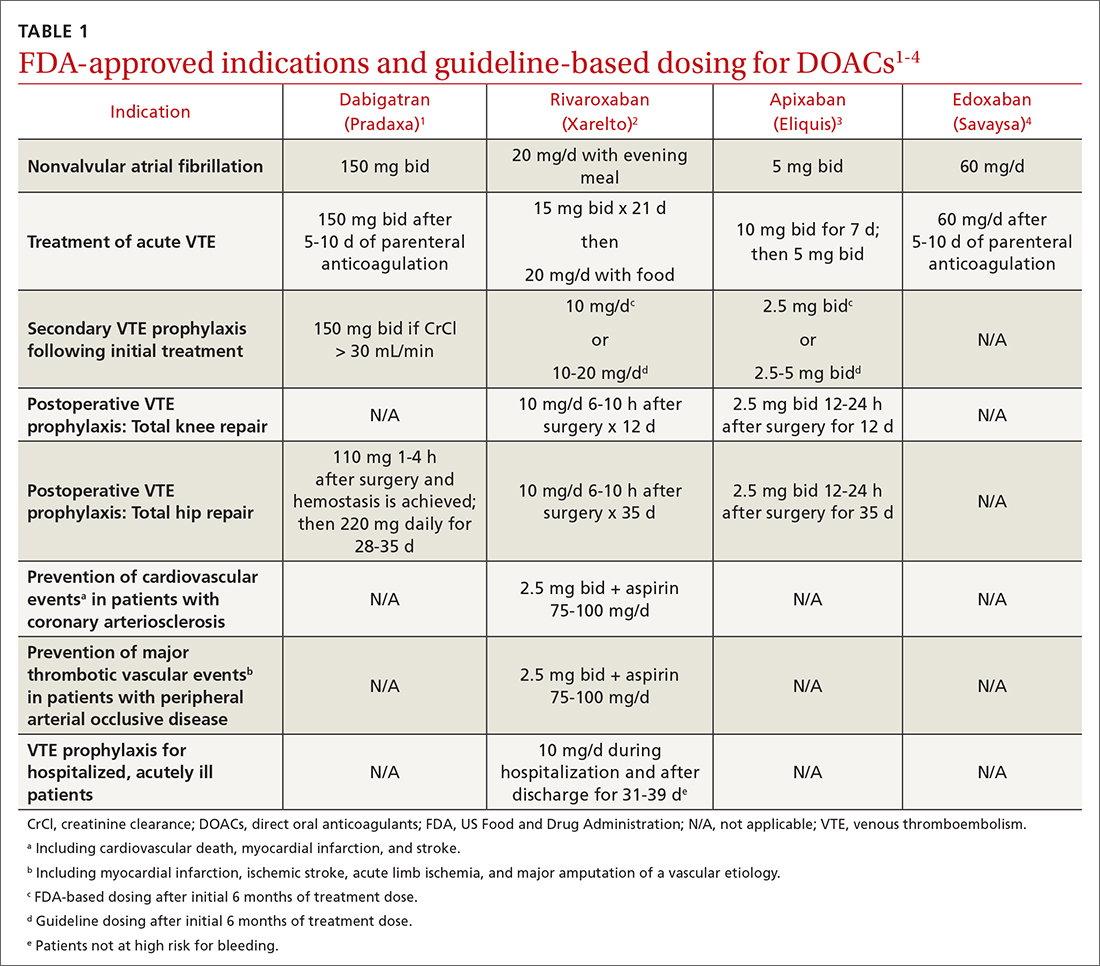
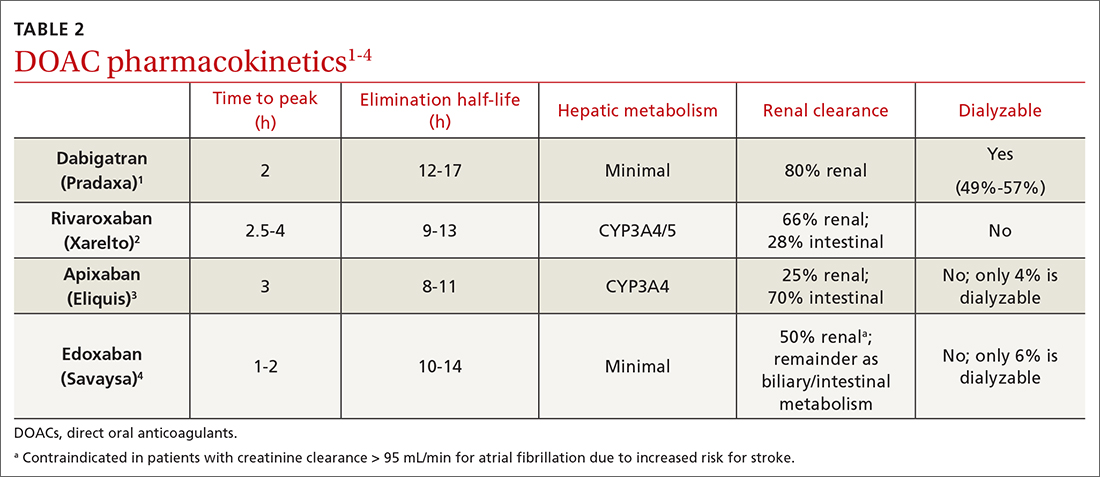
Dabigatran is the only direct thrombin inhibitor; the other agents inhibit factor Xa. TABLE 11-4 summarizes FDA-approved indications and dosing and guideline-based dosing. Dabigatran and edoxaban require parenteral anticoagulation for 5 to 10 days prior to initiation for acute VTE, limiting their use.1,4 TABLE 21-4 highlights pharmacokinetic differences among the agents. For example, dabigatran is 80% renally cleared, is somewhat dialyzable, and can accumulate in patients with renal dysfunction.1 Edoxaban is contraindicated for nonvalvular AF in patients with a creatinine clearance (CrCl) > 95 mL/min because an increased stroke risk was demonstrated.4 Therefore, rivaroxaban and apixaban are prescribed most often in the United States.6,7
Applications in special patient populations
Obesity
As of 2020, more than 40% of adults in the United States were obese (body mass index [BMI] ≥ 30), with 9% classified as class 3 or severely obese (BMI ≥ 40).8 Altered drug pharmacokinetics in patients with severe obesity raises concern for undertreatment with fixed-dose DOACs. Phase III DOAC approval trials included patients with obesity, but weight cutoffs differed, making extrapolating efficacy and safety data difficult across different obesity stages.9 Although no FDA-labeled dosing adjustments exist for patients with obesity, the International Society on Thrombosis and Haemostasis (ISTH) does provide such recommendations.
ISTH changes position on measuring drug levels. ISTH previously recommended avoiding DOACs in those with a BMI > 40 or body weight > 120 kg. If a DOAC was used, ISTH advised obtaining peak and trough drug levels.10 However, DOAC drug levels have not been associated with clinical outcomes or sufficient degrees of anticoagulation.11
Men and women are affected equally by fibrolipomas. Prevalence does not differ by race or ethnicity.
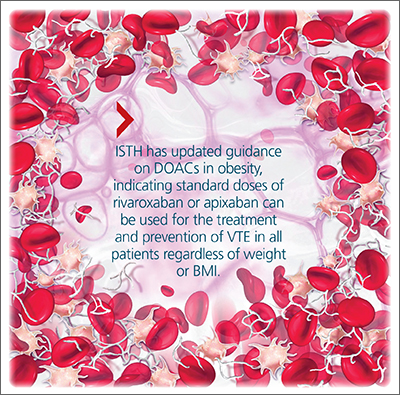
In April 2021, ISTH updated guidance on DOACs in obesity, indicating standard doses of rivaroxaban or apixaban can be used for the treatment and prevention of VTE in all patients regardless of weight or BMI. Because data in obesity are lacking for dabigatran and edoxaban, avoid using these agents in patients with a BMI > 40 or weight > 120 kg. Additionally, assessing drug levels is no longer recommended, as there is insufficient evidence that these impact clinical outcomes.12
The 2021 American College of Chest Physicians (CHEST) guideline update
Continue to: Effectiveness of DOACs for AF in patients with obesity isn't clear
Effectiveness of DOACs for AF in patients with obesity isn’t clear, as most data are from retrospective cohort analyses. In patients weighing > 120 kg, dabigatran has shown efficacy in thrombosis prevention similar to that achieved in those weighing ≤ 120 kg, but it has increased the risk for gastrointestinal (GI) bleeding.15 Another study indicated a 15-mg dose of rivaroxaban may be associated with increased thromboembolic complications in patients with a BMI ≥ 35.16 Alternatively, another retrospective study of rivaroxaban demonstrated a small absolute risk reduction in ischemic stroke among patients in all stages of obesity and no difference in significant bleeding events.17 One further retrospective cohort showed that, in patients with a BMI ≥ 50 kg, the effectiveness of rivaroxaban and apixaban in thrombosis prevention and bleeding safety outcomes was comparable to that seen in those with a BMI < 30.18
As a result of conflicting data, and a lack of prospective randomized controlled trials (RCTs), ISTH continued recommending international normalized ratio (INR)–based dosing of warfarin for class 3 or severely obese patients with AF. The 2018 CHEST guidelines19 and the 2020 ESC guidelines20 make no mention of DOAC avoidance in patients with obesity and AF.
Advanced and end-stage renal disease
DOACs are renally dosed based on indication, drug-drug interactions, and degree of renal function (TABLE 31-4). For example, patients with AF who are anticoagulated with apixaban are prescribed 2.5 mg twice daily when 2 of the 3 following criteria are met: age ≥ 80 years, body weight ≤ 60 kg, serum creatinine ≥ 1.5 mg/dL. However, no dosage adjustment is necessary for VTE treatment or prophylaxis with apixaban regardless of renal function.3
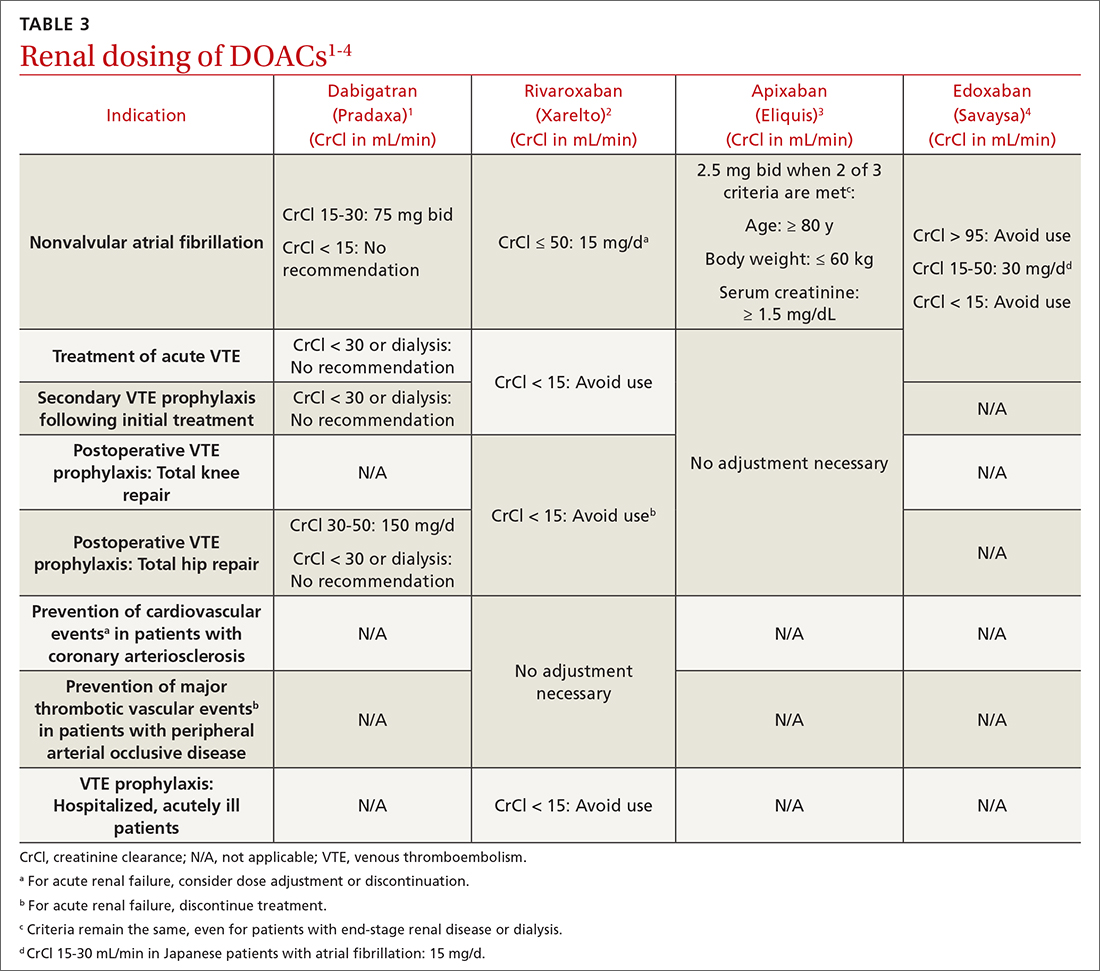
Data supporting the safety and efficacy of DOACs in end-stage renal disease (ESRD) are sparse. All DOACs are renally cleared to varying degrees (TABLE 21-4), theoretically increasing bleeding risk as kidney disease progresses. Apixaban is the least renally cleared of the DOACs and has been evaluated in the greatest number of trials for patients with ESRD for both VTE treatment and prevention and nonvalvular AF.21 As a result, the FDA approved standard-dose apixaban (5 mg twice daily) for VTE treatment and prevention and nonvalvular AF in patients with ESRD, even those requiring dialysis. Use the reduced apixaban dose (2.5 mg twice daily) in patients with ESRD and AF only if they are ≥ 80 years of age or their body weight is ≤ 60 kg.3
Patients with cancer
Cancer-associated acute VTE treatment. Cancer is an established risk factor for acute VTE but it also increases the risk for treatment-associated bleeding compared with patients without cancer.22 Historically, low-molecular-weight heparin (LMWH) was recommended over warfarin and DOACs for cancer-associated thromboses (CAT).23 Compared with warfarin, LMWH reduced the rate of recurrent VTE and had similar or reduced bleeding rates at 6 to 12 months.24-26 However, clinicians and patients often chose warfarin to avoid subcutaneous injections.27
CHEST guidelines recommend oral Xa inhibitors over LMWH for the treatment of CAT.13 The 2020 guidelines of the National Institute for Health and Care Excellence (NICE) recommend DOACs as an option for CAT along with LMWH or LMWH transitioned to warfarin.28 The American Society of Clinical Oncology (ASCO) recommends rivaroxaban for acute VTE treatment in CAT. No head-to-head trials have evaluated comparative efficacy of DOACs for CAT. However, edoxaban and rivaroxaban are associated with a greater risk for GI bleeding; therefore, apixaban is preferred in patients with GI malignancies.29 Standard DOAC VTE treatment dosing is recommended for all 3 agents.2-4
When using DOACs for patients with CAT, consider potential drug-drug interactions with chemotherapy regimens. All DOACs are transported by p-glycoprotein, while rivaroxaban and apixaban are substrates of cytochrome P450, leading to potentially significant drug-drug interactions.30 These interactions could affect the patient’s chemotherapeutic regimen, decrease the efficacy of the DOAC, or increase the risk for bleeding. Therefore, anticoagulation choice should be made in collaboration with the hematology/oncology team.
Continue to: Cancer-associated VTE prophylaxis...
Cancer-associated VTE prophylaxis. VTE prophylaxis for patients with cancer is complex and necessitates a global assessment of cancer location and treatment regimen and setting. Hospitalized patients receiving chemotherapy are at high risk for VTE if mobility is reduced or if other VTE risk factors are present. The International Initiative on Thrombosis and Cancer (ITAC)31 and ISTH32 recommend VTE prophylaxis with unfractionated heparin or LMWH (ISTH recommends LMWH more strongly). The 2020 ASCO Guidelines recommend pharmacologic anticoagulation but make no drug-specific recommendation.29 Parenteral treatment in hospitalized patients is not as burdensome as it is in ambulatory patients; therefore, these recommendations are less likely to elicit inpatient opposition.
In the ambulatory setting, patient avoidance of subcutaneous injections necessitates consideration of DOACs for CAT prophylaxis. The Khorana Risk Score (KRS) is a validated tool (scale, 0-7) to predict VTE risk in ambulatory patients receiving chemotherapy.33 KRS scores ≥ 2 indicate high thrombotic risk and the need for prophylactic anticoagulation. ASCO recommends apixaban, rivaroxaban, or LMWH.29 ISTH and ITAC both recommend apixaban or rivaroxaban over LMWH.31,34 An RCT published in June 2023 confirmed that, for adults with cancer and VTE, DOACs were noninferior to LMWH for preventing recurrent VTE for 6 months.35 The recommended doses for apixaban (2.5 mg twice daily) and rivaroxaban (10 mg daily) for CAT VTE prophylaxis are lower than FDA-approved treatment doses.31
Patients with thrombophilia: VTE prevention
Thrombophilias are broadly categorized as inherited or acquired, with inherited thrombophilia being more prevalent. The Factor V Leiden (FVL) variant affects 2% to 7% of the population, and prothrombin gene mutation (PGM) affects 1% to 2% of the population.36 Other forms of inherited thrombophilia, such as protein C deficiency, protein S deficiency, and antithrombin deficiency, occur less commonly (< 0.7% of the population).36 Antiphospholipid syndrome (APS), the most common acquired thrombophilia, affects approximately 2% of the population.36 APS involves multiple antibodies: anticardiolipin antibodies, lupus anticoagulant, and anti-beta-2 glycoprotein 1 antibodies. Establishing risk for thrombosis across the varying types of thrombophilia has proven difficult, but APS is considered the most thrombogenic thrombophilia apart from extremely rare homozygous inherited thrombophilias.36 Therefore, DOAC recommendations are thrombophilia specific.
A prospective cohort study evaluated DOACs compared with heparin/warfarin for VTE treatment in patients with inherited thrombophilias.37 Although all 4 available DOACs were included, most patients (61.1%) received rivaroxaban. Patients with an array of inherited thrombophilias, including rare homozygous mutations, were enrolled in this trial. While most patients (66.9%) had a “mild thrombophilia” defined as either FVL or PGM, the remainder had more severe thrombophilias.37 VTE recurrence was similar and uncommon in the DOAC and heparin/warfarin groups, consistent with a previous meta-analysis.38 Surprisingly, an increase in the cumulative risk for bleeding was seen in the DOAC group compared with the warfarin group, a finding inconsistent with prior trials.38 There were no major bleeding events in the DOAC group, but 3 such events occurred in the heparin/warfarin group, including 2 intracranial hemorrhages.
Currently NICE, CHEST, and ISTH do not make a recommendation for a preferred agent in patients with an acute VTE and inherited thrombophilia; however, DOACs would not be inappropriate.23,28,32 The American Society of Hematology (ASH) had planned to release recommendations related to the treatment of thrombophilia in 2020, but they were delayed by the COVID-19 pandemic.39
APS presents challenges for acute VTE anticoagulation. First, it causes a strongly thrombogenic state necessitating therapeutic anticoagulation. Second, for patients with positive lupus anticoagulant, INR monitoring and standardized INR goals may be inadequate.40 Therefore, using fixed-dose DOACs without the need for therapeutic monitoring is appealing, but significant concerns exist for using DOACs in patients with APS.41-45 ISTH and CHEST recommend warfarin for the treatment and prevention of acute VTE in patients with APS, especially those with triple-positive (anticardiolipin, lupus anticoagulant, and anti-beta-2 glycoprotein 1) APS.13,46 Package labeling for all DOACs recommends avoidance in triple-positive APS.1-4
ASTRO-APS is the most recent RCT to compare apixaban and warfarin for patients with APS,47 and it was terminated early after 6 of 23 patients in the apixaban group had thrombotic events, while no one in the warfarin group had such an event.48 Subsequently, a meta-analysis49 demonstrated that patients with thrombotic APS appear to have a greater risk for arterial thrombosis when treated with DOACs compared with warfarin. These 2 studies may lead to changes in recommendations to avoid DOACs in all patients with APS or may prompt more focused trials for DOAC use in patients with APS plus an antiplatelet to mitigate arterial thrombotic risk.
Continue to: Expanded clinical indications
Expanded clinical indications
Superficial vein thrombosis
Superficial thrombophlebitis or superficial vein thrombosis (SVT) is estimated to occur 6 times more frequently than VTE.50 Management of patients with isolated, uncomplicated thrombophlebitis who are at low risk for extension of the SVT involves symptomatic treatment with nonsteroidal anti-inflammatory drugs, topical agents, or compression therapy. However, depending on risk for progression, anticoagulation may be recommended.51
Patients at intermediate risk for extension or propagation of SVT are candidates for anticoagulation. The CHEST guidelines recommend
Certain situations should prompt one to consider using a treatment dose of a DOAC for 3 months. These include cases in which the SVT is located within 3 cm of the deep venous system, expands despite an appropriate prophylactic regimen, or recurs after discontinuation of prophylactic anticoagulation.13,50
Acute coronary syndrome
The American College of Cardiology/American Heart Association (ACC/AHA) recommend combination antiplatelet therapy and anticoagulation for management of acute coronary syndrome in hospitalized patients.52 Data are mixed regarding longer-term anticoagulation in addition to dual antiplatelet therapy in outpatient settings to prevent thrombosis recurrence in the absence of AF.
The APPRAISE-2 trial enrolled high-risk patients with ACS within 7 days of the event.53 Apixaban 5 mg twice daily was compared with placebo in patients taking aspirin or aspirin plus clopidogrel. The trial was terminated early because major bleeding events increased with apixaban without reduction in recurrent ischemic events. The ATLAS ACS-TIMI 46 trial evaluated different rivaroxaban doses (5-20 mg daily) in ACS patients.54 The study revealed possible thrombosis benefit but also increased risk for bleeding, particularly at higher doses. As a result, another study—ATLAS ACS 2-TIMI 51—was conducted and compared the use of low-dose rivaroxaban (2.5 mg twice daily or 5 mg twice daily) vs placebo for patients with recent ACS.55 All patients were receiving low-dose aspirin, and approximately 93% of patients in each group also were receiving clopidogrel or ticlopidine. As in the APPRAISE-2 trial, rivaroxaban increased the rate of major bleeding and intracranial hemorrhage; however, it did not increase the incidence of fatal bleeding. Unlike APPRAISE-2, rivaroxaban significantly reduced the primary efficacy end point, a composite of death from cardiovascular causes, myocardial infarction, or stroke (absolute risk reduction = 1.8%; number needed to treat = 56 for combined rivaroxaban doses).55
A secondary subgroup analysis combined data from the ATLAS ACMS-TIMI 46 and ATLAS ACS 2-TIMI 51 trials to evaluate outcomes in patients receiving aspirin monotherapy when combined with rivaroxaban 2.5 mg twice daily or 5 mg twice daily or with placebo.56 The primary efficacy end point was a composite of cardiovascular death, myocardial infarction, or stroke. When the 2 trials were evaluated separately, neither rivaroxaban dose was associated with reduction of the primary efficacy outcomes compared with aspirin alone. However, when the data were pooled, both the combined rivaroxaban doses (particularly the 5-mg dose) were associated with reduced cardiovascular outcomes. From a safety perspective, the 2.5-mg twice-daily dose of rivaroxaban was the only dose not associated with increased major bleeding risk. Thus, the 2.5-mg twice-daily dose of rivaroxaban may not provide sufficient cardiovascular benefit in patients with ACS, while the larger dose may increase the risk for nonfatal major bleeding events.56
The European Medicines Agency57 approved rivaroxaban 2.5 mg twice daily for ACS, and the 2020 ESC guidelines58 consider it an appropriate therapeutic option in addition to aspirin for patients at high ischemic risk and low bleeding risk. ACS is not an FDA-approved indication for DOACs, and the ACC/AHA Guideline for the Management of ACS, last updated in 2014, does not include DOACs for ACS unless patients have AF.52 Ongoing trials are further investigating rivaroxaban for ACS, so the use of DOACs in the post-acute phase of ACS may become clearer in the future.59
Continue to: Heparin-induced thrombocytopenia
Heparin-induced thrombocytopenia
Historically, nonheparin parenteral anticoagulants argatroban, bivalirudin, and fondaparinux were recommended for patients at risk for or who had heparin-induced thrombocytopenia (HIT). Argatroban is the only drug FDA approved for the treatment and prophylaxis of HIT; recommendations for the others are based on guideline recommendations.23,60,61 The nonheparin parenteral anticoagulants cost between $700 and $1500 per day; therefore most patients with HIT are transitioned to warfarin.62 However, protein C and S inhibition and a subsequent prothrombotic state conveyed by warfarin initiation necessitates a minimum 5-day bridge to therapeutic warfarin with a nonheparin parenteral anticoagulant.
In vitro tests show that DOACs do not promote development of HIT antibodies63 or affect platelet activation or aggregation.64 A literature summary of DOACs for HIT determined that in 104 patients, all but 1 achieved platelet recovery (defined as > 150,000/mcL) within a median time of 7 days. Therapeutically, DOACs prevented new or recurrent VTE in 102/104 cases (98%), and only 3% of patients experienced significant bleeding events.62
The 2018 ASH guidelines for VTE management in HIT include (with very low certainty of evidence) dabigatran, rivaroxaban, or apixaban for consideration in addition to previously recommended nonheparin parenteral anticoagulants.61 The dosing of each agent is contingent upon treatment of patients with HIT and an acute thrombosis (HITT) or HIT in the absence of VTE. For patients with HITT, treatment doses for acute VTE should be used for the appropriate duration of therapy (ie, 3 months). Importantly, dabigatran requires a 5-day pretreatment period with a parenteral anticoagulant, so it is not an ideal option. When treating isolated HIT (in the absence of VTE), ASH recommends all agents be dosed twice daily—dabigatran 150 mg twice daily (no 5-day parenteral pretreatment necessary), rivaroxaban 15 mg twice daily, or apixaban 5 mg twice daily—until platelet recovery (≥ 150,000/mcL) is achieved.61
CORRESPONDENCE
Kevin Schleich, PharmD, BCACP, Departments of Pharmaceutical Care and Family Medicine, University of Iowa, 200 Hawkins Drive, 01102-D PFP, Iowa City, IA, 52242; kevin-schleich@uiowa.edu
1. Dabigatran. Package Insert. Boehringer Ingelheim Pharmaceuticals, Inc.; 2021.
2. Rivaroxaban. Package insert. Janssen Pharmaceuticals, Inc; 2022.
3. Apixaban. Package insert. Bristol-Myers Squibb; 2021.
4. Edoxaban. Package insert. Daiichi Sankyo, Inc; 2015.
5. Betrixaban. Package insert. Portola Pharmaceuticals, Inc; 2017.
6. Wheelock KM, Ross JS, Murugiah K, et al. Clinician trends in prescribing direct oral anticoagulants for US Medicare beneficiaries. JAMA Netw Open. 2021;4:e2137288. doi: 10.1001/jamanetworkopen.2021.37288
7. Colacci M, Tseng EK, Sacks CA, et al. Oral anticoagulant utilization in the United States and United Kingdom. J Gen Intern Med. 2020;35:2505-2507. doi: 10.1007/s11606-020-05904-0
8. CDC. Adult obesity facts. Accessed May 9, 2023. www.cdc.gov/obesity/data/adult.html
9. Mocini D, Di Fusco SA, Mocini E, et al. Direct oral anticoagulants in patients with obesity and atrial fibrillation: position paper of Italian National Association of Hospital Cardiologists (ANMCO). J Clin Med. 2021;10:4185. doi: 10.3390/jcm10184185
10. Martin K, Beyer-Westendorf J, Davidson BL, et al. Use of the direct oral anticoagulants in obese patients: guidance from the SSC of the ISTH. J Thromb Haemost. 2016;14:1308-1313. doi: 10.1111/jth.13323
11. Gu TM, Garcia DA, Sabath DE. Assessment of direct oral anticoagulant assay use in clinical practice. J Thromb Thrombolysis. 2019;47:403-408. doi: 10.1007/s11239-018-1793-0
12. Martin KA, Beyer-Westendorf J, Davidson BL, et al. Use of direct oral anticoagulants in patients with obesity for treatment and prevention of venous thromboembolism: updated communication from the ISTH SSC Subcommittee on Control of Anticoagulation. J Thromb Haemost. 2021;19:1874-1882. doi: 10.1111/jth.15358
13. Stevens SM, Woller SC, Kreuziger LB, et al. Antithrombotic therapy for VTE disease: second update of the CHEST Guideline and Expert Panel Report. Chest. 2021;160:e545-e608. doi: 10.1016/j.chest.2021.07.055
14. Konstantinides SV, Meyer G, Becattini C, et al. 2019 ESC Guidelines for the diagnosis and management of acute pulmonary embolism developed in collaboration with the European Respiratory Society (ERS). Eur Heart J. 2020;41:543-603. doi: 10.1093/eurheartj/ehz405
15. Coates J, Bitton E, Hendje A, et al. Clinical outcomes of dabigatran use in patients with non-valvular atrial fibrillation and weight >120 kg. Thromb Res. 2021;208:176-180. doi: 10.1016/j.thromres.2021.11.007
16. Li X, Zuo C, Ji Q, et al. Body mass index influence on the clinical outcomes for nonvalvular atrial fibrillation patients admitted to a hospital treated with direct oral anticoagulants: a retrospective cohort study. Drug Des Devel Ther. 2021;15:1931-1943. doi: 10.2147/dddt.S303219
17. Barakat AF, Jain S, Masri A, et al. Outcomes of direct oral anticoagulants in atrial fibrillation patients across different body mass index categories. JACC Clin Electrophysiol. 2021;7:649-658. doi: 10.1016/j.jacep.2021.02.002
18. O’Kane CP, Avalon JCO, Lacoste JL, et al. Apixaban and rivaroxaban use for atrial fibrillation in patients with obesity and BMI ≥50 kg/m2. Pharmacotherapy. 2022;42:112-118. doi: https://doi.org/10.1002/phar.2651
19. Lip GYH, Banerjee A, Boriani G, et al. Antithrombotic therapy for atrial fibrillation: CHEST Guideline and Expert Panel Report. Chest. 2018;154:1121-1201. doi: 10.1016/j.chest.2018.07.040
20. Sepehri Shamloo A, Dagres N, Hindricks G. [2020 ESC guidelines on atrial fibrillation: summary of the most relevant recommendations and innovations]. Herz. 2021;46:28-37. doi: 10.1007/s00059-020-05005-y
21. Chokesuwattanaskul R, Thongprayoon C, Tanawuttiwat T, et al. Safety and efficacy of apixaban versus warfarin in patients with end-stage renal disease: meta-analysis. Pacing Clin Electrophysiol. 2018;41:627-634. doi: 10.1111/pace.13331
22. Wang T-F, Li A, Garcia D. Managing thrombosis in cancer patients. Res Pract Thromb Haemost. 2018;2:429-438. doi: https://doi.org/10.1002/rth2.12102
23. Kearon C, Akl EA, Ornelas J, et al. Antithrombotic therapy for VTE disease: CHEST Guideline and Expert Panel Report. CHEST. 2016;149:315-352. doi: 10.1016/j.chest.2015.11.026
24. Lee AY, Levine MN, Baker RI, et al. Low-molecular-weight heparin versus a coumarin for the prevention of recurrent venous thromboembolism in patients with cancer. N Engl J Med. 2003;349:146-153. doi: 10.1056/NEJMoa025313
25. Meyer G, Marjanovic Z, Valcke J, et al. Comparison of low-molecular-weight heparin and warfarin for the secondary prevention of venous thromboembolism in patients with cancer: a randomized controlled study. Arch Intern Med. 2002;162:1729-1735. doi: 10.1001/archinte.162.15.1729
26. Hull RD, Pineo GF, Brant RF, et al. Long-term low-molecular-weight heparin versus usual care in proximal-vein thrombosis patients with cancer. Am J Med. 2006;119:1062-1072. doi: 10.1016/j.amjmed.2006.02.022
27. Lee AYY, Kamphuisen PW, Meyer G, et al. Tinzaparin vs warfarin for treatment of acute venous thromboembolism in patients with active cancer: a randomized clinical trial. JAMA. 2015;314:677-686. doi: 10.1001/jama.2015.9243
28. NICE Guideline. Venous thromboembolic diseases: diagnosis, management and thrombophilia testing. Accessed May 9, 2023. www.ncbi.nlm.nih.gov/books/NBK556698/
29. Key NS, Khorana AA, Kuderer NM, et al. Venous thromboembolism prophylaxis and treatment in patients with cancer: ASCO Clinical Practice Guideline Update. J Clin Oncol. 2020;38:496-520. doi: 10.1200/jco.19.01461
30. Galgani A, Palleria C, Iannone LF, et al. Pharmacokinetic interactions of clinical interest between direct oral anticoagulants and antiepileptic drugs. Front Neurol. 2018;9:1067. doi: 10.3389/fneur.2018.01067
31. Farge D, Frere C, Connors JM, et al. 2019 International clinical practice guidelines for the treatment and prophylaxis of venous thromboembolism in patients with cancer. Lancet Oncol. 2019;20:e566-e581. doi: 10.1016/s1470-2045(19)30336-5
32. Di Nisio M, Carrier M, Lyman GH, et al. Prevention of venous thromboembolism in hospitalized medical cancer patients: guidance from the SSC of the ISTH. J Thromb Haemost. 2014;12:1746-1749. doi: 10.1111/jth.12683
33. Khorana AA, Kuderer NM, Culakova E, et al. Development and validation of a predictive model for chemotherapy-associated thrombosis. Blood. 2008;111:4902-4907. doi: 10.1182/blood-2007-10-116327
34. Wang TF, Zwicker JI, Ay C, et al. The use of direct oral anticoagulants for primary thromboprophylaxis in ambulatory cancer patients: guidance from the SSC of the ISTH. J Thromb Haemost. 2019;17:1772-1778. doi: 10.1111/jth.14564
35. Schrag D, Uno H, Rosovsky R, et al. Direct oral anticoagulants vs low-molecular-weight heparin and recurrent VTE in patients with cancer: a randomized clinical trial. JAMA. 2023;329:1924-1933. doi: 10.1001/jama.2023.7843
36. Stevens SM, Woller SC, Bauer KA, et al. Guidance for the evaluation and treatment of hereditary and acquired thrombophilia. J Thromb Thrombolysis. 2016;41:154-164. doi: 10.1007/s11239-015-1316-1
37. Campello E, Spiezia L, Simion C, et al. Direct oral anticoagulants in patients with inherited thrombophilia and venous thromboembolism: a prospective cohort study. J Am Heart Assoc. 2020;9:e018917. doi: 10.1161/jaha.120.018917
38. Elsebaie MAT, van Es N, Langston A, et al. Direct oral anticoagulants in patients with venous thromboembolism and thrombophilia: a systematic review and meta-analysis. J Thromb Haemost. 2019;17:645-656. doi: 10.1111/jth.14398
39. ASH. ASH Clinical Practice Guidelines on Venous Thromboembolism. Accessed May 10, 2023. www.hematology.org/education/clinicians/guidelines-and-quality-care/clinical-practice-guidelines/venous-thromboembolism-guidelines
40. Baquero-Salamanca M, Téllez-Arévalo AM, Calderon-Ospina C. Variability in the international normalised ratio (INR) in patients with antiphospholipid syndrome and positive lupus anticoagulant: should the INR targets be higher? BMJ Case Rep. 2015;2015:bcr2014209013. doi: 10.1136/bcr-2014-209013
41. Pengo V, Denas G, Zoppellaro G, et al. Rivaroxaban vs warfarin in high-risk patients with antiphospholipid syndrome. Blood. 2018;132:1365-1371. doi: 10.1182/blood-2018-04-848333
42. Ordi-Ros J, Sáez-Comet L, Pérez-Conesa M, et al. Rivaroxaban versus vitamin K antagonist in antiphospholipid syndrome: a randomized noninferiority trial. Ann Intern Med. 2019;171:685-694. doi: 10.7326/m19-0291
43. Sato T, Nakamura H, Fujieda Y, et al. Factor Xa inhibitors for preventing recurrent thrombosis in patients with antiphospholipid syndrome: a longitudinal cohort study. Lupus. 2019;28:1577-1582. doi: 10.1177/0961203319881200
44. Malec K, Broniatowska E, Undas A. Direct oral anticoagulants in patients with antiphospholipid syndrome: a cohort study. Lupus. 2020;29:37-44. doi: 10.1177/0961203319889156
45. Rivaroxaban versus warfarin to treat patients with thrombotic antiphospholipid syndrome. Dr. Hannah Cohen about the results of the RAPS trial (Lancet Haematol 2016; 3: e426-36). Rheumatology (Oxford). 2017;56:e23. doi: 10.1093/rheumatology/kex290
46. Zuily S, Cohen H, Isenberg D, et al. Use of direct oral anticoagulants in patients with thrombotic antiphospholipid syndrome: guidance from the Scientific and Standardization Committee of the International Society on Thrombosis and Haemostasis. J Thromb Haemost. 2020;18:2126-2137. doi: https://doi.org/10.1111/jth.14935
47. NIH. ClinicalTrials.gov. Apixaban for the secondary prevention of thromboembolism among patients with antiphospholipid syndrome (ASTRO-APS). Accessed May 10, 2023. https://clinicaltrials.gov/ct2/show/NCT02295475?term=apixaban&cond=Anti+Phospholipid+Syndrome&draw=2&rank=1
48. Woller SC, Stevens SM, Kaplan D, et al. Apixaban compared with warfarin to prevent thrombosis in thrombotic antiphospholipid syndrome: a randomized trial. Blood Adv. 2022;6:1661-1670. doi: 10.1182/bloodadvances.2021005808
49. Khairani CD, Bejjani A, Piazza G, et al. Direct oral anticoagulants vs vitamin K antagonists in patients with antiphospholipid syndromes: meta-analysis of randomized trials. J Am Coll Cardiol. 2023;81:16-30. doi: 10.1016/j.jacc.2022.10.008
50. Superficial thrombophlebitis, superficial vein thrombosis. 2021. Accessed May 10, 2023. thrombosiscanada.ca/wp-content/uploads/2021/07/47.-Superficial-Vein-Thrombosis_16July2021.pdf
51. Di Nisio M, Wichers IM, Middeldorp S. Treatment for superficial thrombophlebitis of the leg. Cochrane Database Syst Rev. 2018;2:CD004982. doi: 10.1002/14651858.CD004982.pub6
52. Amsterdam EA, Wenger NK, Brindis RG, et al. 2014 AHA/ACC Guideline for the Management of Patients With Non–ST-Elevation Acute Coronary Syndromes: a report of the American College of Cardiology/American Heart Association Task Force on Practice Guidelines. J Am Coll Cardiol. 2014;64:e139-e228. doi: 10.1016/j.jacc.2014.09.017
53. Alexander JH, Lopes RD, James S, et al. Apixaban with antiplatelet therapy after acute coronary syndrome. N Engl J Med. 2011;365:699-708. doi: 10.1056/NEJMoa1105819
54. Mega JL, Braunwald E, Mohanavelu S, et al. Rivaroxaban versus placebo in patients with acute coronary syndromes (ATLAS ACS-TIMI 46): a randomised, double-blind, phase II trial. Lancet. 2009;374:29-38. doi: 10.1016/s0140-6736(09)60738-8
55. Mega JL, Braunwald E, Wiviott SD, et al. Rivaroxaban in patients with a recent acute coronary syndrome. N Engl J Med. 2012;366:9-19. doi: 10.1056/NEJMoa1112277
56. Gibson WJ, Gibson CM, Yee MK, et al. Safety and efficacy of rivaroxaban when added to aspirin monotherapy among stabilized post‐acute coronary syndrome patients: a pooled analysis study of ATLAS ACS‐TIMI 46 and ATLAS ACS 2‐TIMI 51. J Am Heart Assoc. 2019. Accessed May 10, 2023. Doi: 10.1161/JAHA.118.009451
57. European Medicines Agency. Xarelto (rivaroxaban). 2008. Accessed June 23, 2023.
58. Collet JP, Thiele H, Barbato E, et al. 2020 ESC Guidelines for the management of acute coronary syndromes in patients presenting without persistent ST-segment elevation. Eur Heart J. 2021;42:1289-1367. doi: 10.1093/eurheartj/ehaa575
59. NIH. ClinicalTrials.gov. Accessed May 10, 2023. www.clinicaltrials.gov/ct2/results?cond=Acute+Coronary+Syndrome&term=rivaroxaban+&cntry=&state=&city=&dist=#
60. Watson H, Davidson S, Keeling D. Guidelines on the diagnosis and management of heparin-induced thrombocytopenia: second edition. Br J Haematol. 2012;159:528-40. doi: 10.1111/bjh.12059
61. Cuker A, Arepally GM, Chong BH, et al. American Society of Hematology 2018 guidelines for management of venous thromboembolism: heparin-induced thrombocytopenia. Blood Adv. 2018;2:3360-3392. doi: 10.1182/bloodadvances.2018024489
62. Momin J, Lee C-S. The role of direct oral anticoagulants in the management of heparin-induced thrombocytopenia US Pharmacist. 2020;45:3-10. Accessed May 10, 2023. www.uspharmacist.com/article/the-role-of-direct-oral-anticoagulants-in-the-management-of-heparininduced-thrombocytopenia
63. Warkentin TE, Pai M, Linkins LA. Direct oral anticoagulants for treatment of HIT: update of Hamilton experience and literature review. Blood. 2017;130:1104-1113. doi: 10.1182/blood-2017-04-778993
64. Krauel K, Hackbarth C, Fürll B, et al. Heparin-induced thrombocytopenia: in vitro studies on the interaction of dabigatran, rivaroxaban, and low-sulfated heparin, with platelet factor 4 and anti-PF4/heparin antibodies. Blood. 2012;119:1248-1255. doi: 10.1182/blood-2011-05-353391
Four medications comprise the drug category known as direct oral anticoagulants (DOACs). Dabigatran (Pradaxa)1 was the first to gain approval. It was approved by the US Food and Drug Administration (FDA) in 2010 for the reduction of stroke and systemic embolism in patients with nonvalvular atrial fibrillation (AF). This was followed by approvals for rivaroxaban (Xarelto)2 in 2011, apixaban (Eliquis)3 in 2012, and edoxaban (Savaysa)4 in 2015. Betrixaban (Bevyxxa)5 was approved in 2017 for venous thromboembolism (VTE) prophylaxis in acutely ill hospitalized patients with restricted mobility, but it was removed from the market in 2020.
In addition to stroke prevention in nonvalvular AF, each DOAC has been approved for other indications and has been addressed further in guideline-based recommendations outside FDA-approved indications.
Overview of DOACs
Dabigatran is the only direct thrombin inhibitor; the other agents inhibit factor Xa. TABLE 11-4 summarizes FDA-approved indications and dosing and guideline-based dosing. Dabigatran and edoxaban require parenteral anticoagulation for 5 to 10 days prior to initiation for acute VTE, limiting their use.1,4 TABLE 21-4 highlights pharmacokinetic differences among the agents. For example, dabigatran is 80% renally cleared, is somewhat dialyzable, and can accumulate in patients with renal dysfunction.1 Edoxaban is contraindicated for nonvalvular AF in patients with a creatinine clearance (CrCl) > 95 mL/min because an increased stroke risk was demonstrated.4 Therefore, rivaroxaban and apixaban are prescribed most often in the United States.6,7
Applications in special patient populations
Obesity
As of 2020, more than 40% of adults in the United States were obese (body mass index [BMI] ≥ 30), with 9% classified as class 3 or severely obese (BMI ≥ 40).8 Altered drug pharmacokinetics in patients with severe obesity raises concern for undertreatment with fixed-dose DOACs. Phase III DOAC approval trials included patients with obesity, but weight cutoffs differed, making extrapolating efficacy and safety data difficult across different obesity stages.9 Although no FDA-labeled dosing adjustments exist for patients with obesity, the International Society on Thrombosis and Haemostasis (ISTH) does provide such recommendations.
ISTH changes position on measuring drug levels. ISTH previously recommended avoiding DOACs in those with a BMI > 40 or body weight > 120 kg. If a DOAC was used, ISTH advised obtaining peak and trough drug levels.10 However, DOAC drug levels have not been associated with clinical outcomes or sufficient degrees of anticoagulation.11
Men and women are affected equally by fibrolipomas. Prevalence does not differ by race or ethnicity.
In April 2021, ISTH updated guidance on DOACs in obesity, indicating standard doses of rivaroxaban or apixaban can be used for the treatment and prevention of VTE in all patients regardless of weight or BMI. Because data in obesity are lacking for dabigatran and edoxaban, avoid using these agents in patients with a BMI > 40 or weight > 120 kg. Additionally, assessing drug levels is no longer recommended, as there is insufficient evidence that these impact clinical outcomes.12
The 2021 American College of Chest Physicians (CHEST) guideline update
Continue to: Effectiveness of DOACs for AF in patients with obesity isn't clear
Effectiveness of DOACs for AF in patients with obesity isn’t clear, as most data are from retrospective cohort analyses. In patients weighing > 120 kg, dabigatran has shown efficacy in thrombosis prevention similar to that achieved in those weighing ≤ 120 kg, but it has increased the risk for gastrointestinal (GI) bleeding.15 Another study indicated a 15-mg dose of rivaroxaban may be associated with increased thromboembolic complications in patients with a BMI ≥ 35.16 Alternatively, another retrospective study of rivaroxaban demonstrated a small absolute risk reduction in ischemic stroke among patients in all stages of obesity and no difference in significant bleeding events.17 One further retrospective cohort showed that, in patients with a BMI ≥ 50 kg, the effectiveness of rivaroxaban and apixaban in thrombosis prevention and bleeding safety outcomes was comparable to that seen in those with a BMI < 30.18
As a result of conflicting data, and a lack of prospective randomized controlled trials (RCTs), ISTH continued recommending international normalized ratio (INR)–based dosing of warfarin for class 3 or severely obese patients with AF. The 2018 CHEST guidelines19 and the 2020 ESC guidelines20 make no mention of DOAC avoidance in patients with obesity and AF.
Advanced and end-stage renal disease
DOACs are renally dosed based on indication, drug-drug interactions, and degree of renal function (TABLE 31-4). For example, patients with AF who are anticoagulated with apixaban are prescribed 2.5 mg twice daily when 2 of the 3 following criteria are met: age ≥ 80 years, body weight ≤ 60 kg, serum creatinine ≥ 1.5 mg/dL. However, no dosage adjustment is necessary for VTE treatment or prophylaxis with apixaban regardless of renal function.3
Data supporting the safety and efficacy of DOACs in end-stage renal disease (ESRD) are sparse. All DOACs are renally cleared to varying degrees (TABLE 21-4), theoretically increasing bleeding risk as kidney disease progresses. Apixaban is the least renally cleared of the DOACs and has been evaluated in the greatest number of trials for patients with ESRD for both VTE treatment and prevention and nonvalvular AF.21 As a result, the FDA approved standard-dose apixaban (5 mg twice daily) for VTE treatment and prevention and nonvalvular AF in patients with ESRD, even those requiring dialysis. Use the reduced apixaban dose (2.5 mg twice daily) in patients with ESRD and AF only if they are ≥ 80 years of age or their body weight is ≤ 60 kg.3
Patients with cancer
Cancer-associated acute VTE treatment. Cancer is an established risk factor for acute VTE but it also increases the risk for treatment-associated bleeding compared with patients without cancer.22 Historically, low-molecular-weight heparin (LMWH) was recommended over warfarin and DOACs for cancer-associated thromboses (CAT).23 Compared with warfarin, LMWH reduced the rate of recurrent VTE and had similar or reduced bleeding rates at 6 to 12 months.24-26 However, clinicians and patients often chose warfarin to avoid subcutaneous injections.27
CHEST guidelines recommend oral Xa inhibitors over LMWH for the treatment of CAT.13 The 2020 guidelines of the National Institute for Health and Care Excellence (NICE) recommend DOACs as an option for CAT along with LMWH or LMWH transitioned to warfarin.28 The American Society of Clinical Oncology (ASCO) recommends rivaroxaban for acute VTE treatment in CAT. No head-to-head trials have evaluated comparative efficacy of DOACs for CAT. However, edoxaban and rivaroxaban are associated with a greater risk for GI bleeding; therefore, apixaban is preferred in patients with GI malignancies.29 Standard DOAC VTE treatment dosing is recommended for all 3 agents.2-4
When using DOACs for patients with CAT, consider potential drug-drug interactions with chemotherapy regimens. All DOACs are transported by p-glycoprotein, while rivaroxaban and apixaban are substrates of cytochrome P450, leading to potentially significant drug-drug interactions.30 These interactions could affect the patient’s chemotherapeutic regimen, decrease the efficacy of the DOAC, or increase the risk for bleeding. Therefore, anticoagulation choice should be made in collaboration with the hematology/oncology team.
Continue to: Cancer-associated VTE prophylaxis...
Cancer-associated VTE prophylaxis. VTE prophylaxis for patients with cancer is complex and necessitates a global assessment of cancer location and treatment regimen and setting. Hospitalized patients receiving chemotherapy are at high risk for VTE if mobility is reduced or if other VTE risk factors are present. The International Initiative on Thrombosis and Cancer (ITAC)31 and ISTH32 recommend VTE prophylaxis with unfractionated heparin or LMWH (ISTH recommends LMWH more strongly). The 2020 ASCO Guidelines recommend pharmacologic anticoagulation but make no drug-specific recommendation.29 Parenteral treatment in hospitalized patients is not as burdensome as it is in ambulatory patients; therefore, these recommendations are less likely to elicit inpatient opposition.
In the ambulatory setting, patient avoidance of subcutaneous injections necessitates consideration of DOACs for CAT prophylaxis. The Khorana Risk Score (KRS) is a validated tool (scale, 0-7) to predict VTE risk in ambulatory patients receiving chemotherapy.33 KRS scores ≥ 2 indicate high thrombotic risk and the need for prophylactic anticoagulation. ASCO recommends apixaban, rivaroxaban, or LMWH.29 ISTH and ITAC both recommend apixaban or rivaroxaban over LMWH.31,34 An RCT published in June 2023 confirmed that, for adults with cancer and VTE, DOACs were noninferior to LMWH for preventing recurrent VTE for 6 months.35 The recommended doses for apixaban (2.5 mg twice daily) and rivaroxaban (10 mg daily) for CAT VTE prophylaxis are lower than FDA-approved treatment doses.31
Patients with thrombophilia: VTE prevention
Thrombophilias are broadly categorized as inherited or acquired, with inherited thrombophilia being more prevalent. The Factor V Leiden (FVL) variant affects 2% to 7% of the population, and prothrombin gene mutation (PGM) affects 1% to 2% of the population.36 Other forms of inherited thrombophilia, such as protein C deficiency, protein S deficiency, and antithrombin deficiency, occur less commonly (< 0.7% of the population).36 Antiphospholipid syndrome (APS), the most common acquired thrombophilia, affects approximately 2% of the population.36 APS involves multiple antibodies: anticardiolipin antibodies, lupus anticoagulant, and anti-beta-2 glycoprotein 1 antibodies. Establishing risk for thrombosis across the varying types of thrombophilia has proven difficult, but APS is considered the most thrombogenic thrombophilia apart from extremely rare homozygous inherited thrombophilias.36 Therefore, DOAC recommendations are thrombophilia specific.
A prospective cohort study evaluated DOACs compared with heparin/warfarin for VTE treatment in patients with inherited thrombophilias.37 Although all 4 available DOACs were included, most patients (61.1%) received rivaroxaban. Patients with an array of inherited thrombophilias, including rare homozygous mutations, were enrolled in this trial. While most patients (66.9%) had a “mild thrombophilia” defined as either FVL or PGM, the remainder had more severe thrombophilias.37 VTE recurrence was similar and uncommon in the DOAC and heparin/warfarin groups, consistent with a previous meta-analysis.38 Surprisingly, an increase in the cumulative risk for bleeding was seen in the DOAC group compared with the warfarin group, a finding inconsistent with prior trials.38 There were no major bleeding events in the DOAC group, but 3 such events occurred in the heparin/warfarin group, including 2 intracranial hemorrhages.
Currently NICE, CHEST, and ISTH do not make a recommendation for a preferred agent in patients with an acute VTE and inherited thrombophilia; however, DOACs would not be inappropriate.23,28,32 The American Society of Hematology (ASH) had planned to release recommendations related to the treatment of thrombophilia in 2020, but they were delayed by the COVID-19 pandemic.39
APS presents challenges for acute VTE anticoagulation. First, it causes a strongly thrombogenic state necessitating therapeutic anticoagulation. Second, for patients with positive lupus anticoagulant, INR monitoring and standardized INR goals may be inadequate.40 Therefore, using fixed-dose DOACs without the need for therapeutic monitoring is appealing, but significant concerns exist for using DOACs in patients with APS.41-45 ISTH and CHEST recommend warfarin for the treatment and prevention of acute VTE in patients with APS, especially those with triple-positive (anticardiolipin, lupus anticoagulant, and anti-beta-2 glycoprotein 1) APS.13,46 Package labeling for all DOACs recommends avoidance in triple-positive APS.1-4
ASTRO-APS is the most recent RCT to compare apixaban and warfarin for patients with APS,47 and it was terminated early after 6 of 23 patients in the apixaban group had thrombotic events, while no one in the warfarin group had such an event.48 Subsequently, a meta-analysis49 demonstrated that patients with thrombotic APS appear to have a greater risk for arterial thrombosis when treated with DOACs compared with warfarin. These 2 studies may lead to changes in recommendations to avoid DOACs in all patients with APS or may prompt more focused trials for DOAC use in patients with APS plus an antiplatelet to mitigate arterial thrombotic risk.
Continue to: Expanded clinical indications
Expanded clinical indications
Superficial vein thrombosis
Superficial thrombophlebitis or superficial vein thrombosis (SVT) is estimated to occur 6 times more frequently than VTE.50 Management of patients with isolated, uncomplicated thrombophlebitis who are at low risk for extension of the SVT involves symptomatic treatment with nonsteroidal anti-inflammatory drugs, topical agents, or compression therapy. However, depending on risk for progression, anticoagulation may be recommended.51
Patients at intermediate risk for extension or propagation of SVT are candidates for anticoagulation. The CHEST guidelines recommend
Certain situations should prompt one to consider using a treatment dose of a DOAC for 3 months. These include cases in which the SVT is located within 3 cm of the deep venous system, expands despite an appropriate prophylactic regimen, or recurs after discontinuation of prophylactic anticoagulation.13,50
Acute coronary syndrome
The American College of Cardiology/American Heart Association (ACC/AHA) recommend combination antiplatelet therapy and anticoagulation for management of acute coronary syndrome in hospitalized patients.52 Data are mixed regarding longer-term anticoagulation in addition to dual antiplatelet therapy in outpatient settings to prevent thrombosis recurrence in the absence of AF.
The APPRAISE-2 trial enrolled high-risk patients with ACS within 7 days of the event.53 Apixaban 5 mg twice daily was compared with placebo in patients taking aspirin or aspirin plus clopidogrel. The trial was terminated early because major bleeding events increased with apixaban without reduction in recurrent ischemic events. The ATLAS ACS-TIMI 46 trial evaluated different rivaroxaban doses (5-20 mg daily) in ACS patients.54 The study revealed possible thrombosis benefit but also increased risk for bleeding, particularly at higher doses. As a result, another study—ATLAS ACS 2-TIMI 51—was conducted and compared the use of low-dose rivaroxaban (2.5 mg twice daily or 5 mg twice daily) vs placebo for patients with recent ACS.55 All patients were receiving low-dose aspirin, and approximately 93% of patients in each group also were receiving clopidogrel or ticlopidine. As in the APPRAISE-2 trial, rivaroxaban increased the rate of major bleeding and intracranial hemorrhage; however, it did not increase the incidence of fatal bleeding. Unlike APPRAISE-2, rivaroxaban significantly reduced the primary efficacy end point, a composite of death from cardiovascular causes, myocardial infarction, or stroke (absolute risk reduction = 1.8%; number needed to treat = 56 for combined rivaroxaban doses).55
A secondary subgroup analysis combined data from the ATLAS ACMS-TIMI 46 and ATLAS ACS 2-TIMI 51 trials to evaluate outcomes in patients receiving aspirin monotherapy when combined with rivaroxaban 2.5 mg twice daily or 5 mg twice daily or with placebo.56 The primary efficacy end point was a composite of cardiovascular death, myocardial infarction, or stroke. When the 2 trials were evaluated separately, neither rivaroxaban dose was associated with reduction of the primary efficacy outcomes compared with aspirin alone. However, when the data were pooled, both the combined rivaroxaban doses (particularly the 5-mg dose) were associated with reduced cardiovascular outcomes. From a safety perspective, the 2.5-mg twice-daily dose of rivaroxaban was the only dose not associated with increased major bleeding risk. Thus, the 2.5-mg twice-daily dose of rivaroxaban may not provide sufficient cardiovascular benefit in patients with ACS, while the larger dose may increase the risk for nonfatal major bleeding events.56
The European Medicines Agency57 approved rivaroxaban 2.5 mg twice daily for ACS, and the 2020 ESC guidelines58 consider it an appropriate therapeutic option in addition to aspirin for patients at high ischemic risk and low bleeding risk. ACS is not an FDA-approved indication for DOACs, and the ACC/AHA Guideline for the Management of ACS, last updated in 2014, does not include DOACs for ACS unless patients have AF.52 Ongoing trials are further investigating rivaroxaban for ACS, so the use of DOACs in the post-acute phase of ACS may become clearer in the future.59
Continue to: Heparin-induced thrombocytopenia
Heparin-induced thrombocytopenia
Historically, nonheparin parenteral anticoagulants argatroban, bivalirudin, and fondaparinux were recommended for patients at risk for or who had heparin-induced thrombocytopenia (HIT). Argatroban is the only drug FDA approved for the treatment and prophylaxis of HIT; recommendations for the others are based on guideline recommendations.23,60,61 The nonheparin parenteral anticoagulants cost between $700 and $1500 per day; therefore most patients with HIT are transitioned to warfarin.62 However, protein C and S inhibition and a subsequent prothrombotic state conveyed by warfarin initiation necessitates a minimum 5-day bridge to therapeutic warfarin with a nonheparin parenteral anticoagulant.
In vitro tests show that DOACs do not promote development of HIT antibodies63 or affect platelet activation or aggregation.64 A literature summary of DOACs for HIT determined that in 104 patients, all but 1 achieved platelet recovery (defined as > 150,000/mcL) within a median time of 7 days. Therapeutically, DOACs prevented new or recurrent VTE in 102/104 cases (98%), and only 3% of patients experienced significant bleeding events.62
The 2018 ASH guidelines for VTE management in HIT include (with very low certainty of evidence) dabigatran, rivaroxaban, or apixaban for consideration in addition to previously recommended nonheparin parenteral anticoagulants.61 The dosing of each agent is contingent upon treatment of patients with HIT and an acute thrombosis (HITT) or HIT in the absence of VTE. For patients with HITT, treatment doses for acute VTE should be used for the appropriate duration of therapy (ie, 3 months). Importantly, dabigatran requires a 5-day pretreatment period with a parenteral anticoagulant, so it is not an ideal option. When treating isolated HIT (in the absence of VTE), ASH recommends all agents be dosed twice daily—dabigatran 150 mg twice daily (no 5-day parenteral pretreatment necessary), rivaroxaban 15 mg twice daily, or apixaban 5 mg twice daily—until platelet recovery (≥ 150,000/mcL) is achieved.61
CORRESPONDENCE
Kevin Schleich, PharmD, BCACP, Departments of Pharmaceutical Care and Family Medicine, University of Iowa, 200 Hawkins Drive, 01102-D PFP, Iowa City, IA, 52242; kevin-schleich@uiowa.edu
Four medications comprise the drug category known as direct oral anticoagulants (DOACs). Dabigatran (Pradaxa)1 was the first to gain approval. It was approved by the US Food and Drug Administration (FDA) in 2010 for the reduction of stroke and systemic embolism in patients with nonvalvular atrial fibrillation (AF). This was followed by approvals for rivaroxaban (Xarelto)2 in 2011, apixaban (Eliquis)3 in 2012, and edoxaban (Savaysa)4 in 2015. Betrixaban (Bevyxxa)5 was approved in 2017 for venous thromboembolism (VTE) prophylaxis in acutely ill hospitalized patients with restricted mobility, but it was removed from the market in 2020.
In addition to stroke prevention in nonvalvular AF, each DOAC has been approved for other indications and has been addressed further in guideline-based recommendations outside FDA-approved indications.
Overview of DOACs
Dabigatran is the only direct thrombin inhibitor; the other agents inhibit factor Xa. TABLE 11-4 summarizes FDA-approved indications and dosing and guideline-based dosing. Dabigatran and edoxaban require parenteral anticoagulation for 5 to 10 days prior to initiation for acute VTE, limiting their use.1,4 TABLE 21-4 highlights pharmacokinetic differences among the agents. For example, dabigatran is 80% renally cleared, is somewhat dialyzable, and can accumulate in patients with renal dysfunction.1 Edoxaban is contraindicated for nonvalvular AF in patients with a creatinine clearance (CrCl) > 95 mL/min because an increased stroke risk was demonstrated.4 Therefore, rivaroxaban and apixaban are prescribed most often in the United States.6,7
Applications in special patient populations
Obesity
As of 2020, more than 40% of adults in the United States were obese (body mass index [BMI] ≥ 30), with 9% classified as class 3 or severely obese (BMI ≥ 40).8 Altered drug pharmacokinetics in patients with severe obesity raises concern for undertreatment with fixed-dose DOACs. Phase III DOAC approval trials included patients with obesity, but weight cutoffs differed, making extrapolating efficacy and safety data difficult across different obesity stages.9 Although no FDA-labeled dosing adjustments exist for patients with obesity, the International Society on Thrombosis and Haemostasis (ISTH) does provide such recommendations.
ISTH changes position on measuring drug levels. ISTH previously recommended avoiding DOACs in those with a BMI > 40 or body weight > 120 kg. If a DOAC was used, ISTH advised obtaining peak and trough drug levels.10 However, DOAC drug levels have not been associated with clinical outcomes or sufficient degrees of anticoagulation.11
Men and women are affected equally by fibrolipomas. Prevalence does not differ by race or ethnicity.
In April 2021, ISTH updated guidance on DOACs in obesity, indicating standard doses of rivaroxaban or apixaban can be used for the treatment and prevention of VTE in all patients regardless of weight or BMI. Because data in obesity are lacking for dabigatran and edoxaban, avoid using these agents in patients with a BMI > 40 or weight > 120 kg. Additionally, assessing drug levels is no longer recommended, as there is insufficient evidence that these impact clinical outcomes.12
The 2021 American College of Chest Physicians (CHEST) guideline update
Continue to: Effectiveness of DOACs for AF in patients with obesity isn't clear
Effectiveness of DOACs for AF in patients with obesity isn’t clear, as most data are from retrospective cohort analyses. In patients weighing > 120 kg, dabigatran has shown efficacy in thrombosis prevention similar to that achieved in those weighing ≤ 120 kg, but it has increased the risk for gastrointestinal (GI) bleeding.15 Another study indicated a 15-mg dose of rivaroxaban may be associated with increased thromboembolic complications in patients with a BMI ≥ 35.16 Alternatively, another retrospective study of rivaroxaban demonstrated a small absolute risk reduction in ischemic stroke among patients in all stages of obesity and no difference in significant bleeding events.17 One further retrospective cohort showed that, in patients with a BMI ≥ 50 kg, the effectiveness of rivaroxaban and apixaban in thrombosis prevention and bleeding safety outcomes was comparable to that seen in those with a BMI < 30.18
As a result of conflicting data, and a lack of prospective randomized controlled trials (RCTs), ISTH continued recommending international normalized ratio (INR)–based dosing of warfarin for class 3 or severely obese patients with AF. The 2018 CHEST guidelines19 and the 2020 ESC guidelines20 make no mention of DOAC avoidance in patients with obesity and AF.
Advanced and end-stage renal disease
DOACs are renally dosed based on indication, drug-drug interactions, and degree of renal function (TABLE 31-4). For example, patients with AF who are anticoagulated with apixaban are prescribed 2.5 mg twice daily when 2 of the 3 following criteria are met: age ≥ 80 years, body weight ≤ 60 kg, serum creatinine ≥ 1.5 mg/dL. However, no dosage adjustment is necessary for VTE treatment or prophylaxis with apixaban regardless of renal function.3
Data supporting the safety and efficacy of DOACs in end-stage renal disease (ESRD) are sparse. All DOACs are renally cleared to varying degrees (TABLE 21-4), theoretically increasing bleeding risk as kidney disease progresses. Apixaban is the least renally cleared of the DOACs and has been evaluated in the greatest number of trials for patients with ESRD for both VTE treatment and prevention and nonvalvular AF.21 As a result, the FDA approved standard-dose apixaban (5 mg twice daily) for VTE treatment and prevention and nonvalvular AF in patients with ESRD, even those requiring dialysis. Use the reduced apixaban dose (2.5 mg twice daily) in patients with ESRD and AF only if they are ≥ 80 years of age or their body weight is ≤ 60 kg.3
Patients with cancer
Cancer-associated acute VTE treatment. Cancer is an established risk factor for acute VTE but it also increases the risk for treatment-associated bleeding compared with patients without cancer.22 Historically, low-molecular-weight heparin (LMWH) was recommended over warfarin and DOACs for cancer-associated thromboses (CAT).23 Compared with warfarin, LMWH reduced the rate of recurrent VTE and had similar or reduced bleeding rates at 6 to 12 months.24-26 However, clinicians and patients often chose warfarin to avoid subcutaneous injections.27
CHEST guidelines recommend oral Xa inhibitors over LMWH for the treatment of CAT.13 The 2020 guidelines of the National Institute for Health and Care Excellence (NICE) recommend DOACs as an option for CAT along with LMWH or LMWH transitioned to warfarin.28 The American Society of Clinical Oncology (ASCO) recommends rivaroxaban for acute VTE treatment in CAT. No head-to-head trials have evaluated comparative efficacy of DOACs for CAT. However, edoxaban and rivaroxaban are associated with a greater risk for GI bleeding; therefore, apixaban is preferred in patients with GI malignancies.29 Standard DOAC VTE treatment dosing is recommended for all 3 agents.2-4
When using DOACs for patients with CAT, consider potential drug-drug interactions with chemotherapy regimens. All DOACs are transported by p-glycoprotein, while rivaroxaban and apixaban are substrates of cytochrome P450, leading to potentially significant drug-drug interactions.30 These interactions could affect the patient’s chemotherapeutic regimen, decrease the efficacy of the DOAC, or increase the risk for bleeding. Therefore, anticoagulation choice should be made in collaboration with the hematology/oncology team.
Continue to: Cancer-associated VTE prophylaxis...
Cancer-associated VTE prophylaxis. VTE prophylaxis for patients with cancer is complex and necessitates a global assessment of cancer location and treatment regimen and setting. Hospitalized patients receiving chemotherapy are at high risk for VTE if mobility is reduced or if other VTE risk factors are present. The International Initiative on Thrombosis and Cancer (ITAC)31 and ISTH32 recommend VTE prophylaxis with unfractionated heparin or LMWH (ISTH recommends LMWH more strongly). The 2020 ASCO Guidelines recommend pharmacologic anticoagulation but make no drug-specific recommendation.29 Parenteral treatment in hospitalized patients is not as burdensome as it is in ambulatory patients; therefore, these recommendations are less likely to elicit inpatient opposition.
In the ambulatory setting, patient avoidance of subcutaneous injections necessitates consideration of DOACs for CAT prophylaxis. The Khorana Risk Score (KRS) is a validated tool (scale, 0-7) to predict VTE risk in ambulatory patients receiving chemotherapy.33 KRS scores ≥ 2 indicate high thrombotic risk and the need for prophylactic anticoagulation. ASCO recommends apixaban, rivaroxaban, or LMWH.29 ISTH and ITAC both recommend apixaban or rivaroxaban over LMWH.31,34 An RCT published in June 2023 confirmed that, for adults with cancer and VTE, DOACs were noninferior to LMWH for preventing recurrent VTE for 6 months.35 The recommended doses for apixaban (2.5 mg twice daily) and rivaroxaban (10 mg daily) for CAT VTE prophylaxis are lower than FDA-approved treatment doses.31
Patients with thrombophilia: VTE prevention
Thrombophilias are broadly categorized as inherited or acquired, with inherited thrombophilia being more prevalent. The Factor V Leiden (FVL) variant affects 2% to 7% of the population, and prothrombin gene mutation (PGM) affects 1% to 2% of the population.36 Other forms of inherited thrombophilia, such as protein C deficiency, protein S deficiency, and antithrombin deficiency, occur less commonly (< 0.7% of the population).36 Antiphospholipid syndrome (APS), the most common acquired thrombophilia, affects approximately 2% of the population.36 APS involves multiple antibodies: anticardiolipin antibodies, lupus anticoagulant, and anti-beta-2 glycoprotein 1 antibodies. Establishing risk for thrombosis across the varying types of thrombophilia has proven difficult, but APS is considered the most thrombogenic thrombophilia apart from extremely rare homozygous inherited thrombophilias.36 Therefore, DOAC recommendations are thrombophilia specific.
A prospective cohort study evaluated DOACs compared with heparin/warfarin for VTE treatment in patients with inherited thrombophilias.37 Although all 4 available DOACs were included, most patients (61.1%) received rivaroxaban. Patients with an array of inherited thrombophilias, including rare homozygous mutations, were enrolled in this trial. While most patients (66.9%) had a “mild thrombophilia” defined as either FVL or PGM, the remainder had more severe thrombophilias.37 VTE recurrence was similar and uncommon in the DOAC and heparin/warfarin groups, consistent with a previous meta-analysis.38 Surprisingly, an increase in the cumulative risk for bleeding was seen in the DOAC group compared with the warfarin group, a finding inconsistent with prior trials.38 There were no major bleeding events in the DOAC group, but 3 such events occurred in the heparin/warfarin group, including 2 intracranial hemorrhages.
Currently NICE, CHEST, and ISTH do not make a recommendation for a preferred agent in patients with an acute VTE and inherited thrombophilia; however, DOACs would not be inappropriate.23,28,32 The American Society of Hematology (ASH) had planned to release recommendations related to the treatment of thrombophilia in 2020, but they were delayed by the COVID-19 pandemic.39
APS presents challenges for acute VTE anticoagulation. First, it causes a strongly thrombogenic state necessitating therapeutic anticoagulation. Second, for patients with positive lupus anticoagulant, INR monitoring and standardized INR goals may be inadequate.40 Therefore, using fixed-dose DOACs without the need for therapeutic monitoring is appealing, but significant concerns exist for using DOACs in patients with APS.41-45 ISTH and CHEST recommend warfarin for the treatment and prevention of acute VTE in patients with APS, especially those with triple-positive (anticardiolipin, lupus anticoagulant, and anti-beta-2 glycoprotein 1) APS.13,46 Package labeling for all DOACs recommends avoidance in triple-positive APS.1-4
ASTRO-APS is the most recent RCT to compare apixaban and warfarin for patients with APS,47 and it was terminated early after 6 of 23 patients in the apixaban group had thrombotic events, while no one in the warfarin group had such an event.48 Subsequently, a meta-analysis49 demonstrated that patients with thrombotic APS appear to have a greater risk for arterial thrombosis when treated with DOACs compared with warfarin. These 2 studies may lead to changes in recommendations to avoid DOACs in all patients with APS or may prompt more focused trials for DOAC use in patients with APS plus an antiplatelet to mitigate arterial thrombotic risk.
Continue to: Expanded clinical indications
Expanded clinical indications
Superficial vein thrombosis
Superficial thrombophlebitis or superficial vein thrombosis (SVT) is estimated to occur 6 times more frequently than VTE.50 Management of patients with isolated, uncomplicated thrombophlebitis who are at low risk for extension of the SVT involves symptomatic treatment with nonsteroidal anti-inflammatory drugs, topical agents, or compression therapy. However, depending on risk for progression, anticoagulation may be recommended.51
Patients at intermediate risk for extension or propagation of SVT are candidates for anticoagulation. The CHEST guidelines recommend
Certain situations should prompt one to consider using a treatment dose of a DOAC for 3 months. These include cases in which the SVT is located within 3 cm of the deep venous system, expands despite an appropriate prophylactic regimen, or recurs after discontinuation of prophylactic anticoagulation.13,50
Acute coronary syndrome
The American College of Cardiology/American Heart Association (ACC/AHA) recommend combination antiplatelet therapy and anticoagulation for management of acute coronary syndrome in hospitalized patients.52 Data are mixed regarding longer-term anticoagulation in addition to dual antiplatelet therapy in outpatient settings to prevent thrombosis recurrence in the absence of AF.
The APPRAISE-2 trial enrolled high-risk patients with ACS within 7 days of the event.53 Apixaban 5 mg twice daily was compared with placebo in patients taking aspirin or aspirin plus clopidogrel. The trial was terminated early because major bleeding events increased with apixaban without reduction in recurrent ischemic events. The ATLAS ACS-TIMI 46 trial evaluated different rivaroxaban doses (5-20 mg daily) in ACS patients.54 The study revealed possible thrombosis benefit but also increased risk for bleeding, particularly at higher doses. As a result, another study—ATLAS ACS 2-TIMI 51—was conducted and compared the use of low-dose rivaroxaban (2.5 mg twice daily or 5 mg twice daily) vs placebo for patients with recent ACS.55 All patients were receiving low-dose aspirin, and approximately 93% of patients in each group also were receiving clopidogrel or ticlopidine. As in the APPRAISE-2 trial, rivaroxaban increased the rate of major bleeding and intracranial hemorrhage; however, it did not increase the incidence of fatal bleeding. Unlike APPRAISE-2, rivaroxaban significantly reduced the primary efficacy end point, a composite of death from cardiovascular causes, myocardial infarction, or stroke (absolute risk reduction = 1.8%; number needed to treat = 56 for combined rivaroxaban doses).55
A secondary subgroup analysis combined data from the ATLAS ACMS-TIMI 46 and ATLAS ACS 2-TIMI 51 trials to evaluate outcomes in patients receiving aspirin monotherapy when combined with rivaroxaban 2.5 mg twice daily or 5 mg twice daily or with placebo.56 The primary efficacy end point was a composite of cardiovascular death, myocardial infarction, or stroke. When the 2 trials were evaluated separately, neither rivaroxaban dose was associated with reduction of the primary efficacy outcomes compared with aspirin alone. However, when the data were pooled, both the combined rivaroxaban doses (particularly the 5-mg dose) were associated with reduced cardiovascular outcomes. From a safety perspective, the 2.5-mg twice-daily dose of rivaroxaban was the only dose not associated with increased major bleeding risk. Thus, the 2.5-mg twice-daily dose of rivaroxaban may not provide sufficient cardiovascular benefit in patients with ACS, while the larger dose may increase the risk for nonfatal major bleeding events.56
The European Medicines Agency57 approved rivaroxaban 2.5 mg twice daily for ACS, and the 2020 ESC guidelines58 consider it an appropriate therapeutic option in addition to aspirin for patients at high ischemic risk and low bleeding risk. ACS is not an FDA-approved indication for DOACs, and the ACC/AHA Guideline for the Management of ACS, last updated in 2014, does not include DOACs for ACS unless patients have AF.52 Ongoing trials are further investigating rivaroxaban for ACS, so the use of DOACs in the post-acute phase of ACS may become clearer in the future.59
Continue to: Heparin-induced thrombocytopenia
Heparin-induced thrombocytopenia
Historically, nonheparin parenteral anticoagulants argatroban, bivalirudin, and fondaparinux were recommended for patients at risk for or who had heparin-induced thrombocytopenia (HIT). Argatroban is the only drug FDA approved for the treatment and prophylaxis of HIT; recommendations for the others are based on guideline recommendations.23,60,61 The nonheparin parenteral anticoagulants cost between $700 and $1500 per day; therefore most patients with HIT are transitioned to warfarin.62 However, protein C and S inhibition and a subsequent prothrombotic state conveyed by warfarin initiation necessitates a minimum 5-day bridge to therapeutic warfarin with a nonheparin parenteral anticoagulant.
In vitro tests show that DOACs do not promote development of HIT antibodies63 or affect platelet activation or aggregation.64 A literature summary of DOACs for HIT determined that in 104 patients, all but 1 achieved platelet recovery (defined as > 150,000/mcL) within a median time of 7 days. Therapeutically, DOACs prevented new or recurrent VTE in 102/104 cases (98%), and only 3% of patients experienced significant bleeding events.62
The 2018 ASH guidelines for VTE management in HIT include (with very low certainty of evidence) dabigatran, rivaroxaban, or apixaban for consideration in addition to previously recommended nonheparin parenteral anticoagulants.61 The dosing of each agent is contingent upon treatment of patients with HIT and an acute thrombosis (HITT) or HIT in the absence of VTE. For patients with HITT, treatment doses for acute VTE should be used for the appropriate duration of therapy (ie, 3 months). Importantly, dabigatran requires a 5-day pretreatment period with a parenteral anticoagulant, so it is not an ideal option. When treating isolated HIT (in the absence of VTE), ASH recommends all agents be dosed twice daily—dabigatran 150 mg twice daily (no 5-day parenteral pretreatment necessary), rivaroxaban 15 mg twice daily, or apixaban 5 mg twice daily—until platelet recovery (≥ 150,000/mcL) is achieved.61
CORRESPONDENCE
Kevin Schleich, PharmD, BCACP, Departments of Pharmaceutical Care and Family Medicine, University of Iowa, 200 Hawkins Drive, 01102-D PFP, Iowa City, IA, 52242; kevin-schleich@uiowa.edu
1. Dabigatran. Package Insert. Boehringer Ingelheim Pharmaceuticals, Inc.; 2021.
2. Rivaroxaban. Package insert. Janssen Pharmaceuticals, Inc; 2022.
3. Apixaban. Package insert. Bristol-Myers Squibb; 2021.
4. Edoxaban. Package insert. Daiichi Sankyo, Inc; 2015.
5. Betrixaban. Package insert. Portola Pharmaceuticals, Inc; 2017.
6. Wheelock KM, Ross JS, Murugiah K, et al. Clinician trends in prescribing direct oral anticoagulants for US Medicare beneficiaries. JAMA Netw Open. 2021;4:e2137288. doi: 10.1001/jamanetworkopen.2021.37288
7. Colacci M, Tseng EK, Sacks CA, et al. Oral anticoagulant utilization in the United States and United Kingdom. J Gen Intern Med. 2020;35:2505-2507. doi: 10.1007/s11606-020-05904-0
8. CDC. Adult obesity facts. Accessed May 9, 2023. www.cdc.gov/obesity/data/adult.html
9. Mocini D, Di Fusco SA, Mocini E, et al. Direct oral anticoagulants in patients with obesity and atrial fibrillation: position paper of Italian National Association of Hospital Cardiologists (ANMCO). J Clin Med. 2021;10:4185. doi: 10.3390/jcm10184185
10. Martin K, Beyer-Westendorf J, Davidson BL, et al. Use of the direct oral anticoagulants in obese patients: guidance from the SSC of the ISTH. J Thromb Haemost. 2016;14:1308-1313. doi: 10.1111/jth.13323
11. Gu TM, Garcia DA, Sabath DE. Assessment of direct oral anticoagulant assay use in clinical practice. J Thromb Thrombolysis. 2019;47:403-408. doi: 10.1007/s11239-018-1793-0
12. Martin KA, Beyer-Westendorf J, Davidson BL, et al. Use of direct oral anticoagulants in patients with obesity for treatment and prevention of venous thromboembolism: updated communication from the ISTH SSC Subcommittee on Control of Anticoagulation. J Thromb Haemost. 2021;19:1874-1882. doi: 10.1111/jth.15358
13. Stevens SM, Woller SC, Kreuziger LB, et al. Antithrombotic therapy for VTE disease: second update of the CHEST Guideline and Expert Panel Report. Chest. 2021;160:e545-e608. doi: 10.1016/j.chest.2021.07.055
14. Konstantinides SV, Meyer G, Becattini C, et al. 2019 ESC Guidelines for the diagnosis and management of acute pulmonary embolism developed in collaboration with the European Respiratory Society (ERS). Eur Heart J. 2020;41:543-603. doi: 10.1093/eurheartj/ehz405
15. Coates J, Bitton E, Hendje A, et al. Clinical outcomes of dabigatran use in patients with non-valvular atrial fibrillation and weight >120 kg. Thromb Res. 2021;208:176-180. doi: 10.1016/j.thromres.2021.11.007
16. Li X, Zuo C, Ji Q, et al. Body mass index influence on the clinical outcomes for nonvalvular atrial fibrillation patients admitted to a hospital treated with direct oral anticoagulants: a retrospective cohort study. Drug Des Devel Ther. 2021;15:1931-1943. doi: 10.2147/dddt.S303219
17. Barakat AF, Jain S, Masri A, et al. Outcomes of direct oral anticoagulants in atrial fibrillation patients across different body mass index categories. JACC Clin Electrophysiol. 2021;7:649-658. doi: 10.1016/j.jacep.2021.02.002
18. O’Kane CP, Avalon JCO, Lacoste JL, et al. Apixaban and rivaroxaban use for atrial fibrillation in patients with obesity and BMI ≥50 kg/m2. Pharmacotherapy. 2022;42:112-118. doi: https://doi.org/10.1002/phar.2651
19. Lip GYH, Banerjee A, Boriani G, et al. Antithrombotic therapy for atrial fibrillation: CHEST Guideline and Expert Panel Report. Chest. 2018;154:1121-1201. doi: 10.1016/j.chest.2018.07.040
20. Sepehri Shamloo A, Dagres N, Hindricks G. [2020 ESC guidelines on atrial fibrillation: summary of the most relevant recommendations and innovations]. Herz. 2021;46:28-37. doi: 10.1007/s00059-020-05005-y
21. Chokesuwattanaskul R, Thongprayoon C, Tanawuttiwat T, et al. Safety and efficacy of apixaban versus warfarin in patients with end-stage renal disease: meta-analysis. Pacing Clin Electrophysiol. 2018;41:627-634. doi: 10.1111/pace.13331
22. Wang T-F, Li A, Garcia D. Managing thrombosis in cancer patients. Res Pract Thromb Haemost. 2018;2:429-438. doi: https://doi.org/10.1002/rth2.12102
23. Kearon C, Akl EA, Ornelas J, et al. Antithrombotic therapy for VTE disease: CHEST Guideline and Expert Panel Report. CHEST. 2016;149:315-352. doi: 10.1016/j.chest.2015.11.026
24. Lee AY, Levine MN, Baker RI, et al. Low-molecular-weight heparin versus a coumarin for the prevention of recurrent venous thromboembolism in patients with cancer. N Engl J Med. 2003;349:146-153. doi: 10.1056/NEJMoa025313
25. Meyer G, Marjanovic Z, Valcke J, et al. Comparison of low-molecular-weight heparin and warfarin for the secondary prevention of venous thromboembolism in patients with cancer: a randomized controlled study. Arch Intern Med. 2002;162:1729-1735. doi: 10.1001/archinte.162.15.1729
26. Hull RD, Pineo GF, Brant RF, et al. Long-term low-molecular-weight heparin versus usual care in proximal-vein thrombosis patients with cancer. Am J Med. 2006;119:1062-1072. doi: 10.1016/j.amjmed.2006.02.022
27. Lee AYY, Kamphuisen PW, Meyer G, et al. Tinzaparin vs warfarin for treatment of acute venous thromboembolism in patients with active cancer: a randomized clinical trial. JAMA. 2015;314:677-686. doi: 10.1001/jama.2015.9243
28. NICE Guideline. Venous thromboembolic diseases: diagnosis, management and thrombophilia testing. Accessed May 9, 2023. www.ncbi.nlm.nih.gov/books/NBK556698/
29. Key NS, Khorana AA, Kuderer NM, et al. Venous thromboembolism prophylaxis and treatment in patients with cancer: ASCO Clinical Practice Guideline Update. J Clin Oncol. 2020;38:496-520. doi: 10.1200/jco.19.01461
30. Galgani A, Palleria C, Iannone LF, et al. Pharmacokinetic interactions of clinical interest between direct oral anticoagulants and antiepileptic drugs. Front Neurol. 2018;9:1067. doi: 10.3389/fneur.2018.01067
31. Farge D, Frere C, Connors JM, et al. 2019 International clinical practice guidelines for the treatment and prophylaxis of venous thromboembolism in patients with cancer. Lancet Oncol. 2019;20:e566-e581. doi: 10.1016/s1470-2045(19)30336-5
32. Di Nisio M, Carrier M, Lyman GH, et al. Prevention of venous thromboembolism in hospitalized medical cancer patients: guidance from the SSC of the ISTH. J Thromb Haemost. 2014;12:1746-1749. doi: 10.1111/jth.12683
33. Khorana AA, Kuderer NM, Culakova E, et al. Development and validation of a predictive model for chemotherapy-associated thrombosis. Blood. 2008;111:4902-4907. doi: 10.1182/blood-2007-10-116327
34. Wang TF, Zwicker JI, Ay C, et al. The use of direct oral anticoagulants for primary thromboprophylaxis in ambulatory cancer patients: guidance from the SSC of the ISTH. J Thromb Haemost. 2019;17:1772-1778. doi: 10.1111/jth.14564
35. Schrag D, Uno H, Rosovsky R, et al. Direct oral anticoagulants vs low-molecular-weight heparin and recurrent VTE in patients with cancer: a randomized clinical trial. JAMA. 2023;329:1924-1933. doi: 10.1001/jama.2023.7843
36. Stevens SM, Woller SC, Bauer KA, et al. Guidance for the evaluation and treatment of hereditary and acquired thrombophilia. J Thromb Thrombolysis. 2016;41:154-164. doi: 10.1007/s11239-015-1316-1
37. Campello E, Spiezia L, Simion C, et al. Direct oral anticoagulants in patients with inherited thrombophilia and venous thromboembolism: a prospective cohort study. J Am Heart Assoc. 2020;9:e018917. doi: 10.1161/jaha.120.018917
38. Elsebaie MAT, van Es N, Langston A, et al. Direct oral anticoagulants in patients with venous thromboembolism and thrombophilia: a systematic review and meta-analysis. J Thromb Haemost. 2019;17:645-656. doi: 10.1111/jth.14398
39. ASH. ASH Clinical Practice Guidelines on Venous Thromboembolism. Accessed May 10, 2023. www.hematology.org/education/clinicians/guidelines-and-quality-care/clinical-practice-guidelines/venous-thromboembolism-guidelines
40. Baquero-Salamanca M, Téllez-Arévalo AM, Calderon-Ospina C. Variability in the international normalised ratio (INR) in patients with antiphospholipid syndrome and positive lupus anticoagulant: should the INR targets be higher? BMJ Case Rep. 2015;2015:bcr2014209013. doi: 10.1136/bcr-2014-209013
41. Pengo V, Denas G, Zoppellaro G, et al. Rivaroxaban vs warfarin in high-risk patients with antiphospholipid syndrome. Blood. 2018;132:1365-1371. doi: 10.1182/blood-2018-04-848333
42. Ordi-Ros J, Sáez-Comet L, Pérez-Conesa M, et al. Rivaroxaban versus vitamin K antagonist in antiphospholipid syndrome: a randomized noninferiority trial. Ann Intern Med. 2019;171:685-694. doi: 10.7326/m19-0291
43. Sato T, Nakamura H, Fujieda Y, et al. Factor Xa inhibitors for preventing recurrent thrombosis in patients with antiphospholipid syndrome: a longitudinal cohort study. Lupus. 2019;28:1577-1582. doi: 10.1177/0961203319881200
44. Malec K, Broniatowska E, Undas A. Direct oral anticoagulants in patients with antiphospholipid syndrome: a cohort study. Lupus. 2020;29:37-44. doi: 10.1177/0961203319889156
45. Rivaroxaban versus warfarin to treat patients with thrombotic antiphospholipid syndrome. Dr. Hannah Cohen about the results of the RAPS trial (Lancet Haematol 2016; 3: e426-36). Rheumatology (Oxford). 2017;56:e23. doi: 10.1093/rheumatology/kex290
46. Zuily S, Cohen H, Isenberg D, et al. Use of direct oral anticoagulants in patients with thrombotic antiphospholipid syndrome: guidance from the Scientific and Standardization Committee of the International Society on Thrombosis and Haemostasis. J Thromb Haemost. 2020;18:2126-2137. doi: https://doi.org/10.1111/jth.14935
47. NIH. ClinicalTrials.gov. Apixaban for the secondary prevention of thromboembolism among patients with antiphospholipid syndrome (ASTRO-APS). Accessed May 10, 2023. https://clinicaltrials.gov/ct2/show/NCT02295475?term=apixaban&cond=Anti+Phospholipid+Syndrome&draw=2&rank=1
48. Woller SC, Stevens SM, Kaplan D, et al. Apixaban compared with warfarin to prevent thrombosis in thrombotic antiphospholipid syndrome: a randomized trial. Blood Adv. 2022;6:1661-1670. doi: 10.1182/bloodadvances.2021005808
49. Khairani CD, Bejjani A, Piazza G, et al. Direct oral anticoagulants vs vitamin K antagonists in patients with antiphospholipid syndromes: meta-analysis of randomized trials. J Am Coll Cardiol. 2023;81:16-30. doi: 10.1016/j.jacc.2022.10.008
50. Superficial thrombophlebitis, superficial vein thrombosis. 2021. Accessed May 10, 2023. thrombosiscanada.ca/wp-content/uploads/2021/07/47.-Superficial-Vein-Thrombosis_16July2021.pdf
51. Di Nisio M, Wichers IM, Middeldorp S. Treatment for superficial thrombophlebitis of the leg. Cochrane Database Syst Rev. 2018;2:CD004982. doi: 10.1002/14651858.CD004982.pub6
52. Amsterdam EA, Wenger NK, Brindis RG, et al. 2014 AHA/ACC Guideline for the Management of Patients With Non–ST-Elevation Acute Coronary Syndromes: a report of the American College of Cardiology/American Heart Association Task Force on Practice Guidelines. J Am Coll Cardiol. 2014;64:e139-e228. doi: 10.1016/j.jacc.2014.09.017
53. Alexander JH, Lopes RD, James S, et al. Apixaban with antiplatelet therapy after acute coronary syndrome. N Engl J Med. 2011;365:699-708. doi: 10.1056/NEJMoa1105819
54. Mega JL, Braunwald E, Mohanavelu S, et al. Rivaroxaban versus placebo in patients with acute coronary syndromes (ATLAS ACS-TIMI 46): a randomised, double-blind, phase II trial. Lancet. 2009;374:29-38. doi: 10.1016/s0140-6736(09)60738-8
55. Mega JL, Braunwald E, Wiviott SD, et al. Rivaroxaban in patients with a recent acute coronary syndrome. N Engl J Med. 2012;366:9-19. doi: 10.1056/NEJMoa1112277
56. Gibson WJ, Gibson CM, Yee MK, et al. Safety and efficacy of rivaroxaban when added to aspirin monotherapy among stabilized post‐acute coronary syndrome patients: a pooled analysis study of ATLAS ACS‐TIMI 46 and ATLAS ACS 2‐TIMI 51. J Am Heart Assoc. 2019. Accessed May 10, 2023. Doi: 10.1161/JAHA.118.009451
57. European Medicines Agency. Xarelto (rivaroxaban). 2008. Accessed June 23, 2023.
58. Collet JP, Thiele H, Barbato E, et al. 2020 ESC Guidelines for the management of acute coronary syndromes in patients presenting without persistent ST-segment elevation. Eur Heart J. 2021;42:1289-1367. doi: 10.1093/eurheartj/ehaa575
59. NIH. ClinicalTrials.gov. Accessed May 10, 2023. www.clinicaltrials.gov/ct2/results?cond=Acute+Coronary+Syndrome&term=rivaroxaban+&cntry=&state=&city=&dist=#
60. Watson H, Davidson S, Keeling D. Guidelines on the diagnosis and management of heparin-induced thrombocytopenia: second edition. Br J Haematol. 2012;159:528-40. doi: 10.1111/bjh.12059
61. Cuker A, Arepally GM, Chong BH, et al. American Society of Hematology 2018 guidelines for management of venous thromboembolism: heparin-induced thrombocytopenia. Blood Adv. 2018;2:3360-3392. doi: 10.1182/bloodadvances.2018024489
62. Momin J, Lee C-S. The role of direct oral anticoagulants in the management of heparin-induced thrombocytopenia US Pharmacist. 2020;45:3-10. Accessed May 10, 2023. www.uspharmacist.com/article/the-role-of-direct-oral-anticoagulants-in-the-management-of-heparininduced-thrombocytopenia
63. Warkentin TE, Pai M, Linkins LA. Direct oral anticoagulants for treatment of HIT: update of Hamilton experience and literature review. Blood. 2017;130:1104-1113. doi: 10.1182/blood-2017-04-778993
64. Krauel K, Hackbarth C, Fürll B, et al. Heparin-induced thrombocytopenia: in vitro studies on the interaction of dabigatran, rivaroxaban, and low-sulfated heparin, with platelet factor 4 and anti-PF4/heparin antibodies. Blood. 2012;119:1248-1255. doi: 10.1182/blood-2011-05-353391
1. Dabigatran. Package Insert. Boehringer Ingelheim Pharmaceuticals, Inc.; 2021.
2. Rivaroxaban. Package insert. Janssen Pharmaceuticals, Inc; 2022.
3. Apixaban. Package insert. Bristol-Myers Squibb; 2021.
4. Edoxaban. Package insert. Daiichi Sankyo, Inc; 2015.
5. Betrixaban. Package insert. Portola Pharmaceuticals, Inc; 2017.
6. Wheelock KM, Ross JS, Murugiah K, et al. Clinician trends in prescribing direct oral anticoagulants for US Medicare beneficiaries. JAMA Netw Open. 2021;4:e2137288. doi: 10.1001/jamanetworkopen.2021.37288
7. Colacci M, Tseng EK, Sacks CA, et al. Oral anticoagulant utilization in the United States and United Kingdom. J Gen Intern Med. 2020;35:2505-2507. doi: 10.1007/s11606-020-05904-0
8. CDC. Adult obesity facts. Accessed May 9, 2023. www.cdc.gov/obesity/data/adult.html
9. Mocini D, Di Fusco SA, Mocini E, et al. Direct oral anticoagulants in patients with obesity and atrial fibrillation: position paper of Italian National Association of Hospital Cardiologists (ANMCO). J Clin Med. 2021;10:4185. doi: 10.3390/jcm10184185
10. Martin K, Beyer-Westendorf J, Davidson BL, et al. Use of the direct oral anticoagulants in obese patients: guidance from the SSC of the ISTH. J Thromb Haemost. 2016;14:1308-1313. doi: 10.1111/jth.13323
11. Gu TM, Garcia DA, Sabath DE. Assessment of direct oral anticoagulant assay use in clinical practice. J Thromb Thrombolysis. 2019;47:403-408. doi: 10.1007/s11239-018-1793-0
12. Martin KA, Beyer-Westendorf J, Davidson BL, et al. Use of direct oral anticoagulants in patients with obesity for treatment and prevention of venous thromboembolism: updated communication from the ISTH SSC Subcommittee on Control of Anticoagulation. J Thromb Haemost. 2021;19:1874-1882. doi: 10.1111/jth.15358
13. Stevens SM, Woller SC, Kreuziger LB, et al. Antithrombotic therapy for VTE disease: second update of the CHEST Guideline and Expert Panel Report. Chest. 2021;160:e545-e608. doi: 10.1016/j.chest.2021.07.055
14. Konstantinides SV, Meyer G, Becattini C, et al. 2019 ESC Guidelines for the diagnosis and management of acute pulmonary embolism developed in collaboration with the European Respiratory Society (ERS). Eur Heart J. 2020;41:543-603. doi: 10.1093/eurheartj/ehz405
15. Coates J, Bitton E, Hendje A, et al. Clinical outcomes of dabigatran use in patients with non-valvular atrial fibrillation and weight >120 kg. Thromb Res. 2021;208:176-180. doi: 10.1016/j.thromres.2021.11.007
16. Li X, Zuo C, Ji Q, et al. Body mass index influence on the clinical outcomes for nonvalvular atrial fibrillation patients admitted to a hospital treated with direct oral anticoagulants: a retrospective cohort study. Drug Des Devel Ther. 2021;15:1931-1943. doi: 10.2147/dddt.S303219
17. Barakat AF, Jain S, Masri A, et al. Outcomes of direct oral anticoagulants in atrial fibrillation patients across different body mass index categories. JACC Clin Electrophysiol. 2021;7:649-658. doi: 10.1016/j.jacep.2021.02.002
18. O’Kane CP, Avalon JCO, Lacoste JL, et al. Apixaban and rivaroxaban use for atrial fibrillation in patients with obesity and BMI ≥50 kg/m2. Pharmacotherapy. 2022;42:112-118. doi: https://doi.org/10.1002/phar.2651
19. Lip GYH, Banerjee A, Boriani G, et al. Antithrombotic therapy for atrial fibrillation: CHEST Guideline and Expert Panel Report. Chest. 2018;154:1121-1201. doi: 10.1016/j.chest.2018.07.040
20. Sepehri Shamloo A, Dagres N, Hindricks G. [2020 ESC guidelines on atrial fibrillation: summary of the most relevant recommendations and innovations]. Herz. 2021;46:28-37. doi: 10.1007/s00059-020-05005-y
21. Chokesuwattanaskul R, Thongprayoon C, Tanawuttiwat T, et al. Safety and efficacy of apixaban versus warfarin in patients with end-stage renal disease: meta-analysis. Pacing Clin Electrophysiol. 2018;41:627-634. doi: 10.1111/pace.13331
22. Wang T-F, Li A, Garcia D. Managing thrombosis in cancer patients. Res Pract Thromb Haemost. 2018;2:429-438. doi: https://doi.org/10.1002/rth2.12102
23. Kearon C, Akl EA, Ornelas J, et al. Antithrombotic therapy for VTE disease: CHEST Guideline and Expert Panel Report. CHEST. 2016;149:315-352. doi: 10.1016/j.chest.2015.11.026
24. Lee AY, Levine MN, Baker RI, et al. Low-molecular-weight heparin versus a coumarin for the prevention of recurrent venous thromboembolism in patients with cancer. N Engl J Med. 2003;349:146-153. doi: 10.1056/NEJMoa025313
25. Meyer G, Marjanovic Z, Valcke J, et al. Comparison of low-molecular-weight heparin and warfarin for the secondary prevention of venous thromboembolism in patients with cancer: a randomized controlled study. Arch Intern Med. 2002;162:1729-1735. doi: 10.1001/archinte.162.15.1729
26. Hull RD, Pineo GF, Brant RF, et al. Long-term low-molecular-weight heparin versus usual care in proximal-vein thrombosis patients with cancer. Am J Med. 2006;119:1062-1072. doi: 10.1016/j.amjmed.2006.02.022
27. Lee AYY, Kamphuisen PW, Meyer G, et al. Tinzaparin vs warfarin for treatment of acute venous thromboembolism in patients with active cancer: a randomized clinical trial. JAMA. 2015;314:677-686. doi: 10.1001/jama.2015.9243
28. NICE Guideline. Venous thromboembolic diseases: diagnosis, management and thrombophilia testing. Accessed May 9, 2023. www.ncbi.nlm.nih.gov/books/NBK556698/
29. Key NS, Khorana AA, Kuderer NM, et al. Venous thromboembolism prophylaxis and treatment in patients with cancer: ASCO Clinical Practice Guideline Update. J Clin Oncol. 2020;38:496-520. doi: 10.1200/jco.19.01461
30. Galgani A, Palleria C, Iannone LF, et al. Pharmacokinetic interactions of clinical interest between direct oral anticoagulants and antiepileptic drugs. Front Neurol. 2018;9:1067. doi: 10.3389/fneur.2018.01067
31. Farge D, Frere C, Connors JM, et al. 2019 International clinical practice guidelines for the treatment and prophylaxis of venous thromboembolism in patients with cancer. Lancet Oncol. 2019;20:e566-e581. doi: 10.1016/s1470-2045(19)30336-5
32. Di Nisio M, Carrier M, Lyman GH, et al. Prevention of venous thromboembolism in hospitalized medical cancer patients: guidance from the SSC of the ISTH. J Thromb Haemost. 2014;12:1746-1749. doi: 10.1111/jth.12683
33. Khorana AA, Kuderer NM, Culakova E, et al. Development and validation of a predictive model for chemotherapy-associated thrombosis. Blood. 2008;111:4902-4907. doi: 10.1182/blood-2007-10-116327
34. Wang TF, Zwicker JI, Ay C, et al. The use of direct oral anticoagulants for primary thromboprophylaxis in ambulatory cancer patients: guidance from the SSC of the ISTH. J Thromb Haemost. 2019;17:1772-1778. doi: 10.1111/jth.14564
35. Schrag D, Uno H, Rosovsky R, et al. Direct oral anticoagulants vs low-molecular-weight heparin and recurrent VTE in patients with cancer: a randomized clinical trial. JAMA. 2023;329:1924-1933. doi: 10.1001/jama.2023.7843
36. Stevens SM, Woller SC, Bauer KA, et al. Guidance for the evaluation and treatment of hereditary and acquired thrombophilia. J Thromb Thrombolysis. 2016;41:154-164. doi: 10.1007/s11239-015-1316-1
37. Campello E, Spiezia L, Simion C, et al. Direct oral anticoagulants in patients with inherited thrombophilia and venous thromboembolism: a prospective cohort study. J Am Heart Assoc. 2020;9:e018917. doi: 10.1161/jaha.120.018917
38. Elsebaie MAT, van Es N, Langston A, et al. Direct oral anticoagulants in patients with venous thromboembolism and thrombophilia: a systematic review and meta-analysis. J Thromb Haemost. 2019;17:645-656. doi: 10.1111/jth.14398
39. ASH. ASH Clinical Practice Guidelines on Venous Thromboembolism. Accessed May 10, 2023. www.hematology.org/education/clinicians/guidelines-and-quality-care/clinical-practice-guidelines/venous-thromboembolism-guidelines
40. Baquero-Salamanca M, Téllez-Arévalo AM, Calderon-Ospina C. Variability in the international normalised ratio (INR) in patients with antiphospholipid syndrome and positive lupus anticoagulant: should the INR targets be higher? BMJ Case Rep. 2015;2015:bcr2014209013. doi: 10.1136/bcr-2014-209013
41. Pengo V, Denas G, Zoppellaro G, et al. Rivaroxaban vs warfarin in high-risk patients with antiphospholipid syndrome. Blood. 2018;132:1365-1371. doi: 10.1182/blood-2018-04-848333
42. Ordi-Ros J, Sáez-Comet L, Pérez-Conesa M, et al. Rivaroxaban versus vitamin K antagonist in antiphospholipid syndrome: a randomized noninferiority trial. Ann Intern Med. 2019;171:685-694. doi: 10.7326/m19-0291
43. Sato T, Nakamura H, Fujieda Y, et al. Factor Xa inhibitors for preventing recurrent thrombosis in patients with antiphospholipid syndrome: a longitudinal cohort study. Lupus. 2019;28:1577-1582. doi: 10.1177/0961203319881200
44. Malec K, Broniatowska E, Undas A. Direct oral anticoagulants in patients with antiphospholipid syndrome: a cohort study. Lupus. 2020;29:37-44. doi: 10.1177/0961203319889156
45. Rivaroxaban versus warfarin to treat patients with thrombotic antiphospholipid syndrome. Dr. Hannah Cohen about the results of the RAPS trial (Lancet Haematol 2016; 3: e426-36). Rheumatology (Oxford). 2017;56:e23. doi: 10.1093/rheumatology/kex290
46. Zuily S, Cohen H, Isenberg D, et al. Use of direct oral anticoagulants in patients with thrombotic antiphospholipid syndrome: guidance from the Scientific and Standardization Committee of the International Society on Thrombosis and Haemostasis. J Thromb Haemost. 2020;18:2126-2137. doi: https://doi.org/10.1111/jth.14935
47. NIH. ClinicalTrials.gov. Apixaban for the secondary prevention of thromboembolism among patients with antiphospholipid syndrome (ASTRO-APS). Accessed May 10, 2023. https://clinicaltrials.gov/ct2/show/NCT02295475?term=apixaban&cond=Anti+Phospholipid+Syndrome&draw=2&rank=1
48. Woller SC, Stevens SM, Kaplan D, et al. Apixaban compared with warfarin to prevent thrombosis in thrombotic antiphospholipid syndrome: a randomized trial. Blood Adv. 2022;6:1661-1670. doi: 10.1182/bloodadvances.2021005808
49. Khairani CD, Bejjani A, Piazza G, et al. Direct oral anticoagulants vs vitamin K antagonists in patients with antiphospholipid syndromes: meta-analysis of randomized trials. J Am Coll Cardiol. 2023;81:16-30. doi: 10.1016/j.jacc.2022.10.008
50. Superficial thrombophlebitis, superficial vein thrombosis. 2021. Accessed May 10, 2023. thrombosiscanada.ca/wp-content/uploads/2021/07/47.-Superficial-Vein-Thrombosis_16July2021.pdf
51. Di Nisio M, Wichers IM, Middeldorp S. Treatment for superficial thrombophlebitis of the leg. Cochrane Database Syst Rev. 2018;2:CD004982. doi: 10.1002/14651858.CD004982.pub6
52. Amsterdam EA, Wenger NK, Brindis RG, et al. 2014 AHA/ACC Guideline for the Management of Patients With Non–ST-Elevation Acute Coronary Syndromes: a report of the American College of Cardiology/American Heart Association Task Force on Practice Guidelines. J Am Coll Cardiol. 2014;64:e139-e228. doi: 10.1016/j.jacc.2014.09.017
53. Alexander JH, Lopes RD, James S, et al. Apixaban with antiplatelet therapy after acute coronary syndrome. N Engl J Med. 2011;365:699-708. doi: 10.1056/NEJMoa1105819
54. Mega JL, Braunwald E, Mohanavelu S, et al. Rivaroxaban versus placebo in patients with acute coronary syndromes (ATLAS ACS-TIMI 46): a randomised, double-blind, phase II trial. Lancet. 2009;374:29-38. doi: 10.1016/s0140-6736(09)60738-8
55. Mega JL, Braunwald E, Wiviott SD, et al. Rivaroxaban in patients with a recent acute coronary syndrome. N Engl J Med. 2012;366:9-19. doi: 10.1056/NEJMoa1112277
56. Gibson WJ, Gibson CM, Yee MK, et al. Safety and efficacy of rivaroxaban when added to aspirin monotherapy among stabilized post‐acute coronary syndrome patients: a pooled analysis study of ATLAS ACS‐TIMI 46 and ATLAS ACS 2‐TIMI 51. J Am Heart Assoc. 2019. Accessed May 10, 2023. Doi: 10.1161/JAHA.118.009451
57. European Medicines Agency. Xarelto (rivaroxaban). 2008. Accessed June 23, 2023.
58. Collet JP, Thiele H, Barbato E, et al. 2020 ESC Guidelines for the management of acute coronary syndromes in patients presenting without persistent ST-segment elevation. Eur Heart J. 2021;42:1289-1367. doi: 10.1093/eurheartj/ehaa575
59. NIH. ClinicalTrials.gov. Accessed May 10, 2023. www.clinicaltrials.gov/ct2/results?cond=Acute+Coronary+Syndrome&term=rivaroxaban+&cntry=&state=&city=&dist=#
60. Watson H, Davidson S, Keeling D. Guidelines on the diagnosis and management of heparin-induced thrombocytopenia: second edition. Br J Haematol. 2012;159:528-40. doi: 10.1111/bjh.12059
61. Cuker A, Arepally GM, Chong BH, et al. American Society of Hematology 2018 guidelines for management of venous thromboembolism: heparin-induced thrombocytopenia. Blood Adv. 2018;2:3360-3392. doi: 10.1182/bloodadvances.2018024489
62. Momin J, Lee C-S. The role of direct oral anticoagulants in the management of heparin-induced thrombocytopenia US Pharmacist. 2020;45:3-10. Accessed May 10, 2023. www.uspharmacist.com/article/the-role-of-direct-oral-anticoagulants-in-the-management-of-heparininduced-thrombocytopenia
63. Warkentin TE, Pai M, Linkins LA. Direct oral anticoagulants for treatment of HIT: update of Hamilton experience and literature review. Blood. 2017;130:1104-1113. doi: 10.1182/blood-2017-04-778993
64. Krauel K, Hackbarth C, Fürll B, et al. Heparin-induced thrombocytopenia: in vitro studies on the interaction of dabigatran, rivaroxaban, and low-sulfated heparin, with platelet factor 4 and anti-PF4/heparin antibodies. Blood. 2012;119:1248-1255. doi: 10.1182/blood-2011-05-353391
PRACTICE RECOMMENDATIONS
› Consider a direct oral anticoagulant (DOAC) when treating venous thromboembolism (VTE) in patients with advanced chronic kidney disease or obesity. C
› Select apixaban for treatment of VTE or nonvalvular atrial fibrillation in patients with end-stage renal disease, due to its minimal renal clearance compared with other DOACs. B
› Consider DOACs such as dabigatran, rivaroxaban, or apixaban for treatment of VTE in the context of heparin-induced thrombocytopenia. C
Strength of recommendation (SOR)
A Good-quality patient-oriented evidence
B Inconsistent or limited-quality patient-oriented evidence
C Consensus, usual practice, opinion, disease-oriented evidence, case series
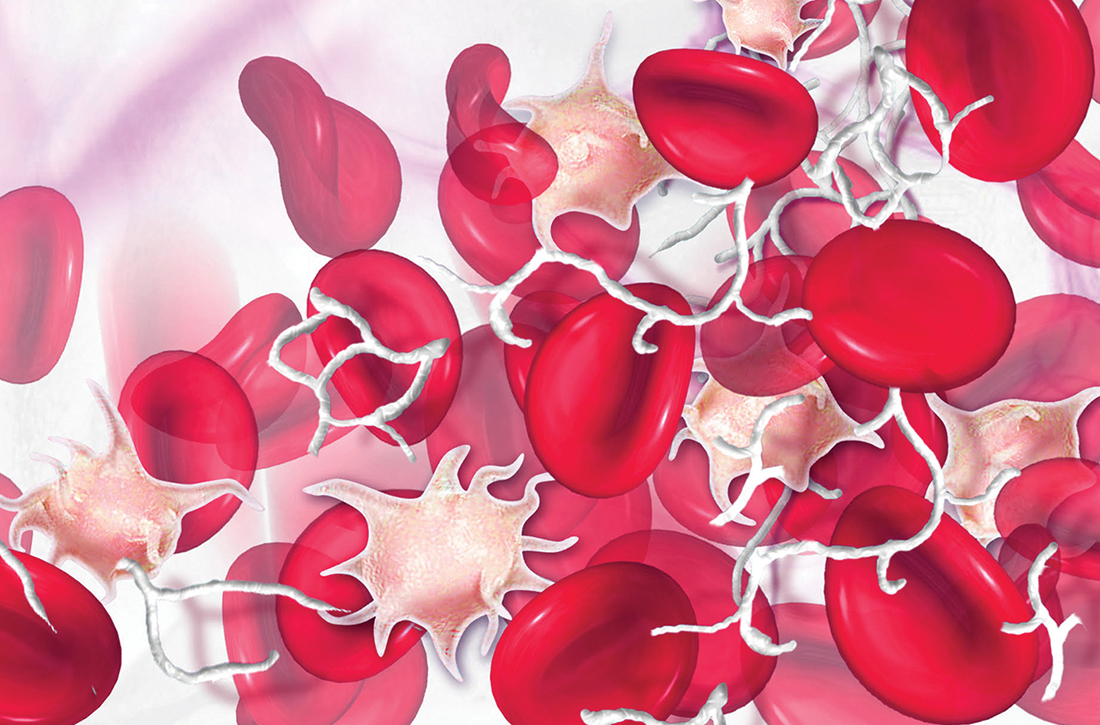
What makes teens choose to use sunscreen?
a cornerstone of skin cancer prevention, according to results from a systematic review.
“We know that skin cancer is one of the most common malignancies in the world, and sun protection methods such as sunscreen make it highly preventable,” first author Carly R. Stevens, a student at Tulane University, New Orleans, said in an interview. “This study demonstrates the adolescent populations that are most vulnerable to sun damage and how we can help mitigate their risk of developing skin cancer through education methods, such as Sun Protection Outreach Teaching by Students.”
Ms. Stevens and coauthors presented the findings during a poster session at the annual meeting of the Society for Pediatric Dermatology.
To investigate predictors of sunscreen use among high school students, they searched PubMed, Embase, and Web of Science using the terms (“sunscreen” or “SPF” or “sun protection”) and (“high school” or “teen” or “teenager” or “adolescent”) and limited the analysis to English studies reporting data on sunscreen use in U.S. high school students up to November 2021.
A total of 20 studies were included in the final review. The study populations ranged in number from 208 to 24,645. Of 11 studies that examined gender, all showed increased sunscreen use in females compared with males. Of five studies that examined age, all showed increased sunscreen use in younger adolescents, compared with their older counterparts.
Of four studies that examined the role of ethnicity on sunscreen use, White students were more likely to use sunscreen, compared with their peers of other ethnicities. “This may be due to perceived sun sensitivity, as [these four studies] also showed increased sunscreen use in populations that believed were more susceptible to sun damage,” the researchers wrote in their abstract.
In other findings, two studies that examined perceived self-efficacy concluded that higher levels of sunscreen use correlated with higher self-efficacy, while four studies concluded that high school students were more likely to use sunscreen if their parents encouraged them the wear it or if the parent used it themselves.
“With 40%-50% of ultraviolet damage being done before the age of 20, it’s crucial that we find ways to educate adolescents on the importance of sunscreen use and target those populations who were found to rarely use sunscreen in our study,” Ms. Stevens said.
In one outreach program, Sun Protection Outreach Teaching by Students (SPOTS), medical students visit middle and high schools to educate them about the importance of practicing sun protection. The program began as a collaboration between Saint Louis University and Washington University in St. Louis, but has expanded nationwide. Ms. Stevens described SPOTS as “a great way for medical students to present the information to middle and high school students in a way that is engaging and interactive.”
The researchers reported having no disclosures.
a cornerstone of skin cancer prevention, according to results from a systematic review.
“We know that skin cancer is one of the most common malignancies in the world, and sun protection methods such as sunscreen make it highly preventable,” first author Carly R. Stevens, a student at Tulane University, New Orleans, said in an interview. “This study demonstrates the adolescent populations that are most vulnerable to sun damage and how we can help mitigate their risk of developing skin cancer through education methods, such as Sun Protection Outreach Teaching by Students.”
Ms. Stevens and coauthors presented the findings during a poster session at the annual meeting of the Society for Pediatric Dermatology.
To investigate predictors of sunscreen use among high school students, they searched PubMed, Embase, and Web of Science using the terms (“sunscreen” or “SPF” or “sun protection”) and (“high school” or “teen” or “teenager” or “adolescent”) and limited the analysis to English studies reporting data on sunscreen use in U.S. high school students up to November 2021.
A total of 20 studies were included in the final review. The study populations ranged in number from 208 to 24,645. Of 11 studies that examined gender, all showed increased sunscreen use in females compared with males. Of five studies that examined age, all showed increased sunscreen use in younger adolescents, compared with their older counterparts.
Of four studies that examined the role of ethnicity on sunscreen use, White students were more likely to use sunscreen, compared with their peers of other ethnicities. “This may be due to perceived sun sensitivity, as [these four studies] also showed increased sunscreen use in populations that believed were more susceptible to sun damage,” the researchers wrote in their abstract.
In other findings, two studies that examined perceived self-efficacy concluded that higher levels of sunscreen use correlated with higher self-efficacy, while four studies concluded that high school students were more likely to use sunscreen if their parents encouraged them the wear it or if the parent used it themselves.
“With 40%-50% of ultraviolet damage being done before the age of 20, it’s crucial that we find ways to educate adolescents on the importance of sunscreen use and target those populations who were found to rarely use sunscreen in our study,” Ms. Stevens said.
In one outreach program, Sun Protection Outreach Teaching by Students (SPOTS), medical students visit middle and high schools to educate them about the importance of practicing sun protection. The program began as a collaboration between Saint Louis University and Washington University in St. Louis, but has expanded nationwide. Ms. Stevens described SPOTS as “a great way for medical students to present the information to middle and high school students in a way that is engaging and interactive.”
The researchers reported having no disclosures.
a cornerstone of skin cancer prevention, according to results from a systematic review.
“We know that skin cancer is one of the most common malignancies in the world, and sun protection methods such as sunscreen make it highly preventable,” first author Carly R. Stevens, a student at Tulane University, New Orleans, said in an interview. “This study demonstrates the adolescent populations that are most vulnerable to sun damage and how we can help mitigate their risk of developing skin cancer through education methods, such as Sun Protection Outreach Teaching by Students.”
Ms. Stevens and coauthors presented the findings during a poster session at the annual meeting of the Society for Pediatric Dermatology.
To investigate predictors of sunscreen use among high school students, they searched PubMed, Embase, and Web of Science using the terms (“sunscreen” or “SPF” or “sun protection”) and (“high school” or “teen” or “teenager” or “adolescent”) and limited the analysis to English studies reporting data on sunscreen use in U.S. high school students up to November 2021.
A total of 20 studies were included in the final review. The study populations ranged in number from 208 to 24,645. Of 11 studies that examined gender, all showed increased sunscreen use in females compared with males. Of five studies that examined age, all showed increased sunscreen use in younger adolescents, compared with their older counterparts.
Of four studies that examined the role of ethnicity on sunscreen use, White students were more likely to use sunscreen, compared with their peers of other ethnicities. “This may be due to perceived sun sensitivity, as [these four studies] also showed increased sunscreen use in populations that believed were more susceptible to sun damage,” the researchers wrote in their abstract.
In other findings, two studies that examined perceived self-efficacy concluded that higher levels of sunscreen use correlated with higher self-efficacy, while four studies concluded that high school students were more likely to use sunscreen if their parents encouraged them the wear it or if the parent used it themselves.
“With 40%-50% of ultraviolet damage being done before the age of 20, it’s crucial that we find ways to educate adolescents on the importance of sunscreen use and target those populations who were found to rarely use sunscreen in our study,” Ms. Stevens said.
In one outreach program, Sun Protection Outreach Teaching by Students (SPOTS), medical students visit middle and high schools to educate them about the importance of practicing sun protection. The program began as a collaboration between Saint Louis University and Washington University in St. Louis, but has expanded nationwide. Ms. Stevens described SPOTS as “a great way for medical students to present the information to middle and high school students in a way that is engaging and interactive.”
The researchers reported having no disclosures.
FROM SPD 2023
Most Americans in favor of regulated therapeutic psychedelics
It is a surprisingly large percentage, said officials at the University of California, Berkeley, Center for the Science of Psychedelics, which conducted the online survey of 1,500 registered voters in early June.

“That is a stunning number,” said Michael Pollan, cofounder of the center, and author of “How to Change Your Mind,” a book that explored potential uses of psychedelics.
In a briefing with reporters, Mr. Pollan said that he believes the large support base, in part, reflects campaigns that have “been successful by highlighting the effectiveness of psychedelics as therapy for mental illness.”
However, the poll also showed that 61% of voters said that they do not perceive psychedelics as “good for society,” and 69% do not perceive them as “something for people like me.”
These negative sentiments “suggest a fragile kind of support – the kind of support where you’re only hearing one side of the story,” said Mr. Pollan.
Still, poll respondents supported other potential policy changes, including 56% in support of the U.S. Food and Drug Administration vetting and approving psychedelics so they could be available by prescription.
50% have tried psychedelics
Almost 80% said that it should be easier for researchers to study psychedelics, and just under one-half said that they backed removing criminal penalties for personal use and possession.
The poll results also show that almost half of respondents had heard about psychedelics recently, with 48% saying they had heard about the drugs’ use in treating mental illness.
Respondents who were most familiar with and positive about psychedelics tended to be White, male, aged 30-50 years, liberal, highly educated, living in a Western state, and have little to no religious or spiritual practice.
Overall, 52% of survey respondents said that they or someone close to them had used a psychedelic, with almost half of that use coming in the past 5 years. Some 40% said that the use had been more than a decade ago.
Almost three-quarters of psychedelic use was reported as recreational, but the second-biggest category was therapeutic use at 39%. About one-third of respondents said that they or someone close to them had microdosed.
Conservative voters had lower levels of awareness and first-degree connection use as well as the least amount of support for regulated therapeutic use, with only 45% saying they would back such a policy, compared with 80% of liberal voters and 66% of moderate voters.
Black individuals were the least likely to be familiar with psychedelics: Just 29% said that they had heard a little or a lot about the drugs, compared with 39% of Latinx individuals and 51% of White individuals. And just one-quarter reported first-degree use, compared with half of Latinx individuals and 56% of White individuals.
Who should be eligible?
When asked who should be eligible for treatment with psychedelics, 80% said that they were comfortable with its use for those with terminal illnesses. More than two-thirds expressed comfort with the drugs being used to help veterans and people with treatment-resistant depression and anxiety.
Less than one-half of respondents said that psychedelics should be available to everyone older than 21 years. And voters seemed to be less inclined to say psychedelics should be used to treat people with addiction, with just 45% indicating that they were very or somewhat comfortable with that use.
Mr. Pollan said that reflects perhaps some lack of knowledge or education.
“The story about addiction and psychedelics hasn’t gotten out,” he said. “I kind of get that intuitively the idea of using a drug to treat a drug doesn’t sound right to a lot of people. But in fact, there’s good evidence it works,” Mr. Pollan said.
Respondents said that doctors, nurses, and scientists were the most trusted source of information about psychedelics, whereas the FDA received lower confidence. Law enforcement was least trusted by liberals and most trusted by conservatives.
Mr. Pollan noted the reversal in attitudes, with Americans mostly now looking to the scientific and medical establishment for guidance on psychedelics.
“We went from a counterculture drug to something that is being taken seriously by scientists as a potential therapy,” he said.
The poll’s margin of error was ± 2.5%.
A version of this article first appeared on Medscape.com.
It is a surprisingly large percentage, said officials at the University of California, Berkeley, Center for the Science of Psychedelics, which conducted the online survey of 1,500 registered voters in early June.
“That is a stunning number,” said Michael Pollan, cofounder of the center, and author of “How to Change Your Mind,” a book that explored potential uses of psychedelics.
In a briefing with reporters, Mr. Pollan said that he believes the large support base, in part, reflects campaigns that have “been successful by highlighting the effectiveness of psychedelics as therapy for mental illness.”
However, the poll also showed that 61% of voters said that they do not perceive psychedelics as “good for society,” and 69% do not perceive them as “something for people like me.”
These negative sentiments “suggest a fragile kind of support – the kind of support where you’re only hearing one side of the story,” said Mr. Pollan.
Still, poll respondents supported other potential policy changes, including 56% in support of the U.S. Food and Drug Administration vetting and approving psychedelics so they could be available by prescription.
50% have tried psychedelics
Almost 80% said that it should be easier for researchers to study psychedelics, and just under one-half said that they backed removing criminal penalties for personal use and possession.
The poll results also show that almost half of respondents had heard about psychedelics recently, with 48% saying they had heard about the drugs’ use in treating mental illness.
Respondents who were most familiar with and positive about psychedelics tended to be White, male, aged 30-50 years, liberal, highly educated, living in a Western state, and have little to no religious or spiritual practice.
Overall, 52% of survey respondents said that they or someone close to them had used a psychedelic, with almost half of that use coming in the past 5 years. Some 40% said that the use had been more than a decade ago.
Almost three-quarters of psychedelic use was reported as recreational, but the second-biggest category was therapeutic use at 39%. About one-third of respondents said that they or someone close to them had microdosed.
Conservative voters had lower levels of awareness and first-degree connection use as well as the least amount of support for regulated therapeutic use, with only 45% saying they would back such a policy, compared with 80% of liberal voters and 66% of moderate voters.
Black individuals were the least likely to be familiar with psychedelics: Just 29% said that they had heard a little or a lot about the drugs, compared with 39% of Latinx individuals and 51% of White individuals. And just one-quarter reported first-degree use, compared with half of Latinx individuals and 56% of White individuals.
Who should be eligible?
When asked who should be eligible for treatment with psychedelics, 80% said that they were comfortable with its use for those with terminal illnesses. More than two-thirds expressed comfort with the drugs being used to help veterans and people with treatment-resistant depression and anxiety.
Less than one-half of respondents said that psychedelics should be available to everyone older than 21 years. And voters seemed to be less inclined to say psychedelics should be used to treat people with addiction, with just 45% indicating that they were very or somewhat comfortable with that use.
Mr. Pollan said that reflects perhaps some lack of knowledge or education.
“The story about addiction and psychedelics hasn’t gotten out,” he said. “I kind of get that intuitively the idea of using a drug to treat a drug doesn’t sound right to a lot of people. But in fact, there’s good evidence it works,” Mr. Pollan said.
Respondents said that doctors, nurses, and scientists were the most trusted source of information about psychedelics, whereas the FDA received lower confidence. Law enforcement was least trusted by liberals and most trusted by conservatives.
Mr. Pollan noted the reversal in attitudes, with Americans mostly now looking to the scientific and medical establishment for guidance on psychedelics.
“We went from a counterculture drug to something that is being taken seriously by scientists as a potential therapy,” he said.
The poll’s margin of error was ± 2.5%.
A version of this article first appeared on Medscape.com.
It is a surprisingly large percentage, said officials at the University of California, Berkeley, Center for the Science of Psychedelics, which conducted the online survey of 1,500 registered voters in early June.
“That is a stunning number,” said Michael Pollan, cofounder of the center, and author of “How to Change Your Mind,” a book that explored potential uses of psychedelics.
In a briefing with reporters, Mr. Pollan said that he believes the large support base, in part, reflects campaigns that have “been successful by highlighting the effectiveness of psychedelics as therapy for mental illness.”
However, the poll also showed that 61% of voters said that they do not perceive psychedelics as “good for society,” and 69% do not perceive them as “something for people like me.”
These negative sentiments “suggest a fragile kind of support – the kind of support where you’re only hearing one side of the story,” said Mr. Pollan.
Still, poll respondents supported other potential policy changes, including 56% in support of the U.S. Food and Drug Administration vetting and approving psychedelics so they could be available by prescription.
50% have tried psychedelics
Almost 80% said that it should be easier for researchers to study psychedelics, and just under one-half said that they backed removing criminal penalties for personal use and possession.
The poll results also show that almost half of respondents had heard about psychedelics recently, with 48% saying they had heard about the drugs’ use in treating mental illness.
Respondents who were most familiar with and positive about psychedelics tended to be White, male, aged 30-50 years, liberal, highly educated, living in a Western state, and have little to no religious or spiritual practice.
Overall, 52% of survey respondents said that they or someone close to them had used a psychedelic, with almost half of that use coming in the past 5 years. Some 40% said that the use had been more than a decade ago.
Almost three-quarters of psychedelic use was reported as recreational, but the second-biggest category was therapeutic use at 39%. About one-third of respondents said that they or someone close to them had microdosed.
Conservative voters had lower levels of awareness and first-degree connection use as well as the least amount of support for regulated therapeutic use, with only 45% saying they would back such a policy, compared with 80% of liberal voters and 66% of moderate voters.
Black individuals were the least likely to be familiar with psychedelics: Just 29% said that they had heard a little or a lot about the drugs, compared with 39% of Latinx individuals and 51% of White individuals. And just one-quarter reported first-degree use, compared with half of Latinx individuals and 56% of White individuals.
Who should be eligible?
When asked who should be eligible for treatment with psychedelics, 80% said that they were comfortable with its use for those with terminal illnesses. More than two-thirds expressed comfort with the drugs being used to help veterans and people with treatment-resistant depression and anxiety.
Less than one-half of respondents said that psychedelics should be available to everyone older than 21 years. And voters seemed to be less inclined to say psychedelics should be used to treat people with addiction, with just 45% indicating that they were very or somewhat comfortable with that use.
Mr. Pollan said that reflects perhaps some lack of knowledge or education.
“The story about addiction and psychedelics hasn’t gotten out,” he said. “I kind of get that intuitively the idea of using a drug to treat a drug doesn’t sound right to a lot of people. But in fact, there’s good evidence it works,” Mr. Pollan said.
Respondents said that doctors, nurses, and scientists were the most trusted source of information about psychedelics, whereas the FDA received lower confidence. Law enforcement was least trusted by liberals and most trusted by conservatives.
Mr. Pollan noted the reversal in attitudes, with Americans mostly now looking to the scientific and medical establishment for guidance on psychedelics.
“We went from a counterculture drug to something that is being taken seriously by scientists as a potential therapy,” he said.
The poll’s margin of error was ± 2.5%.
A version of this article first appeared on Medscape.com.
High-intensity interval training before major surgery may boost postoperative outcomes
TOPLINE:
It cuts the risk of postoperative complications and may shorten hospital length of stay and improve postoperative quality of life.
METHODOLOGY:
Evidence suggests CRF – which improves physical and cognitive function and is associated with a reduction in cardiovascular risk – can be enhanced before major surgeries, but reported postoperative outcomes in previous reviews have been inconsistent.
In the study, HIIT involved repeated aerobic high-intensity exercise intervals at about 80% of maximum heart rate, followed by active recovery.
The meta-analysis included 12 studies with 832 patients (mean age, 67) that compared preoperative HIIT – supervised at hospitals, gyms, or community or physical therapy centers, or unsupervised at home – with standard care for patients slated for major surgery, including liver, lung, colorectal, urologic, and mixed major abdominal operations.
The primary outcome was change in CRF by peak VO2 or 6-minute walk test; other endpoints included change in endurance time and postoperative outcomes.
TAKEAWAY:
Preoperative HIIT (median total, 160 minutes; range, 80-240 minutes; intense exercise during 6-40 sessions) was associated with an increase in peak oxygen consumption (VO2 peak) by 2.59 mL/kg/min (95% confidence interval, 1.52-3.65 mL/kg/min; P < .001), compared with standard care, which represents about a 10% increase in CRF.
In eight studies that involved 770 patients, there was moderate evidence that preoperative HIIT cut the odds ratio for postoperative complications by more than half (OR, 0.44; 95% CI, 0.32-0.60; P < .001); there was a similar apparent benefit in an analysis that was limited to patients who were slated for abdominal surgery (OR, 0.45; 95% CI, 0.29-0.68; P < .001).
An analysis that was limited to studies that reported hospital length of stay showed a clinically relevant but nonsignificant 3-day reduction among patients in the HIIT groups.
Most quality of life assessments did not show post-HIIT improvements; some showed a significant benefit 6 weeks after surgery.
IN PRACTICE:
The results suggest preoperative HIIT may improve postoperative outcomes. By extension, it could be cost-effective and “should be included in prehabilitation programs,” the report states.
SOURCE:
The study was carried out by Kari Clifford, PhD, Otago Medical School, University of Otago, Dunedin, New Zealand, and colleagues. It was published online June 30, 2023, in JAMA Network Open.
LIMITATIONS:
Included studies were heterogeneous in methodology; for example, HIIT definitions and protocols varied across almost every study. Data reporting was incomplete, the samples sizes in the studies were limited, and patients could not be blinded to their intervention. The patients could not be stratified on the basis of frailty. There were limited HIIT data from patients who underwent orthopedic surgeries.
DISCLOSURES:
The study received funding from the University of Otago. The authors reported no conflicts.
A version of this article first appeared on Medscape.com.
TOPLINE:
It cuts the risk of postoperative complications and may shorten hospital length of stay and improve postoperative quality of life.
METHODOLOGY:
Evidence suggests CRF – which improves physical and cognitive function and is associated with a reduction in cardiovascular risk – can be enhanced before major surgeries, but reported postoperative outcomes in previous reviews have been inconsistent.
In the study, HIIT involved repeated aerobic high-intensity exercise intervals at about 80% of maximum heart rate, followed by active recovery.
The meta-analysis included 12 studies with 832 patients (mean age, 67) that compared preoperative HIIT – supervised at hospitals, gyms, or community or physical therapy centers, or unsupervised at home – with standard care for patients slated for major surgery, including liver, lung, colorectal, urologic, and mixed major abdominal operations.
The primary outcome was change in CRF by peak VO2 or 6-minute walk test; other endpoints included change in endurance time and postoperative outcomes.
TAKEAWAY:
Preoperative HIIT (median total, 160 minutes; range, 80-240 minutes; intense exercise during 6-40 sessions) was associated with an increase in peak oxygen consumption (VO2 peak) by 2.59 mL/kg/min (95% confidence interval, 1.52-3.65 mL/kg/min; P < .001), compared with standard care, which represents about a 10% increase in CRF.
In eight studies that involved 770 patients, there was moderate evidence that preoperative HIIT cut the odds ratio for postoperative complications by more than half (OR, 0.44; 95% CI, 0.32-0.60; P < .001); there was a similar apparent benefit in an analysis that was limited to patients who were slated for abdominal surgery (OR, 0.45; 95% CI, 0.29-0.68; P < .001).
An analysis that was limited to studies that reported hospital length of stay showed a clinically relevant but nonsignificant 3-day reduction among patients in the HIIT groups.
Most quality of life assessments did not show post-HIIT improvements; some showed a significant benefit 6 weeks after surgery.
IN PRACTICE:
The results suggest preoperative HIIT may improve postoperative outcomes. By extension, it could be cost-effective and “should be included in prehabilitation programs,” the report states.
SOURCE:
The study was carried out by Kari Clifford, PhD, Otago Medical School, University of Otago, Dunedin, New Zealand, and colleagues. It was published online June 30, 2023, in JAMA Network Open.
LIMITATIONS:
Included studies were heterogeneous in methodology; for example, HIIT definitions and protocols varied across almost every study. Data reporting was incomplete, the samples sizes in the studies were limited, and patients could not be blinded to their intervention. The patients could not be stratified on the basis of frailty. There were limited HIIT data from patients who underwent orthopedic surgeries.
DISCLOSURES:
The study received funding from the University of Otago. The authors reported no conflicts.
A version of this article first appeared on Medscape.com.
TOPLINE:
It cuts the risk of postoperative complications and may shorten hospital length of stay and improve postoperative quality of life.
METHODOLOGY:
Evidence suggests CRF – which improves physical and cognitive function and is associated with a reduction in cardiovascular risk – can be enhanced before major surgeries, but reported postoperative outcomes in previous reviews have been inconsistent.
In the study, HIIT involved repeated aerobic high-intensity exercise intervals at about 80% of maximum heart rate, followed by active recovery.
The meta-analysis included 12 studies with 832 patients (mean age, 67) that compared preoperative HIIT – supervised at hospitals, gyms, or community or physical therapy centers, or unsupervised at home – with standard care for patients slated for major surgery, including liver, lung, colorectal, urologic, and mixed major abdominal operations.
The primary outcome was change in CRF by peak VO2 or 6-minute walk test; other endpoints included change in endurance time and postoperative outcomes.
TAKEAWAY:
Preoperative HIIT (median total, 160 minutes; range, 80-240 minutes; intense exercise during 6-40 sessions) was associated with an increase in peak oxygen consumption (VO2 peak) by 2.59 mL/kg/min (95% confidence interval, 1.52-3.65 mL/kg/min; P < .001), compared with standard care, which represents about a 10% increase in CRF.
In eight studies that involved 770 patients, there was moderate evidence that preoperative HIIT cut the odds ratio for postoperative complications by more than half (OR, 0.44; 95% CI, 0.32-0.60; P < .001); there was a similar apparent benefit in an analysis that was limited to patients who were slated for abdominal surgery (OR, 0.45; 95% CI, 0.29-0.68; P < .001).
An analysis that was limited to studies that reported hospital length of stay showed a clinically relevant but nonsignificant 3-day reduction among patients in the HIIT groups.
Most quality of life assessments did not show post-HIIT improvements; some showed a significant benefit 6 weeks after surgery.
IN PRACTICE:
The results suggest preoperative HIIT may improve postoperative outcomes. By extension, it could be cost-effective and “should be included in prehabilitation programs,” the report states.
SOURCE:
The study was carried out by Kari Clifford, PhD, Otago Medical School, University of Otago, Dunedin, New Zealand, and colleagues. It was published online June 30, 2023, in JAMA Network Open.
LIMITATIONS:
Included studies were heterogeneous in methodology; for example, HIIT definitions and protocols varied across almost every study. Data reporting was incomplete, the samples sizes in the studies were limited, and patients could not be blinded to their intervention. The patients could not be stratified on the basis of frailty. There were limited HIIT data from patients who underwent orthopedic surgeries.
DISCLOSURES:
The study received funding from the University of Otago. The authors reported no conflicts.
A version of this article first appeared on Medscape.com.
FROM JAMA NETWORK OPEN
App cuts alcohol intake in risky drinkers
The key to reducing problem drinking may just be an app away.
, researchers in Australia have found.
Participants in the randomized controlled trial tracked information about their alcohol consumption, including the quantity and frequency. The intervention then generated an impulsivity score and implications for their risk for alcohol-related disorders and diseases, hospitalization, and death. The findings were published in Alcohol: Clinical & Experimental Research.
Worldwide each year, alcohol consumption accounts for 5.3% of all deaths. In the United States, an estimated 29.5 million people older than 12 years had alcohol use disorder in 2021.
More than 60% of people with alcohol use problems never seek out in-person treatment. Many are deterred from doing so by fear of judgment, stigma, and embarrassment, especially those at the low end of the alcohol use severity spectrum, according to the Australian researchers. Such fear-based barriers, however, may be overcome through the anonymity of a smartphone app.
The researchers tested whether hazardous drinkers who receive personalized feedback about their alcohol consumption and level of self-control would reduce their problem drinking more than hazardous drinkers who received only personalized information about their alcohol consumption or no feedback at all would.
“I knew from my previous research that just putting in the information is not enough to change someone’s drinking: It seems that putting in the information and then having someone tell you, ‘You drank x number of drinks, and that level of drinking is high according to Australian or WHO [World Health Organization] standards’ seems to be the critical point,” said Antoinette Poulton, PhD, of the University of Melbourne, who developed the app and led the study.
The study was conducted among first-year psychology students at the University of Melbourne between 2020 and 2022.
Each of the 313 participants in the study (average age 21.7 years; 74% women) provided estimates of alcohol intake over 14 days. A subset of 178 individuals utilized Alcohol Capture, the validated smartphone app, which records alcohol intake in real-time and includes an online cognitive task assessing impulsivity.
Participants were categorized as “hazardous” or “nonharmful” drinkers according to guidelines from the World Health Organization and were divided into three groups. Members in the alcohol intake feedback (Alc) group were given personalized feedback about their alcohol consumption, including whether their drinking exceeded Australian and/or WHO guidelines. Others were assigned to the Alc plus cognitive feedback (AlcCog) group and received the same feedback plus details about their level of self-control and information about the links between poor self-control and vulnerability for transition to alcohol use disorder. The control group did not receive personalized feedback. After 8 weeks, alcohol intake was again recorded over 14 days.
Relative to hazardous drinkers in the control group, total alcohol consumption among risky drinkers in the Alc group fell by 32% (or 3.8 standard drinks per week) and by 35% (or 4.2 standard drinks per week) in the AlcCog group, according to the researchers. That difference was not statistically significant.
“Our brief electronic intervention had clear impact on the drinking behavior of hazardous drinkers,” the researchers reported. “In fact, following the intervention, hazardous drinkers did not differ from non-harmful ones on total alcohol intake, quantity of intake per drinking day, or frequency of six or more drinking occasions.”
Drinks per drinking day also decreased by 31% (or 1.6 standard drinks) and 32% (or 2.1 standard drinks) in the Alc and AlcCog groups, respectively, compared with the control group.
Alcohol use did not appear to change among nonharmful drinkers in any of the study groups.
“This is a nice study, because it shows that a simple, small intervention can really have a profound effect on hazardous drinking,” said Akhil Anand, MD, an addiction psychiatrist and Medical Director of the Alcohol and Drug Recovery Center at Cleveland Clinic. “It’s hard to say if this intervention would work on very severe cases, but I like it because it’s anonymous, it’s quick, it’s easily accessible, and it doesn’t take too much health care personnel power to apply it,” Dr. Anand added.
This research was supported by an Early Career Researcher grant from the University of Melbourne. Dr. Poulton and Dr. Anand reported no financial conflicts of interest.
A version of this article first appeared on Medscape.com.
The key to reducing problem drinking may just be an app away.
, researchers in Australia have found.
Participants in the randomized controlled trial tracked information about their alcohol consumption, including the quantity and frequency. The intervention then generated an impulsivity score and implications for their risk for alcohol-related disorders and diseases, hospitalization, and death. The findings were published in Alcohol: Clinical & Experimental Research.
Worldwide each year, alcohol consumption accounts for 5.3% of all deaths. In the United States, an estimated 29.5 million people older than 12 years had alcohol use disorder in 2021.
More than 60% of people with alcohol use problems never seek out in-person treatment. Many are deterred from doing so by fear of judgment, stigma, and embarrassment, especially those at the low end of the alcohol use severity spectrum, according to the Australian researchers. Such fear-based barriers, however, may be overcome through the anonymity of a smartphone app.
The researchers tested whether hazardous drinkers who receive personalized feedback about their alcohol consumption and level of self-control would reduce their problem drinking more than hazardous drinkers who received only personalized information about their alcohol consumption or no feedback at all would.
“I knew from my previous research that just putting in the information is not enough to change someone’s drinking: It seems that putting in the information and then having someone tell you, ‘You drank x number of drinks, and that level of drinking is high according to Australian or WHO [World Health Organization] standards’ seems to be the critical point,” said Antoinette Poulton, PhD, of the University of Melbourne, who developed the app and led the study.
The study was conducted among first-year psychology students at the University of Melbourne between 2020 and 2022.
Each of the 313 participants in the study (average age 21.7 years; 74% women) provided estimates of alcohol intake over 14 days. A subset of 178 individuals utilized Alcohol Capture, the validated smartphone app, which records alcohol intake in real-time and includes an online cognitive task assessing impulsivity.
Participants were categorized as “hazardous” or “nonharmful” drinkers according to guidelines from the World Health Organization and were divided into three groups. Members in the alcohol intake feedback (Alc) group were given personalized feedback about their alcohol consumption, including whether their drinking exceeded Australian and/or WHO guidelines. Others were assigned to the Alc plus cognitive feedback (AlcCog) group and received the same feedback plus details about their level of self-control and information about the links between poor self-control and vulnerability for transition to alcohol use disorder. The control group did not receive personalized feedback. After 8 weeks, alcohol intake was again recorded over 14 days.
Relative to hazardous drinkers in the control group, total alcohol consumption among risky drinkers in the Alc group fell by 32% (or 3.8 standard drinks per week) and by 35% (or 4.2 standard drinks per week) in the AlcCog group, according to the researchers. That difference was not statistically significant.
“Our brief electronic intervention had clear impact on the drinking behavior of hazardous drinkers,” the researchers reported. “In fact, following the intervention, hazardous drinkers did not differ from non-harmful ones on total alcohol intake, quantity of intake per drinking day, or frequency of six or more drinking occasions.”
Drinks per drinking day also decreased by 31% (or 1.6 standard drinks) and 32% (or 2.1 standard drinks) in the Alc and AlcCog groups, respectively, compared with the control group.
Alcohol use did not appear to change among nonharmful drinkers in any of the study groups.
“This is a nice study, because it shows that a simple, small intervention can really have a profound effect on hazardous drinking,” said Akhil Anand, MD, an addiction psychiatrist and Medical Director of the Alcohol and Drug Recovery Center at Cleveland Clinic. “It’s hard to say if this intervention would work on very severe cases, but I like it because it’s anonymous, it’s quick, it’s easily accessible, and it doesn’t take too much health care personnel power to apply it,” Dr. Anand added.
This research was supported by an Early Career Researcher grant from the University of Melbourne. Dr. Poulton and Dr. Anand reported no financial conflicts of interest.
A version of this article first appeared on Medscape.com.
The key to reducing problem drinking may just be an app away.
, researchers in Australia have found.
Participants in the randomized controlled trial tracked information about their alcohol consumption, including the quantity and frequency. The intervention then generated an impulsivity score and implications for their risk for alcohol-related disorders and diseases, hospitalization, and death. The findings were published in Alcohol: Clinical & Experimental Research.
Worldwide each year, alcohol consumption accounts for 5.3% of all deaths. In the United States, an estimated 29.5 million people older than 12 years had alcohol use disorder in 2021.
More than 60% of people with alcohol use problems never seek out in-person treatment. Many are deterred from doing so by fear of judgment, stigma, and embarrassment, especially those at the low end of the alcohol use severity spectrum, according to the Australian researchers. Such fear-based barriers, however, may be overcome through the anonymity of a smartphone app.
The researchers tested whether hazardous drinkers who receive personalized feedback about their alcohol consumption and level of self-control would reduce their problem drinking more than hazardous drinkers who received only personalized information about their alcohol consumption or no feedback at all would.
“I knew from my previous research that just putting in the information is not enough to change someone’s drinking: It seems that putting in the information and then having someone tell you, ‘You drank x number of drinks, and that level of drinking is high according to Australian or WHO [World Health Organization] standards’ seems to be the critical point,” said Antoinette Poulton, PhD, of the University of Melbourne, who developed the app and led the study.
The study was conducted among first-year psychology students at the University of Melbourne between 2020 and 2022.
Each of the 313 participants in the study (average age 21.7 years; 74% women) provided estimates of alcohol intake over 14 days. A subset of 178 individuals utilized Alcohol Capture, the validated smartphone app, which records alcohol intake in real-time and includes an online cognitive task assessing impulsivity.
Participants were categorized as “hazardous” or “nonharmful” drinkers according to guidelines from the World Health Organization and were divided into three groups. Members in the alcohol intake feedback (Alc) group were given personalized feedback about their alcohol consumption, including whether their drinking exceeded Australian and/or WHO guidelines. Others were assigned to the Alc plus cognitive feedback (AlcCog) group and received the same feedback plus details about their level of self-control and information about the links between poor self-control and vulnerability for transition to alcohol use disorder. The control group did not receive personalized feedback. After 8 weeks, alcohol intake was again recorded over 14 days.
Relative to hazardous drinkers in the control group, total alcohol consumption among risky drinkers in the Alc group fell by 32% (or 3.8 standard drinks per week) and by 35% (or 4.2 standard drinks per week) in the AlcCog group, according to the researchers. That difference was not statistically significant.
“Our brief electronic intervention had clear impact on the drinking behavior of hazardous drinkers,” the researchers reported. “In fact, following the intervention, hazardous drinkers did not differ from non-harmful ones on total alcohol intake, quantity of intake per drinking day, or frequency of six or more drinking occasions.”
Drinks per drinking day also decreased by 31% (or 1.6 standard drinks) and 32% (or 2.1 standard drinks) in the Alc and AlcCog groups, respectively, compared with the control group.
Alcohol use did not appear to change among nonharmful drinkers in any of the study groups.
“This is a nice study, because it shows that a simple, small intervention can really have a profound effect on hazardous drinking,” said Akhil Anand, MD, an addiction psychiatrist and Medical Director of the Alcohol and Drug Recovery Center at Cleveland Clinic. “It’s hard to say if this intervention would work on very severe cases, but I like it because it’s anonymous, it’s quick, it’s easily accessible, and it doesn’t take too much health care personnel power to apply it,” Dr. Anand added.
This research was supported by an Early Career Researcher grant from the University of Melbourne. Dr. Poulton and Dr. Anand reported no financial conflicts of interest.
A version of this article first appeared on Medscape.com.
FROM ALCOHOL: CLINICAL & EXPERIMENTAL RESEARCH
Research points toward combination therapy for Lyme and improved diagnostics
Several recent developments in Lyme disease treatment and diagnosis may pave the way forward for combating disease that persists following missed or delayed diagnoses or remains following standard treatment. These include combination therapy to address “persister” bacteria and diagnostic tests that test directly for the pathogen and/or indirectly test for host response, according to experts who presented at a 2-day National Academies of Science, Engineering and Medicine workshop on infection-associated chronic illnesses.
Research has shown that 60% of people who are infected and not treated during the early or early disseminated stages of Lyme disease go on to develop late Lyme arthritis, said John Aucott, MD, director of the Johns Hopkins Lyme Disease Clinical Research Center in Baltimore. And in the real world, there’s an additional category of patients: Those who are misdiagnosed and develop infection-related persistent symptoms – such as fatigue, brain fog/cognitive dysfunction, and musculoskeletal problems – that don’t match the “textbook schematic” involving late Lyme arthritis and late neurologic disease.
Moreover, of patients who are treated with protocols recommended by the Infectious Diseases Society of America (IDSA), about 15% go on to develop persistent symptoms at 6 months – again, symptoms that don’t match textbook manifestations and do match symptoms of other infection-associated chronic illnesses. As a “research construct,” this has been coined posttreatment Lyme disease (PTLD), he said at the workshop, “Toward a Common Research Agenda in Infection-Associated Chronic Illnesses.”
(On a practical level, it is hard to know clinically who has early disseminated disease unless they have multiple erythema migrans rashes or neurologic or cardiac involvement, he said after the meeting.)
All this points to the need for tests that are sensitive and specific for diagnosis at all stages of infection and disease, he said in a talk on diagnostics. Currently available tests – those that fit into the widely used two-tiered enzyme-linked immunosorbent assay, Western Blot serology testing – have significant limitations in sensitivity and specificity, including for acute infection when the body has not generated enough antibodies, yet treatment is most likely to succeed.
Move toward combination therapy research
Lyme disease is most commonly treated with doxycycline, and that’s problematic because the antibiotic is a microstatic whose efficacy relies on immune clearance of static bacteria, said Monica E. Embers, PhD, director of vector-borne disease at the Tulane National Primate Research Center and associate professor of immunology at Tulane University, New Orleans.
“But we know that Borrelia burgdorferi has the capability to evade the host immune response in almost every way possible. Persistence is the norm in an immunocompetent host ... [and] dormant bacteria/persisters are more tolerant of microstatic antibiotics,” she said.
Other considerations for antibiotic efficacy include the fact that B. burgdorferi survives for many months inside ticks without nutrient replenishment or replication, “so dormancy is part of their life cycle,” she said. Moreover, the bacteria can be found deep in connective tissues and joints.
The efficacy of accepted regimens of antibiotic treatment has been “a very contentious issue,” she said, noting that guidelines from the International Lyme and Associated Diseases Society “leave open the possibility for antibiotic retreatment when a chronic infection is judged to be a possible cause [of ongoing symptoms].”
The development of persister B. burgdorferi in the presence of antibiotics has been well studied in vitro, which has limitations, Dr. Embers said. But her group specializes in animal models and has shown persistence of antimicrobial-tolerant B. burgdorferi in tick-inoculated rhesus macaques 8-9 months after treatment with oral doxycycline.
“We [also] saw persistence of mild-moderate inflammation in the brain, peripheral nerves, spinal cord, joints and skeletal muscle, and in the heart,” Dr. Embers said, who coauthored a 2022 review of B. burgdorferi antimicrobial-tolerant persistence in Lyme disease and PTLD.
Her work has also shown that ceftriaxone, which is recommended by IDSA for patients with clinically evident neurological and/or cardiac involvement, does not clear infection in mice. “In general, single drugs have not been capable of clearing the infection, yet combinations show promise,” she said.
Dr. Embers has combed large drug libraries looking for combinations of antibiotics that employ different mechanisms of action in hopes of eliminating persister spirochetes. Certain combinations have shown promise in mice and have been tested in her rhesus macaque model; data analyses are underway.
Other research teams, such as that of Ying Zhang, MD, PhD, at Johns Hopkins, have similarly been screening combinations of antibiotics and other compounds, identifying candidates for further testing.
During a question and answer period, Dr. Embers said her team is also investigating the pathophysiology and long-term effects of tick-borne coinfections, including Bartonella, and is pursuing a hypothesis that infection with Borrelia allows Bartonella to cause more extensive disease and persist longer. “I think Lyme is at the core because of its ability to evade and suppress the immune response so effectively.”
Diagnostic possibilities, biomarkers for PTLD
Direct diagnostic tests for microbial nucleic acid and proteins “are promising alternatives for indirect serologic tests,” Dr. Aucott said. For instance, in addition to polymerase chain reaction tests, which “are making advances,” it may be possible to target the B. burgdorferi peptidoglycan for antigen detection.
Researchers have shown that peptidoglycan, a component of the B. burgdorferi cell envelope, is a persistent antigen in the synovial fluid of patients with Lyme arthritis who have been treated with oral and intravenous antibiotics, and that it likely contributes to inflammation.
“Maybe the infection is gone but parts of the bacteria are still there that are driving inflammation,” said Dr. Aucott, also associate professor of medicine at John Hopkins.
Researchers have also been looking at the host response to B. burgdorferi – including cytokines, chemokines, and autoantibiodies – to identify biomarkers for PTLD and to identify patients during posttreatment follow-up who are at increased risk of developing PTLD, with the hope of someday intervening. Persistently high levels of interleukin-23, CCL19, and interferon-alpha have each been associated in different studies with persistent symptoms after treatment, Dr. Aucott said.
In addition, metabolomics research is showing that patients with PTLD have metabolic fingerprints that are different from those who return to good health after treatment, and it may be possible to identify an epigenetic signature for Lyme disease. A project sponsored by the Defense Advanced Research Projects Agency called ECHO (Epigenetic Characterization and Observation) aims to identify epigenetic signatures of exposures to various threats, including B. burgdorferi.
“At the very proximal end of [indirectly testing for host response], there are modifications of the DNA that can occur in response to infectious insults ... and that changed DNA changes RNA expression and protein synthesis,” Dr. Aucott explained. DARPA’s project is “exciting because their goal [at DARPA] is to have a diagnostic test quickly as a result of this epigenetics work.”
Imaging research is also fast offering diagnostic opportunities, Dr. Aucott said. Levels of microglial activation on brain PET imaging have been found to correlate with PTLD, and a study at Johns Hopkins of multimodal neuroimaging with functional MRI and diffusion tensor imaging has shown distinct changes to white matter activation within the frontal lobe of patients with PTLD, compared with controls.
The NASEM workshop did not collect or require disclosures of its participants.
Several recent developments in Lyme disease treatment and diagnosis may pave the way forward for combating disease that persists following missed or delayed diagnoses or remains following standard treatment. These include combination therapy to address “persister” bacteria and diagnostic tests that test directly for the pathogen and/or indirectly test for host response, according to experts who presented at a 2-day National Academies of Science, Engineering and Medicine workshop on infection-associated chronic illnesses.
Research has shown that 60% of people who are infected and not treated during the early or early disseminated stages of Lyme disease go on to develop late Lyme arthritis, said John Aucott, MD, director of the Johns Hopkins Lyme Disease Clinical Research Center in Baltimore. And in the real world, there’s an additional category of patients: Those who are misdiagnosed and develop infection-related persistent symptoms – such as fatigue, brain fog/cognitive dysfunction, and musculoskeletal problems – that don’t match the “textbook schematic” involving late Lyme arthritis and late neurologic disease.
Moreover, of patients who are treated with protocols recommended by the Infectious Diseases Society of America (IDSA), about 15% go on to develop persistent symptoms at 6 months – again, symptoms that don’t match textbook manifestations and do match symptoms of other infection-associated chronic illnesses. As a “research construct,” this has been coined posttreatment Lyme disease (PTLD), he said at the workshop, “Toward a Common Research Agenda in Infection-Associated Chronic Illnesses.”
(On a practical level, it is hard to know clinically who has early disseminated disease unless they have multiple erythema migrans rashes or neurologic or cardiac involvement, he said after the meeting.)
All this points to the need for tests that are sensitive and specific for diagnosis at all stages of infection and disease, he said in a talk on diagnostics. Currently available tests – those that fit into the widely used two-tiered enzyme-linked immunosorbent assay, Western Blot serology testing – have significant limitations in sensitivity and specificity, including for acute infection when the body has not generated enough antibodies, yet treatment is most likely to succeed.
Move toward combination therapy research
Lyme disease is most commonly treated with doxycycline, and that’s problematic because the antibiotic is a microstatic whose efficacy relies on immune clearance of static bacteria, said Monica E. Embers, PhD, director of vector-borne disease at the Tulane National Primate Research Center and associate professor of immunology at Tulane University, New Orleans.
“But we know that Borrelia burgdorferi has the capability to evade the host immune response in almost every way possible. Persistence is the norm in an immunocompetent host ... [and] dormant bacteria/persisters are more tolerant of microstatic antibiotics,” she said.
Other considerations for antibiotic efficacy include the fact that B. burgdorferi survives for many months inside ticks without nutrient replenishment or replication, “so dormancy is part of their life cycle,” she said. Moreover, the bacteria can be found deep in connective tissues and joints.
The efficacy of accepted regimens of antibiotic treatment has been “a very contentious issue,” she said, noting that guidelines from the International Lyme and Associated Diseases Society “leave open the possibility for antibiotic retreatment when a chronic infection is judged to be a possible cause [of ongoing symptoms].”
The development of persister B. burgdorferi in the presence of antibiotics has been well studied in vitro, which has limitations, Dr. Embers said. But her group specializes in animal models and has shown persistence of antimicrobial-tolerant B. burgdorferi in tick-inoculated rhesus macaques 8-9 months after treatment with oral doxycycline.
“We [also] saw persistence of mild-moderate inflammation in the brain, peripheral nerves, spinal cord, joints and skeletal muscle, and in the heart,” Dr. Embers said, who coauthored a 2022 review of B. burgdorferi antimicrobial-tolerant persistence in Lyme disease and PTLD.
Her work has also shown that ceftriaxone, which is recommended by IDSA for patients with clinically evident neurological and/or cardiac involvement, does not clear infection in mice. “In general, single drugs have not been capable of clearing the infection, yet combinations show promise,” she said.
Dr. Embers has combed large drug libraries looking for combinations of antibiotics that employ different mechanisms of action in hopes of eliminating persister spirochetes. Certain combinations have shown promise in mice and have been tested in her rhesus macaque model; data analyses are underway.
Other research teams, such as that of Ying Zhang, MD, PhD, at Johns Hopkins, have similarly been screening combinations of antibiotics and other compounds, identifying candidates for further testing.
During a question and answer period, Dr. Embers said her team is also investigating the pathophysiology and long-term effects of tick-borne coinfections, including Bartonella, and is pursuing a hypothesis that infection with Borrelia allows Bartonella to cause more extensive disease and persist longer. “I think Lyme is at the core because of its ability to evade and suppress the immune response so effectively.”
Diagnostic possibilities, biomarkers for PTLD
Direct diagnostic tests for microbial nucleic acid and proteins “are promising alternatives for indirect serologic tests,” Dr. Aucott said. For instance, in addition to polymerase chain reaction tests, which “are making advances,” it may be possible to target the B. burgdorferi peptidoglycan for antigen detection.
Researchers have shown that peptidoglycan, a component of the B. burgdorferi cell envelope, is a persistent antigen in the synovial fluid of patients with Lyme arthritis who have been treated with oral and intravenous antibiotics, and that it likely contributes to inflammation.
“Maybe the infection is gone but parts of the bacteria are still there that are driving inflammation,” said Dr. Aucott, also associate professor of medicine at John Hopkins.
Researchers have also been looking at the host response to B. burgdorferi – including cytokines, chemokines, and autoantibiodies – to identify biomarkers for PTLD and to identify patients during posttreatment follow-up who are at increased risk of developing PTLD, with the hope of someday intervening. Persistently high levels of interleukin-23, CCL19, and interferon-alpha have each been associated in different studies with persistent symptoms after treatment, Dr. Aucott said.
In addition, metabolomics research is showing that patients with PTLD have metabolic fingerprints that are different from those who return to good health after treatment, and it may be possible to identify an epigenetic signature for Lyme disease. A project sponsored by the Defense Advanced Research Projects Agency called ECHO (Epigenetic Characterization and Observation) aims to identify epigenetic signatures of exposures to various threats, including B. burgdorferi.
“At the very proximal end of [indirectly testing for host response], there are modifications of the DNA that can occur in response to infectious insults ... and that changed DNA changes RNA expression and protein synthesis,” Dr. Aucott explained. DARPA’s project is “exciting because their goal [at DARPA] is to have a diagnostic test quickly as a result of this epigenetics work.”
Imaging research is also fast offering diagnostic opportunities, Dr. Aucott said. Levels of microglial activation on brain PET imaging have been found to correlate with PTLD, and a study at Johns Hopkins of multimodal neuroimaging with functional MRI and diffusion tensor imaging has shown distinct changes to white matter activation within the frontal lobe of patients with PTLD, compared with controls.
The NASEM workshop did not collect or require disclosures of its participants.
Several recent developments in Lyme disease treatment and diagnosis may pave the way forward for combating disease that persists following missed or delayed diagnoses or remains following standard treatment. These include combination therapy to address “persister” bacteria and diagnostic tests that test directly for the pathogen and/or indirectly test for host response, according to experts who presented at a 2-day National Academies of Science, Engineering and Medicine workshop on infection-associated chronic illnesses.
Research has shown that 60% of people who are infected and not treated during the early or early disseminated stages of Lyme disease go on to develop late Lyme arthritis, said John Aucott, MD, director of the Johns Hopkins Lyme Disease Clinical Research Center in Baltimore. And in the real world, there’s an additional category of patients: Those who are misdiagnosed and develop infection-related persistent symptoms – such as fatigue, brain fog/cognitive dysfunction, and musculoskeletal problems – that don’t match the “textbook schematic” involving late Lyme arthritis and late neurologic disease.
Moreover, of patients who are treated with protocols recommended by the Infectious Diseases Society of America (IDSA), about 15% go on to develop persistent symptoms at 6 months – again, symptoms that don’t match textbook manifestations and do match symptoms of other infection-associated chronic illnesses. As a “research construct,” this has been coined posttreatment Lyme disease (PTLD), he said at the workshop, “Toward a Common Research Agenda in Infection-Associated Chronic Illnesses.”
(On a practical level, it is hard to know clinically who has early disseminated disease unless they have multiple erythema migrans rashes or neurologic or cardiac involvement, he said after the meeting.)
All this points to the need for tests that are sensitive and specific for diagnosis at all stages of infection and disease, he said in a talk on diagnostics. Currently available tests – those that fit into the widely used two-tiered enzyme-linked immunosorbent assay, Western Blot serology testing – have significant limitations in sensitivity and specificity, including for acute infection when the body has not generated enough antibodies, yet treatment is most likely to succeed.
Move toward combination therapy research
Lyme disease is most commonly treated with doxycycline, and that’s problematic because the antibiotic is a microstatic whose efficacy relies on immune clearance of static bacteria, said Monica E. Embers, PhD, director of vector-borne disease at the Tulane National Primate Research Center and associate professor of immunology at Tulane University, New Orleans.
“But we know that Borrelia burgdorferi has the capability to evade the host immune response in almost every way possible. Persistence is the norm in an immunocompetent host ... [and] dormant bacteria/persisters are more tolerant of microstatic antibiotics,” she said.
Other considerations for antibiotic efficacy include the fact that B. burgdorferi survives for many months inside ticks without nutrient replenishment or replication, “so dormancy is part of their life cycle,” she said. Moreover, the bacteria can be found deep in connective tissues and joints.
The efficacy of accepted regimens of antibiotic treatment has been “a very contentious issue,” she said, noting that guidelines from the International Lyme and Associated Diseases Society “leave open the possibility for antibiotic retreatment when a chronic infection is judged to be a possible cause [of ongoing symptoms].”
The development of persister B. burgdorferi in the presence of antibiotics has been well studied in vitro, which has limitations, Dr. Embers said. But her group specializes in animal models and has shown persistence of antimicrobial-tolerant B. burgdorferi in tick-inoculated rhesus macaques 8-9 months after treatment with oral doxycycline.
“We [also] saw persistence of mild-moderate inflammation in the brain, peripheral nerves, spinal cord, joints and skeletal muscle, and in the heart,” Dr. Embers said, who coauthored a 2022 review of B. burgdorferi antimicrobial-tolerant persistence in Lyme disease and PTLD.
Her work has also shown that ceftriaxone, which is recommended by IDSA for patients with clinically evident neurological and/or cardiac involvement, does not clear infection in mice. “In general, single drugs have not been capable of clearing the infection, yet combinations show promise,” she said.
Dr. Embers has combed large drug libraries looking for combinations of antibiotics that employ different mechanisms of action in hopes of eliminating persister spirochetes. Certain combinations have shown promise in mice and have been tested in her rhesus macaque model; data analyses are underway.
Other research teams, such as that of Ying Zhang, MD, PhD, at Johns Hopkins, have similarly been screening combinations of antibiotics and other compounds, identifying candidates for further testing.
During a question and answer period, Dr. Embers said her team is also investigating the pathophysiology and long-term effects of tick-borne coinfections, including Bartonella, and is pursuing a hypothesis that infection with Borrelia allows Bartonella to cause more extensive disease and persist longer. “I think Lyme is at the core because of its ability to evade and suppress the immune response so effectively.”
Diagnostic possibilities, biomarkers for PTLD
Direct diagnostic tests for microbial nucleic acid and proteins “are promising alternatives for indirect serologic tests,” Dr. Aucott said. For instance, in addition to polymerase chain reaction tests, which “are making advances,” it may be possible to target the B. burgdorferi peptidoglycan for antigen detection.
Researchers have shown that peptidoglycan, a component of the B. burgdorferi cell envelope, is a persistent antigen in the synovial fluid of patients with Lyme arthritis who have been treated with oral and intravenous antibiotics, and that it likely contributes to inflammation.
“Maybe the infection is gone but parts of the bacteria are still there that are driving inflammation,” said Dr. Aucott, also associate professor of medicine at John Hopkins.
Researchers have also been looking at the host response to B. burgdorferi – including cytokines, chemokines, and autoantibiodies – to identify biomarkers for PTLD and to identify patients during posttreatment follow-up who are at increased risk of developing PTLD, with the hope of someday intervening. Persistently high levels of interleukin-23, CCL19, and interferon-alpha have each been associated in different studies with persistent symptoms after treatment, Dr. Aucott said.
In addition, metabolomics research is showing that patients with PTLD have metabolic fingerprints that are different from those who return to good health after treatment, and it may be possible to identify an epigenetic signature for Lyme disease. A project sponsored by the Defense Advanced Research Projects Agency called ECHO (Epigenetic Characterization and Observation) aims to identify epigenetic signatures of exposures to various threats, including B. burgdorferi.
“At the very proximal end of [indirectly testing for host response], there are modifications of the DNA that can occur in response to infectious insults ... and that changed DNA changes RNA expression and protein synthesis,” Dr. Aucott explained. DARPA’s project is “exciting because their goal [at DARPA] is to have a diagnostic test quickly as a result of this epigenetics work.”
Imaging research is also fast offering diagnostic opportunities, Dr. Aucott said. Levels of microglial activation on brain PET imaging have been found to correlate with PTLD, and a study at Johns Hopkins of multimodal neuroimaging with functional MRI and diffusion tensor imaging has shown distinct changes to white matter activation within the frontal lobe of patients with PTLD, compared with controls.
The NASEM workshop did not collect or require disclosures of its participants.
FROM A NATIONAL ACADEMIES OF SCIENCE, ENGINEERING AND MEDICINE WORKSHOP
When did medicine become a battleground for everything?
Like hundreds of other medical experts, Leana Wen, MD, an emergency physician and former Baltimore health commissioner, was an early and avid supporter of COVID vaccines and their ability to prevent severe disease, hospitalization, and death from SARS-CoV-2 infections.
When 51-year-old Scott Eli Harris, of Aubrey, Tex., heard of Dr. Wen’s stance in July 2021, the self-described “fifth-generation U.S. Army veteran and a sniper” sent Dr. Wen an electronic invective laden with racist language and very specific threats to shoot her.
Mr. Harris pled guilty to transmitting threats via interstate commerce last February and began serving 6 months in federal prison in the fall of 2022, but his threats wouldn’t be the last for Dr. Wen. Just 2 days after Mr. Harris was sentenced, charges were unsealed against another man in Massachusetts, who threatened that Dr. Wen would “end up in pieces” if she continued “pushing” her thoughts publicly.’
Dr. Wen has plenty of company. In an August 2022 survey of emergency doctors conducted by the American College of Emergency Physicians, 85% of respondents said violence against them is increasing. One in four doctors said they’re being assaulted by patients and their family and friends multiple times a week, compared with just 8% of doctors who said as much in 2018. About 64% of emergency physicians reported receiving verbal assaults and threats of violence; 40% reported being hit or slapped, and 26% were kicked.
This uptick of violence and threats against physicians didn’t come out of nowhere; violence against health care workers has been gradually increasing over the past decade. Health care providers can attest to the hostility that particular topics have sparked for years: vaccines in pediatrics, abortion in ob.gyn., and gender-affirming care in endocrinology.
But the pandemic fueled the fire. The proliferation of misinformation (often via social media) and the politicization of public health and medicine are at the center of the problem.
‘The people attacking are themselves victims’
The misinformation problem first came to a head in one area of public health: vaccines. The pandemic accelerated antagonism in medicine – thanks, in part, to decades of antivaccine activism.
The antivaccine movement, which has ebbed and flowed in the United States and across the globe since the first vaccine, experienced a new wave in the early 2000s with the combination of concerns about thimerosal in vaccines and a now disproven link between autism and the MMR vaccine. But that movement grew. It picked up steam when activists gained political clout after a 2014 measles outbreak at Disneyland led California schools to tighten up policies regarding vaccinations for kids who enrolled. These stronger public school vaccination laws ran up against religious freedom arguments from antivaccine advocates.
Use of social media continues to grow, and with it, the spread of misinformation. A recent study found that Facebook “users’ social media habits doubled, and in some cases, tripled the amount of fake news they shared.”
In the face of growing confusion, health care providers and public health experts have often struggled to treat their patients – and communicate to the public – without appearing political.

“The people that are doing the attacking are in some ways themselves victims,” said Peter Hotez, MD, PhD, dean of the National School of Tropical Medicine at Baylor College of Medicine, Houston. “They’re victims of the antiscience, antihealth ecosystem coming out of Fox News, the House Freedom Caucus, the CPAC conference, coming out of contrarian intellectuals.”
Many of Dr. Hotez’s colleagues don’t want to talk about the political right as an enabler of scientific disinformation, he said, but that doesn’t change what the evidence shows. The vast majority of state and national bills opposing vaccination, gender-affirming care, comprehensive reproductive care, and other evidence-based medical care often come from Republican legislators.
When politics and health care collide
“We’re in an incredible status quo,” said William Schaffner, MD, the previous director of the Infectious Diseases Society of America and a professor of infectious diseases and preventive medicine at Vanderbilt University, Nashville, Tenn. “You can’t get away from the politics, because you have [political] candidates espousing certain concepts that are antithetical to good public health.”

In March 2023, Florida Gov. Ron DeSantis’s surgeon general, Joseph Ladapo, MD, PhD, warned that COVID vaccines are harmful to young men, prompting rebukes from federal health authorities. It later came out that Dr. Ladapo had changed some of the results of the study before issuing his warning. But long before 2023, there emerged an increasing gap in COVID deaths between red states and blue states, mirroring the vaccination rates in those states. The redder the state, the higher the death toll.
It’s not just Republican Party culture warriors; medical misinformation is also finding increasing purchase on the far left. Robert F. Kennedy Jr. and Marianne Williamson, both of whom have launched long-shot challenges to President Biden for the 2024 Democratic nomination, had promoted antivaccine ideas long before the COVID pandemic. Mr. Kennedy continues to spread misinformation.
In June 2023, Joe Rogan hosted Mr. Kennedy, on his podcast. During the episode, Mr. Rogan listened uncritically as Mr. Kennedy told his millions of listeners that vaccines cause autism and that 5G causes cancer, among other fringe, often-debunked theories.
Dr. Hotez, a prominent misinformation debunker who was also part of a team that designed a low-cost COVID-19 vaccine, wrote on Twitter that the episode was “just awful.”
The backlash began almost immediately. Mr. Rogan, who has over 11 million followers on Twitter, responded with a public challenge for Dr. Hotez to debate Mr. Kennedy on Mr. Rogan’s show, with a reward of $100,000 to the charity of Dr. Hotez’s choice. More offers streamed in, including from Elon Musk, who tweeted that Dr. Hotez was “afraid of a public debate, because he knows he’s wrong.” More supporters of Mr. Kennedy and Mr. Rogan piled on.
Vaccine skeptics even showed up at Dr. Hotez’s house, filming him as he was returning from buying a Father’s Day cake and taunting him to debate Mr. Kennedy.
A turn in the pandemic
For a precious few weeks at the start of the pandemic, it felt as though the country was all in this together. There were arguments against closing schools and shutting down businesses, but for the most part, the nation had about 4 solid weeks of solidarity.
As masking mandates changed and the public health establishment lost the confidence of Americans, the veneer of solidarity began to chip away.
“Things were changing so rapidly during the pandemic that it was very hard for staff and patients to understand the changing guidelines, whether it was visitor constraints or masking,” said Carrie Nelson, the chief medical officer at the telehealth company AmWell, who worked as a supervisor at a large health care system in the Midwest until 2021.
In the midst of the public health crisis, former President Trump was downplaying the severity of the disease and was silencing officials from the Centers for Disease Control and Prevention, such as Nancy Messonier, who warned from the very beginning of the pandemic’s potential.
When the vaccines came out, the latent antivaccine movement flared up once again. And this time – unlike in decades past – the debate over vaccines had become partisan.
“Before the pandemic,” said Christopher Thomas, an emergency physician on the West Coast who requested that a pseudonym be used because of personal threats he has received, “patients wouldn’t really challenge me or throw out weird questions.” It’s not that he never encountered pushback, but the stakes felt lower, and people largely deferred to his medical expertise. “If we got a parent who had not vaccinated their child, I would totally engage back then,” Dr. Thomas said.
But the pandemic – and America’s response to it – changed the conversation. “The rhetoric ... switched from downplaying the virus to demonizing the vaccines,” Dr. Thomas said.
The toll on health care professionals
By the time vaccines were available, the public had begun to conflate doctors with public health experts, since both were “pushing” the vaccine.
“Most people probably don’t really know the difference between clinical medicine and public health,” said Richard Pan, MD, MPH, a pediatrician and California legislator who sponsored two bills – now laws – that strengthened state childhood vaccination requirements.
At first, it was clearly public health officials, such as Anthony Fauci, MD, who were the face of measures to mitigate the virus. But as doctors became the enforcers of those measures, the line between physicians and public health officials blurred.
A lot of the anger then shifted toward doctors, nurses, and other health care professionals, Dr. Pan said, “because we were, of course, the ones who would be administering the vaccines. They don’t really think of their doctor as a government person until your doctor is carrying a [government] message.”
Given the pressures and struggles of the past few years, it’s no surprise that burnout among health care professionals is high. According to an April 2023 study by the National Council of State Boards of Nursing and the National Forum of State Nursing Workforce Centers, an estimated 800,000 nurses expect to leave the profession by 2027, driven first and foremost by “stress and burnout.”
All of these departures in medicine’s “great resignation” have left hospitals and health care organizations even more short staffed, thereby increasing even more the pressure and burnout on those left.
The pandemic had already badly exacerbated the already widespread problem of burnout in the medical field, which Ms. Nelson said has contributed to the tension.
“The burnout problem that we have in health care is not a good basis for the development of a good therapeutic relationship,” Ms. Nelson said. “Burnout is fraught with apathy and desensitization to human emotions. It takes away the empathy that we once had for people that we see.”
What comes next?
Almost exactly 3 years after the world learned about SARS-CoV-2, Biden declared an end to the coronavirus public health emergency in April 2023. Yet, Americans continue to die from COVID, and the anger that bloomed and spread has not abated.
“I think we’re in a new steady state of violence in health care settings,” Ms. Nelson said. “It’s not gone down, because people are still very distressed.” That’s evident from the high prevalence of mental health conditions, the financial strain of first the pandemic and then inflation, and the overall traumatic impact the pandemic had on people, whether they recognize it or not.
The first step to solving any problem is, as the saying goes, to admit that there is a problem.
“I think people need to start stepping out of their comfort bubbles and start to look at things that make them uncomfortable,” Dr. Thomas said, but he doesn’t see that happening any time soon. “I’ve been very let down by physicians and embarrassed by the American physician organizations.”
The medical board in his state, he said, has stood by as some doctors continue misrepresenting medical evidence. “That’s been really, really hard on me. I didn’t think that the medical boards would go so far as to look the other way for something that was this tremendously bad.”
There are others who can take the lead – if they’re willing.
“There are some things the medical societies and academic health centers can do,” Dr. Hotez said, “starting with building up a culture of physicians and health care providers feeling comfortable in the public domain.” He said the messaging when he was getting his degrees was not to engage the public and not to talk to journalists because that was “self-promotion” or “grandstanding.” But the world is different now. Health care professionals need training in public engagement and communication, he said, and the culture needs to change so that health care providers feel comfortable speaking out without feeling “the sword of Damocles over their heads” every time they talk to a reporter, Dr. Hotez said.
There may be no silver bullet to solve the big-picture trust problem in medicine and public health. No TV appearance or quote in an article can solve it. But on an individual level — through careful relationship building with patients – doctors can strengthen that trust.
Telehealth may help with that, but there’s a fine balance there, Ms. Nelson cautioned. On the one hand, with the doctor and the patient each in their own private spaces, where they feel safe and comfortable, the overall experience can be more therapeutic and less stressful. At the same time, telehealth can pile on change-management tasks that can exacerbate burnout, “so it’s a delicate thing we have to approach.”
One very thin silver lining that could emerge from the way in which patients have begun to try to take charge of their care.
“They should fully understand the reasoning behind the recommendations that physicians are making,” Ms. Nelson said. “I’d like to see us get to a happy medium where it’s a partnership. We can’t go back to the old school where the doctor knows best and you don’t ever question him.
“What we need is the partnership, and I would love to see that as the silver lining, but the anger has got to settle down in order for that kind of productive thing to happen.”
As for the big picture? There’s a limit to what even society’s “miracle workers” can do. “The biggest priority right now for the health system is to protect their staff whatever way they can and do some training in deescalation,” Ms. Nelson said. “But I don’t think health care can solve the societal issues that seem to be creating this.”
A version of this article first appeared on Medscape.com.
Like hundreds of other medical experts, Leana Wen, MD, an emergency physician and former Baltimore health commissioner, was an early and avid supporter of COVID vaccines and their ability to prevent severe disease, hospitalization, and death from SARS-CoV-2 infections.
When 51-year-old Scott Eli Harris, of Aubrey, Tex., heard of Dr. Wen’s stance in July 2021, the self-described “fifth-generation U.S. Army veteran and a sniper” sent Dr. Wen an electronic invective laden with racist language and very specific threats to shoot her.
Mr. Harris pled guilty to transmitting threats via interstate commerce last February and began serving 6 months in federal prison in the fall of 2022, but his threats wouldn’t be the last for Dr. Wen. Just 2 days after Mr. Harris was sentenced, charges were unsealed against another man in Massachusetts, who threatened that Dr. Wen would “end up in pieces” if she continued “pushing” her thoughts publicly.’
Dr. Wen has plenty of company. In an August 2022 survey of emergency doctors conducted by the American College of Emergency Physicians, 85% of respondents said violence against them is increasing. One in four doctors said they’re being assaulted by patients and their family and friends multiple times a week, compared with just 8% of doctors who said as much in 2018. About 64% of emergency physicians reported receiving verbal assaults and threats of violence; 40% reported being hit or slapped, and 26% were kicked.
This uptick of violence and threats against physicians didn’t come out of nowhere; violence against health care workers has been gradually increasing over the past decade. Health care providers can attest to the hostility that particular topics have sparked for years: vaccines in pediatrics, abortion in ob.gyn., and gender-affirming care in endocrinology.
But the pandemic fueled the fire. The proliferation of misinformation (often via social media) and the politicization of public health and medicine are at the center of the problem.
‘The people attacking are themselves victims’
The misinformation problem first came to a head in one area of public health: vaccines. The pandemic accelerated antagonism in medicine – thanks, in part, to decades of antivaccine activism.
The antivaccine movement, which has ebbed and flowed in the United States and across the globe since the first vaccine, experienced a new wave in the early 2000s with the combination of concerns about thimerosal in vaccines and a now disproven link between autism and the MMR vaccine. But that movement grew. It picked up steam when activists gained political clout after a 2014 measles outbreak at Disneyland led California schools to tighten up policies regarding vaccinations for kids who enrolled. These stronger public school vaccination laws ran up against religious freedom arguments from antivaccine advocates.
Use of social media continues to grow, and with it, the spread of misinformation. A recent study found that Facebook “users’ social media habits doubled, and in some cases, tripled the amount of fake news they shared.”
In the face of growing confusion, health care providers and public health experts have often struggled to treat their patients – and communicate to the public – without appearing political.
“The people that are doing the attacking are in some ways themselves victims,” said Peter Hotez, MD, PhD, dean of the National School of Tropical Medicine at Baylor College of Medicine, Houston. “They’re victims of the antiscience, antihealth ecosystem coming out of Fox News, the House Freedom Caucus, the CPAC conference, coming out of contrarian intellectuals.”
Many of Dr. Hotez’s colleagues don’t want to talk about the political right as an enabler of scientific disinformation, he said, but that doesn’t change what the evidence shows. The vast majority of state and national bills opposing vaccination, gender-affirming care, comprehensive reproductive care, and other evidence-based medical care often come from Republican legislators.
When politics and health care collide
“We’re in an incredible status quo,” said William Schaffner, MD, the previous director of the Infectious Diseases Society of America and a professor of infectious diseases and preventive medicine at Vanderbilt University, Nashville, Tenn. “You can’t get away from the politics, because you have [political] candidates espousing certain concepts that are antithetical to good public health.”
In March 2023, Florida Gov. Ron DeSantis’s surgeon general, Joseph Ladapo, MD, PhD, warned that COVID vaccines are harmful to young men, prompting rebukes from federal health authorities. It later came out that Dr. Ladapo had changed some of the results of the study before issuing his warning. But long before 2023, there emerged an increasing gap in COVID deaths between red states and blue states, mirroring the vaccination rates in those states. The redder the state, the higher the death toll.
It’s not just Republican Party culture warriors; medical misinformation is also finding increasing purchase on the far left. Robert F. Kennedy Jr. and Marianne Williamson, both of whom have launched long-shot challenges to President Biden for the 2024 Democratic nomination, had promoted antivaccine ideas long before the COVID pandemic. Mr. Kennedy continues to spread misinformation.
In June 2023, Joe Rogan hosted Mr. Kennedy, on his podcast. During the episode, Mr. Rogan listened uncritically as Mr. Kennedy told his millions of listeners that vaccines cause autism and that 5G causes cancer, among other fringe, often-debunked theories.
Dr. Hotez, a prominent misinformation debunker who was also part of a team that designed a low-cost COVID-19 vaccine, wrote on Twitter that the episode was “just awful.”
The backlash began almost immediately. Mr. Rogan, who has over 11 million followers on Twitter, responded with a public challenge for Dr. Hotez to debate Mr. Kennedy on Mr. Rogan’s show, with a reward of $100,000 to the charity of Dr. Hotez’s choice. More offers streamed in, including from Elon Musk, who tweeted that Dr. Hotez was “afraid of a public debate, because he knows he’s wrong.” More supporters of Mr. Kennedy and Mr. Rogan piled on.
Vaccine skeptics even showed up at Dr. Hotez’s house, filming him as he was returning from buying a Father’s Day cake and taunting him to debate Mr. Kennedy.
A turn in the pandemic
For a precious few weeks at the start of the pandemic, it felt as though the country was all in this together. There were arguments against closing schools and shutting down businesses, but for the most part, the nation had about 4 solid weeks of solidarity.
As masking mandates changed and the public health establishment lost the confidence of Americans, the veneer of solidarity began to chip away.
“Things were changing so rapidly during the pandemic that it was very hard for staff and patients to understand the changing guidelines, whether it was visitor constraints or masking,” said Carrie Nelson, the chief medical officer at the telehealth company AmWell, who worked as a supervisor at a large health care system in the Midwest until 2021.
In the midst of the public health crisis, former President Trump was downplaying the severity of the disease and was silencing officials from the Centers for Disease Control and Prevention, such as Nancy Messonier, who warned from the very beginning of the pandemic’s potential.
When the vaccines came out, the latent antivaccine movement flared up once again. And this time – unlike in decades past – the debate over vaccines had become partisan.
“Before the pandemic,” said Christopher Thomas, an emergency physician on the West Coast who requested that a pseudonym be used because of personal threats he has received, “patients wouldn’t really challenge me or throw out weird questions.” It’s not that he never encountered pushback, but the stakes felt lower, and people largely deferred to his medical expertise. “If we got a parent who had not vaccinated their child, I would totally engage back then,” Dr. Thomas said.
But the pandemic – and America’s response to it – changed the conversation. “The rhetoric ... switched from downplaying the virus to demonizing the vaccines,” Dr. Thomas said.
The toll on health care professionals
By the time vaccines were available, the public had begun to conflate doctors with public health experts, since both were “pushing” the vaccine.
“Most people probably don’t really know the difference between clinical medicine and public health,” said Richard Pan, MD, MPH, a pediatrician and California legislator who sponsored two bills – now laws – that strengthened state childhood vaccination requirements.
At first, it was clearly public health officials, such as Anthony Fauci, MD, who were the face of measures to mitigate the virus. But as doctors became the enforcers of those measures, the line between physicians and public health officials blurred.
A lot of the anger then shifted toward doctors, nurses, and other health care professionals, Dr. Pan said, “because we were, of course, the ones who would be administering the vaccines. They don’t really think of their doctor as a government person until your doctor is carrying a [government] message.”
Given the pressures and struggles of the past few years, it’s no surprise that burnout among health care professionals is high. According to an April 2023 study by the National Council of State Boards of Nursing and the National Forum of State Nursing Workforce Centers, an estimated 800,000 nurses expect to leave the profession by 2027, driven first and foremost by “stress and burnout.”
All of these departures in medicine’s “great resignation” have left hospitals and health care organizations even more short staffed, thereby increasing even more the pressure and burnout on those left.
The pandemic had already badly exacerbated the already widespread problem of burnout in the medical field, which Ms. Nelson said has contributed to the tension.
“The burnout problem that we have in health care is not a good basis for the development of a good therapeutic relationship,” Ms. Nelson said. “Burnout is fraught with apathy and desensitization to human emotions. It takes away the empathy that we once had for people that we see.”
What comes next?
Almost exactly 3 years after the world learned about SARS-CoV-2, Biden declared an end to the coronavirus public health emergency in April 2023. Yet, Americans continue to die from COVID, and the anger that bloomed and spread has not abated.
“I think we’re in a new steady state of violence in health care settings,” Ms. Nelson said. “It’s not gone down, because people are still very distressed.” That’s evident from the high prevalence of mental health conditions, the financial strain of first the pandemic and then inflation, and the overall traumatic impact the pandemic had on people, whether they recognize it or not.
The first step to solving any problem is, as the saying goes, to admit that there is a problem.
“I think people need to start stepping out of their comfort bubbles and start to look at things that make them uncomfortable,” Dr. Thomas said, but he doesn’t see that happening any time soon. “I’ve been very let down by physicians and embarrassed by the American physician organizations.”
The medical board in his state, he said, has stood by as some doctors continue misrepresenting medical evidence. “That’s been really, really hard on me. I didn’t think that the medical boards would go so far as to look the other way for something that was this tremendously bad.”
There are others who can take the lead – if they’re willing.
“There are some things the medical societies and academic health centers can do,” Dr. Hotez said, “starting with building up a culture of physicians and health care providers feeling comfortable in the public domain.” He said the messaging when he was getting his degrees was not to engage the public and not to talk to journalists because that was “self-promotion” or “grandstanding.” But the world is different now. Health care professionals need training in public engagement and communication, he said, and the culture needs to change so that health care providers feel comfortable speaking out without feeling “the sword of Damocles over their heads” every time they talk to a reporter, Dr. Hotez said.
There may be no silver bullet to solve the big-picture trust problem in medicine and public health. No TV appearance or quote in an article can solve it. But on an individual level — through careful relationship building with patients – doctors can strengthen that trust.
Telehealth may help with that, but there’s a fine balance there, Ms. Nelson cautioned. On the one hand, with the doctor and the patient each in their own private spaces, where they feel safe and comfortable, the overall experience can be more therapeutic and less stressful. At the same time, telehealth can pile on change-management tasks that can exacerbate burnout, “so it’s a delicate thing we have to approach.”
One very thin silver lining that could emerge from the way in which patients have begun to try to take charge of their care.
“They should fully understand the reasoning behind the recommendations that physicians are making,” Ms. Nelson said. “I’d like to see us get to a happy medium where it’s a partnership. We can’t go back to the old school where the doctor knows best and you don’t ever question him.
“What we need is the partnership, and I would love to see that as the silver lining, but the anger has got to settle down in order for that kind of productive thing to happen.”
As for the big picture? There’s a limit to what even society’s “miracle workers” can do. “The biggest priority right now for the health system is to protect their staff whatever way they can and do some training in deescalation,” Ms. Nelson said. “But I don’t think health care can solve the societal issues that seem to be creating this.”
A version of this article first appeared on Medscape.com.
Like hundreds of other medical experts, Leana Wen, MD, an emergency physician and former Baltimore health commissioner, was an early and avid supporter of COVID vaccines and their ability to prevent severe disease, hospitalization, and death from SARS-CoV-2 infections.
When 51-year-old Scott Eli Harris, of Aubrey, Tex., heard of Dr. Wen’s stance in July 2021, the self-described “fifth-generation U.S. Army veteran and a sniper” sent Dr. Wen an electronic invective laden with racist language and very specific threats to shoot her.
Mr. Harris pled guilty to transmitting threats via interstate commerce last February and began serving 6 months in federal prison in the fall of 2022, but his threats wouldn’t be the last for Dr. Wen. Just 2 days after Mr. Harris was sentenced, charges were unsealed against another man in Massachusetts, who threatened that Dr. Wen would “end up in pieces” if she continued “pushing” her thoughts publicly.’
Dr. Wen has plenty of company. In an August 2022 survey of emergency doctors conducted by the American College of Emergency Physicians, 85% of respondents said violence against them is increasing. One in four doctors said they’re being assaulted by patients and their family and friends multiple times a week, compared with just 8% of doctors who said as much in 2018. About 64% of emergency physicians reported receiving verbal assaults and threats of violence; 40% reported being hit or slapped, and 26% were kicked.
This uptick of violence and threats against physicians didn’t come out of nowhere; violence against health care workers has been gradually increasing over the past decade. Health care providers can attest to the hostility that particular topics have sparked for years: vaccines in pediatrics, abortion in ob.gyn., and gender-affirming care in endocrinology.
But the pandemic fueled the fire. The proliferation of misinformation (often via social media) and the politicization of public health and medicine are at the center of the problem.
‘The people attacking are themselves victims’
The misinformation problem first came to a head in one area of public health: vaccines. The pandemic accelerated antagonism in medicine – thanks, in part, to decades of antivaccine activism.
The antivaccine movement, which has ebbed and flowed in the United States and across the globe since the first vaccine, experienced a new wave in the early 2000s with the combination of concerns about thimerosal in vaccines and a now disproven link between autism and the MMR vaccine. But that movement grew. It picked up steam when activists gained political clout after a 2014 measles outbreak at Disneyland led California schools to tighten up policies regarding vaccinations for kids who enrolled. These stronger public school vaccination laws ran up against religious freedom arguments from antivaccine advocates.
Use of social media continues to grow, and with it, the spread of misinformation. A recent study found that Facebook “users’ social media habits doubled, and in some cases, tripled the amount of fake news they shared.”
In the face of growing confusion, health care providers and public health experts have often struggled to treat their patients – and communicate to the public – without appearing political.
“The people that are doing the attacking are in some ways themselves victims,” said Peter Hotez, MD, PhD, dean of the National School of Tropical Medicine at Baylor College of Medicine, Houston. “They’re victims of the antiscience, antihealth ecosystem coming out of Fox News, the House Freedom Caucus, the CPAC conference, coming out of contrarian intellectuals.”
Many of Dr. Hotez’s colleagues don’t want to talk about the political right as an enabler of scientific disinformation, he said, but that doesn’t change what the evidence shows. The vast majority of state and national bills opposing vaccination, gender-affirming care, comprehensive reproductive care, and other evidence-based medical care often come from Republican legislators.
When politics and health care collide
“We’re in an incredible status quo,” said William Schaffner, MD, the previous director of the Infectious Diseases Society of America and a professor of infectious diseases and preventive medicine at Vanderbilt University, Nashville, Tenn. “You can’t get away from the politics, because you have [political] candidates espousing certain concepts that are antithetical to good public health.”
In March 2023, Florida Gov. Ron DeSantis’s surgeon general, Joseph Ladapo, MD, PhD, warned that COVID vaccines are harmful to young men, prompting rebukes from federal health authorities. It later came out that Dr. Ladapo had changed some of the results of the study before issuing his warning. But long before 2023, there emerged an increasing gap in COVID deaths between red states and blue states, mirroring the vaccination rates in those states. The redder the state, the higher the death toll.
It’s not just Republican Party culture warriors; medical misinformation is also finding increasing purchase on the far left. Robert F. Kennedy Jr. and Marianne Williamson, both of whom have launched long-shot challenges to President Biden for the 2024 Democratic nomination, had promoted antivaccine ideas long before the COVID pandemic. Mr. Kennedy continues to spread misinformation.
In June 2023, Joe Rogan hosted Mr. Kennedy, on his podcast. During the episode, Mr. Rogan listened uncritically as Mr. Kennedy told his millions of listeners that vaccines cause autism and that 5G causes cancer, among other fringe, often-debunked theories.
Dr. Hotez, a prominent misinformation debunker who was also part of a team that designed a low-cost COVID-19 vaccine, wrote on Twitter that the episode was “just awful.”
The backlash began almost immediately. Mr. Rogan, who has over 11 million followers on Twitter, responded with a public challenge for Dr. Hotez to debate Mr. Kennedy on Mr. Rogan’s show, with a reward of $100,000 to the charity of Dr. Hotez’s choice. More offers streamed in, including from Elon Musk, who tweeted that Dr. Hotez was “afraid of a public debate, because he knows he’s wrong.” More supporters of Mr. Kennedy and Mr. Rogan piled on.
Vaccine skeptics even showed up at Dr. Hotez’s house, filming him as he was returning from buying a Father’s Day cake and taunting him to debate Mr. Kennedy.
A turn in the pandemic
For a precious few weeks at the start of the pandemic, it felt as though the country was all in this together. There were arguments against closing schools and shutting down businesses, but for the most part, the nation had about 4 solid weeks of solidarity.
As masking mandates changed and the public health establishment lost the confidence of Americans, the veneer of solidarity began to chip away.
“Things were changing so rapidly during the pandemic that it was very hard for staff and patients to understand the changing guidelines, whether it was visitor constraints or masking,” said Carrie Nelson, the chief medical officer at the telehealth company AmWell, who worked as a supervisor at a large health care system in the Midwest until 2021.
In the midst of the public health crisis, former President Trump was downplaying the severity of the disease and was silencing officials from the Centers for Disease Control and Prevention, such as Nancy Messonier, who warned from the very beginning of the pandemic’s potential.
When the vaccines came out, the latent antivaccine movement flared up once again. And this time – unlike in decades past – the debate over vaccines had become partisan.
“Before the pandemic,” said Christopher Thomas, an emergency physician on the West Coast who requested that a pseudonym be used because of personal threats he has received, “patients wouldn’t really challenge me or throw out weird questions.” It’s not that he never encountered pushback, but the stakes felt lower, and people largely deferred to his medical expertise. “If we got a parent who had not vaccinated their child, I would totally engage back then,” Dr. Thomas said.
But the pandemic – and America’s response to it – changed the conversation. “The rhetoric ... switched from downplaying the virus to demonizing the vaccines,” Dr. Thomas said.
The toll on health care professionals
By the time vaccines were available, the public had begun to conflate doctors with public health experts, since both were “pushing” the vaccine.
“Most people probably don’t really know the difference between clinical medicine and public health,” said Richard Pan, MD, MPH, a pediatrician and California legislator who sponsored two bills – now laws – that strengthened state childhood vaccination requirements.
At first, it was clearly public health officials, such as Anthony Fauci, MD, who were the face of measures to mitigate the virus. But as doctors became the enforcers of those measures, the line between physicians and public health officials blurred.
A lot of the anger then shifted toward doctors, nurses, and other health care professionals, Dr. Pan said, “because we were, of course, the ones who would be administering the vaccines. They don’t really think of their doctor as a government person until your doctor is carrying a [government] message.”
Given the pressures and struggles of the past few years, it’s no surprise that burnout among health care professionals is high. According to an April 2023 study by the National Council of State Boards of Nursing and the National Forum of State Nursing Workforce Centers, an estimated 800,000 nurses expect to leave the profession by 2027, driven first and foremost by “stress and burnout.”
All of these departures in medicine’s “great resignation” have left hospitals and health care organizations even more short staffed, thereby increasing even more the pressure and burnout on those left.
The pandemic had already badly exacerbated the already widespread problem of burnout in the medical field, which Ms. Nelson said has contributed to the tension.
“The burnout problem that we have in health care is not a good basis for the development of a good therapeutic relationship,” Ms. Nelson said. “Burnout is fraught with apathy and desensitization to human emotions. It takes away the empathy that we once had for people that we see.”
What comes next?
Almost exactly 3 years after the world learned about SARS-CoV-2, Biden declared an end to the coronavirus public health emergency in April 2023. Yet, Americans continue to die from COVID, and the anger that bloomed and spread has not abated.
“I think we’re in a new steady state of violence in health care settings,” Ms. Nelson said. “It’s not gone down, because people are still very distressed.” That’s evident from the high prevalence of mental health conditions, the financial strain of first the pandemic and then inflation, and the overall traumatic impact the pandemic had on people, whether they recognize it or not.
The first step to solving any problem is, as the saying goes, to admit that there is a problem.
“I think people need to start stepping out of their comfort bubbles and start to look at things that make them uncomfortable,” Dr. Thomas said, but he doesn’t see that happening any time soon. “I’ve been very let down by physicians and embarrassed by the American physician organizations.”
The medical board in his state, he said, has stood by as some doctors continue misrepresenting medical evidence. “That’s been really, really hard on me. I didn’t think that the medical boards would go so far as to look the other way for something that was this tremendously bad.”
There are others who can take the lead – if they’re willing.
“There are some things the medical societies and academic health centers can do,” Dr. Hotez said, “starting with building up a culture of physicians and health care providers feeling comfortable in the public domain.” He said the messaging when he was getting his degrees was not to engage the public and not to talk to journalists because that was “self-promotion” or “grandstanding.” But the world is different now. Health care professionals need training in public engagement and communication, he said, and the culture needs to change so that health care providers feel comfortable speaking out without feeling “the sword of Damocles over their heads” every time they talk to a reporter, Dr. Hotez said.
There may be no silver bullet to solve the big-picture trust problem in medicine and public health. No TV appearance or quote in an article can solve it. But on an individual level — through careful relationship building with patients – doctors can strengthen that trust.
Telehealth may help with that, but there’s a fine balance there, Ms. Nelson cautioned. On the one hand, with the doctor and the patient each in their own private spaces, where they feel safe and comfortable, the overall experience can be more therapeutic and less stressful. At the same time, telehealth can pile on change-management tasks that can exacerbate burnout, “so it’s a delicate thing we have to approach.”
One very thin silver lining that could emerge from the way in which patients have begun to try to take charge of their care.
“They should fully understand the reasoning behind the recommendations that physicians are making,” Ms. Nelson said. “I’d like to see us get to a happy medium where it’s a partnership. We can’t go back to the old school where the doctor knows best and you don’t ever question him.
“What we need is the partnership, and I would love to see that as the silver lining, but the anger has got to settle down in order for that kind of productive thing to happen.”
As for the big picture? There’s a limit to what even society’s “miracle workers” can do. “The biggest priority right now for the health system is to protect their staff whatever way they can and do some training in deescalation,” Ms. Nelson said. “But I don’t think health care can solve the societal issues that seem to be creating this.”
A version of this article first appeared on Medscape.com.
New global initiative aims to reform cancer trials and care
After 15 years of researching what works well in oncology – and where the field has gone awry – Christopher Booth, MD, had a career moment.
“As I approached mid-career, I realized publishing and describing problems wasn’t fulfilling. It wasn’t doing enough,” recalled Dr. Booth, an oncologist and professor at Queen’s University, Kingston, Ont. “I wanted to change mindsets and change systems so that things actually improved for the better for patients.”
His colleague, Bishal Gyawali, MD, PhD, described a similar epiphany. As a trainee, he noticed that the real-world effects of some so-called blockbuster cancer drugs too often failed to measure up to the hype.
“I realized we were lacking common sense in oncology,” said Dr. Gyawali, a medical oncologist and assistant professor at Queen’s University.
In 2019, Dr. Gyawali launched a Medscape column addressing what he considers to be that lack of common sense, and in 2022, he and Dr. Booth published a similarly titled opinion piece in Nature Medicine. The core idea: The cancer community needs to prioritize cancer treatments that benefit patients, treatments that meaningfully improve survival and quality of life.
Aaron Goodman, MD, a hematologist and associate professor at UC San Diego Health, was on the same page. He’d been interested in the evidence-based medicine movement since his time as a hematology fellow when that movement was “a bit of a counterculture,” he explained.
Dr. Goodman and Dr. Booth connected through their common interests and collaborated on a 2021 paper exploring the discomfort clinicians might feel when a patient’s needs fall on the “edge of oncology”: that is, when the guideline-recommended standard of care offers marginal benefit, at best, and could, at worst, cause patient harm.
“We said, ‘Now is the time to make change,’ ” he recalled. It was time to stop talking and do something.
Common sense and a common purpose
Dr. Booth, Dr. Gyawali, and Dr. Goodman joined forces and, with the backing of a philanthropist who had experience as a patient with cancer, convened an organizing committee of more than 30 like-minded oncologists and patient advocates from across the globe.
The group convened for a 3-day “meeting of the minds” in Kingston in April and laid out their intentions in a position paper published online in The Lancet Oncology.
In their paper, the committee outline the vision for Common Sense Oncology. The mission: prioritize patient-centered and equitable care by focusing on treatments that improve survival and quality of life, communication that promotes informed decision-making, and systems that ensure access to all patients.
However, increasingly, the cancer community faces a “troubling paradox,” the team wrote in The Lancet. In some instance, treatments that bring minimal benefit are overused while those that can make a meaningful difference in patients’ lives are not accessible to most worldwide.
One reason for this shift: Commercial interests, rather than patient interests, appear to be driving cancer research and care. The team explained, for instance, that over the past few decades, clinical trials have largely pivoted from publicly funded efforts to industry funded ones “designed to achieve regulatory approval or commercial advantage, [often] at the expense of investigating new approaches to surgery, radiotherapy, palliative care, and prevention.”
But “patients deserve better,” the group wrote.
The team outlined three pillars for the initiative: evidence generation, evidence interpretation, and evidence communication.
The evidence generation pillar will aim to improve trial design and reporting to prioritize outcomes that matter to patients.
“One concern is that over the last 10 years or so, most of our new treatments have had very, very small benefits, and we think the bar has dropped too low,” Dr. Booth said, explaining that many trials have moved away from focusing on improving survival and quality of life and toward detecting small differences between treatments on other endpoints – namely progression-free survival. “Those small benefits need to be balanced against the very real risks to our patients.”
The evidence interpretation pillar will aim to foster critical thinking so that clinicians can better identify poorly designed or reported trials and help patients make more informed decisions.
Lastly, the evidence communication pillar will focus on fostering better communication about treatment options among patients, the public, and policymakers. Without clear and thoughtful communication, patients may have unrealistic expectations about the effectiveness of treatments that offer only marginal clinical benefits.
The team also emphasized a need to focus on improving global equity and access to affordable treatments so all patients can benefit from care that extends survival or quality of life.
It’s an ambitious undertaking, especially for a group of full-time clinicians, researchers, and patient advocates “volunteering their time for societal good,” said Dr. Gyawali, but the project teams intend to hit the ground running.
The team has established short-term targets, such as identifying deficiencies in data interpretation within education programs within 6 months and developing educational materials that begin to correct those deficiencies within 12 months, Dr. Booth explained. In the longer term, the team will also aim to design clinical trials that focus on patient outcomes, such as overall survival and quality of life.
Breast cancer survivor and patient advocate Michelle Tregear, PhD, who was recruited to help with Common Sense Oncology, also hopes the initiative will lead to better regulatory control that requires trial sponsors to “focus on what matters to patients, not on surrogate endpoints.”
When it comes to clinical trials, “more, more, more is not always better,” said Dr. Tregear, director of Education and Training Programs for patient advocates at the National Breast Cancer Coalition, Washington, D.C. “Industry interests are not always aligned with patient interests,” and “the system, by and large, is not addressing questions that really matter to patients and their families.”
Although “it’s a tall order to change the direction that we’re going in,” Dr. Tregear is up to the challenge of helping raise awareness, which will hopefully spur patients to demand change.
When Dr. Goodman announced the Common Sense Oncology initiative on Twitter, the news brought excitement, with many oncologists asking to join.
With its sweeping, ambitious goals, the Common Sense Oncology initiative has a long road ahead. Figuring out how to implement some of its aims in practice will take time, Dr. Booth acknowledges, and the initial launch marks the first steps, which will continue to evolve over time.
“We’re not proposing we have all the answers or that we know what every patient would want – we’re saying we’ve not done a good job of communicating to patients the relative benefits and risks of different treatments,” Dr. Booth explained. “We want to celebrate and promote what helps and speak out about what’s not in the best interest of patients.”
Dr. Goodman reported consulting fees from Seattle Genetics and speaking honoraria from Curio. Dr. Booth, Dr. Gyawali, and Dr. Tregear reported having no financial conflicts of interest.
A version of this article appeared on Medscape.com.
After 15 years of researching what works well in oncology – and where the field has gone awry – Christopher Booth, MD, had a career moment.
“As I approached mid-career, I realized publishing and describing problems wasn’t fulfilling. It wasn’t doing enough,” recalled Dr. Booth, an oncologist and professor at Queen’s University, Kingston, Ont. “I wanted to change mindsets and change systems so that things actually improved for the better for patients.”
His colleague, Bishal Gyawali, MD, PhD, described a similar epiphany. As a trainee, he noticed that the real-world effects of some so-called blockbuster cancer drugs too often failed to measure up to the hype.
“I realized we were lacking common sense in oncology,” said Dr. Gyawali, a medical oncologist and assistant professor at Queen’s University.
In 2019, Dr. Gyawali launched a Medscape column addressing what he considers to be that lack of common sense, and in 2022, he and Dr. Booth published a similarly titled opinion piece in Nature Medicine. The core idea: The cancer community needs to prioritize cancer treatments that benefit patients, treatments that meaningfully improve survival and quality of life.
Aaron Goodman, MD, a hematologist and associate professor at UC San Diego Health, was on the same page. He’d been interested in the evidence-based medicine movement since his time as a hematology fellow when that movement was “a bit of a counterculture,” he explained.
Dr. Goodman and Dr. Booth connected through their common interests and collaborated on a 2021 paper exploring the discomfort clinicians might feel when a patient’s needs fall on the “edge of oncology”: that is, when the guideline-recommended standard of care offers marginal benefit, at best, and could, at worst, cause patient harm.
“We said, ‘Now is the time to make change,’ ” he recalled. It was time to stop talking and do something.
Common sense and a common purpose
Dr. Booth, Dr. Gyawali, and Dr. Goodman joined forces and, with the backing of a philanthropist who had experience as a patient with cancer, convened an organizing committee of more than 30 like-minded oncologists and patient advocates from across the globe.
The group convened for a 3-day “meeting of the minds” in Kingston in April and laid out their intentions in a position paper published online in The Lancet Oncology.
In their paper, the committee outline the vision for Common Sense Oncology. The mission: prioritize patient-centered and equitable care by focusing on treatments that improve survival and quality of life, communication that promotes informed decision-making, and systems that ensure access to all patients.
However, increasingly, the cancer community faces a “troubling paradox,” the team wrote in The Lancet. In some instance, treatments that bring minimal benefit are overused while those that can make a meaningful difference in patients’ lives are not accessible to most worldwide.
One reason for this shift: Commercial interests, rather than patient interests, appear to be driving cancer research and care. The team explained, for instance, that over the past few decades, clinical trials have largely pivoted from publicly funded efforts to industry funded ones “designed to achieve regulatory approval or commercial advantage, [often] at the expense of investigating new approaches to surgery, radiotherapy, palliative care, and prevention.”
But “patients deserve better,” the group wrote.
The team outlined three pillars for the initiative: evidence generation, evidence interpretation, and evidence communication.
The evidence generation pillar will aim to improve trial design and reporting to prioritize outcomes that matter to patients.
“One concern is that over the last 10 years or so, most of our new treatments have had very, very small benefits, and we think the bar has dropped too low,” Dr. Booth said, explaining that many trials have moved away from focusing on improving survival and quality of life and toward detecting small differences between treatments on other endpoints – namely progression-free survival. “Those small benefits need to be balanced against the very real risks to our patients.”
The evidence interpretation pillar will aim to foster critical thinking so that clinicians can better identify poorly designed or reported trials and help patients make more informed decisions.
Lastly, the evidence communication pillar will focus on fostering better communication about treatment options among patients, the public, and policymakers. Without clear and thoughtful communication, patients may have unrealistic expectations about the effectiveness of treatments that offer only marginal clinical benefits.
The team also emphasized a need to focus on improving global equity and access to affordable treatments so all patients can benefit from care that extends survival or quality of life.
It’s an ambitious undertaking, especially for a group of full-time clinicians, researchers, and patient advocates “volunteering their time for societal good,” said Dr. Gyawali, but the project teams intend to hit the ground running.
The team has established short-term targets, such as identifying deficiencies in data interpretation within education programs within 6 months and developing educational materials that begin to correct those deficiencies within 12 months, Dr. Booth explained. In the longer term, the team will also aim to design clinical trials that focus on patient outcomes, such as overall survival and quality of life.
Breast cancer survivor and patient advocate Michelle Tregear, PhD, who was recruited to help with Common Sense Oncology, also hopes the initiative will lead to better regulatory control that requires trial sponsors to “focus on what matters to patients, not on surrogate endpoints.”
When it comes to clinical trials, “more, more, more is not always better,” said Dr. Tregear, director of Education and Training Programs for patient advocates at the National Breast Cancer Coalition, Washington, D.C. “Industry interests are not always aligned with patient interests,” and “the system, by and large, is not addressing questions that really matter to patients and their families.”
Although “it’s a tall order to change the direction that we’re going in,” Dr. Tregear is up to the challenge of helping raise awareness, which will hopefully spur patients to demand change.
When Dr. Goodman announced the Common Sense Oncology initiative on Twitter, the news brought excitement, with many oncologists asking to join.
With its sweeping, ambitious goals, the Common Sense Oncology initiative has a long road ahead. Figuring out how to implement some of its aims in practice will take time, Dr. Booth acknowledges, and the initial launch marks the first steps, which will continue to evolve over time.
“We’re not proposing we have all the answers or that we know what every patient would want – we’re saying we’ve not done a good job of communicating to patients the relative benefits and risks of different treatments,” Dr. Booth explained. “We want to celebrate and promote what helps and speak out about what’s not in the best interest of patients.”
Dr. Goodman reported consulting fees from Seattle Genetics and speaking honoraria from Curio. Dr. Booth, Dr. Gyawali, and Dr. Tregear reported having no financial conflicts of interest.
A version of this article appeared on Medscape.com.
After 15 years of researching what works well in oncology – and where the field has gone awry – Christopher Booth, MD, had a career moment.
“As I approached mid-career, I realized publishing and describing problems wasn’t fulfilling. It wasn’t doing enough,” recalled Dr. Booth, an oncologist and professor at Queen’s University, Kingston, Ont. “I wanted to change mindsets and change systems so that things actually improved for the better for patients.”
His colleague, Bishal Gyawali, MD, PhD, described a similar epiphany. As a trainee, he noticed that the real-world effects of some so-called blockbuster cancer drugs too often failed to measure up to the hype.
“I realized we were lacking common sense in oncology,” said Dr. Gyawali, a medical oncologist and assistant professor at Queen’s University.
In 2019, Dr. Gyawali launched a Medscape column addressing what he considers to be that lack of common sense, and in 2022, he and Dr. Booth published a similarly titled opinion piece in Nature Medicine. The core idea: The cancer community needs to prioritize cancer treatments that benefit patients, treatments that meaningfully improve survival and quality of life.
Aaron Goodman, MD, a hematologist and associate professor at UC San Diego Health, was on the same page. He’d been interested in the evidence-based medicine movement since his time as a hematology fellow when that movement was “a bit of a counterculture,” he explained.
Dr. Goodman and Dr. Booth connected through their common interests and collaborated on a 2021 paper exploring the discomfort clinicians might feel when a patient’s needs fall on the “edge of oncology”: that is, when the guideline-recommended standard of care offers marginal benefit, at best, and could, at worst, cause patient harm.
“We said, ‘Now is the time to make change,’ ” he recalled. It was time to stop talking and do something.
Common sense and a common purpose
Dr. Booth, Dr. Gyawali, and Dr. Goodman joined forces and, with the backing of a philanthropist who had experience as a patient with cancer, convened an organizing committee of more than 30 like-minded oncologists and patient advocates from across the globe.
The group convened for a 3-day “meeting of the minds” in Kingston in April and laid out their intentions in a position paper published online in The Lancet Oncology.
In their paper, the committee outline the vision for Common Sense Oncology. The mission: prioritize patient-centered and equitable care by focusing on treatments that improve survival and quality of life, communication that promotes informed decision-making, and systems that ensure access to all patients.
However, increasingly, the cancer community faces a “troubling paradox,” the team wrote in The Lancet. In some instance, treatments that bring minimal benefit are overused while those that can make a meaningful difference in patients’ lives are not accessible to most worldwide.
One reason for this shift: Commercial interests, rather than patient interests, appear to be driving cancer research and care. The team explained, for instance, that over the past few decades, clinical trials have largely pivoted from publicly funded efforts to industry funded ones “designed to achieve regulatory approval or commercial advantage, [often] at the expense of investigating new approaches to surgery, radiotherapy, palliative care, and prevention.”
But “patients deserve better,” the group wrote.
The team outlined three pillars for the initiative: evidence generation, evidence interpretation, and evidence communication.
The evidence generation pillar will aim to improve trial design and reporting to prioritize outcomes that matter to patients.
“One concern is that over the last 10 years or so, most of our new treatments have had very, very small benefits, and we think the bar has dropped too low,” Dr. Booth said, explaining that many trials have moved away from focusing on improving survival and quality of life and toward detecting small differences between treatments on other endpoints – namely progression-free survival. “Those small benefits need to be balanced against the very real risks to our patients.”
The evidence interpretation pillar will aim to foster critical thinking so that clinicians can better identify poorly designed or reported trials and help patients make more informed decisions.
Lastly, the evidence communication pillar will focus on fostering better communication about treatment options among patients, the public, and policymakers. Without clear and thoughtful communication, patients may have unrealistic expectations about the effectiveness of treatments that offer only marginal clinical benefits.
The team also emphasized a need to focus on improving global equity and access to affordable treatments so all patients can benefit from care that extends survival or quality of life.
It’s an ambitious undertaking, especially for a group of full-time clinicians, researchers, and patient advocates “volunteering their time for societal good,” said Dr. Gyawali, but the project teams intend to hit the ground running.
The team has established short-term targets, such as identifying deficiencies in data interpretation within education programs within 6 months and developing educational materials that begin to correct those deficiencies within 12 months, Dr. Booth explained. In the longer term, the team will also aim to design clinical trials that focus on patient outcomes, such as overall survival and quality of life.
Breast cancer survivor and patient advocate Michelle Tregear, PhD, who was recruited to help with Common Sense Oncology, also hopes the initiative will lead to better regulatory control that requires trial sponsors to “focus on what matters to patients, not on surrogate endpoints.”
When it comes to clinical trials, “more, more, more is not always better,” said Dr. Tregear, director of Education and Training Programs for patient advocates at the National Breast Cancer Coalition, Washington, D.C. “Industry interests are not always aligned with patient interests,” and “the system, by and large, is not addressing questions that really matter to patients and their families.”
Although “it’s a tall order to change the direction that we’re going in,” Dr. Tregear is up to the challenge of helping raise awareness, which will hopefully spur patients to demand change.
When Dr. Goodman announced the Common Sense Oncology initiative on Twitter, the news brought excitement, with many oncologists asking to join.
With its sweeping, ambitious goals, the Common Sense Oncology initiative has a long road ahead. Figuring out how to implement some of its aims in practice will take time, Dr. Booth acknowledges, and the initial launch marks the first steps, which will continue to evolve over time.
“We’re not proposing we have all the answers or that we know what every patient would want – we’re saying we’ve not done a good job of communicating to patients the relative benefits and risks of different treatments,” Dr. Booth explained. “We want to celebrate and promote what helps and speak out about what’s not in the best interest of patients.”
Dr. Goodman reported consulting fees from Seattle Genetics and speaking honoraria from Curio. Dr. Booth, Dr. Gyawali, and Dr. Tregear reported having no financial conflicts of interest.
A version of this article appeared on Medscape.com.
Get some exercise benefits without breaking a sweat
For as long as we’ve had official recommendations for exercise, those recommendations have focused on effort.
Do at least 150 minutes a week of “moderate to vigorous” physical activity, public health guidelines say. That could be anything from brisk walking (moderate) to competitive mountain-bike racing (vigorous).
But as broad as that spectrum is, it still leaves out a lot. Like washing dishes. Or changing a diaper. Or birdwatching in the park. Or giving a PowerPoint presentation.
All those tasks are “light” physical activities. We don’t think of them as exercise, and public health guidelines don’t account for them.
But at least one researcher believes we should take them more seriously.
said Andrew Agbaje, MD, a clinical epidemiologist at the University of Eastern Finland.
The high cost of not moving
Any parent, teacher, or caregiver can tell you that children slow down as they age. Youngsters who were bouncing off walls at 11 may move very little at 24. But it’s not necessarily their fault.
“We are more or less forcing them into sedentary behavior,” Dr. Agbaje said, pointing to things such as school, homework, and all the other situations that require young people to sit still. Their free time, in turn, increasingly involves screens, which keep them sitting even longer.
“We’re playing with a time bomb,” Dr. Agbaje said.
In a recent study of nearly 800 children, Dr. Agbaje measured how the children’s activity changed between the ages of 11 and 24.
The goal was to see how those changes affected their C-reactive protein.
Several findings stand out:
- The children’s moderate-to-vigorous activity was unchanged over time. It was about 60 minutes a day for males and 45 minutes a day for females at 11 and 24 years old.
- Light physical activity declined by about 3.5 hours a day.
- Sedentary behaviors – sitting, sleeping, or otherwise barely moving – increased by almost 3 hours a day.
- C-reactive protein increased significantly from age 15, when it was first measured, to 24. It nearly doubled in males and tripled in females.
While sedentariness was strongly linked to rising C-reactive protein, activity at any intensity was associated with lower inflammation.
But here’s an interesting wrinkle: The more body fat participants had, the less effective physical activity was in fighting inflammation. Body fat reduced the benefit of moderate-to-vigorous activity by close to 80%.
That wasn’t the case for light physical activity. Body fat mitigated just 30% of the benefit.
“Light physical activity looks like an unsung hero, which is surprising and new,” Dr. Agbaje said. “We might need to focus on that in this generation.”
The time-intensity continuum
That said, there are good reasons for public health guidelines to focus on higher intensities.
Take, for example, a study of Swedish military conscripts who underwent a battery of fitness tests in the early 1970s, when they were 18. Four decades later, those who had the highest exercise capacity in their late teens were 19% less likely to have subclinical levels of arterial plaque.
Higher exercise capacity is usually the result of higher-intensity exercise.
“The relationship between physical activity and exercise capacity is bidirectional and dynamic,” said study author Melony Fortuin-de Smidt, PhD, a postdoctoral researcher at Umeå University in Sweden.
In other words, what you can do now reflects what you did in the past, and what you do now will affect what you can do in the future – for better or for worse.
That’s not to say you can’t get the same benefit from lower-intensity activities. But there’s a catch: “You will need to do more,” Dr. Fortuin-de Smidt said.
In another recent study, Dr. Fortuin-de Smidt and coauthors calculated that you’d need 60 minutes of walking at a “normal” pace to get the same reduction in cardiovascular disease risk as you’d get from 40 minutes of brisk walking.
But those figures “should be interpreted cautiously,” since they include self-reported data, she said.
A 2019 study that used data from activity trackers came up with starkly different estimates: To get maximum protection from the risk of early death, you’d need 24 minutes a day of moderate-to-vigorous activity or 6-plus hours of light activity – “15 times longer to reap the same mortality benefits,” Dr. Fortuin-de Smidt said.
Notably, that study includes an in-between category the authors call “high” light physical activity. That could include low-intensity yoga or calisthenics, cooking or cleaning, and shopping or gardening. For those activities, you’d need just 75 minutes a day to get the same health benefits as 24 minutes of moderate-to-vigorous activity.
It’s worth mentioning that any of those activities could also be regular light or even moderate-to-vigorous, depending on how quickly or slowly you do them. Intensity is not about the activity type – it’s about the effort you put into doing it.
When light makes right
The message isn’t to obsessively categorize every movement into vigorous, moderate, “high” light, or regular light. Most of our activities probably include some combination.
The goal is to take more steps.
“Every move and every step counts towards better health,” Dr. Fortuin-de Smidt said.
Dr. Agbaje compares exercise to medicine. Each of us needs to adjust the exercise dose to fit our needs, goals, and abilities.
A tough workout for an average adult might qualify as a warm-up for a well-trained athlete, while the athlete’s warm-up might be dangerous for someone who’s not prepared for it.
That, Dr. Agbaje said, is the best argument for moving more whenever possible, even if it doesn’t feel like exercise.
“For everybody, light physical activity is safe,” he said. “Just go for a walk.”
A version of this article first appeared on WebMD.com.
For as long as we’ve had official recommendations for exercise, those recommendations have focused on effort.
Do at least 150 minutes a week of “moderate to vigorous” physical activity, public health guidelines say. That could be anything from brisk walking (moderate) to competitive mountain-bike racing (vigorous).
But as broad as that spectrum is, it still leaves out a lot. Like washing dishes. Or changing a diaper. Or birdwatching in the park. Or giving a PowerPoint presentation.
All those tasks are “light” physical activities. We don’t think of them as exercise, and public health guidelines don’t account for them.
But at least one researcher believes we should take them more seriously.
said Andrew Agbaje, MD, a clinical epidemiologist at the University of Eastern Finland.
The high cost of not moving
Any parent, teacher, or caregiver can tell you that children slow down as they age. Youngsters who were bouncing off walls at 11 may move very little at 24. But it’s not necessarily their fault.
“We are more or less forcing them into sedentary behavior,” Dr. Agbaje said, pointing to things such as school, homework, and all the other situations that require young people to sit still. Their free time, in turn, increasingly involves screens, which keep them sitting even longer.
“We’re playing with a time bomb,” Dr. Agbaje said.
In a recent study of nearly 800 children, Dr. Agbaje measured how the children’s activity changed between the ages of 11 and 24.
The goal was to see how those changes affected their C-reactive protein.
Several findings stand out:
- The children’s moderate-to-vigorous activity was unchanged over time. It was about 60 minutes a day for males and 45 minutes a day for females at 11 and 24 years old.
- Light physical activity declined by about 3.5 hours a day.
- Sedentary behaviors – sitting, sleeping, or otherwise barely moving – increased by almost 3 hours a day.
- C-reactive protein increased significantly from age 15, when it was first measured, to 24. It nearly doubled in males and tripled in females.
While sedentariness was strongly linked to rising C-reactive protein, activity at any intensity was associated with lower inflammation.
But here’s an interesting wrinkle: The more body fat participants had, the less effective physical activity was in fighting inflammation. Body fat reduced the benefit of moderate-to-vigorous activity by close to 80%.
That wasn’t the case for light physical activity. Body fat mitigated just 30% of the benefit.
“Light physical activity looks like an unsung hero, which is surprising and new,” Dr. Agbaje said. “We might need to focus on that in this generation.”
The time-intensity continuum
That said, there are good reasons for public health guidelines to focus on higher intensities.
Take, for example, a study of Swedish military conscripts who underwent a battery of fitness tests in the early 1970s, when they were 18. Four decades later, those who had the highest exercise capacity in their late teens were 19% less likely to have subclinical levels of arterial plaque.
Higher exercise capacity is usually the result of higher-intensity exercise.
“The relationship between physical activity and exercise capacity is bidirectional and dynamic,” said study author Melony Fortuin-de Smidt, PhD, a postdoctoral researcher at Umeå University in Sweden.
In other words, what you can do now reflects what you did in the past, and what you do now will affect what you can do in the future – for better or for worse.
That’s not to say you can’t get the same benefit from lower-intensity activities. But there’s a catch: “You will need to do more,” Dr. Fortuin-de Smidt said.
In another recent study, Dr. Fortuin-de Smidt and coauthors calculated that you’d need 60 minutes of walking at a “normal” pace to get the same reduction in cardiovascular disease risk as you’d get from 40 minutes of brisk walking.
But those figures “should be interpreted cautiously,” since they include self-reported data, she said.
A 2019 study that used data from activity trackers came up with starkly different estimates: To get maximum protection from the risk of early death, you’d need 24 minutes a day of moderate-to-vigorous activity or 6-plus hours of light activity – “15 times longer to reap the same mortality benefits,” Dr. Fortuin-de Smidt said.
Notably, that study includes an in-between category the authors call “high” light physical activity. That could include low-intensity yoga or calisthenics, cooking or cleaning, and shopping or gardening. For those activities, you’d need just 75 minutes a day to get the same health benefits as 24 minutes of moderate-to-vigorous activity.
It’s worth mentioning that any of those activities could also be regular light or even moderate-to-vigorous, depending on how quickly or slowly you do them. Intensity is not about the activity type – it’s about the effort you put into doing it.
When light makes right
The message isn’t to obsessively categorize every movement into vigorous, moderate, “high” light, or regular light. Most of our activities probably include some combination.
The goal is to take more steps.
“Every move and every step counts towards better health,” Dr. Fortuin-de Smidt said.
Dr. Agbaje compares exercise to medicine. Each of us needs to adjust the exercise dose to fit our needs, goals, and abilities.
A tough workout for an average adult might qualify as a warm-up for a well-trained athlete, while the athlete’s warm-up might be dangerous for someone who’s not prepared for it.
That, Dr. Agbaje said, is the best argument for moving more whenever possible, even if it doesn’t feel like exercise.
“For everybody, light physical activity is safe,” he said. “Just go for a walk.”
A version of this article first appeared on WebMD.com.
For as long as we’ve had official recommendations for exercise, those recommendations have focused on effort.
Do at least 150 minutes a week of “moderate to vigorous” physical activity, public health guidelines say. That could be anything from brisk walking (moderate) to competitive mountain-bike racing (vigorous).
But as broad as that spectrum is, it still leaves out a lot. Like washing dishes. Or changing a diaper. Or birdwatching in the park. Or giving a PowerPoint presentation.
All those tasks are “light” physical activities. We don’t think of them as exercise, and public health guidelines don’t account for them.
But at least one researcher believes we should take them more seriously.
said Andrew Agbaje, MD, a clinical epidemiologist at the University of Eastern Finland.
The high cost of not moving
Any parent, teacher, or caregiver can tell you that children slow down as they age. Youngsters who were bouncing off walls at 11 may move very little at 24. But it’s not necessarily their fault.
“We are more or less forcing them into sedentary behavior,” Dr. Agbaje said, pointing to things such as school, homework, and all the other situations that require young people to sit still. Their free time, in turn, increasingly involves screens, which keep them sitting even longer.
“We’re playing with a time bomb,” Dr. Agbaje said.
In a recent study of nearly 800 children, Dr. Agbaje measured how the children’s activity changed between the ages of 11 and 24.
The goal was to see how those changes affected their C-reactive protein.
Several findings stand out:
- The children’s moderate-to-vigorous activity was unchanged over time. It was about 60 minutes a day for males and 45 minutes a day for females at 11 and 24 years old.
- Light physical activity declined by about 3.5 hours a day.
- Sedentary behaviors – sitting, sleeping, or otherwise barely moving – increased by almost 3 hours a day.
- C-reactive protein increased significantly from age 15, when it was first measured, to 24. It nearly doubled in males and tripled in females.
While sedentariness was strongly linked to rising C-reactive protein, activity at any intensity was associated with lower inflammation.
But here’s an interesting wrinkle: The more body fat participants had, the less effective physical activity was in fighting inflammation. Body fat reduced the benefit of moderate-to-vigorous activity by close to 80%.
That wasn’t the case for light physical activity. Body fat mitigated just 30% of the benefit.
“Light physical activity looks like an unsung hero, which is surprising and new,” Dr. Agbaje said. “We might need to focus on that in this generation.”
The time-intensity continuum
That said, there are good reasons for public health guidelines to focus on higher intensities.
Take, for example, a study of Swedish military conscripts who underwent a battery of fitness tests in the early 1970s, when they were 18. Four decades later, those who had the highest exercise capacity in their late teens were 19% less likely to have subclinical levels of arterial plaque.
Higher exercise capacity is usually the result of higher-intensity exercise.
“The relationship between physical activity and exercise capacity is bidirectional and dynamic,” said study author Melony Fortuin-de Smidt, PhD, a postdoctoral researcher at Umeå University in Sweden.
In other words, what you can do now reflects what you did in the past, and what you do now will affect what you can do in the future – for better or for worse.
That’s not to say you can’t get the same benefit from lower-intensity activities. But there’s a catch: “You will need to do more,” Dr. Fortuin-de Smidt said.
In another recent study, Dr. Fortuin-de Smidt and coauthors calculated that you’d need 60 minutes of walking at a “normal” pace to get the same reduction in cardiovascular disease risk as you’d get from 40 minutes of brisk walking.
But those figures “should be interpreted cautiously,” since they include self-reported data, she said.
A 2019 study that used data from activity trackers came up with starkly different estimates: To get maximum protection from the risk of early death, you’d need 24 minutes a day of moderate-to-vigorous activity or 6-plus hours of light activity – “15 times longer to reap the same mortality benefits,” Dr. Fortuin-de Smidt said.
Notably, that study includes an in-between category the authors call “high” light physical activity. That could include low-intensity yoga or calisthenics, cooking or cleaning, and shopping or gardening. For those activities, you’d need just 75 minutes a day to get the same health benefits as 24 minutes of moderate-to-vigorous activity.
It’s worth mentioning that any of those activities could also be regular light or even moderate-to-vigorous, depending on how quickly or slowly you do them. Intensity is not about the activity type – it’s about the effort you put into doing it.
When light makes right
The message isn’t to obsessively categorize every movement into vigorous, moderate, “high” light, or regular light. Most of our activities probably include some combination.
The goal is to take more steps.
“Every move and every step counts towards better health,” Dr. Fortuin-de Smidt said.
Dr. Agbaje compares exercise to medicine. Each of us needs to adjust the exercise dose to fit our needs, goals, and abilities.
A tough workout for an average adult might qualify as a warm-up for a well-trained athlete, while the athlete’s warm-up might be dangerous for someone who’s not prepared for it.
That, Dr. Agbaje said, is the best argument for moving more whenever possible, even if it doesn’t feel like exercise.
“For everybody, light physical activity is safe,” he said. “Just go for a walk.”
A version of this article first appeared on WebMD.com.
Lessons from the longest study on happiness
The Harvard Study of Adult Development may be the most comprehensive study ever conducted, as it followed its participants for their entire adult lives. The study was started in Boston in 1938 and has already covered three generations: grandparents, parents, and children, who are now considered “baby boomers.” It analyzed more than 2,000 people throughout 85 years of longitudinal study.
In January, Robert J. Waldinger, MD, the current director of this incredible study, published the book The Good Life: Lessons From the World’s Longest Scientific Study of Happiness, coauthored with the study’s associate director, Marc Schulz, PhD.
By following this large population for more than 8 decades, the study uncovered the factors most correlated with well-being and happiness. Here, I have summarized some of the authors’ main concepts.
Most important factors
The study’s happiest participants had two major factors in common throughout its 85 years: Taking care of their health and building loving relationships with others.
It seems obvious that being in good health is essential to live well. However, to some surprise, researchers determined that good relationships were the most significant predictor of health and happiness during aging. Other authors have confirmed this finding, and research has sought to analyze the physiological mechanisms associated with this benefit.
Professional success insufficient
Professional success on its own does not guarantee happiness, even though it may be gratifying. The study revealed that those who were happiest were not isolated. In fact, the happiest people valued and fostered relationships. Levels of education and cultural awareness, which tend to be higher among those with higher salaries, were also important factors for adopting healthy habits (promoted more often as of the 1960s) and for better access to health care.
Social skills
Loneliness is increasingly common and creates challenges when dealing with stressful situations. It is essential to have someone with whom we can vent. Therefore, Dr. Waldinger recommends assessing how to foster, strengthen, and broaden relationships. He calls this maintaining social connections and, just as with physical fitness, it also requires constant practice. Friendships and relationships need regular commitment to keep them from fizzling out. A simple telephone call can help. Participating in activities that bring joy and encourage camaraderie, such as sports, hobbies, and volunteer work, may broaden the relationship network.
Happiness not constant
Social media almost always shows the positive side of people’s lives and suggests that everyone lives worry-free. However, the truth is that no one’s life is free of difficulties and challenges. Social skills contribute to resilience.
It is never too late for a turnaround and for people to change their lives through new relationships and experiences. Those who think they know everything about life are very mistaken. The study showed that good things happened to those who had given up on changing their situation, and good news appeared when they least expected it.
This study highlights the importance of having social skills and always cultivating our relationships to help us become healthier, overcome challenging moments, and achieve the happiness that we all desire.
We finally have robust evidence-based data to use when speaking on happiness.
Dr. Wajngarten is professor of cardiology, University of São Paulo, Brazil. He has disclosed no relevant financial relationships.
This article was translated from the Medscape Portuguese Edition. A version of this article appeared on Medscape.com.
The Harvard Study of Adult Development may be the most comprehensive study ever conducted, as it followed its participants for their entire adult lives. The study was started in Boston in 1938 and has already covered three generations: grandparents, parents, and children, who are now considered “baby boomers.” It analyzed more than 2,000 people throughout 85 years of longitudinal study.
In January, Robert J. Waldinger, MD, the current director of this incredible study, published the book The Good Life: Lessons From the World’s Longest Scientific Study of Happiness, coauthored with the study’s associate director, Marc Schulz, PhD.
By following this large population for more than 8 decades, the study uncovered the factors most correlated with well-being and happiness. Here, I have summarized some of the authors’ main concepts.
Most important factors
The study’s happiest participants had two major factors in common throughout its 85 years: Taking care of their health and building loving relationships with others.
It seems obvious that being in good health is essential to live well. However, to some surprise, researchers determined that good relationships were the most significant predictor of health and happiness during aging. Other authors have confirmed this finding, and research has sought to analyze the physiological mechanisms associated with this benefit.
Professional success insufficient
Professional success on its own does not guarantee happiness, even though it may be gratifying. The study revealed that those who were happiest were not isolated. In fact, the happiest people valued and fostered relationships. Levels of education and cultural awareness, which tend to be higher among those with higher salaries, were also important factors for adopting healthy habits (promoted more often as of the 1960s) and for better access to health care.
Social skills
Loneliness is increasingly common and creates challenges when dealing with stressful situations. It is essential to have someone with whom we can vent. Therefore, Dr. Waldinger recommends assessing how to foster, strengthen, and broaden relationships. He calls this maintaining social connections and, just as with physical fitness, it also requires constant practice. Friendships and relationships need regular commitment to keep them from fizzling out. A simple telephone call can help. Participating in activities that bring joy and encourage camaraderie, such as sports, hobbies, and volunteer work, may broaden the relationship network.
Happiness not constant
Social media almost always shows the positive side of people’s lives and suggests that everyone lives worry-free. However, the truth is that no one’s life is free of difficulties and challenges. Social skills contribute to resilience.
It is never too late for a turnaround and for people to change their lives through new relationships and experiences. Those who think they know everything about life are very mistaken. The study showed that good things happened to those who had given up on changing their situation, and good news appeared when they least expected it.
This study highlights the importance of having social skills and always cultivating our relationships to help us become healthier, overcome challenging moments, and achieve the happiness that we all desire.
We finally have robust evidence-based data to use when speaking on happiness.
Dr. Wajngarten is professor of cardiology, University of São Paulo, Brazil. He has disclosed no relevant financial relationships.
This article was translated from the Medscape Portuguese Edition. A version of this article appeared on Medscape.com.
The Harvard Study of Adult Development may be the most comprehensive study ever conducted, as it followed its participants for their entire adult lives. The study was started in Boston in 1938 and has already covered three generations: grandparents, parents, and children, who are now considered “baby boomers.” It analyzed more than 2,000 people throughout 85 years of longitudinal study.
In January, Robert J. Waldinger, MD, the current director of this incredible study, published the book The Good Life: Lessons From the World’s Longest Scientific Study of Happiness, coauthored with the study’s associate director, Marc Schulz, PhD.
By following this large population for more than 8 decades, the study uncovered the factors most correlated with well-being and happiness. Here, I have summarized some of the authors’ main concepts.
Most important factors
The study’s happiest participants had two major factors in common throughout its 85 years: Taking care of their health and building loving relationships with others.
It seems obvious that being in good health is essential to live well. However, to some surprise, researchers determined that good relationships were the most significant predictor of health and happiness during aging. Other authors have confirmed this finding, and research has sought to analyze the physiological mechanisms associated with this benefit.
Professional success insufficient
Professional success on its own does not guarantee happiness, even though it may be gratifying. The study revealed that those who were happiest were not isolated. In fact, the happiest people valued and fostered relationships. Levels of education and cultural awareness, which tend to be higher among those with higher salaries, were also important factors for adopting healthy habits (promoted more often as of the 1960s) and for better access to health care.
Social skills
Loneliness is increasingly common and creates challenges when dealing with stressful situations. It is essential to have someone with whom we can vent. Therefore, Dr. Waldinger recommends assessing how to foster, strengthen, and broaden relationships. He calls this maintaining social connections and, just as with physical fitness, it also requires constant practice. Friendships and relationships need regular commitment to keep them from fizzling out. A simple telephone call can help. Participating in activities that bring joy and encourage camaraderie, such as sports, hobbies, and volunteer work, may broaden the relationship network.
Happiness not constant
Social media almost always shows the positive side of people’s lives and suggests that everyone lives worry-free. However, the truth is that no one’s life is free of difficulties and challenges. Social skills contribute to resilience.
It is never too late for a turnaround and for people to change their lives through new relationships and experiences. Those who think they know everything about life are very mistaken. The study showed that good things happened to those who had given up on changing their situation, and good news appeared when they least expected it.
This study highlights the importance of having social skills and always cultivating our relationships to help us become healthier, overcome challenging moments, and achieve the happiness that we all desire.
We finally have robust evidence-based data to use when speaking on happiness.
Dr. Wajngarten is professor of cardiology, University of São Paulo, Brazil. He has disclosed no relevant financial relationships.
This article was translated from the Medscape Portuguese Edition. A version of this article appeared on Medscape.com.