User login
How does radiofrequency microneedling work?
Technology in the field of aesthetic dermatology continues to advance over time. Microneedling, largely used to improve textural changes of the skin associated with photoaging and acne scarring, has evolved over time from the use of dermarollers and microneedling skin pens to energy-based devices that deliver radiofrequency (RF) energy though microneedles that are used today.
.

Unlike prior radiofrequency energy-based devices that deliver radiofrequency energy on the skin surface to allow bulk thermal energy (or heat) to stimulate collagen remodeling and tissue tightening, RF microneedling devices deliver the same RF or thermal energy via needles. RF, measured in Hertz (Hz) is part of the electromagnetic spectrum, with most devices delivering thermal energy at around 1-2 MHz, which is less than most typical RF only devices (at around 4-6 MHz), but with potentially more precise depth and delivery. For comparison, the RF of household electrical currents are around 60 Hz; traditional electrosurgical units, 50Hz -300 kHz; AM radio, 500 KHz; and microwaves, 2500 MHz.
When delivered to the skin, RF energy produces a change in the electrical charge of the skin, resulting in movement of electrons. The impedance (or resistance) of the tissue to the electron movement is what generates heat. Different factors, including tissue thickness, pressure applied to the tissue, hydration, bipolar versus monopolar delivery, and the number of needles are several factors than can affect the impedance.
Bipolar RF means that the current passes between two electrodes, whereas monopolar RF means that the electrical current is between an active treatment electrode and a passive grounding electrode (or grounding pad typically placed on the patient’s back). With bipolar RF, the current is limited to the area between the two electrodes. The depth of penetration is half of the distance between the electrodes, thus resulting in shallow (but potentially more aggressive) tissue heating. With monopolar RF, deeper tissue penetration occurs that is also often less uncomfortable to the patient.
The desired result of the energy delivery is collagen remodeling and strengthening of elastin. RF microneedling and microneedling in general may also have potential for use in enhancing topical product delivery.
Depending on the device, settings can be tailored to affect the energy delivery, including the type of needle (insulated vs. uninsulated vs. semi-insulated), Hz, number of needles, depth of needles, and time of exposure. In general, insulated needle tips provide less heat accumulation and potential injury to the skin surface, whereas uninsulated needles allow for more heat accumulation. Insulated needles, longer time of exposure, and lower energies (Hz) are safer options for darker skin types and those who hyperpigment easily.
Immediately after treatment, expected clinical endpoints can include erythema, edema, and possibly pinpoint bleeding that may last approximately several days to 2 weeks depending on the intensity of treatment. Potential side effects include infection, pigmentary alteration, folliculitis, prolonged grid marks, and scarring. Contraindications to treatment include having a pacemaker, history of keloid formation, active skin infections, prior gold threads in the treatment area, pregnancy and breastfeeding, metal implants in the treatment area, embedded electronic devices that cannot be turned off, isotretinoin use in the past 6 months, and allergy to any of the components of treatment.
Caution should be taken with tattoos in the treatment area or grounding pad (including cosmetic tattoos as tattoo ink may often contain metals that may absorb some of the heat, increasing the risk for injury or extrusion of the ink), a history of cold sores or herpes simplex virus in the treatment area (if so, a prophylactic antiviral would be indicated prior to treatment), use of topical retinoids in the past 7 days, having received neurotoxin or fillers in the prior 2 weeks, autoimmune disease, bleeding disorders, neuropathy, and history of poor healing.
Depending on the device and area being treated, most RF microneedling treatments require two to five treatments, typically 4-6 weeks apart. If improvement is seen, it may be noticeable after one to two treatments, and as with laser resurfacing, continued improvement may be noticeable over the following 6-12 months post treatment.
Dr. Wesley and Dr. Lily Talakoub are cocontributors to this column. Dr. Wesley practices dermatology in Beverly Hills, Calif. Dr. Talakoub is in private practice in McLean, Va. This month’s column is by Dr. Wesley. Write to them at dermnews@mdedge.com. Dr. Wesley has no relevant disclosures.
Technology in the field of aesthetic dermatology continues to advance over time. Microneedling, largely used to improve textural changes of the skin associated with photoaging and acne scarring, has evolved over time from the use of dermarollers and microneedling skin pens to energy-based devices that deliver radiofrequency (RF) energy though microneedles that are used today.
.
Unlike prior radiofrequency energy-based devices that deliver radiofrequency energy on the skin surface to allow bulk thermal energy (or heat) to stimulate collagen remodeling and tissue tightening, RF microneedling devices deliver the same RF or thermal energy via needles. RF, measured in Hertz (Hz) is part of the electromagnetic spectrum, with most devices delivering thermal energy at around 1-2 MHz, which is less than most typical RF only devices (at around 4-6 MHz), but with potentially more precise depth and delivery. For comparison, the RF of household electrical currents are around 60 Hz; traditional electrosurgical units, 50Hz -300 kHz; AM radio, 500 KHz; and microwaves, 2500 MHz.
When delivered to the skin, RF energy produces a change in the electrical charge of the skin, resulting in movement of electrons. The impedance (or resistance) of the tissue to the electron movement is what generates heat. Different factors, including tissue thickness, pressure applied to the tissue, hydration, bipolar versus monopolar delivery, and the number of needles are several factors than can affect the impedance.
Bipolar RF means that the current passes between two electrodes, whereas monopolar RF means that the electrical current is between an active treatment electrode and a passive grounding electrode (or grounding pad typically placed on the patient’s back). With bipolar RF, the current is limited to the area between the two electrodes. The depth of penetration is half of the distance between the electrodes, thus resulting in shallow (but potentially more aggressive) tissue heating. With monopolar RF, deeper tissue penetration occurs that is also often less uncomfortable to the patient.
The desired result of the energy delivery is collagen remodeling and strengthening of elastin. RF microneedling and microneedling in general may also have potential for use in enhancing topical product delivery.
Depending on the device, settings can be tailored to affect the energy delivery, including the type of needle (insulated vs. uninsulated vs. semi-insulated), Hz, number of needles, depth of needles, and time of exposure. In general, insulated needle tips provide less heat accumulation and potential injury to the skin surface, whereas uninsulated needles allow for more heat accumulation. Insulated needles, longer time of exposure, and lower energies (Hz) are safer options for darker skin types and those who hyperpigment easily.
Immediately after treatment, expected clinical endpoints can include erythema, edema, and possibly pinpoint bleeding that may last approximately several days to 2 weeks depending on the intensity of treatment. Potential side effects include infection, pigmentary alteration, folliculitis, prolonged grid marks, and scarring. Contraindications to treatment include having a pacemaker, history of keloid formation, active skin infections, prior gold threads in the treatment area, pregnancy and breastfeeding, metal implants in the treatment area, embedded electronic devices that cannot be turned off, isotretinoin use in the past 6 months, and allergy to any of the components of treatment.
Caution should be taken with tattoos in the treatment area or grounding pad (including cosmetic tattoos as tattoo ink may often contain metals that may absorb some of the heat, increasing the risk for injury or extrusion of the ink), a history of cold sores or herpes simplex virus in the treatment area (if so, a prophylactic antiviral would be indicated prior to treatment), use of topical retinoids in the past 7 days, having received neurotoxin or fillers in the prior 2 weeks, autoimmune disease, bleeding disorders, neuropathy, and history of poor healing.
Depending on the device and area being treated, most RF microneedling treatments require two to five treatments, typically 4-6 weeks apart. If improvement is seen, it may be noticeable after one to two treatments, and as with laser resurfacing, continued improvement may be noticeable over the following 6-12 months post treatment.
Dr. Wesley and Dr. Lily Talakoub are cocontributors to this column. Dr. Wesley practices dermatology in Beverly Hills, Calif. Dr. Talakoub is in private practice in McLean, Va. This month’s column is by Dr. Wesley. Write to them at dermnews@mdedge.com. Dr. Wesley has no relevant disclosures.
Technology in the field of aesthetic dermatology continues to advance over time. Microneedling, largely used to improve textural changes of the skin associated with photoaging and acne scarring, has evolved over time from the use of dermarollers and microneedling skin pens to energy-based devices that deliver radiofrequency (RF) energy though microneedles that are used today.
.
Unlike prior radiofrequency energy-based devices that deliver radiofrequency energy on the skin surface to allow bulk thermal energy (or heat) to stimulate collagen remodeling and tissue tightening, RF microneedling devices deliver the same RF or thermal energy via needles. RF, measured in Hertz (Hz) is part of the electromagnetic spectrum, with most devices delivering thermal energy at around 1-2 MHz, which is less than most typical RF only devices (at around 4-6 MHz), but with potentially more precise depth and delivery. For comparison, the RF of household electrical currents are around 60 Hz; traditional electrosurgical units, 50Hz -300 kHz; AM radio, 500 KHz; and microwaves, 2500 MHz.
When delivered to the skin, RF energy produces a change in the electrical charge of the skin, resulting in movement of electrons. The impedance (or resistance) of the tissue to the electron movement is what generates heat. Different factors, including tissue thickness, pressure applied to the tissue, hydration, bipolar versus monopolar delivery, and the number of needles are several factors than can affect the impedance.
Bipolar RF means that the current passes between two electrodes, whereas monopolar RF means that the electrical current is between an active treatment electrode and a passive grounding electrode (or grounding pad typically placed on the patient’s back). With bipolar RF, the current is limited to the area between the two electrodes. The depth of penetration is half of the distance between the electrodes, thus resulting in shallow (but potentially more aggressive) tissue heating. With monopolar RF, deeper tissue penetration occurs that is also often less uncomfortable to the patient.
The desired result of the energy delivery is collagen remodeling and strengthening of elastin. RF microneedling and microneedling in general may also have potential for use in enhancing topical product delivery.
Depending on the device, settings can be tailored to affect the energy delivery, including the type of needle (insulated vs. uninsulated vs. semi-insulated), Hz, number of needles, depth of needles, and time of exposure. In general, insulated needle tips provide less heat accumulation and potential injury to the skin surface, whereas uninsulated needles allow for more heat accumulation. Insulated needles, longer time of exposure, and lower energies (Hz) are safer options for darker skin types and those who hyperpigment easily.
Immediately after treatment, expected clinical endpoints can include erythema, edema, and possibly pinpoint bleeding that may last approximately several days to 2 weeks depending on the intensity of treatment. Potential side effects include infection, pigmentary alteration, folliculitis, prolonged grid marks, and scarring. Contraindications to treatment include having a pacemaker, history of keloid formation, active skin infections, prior gold threads in the treatment area, pregnancy and breastfeeding, metal implants in the treatment area, embedded electronic devices that cannot be turned off, isotretinoin use in the past 6 months, and allergy to any of the components of treatment.
Caution should be taken with tattoos in the treatment area or grounding pad (including cosmetic tattoos as tattoo ink may often contain metals that may absorb some of the heat, increasing the risk for injury or extrusion of the ink), a history of cold sores or herpes simplex virus in the treatment area (if so, a prophylactic antiviral would be indicated prior to treatment), use of topical retinoids in the past 7 days, having received neurotoxin or fillers in the prior 2 weeks, autoimmune disease, bleeding disorders, neuropathy, and history of poor healing.
Depending on the device and area being treated, most RF microneedling treatments require two to five treatments, typically 4-6 weeks apart. If improvement is seen, it may be noticeable after one to two treatments, and as with laser resurfacing, continued improvement may be noticeable over the following 6-12 months post treatment.
Dr. Wesley and Dr. Lily Talakoub are cocontributors to this column. Dr. Wesley practices dermatology in Beverly Hills, Calif. Dr. Talakoub is in private practice in McLean, Va. This month’s column is by Dr. Wesley. Write to them at dermnews@mdedge.com. Dr. Wesley has no relevant disclosures.
Toe growth
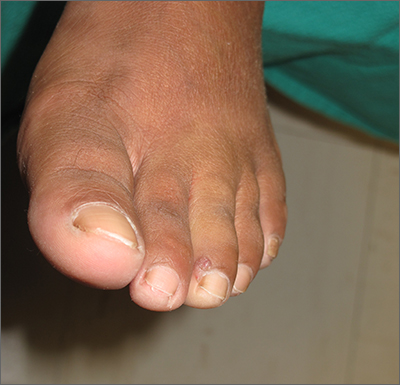
Shave biopsy was consistent with a solitary periungual angiofibroma, often termed a Koenen tumor. These can manifest as a soft pink papule (as with this patient), sometimes with a distal keratinaceous tip. At times, the nail bed and nail plate may be deformed because of the angiofibroma.
Periungual angiofibromas can occur sporadically in children and adults, it was a solitary finding in this case. Importantly, periungual angiofibromas may also occur as a visible sign of a multisystem genetic disorder known as tuberous sclerosis complex (TSC). TSC causes benign tumors to develop throughout the body (eg, skin, brain, heart, lungs). The condition can be mild or lead to serious disabilities, including seizures and developmental delays.
In isolation, periungual angiofibromas are benign but occasionally hurt or bleed from light trauma. In such cases, or for cosmetic reasons, patients may seek treatments. Complete excision of the lesion may include the affected portion of the nail bed or matrix. This is more easily repaired when the lesion is on the lateral nail fold, facilitating an en bloc fusiform excision and matrixectomy.1 Surgical excision of a lesion in the mid-proximal nail fold is much more likely to result in long-term nail deformity. Electrosurgery and various laser modalities have been successful as less invasive removal options.2 While expensive, topical sirolimus 1% has been used successfully in sporadic angiofibromas and those associated with TSC.
The patient in this case underwent lateral nail fold excision with complete removal of the tumor and repair with a side-to-side closure.
Text courtesy of Jonathan Karnes, MD, medical director, MDFMR Dermatology Services, Augusta, ME. Photos courtesy of Jonathan Karnes, MD (copyright retained).
1. Tisa LM, Iurcotta A. Solitary periungual angiofibroma. An unusual case report. J Am Podiatr Med Assoc. 1993;83:679-80. doi: 10.7547/87507315-83-12-679
2. Boixeda P, Sánchez-Miralles E, Azaña JM, et al. CO2, argon, and pulsed dye laser treatment of angiofibromas. J Dermatol Surg Oncol. 1994;20:808-812. doi: 10.1111/j.1524- 4725.1994.tb03709.x
Shave biopsy was consistent with a solitary periungual angiofibroma, often termed a Koenen tumor. These can manifest as a soft pink papule (as with this patient), sometimes with a distal keratinaceous tip. At times, the nail bed and nail plate may be deformed because of the angiofibroma.
Periungual angiofibromas can occur sporadically in children and adults, it was a solitary finding in this case. Importantly, periungual angiofibromas may also occur as a visible sign of a multisystem genetic disorder known as tuberous sclerosis complex (TSC). TSC causes benign tumors to develop throughout the body (eg, skin, brain, heart, lungs). The condition can be mild or lead to serious disabilities, including seizures and developmental delays.
In isolation, periungual angiofibromas are benign but occasionally hurt or bleed from light trauma. In such cases, or for cosmetic reasons, patients may seek treatments. Complete excision of the lesion may include the affected portion of the nail bed or matrix. This is more easily repaired when the lesion is on the lateral nail fold, facilitating an en bloc fusiform excision and matrixectomy.1 Surgical excision of a lesion in the mid-proximal nail fold is much more likely to result in long-term nail deformity. Electrosurgery and various laser modalities have been successful as less invasive removal options.2 While expensive, topical sirolimus 1% has been used successfully in sporadic angiofibromas and those associated with TSC.
The patient in this case underwent lateral nail fold excision with complete removal of the tumor and repair with a side-to-side closure.
Text courtesy of Jonathan Karnes, MD, medical director, MDFMR Dermatology Services, Augusta, ME. Photos courtesy of Jonathan Karnes, MD (copyright retained).
Shave biopsy was consistent with a solitary periungual angiofibroma, often termed a Koenen tumor. These can manifest as a soft pink papule (as with this patient), sometimes with a distal keratinaceous tip. At times, the nail bed and nail plate may be deformed because of the angiofibroma.
Periungual angiofibromas can occur sporadically in children and adults, it was a solitary finding in this case. Importantly, periungual angiofibromas may also occur as a visible sign of a multisystem genetic disorder known as tuberous sclerosis complex (TSC). TSC causes benign tumors to develop throughout the body (eg, skin, brain, heart, lungs). The condition can be mild or lead to serious disabilities, including seizures and developmental delays.
In isolation, periungual angiofibromas are benign but occasionally hurt or bleed from light trauma. In such cases, or for cosmetic reasons, patients may seek treatments. Complete excision of the lesion may include the affected portion of the nail bed or matrix. This is more easily repaired when the lesion is on the lateral nail fold, facilitating an en bloc fusiform excision and matrixectomy.1 Surgical excision of a lesion in the mid-proximal nail fold is much more likely to result in long-term nail deformity. Electrosurgery and various laser modalities have been successful as less invasive removal options.2 While expensive, topical sirolimus 1% has been used successfully in sporadic angiofibromas and those associated with TSC.
The patient in this case underwent lateral nail fold excision with complete removal of the tumor and repair with a side-to-side closure.
Text courtesy of Jonathan Karnes, MD, medical director, MDFMR Dermatology Services, Augusta, ME. Photos courtesy of Jonathan Karnes, MD (copyright retained).
1. Tisa LM, Iurcotta A. Solitary periungual angiofibroma. An unusual case report. J Am Podiatr Med Assoc. 1993;83:679-80. doi: 10.7547/87507315-83-12-679
2. Boixeda P, Sánchez-Miralles E, Azaña JM, et al. CO2, argon, and pulsed dye laser treatment of angiofibromas. J Dermatol Surg Oncol. 1994;20:808-812. doi: 10.1111/j.1524- 4725.1994.tb03709.x
1. Tisa LM, Iurcotta A. Solitary periungual angiofibroma. An unusual case report. J Am Podiatr Med Assoc. 1993;83:679-80. doi: 10.7547/87507315-83-12-679
2. Boixeda P, Sánchez-Miralles E, Azaña JM, et al. CO2, argon, and pulsed dye laser treatment of angiofibromas. J Dermatol Surg Oncol. 1994;20:808-812. doi: 10.1111/j.1524- 4725.1994.tb03709.x
Meta-analysis evaluates probiotic vs drug intervention in IBS
Key clinical point: Both probiotic and drug interventions decreased the persistence of irritable bowel syndrome (IBS) symptoms and abdominal pain scores compared with placebo in patients with IBS.
Major finding: Compared with placebo, both probiotic and drug interventions improved the persistence of IBS symptoms (relative risk [RR] 0.68; 95% CI 0.51-0.92, and RR 0.87; 95% CI 0.81-0.92, respectively) and abdominal pain scores (standardized mean difference [SMD] −0.35; 95% CI −0.56 to −0.14, and SMD −0.10; 95% CI −0.20 to 0.00, respectively).
Study details Findings are from a systematic review and meta-analysis of 32 randomized controlled trials including adults with IBS.
Disclosures: This study did not receive financial support. The authors declared being scientific advisory board members or serving as consultants for various sources.
Source: van der Geest AM et al. Comparing probiotic and drug interventions in irritable bowel syndrome: A meta-analysis of randomised controlled trials. Benef Microbes. 2022 (Jul 18). Doi: 10.3920/BM2021.0123
Key clinical point: Both probiotic and drug interventions decreased the persistence of irritable bowel syndrome (IBS) symptoms and abdominal pain scores compared with placebo in patients with IBS.
Major finding: Compared with placebo, both probiotic and drug interventions improved the persistence of IBS symptoms (relative risk [RR] 0.68; 95% CI 0.51-0.92, and RR 0.87; 95% CI 0.81-0.92, respectively) and abdominal pain scores (standardized mean difference [SMD] −0.35; 95% CI −0.56 to −0.14, and SMD −0.10; 95% CI −0.20 to 0.00, respectively).
Study details Findings are from a systematic review and meta-analysis of 32 randomized controlled trials including adults with IBS.
Disclosures: This study did not receive financial support. The authors declared being scientific advisory board members or serving as consultants for various sources.
Source: van der Geest AM et al. Comparing probiotic and drug interventions in irritable bowel syndrome: A meta-analysis of randomised controlled trials. Benef Microbes. 2022 (Jul 18). Doi: 10.3920/BM2021.0123
Key clinical point: Both probiotic and drug interventions decreased the persistence of irritable bowel syndrome (IBS) symptoms and abdominal pain scores compared with placebo in patients with IBS.
Major finding: Compared with placebo, both probiotic and drug interventions improved the persistence of IBS symptoms (relative risk [RR] 0.68; 95% CI 0.51-0.92, and RR 0.87; 95% CI 0.81-0.92, respectively) and abdominal pain scores (standardized mean difference [SMD] −0.35; 95% CI −0.56 to −0.14, and SMD −0.10; 95% CI −0.20 to 0.00, respectively).
Study details Findings are from a systematic review and meta-analysis of 32 randomized controlled trials including adults with IBS.
Disclosures: This study did not receive financial support. The authors declared being scientific advisory board members or serving as consultants for various sources.
Source: van der Geest AM et al. Comparing probiotic and drug interventions in irritable bowel syndrome: A meta-analysis of randomised controlled trials. Benef Microbes. 2022 (Jul 18). Doi: 10.3920/BM2021.0123
Fecal microbiota transplantation shows promise in patients with refractory IBS
Key clinical point: Fecal microbiota transplantation (FMT) reduced disease severity, improved microbiome α-diversity, and demonstrated a favorable safety profile in patients with refractory irritable bowel syndrome (IBS).
Major finding: The IBS severity index improved significantly at 12 weeks after FMT (P = .001), with 58.8% of patients being responders (≥50-point decrease in IBS severity index). Responders showed a significant increase in the median α-diversity index (P = .017), increased abundance of Neisseria and Akkermansia bacteria, and decreased abundance of Desulfovibrio and Delftia bacteria. No severe adverse events were reported.
Study details Findings are from a prospective study including 17 patients with refractory IBS who received FMT under colonoscopy.
Disclosures: This study was partly supported by the Japan Society for the Promotion of Science. The authors declared no conflicts of interest.
Source: Hamazaki M et al. Fecal microbiota transplantation in the treatment of irritable bowel syndrome: A single-center prospective study in Japan. BMC Gastroenterol. 2022;22:342 (Jul 14). Doi: 10.1186/s12876-022-02408-5
Key clinical point: Fecal microbiota transplantation (FMT) reduced disease severity, improved microbiome α-diversity, and demonstrated a favorable safety profile in patients with refractory irritable bowel syndrome (IBS).
Major finding: The IBS severity index improved significantly at 12 weeks after FMT (P = .001), with 58.8% of patients being responders (≥50-point decrease in IBS severity index). Responders showed a significant increase in the median α-diversity index (P = .017), increased abundance of Neisseria and Akkermansia bacteria, and decreased abundance of Desulfovibrio and Delftia bacteria. No severe adverse events were reported.
Study details Findings are from a prospective study including 17 patients with refractory IBS who received FMT under colonoscopy.
Disclosures: This study was partly supported by the Japan Society for the Promotion of Science. The authors declared no conflicts of interest.
Source: Hamazaki M et al. Fecal microbiota transplantation in the treatment of irritable bowel syndrome: A single-center prospective study in Japan. BMC Gastroenterol. 2022;22:342 (Jul 14). Doi: 10.1186/s12876-022-02408-5
Key clinical point: Fecal microbiota transplantation (FMT) reduced disease severity, improved microbiome α-diversity, and demonstrated a favorable safety profile in patients with refractory irritable bowel syndrome (IBS).
Major finding: The IBS severity index improved significantly at 12 weeks after FMT (P = .001), with 58.8% of patients being responders (≥50-point decrease in IBS severity index). Responders showed a significant increase in the median α-diversity index (P = .017), increased abundance of Neisseria and Akkermansia bacteria, and decreased abundance of Desulfovibrio and Delftia bacteria. No severe adverse events were reported.
Study details Findings are from a prospective study including 17 patients with refractory IBS who received FMT under colonoscopy.
Disclosures: This study was partly supported by the Japan Society for the Promotion of Science. The authors declared no conflicts of interest.
Source: Hamazaki M et al. Fecal microbiota transplantation in the treatment of irritable bowel syndrome: A single-center prospective study in Japan. BMC Gastroenterol. 2022;22:342 (Jul 14). Doi: 10.1186/s12876-022-02408-5
Irritable bowel syndrome severely hampers work and daily living activities
Key clinical point: Patients with irritable bowel syndrome (IBS) report a substantial impact of IBS on their abilities to work and perform daily activities.
Major finding: Overall, 10.5% of patients reported being unemployed, partly because of their condition, with the median level of absenteeism, presenteeism, and overall work impairment among employed patients being 0.0% (interquartile range [IQR] 0.0%-2.9%), 35.0% (IQR, 20.0%-60.0%), and 30.0% (IQR, 10.0%-60.0%), respectively. Moreover, 91.0% and 56.3% of patients reported that IBS symptoms interfered with their daily and social leisure activities, respectively.
Study details: This was a questionnaire-based study including 752 patients with Rome IV-defined IBS.
Disclosures: This study was supported by Tillotts Pharma UK Ltd. The authors declared no conflicts of interest.
Source: Goodoory VC et al. Impact of Rome IV irritable bowel syndrome on work and activities of daily living .Aliment Pharmacol Ther. 2022 (Jul 6). Doi: 10.1111/apt.17132
Key clinical point: Patients with irritable bowel syndrome (IBS) report a substantial impact of IBS on their abilities to work and perform daily activities.
Major finding: Overall, 10.5% of patients reported being unemployed, partly because of their condition, with the median level of absenteeism, presenteeism, and overall work impairment among employed patients being 0.0% (interquartile range [IQR] 0.0%-2.9%), 35.0% (IQR, 20.0%-60.0%), and 30.0% (IQR, 10.0%-60.0%), respectively. Moreover, 91.0% and 56.3% of patients reported that IBS symptoms interfered with their daily and social leisure activities, respectively.
Study details: This was a questionnaire-based study including 752 patients with Rome IV-defined IBS.
Disclosures: This study was supported by Tillotts Pharma UK Ltd. The authors declared no conflicts of interest.
Source: Goodoory VC et al. Impact of Rome IV irritable bowel syndrome on work and activities of daily living .Aliment Pharmacol Ther. 2022 (Jul 6). Doi: 10.1111/apt.17132
Key clinical point: Patients with irritable bowel syndrome (IBS) report a substantial impact of IBS on their abilities to work and perform daily activities.
Major finding: Overall, 10.5% of patients reported being unemployed, partly because of their condition, with the median level of absenteeism, presenteeism, and overall work impairment among employed patients being 0.0% (interquartile range [IQR] 0.0%-2.9%), 35.0% (IQR, 20.0%-60.0%), and 30.0% (IQR, 10.0%-60.0%), respectively. Moreover, 91.0% and 56.3% of patients reported that IBS symptoms interfered with their daily and social leisure activities, respectively.
Study details: This was a questionnaire-based study including 752 patients with Rome IV-defined IBS.
Disclosures: This study was supported by Tillotts Pharma UK Ltd. The authors declared no conflicts of interest.
Source: Goodoory VC et al. Impact of Rome IV irritable bowel syndrome on work and activities of daily living .Aliment Pharmacol Ther. 2022 (Jul 6). Doi: 10.1111/apt.17132
Probiotics improve stool consistency and are well tolerated in IBS-C
Key clinical point: In patients with constipation-predominant irritable bowel syndrome (IBS-C), short-term treatment with probiotics vs placebo led to a significant improvement in stool consistency and increased the number of fecal bacteria without increasing adverse events.
Major finding: Probiotics vs placebo significantly improved stool consistency (mean difference [MD] 0.71; P < .05) in 8 weeks and increased the number of fecal Bifidobacterium (MD 1.76; P < .05) and Lactobacillus (MD 1.69; P < .05) in 4 weeks, although the effects were not significant with longer treatment duration. Adverse effects were not significantly different between the probiotic and placebo groups.
Study details Findings are from a systematic review and meta-analysis of 10 randomized controlled trials including 757 patients with IBS-C.
Disclosures: This study was supported by the National Natural Science Foundation of China, the Gansu Special Project of Soft Science, and others. The authors declared no conflicts of interest.
Source: Shang X et al. Effectiveness and safety of probiotics for patients with constipation-predominant irritable bowel syndrome: A systematic review and meta-analysis of 10 randomized controlled trials. Nutrients. 2022;14(12):2482 (Jun 15). Doi: 10.3390/nu14122482
Key clinical point: In patients with constipation-predominant irritable bowel syndrome (IBS-C), short-term treatment with probiotics vs placebo led to a significant improvement in stool consistency and increased the number of fecal bacteria without increasing adverse events.
Major finding: Probiotics vs placebo significantly improved stool consistency (mean difference [MD] 0.71; P < .05) in 8 weeks and increased the number of fecal Bifidobacterium (MD 1.76; P < .05) and Lactobacillus (MD 1.69; P < .05) in 4 weeks, although the effects were not significant with longer treatment duration. Adverse effects were not significantly different between the probiotic and placebo groups.
Study details Findings are from a systematic review and meta-analysis of 10 randomized controlled trials including 757 patients with IBS-C.
Disclosures: This study was supported by the National Natural Science Foundation of China, the Gansu Special Project of Soft Science, and others. The authors declared no conflicts of interest.
Source: Shang X et al. Effectiveness and safety of probiotics for patients with constipation-predominant irritable bowel syndrome: A systematic review and meta-analysis of 10 randomized controlled trials. Nutrients. 2022;14(12):2482 (Jun 15). Doi: 10.3390/nu14122482
Key clinical point: In patients with constipation-predominant irritable bowel syndrome (IBS-C), short-term treatment with probiotics vs placebo led to a significant improvement in stool consistency and increased the number of fecal bacteria without increasing adverse events.
Major finding: Probiotics vs placebo significantly improved stool consistency (mean difference [MD] 0.71; P < .05) in 8 weeks and increased the number of fecal Bifidobacterium (MD 1.76; P < .05) and Lactobacillus (MD 1.69; P < .05) in 4 weeks, although the effects were not significant with longer treatment duration. Adverse effects were not significantly different between the probiotic and placebo groups.
Study details Findings are from a systematic review and meta-analysis of 10 randomized controlled trials including 757 patients with IBS-C.
Disclosures: This study was supported by the National Natural Science Foundation of China, the Gansu Special Project of Soft Science, and others. The authors declared no conflicts of interest.
Source: Shang X et al. Effectiveness and safety of probiotics for patients with constipation-predominant irritable bowel syndrome: A systematic review and meta-analysis of 10 randomized controlled trials. Nutrients. 2022;14(12):2482 (Jun 15). Doi: 10.3390/nu14122482
Food supplements improve standard treatment efficacy in IBS
Key clinical point: Food supplements containing standardized menthol, limonene, and gingerol content significantly improved the efficacy of standard treatment in patients with irritable bowel syndrome (IBS) or IBS/functional dyspepsia (FD) without causing any obvious side effects.
Major finding: At visit 1 (before treatment), the median 7×7 questionnaire score of all patients indicated moderate illness. However, at visit 3, the score range indicated borderline illness in patients who received the food supplement and mild illness in those who received placebo (mean difference, −2.68; P = .009). No side effects were reported.
Study details Findings are from a randomized controlled trial including 56 patients with IBS or IBS/FD who were randomly assigned to receive food supplements or placebo in addition to the standard treatment regimen for 30 days.
Disclosures: This study did not receive any funding. The authors declared no conflicts of interest.
Source: Ivashkin VT et al. Efficacy and safety of a food supplement with standardized menthol, limonene, and gingerol content in patients with irritable bowel syndrome: A double-blind, randomized, placebo-controlled trial. PloS One. 2022;17(6):e0263880 (Jun 15). Doi: 10.1371/journal.pone.0263880
Key clinical point: Food supplements containing standardized menthol, limonene, and gingerol content significantly improved the efficacy of standard treatment in patients with irritable bowel syndrome (IBS) or IBS/functional dyspepsia (FD) without causing any obvious side effects.
Major finding: At visit 1 (before treatment), the median 7×7 questionnaire score of all patients indicated moderate illness. However, at visit 3, the score range indicated borderline illness in patients who received the food supplement and mild illness in those who received placebo (mean difference, −2.68; P = .009). No side effects were reported.
Study details Findings are from a randomized controlled trial including 56 patients with IBS or IBS/FD who were randomly assigned to receive food supplements or placebo in addition to the standard treatment regimen for 30 days.
Disclosures: This study did not receive any funding. The authors declared no conflicts of interest.
Source: Ivashkin VT et al. Efficacy and safety of a food supplement with standardized menthol, limonene, and gingerol content in patients with irritable bowel syndrome: A double-blind, randomized, placebo-controlled trial. PloS One. 2022;17(6):e0263880 (Jun 15). Doi: 10.1371/journal.pone.0263880
Key clinical point: Food supplements containing standardized menthol, limonene, and gingerol content significantly improved the efficacy of standard treatment in patients with irritable bowel syndrome (IBS) or IBS/functional dyspepsia (FD) without causing any obvious side effects.
Major finding: At visit 1 (before treatment), the median 7×7 questionnaire score of all patients indicated moderate illness. However, at visit 3, the score range indicated borderline illness in patients who received the food supplement and mild illness in those who received placebo (mean difference, −2.68; P = .009). No side effects were reported.
Study details Findings are from a randomized controlled trial including 56 patients with IBS or IBS/FD who were randomly assigned to receive food supplements or placebo in addition to the standard treatment regimen for 30 days.
Disclosures: This study did not receive any funding. The authors declared no conflicts of interest.
Source: Ivashkin VT et al. Efficacy and safety of a food supplement with standardized menthol, limonene, and gingerol content in patients with irritable bowel syndrome: A double-blind, randomized, placebo-controlled trial. PloS One. 2022;17(6):e0263880 (Jun 15). Doi: 10.1371/journal.pone.0263880
Serum zinc levels, poor mood states, and QoL in diarrhea-predominant IBS
Key clinical point: Patients with diarrhea-predominant irritable bowel syndrome (IBS-D) vs healthy controls had lower serum zinc levels and poor scores for the quality of life (QoL) and physical and psychological health, and higher scores for depression, anxiety, and stress.
Major finding: Patients with IBS-D vs healthy controls reported significantly lower serum zinc levels (P = .001); mean scores for overall QoL and general health (53.48 vs 72.74; P ≤ .001), physical health (59.59 vs 71.30; P ≤ .001), and psychological health (55.80 vs 65.22; P ≤ .001); and higher mean scores for depression (P = .014), anxiety (P = .005), and stress (P = .001). Higher dietary zinc intake improved body image in patients with IBS-D (r 0.266; P = .044) without significantly influencing other parameters.
Study details: This was a case-control study including patients newly diagnosed with IBS-D (n = 61) and matched healthy controls (n = 61).
Disclosures: This study was supported by the Vice-Chancellor for Research of Isfahan University of Medical Sciences. The authors declared no conflicts of interest.
Source: Rezazadegan M et al. Sci Rep. 2022 Jun 29. doi: 10.1038/s41598-022-15080-2.
Key clinical point: Patients with diarrhea-predominant irritable bowel syndrome (IBS-D) vs healthy controls had lower serum zinc levels and poor scores for the quality of life (QoL) and physical and psychological health, and higher scores for depression, anxiety, and stress.
Major finding: Patients with IBS-D vs healthy controls reported significantly lower serum zinc levels (P = .001); mean scores for overall QoL and general health (53.48 vs 72.74; P ≤ .001), physical health (59.59 vs 71.30; P ≤ .001), and psychological health (55.80 vs 65.22; P ≤ .001); and higher mean scores for depression (P = .014), anxiety (P = .005), and stress (P = .001). Higher dietary zinc intake improved body image in patients with IBS-D (r 0.266; P = .044) without significantly influencing other parameters.
Study details: This was a case-control study including patients newly diagnosed with IBS-D (n = 61) and matched healthy controls (n = 61).
Disclosures: This study was supported by the Vice-Chancellor for Research of Isfahan University of Medical Sciences. The authors declared no conflicts of interest.
Source: Rezazadegan M et al. Sci Rep. 2022 Jun 29. doi: 10.1038/s41598-022-15080-2.
Key clinical point: Patients with diarrhea-predominant irritable bowel syndrome (IBS-D) vs healthy controls had lower serum zinc levels and poor scores for the quality of life (QoL) and physical and psychological health, and higher scores for depression, anxiety, and stress.
Major finding: Patients with IBS-D vs healthy controls reported significantly lower serum zinc levels (P = .001); mean scores for overall QoL and general health (53.48 vs 72.74; P ≤ .001), physical health (59.59 vs 71.30; P ≤ .001), and psychological health (55.80 vs 65.22; P ≤ .001); and higher mean scores for depression (P = .014), anxiety (P = .005), and stress (P = .001). Higher dietary zinc intake improved body image in patients with IBS-D (r 0.266; P = .044) without significantly influencing other parameters.
Study details: This was a case-control study including patients newly diagnosed with IBS-D (n = 61) and matched healthy controls (n = 61).
Disclosures: This study was supported by the Vice-Chancellor for Research of Isfahan University of Medical Sciences. The authors declared no conflicts of interest.
Source: Rezazadegan M et al. Sci Rep. 2022 Jun 29. doi: 10.1038/s41598-022-15080-2.
IBS: Effect of a low FODMAP diet on the colonic microbiome
Key clinical point: Compared with the control diet, a diet low in fermentable oligosaccharides, disaccharides, monosaccharides, and polyols (FODMAP) reduced the abundance of Bifidobacteria in the colonic microbiome of patients with irritable bowel syndrome (IBS), with no significant impact on other microbiome metrics.
Major finding: Overall, a low FODMAP diet had no clear impact on the microbiome biodiversity, total fecal short-chain fatty acid concentration (P = .20), and fecal pH (P = .14) compared with the control diet, but it was consistently associated with a reduced abundance of Bifidobacteria in the colonic microbiome.
Study details: Findings are from a systematic review and meta-analysis of 9 randomized controlled trials and 1 secondary publication including 403 patients with IBS who received a low FODMAP or control diet.
Disclosures: This study did not receive any funding. D So declared working in a department benefitting from the sales of a digital application and booklets on a low FODMAP diet.
Source: So D et al. Effects of a low FODMAP diet on the colonic microbiome in irritable bowel syndrome: A systematic review with meta-analysis. Am J Clin Nutr. 2022 (Jun 21). Doi: 10.1093/ajcn/nqac176
Key clinical point: Compared with the control diet, a diet low in fermentable oligosaccharides, disaccharides, monosaccharides, and polyols (FODMAP) reduced the abundance of Bifidobacteria in the colonic microbiome of patients with irritable bowel syndrome (IBS), with no significant impact on other microbiome metrics.
Major finding: Overall, a low FODMAP diet had no clear impact on the microbiome biodiversity, total fecal short-chain fatty acid concentration (P = .20), and fecal pH (P = .14) compared with the control diet, but it was consistently associated with a reduced abundance of Bifidobacteria in the colonic microbiome.
Study details: Findings are from a systematic review and meta-analysis of 9 randomized controlled trials and 1 secondary publication including 403 patients with IBS who received a low FODMAP or control diet.
Disclosures: This study did not receive any funding. D So declared working in a department benefitting from the sales of a digital application and booklets on a low FODMAP diet.
Source: So D et al. Effects of a low FODMAP diet on the colonic microbiome in irritable bowel syndrome: A systematic review with meta-analysis. Am J Clin Nutr. 2022 (Jun 21). Doi: 10.1093/ajcn/nqac176
Key clinical point: Compared with the control diet, a diet low in fermentable oligosaccharides, disaccharides, monosaccharides, and polyols (FODMAP) reduced the abundance of Bifidobacteria in the colonic microbiome of patients with irritable bowel syndrome (IBS), with no significant impact on other microbiome metrics.
Major finding: Overall, a low FODMAP diet had no clear impact on the microbiome biodiversity, total fecal short-chain fatty acid concentration (P = .20), and fecal pH (P = .14) compared with the control diet, but it was consistently associated with a reduced abundance of Bifidobacteria in the colonic microbiome.
Study details: Findings are from a systematic review and meta-analysis of 9 randomized controlled trials and 1 secondary publication including 403 patients with IBS who received a low FODMAP or control diet.
Disclosures: This study did not receive any funding. D So declared working in a department benefitting from the sales of a digital application and booklets on a low FODMAP diet.
Source: So D et al. Effects of a low FODMAP diet on the colonic microbiome in irritable bowel syndrome: A systematic review with meta-analysis. Am J Clin Nutr. 2022 (Jun 21). Doi: 10.1093/ajcn/nqac176
Enterosgel shows significant treatment benefits in IBS with diarrhea
Key clinical point: In patients with irritable bowel syndrome with diarrhea (IBS-D), enterosgel vs placebo significantly improved abdominal pain and stool consistency, along with improving global symptoms and demonstrating a favorable safety profile.
Major finding: Significantly higher proportion of patients receiving enterosgel vs placebo showed response for the composite of abdominal pain and stool consistency during at least 4 weeks in the 8-week treatment period (37.4% vs 24.3%; adjusted odds ratio 1.95; P = .0020), with significant benefits for bloating (P = .0021), urgency (P < .0001), and loperamide use (P = .0049), and adequate relief from symptoms (P < .0001) in weeks 1-8. There were no enterosgel-related serious adverse events.
Study details Findings are from a randomized controlled trial including 431 patients with IBS-D who received enterosgel or placebo.
Disclosures: This study was funded by Bioline Products s.r.o. E Markaryan declared being the CEO of Enteromed, the study sponsor. CA Howell declared being an employee of Enteromed. The other authors declared being subcontracted by the sponsor or serving as chief investigator or trial steering committee members.
Source: Howell CA et al. Double-blinded randomised placebo controlled trial of enterosgel (polymethylsiloxane polyhydrate) for the treatment of IBS with diarrhoea (IBS-D). Gut. 2022 (Jun 27). Doi: 10.1136/gutjnl-2022-327293
Key clinical point: In patients with irritable bowel syndrome with diarrhea (IBS-D), enterosgel vs placebo significantly improved abdominal pain and stool consistency, along with improving global symptoms and demonstrating a favorable safety profile.
Major finding: Significantly higher proportion of patients receiving enterosgel vs placebo showed response for the composite of abdominal pain and stool consistency during at least 4 weeks in the 8-week treatment period (37.4% vs 24.3%; adjusted odds ratio 1.95; P = .0020), with significant benefits for bloating (P = .0021), urgency (P < .0001), and loperamide use (P = .0049), and adequate relief from symptoms (P < .0001) in weeks 1-8. There were no enterosgel-related serious adverse events.
Study details Findings are from a randomized controlled trial including 431 patients with IBS-D who received enterosgel or placebo.
Disclosures: This study was funded by Bioline Products s.r.o. E Markaryan declared being the CEO of Enteromed, the study sponsor. CA Howell declared being an employee of Enteromed. The other authors declared being subcontracted by the sponsor or serving as chief investigator or trial steering committee members.
Source: Howell CA et al. Double-blinded randomised placebo controlled trial of enterosgel (polymethylsiloxane polyhydrate) for the treatment of IBS with diarrhoea (IBS-D). Gut. 2022 (Jun 27). Doi: 10.1136/gutjnl-2022-327293
Key clinical point: In patients with irritable bowel syndrome with diarrhea (IBS-D), enterosgel vs placebo significantly improved abdominal pain and stool consistency, along with improving global symptoms and demonstrating a favorable safety profile.
Major finding: Significantly higher proportion of patients receiving enterosgel vs placebo showed response for the composite of abdominal pain and stool consistency during at least 4 weeks in the 8-week treatment period (37.4% vs 24.3%; adjusted odds ratio 1.95; P = .0020), with significant benefits for bloating (P = .0021), urgency (P < .0001), and loperamide use (P = .0049), and adequate relief from symptoms (P < .0001) in weeks 1-8. There were no enterosgel-related serious adverse events.
Study details Findings are from a randomized controlled trial including 431 patients with IBS-D who received enterosgel or placebo.
Disclosures: This study was funded by Bioline Products s.r.o. E Markaryan declared being the CEO of Enteromed, the study sponsor. CA Howell declared being an employee of Enteromed. The other authors declared being subcontracted by the sponsor or serving as chief investigator or trial steering committee members.
Source: Howell CA et al. Double-blinded randomised placebo controlled trial of enterosgel (polymethylsiloxane polyhydrate) for the treatment of IBS with diarrhoea (IBS-D). Gut. 2022 (Jun 27). Doi: 10.1136/gutjnl-2022-327293