User login
For MD-IQ use only
Battling pediatric cancer outcome disparities, new interventions aim to close gaps
Pediatric oncologist Lena Winestone, MD, recalls treating a 2-year-old leukemia patient who underwent a bone marrow transplant as her only chance for a cure.
The girl’s family, who spoke only Spanish and struggled with literacy, could not pay their rent or afford the girl’s weekly transportation to the hospital for after-transplant care. The family had three other children and lived more than 2 hours from the transplant center, remembers Dr. Winestone, an assistant professor of pediatrics in the division of malignancies and bone & marrow transplant at the University of California, San Francisco.
The hospital’s social worker was able to secure grant support for the family’s housing and worked with the patient’s insurance to arrange for transportation. However, the departure times were rigid, Dr. Winestone said, and the family sometimes had to leave the hospital before the child’s graft vs. host disease (GvHD) treatment was complete for the day.
“If we had not finished her treatment, we had to disconnect her from the machine early,” Dr. Winestone said. “Her mother also had to load her oxygen tanks [three of them], her BiPAP machine, and her tube feeds into the transportation every week in order to make sure she could be safely transported. She was treated for GvHD for almost 2 years, but unfortunately, her GvHD started to affect her lungs and ultimately, she passed away.”
Dr. Winestone says it’s difficult to know whether the girl’s death was directly related to her socioeconomic status, but that it certainly made all aspects of the child’s care more complicated and forced health care providers to adapt her cancer care to accommodate the family’s circumstances.
This story is one of countless cases where socioeconomic status impacted a young patient’s cancer care and likely contributed to a worse outcome.
A 2022 study for example, found that children from marginalized racial/ethnic groups and those living in poverty were more likely to have inferior 5-year overall survival, compared with other children, even when assigned to receive the same initial treatment. Of 696 children with high-risk neuroblastoma, 47% of Hispanic children had a 5-year overall survival (OS), compared with 50% for other non-Hispanic children, and 61% for white non-Hispanic patients. Children on public health insurance (a proxy for household poverty) had a 53% 5-year OS, compared with 63% for children unexposed to household poverty. Pediatric patients exposed to neighborhood poverty had a 54% 5-year OS, compared with 62% for unexposed children.
In another study, children with acute lymphoblastic leukemia who lived in high-poverty areas were more likely to experience early relapse than other patients, despite having the same treatment. Of the 575 children studied, 92% of children from high-poverty areas who relapsed, experienced early relapse, defined as less than 36 months after remission. By comparison, only 48% of other children who relapsed experienced early relapse.
Reasons behind the relapse and survival disparities are multifold, which has led to challenges in addressing the gaps and improving cancer outcomes for poverty-stricken children. A research infrastructure that is largely based on biological, rather than social determinants of health, acts as another barrier, oncologists say.
Historically, interventions to address disparities in pediatric oncology have never been evaluated, said Kira Bona, MD, MPH, a pediatric oncologist at Dana-Farber/Boston Children’s Cancer and Blood Disorders Center. This is in large part because the body of literature illustrating the disparities is relatively new, said Dr. Bona, whose research focuses on poverty-associated outcome disparities in childhood cancer.
However, new efforts aim to change this landscape by using the growing data to develop and analyze possible interventions. A set of three novel interventions led by Dr. Bona and her research team are in the works, some of which have shown promise in early studies.
“Now is the time to begin to actively intervene on disparities in childhood cancer,” Dr. Bona said. “We’re really good at studying genetic mutations in cancer cells that might lead to a risk of relapse, and when we identify those mutations, what we do is intervene. We try new chemotherapy agents, new ways of delivering therapy. We are now at the point where we have identified that social determinants of health may be equally ‘risky’ but we haven’t taken the next step to begin intervening in the same way.”
What is causing disparities in pediatric cancer outcomes?
Lack of access to the health care system is a top contributor to the disparities, although there is no single root cause, said Sharon Castellino, MD, director of the Leukemia and Lymphoma Program at the Aflac Cancer & Blood Disorders Center of Children’s Healthcare of Atlanta, and a professor in the department of pediatrics at Emory University, Atlanta.
Even before cancer diagnosis, Dr. Castellino notes that many children of color and/or of lower socioeconomic status are not receiving regular health care, leading to sicker children and more advanced-stage cancer by the time they are diagnosed.
Lack of insurance is a primary barrier to this access, adds Xu Ji, PhD, MSPH, an assistant professor in the department of pediatrics at Emory University and a member of the Cancer Prevention and Control Research Program at the university’s Winship Cancer Institute.
Studies have long shown that uninsured children are more likely to go without needed care, compared with those with private insurance. Patients of color are at much higher risk of being uninsured than White patients, with the uninsured rates for Hispanic, American Indian, and Alaska Native patients being more than 2.5 times higher than that of White patients.
“We all know that insurance is a strong predictor of health outcomes,” said Dr. Ji, whose research focuses on insurance disparities and gains among cancer patients. “Lack of insurance coverage and therefore lack of access to care along the pediatric cancer continuum from early detection to early diagnosis to timely initiation of treatment to receipt of high-quality treatment to access to recommended survivorship care and even access to palliative and end-of-life care are all very important constructs in the pathway from poverty to ultimate cancer outcomes for children.”
Unstable housing, employment difficulties, and lack of family support can also come into play. Dr. Castellino remembers the case of a 12-year-old cancer patient who entered treatment with advanced-stage Hodgkin Lymphoma. The girl came from a low-income, single-parent household without stable housing. Dr. Castellino said when the child was granted a wish from the Make-a-Wish Foundation, she asked for her own bed.
“We had been working with her every week for 6 months when that request came up,” she recalled. “We said, ‘You don’t have to wait for your make-a-wish, we can get you a bed now.’ We don’t even know the extent of what happens at home for many of these children.”
The impact of toxic stress on child cancer patients is an emerging area of research, said Dr. Winestone, whose research explores racial, ethnic, and socioeconomic disparities in access to care and outcomes of leukemia and lymphoma treatment. For example, Dr. Winestone’s research includes understanding how exposure to poverty or adverse experiences in childhood may influence a patient’s biological response to chemotherapy.
Other contributors to disparities include transportation issues, lack of childcare for other children, literacy, and language barriers. A 2016 study suggests that language barriers negatively impact the quality of informed decision-making and the care experience for Spanish-speaking parents of pediatric cancer patients with limited English proficiency.
Such access issues are also compounded by systemic factors, including a shortage of physicians of color who may be able to forge better trust relationships with families of similar race and ethnicity, Dr. Castellino adds. Lower enrollment of pediatric cancer patients with higher social vulnerabilities in clinical trials is another problem.
“In childhood cancer, I believe our improvements have been built on the backs of prior generations of families and children who have enrolled in trials. We learn things, and the next generation of therapy improves,” Dr. Castellino said. “If you have a whole group of the population not represented in trials, you don’t know what’s driving the fact they may or may not improve.”
Working toward solutions
With such a diverse set of factors fueling outcome gaps, a similarly diverse approach is needed to help bridge the divide, say disparity researchers.
To this end, Dr. Bona and her research team are currently building the first portfolio of health equity interventions, each designed to address a different adverse social determinant of health differently.
The Pediatric Cancer Resource Equity (PediCARE) intervention is a centrally delivered, household material hardship (HMH)–targeted intervention that provides transportation and groceries to low-income pediatric oncology families. The intervention was recently studied in a pilot, randomized, controlled trial at Dana-Farber Cancer Institute and the University of Alabama between May 2019 and August 2021.
Families were first screened for HMH and randomized into receiving either the intervention or usual care for 6 months. The intervention group received groceries via Instacart and transportation to and from the hospital coordinated through the Ride Health platform using Uber or Lyft. For families with their own cars, gas cards were provided. Of the families offered the chance to participate, 100% agreed to participate in the program, and there was 0% attrition in either arm of the program during the 6 months, according to the study findings, which were presented at the 2023 American Society of Clinical Oncology annual meeting in June.
Among families who received the PediCARE intervention, 100% successfully received grocery and transportation resources, 100% reported that it was “easier to buy food for my family,” 85% reported it was easier to get to and from the hospital, and 95% reported they would be “very likely to recommend the intervention to other families,” according to the results.
“The key takeaway is that we had excellent feasibility outcomes,” said Haley Newman, MD, lead author of the study and an attending physician in the division of oncology at The Children’s Hospital of Philadelphia. “From this study, we learned that PediCARE is accessible and feasible in very diverse settings. From this, what we really took away is that PediCARE could be successfully rolled out in a phase 3 randomized trial, which would be the best way to examine efficacy.”
Another initiative in its early stages is Pediatric RISE, a guaranteed income intervention being developed with support from the Children’s Cancer Research Fund, the American Cancer Society, and other donors. The intervention will provide unrestricted cash transfers to low-income families during the early months of chemotherapy, Dr. Bona said. Families are currently being enrolled in a pilot study with a goal of refining the intervention before it’s tested for feasibility and efficacy.
“The goal here is ultimately to evaluate the question: If we are able to successfully provide income support to low-income families going through childhood cancer treatment, might we be able to ameliorate some of the disparities associated with living in poverty that we have already described in childhood cancer,” Dr. Bona said.
Pediatric Assist, a developing intervention centering on benefits, is a third initiative that will soon be evaluated. The intervention will provide newly diagnosed families with systemic access to a centralized benefits counselor who can help them determine which existing government benefits they might be eligible for and assist them in navigating the application process.
“The idea here is that we know many lower-income families in the U.S. are eligible for existing supports, but may not be accessing them because of how incredibly difficult the system is to navigate,” Dr. Bona said. “For example, we know that low-income families may be eligible for SNAP benefits, but figuring out if you are eligible and then applying for SNAP involves multiple, complicated steps that are often infeasible for a parent when their child is admitted to the hospital with a newly diagnosed, life-threatening illness.”
Pilot refinement of the intervention is expected in the fall of 2023.
Overcoming barriers, addressing challenges
Investigators are also making headway in proving that collecting social determinants of health (SDoH) data during existing clinical trials is easily achievable.
Past Children’s Oncology Group trials have collected only race, ethnicity, insurance, and zip code data as proxies for exposure to adverse SDoH. Dr. Winestone and her colleagues recently investigated the feasibility and acceptability of the first COG trial to prospectively embed SDoH data collection.
Of eligible participants, 360 of 413 opted-in to the embedded SDOH aim across 101 COG sites (87.2% consent rate). Among participants, 316 surveys (87.8%) were completed a median of 11 days post enrollment, according to the findings, which were presented at the ASCO annual meeting.
“We’ve come to realize the importance of the social determinants of health [as it pertains] to outcomes, but it has been a process to learn how to effectively collect that data in a large collaborative environment,” said Dr. Winestone. “This abstract demonstrates that patients are very willing to provide this data, and they’re able to do it in an efficient way. People think of these questions as very sensitive and that families may not want to share the answers, but this study demonstrates those presumptions are false.”
The authors hope the findings fuel incorporation of SDoH data collection in future National Clinical Trials Network trials to inform impactful health equity research.
While such research and intervention efforts are gaining momentum, challenges to do the work remain. A lack of research funding and support are among the obstacles, Dr. Winestone said.
To date, much of pediatric cancer work has focused on developing new therapeutic approaches to reach a cure for more patients, she explained.
“While that’s incredibly essential, if we’re creating these approaches that only work for a subset of patients that have resources, we’re contributing to the inequities in the system,” Dr. Winestone said. “Really, [we need] dedicated support to studying how to make sure the interventions we know are effective are reaching all populations, and that the patients are poised to benefit from those interventions by setting them up for success.”
A strong research infrastructure exists to evaluate and support clinical drug trials in pediatric oncology, but the same does not exist for health equity interventions, Dr. Bona adds. A significant question that needs to be addressed is how best to integrate health equity evaluation into existing infrastructure or whether to build a parallel infrastructure.
Despite the challenges, Dr. Bona believes now is exactly the right time to investigate and intervene in poverty as a risk factor for childhood cancer relapse and outcomes. What has led to success in childhood cancer is how pediatric oncology has collaborated across the country to operate clinical drug trials at various centers, all in the same way, to identify which treatments work best, she said.
“We have an opportunity now in pediatrics to take advantage of this highly successful clinical trials research infrastructure to integrate interventions to address disparities in a way that has not been done previously,” she said. “The opportunity to significantly improve survival in childhood cancer by reducing disparities exists if we take this head on from a research and funding perspective and approach social risk factors just as we already know how to approach tumor genomic risk factors.”
Pediatric oncologist Lena Winestone, MD, recalls treating a 2-year-old leukemia patient who underwent a bone marrow transplant as her only chance for a cure.
The girl’s family, who spoke only Spanish and struggled with literacy, could not pay their rent or afford the girl’s weekly transportation to the hospital for after-transplant care. The family had three other children and lived more than 2 hours from the transplant center, remembers Dr. Winestone, an assistant professor of pediatrics in the division of malignancies and bone & marrow transplant at the University of California, San Francisco.
The hospital’s social worker was able to secure grant support for the family’s housing and worked with the patient’s insurance to arrange for transportation. However, the departure times were rigid, Dr. Winestone said, and the family sometimes had to leave the hospital before the child’s graft vs. host disease (GvHD) treatment was complete for the day.
“If we had not finished her treatment, we had to disconnect her from the machine early,” Dr. Winestone said. “Her mother also had to load her oxygen tanks [three of them], her BiPAP machine, and her tube feeds into the transportation every week in order to make sure she could be safely transported. She was treated for GvHD for almost 2 years, but unfortunately, her GvHD started to affect her lungs and ultimately, she passed away.”
Dr. Winestone says it’s difficult to know whether the girl’s death was directly related to her socioeconomic status, but that it certainly made all aspects of the child’s care more complicated and forced health care providers to adapt her cancer care to accommodate the family’s circumstances.
This story is one of countless cases where socioeconomic status impacted a young patient’s cancer care and likely contributed to a worse outcome.
A 2022 study for example, found that children from marginalized racial/ethnic groups and those living in poverty were more likely to have inferior 5-year overall survival, compared with other children, even when assigned to receive the same initial treatment. Of 696 children with high-risk neuroblastoma, 47% of Hispanic children had a 5-year overall survival (OS), compared with 50% for other non-Hispanic children, and 61% for white non-Hispanic patients. Children on public health insurance (a proxy for household poverty) had a 53% 5-year OS, compared with 63% for children unexposed to household poverty. Pediatric patients exposed to neighborhood poverty had a 54% 5-year OS, compared with 62% for unexposed children.
In another study, children with acute lymphoblastic leukemia who lived in high-poverty areas were more likely to experience early relapse than other patients, despite having the same treatment. Of the 575 children studied, 92% of children from high-poverty areas who relapsed, experienced early relapse, defined as less than 36 months after remission. By comparison, only 48% of other children who relapsed experienced early relapse.
Reasons behind the relapse and survival disparities are multifold, which has led to challenges in addressing the gaps and improving cancer outcomes for poverty-stricken children. A research infrastructure that is largely based on biological, rather than social determinants of health, acts as another barrier, oncologists say.
Historically, interventions to address disparities in pediatric oncology have never been evaluated, said Kira Bona, MD, MPH, a pediatric oncologist at Dana-Farber/Boston Children’s Cancer and Blood Disorders Center. This is in large part because the body of literature illustrating the disparities is relatively new, said Dr. Bona, whose research focuses on poverty-associated outcome disparities in childhood cancer.
However, new efforts aim to change this landscape by using the growing data to develop and analyze possible interventions. A set of three novel interventions led by Dr. Bona and her research team are in the works, some of which have shown promise in early studies.
“Now is the time to begin to actively intervene on disparities in childhood cancer,” Dr. Bona said. “We’re really good at studying genetic mutations in cancer cells that might lead to a risk of relapse, and when we identify those mutations, what we do is intervene. We try new chemotherapy agents, new ways of delivering therapy. We are now at the point where we have identified that social determinants of health may be equally ‘risky’ but we haven’t taken the next step to begin intervening in the same way.”
What is causing disparities in pediatric cancer outcomes?
Lack of access to the health care system is a top contributor to the disparities, although there is no single root cause, said Sharon Castellino, MD, director of the Leukemia and Lymphoma Program at the Aflac Cancer & Blood Disorders Center of Children’s Healthcare of Atlanta, and a professor in the department of pediatrics at Emory University, Atlanta.
Even before cancer diagnosis, Dr. Castellino notes that many children of color and/or of lower socioeconomic status are not receiving regular health care, leading to sicker children and more advanced-stage cancer by the time they are diagnosed.
Lack of insurance is a primary barrier to this access, adds Xu Ji, PhD, MSPH, an assistant professor in the department of pediatrics at Emory University and a member of the Cancer Prevention and Control Research Program at the university’s Winship Cancer Institute.
Studies have long shown that uninsured children are more likely to go without needed care, compared with those with private insurance. Patients of color are at much higher risk of being uninsured than White patients, with the uninsured rates for Hispanic, American Indian, and Alaska Native patients being more than 2.5 times higher than that of White patients.
“We all know that insurance is a strong predictor of health outcomes,” said Dr. Ji, whose research focuses on insurance disparities and gains among cancer patients. “Lack of insurance coverage and therefore lack of access to care along the pediatric cancer continuum from early detection to early diagnosis to timely initiation of treatment to receipt of high-quality treatment to access to recommended survivorship care and even access to palliative and end-of-life care are all very important constructs in the pathway from poverty to ultimate cancer outcomes for children.”
Unstable housing, employment difficulties, and lack of family support can also come into play. Dr. Castellino remembers the case of a 12-year-old cancer patient who entered treatment with advanced-stage Hodgkin Lymphoma. The girl came from a low-income, single-parent household without stable housing. Dr. Castellino said when the child was granted a wish from the Make-a-Wish Foundation, she asked for her own bed.
“We had been working with her every week for 6 months when that request came up,” she recalled. “We said, ‘You don’t have to wait for your make-a-wish, we can get you a bed now.’ We don’t even know the extent of what happens at home for many of these children.”
The impact of toxic stress on child cancer patients is an emerging area of research, said Dr. Winestone, whose research explores racial, ethnic, and socioeconomic disparities in access to care and outcomes of leukemia and lymphoma treatment. For example, Dr. Winestone’s research includes understanding how exposure to poverty or adverse experiences in childhood may influence a patient’s biological response to chemotherapy.
Other contributors to disparities include transportation issues, lack of childcare for other children, literacy, and language barriers. A 2016 study suggests that language barriers negatively impact the quality of informed decision-making and the care experience for Spanish-speaking parents of pediatric cancer patients with limited English proficiency.
Such access issues are also compounded by systemic factors, including a shortage of physicians of color who may be able to forge better trust relationships with families of similar race and ethnicity, Dr. Castellino adds. Lower enrollment of pediatric cancer patients with higher social vulnerabilities in clinical trials is another problem.
“In childhood cancer, I believe our improvements have been built on the backs of prior generations of families and children who have enrolled in trials. We learn things, and the next generation of therapy improves,” Dr. Castellino said. “If you have a whole group of the population not represented in trials, you don’t know what’s driving the fact they may or may not improve.”
Working toward solutions
With such a diverse set of factors fueling outcome gaps, a similarly diverse approach is needed to help bridge the divide, say disparity researchers.
To this end, Dr. Bona and her research team are currently building the first portfolio of health equity interventions, each designed to address a different adverse social determinant of health differently.
The Pediatric Cancer Resource Equity (PediCARE) intervention is a centrally delivered, household material hardship (HMH)–targeted intervention that provides transportation and groceries to low-income pediatric oncology families. The intervention was recently studied in a pilot, randomized, controlled trial at Dana-Farber Cancer Institute and the University of Alabama between May 2019 and August 2021.
Families were first screened for HMH and randomized into receiving either the intervention or usual care for 6 months. The intervention group received groceries via Instacart and transportation to and from the hospital coordinated through the Ride Health platform using Uber or Lyft. For families with their own cars, gas cards were provided. Of the families offered the chance to participate, 100% agreed to participate in the program, and there was 0% attrition in either arm of the program during the 6 months, according to the study findings, which were presented at the 2023 American Society of Clinical Oncology annual meeting in June.
Among families who received the PediCARE intervention, 100% successfully received grocery and transportation resources, 100% reported that it was “easier to buy food for my family,” 85% reported it was easier to get to and from the hospital, and 95% reported they would be “very likely to recommend the intervention to other families,” according to the results.
“The key takeaway is that we had excellent feasibility outcomes,” said Haley Newman, MD, lead author of the study and an attending physician in the division of oncology at The Children’s Hospital of Philadelphia. “From this study, we learned that PediCARE is accessible and feasible in very diverse settings. From this, what we really took away is that PediCARE could be successfully rolled out in a phase 3 randomized trial, which would be the best way to examine efficacy.”
Another initiative in its early stages is Pediatric RISE, a guaranteed income intervention being developed with support from the Children’s Cancer Research Fund, the American Cancer Society, and other donors. The intervention will provide unrestricted cash transfers to low-income families during the early months of chemotherapy, Dr. Bona said. Families are currently being enrolled in a pilot study with a goal of refining the intervention before it’s tested for feasibility and efficacy.
“The goal here is ultimately to evaluate the question: If we are able to successfully provide income support to low-income families going through childhood cancer treatment, might we be able to ameliorate some of the disparities associated with living in poverty that we have already described in childhood cancer,” Dr. Bona said.
Pediatric Assist, a developing intervention centering on benefits, is a third initiative that will soon be evaluated. The intervention will provide newly diagnosed families with systemic access to a centralized benefits counselor who can help them determine which existing government benefits they might be eligible for and assist them in navigating the application process.
“The idea here is that we know many lower-income families in the U.S. are eligible for existing supports, but may not be accessing them because of how incredibly difficult the system is to navigate,” Dr. Bona said. “For example, we know that low-income families may be eligible for SNAP benefits, but figuring out if you are eligible and then applying for SNAP involves multiple, complicated steps that are often infeasible for a parent when their child is admitted to the hospital with a newly diagnosed, life-threatening illness.”
Pilot refinement of the intervention is expected in the fall of 2023.
Overcoming barriers, addressing challenges
Investigators are also making headway in proving that collecting social determinants of health (SDoH) data during existing clinical trials is easily achievable.
Past Children’s Oncology Group trials have collected only race, ethnicity, insurance, and zip code data as proxies for exposure to adverse SDoH. Dr. Winestone and her colleagues recently investigated the feasibility and acceptability of the first COG trial to prospectively embed SDoH data collection.
Of eligible participants, 360 of 413 opted-in to the embedded SDOH aim across 101 COG sites (87.2% consent rate). Among participants, 316 surveys (87.8%) were completed a median of 11 days post enrollment, according to the findings, which were presented at the ASCO annual meeting.
“We’ve come to realize the importance of the social determinants of health [as it pertains] to outcomes, but it has been a process to learn how to effectively collect that data in a large collaborative environment,” said Dr. Winestone. “This abstract demonstrates that patients are very willing to provide this data, and they’re able to do it in an efficient way. People think of these questions as very sensitive and that families may not want to share the answers, but this study demonstrates those presumptions are false.”
The authors hope the findings fuel incorporation of SDoH data collection in future National Clinical Trials Network trials to inform impactful health equity research.
While such research and intervention efforts are gaining momentum, challenges to do the work remain. A lack of research funding and support are among the obstacles, Dr. Winestone said.
To date, much of pediatric cancer work has focused on developing new therapeutic approaches to reach a cure for more patients, she explained.
“While that’s incredibly essential, if we’re creating these approaches that only work for a subset of patients that have resources, we’re contributing to the inequities in the system,” Dr. Winestone said. “Really, [we need] dedicated support to studying how to make sure the interventions we know are effective are reaching all populations, and that the patients are poised to benefit from those interventions by setting them up for success.”
A strong research infrastructure exists to evaluate and support clinical drug trials in pediatric oncology, but the same does not exist for health equity interventions, Dr. Bona adds. A significant question that needs to be addressed is how best to integrate health equity evaluation into existing infrastructure or whether to build a parallel infrastructure.
Despite the challenges, Dr. Bona believes now is exactly the right time to investigate and intervene in poverty as a risk factor for childhood cancer relapse and outcomes. What has led to success in childhood cancer is how pediatric oncology has collaborated across the country to operate clinical drug trials at various centers, all in the same way, to identify which treatments work best, she said.
“We have an opportunity now in pediatrics to take advantage of this highly successful clinical trials research infrastructure to integrate interventions to address disparities in a way that has not been done previously,” she said. “The opportunity to significantly improve survival in childhood cancer by reducing disparities exists if we take this head on from a research and funding perspective and approach social risk factors just as we already know how to approach tumor genomic risk factors.”
Pediatric oncologist Lena Winestone, MD, recalls treating a 2-year-old leukemia patient who underwent a bone marrow transplant as her only chance for a cure.
The girl’s family, who spoke only Spanish and struggled with literacy, could not pay their rent or afford the girl’s weekly transportation to the hospital for after-transplant care. The family had three other children and lived more than 2 hours from the transplant center, remembers Dr. Winestone, an assistant professor of pediatrics in the division of malignancies and bone & marrow transplant at the University of California, San Francisco.
The hospital’s social worker was able to secure grant support for the family’s housing and worked with the patient’s insurance to arrange for transportation. However, the departure times were rigid, Dr. Winestone said, and the family sometimes had to leave the hospital before the child’s graft vs. host disease (GvHD) treatment was complete for the day.
“If we had not finished her treatment, we had to disconnect her from the machine early,” Dr. Winestone said. “Her mother also had to load her oxygen tanks [three of them], her BiPAP machine, and her tube feeds into the transportation every week in order to make sure she could be safely transported. She was treated for GvHD for almost 2 years, but unfortunately, her GvHD started to affect her lungs and ultimately, she passed away.”
Dr. Winestone says it’s difficult to know whether the girl’s death was directly related to her socioeconomic status, but that it certainly made all aspects of the child’s care more complicated and forced health care providers to adapt her cancer care to accommodate the family’s circumstances.
This story is one of countless cases where socioeconomic status impacted a young patient’s cancer care and likely contributed to a worse outcome.
A 2022 study for example, found that children from marginalized racial/ethnic groups and those living in poverty were more likely to have inferior 5-year overall survival, compared with other children, even when assigned to receive the same initial treatment. Of 696 children with high-risk neuroblastoma, 47% of Hispanic children had a 5-year overall survival (OS), compared with 50% for other non-Hispanic children, and 61% for white non-Hispanic patients. Children on public health insurance (a proxy for household poverty) had a 53% 5-year OS, compared with 63% for children unexposed to household poverty. Pediatric patients exposed to neighborhood poverty had a 54% 5-year OS, compared with 62% for unexposed children.
In another study, children with acute lymphoblastic leukemia who lived in high-poverty areas were more likely to experience early relapse than other patients, despite having the same treatment. Of the 575 children studied, 92% of children from high-poverty areas who relapsed, experienced early relapse, defined as less than 36 months after remission. By comparison, only 48% of other children who relapsed experienced early relapse.
Reasons behind the relapse and survival disparities are multifold, which has led to challenges in addressing the gaps and improving cancer outcomes for poverty-stricken children. A research infrastructure that is largely based on biological, rather than social determinants of health, acts as another barrier, oncologists say.
Historically, interventions to address disparities in pediatric oncology have never been evaluated, said Kira Bona, MD, MPH, a pediatric oncologist at Dana-Farber/Boston Children’s Cancer and Blood Disorders Center. This is in large part because the body of literature illustrating the disparities is relatively new, said Dr. Bona, whose research focuses on poverty-associated outcome disparities in childhood cancer.
However, new efforts aim to change this landscape by using the growing data to develop and analyze possible interventions. A set of three novel interventions led by Dr. Bona and her research team are in the works, some of which have shown promise in early studies.
“Now is the time to begin to actively intervene on disparities in childhood cancer,” Dr. Bona said. “We’re really good at studying genetic mutations in cancer cells that might lead to a risk of relapse, and when we identify those mutations, what we do is intervene. We try new chemotherapy agents, new ways of delivering therapy. We are now at the point where we have identified that social determinants of health may be equally ‘risky’ but we haven’t taken the next step to begin intervening in the same way.”
What is causing disparities in pediatric cancer outcomes?
Lack of access to the health care system is a top contributor to the disparities, although there is no single root cause, said Sharon Castellino, MD, director of the Leukemia and Lymphoma Program at the Aflac Cancer & Blood Disorders Center of Children’s Healthcare of Atlanta, and a professor in the department of pediatrics at Emory University, Atlanta.
Even before cancer diagnosis, Dr. Castellino notes that many children of color and/or of lower socioeconomic status are not receiving regular health care, leading to sicker children and more advanced-stage cancer by the time they are diagnosed.
Lack of insurance is a primary barrier to this access, adds Xu Ji, PhD, MSPH, an assistant professor in the department of pediatrics at Emory University and a member of the Cancer Prevention and Control Research Program at the university’s Winship Cancer Institute.
Studies have long shown that uninsured children are more likely to go without needed care, compared with those with private insurance. Patients of color are at much higher risk of being uninsured than White patients, with the uninsured rates for Hispanic, American Indian, and Alaska Native patients being more than 2.5 times higher than that of White patients.
“We all know that insurance is a strong predictor of health outcomes,” said Dr. Ji, whose research focuses on insurance disparities and gains among cancer patients. “Lack of insurance coverage and therefore lack of access to care along the pediatric cancer continuum from early detection to early diagnosis to timely initiation of treatment to receipt of high-quality treatment to access to recommended survivorship care and even access to palliative and end-of-life care are all very important constructs in the pathway from poverty to ultimate cancer outcomes for children.”
Unstable housing, employment difficulties, and lack of family support can also come into play. Dr. Castellino remembers the case of a 12-year-old cancer patient who entered treatment with advanced-stage Hodgkin Lymphoma. The girl came from a low-income, single-parent household without stable housing. Dr. Castellino said when the child was granted a wish from the Make-a-Wish Foundation, she asked for her own bed.
“We had been working with her every week for 6 months when that request came up,” she recalled. “We said, ‘You don’t have to wait for your make-a-wish, we can get you a bed now.’ We don’t even know the extent of what happens at home for many of these children.”
The impact of toxic stress on child cancer patients is an emerging area of research, said Dr. Winestone, whose research explores racial, ethnic, and socioeconomic disparities in access to care and outcomes of leukemia and lymphoma treatment. For example, Dr. Winestone’s research includes understanding how exposure to poverty or adverse experiences in childhood may influence a patient’s biological response to chemotherapy.
Other contributors to disparities include transportation issues, lack of childcare for other children, literacy, and language barriers. A 2016 study suggests that language barriers negatively impact the quality of informed decision-making and the care experience for Spanish-speaking parents of pediatric cancer patients with limited English proficiency.
Such access issues are also compounded by systemic factors, including a shortage of physicians of color who may be able to forge better trust relationships with families of similar race and ethnicity, Dr. Castellino adds. Lower enrollment of pediatric cancer patients with higher social vulnerabilities in clinical trials is another problem.
“In childhood cancer, I believe our improvements have been built on the backs of prior generations of families and children who have enrolled in trials. We learn things, and the next generation of therapy improves,” Dr. Castellino said. “If you have a whole group of the population not represented in trials, you don’t know what’s driving the fact they may or may not improve.”
Working toward solutions
With such a diverse set of factors fueling outcome gaps, a similarly diverse approach is needed to help bridge the divide, say disparity researchers.
To this end, Dr. Bona and her research team are currently building the first portfolio of health equity interventions, each designed to address a different adverse social determinant of health differently.
The Pediatric Cancer Resource Equity (PediCARE) intervention is a centrally delivered, household material hardship (HMH)–targeted intervention that provides transportation and groceries to low-income pediatric oncology families. The intervention was recently studied in a pilot, randomized, controlled trial at Dana-Farber Cancer Institute and the University of Alabama between May 2019 and August 2021.
Families were first screened for HMH and randomized into receiving either the intervention or usual care for 6 months. The intervention group received groceries via Instacart and transportation to and from the hospital coordinated through the Ride Health platform using Uber or Lyft. For families with their own cars, gas cards were provided. Of the families offered the chance to participate, 100% agreed to participate in the program, and there was 0% attrition in either arm of the program during the 6 months, according to the study findings, which were presented at the 2023 American Society of Clinical Oncology annual meeting in June.
Among families who received the PediCARE intervention, 100% successfully received grocery and transportation resources, 100% reported that it was “easier to buy food for my family,” 85% reported it was easier to get to and from the hospital, and 95% reported they would be “very likely to recommend the intervention to other families,” according to the results.
“The key takeaway is that we had excellent feasibility outcomes,” said Haley Newman, MD, lead author of the study and an attending physician in the division of oncology at The Children’s Hospital of Philadelphia. “From this study, we learned that PediCARE is accessible and feasible in very diverse settings. From this, what we really took away is that PediCARE could be successfully rolled out in a phase 3 randomized trial, which would be the best way to examine efficacy.”
Another initiative in its early stages is Pediatric RISE, a guaranteed income intervention being developed with support from the Children’s Cancer Research Fund, the American Cancer Society, and other donors. The intervention will provide unrestricted cash transfers to low-income families during the early months of chemotherapy, Dr. Bona said. Families are currently being enrolled in a pilot study with a goal of refining the intervention before it’s tested for feasibility and efficacy.
“The goal here is ultimately to evaluate the question: If we are able to successfully provide income support to low-income families going through childhood cancer treatment, might we be able to ameliorate some of the disparities associated with living in poverty that we have already described in childhood cancer,” Dr. Bona said.
Pediatric Assist, a developing intervention centering on benefits, is a third initiative that will soon be evaluated. The intervention will provide newly diagnosed families with systemic access to a centralized benefits counselor who can help them determine which existing government benefits they might be eligible for and assist them in navigating the application process.
“The idea here is that we know many lower-income families in the U.S. are eligible for existing supports, but may not be accessing them because of how incredibly difficult the system is to navigate,” Dr. Bona said. “For example, we know that low-income families may be eligible for SNAP benefits, but figuring out if you are eligible and then applying for SNAP involves multiple, complicated steps that are often infeasible for a parent when their child is admitted to the hospital with a newly diagnosed, life-threatening illness.”
Pilot refinement of the intervention is expected in the fall of 2023.
Overcoming barriers, addressing challenges
Investigators are also making headway in proving that collecting social determinants of health (SDoH) data during existing clinical trials is easily achievable.
Past Children’s Oncology Group trials have collected only race, ethnicity, insurance, and zip code data as proxies for exposure to adverse SDoH. Dr. Winestone and her colleagues recently investigated the feasibility and acceptability of the first COG trial to prospectively embed SDoH data collection.
Of eligible participants, 360 of 413 opted-in to the embedded SDOH aim across 101 COG sites (87.2% consent rate). Among participants, 316 surveys (87.8%) were completed a median of 11 days post enrollment, according to the findings, which were presented at the ASCO annual meeting.
“We’ve come to realize the importance of the social determinants of health [as it pertains] to outcomes, but it has been a process to learn how to effectively collect that data in a large collaborative environment,” said Dr. Winestone. “This abstract demonstrates that patients are very willing to provide this data, and they’re able to do it in an efficient way. People think of these questions as very sensitive and that families may not want to share the answers, but this study demonstrates those presumptions are false.”
The authors hope the findings fuel incorporation of SDoH data collection in future National Clinical Trials Network trials to inform impactful health equity research.
While such research and intervention efforts are gaining momentum, challenges to do the work remain. A lack of research funding and support are among the obstacles, Dr. Winestone said.
To date, much of pediatric cancer work has focused on developing new therapeutic approaches to reach a cure for more patients, she explained.
“While that’s incredibly essential, if we’re creating these approaches that only work for a subset of patients that have resources, we’re contributing to the inequities in the system,” Dr. Winestone said. “Really, [we need] dedicated support to studying how to make sure the interventions we know are effective are reaching all populations, and that the patients are poised to benefit from those interventions by setting them up for success.”
A strong research infrastructure exists to evaluate and support clinical drug trials in pediatric oncology, but the same does not exist for health equity interventions, Dr. Bona adds. A significant question that needs to be addressed is how best to integrate health equity evaluation into existing infrastructure or whether to build a parallel infrastructure.
Despite the challenges, Dr. Bona believes now is exactly the right time to investigate and intervene in poverty as a risk factor for childhood cancer relapse and outcomes. What has led to success in childhood cancer is how pediatric oncology has collaborated across the country to operate clinical drug trials at various centers, all in the same way, to identify which treatments work best, she said.
“We have an opportunity now in pediatrics to take advantage of this highly successful clinical trials research infrastructure to integrate interventions to address disparities in a way that has not been done previously,” she said. “The opportunity to significantly improve survival in childhood cancer by reducing disparities exists if we take this head on from a research and funding perspective and approach social risk factors just as we already know how to approach tumor genomic risk factors.”
On the trail of a new vaccine for Lyme disease
The results of their study were published in the journal Microbiome.
Ticks are vectors of many harmful pathogens that can cause life-threatening illnesses. Ixodes ricinus (in Europe) and Ixodes scapularis (in Canada and the United States) carry Borrelia, the bacteria that cause Lyme disease. At the moment, there is no vaccine for this disease. But that could all change, thanks to the findings of scientists at the National Research Institute for Agriculture, Food, and Environment (INRAE), in collaboration with the Agency for Food, Environmental, and Occupational Health and Safety and the National Veterinary School of Alfort, France.
“Ticks can transmit a broad variety of pathogens of medical importance, including Borrelia afzelii, the causative agent of Lyme borreliosis in Europe. Tick microbiota is an important factor modulating not only vector physiology, but also the vector competence,” the team reported. They focused their efforts on developing a vaccine that would disturb the tick microbiota and thus reduce Borrelia colonization.
To explore this indirect approach, they injected a harmless strain of Escherichia coli bacteria into mice, which then produced antibodies. Their reasoning was that when a tick bites one of these mice, the antibodies would pass into the arachnid’s microbiota and disturb it, thereby making the tick less harmful. And indeed, the researchers’ work showed that in the ticks that fed on vaccinated mice, levels of Borrelia levels were much lower than in than ticks that fed on unvaccinated mice (see video for an explanation). So, when given to a mouse, this vaccine “protects” the tick against colonization by Borrelia but does not protect the mouse against the disease.
The study has advanced this area of research in two significant ways: It provides new information on the importance of the microbiota when it comes to ticks that are infected with Borrelia, and it suggests an innovative vaccination strategy. Indeed, the results confirm that tick microbiota is essential for the development of Borrelia in the arachnid. As noted in an INRAE press release, “This is a key piece of data that opens the door to one day having an innovative vaccination strategy aimed at perturbing the microbiota of the vector of the Lyme disease agent.”
Dengue, Zika virus, and malaria are also transmitted by a vector – the mosquito. Innovative antimicrobiota vaccines may be able to control these diseases as well.
This article was translated from the Medscape French Edition. A version of this article appeared on Medscape.com.
The results of their study were published in the journal Microbiome.
Ticks are vectors of many harmful pathogens that can cause life-threatening illnesses. Ixodes ricinus (in Europe) and Ixodes scapularis (in Canada and the United States) carry Borrelia, the bacteria that cause Lyme disease. At the moment, there is no vaccine for this disease. But that could all change, thanks to the findings of scientists at the National Research Institute for Agriculture, Food, and Environment (INRAE), in collaboration with the Agency for Food, Environmental, and Occupational Health and Safety and the National Veterinary School of Alfort, France.
“Ticks can transmit a broad variety of pathogens of medical importance, including Borrelia afzelii, the causative agent of Lyme borreliosis in Europe. Tick microbiota is an important factor modulating not only vector physiology, but also the vector competence,” the team reported. They focused their efforts on developing a vaccine that would disturb the tick microbiota and thus reduce Borrelia colonization.
To explore this indirect approach, they injected a harmless strain of Escherichia coli bacteria into mice, which then produced antibodies. Their reasoning was that when a tick bites one of these mice, the antibodies would pass into the arachnid’s microbiota and disturb it, thereby making the tick less harmful. And indeed, the researchers’ work showed that in the ticks that fed on vaccinated mice, levels of Borrelia levels were much lower than in than ticks that fed on unvaccinated mice (see video for an explanation). So, when given to a mouse, this vaccine “protects” the tick against colonization by Borrelia but does not protect the mouse against the disease.
The study has advanced this area of research in two significant ways: It provides new information on the importance of the microbiota when it comes to ticks that are infected with Borrelia, and it suggests an innovative vaccination strategy. Indeed, the results confirm that tick microbiota is essential for the development of Borrelia in the arachnid. As noted in an INRAE press release, “This is a key piece of data that opens the door to one day having an innovative vaccination strategy aimed at perturbing the microbiota of the vector of the Lyme disease agent.”
Dengue, Zika virus, and malaria are also transmitted by a vector – the mosquito. Innovative antimicrobiota vaccines may be able to control these diseases as well.
This article was translated from the Medscape French Edition. A version of this article appeared on Medscape.com.
The results of their study were published in the journal Microbiome.
Ticks are vectors of many harmful pathogens that can cause life-threatening illnesses. Ixodes ricinus (in Europe) and Ixodes scapularis (in Canada and the United States) carry Borrelia, the bacteria that cause Lyme disease. At the moment, there is no vaccine for this disease. But that could all change, thanks to the findings of scientists at the National Research Institute for Agriculture, Food, and Environment (INRAE), in collaboration with the Agency for Food, Environmental, and Occupational Health and Safety and the National Veterinary School of Alfort, France.
“Ticks can transmit a broad variety of pathogens of medical importance, including Borrelia afzelii, the causative agent of Lyme borreliosis in Europe. Tick microbiota is an important factor modulating not only vector physiology, but also the vector competence,” the team reported. They focused their efforts on developing a vaccine that would disturb the tick microbiota and thus reduce Borrelia colonization.
To explore this indirect approach, they injected a harmless strain of Escherichia coli bacteria into mice, which then produced antibodies. Their reasoning was that when a tick bites one of these mice, the antibodies would pass into the arachnid’s microbiota and disturb it, thereby making the tick less harmful. And indeed, the researchers’ work showed that in the ticks that fed on vaccinated mice, levels of Borrelia levels were much lower than in than ticks that fed on unvaccinated mice (see video for an explanation). So, when given to a mouse, this vaccine “protects” the tick against colonization by Borrelia but does not protect the mouse against the disease.
The study has advanced this area of research in two significant ways: It provides new information on the importance of the microbiota when it comes to ticks that are infected with Borrelia, and it suggests an innovative vaccination strategy. Indeed, the results confirm that tick microbiota is essential for the development of Borrelia in the arachnid. As noted in an INRAE press release, “This is a key piece of data that opens the door to one day having an innovative vaccination strategy aimed at perturbing the microbiota of the vector of the Lyme disease agent.”
Dengue, Zika virus, and malaria are also transmitted by a vector – the mosquito. Innovative antimicrobiota vaccines may be able to control these diseases as well.
This article was translated from the Medscape French Edition. A version of this article appeared on Medscape.com.
FROM MICROBIOME
Brain volume patterns vary across psychiatric disorders
A large brain imaging study of adults with six different psychiatric illnesses shows that heterogeneity in regional gray matter volume deviations is a general feature of psychiatric illness, but that these regionally heterogeneous areas are often embedded within common functional circuits and networks.
study investigator Ashlea Segal said in an email.
The findings also suggest that it’s “unlikely that a single cause or mechanism of a given disorder exists, and that a ‘one-size-fits-all’ approach to treatment is likely only appropriate for a small subset of individuals. In fact, one size doesn’t fit all. It probably doesn’t even fit most,” said Ms. Segal, a PhD candidate with the Turner Institute for Brain and Mental Health’s Neural Systems and Behaviour Lab at Monash University in Melbourne.
“Focusing on brain alterations at an individual level allows us to develop more personally tailored treatments,” Ms. Segal added.
Regional heterogeneity, the authors write, “thus offers a plausible explanation for the well-described clinical heterogeneity observed in psychiatric disorders, while circuit- and network-level aggregation of deviations is a putative neural substrate for phenotypic similarities between patients assigned the same diagnosis.”
The study was published online in Nature Neuroscience
Beyond group averages
For decades, researchers have mapped brain areas showing reduced gray matter volume (GMV) in people diagnosed with a variety of mental illnesses, but these maps have only been generated at the level of group averages, Ms. Segal explained.
“This means that we understand how the brains of people with, say, schizophrenia, differ from those without schizophrenia on average, but we can’t really say much about individual people,” Ms. Segal said.
For their study, the researchers used new statistical techniques developed by Andre Marquand, PhD, who co-led the project, to characterize the heterogeneity of GMV differences in 1,294 individuals diagnosed with one of six psychiatric conditions and 1,465 matched controls. Dr. Marquand is affiliated with the Donders Institute for Brain, Cognition, and Behavior in Nijmegen, the Netherlands.
These techniques “allow us to benchmark the size of over 1,000 different brain regions in any given person relative to what we should expect to see in the general population. In this way, we can identify, for any person, brain regions showing unusually small or large volumes, given that person’s age and sex,” Ms. Segal told this news organization.
The clinical sample included 202 individuals with autism spectrum disorder, 153 with attention-deficit/hyperactivity disorder (ADHD), 228 with bipolar disorder, 161 with major depressive disorder, 167 with obsessive-compulsive disorder, and 383 individuals with schizophrenia.
Confirming earlier findings, those with psychiatric illness showed more GMV deviations than healthy controls, the researchers found.
However, at the individual level, deviations from population expectations for regional gray matter volumes were “highly heterogeneous,” affecting the same area in less than 7% of people with the same diagnosis, they note. “This result means that it is difficult to pinpoint treatment targets or causal mechanisms by focusing on group averages alone,” Alex Fornito, PhD, of Monash University, who led the research team, said in a statement.
“It may also explain why people with the same diagnosis show wide variability in their symptom profiles and treatment outcomes,” Dr. Fornito added.
Yet, despite considerable heterogeneity at the regional level across different diagnoses, these deviations were embedded within common functional circuits and networks in up to 56% of cases.
The salience-ventral attention network, for example, which plays a central role in cognitive control, interoceptive awareness, and switching between internally and externally focused attention, was implicated across diagnoses, with other neural networks selectively involved in depression, bipolar disorder, schizophrenia, and ADHD.
The researchers say the approach they developed opens new opportunities for mapping brain changes in mental illness.
“The framework we have developed allows us to understand the diversity of brain changes in people with mental illness at different levels, from individual regions through to more widespread brain circuits and networks, offering a deeper insight into how the brain is affected in individual people,” Dr. Fornito said in a statement.
The study had no commercial funding. Ms. Segal, Dr. Fornito, and Dr. Marquand report no relevant financial relationships.
A version of this article first appeared on Medscape.com.
A large brain imaging study of adults with six different psychiatric illnesses shows that heterogeneity in regional gray matter volume deviations is a general feature of psychiatric illness, but that these regionally heterogeneous areas are often embedded within common functional circuits and networks.
study investigator Ashlea Segal said in an email.
The findings also suggest that it’s “unlikely that a single cause or mechanism of a given disorder exists, and that a ‘one-size-fits-all’ approach to treatment is likely only appropriate for a small subset of individuals. In fact, one size doesn’t fit all. It probably doesn’t even fit most,” said Ms. Segal, a PhD candidate with the Turner Institute for Brain and Mental Health’s Neural Systems and Behaviour Lab at Monash University in Melbourne.
“Focusing on brain alterations at an individual level allows us to develop more personally tailored treatments,” Ms. Segal added.
Regional heterogeneity, the authors write, “thus offers a plausible explanation for the well-described clinical heterogeneity observed in psychiatric disorders, while circuit- and network-level aggregation of deviations is a putative neural substrate for phenotypic similarities between patients assigned the same diagnosis.”
The study was published online in Nature Neuroscience
Beyond group averages
For decades, researchers have mapped brain areas showing reduced gray matter volume (GMV) in people diagnosed with a variety of mental illnesses, but these maps have only been generated at the level of group averages, Ms. Segal explained.
“This means that we understand how the brains of people with, say, schizophrenia, differ from those without schizophrenia on average, but we can’t really say much about individual people,” Ms. Segal said.
For their study, the researchers used new statistical techniques developed by Andre Marquand, PhD, who co-led the project, to characterize the heterogeneity of GMV differences in 1,294 individuals diagnosed with one of six psychiatric conditions and 1,465 matched controls. Dr. Marquand is affiliated with the Donders Institute for Brain, Cognition, and Behavior in Nijmegen, the Netherlands.
These techniques “allow us to benchmark the size of over 1,000 different brain regions in any given person relative to what we should expect to see in the general population. In this way, we can identify, for any person, brain regions showing unusually small or large volumes, given that person’s age and sex,” Ms. Segal told this news organization.
The clinical sample included 202 individuals with autism spectrum disorder, 153 with attention-deficit/hyperactivity disorder (ADHD), 228 with bipolar disorder, 161 with major depressive disorder, 167 with obsessive-compulsive disorder, and 383 individuals with schizophrenia.
Confirming earlier findings, those with psychiatric illness showed more GMV deviations than healthy controls, the researchers found.
However, at the individual level, deviations from population expectations for regional gray matter volumes were “highly heterogeneous,” affecting the same area in less than 7% of people with the same diagnosis, they note. “This result means that it is difficult to pinpoint treatment targets or causal mechanisms by focusing on group averages alone,” Alex Fornito, PhD, of Monash University, who led the research team, said in a statement.
“It may also explain why people with the same diagnosis show wide variability in their symptom profiles and treatment outcomes,” Dr. Fornito added.
Yet, despite considerable heterogeneity at the regional level across different diagnoses, these deviations were embedded within common functional circuits and networks in up to 56% of cases.
The salience-ventral attention network, for example, which plays a central role in cognitive control, interoceptive awareness, and switching between internally and externally focused attention, was implicated across diagnoses, with other neural networks selectively involved in depression, bipolar disorder, schizophrenia, and ADHD.
The researchers say the approach they developed opens new opportunities for mapping brain changes in mental illness.
“The framework we have developed allows us to understand the diversity of brain changes in people with mental illness at different levels, from individual regions through to more widespread brain circuits and networks, offering a deeper insight into how the brain is affected in individual people,” Dr. Fornito said in a statement.
The study had no commercial funding. Ms. Segal, Dr. Fornito, and Dr. Marquand report no relevant financial relationships.
A version of this article first appeared on Medscape.com.
A large brain imaging study of adults with six different psychiatric illnesses shows that heterogeneity in regional gray matter volume deviations is a general feature of psychiatric illness, but that these regionally heterogeneous areas are often embedded within common functional circuits and networks.
study investigator Ashlea Segal said in an email.
The findings also suggest that it’s “unlikely that a single cause or mechanism of a given disorder exists, and that a ‘one-size-fits-all’ approach to treatment is likely only appropriate for a small subset of individuals. In fact, one size doesn’t fit all. It probably doesn’t even fit most,” said Ms. Segal, a PhD candidate with the Turner Institute for Brain and Mental Health’s Neural Systems and Behaviour Lab at Monash University in Melbourne.
“Focusing on brain alterations at an individual level allows us to develop more personally tailored treatments,” Ms. Segal added.
Regional heterogeneity, the authors write, “thus offers a plausible explanation for the well-described clinical heterogeneity observed in psychiatric disorders, while circuit- and network-level aggregation of deviations is a putative neural substrate for phenotypic similarities between patients assigned the same diagnosis.”
The study was published online in Nature Neuroscience
Beyond group averages
For decades, researchers have mapped brain areas showing reduced gray matter volume (GMV) in people diagnosed with a variety of mental illnesses, but these maps have only been generated at the level of group averages, Ms. Segal explained.
“This means that we understand how the brains of people with, say, schizophrenia, differ from those without schizophrenia on average, but we can’t really say much about individual people,” Ms. Segal said.
For their study, the researchers used new statistical techniques developed by Andre Marquand, PhD, who co-led the project, to characterize the heterogeneity of GMV differences in 1,294 individuals diagnosed with one of six psychiatric conditions and 1,465 matched controls. Dr. Marquand is affiliated with the Donders Institute for Brain, Cognition, and Behavior in Nijmegen, the Netherlands.
These techniques “allow us to benchmark the size of over 1,000 different brain regions in any given person relative to what we should expect to see in the general population. In this way, we can identify, for any person, brain regions showing unusually small or large volumes, given that person’s age and sex,” Ms. Segal told this news organization.
The clinical sample included 202 individuals with autism spectrum disorder, 153 with attention-deficit/hyperactivity disorder (ADHD), 228 with bipolar disorder, 161 with major depressive disorder, 167 with obsessive-compulsive disorder, and 383 individuals with schizophrenia.
Confirming earlier findings, those with psychiatric illness showed more GMV deviations than healthy controls, the researchers found.
However, at the individual level, deviations from population expectations for regional gray matter volumes were “highly heterogeneous,” affecting the same area in less than 7% of people with the same diagnosis, they note. “This result means that it is difficult to pinpoint treatment targets or causal mechanisms by focusing on group averages alone,” Alex Fornito, PhD, of Monash University, who led the research team, said in a statement.
“It may also explain why people with the same diagnosis show wide variability in their symptom profiles and treatment outcomes,” Dr. Fornito added.
Yet, despite considerable heterogeneity at the regional level across different diagnoses, these deviations were embedded within common functional circuits and networks in up to 56% of cases.
The salience-ventral attention network, for example, which plays a central role in cognitive control, interoceptive awareness, and switching between internally and externally focused attention, was implicated across diagnoses, with other neural networks selectively involved in depression, bipolar disorder, schizophrenia, and ADHD.
The researchers say the approach they developed opens new opportunities for mapping brain changes in mental illness.
“The framework we have developed allows us to understand the diversity of brain changes in people with mental illness at different levels, from individual regions through to more widespread brain circuits and networks, offering a deeper insight into how the brain is affected in individual people,” Dr. Fornito said in a statement.
The study had no commercial funding. Ms. Segal, Dr. Fornito, and Dr. Marquand report no relevant financial relationships.
A version of this article first appeared on Medscape.com.
FROM NATURE NEUROSCIENCE
What can you do during a mass shooting? This MD found out
Sunday night. Las Vegas. Jason Aldean had just started playing.
My wife and I were at the 2017 Route 91 Harvest Festival with three other couples; two of them were our close friends. We were sitting in the VIP section, a tented area right next to the stage. We started hearing what I was convinced were fireworks.
I’ve been in the Army for 20 some years. I’ve been deployed and shot at multiple times. But these shots were far away. And you don’t expect people to be shooting at you at a concert.
I was on the edge of the VIP area, so I could see around the corner of the tent. I looked up at the Mandalay Bay and saw the muzzle flash in the hotel window. That’s when I knew.
I screamed: “Somebody’s shooting at us! Everybody get down!”
It took a while for people to realize what was going on. When the first couple volleys sprayed into the crowd, nobody understood. But once enough people had been hit and dropped, everyone knew, and it was just mass exodus.
People screamed and ran everywhere. Some of them tried to jump over the front barrier so they could get underneath the stage. Others were trying to pick up loved ones who’d been shot.
The next 15 minutes are a little foggy. I was helping my wife and the people around us to get down. Funny things come back to you afterward. One of my friends was carrying a 16-ounce beer in his hand. Somebody’s shooting at him and he’s walking around with his beer like he’s afraid to put it down. It was so surreal.
We got everybody underneath the tent, and then we just sat there. There would be shooting and then a pause. You’d think it was over. And then there would be more shooting and another pause. It felt like it never was going to stop.
After a short period of time, somebody came in with an official badge, maybe FBI, who knows. They said: “Okay, everybody up. We’ve got to get you out of here.” So, we all got up and headed across the stage. The gate they were taking us to was in full view of the shooter, so it wasn’t very safe.
As I got up, I looked out at the field. Bodies were scattered everywhere. I’m a trauma surgeon by trade. I couldn’t just leave.
I told my two best friends to take my wife with them. My wife lost her mind at that point. She didn’t want me to run out on the field. But I had to. I saw the injured and they needed help. Another buddy and I jumped over the fence and started taking care of people.
The feeling of being out on the field was one of complete frustration. I was in sandals, shorts, and a t-shirt. We had no stretchers, no medical supplies, no nothing. I didn’t have a belt to use as a tourniquet. I didn’t even have a bandage.
Worse: We were seeing high-velocity gunshot wounds that I’ve seen for 20 years in the Army. I know how to take care of them. I know how to fix them. But there wasn’t a single thing I could do.
We had to get people off the field, so we started gathering up as many as we could. We didn’t know if we were going to get shot at again, so we were trying to hide behind things as we ran. Our main objective was just to get people to a place of safety.
A lot of it is a blur. But a few patients stick out in my mind.
A father and son. The father had been shot through the abdomen, exited out through his back. He was in severe pain and couldn’t walk.
A young girl shot in the arm. Her parents carrying her.
A group of people doing CPR on a young lady. She had a gunshot wound to the head or neck. She was obviously dead. But they were still doing chest compressions in the middle of the field. I had to say to them: “She’s dead. You can’t save her. You need to get off the field.” But they wouldn’t stop. We picked her up and took her out while they continued to do CPR.
Later, I realized I knew that woman. She was part of a group of friends that we would see at the festival. I hadn’t recognized her. I also didn’t know that my friend Marco was there. A month or 2 later, we figured out that he was one of the people doing CPR. And I was the guy who came up and said his friend was dead.
Some people were so badly injured we couldn’t lift them. We started tearing apart the fencing used to separate the crowd and slid sections of the barricades under the wounded to carry them. We also carried off a bunch of people who were dead.
We were moving patients to a covered bar area where we thought they would be safer. What we didn’t know was there was an ambulance rally point at the very far end of the field. Unfortunately, we had no idea it was there.
I saw a lot of other first responders out there, people from the fire department, corpsmen from the Navy, medics. I ran into an anesthesia provider and a series of nurses.
When we got everybody off the field, we started moving them into vehicles. People were bringing their trucks up. One guy even stole a truck so he could drive people to the ED. There wasn’t a lot of triage. We were just stacking whoever we could into the backs of these pickups.
I tried to help a nurse taking care of a lady who had been shot in the neck. She was sitting sort of half upright with the patient lying in her arms. When I reached to help her, she said: “You can’t move her.”
“We need to get her to the hospital,” I replied.
“This is the only position that this lady has an airway,” she said. “You’re going to have to move both of us together. If I move at all, she loses her airway.”
So, a group of us managed to slide something underneath and lift them into the back of a truck.
Loading the wounded went on for a while. And then, just like that, everybody was gone.
I walked back out onto this field which not too long ago held 30,000 people. It was as if aliens had just suddenly beamed everyone out.
There was stuff on the ground everywhere – blankets, clothing, single boots, wallets, purses. I walked past a food stand with food still cooking on the grill. There was a beer tap still running. It was the weirdest feeling I’d ever had in my life.
After that, things got a little crazy again. There had been a report of a second shooter, and no one knew if it was real or not. The police started herding a group of us across the street to the Tropicana. We were still trying to take cover as we walked there. We went past a big lion statue in front of one of the casinos. I have a picture from two years earlier of me sitting on the back of that lion. I remember thinking: Now I’m hunkered down behind the same lion hiding from a shooter. Times change.
They brought about 50 of us into a food court, which was closed. They wouldn’t tell us what was going on. And they wouldn’t let us leave. This went on for hours. Meanwhile, I had dropped my cell phone on the field, so my wife couldn’t get hold of me, and later she told me she assumed I’d been shot. I was just hoping that she was safe.
People were huddled together, crying, holding each other. Most were wearing Western concert–going stuff, which for a lot of them wasn’t very much clothing. The hotel eventually brought some blankets.
I was covered in blood. My shirt, shorts, and sandals were soaked. It was running down my legs. I couldn’t find anything to eat or drink. At one point, I sat down at a slot machine, put a hundred dollars in, and started playing slots. I didn’t know what else to do. It didn’t take me very long to lose it all.
Finally, I started looking for a way to get out. I checked all the exits, but there were security and police there. Then I ran into a guy who said he had found a fire exit. When we opened the fire door, there was a big security guard there, and he said: “You can’t leave.”
We said: “Try to stop us. We’re out of here.”
Another thing I’ll always remember – after I broke out of the Tropicana, I was low crawling through the bushes along the Strip toward my hotel. I got a block away and stood up to cross the street. I pushed the crosswalk button and waited. There were no cars, no people. I’ve just broken all the rules, violated police orders, and now I’m standing there waiting for a blinking light to allow me to cross the street!
I made it back to my hotel room around 3:30 or 4:00 in the morning. My wife was hysterical because I hadn’t been answering my cell phone. I came in, and she gave me a big hug, and I got in the shower. Our plane was leaving in a few hours, so we laid down, but didn’t sleep.
As we were getting ready to leave, my wife’s phone rang, and it was my number. A guy at the same hotel had found my phone on the field and called the “in case of emergency” number. So, I got my phone back.
It wasn’t easy to deal with the aftermath. It really affected everybody’s life. To this day, I’m particular about where we sit at concerts. My wife isn’t comfortable if she can’t see an exit. I now have a med bag in my car with tourniquets, pressure dressings, airway masks for CPR.
I’ll never forget that feeling of absolute frustration. That lady without an airway – I could’ve put a trach in her very quickly and made a difference. Were they able to keep her airway? Did she live?
The father and son – did the father make it? I have no idea what happened to any of them. Later, I went through and looked at the pictures of all the people who had died, but I couldn’t recognize anybody.
The hardest part was being there with my wife. I’ve been in places where people are shooting at you, in vehicles that are getting bombed. I’ve always believed that when it’s your time, it’s your time. If I get shot, well, okay, that happens. But if she got shot or my friends ... that would be really tough.
A year later, I gave a talk about it at a conference. I thought I had worked through everything. But all of those feelings, all of that helplessness, that anger, everything came roaring back to the surface again. They asked me how I deal with it, and I said: “Well ... poorly.” I’m the guy who sticks it in a box in the back of his brain, tucks it in and buries it with a bunch of other boxes, and hopes it never comes out again. But every once in a while, it does.
There were all kinds of people out on that field, some with medical training, some without, all determined to help, trying to get those injured people where they needed to be. In retrospect, it does make you feel good. Somebody was shooting at us, but people were still willing to stand up and risk their lives to help others.
We still talk with our friends about what happened that night. Over the years, it’s become less and less. But there’s still a text sent out every year on that day: “Today is the anniversary. Glad we’re all alive. Thanks for being our friends.”
Dr. Sebesta is a bariatric surgeon with MultiCare Health System in Tacoma, Wash.
A version of this article first appeared on Medscape.com.
Sunday night. Las Vegas. Jason Aldean had just started playing.
My wife and I were at the 2017 Route 91 Harvest Festival with three other couples; two of them were our close friends. We were sitting in the VIP section, a tented area right next to the stage. We started hearing what I was convinced were fireworks.
I’ve been in the Army for 20 some years. I’ve been deployed and shot at multiple times. But these shots were far away. And you don’t expect people to be shooting at you at a concert.
I was on the edge of the VIP area, so I could see around the corner of the tent. I looked up at the Mandalay Bay and saw the muzzle flash in the hotel window. That’s when I knew.
I screamed: “Somebody’s shooting at us! Everybody get down!”
It took a while for people to realize what was going on. When the first couple volleys sprayed into the crowd, nobody understood. But once enough people had been hit and dropped, everyone knew, and it was just mass exodus.
People screamed and ran everywhere. Some of them tried to jump over the front barrier so they could get underneath the stage. Others were trying to pick up loved ones who’d been shot.
The next 15 minutes are a little foggy. I was helping my wife and the people around us to get down. Funny things come back to you afterward. One of my friends was carrying a 16-ounce beer in his hand. Somebody’s shooting at him and he’s walking around with his beer like he’s afraid to put it down. It was so surreal.
We got everybody underneath the tent, and then we just sat there. There would be shooting and then a pause. You’d think it was over. And then there would be more shooting and another pause. It felt like it never was going to stop.
After a short period of time, somebody came in with an official badge, maybe FBI, who knows. They said: “Okay, everybody up. We’ve got to get you out of here.” So, we all got up and headed across the stage. The gate they were taking us to was in full view of the shooter, so it wasn’t very safe.
As I got up, I looked out at the field. Bodies were scattered everywhere. I’m a trauma surgeon by trade. I couldn’t just leave.
I told my two best friends to take my wife with them. My wife lost her mind at that point. She didn’t want me to run out on the field. But I had to. I saw the injured and they needed help. Another buddy and I jumped over the fence and started taking care of people.
The feeling of being out on the field was one of complete frustration. I was in sandals, shorts, and a t-shirt. We had no stretchers, no medical supplies, no nothing. I didn’t have a belt to use as a tourniquet. I didn’t even have a bandage.
Worse: We were seeing high-velocity gunshot wounds that I’ve seen for 20 years in the Army. I know how to take care of them. I know how to fix them. But there wasn’t a single thing I could do.
We had to get people off the field, so we started gathering up as many as we could. We didn’t know if we were going to get shot at again, so we were trying to hide behind things as we ran. Our main objective was just to get people to a place of safety.
A lot of it is a blur. But a few patients stick out in my mind.
A father and son. The father had been shot through the abdomen, exited out through his back. He was in severe pain and couldn’t walk.
A young girl shot in the arm. Her parents carrying her.
A group of people doing CPR on a young lady. She had a gunshot wound to the head or neck. She was obviously dead. But they were still doing chest compressions in the middle of the field. I had to say to them: “She’s dead. You can’t save her. You need to get off the field.” But they wouldn’t stop. We picked her up and took her out while they continued to do CPR.
Later, I realized I knew that woman. She was part of a group of friends that we would see at the festival. I hadn’t recognized her. I also didn’t know that my friend Marco was there. A month or 2 later, we figured out that he was one of the people doing CPR. And I was the guy who came up and said his friend was dead.
Some people were so badly injured we couldn’t lift them. We started tearing apart the fencing used to separate the crowd and slid sections of the barricades under the wounded to carry them. We also carried off a bunch of people who were dead.
We were moving patients to a covered bar area where we thought they would be safer. What we didn’t know was there was an ambulance rally point at the very far end of the field. Unfortunately, we had no idea it was there.
I saw a lot of other first responders out there, people from the fire department, corpsmen from the Navy, medics. I ran into an anesthesia provider and a series of nurses.
When we got everybody off the field, we started moving them into vehicles. People were bringing their trucks up. One guy even stole a truck so he could drive people to the ED. There wasn’t a lot of triage. We were just stacking whoever we could into the backs of these pickups.
I tried to help a nurse taking care of a lady who had been shot in the neck. She was sitting sort of half upright with the patient lying in her arms. When I reached to help her, she said: “You can’t move her.”
“We need to get her to the hospital,” I replied.
“This is the only position that this lady has an airway,” she said. “You’re going to have to move both of us together. If I move at all, she loses her airway.”
So, a group of us managed to slide something underneath and lift them into the back of a truck.
Loading the wounded went on for a while. And then, just like that, everybody was gone.
I walked back out onto this field which not too long ago held 30,000 people. It was as if aliens had just suddenly beamed everyone out.
There was stuff on the ground everywhere – blankets, clothing, single boots, wallets, purses. I walked past a food stand with food still cooking on the grill. There was a beer tap still running. It was the weirdest feeling I’d ever had in my life.
After that, things got a little crazy again. There had been a report of a second shooter, and no one knew if it was real or not. The police started herding a group of us across the street to the Tropicana. We were still trying to take cover as we walked there. We went past a big lion statue in front of one of the casinos. I have a picture from two years earlier of me sitting on the back of that lion. I remember thinking: Now I’m hunkered down behind the same lion hiding from a shooter. Times change.
They brought about 50 of us into a food court, which was closed. They wouldn’t tell us what was going on. And they wouldn’t let us leave. This went on for hours. Meanwhile, I had dropped my cell phone on the field, so my wife couldn’t get hold of me, and later she told me she assumed I’d been shot. I was just hoping that she was safe.
People were huddled together, crying, holding each other. Most were wearing Western concert–going stuff, which for a lot of them wasn’t very much clothing. The hotel eventually brought some blankets.
I was covered in blood. My shirt, shorts, and sandals were soaked. It was running down my legs. I couldn’t find anything to eat or drink. At one point, I sat down at a slot machine, put a hundred dollars in, and started playing slots. I didn’t know what else to do. It didn’t take me very long to lose it all.
Finally, I started looking for a way to get out. I checked all the exits, but there were security and police there. Then I ran into a guy who said he had found a fire exit. When we opened the fire door, there was a big security guard there, and he said: “You can’t leave.”
We said: “Try to stop us. We’re out of here.”
Another thing I’ll always remember – after I broke out of the Tropicana, I was low crawling through the bushes along the Strip toward my hotel. I got a block away and stood up to cross the street. I pushed the crosswalk button and waited. There were no cars, no people. I’ve just broken all the rules, violated police orders, and now I’m standing there waiting for a blinking light to allow me to cross the street!
I made it back to my hotel room around 3:30 or 4:00 in the morning. My wife was hysterical because I hadn’t been answering my cell phone. I came in, and she gave me a big hug, and I got in the shower. Our plane was leaving in a few hours, so we laid down, but didn’t sleep.
As we were getting ready to leave, my wife’s phone rang, and it was my number. A guy at the same hotel had found my phone on the field and called the “in case of emergency” number. So, I got my phone back.
It wasn’t easy to deal with the aftermath. It really affected everybody’s life. To this day, I’m particular about where we sit at concerts. My wife isn’t comfortable if she can’t see an exit. I now have a med bag in my car with tourniquets, pressure dressings, airway masks for CPR.
I’ll never forget that feeling of absolute frustration. That lady without an airway – I could’ve put a trach in her very quickly and made a difference. Were they able to keep her airway? Did she live?
The father and son – did the father make it? I have no idea what happened to any of them. Later, I went through and looked at the pictures of all the people who had died, but I couldn’t recognize anybody.
The hardest part was being there with my wife. I’ve been in places where people are shooting at you, in vehicles that are getting bombed. I’ve always believed that when it’s your time, it’s your time. If I get shot, well, okay, that happens. But if she got shot or my friends ... that would be really tough.
A year later, I gave a talk about it at a conference. I thought I had worked through everything. But all of those feelings, all of that helplessness, that anger, everything came roaring back to the surface again. They asked me how I deal with it, and I said: “Well ... poorly.” I’m the guy who sticks it in a box in the back of his brain, tucks it in and buries it with a bunch of other boxes, and hopes it never comes out again. But every once in a while, it does.
There were all kinds of people out on that field, some with medical training, some without, all determined to help, trying to get those injured people where they needed to be. In retrospect, it does make you feel good. Somebody was shooting at us, but people were still willing to stand up and risk their lives to help others.
We still talk with our friends about what happened that night. Over the years, it’s become less and less. But there’s still a text sent out every year on that day: “Today is the anniversary. Glad we’re all alive. Thanks for being our friends.”
Dr. Sebesta is a bariatric surgeon with MultiCare Health System in Tacoma, Wash.
A version of this article first appeared on Medscape.com.
Sunday night. Las Vegas. Jason Aldean had just started playing.
My wife and I were at the 2017 Route 91 Harvest Festival with three other couples; two of them were our close friends. We were sitting in the VIP section, a tented area right next to the stage. We started hearing what I was convinced were fireworks.
I’ve been in the Army for 20 some years. I’ve been deployed and shot at multiple times. But these shots were far away. And you don’t expect people to be shooting at you at a concert.
I was on the edge of the VIP area, so I could see around the corner of the tent. I looked up at the Mandalay Bay and saw the muzzle flash in the hotel window. That’s when I knew.
I screamed: “Somebody’s shooting at us! Everybody get down!”
It took a while for people to realize what was going on. When the first couple volleys sprayed into the crowd, nobody understood. But once enough people had been hit and dropped, everyone knew, and it was just mass exodus.
People screamed and ran everywhere. Some of them tried to jump over the front barrier so they could get underneath the stage. Others were trying to pick up loved ones who’d been shot.
The next 15 minutes are a little foggy. I was helping my wife and the people around us to get down. Funny things come back to you afterward. One of my friends was carrying a 16-ounce beer in his hand. Somebody’s shooting at him and he’s walking around with his beer like he’s afraid to put it down. It was so surreal.
We got everybody underneath the tent, and then we just sat there. There would be shooting and then a pause. You’d think it was over. And then there would be more shooting and another pause. It felt like it never was going to stop.
After a short period of time, somebody came in with an official badge, maybe FBI, who knows. They said: “Okay, everybody up. We’ve got to get you out of here.” So, we all got up and headed across the stage. The gate they were taking us to was in full view of the shooter, so it wasn’t very safe.
As I got up, I looked out at the field. Bodies were scattered everywhere. I’m a trauma surgeon by trade. I couldn’t just leave.
I told my two best friends to take my wife with them. My wife lost her mind at that point. She didn’t want me to run out on the field. But I had to. I saw the injured and they needed help. Another buddy and I jumped over the fence and started taking care of people.
The feeling of being out on the field was one of complete frustration. I was in sandals, shorts, and a t-shirt. We had no stretchers, no medical supplies, no nothing. I didn’t have a belt to use as a tourniquet. I didn’t even have a bandage.
Worse: We were seeing high-velocity gunshot wounds that I’ve seen for 20 years in the Army. I know how to take care of them. I know how to fix them. But there wasn’t a single thing I could do.
We had to get people off the field, so we started gathering up as many as we could. We didn’t know if we were going to get shot at again, so we were trying to hide behind things as we ran. Our main objective was just to get people to a place of safety.
A lot of it is a blur. But a few patients stick out in my mind.
A father and son. The father had been shot through the abdomen, exited out through his back. He was in severe pain and couldn’t walk.
A young girl shot in the arm. Her parents carrying her.
A group of people doing CPR on a young lady. She had a gunshot wound to the head or neck. She was obviously dead. But they were still doing chest compressions in the middle of the field. I had to say to them: “She’s dead. You can’t save her. You need to get off the field.” But they wouldn’t stop. We picked her up and took her out while they continued to do CPR.
Later, I realized I knew that woman. She was part of a group of friends that we would see at the festival. I hadn’t recognized her. I also didn’t know that my friend Marco was there. A month or 2 later, we figured out that he was one of the people doing CPR. And I was the guy who came up and said his friend was dead.
Some people were so badly injured we couldn’t lift them. We started tearing apart the fencing used to separate the crowd and slid sections of the barricades under the wounded to carry them. We also carried off a bunch of people who were dead.
We were moving patients to a covered bar area where we thought they would be safer. What we didn’t know was there was an ambulance rally point at the very far end of the field. Unfortunately, we had no idea it was there.
I saw a lot of other first responders out there, people from the fire department, corpsmen from the Navy, medics. I ran into an anesthesia provider and a series of nurses.
When we got everybody off the field, we started moving them into vehicles. People were bringing their trucks up. One guy even stole a truck so he could drive people to the ED. There wasn’t a lot of triage. We were just stacking whoever we could into the backs of these pickups.
I tried to help a nurse taking care of a lady who had been shot in the neck. She was sitting sort of half upright with the patient lying in her arms. When I reached to help her, she said: “You can’t move her.”
“We need to get her to the hospital,” I replied.
“This is the only position that this lady has an airway,” she said. “You’re going to have to move both of us together. If I move at all, she loses her airway.”
So, a group of us managed to slide something underneath and lift them into the back of a truck.
Loading the wounded went on for a while. And then, just like that, everybody was gone.
I walked back out onto this field which not too long ago held 30,000 people. It was as if aliens had just suddenly beamed everyone out.
There was stuff on the ground everywhere – blankets, clothing, single boots, wallets, purses. I walked past a food stand with food still cooking on the grill. There was a beer tap still running. It was the weirdest feeling I’d ever had in my life.
After that, things got a little crazy again. There had been a report of a second shooter, and no one knew if it was real or not. The police started herding a group of us across the street to the Tropicana. We were still trying to take cover as we walked there. We went past a big lion statue in front of one of the casinos. I have a picture from two years earlier of me sitting on the back of that lion. I remember thinking: Now I’m hunkered down behind the same lion hiding from a shooter. Times change.
They brought about 50 of us into a food court, which was closed. They wouldn’t tell us what was going on. And they wouldn’t let us leave. This went on for hours. Meanwhile, I had dropped my cell phone on the field, so my wife couldn’t get hold of me, and later she told me she assumed I’d been shot. I was just hoping that she was safe.
People were huddled together, crying, holding each other. Most were wearing Western concert–going stuff, which for a lot of them wasn’t very much clothing. The hotel eventually brought some blankets.
I was covered in blood. My shirt, shorts, and sandals were soaked. It was running down my legs. I couldn’t find anything to eat or drink. At one point, I sat down at a slot machine, put a hundred dollars in, and started playing slots. I didn’t know what else to do. It didn’t take me very long to lose it all.
Finally, I started looking for a way to get out. I checked all the exits, but there were security and police there. Then I ran into a guy who said he had found a fire exit. When we opened the fire door, there was a big security guard there, and he said: “You can’t leave.”
We said: “Try to stop us. We’re out of here.”
Another thing I’ll always remember – after I broke out of the Tropicana, I was low crawling through the bushes along the Strip toward my hotel. I got a block away and stood up to cross the street. I pushed the crosswalk button and waited. There were no cars, no people. I’ve just broken all the rules, violated police orders, and now I’m standing there waiting for a blinking light to allow me to cross the street!
I made it back to my hotel room around 3:30 or 4:00 in the morning. My wife was hysterical because I hadn’t been answering my cell phone. I came in, and she gave me a big hug, and I got in the shower. Our plane was leaving in a few hours, so we laid down, but didn’t sleep.
As we were getting ready to leave, my wife’s phone rang, and it was my number. A guy at the same hotel had found my phone on the field and called the “in case of emergency” number. So, I got my phone back.
It wasn’t easy to deal with the aftermath. It really affected everybody’s life. To this day, I’m particular about where we sit at concerts. My wife isn’t comfortable if she can’t see an exit. I now have a med bag in my car with tourniquets, pressure dressings, airway masks for CPR.
I’ll never forget that feeling of absolute frustration. That lady without an airway – I could’ve put a trach in her very quickly and made a difference. Were they able to keep her airway? Did she live?
The father and son – did the father make it? I have no idea what happened to any of them. Later, I went through and looked at the pictures of all the people who had died, but I couldn’t recognize anybody.
The hardest part was being there with my wife. I’ve been in places where people are shooting at you, in vehicles that are getting bombed. I’ve always believed that when it’s your time, it’s your time. If I get shot, well, okay, that happens. But if she got shot or my friends ... that would be really tough.
A year later, I gave a talk about it at a conference. I thought I had worked through everything. But all of those feelings, all of that helplessness, that anger, everything came roaring back to the surface again. They asked me how I deal with it, and I said: “Well ... poorly.” I’m the guy who sticks it in a box in the back of his brain, tucks it in and buries it with a bunch of other boxes, and hopes it never comes out again. But every once in a while, it does.
There were all kinds of people out on that field, some with medical training, some without, all determined to help, trying to get those injured people where they needed to be. In retrospect, it does make you feel good. Somebody was shooting at us, but people were still willing to stand up and risk their lives to help others.
We still talk with our friends about what happened that night. Over the years, it’s become less and less. But there’s still a text sent out every year on that day: “Today is the anniversary. Glad we’re all alive. Thanks for being our friends.”
Dr. Sebesta is a bariatric surgeon with MultiCare Health System in Tacoma, Wash.
A version of this article first appeared on Medscape.com.
Two historical events that changed the field of gastroenterology
The first event took place in 1822 at Fort Mackinac, which today is known as Mackinac Island on northern Lake Huron in Michigan. Alexis St. Martin, a French-Canadian fur trapper, was standing outside of the general store when a shotgun blast accidentally struck him in the stomach. Ordinarily, this would have been a fatal wound, but St. Martin miraculously survived--but with a gastric fistula that permanently exposed the interior of his stomach.
William Beaumont, the post surgeon at Fort Mackinac, engaged in a series of experiments – purportedly 238 – to study human digestion. In one experiment, Dr. Beaumont would pull food in and out of the stomach to study digestion. In another, he would withdraw fluid from the stomach to observe digestion outside of the body. The experiments caused St. Martin considerable discomfort. He eventually returned to Canada, but returned later when the U.S. Army agreed to compensate him for some of his expenses. Today, the experiments would be called into question as having crossed ethical boundaries. Dr. Beaumont published the results from his experiments in a book that established the fundamental basics of our current beliefs about digestion. The experiments arguably mark the first example of gastrointestinal research in the United States.
The second historical event – the invention of the fiber-optic endoscope – also occurred in Michigan. At the University of Michigan, Basil Hirschowitz, MD, invented a flexible, fiber-optic instrument that could be used to look into the stomach, and perhaps even the duodenum. He first tried the invention on himself, and in 1957, he demonstrated it at the national meeting of the American Gastroscopic Society by reading a telephone directory through the new device.
The instrument was soon adopted for clinical use by physicians. Whether the fiber-optic machine was superior for visualizing the stomach was hotly debated, but what was very clear was that the fiber-optic tool was more comfortable for patients. By the mid-1960s, the fiber-optic invention had become the instrument of choice for gastrointestinal endoscopy. Many advances have since been made to the original instrument.
Dr. Howell is the Elizabeth Farrand Professor and a professor of internal medicine, history, and health management and policy at the University of Michigan, Ann Arbor. He has no financial disclosures.
The first event took place in 1822 at Fort Mackinac, which today is known as Mackinac Island on northern Lake Huron in Michigan. Alexis St. Martin, a French-Canadian fur trapper, was standing outside of the general store when a shotgun blast accidentally struck him in the stomach. Ordinarily, this would have been a fatal wound, but St. Martin miraculously survived--but with a gastric fistula that permanently exposed the interior of his stomach.
William Beaumont, the post surgeon at Fort Mackinac, engaged in a series of experiments – purportedly 238 – to study human digestion. In one experiment, Dr. Beaumont would pull food in and out of the stomach to study digestion. In another, he would withdraw fluid from the stomach to observe digestion outside of the body. The experiments caused St. Martin considerable discomfort. He eventually returned to Canada, but returned later when the U.S. Army agreed to compensate him for some of his expenses. Today, the experiments would be called into question as having crossed ethical boundaries. Dr. Beaumont published the results from his experiments in a book that established the fundamental basics of our current beliefs about digestion. The experiments arguably mark the first example of gastrointestinal research in the United States.
The second historical event – the invention of the fiber-optic endoscope – also occurred in Michigan. At the University of Michigan, Basil Hirschowitz, MD, invented a flexible, fiber-optic instrument that could be used to look into the stomach, and perhaps even the duodenum. He first tried the invention on himself, and in 1957, he demonstrated it at the national meeting of the American Gastroscopic Society by reading a telephone directory through the new device.
The instrument was soon adopted for clinical use by physicians. Whether the fiber-optic machine was superior for visualizing the stomach was hotly debated, but what was very clear was that the fiber-optic tool was more comfortable for patients. By the mid-1960s, the fiber-optic invention had become the instrument of choice for gastrointestinal endoscopy. Many advances have since been made to the original instrument.
Dr. Howell is the Elizabeth Farrand Professor and a professor of internal medicine, history, and health management and policy at the University of Michigan, Ann Arbor. He has no financial disclosures.
The first event took place in 1822 at Fort Mackinac, which today is known as Mackinac Island on northern Lake Huron in Michigan. Alexis St. Martin, a French-Canadian fur trapper, was standing outside of the general store when a shotgun blast accidentally struck him in the stomach. Ordinarily, this would have been a fatal wound, but St. Martin miraculously survived--but with a gastric fistula that permanently exposed the interior of his stomach.
William Beaumont, the post surgeon at Fort Mackinac, engaged in a series of experiments – purportedly 238 – to study human digestion. In one experiment, Dr. Beaumont would pull food in and out of the stomach to study digestion. In another, he would withdraw fluid from the stomach to observe digestion outside of the body. The experiments caused St. Martin considerable discomfort. He eventually returned to Canada, but returned later when the U.S. Army agreed to compensate him for some of his expenses. Today, the experiments would be called into question as having crossed ethical boundaries. Dr. Beaumont published the results from his experiments in a book that established the fundamental basics of our current beliefs about digestion. The experiments arguably mark the first example of gastrointestinal research in the United States.
The second historical event – the invention of the fiber-optic endoscope – also occurred in Michigan. At the University of Michigan, Basil Hirschowitz, MD, invented a flexible, fiber-optic instrument that could be used to look into the stomach, and perhaps even the duodenum. He first tried the invention on himself, and in 1957, he demonstrated it at the national meeting of the American Gastroscopic Society by reading a telephone directory through the new device.
The instrument was soon adopted for clinical use by physicians. Whether the fiber-optic machine was superior for visualizing the stomach was hotly debated, but what was very clear was that the fiber-optic tool was more comfortable for patients. By the mid-1960s, the fiber-optic invention had become the instrument of choice for gastrointestinal endoscopy. Many advances have since been made to the original instrument.
Dr. Howell is the Elizabeth Farrand Professor and a professor of internal medicine, history, and health management and policy at the University of Michigan, Ann Arbor. He has no financial disclosures.
CDC alerts clinicians to signs of alpha-gal syndrome
AGS causes patients to become allergic to meat, and in some cases the reaction can be life-threatening. Symptoms typically start 2-6 hours after eating the meat.
The American Gastroenterological Association published a Clinical Practice Update in February notifying gastroenterologists that a subset of AGS patients are presenting with abdominal pain, nausea, diarrhea or vomiting, without skin changes or anaphylaxis. If alpha-gal is suspected, serum tests for immunoglobulin E (IgE) antibodies should be performed.
“It is important for gastroenterologists to be aware of this condition and to be capable of diagnosing and treating it in a timely manner,” wrote authors of the clinical practice update in Clinical Gastroenterology and Hepatology.
A Morbidity and Mortality Weekly Report demonstrates that health care provider knowledge is low surrounding AGS. Almost half of the 1,500 health care providers surveyed (42%) had never heard of the syndrome and another 35% were not confident in diagnosing or managing affected patients.
The low knowledge is concerning because the range of the lone star tick, which is the species primarily associated with this syndrome, is expanding. The knowledge gaps may lead to delayed or overlooked diagnoses.
“Improved health care provider education might facilitate a rapid diagnosis of AGS, improve patient care, and support public health understanding of this emerging condition,” write the report authors, led by Ann Carpenter, DVM, with the CDC.
Another Morbidity and Mortality Weekly Report, with lead author Johanna S. Salzer, DVM, PhD, of the CDC, also issued on July 28, notes that specific symptoms and severity of AGS vary and no cure or treatment is currently available. From 2010 to 2018, there were more than 34,000 suspected cases of AGS in the United States, but current knowledge of where the cases have occurred is limited, the study authors write.
According to the report, the suspected AGS cases were concentrated in areas where the lone star tick is known to be found, particularly throughout Arkansas, Kentucky, Missouri, and Suffolk County, N.Y.
The report also notes that, “during 2017-2021, there was an annual increase in positive test results for AGS in the United States. More than 90,000 suspected AGS cases were identified during the study period, and the number of new suspected cases increased by approximately 15,000 each year during the study.”
An AGS diagnosis “can be made with GI distress and increased serum alpha-gal IgE antibodies whose symptoms are relieved adequately on an alpha-gal avoidance diet that eliminates pork, beef, and mammalian-derived products,” the practice update says.
Patients whose symptoms also include facial swelling, urticaria, and trouble breathing should be referred to allergists, the AGA update states.
Patients should also be counseled to avoid further tick bites because additional bites can worsen the allergy.
The authors declare no relevant financial relationships.
AGS causes patients to become allergic to meat, and in some cases the reaction can be life-threatening. Symptoms typically start 2-6 hours after eating the meat.
The American Gastroenterological Association published a Clinical Practice Update in February notifying gastroenterologists that a subset of AGS patients are presenting with abdominal pain, nausea, diarrhea or vomiting, without skin changes or anaphylaxis. If alpha-gal is suspected, serum tests for immunoglobulin E (IgE) antibodies should be performed.
“It is important for gastroenterologists to be aware of this condition and to be capable of diagnosing and treating it in a timely manner,” wrote authors of the clinical practice update in Clinical Gastroenterology and Hepatology.
A Morbidity and Mortality Weekly Report demonstrates that health care provider knowledge is low surrounding AGS. Almost half of the 1,500 health care providers surveyed (42%) had never heard of the syndrome and another 35% were not confident in diagnosing or managing affected patients.
The low knowledge is concerning because the range of the lone star tick, which is the species primarily associated with this syndrome, is expanding. The knowledge gaps may lead to delayed or overlooked diagnoses.
“Improved health care provider education might facilitate a rapid diagnosis of AGS, improve patient care, and support public health understanding of this emerging condition,” write the report authors, led by Ann Carpenter, DVM, with the CDC.
Another Morbidity and Mortality Weekly Report, with lead author Johanna S. Salzer, DVM, PhD, of the CDC, also issued on July 28, notes that specific symptoms and severity of AGS vary and no cure or treatment is currently available. From 2010 to 2018, there were more than 34,000 suspected cases of AGS in the United States, but current knowledge of where the cases have occurred is limited, the study authors write.
According to the report, the suspected AGS cases were concentrated in areas where the lone star tick is known to be found, particularly throughout Arkansas, Kentucky, Missouri, and Suffolk County, N.Y.
The report also notes that, “during 2017-2021, there was an annual increase in positive test results for AGS in the United States. More than 90,000 suspected AGS cases were identified during the study period, and the number of new suspected cases increased by approximately 15,000 each year during the study.”
An AGS diagnosis “can be made with GI distress and increased serum alpha-gal IgE antibodies whose symptoms are relieved adequately on an alpha-gal avoidance diet that eliminates pork, beef, and mammalian-derived products,” the practice update says.
Patients whose symptoms also include facial swelling, urticaria, and trouble breathing should be referred to allergists, the AGA update states.
Patients should also be counseled to avoid further tick bites because additional bites can worsen the allergy.
The authors declare no relevant financial relationships.
AGS causes patients to become allergic to meat, and in some cases the reaction can be life-threatening. Symptoms typically start 2-6 hours after eating the meat.
The American Gastroenterological Association published a Clinical Practice Update in February notifying gastroenterologists that a subset of AGS patients are presenting with abdominal pain, nausea, diarrhea or vomiting, without skin changes or anaphylaxis. If alpha-gal is suspected, serum tests for immunoglobulin E (IgE) antibodies should be performed.
“It is important for gastroenterologists to be aware of this condition and to be capable of diagnosing and treating it in a timely manner,” wrote authors of the clinical practice update in Clinical Gastroenterology and Hepatology.
A Morbidity and Mortality Weekly Report demonstrates that health care provider knowledge is low surrounding AGS. Almost half of the 1,500 health care providers surveyed (42%) had never heard of the syndrome and another 35% were not confident in diagnosing or managing affected patients.
The low knowledge is concerning because the range of the lone star tick, which is the species primarily associated with this syndrome, is expanding. The knowledge gaps may lead to delayed or overlooked diagnoses.
“Improved health care provider education might facilitate a rapid diagnosis of AGS, improve patient care, and support public health understanding of this emerging condition,” write the report authors, led by Ann Carpenter, DVM, with the CDC.
Another Morbidity and Mortality Weekly Report, with lead author Johanna S. Salzer, DVM, PhD, of the CDC, also issued on July 28, notes that specific symptoms and severity of AGS vary and no cure or treatment is currently available. From 2010 to 2018, there were more than 34,000 suspected cases of AGS in the United States, but current knowledge of where the cases have occurred is limited, the study authors write.
According to the report, the suspected AGS cases were concentrated in areas where the lone star tick is known to be found, particularly throughout Arkansas, Kentucky, Missouri, and Suffolk County, N.Y.
The report also notes that, “during 2017-2021, there was an annual increase in positive test results for AGS in the United States. More than 90,000 suspected AGS cases were identified during the study period, and the number of new suspected cases increased by approximately 15,000 each year during the study.”
An AGS diagnosis “can be made with GI distress and increased serum alpha-gal IgE antibodies whose symptoms are relieved adequately on an alpha-gal avoidance diet that eliminates pork, beef, and mammalian-derived products,” the practice update says.
Patients whose symptoms also include facial swelling, urticaria, and trouble breathing should be referred to allergists, the AGA update states.
Patients should also be counseled to avoid further tick bites because additional bites can worsen the allergy.
The authors declare no relevant financial relationships.
Liver transplant in CRC: Who might benefit?
Findings from a Norwegian review of 61 patients who had liver transplants for unresectable colorectal liver metastases found half of patients were still alive at 5 years, and about one in five appeared to be cured at 10 years.
“It seems likely that there is a small group of patients with unresectable colorectal liver metastases who should be considered for transplant, and long-term survival and possibly cure are achievable in these patients with appropriate selection,” Ryan Ellis, MD, and Michael D’Angelica, MD, wrote in a commentary published alongside the study in JAMA Surgery.
The core question, however, is how to identify patients who will benefit the most from a liver transplant, said Dr. Ellis and Dr. D’Angelica, both surgical oncologists in the Hepatopancreatobiliary Service at Memorial Sloan Kettering Cancer Center, New York. Looking closely at who did well in this analysis can offer clues to appropriate patient selection, the editorialists said.
Three decades ago, the oncology community had largely abandoned liver transplant in this population after studies showed overall 5-year survival of less than 20%. Some patients, however, did better, which prompted the Norwegian investigators to attempt to refine patient selection.
In the current prospective nonrandomized study, 61 patients had liver transplants for unresectable metastases at Oslo University Hospital from 2006 to 2020.
The researchers reported a median overall survival of 60.3 months, with about half of patients (50.4%) alive at 5 years.
Most patients (78.3%) experienced a relapse after liver transplant, with a median time to relapse of 9 months and with most occurring within 2 years of transplant. Median overall survival from time of relapse was 37.1 months, with 5-year survival at nearly 35% in this group and with one patient still alive 156 months after relapse.
The remaining 21.7% of patients (n = 13) did not experience a relapse post-transplant at their last follow-up.
Given the variety of responses to liver transplant, how can experts differentiate patients who will benefit most from those who won’t?
The researchers looked at several factors, including Oslo score and Fong Clinical Risk Score. The Oslo score assesses overall survival among liver transplant patients, while the Fong score predicts recurrence risk for patients with CRC liver metastasis following resection. These scores assign one point for each adverse prognostic factor.
Among the 10 patients who had an Oslo Score of 0, median overall survival was 151.6 months, and the 5-year and 10-year survival rates reached nearly 89%. Among the 27 patients with an Oslo Score of 1, median overall survival was 60.3 months, and 5-year overall survival was 54.7%. No patients with an Oslo score of 4 lived for 5 years.
As for FCRS, median overall survival was 164.9 months among those with a score of 1, 90.5 months among those with a score of 2, 59.9 months for those with a score of 3, 32.8 months for those with a score of 4, and 25.3 months for those with the highest score of 5 (P < .001). Overall, these patients had 5-year overall survival of 100%, 63.9%, 49.4%, 33.3%, and 0%, respectively.
In addition to Oslo and Fong scores, metabolic tumor volume on PET scan (PET-MTV) was also a good prognostic factor for survival. Among the 40 patients with MTV values less than 70 cm3, median 5-year overall survival was nearly 67%, while those with values above 70 cm3 had a median 5-year overall survival of 23.3%.
Additional harbingers of low 5-year survival, in addition to higher Oslo and Fong scores and PET-MTV above 70 cm3, included a tumor size greater than 5.5 cm, progressive disease while receiving chemotherapy, primary tumors in the ascending colon, tumor burden scores of 9 or higher, and nine or more liver lesions.
Overall, the current analysis can help oncologists identify patients who may benefit from a liver transplant.
The findings indicate that “patients with liver-only metastases and favorable pretransplant prognostic scoring [have] long-term survival comparable with conventional indications for liver transplant, thus providing a potential curative treatment option in patients otherwise offered only palliative care,” said investigators led by Svein Dueland, MD, PhD, a member of the Transplant Oncology Research Group at Oslo University Hospital.
Perhaps “the most compelling argument in favor of liver transplant lies in the likely curative potential evidenced by the 13 disease-free patients,” Dr. Ellis and Dr. D’Angelica wrote.
But even some patients who had early recurrences did well following transplant. The investigators noted that early recurrences in this population aren’t as dire as in other settings because they generally manifest as slow growing lung metastases that can be caught early and resected with curative intent.
A major hurdle to broader use of liver transplants in this population is the scarcity of donor grafts. To manage demand, the investigators suggested “extended-criteria donor grafts” – grafts that don’t meet ideal criteria – and the use of the RAPID technique for liver transplant, which opens the door to using one graft for two patients and using living donors with low risk to the donor.
Another challenge will be identifying patients with unresectable colorectal liver metastases who may experience long-term survival following transplant and possibly a cure. “We all will need to keep a sharp eye out for these patients – they might be hard to find!” Dr. Ellis and Dr. D’Angelica wrote.
The study was supported by Oslo University Hospital, the Norwegian Cancer Society, and South-Eastern Norway Regional Health Authority. The investigators and editorialists report no relevant financial relationships.
A version of this article first appeared on Medscape.com.
Findings from a Norwegian review of 61 patients who had liver transplants for unresectable colorectal liver metastases found half of patients were still alive at 5 years, and about one in five appeared to be cured at 10 years.
“It seems likely that there is a small group of patients with unresectable colorectal liver metastases who should be considered for transplant, and long-term survival and possibly cure are achievable in these patients with appropriate selection,” Ryan Ellis, MD, and Michael D’Angelica, MD, wrote in a commentary published alongside the study in JAMA Surgery.
The core question, however, is how to identify patients who will benefit the most from a liver transplant, said Dr. Ellis and Dr. D’Angelica, both surgical oncologists in the Hepatopancreatobiliary Service at Memorial Sloan Kettering Cancer Center, New York. Looking closely at who did well in this analysis can offer clues to appropriate patient selection, the editorialists said.
Three decades ago, the oncology community had largely abandoned liver transplant in this population after studies showed overall 5-year survival of less than 20%. Some patients, however, did better, which prompted the Norwegian investigators to attempt to refine patient selection.
In the current prospective nonrandomized study, 61 patients had liver transplants for unresectable metastases at Oslo University Hospital from 2006 to 2020.
The researchers reported a median overall survival of 60.3 months, with about half of patients (50.4%) alive at 5 years.
Most patients (78.3%) experienced a relapse after liver transplant, with a median time to relapse of 9 months and with most occurring within 2 years of transplant. Median overall survival from time of relapse was 37.1 months, with 5-year survival at nearly 35% in this group and with one patient still alive 156 months after relapse.
The remaining 21.7% of patients (n = 13) did not experience a relapse post-transplant at their last follow-up.
Given the variety of responses to liver transplant, how can experts differentiate patients who will benefit most from those who won’t?
The researchers looked at several factors, including Oslo score and Fong Clinical Risk Score. The Oslo score assesses overall survival among liver transplant patients, while the Fong score predicts recurrence risk for patients with CRC liver metastasis following resection. These scores assign one point for each adverse prognostic factor.
Among the 10 patients who had an Oslo Score of 0, median overall survival was 151.6 months, and the 5-year and 10-year survival rates reached nearly 89%. Among the 27 patients with an Oslo Score of 1, median overall survival was 60.3 months, and 5-year overall survival was 54.7%. No patients with an Oslo score of 4 lived for 5 years.
As for FCRS, median overall survival was 164.9 months among those with a score of 1, 90.5 months among those with a score of 2, 59.9 months for those with a score of 3, 32.8 months for those with a score of 4, and 25.3 months for those with the highest score of 5 (P < .001). Overall, these patients had 5-year overall survival of 100%, 63.9%, 49.4%, 33.3%, and 0%, respectively.
In addition to Oslo and Fong scores, metabolic tumor volume on PET scan (PET-MTV) was also a good prognostic factor for survival. Among the 40 patients with MTV values less than 70 cm3, median 5-year overall survival was nearly 67%, while those with values above 70 cm3 had a median 5-year overall survival of 23.3%.
Additional harbingers of low 5-year survival, in addition to higher Oslo and Fong scores and PET-MTV above 70 cm3, included a tumor size greater than 5.5 cm, progressive disease while receiving chemotherapy, primary tumors in the ascending colon, tumor burden scores of 9 or higher, and nine or more liver lesions.
Overall, the current analysis can help oncologists identify patients who may benefit from a liver transplant.
The findings indicate that “patients with liver-only metastases and favorable pretransplant prognostic scoring [have] long-term survival comparable with conventional indications for liver transplant, thus providing a potential curative treatment option in patients otherwise offered only palliative care,” said investigators led by Svein Dueland, MD, PhD, a member of the Transplant Oncology Research Group at Oslo University Hospital.
Perhaps “the most compelling argument in favor of liver transplant lies in the likely curative potential evidenced by the 13 disease-free patients,” Dr. Ellis and Dr. D’Angelica wrote.
But even some patients who had early recurrences did well following transplant. The investigators noted that early recurrences in this population aren’t as dire as in other settings because they generally manifest as slow growing lung metastases that can be caught early and resected with curative intent.
A major hurdle to broader use of liver transplants in this population is the scarcity of donor grafts. To manage demand, the investigators suggested “extended-criteria donor grafts” – grafts that don’t meet ideal criteria – and the use of the RAPID technique for liver transplant, which opens the door to using one graft for two patients and using living donors with low risk to the donor.
Another challenge will be identifying patients with unresectable colorectal liver metastases who may experience long-term survival following transplant and possibly a cure. “We all will need to keep a sharp eye out for these patients – they might be hard to find!” Dr. Ellis and Dr. D’Angelica wrote.
The study was supported by Oslo University Hospital, the Norwegian Cancer Society, and South-Eastern Norway Regional Health Authority. The investigators and editorialists report no relevant financial relationships.
A version of this article first appeared on Medscape.com.
Findings from a Norwegian review of 61 patients who had liver transplants for unresectable colorectal liver metastases found half of patients were still alive at 5 years, and about one in five appeared to be cured at 10 years.
“It seems likely that there is a small group of patients with unresectable colorectal liver metastases who should be considered for transplant, and long-term survival and possibly cure are achievable in these patients with appropriate selection,” Ryan Ellis, MD, and Michael D’Angelica, MD, wrote in a commentary published alongside the study in JAMA Surgery.
The core question, however, is how to identify patients who will benefit the most from a liver transplant, said Dr. Ellis and Dr. D’Angelica, both surgical oncologists in the Hepatopancreatobiliary Service at Memorial Sloan Kettering Cancer Center, New York. Looking closely at who did well in this analysis can offer clues to appropriate patient selection, the editorialists said.
Three decades ago, the oncology community had largely abandoned liver transplant in this population after studies showed overall 5-year survival of less than 20%. Some patients, however, did better, which prompted the Norwegian investigators to attempt to refine patient selection.
In the current prospective nonrandomized study, 61 patients had liver transplants for unresectable metastases at Oslo University Hospital from 2006 to 2020.
The researchers reported a median overall survival of 60.3 months, with about half of patients (50.4%) alive at 5 years.
Most patients (78.3%) experienced a relapse after liver transplant, with a median time to relapse of 9 months and with most occurring within 2 years of transplant. Median overall survival from time of relapse was 37.1 months, with 5-year survival at nearly 35% in this group and with one patient still alive 156 months after relapse.
The remaining 21.7% of patients (n = 13) did not experience a relapse post-transplant at their last follow-up.
Given the variety of responses to liver transplant, how can experts differentiate patients who will benefit most from those who won’t?
The researchers looked at several factors, including Oslo score and Fong Clinical Risk Score. The Oslo score assesses overall survival among liver transplant patients, while the Fong score predicts recurrence risk for patients with CRC liver metastasis following resection. These scores assign one point for each adverse prognostic factor.
Among the 10 patients who had an Oslo Score of 0, median overall survival was 151.6 months, and the 5-year and 10-year survival rates reached nearly 89%. Among the 27 patients with an Oslo Score of 1, median overall survival was 60.3 months, and 5-year overall survival was 54.7%. No patients with an Oslo score of 4 lived for 5 years.
As for FCRS, median overall survival was 164.9 months among those with a score of 1, 90.5 months among those with a score of 2, 59.9 months for those with a score of 3, 32.8 months for those with a score of 4, and 25.3 months for those with the highest score of 5 (P < .001). Overall, these patients had 5-year overall survival of 100%, 63.9%, 49.4%, 33.3%, and 0%, respectively.
In addition to Oslo and Fong scores, metabolic tumor volume on PET scan (PET-MTV) was also a good prognostic factor for survival. Among the 40 patients with MTV values less than 70 cm3, median 5-year overall survival was nearly 67%, while those with values above 70 cm3 had a median 5-year overall survival of 23.3%.
Additional harbingers of low 5-year survival, in addition to higher Oslo and Fong scores and PET-MTV above 70 cm3, included a tumor size greater than 5.5 cm, progressive disease while receiving chemotherapy, primary tumors in the ascending colon, tumor burden scores of 9 or higher, and nine or more liver lesions.
Overall, the current analysis can help oncologists identify patients who may benefit from a liver transplant.
The findings indicate that “patients with liver-only metastases and favorable pretransplant prognostic scoring [have] long-term survival comparable with conventional indications for liver transplant, thus providing a potential curative treatment option in patients otherwise offered only palliative care,” said investigators led by Svein Dueland, MD, PhD, a member of the Transplant Oncology Research Group at Oslo University Hospital.
Perhaps “the most compelling argument in favor of liver transplant lies in the likely curative potential evidenced by the 13 disease-free patients,” Dr. Ellis and Dr. D’Angelica wrote.
But even some patients who had early recurrences did well following transplant. The investigators noted that early recurrences in this population aren’t as dire as in other settings because they generally manifest as slow growing lung metastases that can be caught early and resected with curative intent.
A major hurdle to broader use of liver transplants in this population is the scarcity of donor grafts. To manage demand, the investigators suggested “extended-criteria donor grafts” – grafts that don’t meet ideal criteria – and the use of the RAPID technique for liver transplant, which opens the door to using one graft for two patients and using living donors with low risk to the donor.
Another challenge will be identifying patients with unresectable colorectal liver metastases who may experience long-term survival following transplant and possibly a cure. “We all will need to keep a sharp eye out for these patients – they might be hard to find!” Dr. Ellis and Dr. D’Angelica wrote.
The study was supported by Oslo University Hospital, the Norwegian Cancer Society, and South-Eastern Norway Regional Health Authority. The investigators and editorialists report no relevant financial relationships.
A version of this article first appeared on Medscape.com.
FROM JAMA SURGERY
Patient safety vs. public health: The ethylene oxide dilemma
Ethylene oxide is a compound used to sterilize more than 20 billion devices sold in the U.S. every year. Although this sterilization process helps keep medical devices – and patients – safe, the odorless, flammable gas may also be harming people who live near sterilization plants and who may inhale the compound, which has been linked to an elevated risk of cancer.
Lawmakers are weighing in on the matter, which has been the source of multiple civil lawsuits filed by individuals who say they have suffered health problems as a result of exposure to ethylene oxide.
The Environmental Protection Agency and the U.S. Food and Drug Administration agree that use of the compound should be limited, but they are at odds about how quickly limits should be put in place, according to Axios.
A new commercial standard for ethylene oxide proposed by the EPA in April would impose stricter emission restrictions for sterilization facilities and chemical plants – a move that would cut ethylene oxide emissions by 80%, the EPA estimates.
While the FDA says it “shares concerns about the release of ethylene oxide at unsafe levels into the environment,” the agency cautions that moving too fast to cut emissions would disrupt the medical supply chain, which is already experiencing turbulence. The U.S. has been facing the worst drug supply shortages in a decade in addition to severe medical device shortages.
Currently, other methods of sterilization cannot replace the use of ethylene oxide for many devices. Ethylene oxide is used to sterilize about half of all medical devices in the U.S., the FDA says. Given the country’s reliance on this compound for sterilization, the FDA says it is “equally concerned about the potential impact of shortages of sterilized medical devices that would result from disruptions in commercial sterilizer facility operations.”
In 2019, Illinois temporarily closed a sterilization facility over concern regarding ethylene oxide emissions. The closure caused a shortage of a pediatric breathing tube.
Some lawmakers agree that an Interior-Environment bill would require FDA certification that any action by the EPA would not cause a medical device shortage.
The FDA has been working to identify safe alternatives to ethylene oxide for sterilizing medical supplies as well as strategies to reduce emissions of ethylene oxide by capturing the gas or by turning it into a harmless byproduct. In 2019, the FDA launched a pilot program to incentivize companies to develop new sterilization technologies.
“The FDA remains focused in our commitment to encourage novel ways to sterilize medical devices while reducing adverse impacts on the environment and public health and developing solutions to avoid potential shortages of devices that the American public relies upon,” the agency said.
A version of this article first appeared on Medscape.com.
Ethylene oxide is a compound used to sterilize more than 20 billion devices sold in the U.S. every year. Although this sterilization process helps keep medical devices – and patients – safe, the odorless, flammable gas may also be harming people who live near sterilization plants and who may inhale the compound, which has been linked to an elevated risk of cancer.
Lawmakers are weighing in on the matter, which has been the source of multiple civil lawsuits filed by individuals who say they have suffered health problems as a result of exposure to ethylene oxide.
The Environmental Protection Agency and the U.S. Food and Drug Administration agree that use of the compound should be limited, but they are at odds about how quickly limits should be put in place, according to Axios.
A new commercial standard for ethylene oxide proposed by the EPA in April would impose stricter emission restrictions for sterilization facilities and chemical plants – a move that would cut ethylene oxide emissions by 80%, the EPA estimates.
While the FDA says it “shares concerns about the release of ethylene oxide at unsafe levels into the environment,” the agency cautions that moving too fast to cut emissions would disrupt the medical supply chain, which is already experiencing turbulence. The U.S. has been facing the worst drug supply shortages in a decade in addition to severe medical device shortages.
Currently, other methods of sterilization cannot replace the use of ethylene oxide for many devices. Ethylene oxide is used to sterilize about half of all medical devices in the U.S., the FDA says. Given the country’s reliance on this compound for sterilization, the FDA says it is “equally concerned about the potential impact of shortages of sterilized medical devices that would result from disruptions in commercial sterilizer facility operations.”
In 2019, Illinois temporarily closed a sterilization facility over concern regarding ethylene oxide emissions. The closure caused a shortage of a pediatric breathing tube.
Some lawmakers agree that an Interior-Environment bill would require FDA certification that any action by the EPA would not cause a medical device shortage.
The FDA has been working to identify safe alternatives to ethylene oxide for sterilizing medical supplies as well as strategies to reduce emissions of ethylene oxide by capturing the gas or by turning it into a harmless byproduct. In 2019, the FDA launched a pilot program to incentivize companies to develop new sterilization technologies.
“The FDA remains focused in our commitment to encourage novel ways to sterilize medical devices while reducing adverse impacts on the environment and public health and developing solutions to avoid potential shortages of devices that the American public relies upon,” the agency said.
A version of this article first appeared on Medscape.com.
Ethylene oxide is a compound used to sterilize more than 20 billion devices sold in the U.S. every year. Although this sterilization process helps keep medical devices – and patients – safe, the odorless, flammable gas may also be harming people who live near sterilization plants and who may inhale the compound, which has been linked to an elevated risk of cancer.
Lawmakers are weighing in on the matter, which has been the source of multiple civil lawsuits filed by individuals who say they have suffered health problems as a result of exposure to ethylene oxide.
The Environmental Protection Agency and the U.S. Food and Drug Administration agree that use of the compound should be limited, but they are at odds about how quickly limits should be put in place, according to Axios.
A new commercial standard for ethylene oxide proposed by the EPA in April would impose stricter emission restrictions for sterilization facilities and chemical plants – a move that would cut ethylene oxide emissions by 80%, the EPA estimates.
While the FDA says it “shares concerns about the release of ethylene oxide at unsafe levels into the environment,” the agency cautions that moving too fast to cut emissions would disrupt the medical supply chain, which is already experiencing turbulence. The U.S. has been facing the worst drug supply shortages in a decade in addition to severe medical device shortages.
Currently, other methods of sterilization cannot replace the use of ethylene oxide for many devices. Ethylene oxide is used to sterilize about half of all medical devices in the U.S., the FDA says. Given the country’s reliance on this compound for sterilization, the FDA says it is “equally concerned about the potential impact of shortages of sterilized medical devices that would result from disruptions in commercial sterilizer facility operations.”
In 2019, Illinois temporarily closed a sterilization facility over concern regarding ethylene oxide emissions. The closure caused a shortage of a pediatric breathing tube.
Some lawmakers agree that an Interior-Environment bill would require FDA certification that any action by the EPA would not cause a medical device shortage.
The FDA has been working to identify safe alternatives to ethylene oxide for sterilizing medical supplies as well as strategies to reduce emissions of ethylene oxide by capturing the gas or by turning it into a harmless byproduct. In 2019, the FDA launched a pilot program to incentivize companies to develop new sterilization technologies.
“The FDA remains focused in our commitment to encourage novel ways to sterilize medical devices while reducing adverse impacts on the environment and public health and developing solutions to avoid potential shortages of devices that the American public relies upon,” the agency said.
A version of this article first appeared on Medscape.com.
The Use of Magnets, Magnetic Fields, and Copper Devices in a Veteran Population
Complementary and alternative medicine (CAM) is a therapeutic approach to health care used in association with or in place of standard medical therapeutic approaches. When describing CAM, the terms complementary and alternative are often used interchangeably, but the terms refer to different concepts. A nonmainstream approach used together with conventional medicine is considered complementary, whereas an approach used in place of conventional medicine is considered alternative. Most people who use nonmainstream approaches also use conventional health care.1
Integrative medicine represents therapeutic interventions that bring conventional and complementary approaches together in a coordinated way. Integrative health also emphasizes multimodal interventions, which are ≥ 2 interventions such as conventional (eg, medication, physical rehabilitation, psychotherapy) and complementary health approaches (eg, acupuncture, yoga, and probiotics) in various combinations, with an emphasis on treating the whole person rather than 1 organ system. Integrative health aims for well-coordinated care among different practitioners and institutions.1
Functional medicine requires an individualized assessment and therapeutic plan for each patient, including optimizing the function of each organ system. It uses research to understand a patient’s unique needs and formulates a plan that often uses diet, exercise, and stress reduction methods. Functional medicine may use combinations of naturopathic, osteopathic, and chiropractic medicine, among other therapies. Functional medicine has been called a systems biology model, and patients and practitioners work together to achieve the highest expression of health by addressing the underlying causes of disease.2,3
According to a 2012 national survey, more than 30% of adults and about 12% of children use health care approaches that are not part of conventional medical care or that may have unconventional origins. A National Center for Health Statistics study found that the most common complementary medical interventions from 2002 to 2012 included natural products, deep breathing, yoga and other movement programs, and chiropractic, among others. Magnets, magnetic fields, and copper devices (MMFC), which are the focus of this study, were not among the top listed interventions.4 Recent data showed that individuals in the United States are high users of CAM, including many patients who have neoplastic disease.5,6
MMFCs are a part of CAM and are reported to be a billion-dollar industry worldwide, although it is not well studied.7,8 In our study, magnet refers to the use of a magnet in contact with the body, magnetic field refers to exposure to a magnetic field administered without direct contact with the body, and copper devices refer to devices that are in contact with the body, such as bracelets, necklaces, wraps, and joint braces. These devices are often constructed using copper mesh, or weaved copper wires. Advertising has helped to increase interest in the use of these devices for musculoskeletal pain and restricted joint movement therapies. However, it is less clear whether MMFCs are being used to provide therapy for other medical conditions, such as neoplastic disease.
It is unclear how widespread MMFC use is or how it is accessed. A 2016 study of veterans and CAM use did not specifically address MMFCs.9 A Japanese study of the use of CAM provided or prescribed by a physician found that just 12 of 1575 respondents (0.7%) described using magnetic therapy.10 A Korean internet study that assessed the use of CAM found that of 1668 respondents who received CAM therapy by practice or advice of a physician, 1.2% used magnet therapy.11,12 An online study of CAM use in patients with multiple sclerosis found that 9 of 1286 respondents (0.7%) had used magnetic field therapy in the previous 3 months.13
In this study, we aimed to assess MMFC use and perspectives in a veteran population at the Carl T. Hayden Veterans Affairs Medical Center (CTHVAMC) in Phoenix, Arizona.
METHODS
We created a brief questionnaire regarding MMFC use and perspectives and distributed it to veteran patients at the infusion center at the CTHVAMC. The study was approved by the CTHVAMC department of research, and the institutional review board determined that informed consent was not required. The questionnaire did not collect any specific personal identifying data but included the participant’s sex, age, and diagnosis. Although there are standardized questionnaires concerning the use of CAM, we designed a new survey for MMFCs. The participants in the study were consecutive patients referred to the CTHVAMC infusion center for IV or other nonoral therapies. Referrals came from endocrinology, gastroenterology, hematology/oncology, neurology, rheumatology, and other specialties (eg, allergy/immunology).
The questionnaire was 1 page (front and back) and was completed anonymously without involvement by the study investigators or infusion center staff. Dated and consecutively numbered questionnaires were given to patients receiving therapy regardless of their diagnosis. Ages were categorized into groups: 18 to 30 years; 31 to 50 years; 51 to 65 years; and ≥ 66 years. Diagnoses were categorized by specialty: endocrinology, gastroenterology, hematology/oncology, neurology, rheumatology, and other. We noted in a previous similar study that the exact diagnosis was often left blank, but the specialty was more often completed.9 Since some patients required multiple visits to the infusion center, respondents were asked whether they had previously answered the questionnaire; there were no duplications.
The population we studied was under stress while receiving therapy for underlying illnesses. To improve the response rate and accuracy of the responses, we limited the number of survey questions. Since many of the respondents in the infusion center for therapy received medications that could alter their ability to respond, all questionnaires were administered prior to therapeutic intervention. In addition to the background data, respondents were asked: Do you apply magnets to your body, use magnetic field therapy, or copper devices? If you use any of these therapies, is it for pain, your diagnosis, or other? Would you consider participating in a clinical trial using magnets applied to the body or magnetic therapy?
RESULTS
We collected 210 surveys. Four surveys were missing data and were excluded. The majority of respondents (n = 133, 64%) were in the hematology/oncology diagnostic group and 121 (59%) were aged ≥ 66 years (Table 1).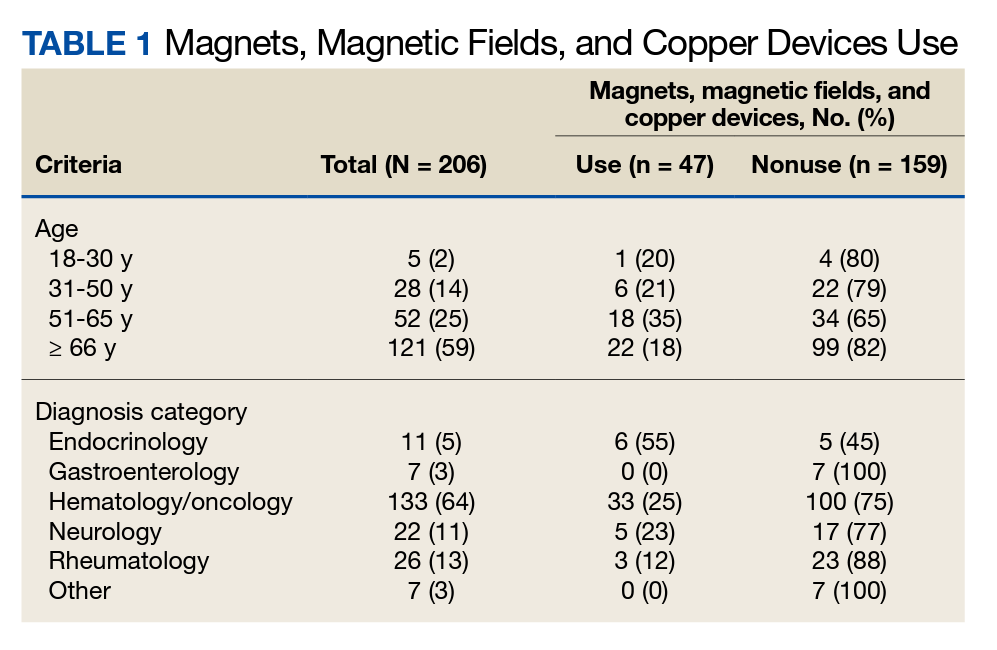
Respondents were asked whether they were using MMFC therapies. The results from all age groups showed an 18% overall use and in the diagnosis groups an overall use of 23%. Eighteen respondents (35%) aged 51 to 65 years reported using MMFC, followed by 6 respondents (21%) aged 31 to 50 years. Patients with an endocrinology diagnosis had the highest rate of MMFC use (6 of 11 patients; 55%) but more patients (33 of 133 [25%]) with a hematology/oncology diagnosis used MMFCs.
Copper was the most widely used MMFC therapy among individuals who used a single MMFC therapy. Twenty respondents reported copper use, 6 used magnets, and no respondents used magnetic field therapy (Table 2).
Although we were interested in understanding veterans’ use of these therapies, we were also interested in whether the respondent group would see MMFC as a potential therapy. The highest level of interest in participation in magnet clinical trials was reported by patients aged 31 to 50 years (64%) age group, followed by those aged 51 to 65 (62%). All of the respondents in hematology/oncology, rheumatology, neurology, endocrinology, and gastroenterology groups indicated that they would consider participating in clinical studies using magnets.
DISCUSSION
We surveyed a population of veterans at the CTHVAMC infusion center who were receiving antineoplastic chemotherapy, biologic therapy, immunomodulatory therapy, transfusion, and other therapies to evaluate their use of MMFC. We chose this group to sample because of how accessible this group was and the belief that there would be an adequate survey response. We hypothesized that by asking about a specific group of CAM therapies and not, as in many surveys, multiple CAM therapies, there would be an improved response rate. We expected that very few respondents would indicate MMFC use because in a similar study conducted in 2003 to 2004 at CTHVAMC, none of the 380 survey respondents (all with a hematology/oncology diagnosis) indicated magnet or magnetic field use (JR Salvatore, unpublished data). Although copper devices were available at that time, they were not included in that study. The current survey added copper devices and showed a greater use of MMFC, including copper devices. We identified veterans who used either 1 MMFC or multiple therapies. In both groups, copper devices were the most common. This may be due to the ubiquity and availability of copper devices. These devices are highly visible and promoted by professional athletes and other well-known personalities.
Our findings showed 2 unexpected results. First, there was greater than expected use of magnets and copper devices. Second, an even less expected result that there was considerable interest in participating in clinical research that used magnets or magnetic fields.
Respondents indicated a high interest in participating in clinical trials using magnets or magnetic fields regardless of their history of MMFC use. We did not ask about a trial using copper devices because there is less scientific/medical research to justify studying those devices as opposed to data that support the use of magnets or magnetic fields. The data presented in this study suggest interest in participating in clinical trials using magnets or magnetic field therapy. One clinical trial combined static magnets as an adjuvant to antineoplastic chemotherapy.14 We believe this is the first publication to specifically quantify both MMFC use in a veteran (or any) population, and to identify the desire to participate in clinical studies that would utilize magnets or magnetic fields, whether or not they currently use magnets or magnetic fields. Based on current knowledge, it is not clear whether use of MMFC by patients represents a risk or a benefit to the population studied, and seeking that information is part of the continuation of our work. We also believe that the data in this study will help practitioners to consider asking patients specifically whether they are using these therapies, and if so why and with what result. We are extending our work to a more generalized patient population.
The use of copper devices relates to beliefs (dating to the mid-1800s) that there was a relationship between copper deficiency and rheumatologic disorders. Copper devices are used as therapies because of the belief that small amounts of copper are absorbed through the skin, decreasing inflammation, particularly around joint spaces.15 Recent data suggest a mechanism for copper-induced cell death.16 Although this recent research suggests a mechanism for how copper might induce cell death, it is unclear how this would be applied to establishing a mechanism for the health effects of wearing copper devices. Since copper devices are thought to decrease inflammation, they may have a theoretical function by decreasing the number of inflammatory cells in an affected space.
CAM magnetics are typically of lower strength. The field generated by magnets is measured and reported in Tesla. Magnetic resonance imaging typically generates from 1.5 to 3 Tesla. A refrigerator magnet is about 1 milliTesla.17 In a study conducted at the CTHVAMC, the strength of the magnets used was measured at distances from the magnet. For example, at 2 cm from the magnet, the measured strength was 18 milliTesla.14 Many MMFC devices approved by the US Food and Drug Administration are pulsed electromagnetic fields (PEMF) devices for healing of nonunion fractures (approved in 1979); cervical and lumbar fusion therapies (approved in 2004); and therapy for anxiety and depression (approved in 2006).18
Limitations
Patients with endocrinology diagnoses were the most likely to use MMFCs but were a very small percentage of the infusion center population, which could skew the data. The surveyed individuals may not have been representative of the overall patient population. Similarly, the patient population at CTHVAMC, which is primarily male and aged ≥ 66 years, may not be representative of other veteran and nonveteran patient populations.
Conclusions
MMFC devices are being used regularly by patients as a form of CAM therapy, but few studies researching the use of CAM therapy have generated data that are as specific as this study is about the use of these MMFC devices. Although there is considerable general public awareness of MMFC therapies and devices, we believe that there is a need to quantify the use of these devices. We further believe that our study is one of the first to look specifically at the use of MMFCs in a veteran population. We have found a considerable use of MMFCs in the veteran population studied, and we also showed that whether or not veterans are using these devices, they are willing to be part of research that uses the devices. Further studies would look at a more general veteran population, look more in depth at the way and for what purpose these devices are being used, and consider the development of clinical research studies that use MMFCs.
1. National Institute of Health. National Center for Complementary and Integrative Health. Updated April 2021. Accessed June 26, 2023. https://www.nccih.nih.gov/health/complementary-alternative-or-integrative-health-whats-in-a-name
2. Hanaway P. Form follows function: a functional medicine overview. Perm J. 2016;20(4):16-109. doi:10.7812/TPP/16-109
3. Bland JS. Functional medicine past, present, and future. Integr Med (Encinitas). 2022;21(2):22-26.
4. Clarke TC, Black LI, Stussman BJ, Barnes PM, Nahin RL. Trends in the use of complementary health approaches among adults: United States, 2002-2012. Natl Health Stat Report. 2015;(79):1-16.
5. Horneber M, Bueschel G, Dennert G, Less D, Ritter E, Zwahlen M. How many cancer patients use complementary and alternative medicine: a systematic review and metaanalysis. Integr Cancer Ther. 2012;11(3):187-203. doi:10.1177/1534735411423920
6. Buckner CA, Lafrenie RM, Dénommée JA, Caswell JM, Want DA. Complementary and alternative medicine use in patients before and after a cancer diagnosis. Curr Oncol. 2018;25(4):e275-e281. doi:10.3747/co.25.3884
7. Weintraub MI. Magnetic bio-stimulation in painful diabetic peripheral neuropathy: a novel intervention–a randomized, double-placebo crossover study. Am J Pain Manage. 1999; 9(1):8-17.
8. Colbert AP, Wahbeh H, Harling N, et al. Static magnetic field therapy: a critical review of treatment parameters. Evid Based Complement Alternat Med. 2009;6(2):133-139. doi:10.1093/ecam/nem131
9. Held RF, Santos S, Marki M, Helmer D. Veteran perceptions, interest, and use of complementary and alternative medicine. Fed Pract. 2016;33(9):41-47.
10. Motoo Y, Yukawa K, Arai I, Hisamura K, Tsutani K. Use of complementary and alternative medicine in Japan: a cross-sectional internet survey using the Japanese version of the International Complementary and Alternative Medicine Questionnaire. JMAJ. 2019;2(1):35-46. doi:10.31662/jmaj.2018-0044
11. Quandt SA, Verhoef MJ, Arcury TA, et al. Development of an international questionnaire to measure use of complementary and alternative medicine (I-CAM-Q). J Altern Complement Med. 2009;15(4):331-339. doi:10.1089/acm.2008.0521
12. Lee JA, Sasaki Y, Arai I, et al. An assessment of the use of complementary and alternative medicine by Korean people using an adapted version of the standardized international questionnaire (I-CAM-QK): a cross-sectional study of an internet survey. BMC Complement Altern Med. 2018;18(1):238. Published 2018 Aug 13. doi:10.1186/s12906-018-2294-6
13. Campbell E, Coulter E, Mattison P, McFadyen A, Miller L, Paul L. Access, delivery and perceived efficacy of physiotherapy and use of complementary and alternative therapies by people with progressive multiple sclerosis in the United Kingdom: An online survey. Mult Scler Relat Disord. 2017;12:64-69. doi:10.1016/j.msard.2017.01.002
14. Salvatore JR, Harrington J, Kummet T. Phase I clinical study of a static magnetic field combined with anti-neoplastic chemotherapy in the treatment of human malignancy: initial safety and toxicity data. Bioelectromagnetics. 2003;24(7):524-527. doi:10.1002/bem.10149
15. Richmond SJ, Gunadasa S, Bland M, Macpherson H. Copper bracelets and magnetic wrist straps for rheumatoid arthritis--analgesic and anti-inflammatory effects: a randomised double-blind placebo controlled crossover trial. PLoS One. 2013;8(9):e71529. Published 2013 Sep 16. doi:10.1371/journal.pone.0071529
16. Tsvetkov P, Coy S, Petrova B, et al. Copper induces cell death by targeting lipoylated TCA cycle proteins. Science. 2022;375(6586):1254-1261. doi:10.1126/science.abf0529
17. Simon NJ. Biological Effects of Static Magnetic Fields: A Review. International Cryogenic Materials Commission; 1992:179.
18. Waldorff EI, Zhang N, Ryaby JT. Pulsed electromagnetic field applications: a corporate perspective. J Orthop Translat. 2017;9:60-68. Published 2017 Mar 31. doi:10.1016/j.jot.2017.02.006
Complementary and alternative medicine (CAM) is a therapeutic approach to health care used in association with or in place of standard medical therapeutic approaches. When describing CAM, the terms complementary and alternative are often used interchangeably, but the terms refer to different concepts. A nonmainstream approach used together with conventional medicine is considered complementary, whereas an approach used in place of conventional medicine is considered alternative. Most people who use nonmainstream approaches also use conventional health care.1
Integrative medicine represents therapeutic interventions that bring conventional and complementary approaches together in a coordinated way. Integrative health also emphasizes multimodal interventions, which are ≥ 2 interventions such as conventional (eg, medication, physical rehabilitation, psychotherapy) and complementary health approaches (eg, acupuncture, yoga, and probiotics) in various combinations, with an emphasis on treating the whole person rather than 1 organ system. Integrative health aims for well-coordinated care among different practitioners and institutions.1
Functional medicine requires an individualized assessment and therapeutic plan for each patient, including optimizing the function of each organ system. It uses research to understand a patient’s unique needs and formulates a plan that often uses diet, exercise, and stress reduction methods. Functional medicine may use combinations of naturopathic, osteopathic, and chiropractic medicine, among other therapies. Functional medicine has been called a systems biology model, and patients and practitioners work together to achieve the highest expression of health by addressing the underlying causes of disease.2,3
According to a 2012 national survey, more than 30% of adults and about 12% of children use health care approaches that are not part of conventional medical care or that may have unconventional origins. A National Center for Health Statistics study found that the most common complementary medical interventions from 2002 to 2012 included natural products, deep breathing, yoga and other movement programs, and chiropractic, among others. Magnets, magnetic fields, and copper devices (MMFC), which are the focus of this study, were not among the top listed interventions.4 Recent data showed that individuals in the United States are high users of CAM, including many patients who have neoplastic disease.5,6
MMFCs are a part of CAM and are reported to be a billion-dollar industry worldwide, although it is not well studied.7,8 In our study, magnet refers to the use of a magnet in contact with the body, magnetic field refers to exposure to a magnetic field administered without direct contact with the body, and copper devices refer to devices that are in contact with the body, such as bracelets, necklaces, wraps, and joint braces. These devices are often constructed using copper mesh, or weaved copper wires. Advertising has helped to increase interest in the use of these devices for musculoskeletal pain and restricted joint movement therapies. However, it is less clear whether MMFCs are being used to provide therapy for other medical conditions, such as neoplastic disease.
It is unclear how widespread MMFC use is or how it is accessed. A 2016 study of veterans and CAM use did not specifically address MMFCs.9 A Japanese study of the use of CAM provided or prescribed by a physician found that just 12 of 1575 respondents (0.7%) described using magnetic therapy.10 A Korean internet study that assessed the use of CAM found that of 1668 respondents who received CAM therapy by practice or advice of a physician, 1.2% used magnet therapy.11,12 An online study of CAM use in patients with multiple sclerosis found that 9 of 1286 respondents (0.7%) had used magnetic field therapy in the previous 3 months.13
In this study, we aimed to assess MMFC use and perspectives in a veteran population at the Carl T. Hayden Veterans Affairs Medical Center (CTHVAMC) in Phoenix, Arizona.
METHODS
We created a brief questionnaire regarding MMFC use and perspectives and distributed it to veteran patients at the infusion center at the CTHVAMC. The study was approved by the CTHVAMC department of research, and the institutional review board determined that informed consent was not required. The questionnaire did not collect any specific personal identifying data but included the participant’s sex, age, and diagnosis. Although there are standardized questionnaires concerning the use of CAM, we designed a new survey for MMFCs. The participants in the study were consecutive patients referred to the CTHVAMC infusion center for IV or other nonoral therapies. Referrals came from endocrinology, gastroenterology, hematology/oncology, neurology, rheumatology, and other specialties (eg, allergy/immunology).
The questionnaire was 1 page (front and back) and was completed anonymously without involvement by the study investigators or infusion center staff. Dated and consecutively numbered questionnaires were given to patients receiving therapy regardless of their diagnosis. Ages were categorized into groups: 18 to 30 years; 31 to 50 years; 51 to 65 years; and ≥ 66 years. Diagnoses were categorized by specialty: endocrinology, gastroenterology, hematology/oncology, neurology, rheumatology, and other. We noted in a previous similar study that the exact diagnosis was often left blank, but the specialty was more often completed.9 Since some patients required multiple visits to the infusion center, respondents were asked whether they had previously answered the questionnaire; there were no duplications.
The population we studied was under stress while receiving therapy for underlying illnesses. To improve the response rate and accuracy of the responses, we limited the number of survey questions. Since many of the respondents in the infusion center for therapy received medications that could alter their ability to respond, all questionnaires were administered prior to therapeutic intervention. In addition to the background data, respondents were asked: Do you apply magnets to your body, use magnetic field therapy, or copper devices? If you use any of these therapies, is it for pain, your diagnosis, or other? Would you consider participating in a clinical trial using magnets applied to the body or magnetic therapy?
RESULTS
We collected 210 surveys. Four surveys were missing data and were excluded. The majority of respondents (n = 133, 64%) were in the hematology/oncology diagnostic group and 121 (59%) were aged ≥ 66 years (Table 1).
Respondents were asked whether they were using MMFC therapies. The results from all age groups showed an 18% overall use and in the diagnosis groups an overall use of 23%. Eighteen respondents (35%) aged 51 to 65 years reported using MMFC, followed by 6 respondents (21%) aged 31 to 50 years. Patients with an endocrinology diagnosis had the highest rate of MMFC use (6 of 11 patients; 55%) but more patients (33 of 133 [25%]) with a hematology/oncology diagnosis used MMFCs.
Copper was the most widely used MMFC therapy among individuals who used a single MMFC therapy. Twenty respondents reported copper use, 6 used magnets, and no respondents used magnetic field therapy (Table 2).
Although we were interested in understanding veterans’ use of these therapies, we were also interested in whether the respondent group would see MMFC as a potential therapy. The highest level of interest in participation in magnet clinical trials was reported by patients aged 31 to 50 years (64%) age group, followed by those aged 51 to 65 (62%). All of the respondents in hematology/oncology, rheumatology, neurology, endocrinology, and gastroenterology groups indicated that they would consider participating in clinical studies using magnets.
DISCUSSION
We surveyed a population of veterans at the CTHVAMC infusion center who were receiving antineoplastic chemotherapy, biologic therapy, immunomodulatory therapy, transfusion, and other therapies to evaluate their use of MMFC. We chose this group to sample because of how accessible this group was and the belief that there would be an adequate survey response. We hypothesized that by asking about a specific group of CAM therapies and not, as in many surveys, multiple CAM therapies, there would be an improved response rate. We expected that very few respondents would indicate MMFC use because in a similar study conducted in 2003 to 2004 at CTHVAMC, none of the 380 survey respondents (all with a hematology/oncology diagnosis) indicated magnet or magnetic field use (JR Salvatore, unpublished data). Although copper devices were available at that time, they were not included in that study. The current survey added copper devices and showed a greater use of MMFC, including copper devices. We identified veterans who used either 1 MMFC or multiple therapies. In both groups, copper devices were the most common. This may be due to the ubiquity and availability of copper devices. These devices are highly visible and promoted by professional athletes and other well-known personalities.
Our findings showed 2 unexpected results. First, there was greater than expected use of magnets and copper devices. Second, an even less expected result that there was considerable interest in participating in clinical research that used magnets or magnetic fields.
Respondents indicated a high interest in participating in clinical trials using magnets or magnetic fields regardless of their history of MMFC use. We did not ask about a trial using copper devices because there is less scientific/medical research to justify studying those devices as opposed to data that support the use of magnets or magnetic fields. The data presented in this study suggest interest in participating in clinical trials using magnets or magnetic field therapy. One clinical trial combined static magnets as an adjuvant to antineoplastic chemotherapy.14 We believe this is the first publication to specifically quantify both MMFC use in a veteran (or any) population, and to identify the desire to participate in clinical studies that would utilize magnets or magnetic fields, whether or not they currently use magnets or magnetic fields. Based on current knowledge, it is not clear whether use of MMFC by patients represents a risk or a benefit to the population studied, and seeking that information is part of the continuation of our work. We also believe that the data in this study will help practitioners to consider asking patients specifically whether they are using these therapies, and if so why and with what result. We are extending our work to a more generalized patient population.
The use of copper devices relates to beliefs (dating to the mid-1800s) that there was a relationship between copper deficiency and rheumatologic disorders. Copper devices are used as therapies because of the belief that small amounts of copper are absorbed through the skin, decreasing inflammation, particularly around joint spaces.15 Recent data suggest a mechanism for copper-induced cell death.16 Although this recent research suggests a mechanism for how copper might induce cell death, it is unclear how this would be applied to establishing a mechanism for the health effects of wearing copper devices. Since copper devices are thought to decrease inflammation, they may have a theoretical function by decreasing the number of inflammatory cells in an affected space.
CAM magnetics are typically of lower strength. The field generated by magnets is measured and reported in Tesla. Magnetic resonance imaging typically generates from 1.5 to 3 Tesla. A refrigerator magnet is about 1 milliTesla.17 In a study conducted at the CTHVAMC, the strength of the magnets used was measured at distances from the magnet. For example, at 2 cm from the magnet, the measured strength was 18 milliTesla.14 Many MMFC devices approved by the US Food and Drug Administration are pulsed electromagnetic fields (PEMF) devices for healing of nonunion fractures (approved in 1979); cervical and lumbar fusion therapies (approved in 2004); and therapy for anxiety and depression (approved in 2006).18
Limitations
Patients with endocrinology diagnoses were the most likely to use MMFCs but were a very small percentage of the infusion center population, which could skew the data. The surveyed individuals may not have been representative of the overall patient population. Similarly, the patient population at CTHVAMC, which is primarily male and aged ≥ 66 years, may not be representative of other veteran and nonveteran patient populations.
Conclusions
MMFC devices are being used regularly by patients as a form of CAM therapy, but few studies researching the use of CAM therapy have generated data that are as specific as this study is about the use of these MMFC devices. Although there is considerable general public awareness of MMFC therapies and devices, we believe that there is a need to quantify the use of these devices. We further believe that our study is one of the first to look specifically at the use of MMFCs in a veteran population. We have found a considerable use of MMFCs in the veteran population studied, and we also showed that whether or not veterans are using these devices, they are willing to be part of research that uses the devices. Further studies would look at a more general veteran population, look more in depth at the way and for what purpose these devices are being used, and consider the development of clinical research studies that use MMFCs.
Complementary and alternative medicine (CAM) is a therapeutic approach to health care used in association with or in place of standard medical therapeutic approaches. When describing CAM, the terms complementary and alternative are often used interchangeably, but the terms refer to different concepts. A nonmainstream approach used together with conventional medicine is considered complementary, whereas an approach used in place of conventional medicine is considered alternative. Most people who use nonmainstream approaches also use conventional health care.1
Integrative medicine represents therapeutic interventions that bring conventional and complementary approaches together in a coordinated way. Integrative health also emphasizes multimodal interventions, which are ≥ 2 interventions such as conventional (eg, medication, physical rehabilitation, psychotherapy) and complementary health approaches (eg, acupuncture, yoga, and probiotics) in various combinations, with an emphasis on treating the whole person rather than 1 organ system. Integrative health aims for well-coordinated care among different practitioners and institutions.1
Functional medicine requires an individualized assessment and therapeutic plan for each patient, including optimizing the function of each organ system. It uses research to understand a patient’s unique needs and formulates a plan that often uses diet, exercise, and stress reduction methods. Functional medicine may use combinations of naturopathic, osteopathic, and chiropractic medicine, among other therapies. Functional medicine has been called a systems biology model, and patients and practitioners work together to achieve the highest expression of health by addressing the underlying causes of disease.2,3
According to a 2012 national survey, more than 30% of adults and about 12% of children use health care approaches that are not part of conventional medical care or that may have unconventional origins. A National Center for Health Statistics study found that the most common complementary medical interventions from 2002 to 2012 included natural products, deep breathing, yoga and other movement programs, and chiropractic, among others. Magnets, magnetic fields, and copper devices (MMFC), which are the focus of this study, were not among the top listed interventions.4 Recent data showed that individuals in the United States are high users of CAM, including many patients who have neoplastic disease.5,6
MMFCs are a part of CAM and are reported to be a billion-dollar industry worldwide, although it is not well studied.7,8 In our study, magnet refers to the use of a magnet in contact with the body, magnetic field refers to exposure to a magnetic field administered without direct contact with the body, and copper devices refer to devices that are in contact with the body, such as bracelets, necklaces, wraps, and joint braces. These devices are often constructed using copper mesh, or weaved copper wires. Advertising has helped to increase interest in the use of these devices for musculoskeletal pain and restricted joint movement therapies. However, it is less clear whether MMFCs are being used to provide therapy for other medical conditions, such as neoplastic disease.
It is unclear how widespread MMFC use is or how it is accessed. A 2016 study of veterans and CAM use did not specifically address MMFCs.9 A Japanese study of the use of CAM provided or prescribed by a physician found that just 12 of 1575 respondents (0.7%) described using magnetic therapy.10 A Korean internet study that assessed the use of CAM found that of 1668 respondents who received CAM therapy by practice or advice of a physician, 1.2% used magnet therapy.11,12 An online study of CAM use in patients with multiple sclerosis found that 9 of 1286 respondents (0.7%) had used magnetic field therapy in the previous 3 months.13
In this study, we aimed to assess MMFC use and perspectives in a veteran population at the Carl T. Hayden Veterans Affairs Medical Center (CTHVAMC) in Phoenix, Arizona.
METHODS
We created a brief questionnaire regarding MMFC use and perspectives and distributed it to veteran patients at the infusion center at the CTHVAMC. The study was approved by the CTHVAMC department of research, and the institutional review board determined that informed consent was not required. The questionnaire did not collect any specific personal identifying data but included the participant’s sex, age, and diagnosis. Although there are standardized questionnaires concerning the use of CAM, we designed a new survey for MMFCs. The participants in the study were consecutive patients referred to the CTHVAMC infusion center for IV or other nonoral therapies. Referrals came from endocrinology, gastroenterology, hematology/oncology, neurology, rheumatology, and other specialties (eg, allergy/immunology).
The questionnaire was 1 page (front and back) and was completed anonymously without involvement by the study investigators or infusion center staff. Dated and consecutively numbered questionnaires were given to patients receiving therapy regardless of their diagnosis. Ages were categorized into groups: 18 to 30 years; 31 to 50 years; 51 to 65 years; and ≥ 66 years. Diagnoses were categorized by specialty: endocrinology, gastroenterology, hematology/oncology, neurology, rheumatology, and other. We noted in a previous similar study that the exact diagnosis was often left blank, but the specialty was more often completed.9 Since some patients required multiple visits to the infusion center, respondents were asked whether they had previously answered the questionnaire; there were no duplications.
The population we studied was under stress while receiving therapy for underlying illnesses. To improve the response rate and accuracy of the responses, we limited the number of survey questions. Since many of the respondents in the infusion center for therapy received medications that could alter their ability to respond, all questionnaires were administered prior to therapeutic intervention. In addition to the background data, respondents were asked: Do you apply magnets to your body, use magnetic field therapy, or copper devices? If you use any of these therapies, is it for pain, your diagnosis, or other? Would you consider participating in a clinical trial using magnets applied to the body or magnetic therapy?
RESULTS
We collected 210 surveys. Four surveys were missing data and were excluded. The majority of respondents (n = 133, 64%) were in the hematology/oncology diagnostic group and 121 (59%) were aged ≥ 66 years (Table 1).
Respondents were asked whether they were using MMFC therapies. The results from all age groups showed an 18% overall use and in the diagnosis groups an overall use of 23%. Eighteen respondents (35%) aged 51 to 65 years reported using MMFC, followed by 6 respondents (21%) aged 31 to 50 years. Patients with an endocrinology diagnosis had the highest rate of MMFC use (6 of 11 patients; 55%) but more patients (33 of 133 [25%]) with a hematology/oncology diagnosis used MMFCs.
Copper was the most widely used MMFC therapy among individuals who used a single MMFC therapy. Twenty respondents reported copper use, 6 used magnets, and no respondents used magnetic field therapy (Table 2).
Although we were interested in understanding veterans’ use of these therapies, we were also interested in whether the respondent group would see MMFC as a potential therapy. The highest level of interest in participation in magnet clinical trials was reported by patients aged 31 to 50 years (64%) age group, followed by those aged 51 to 65 (62%). All of the respondents in hematology/oncology, rheumatology, neurology, endocrinology, and gastroenterology groups indicated that they would consider participating in clinical studies using magnets.
DISCUSSION
We surveyed a population of veterans at the CTHVAMC infusion center who were receiving antineoplastic chemotherapy, biologic therapy, immunomodulatory therapy, transfusion, and other therapies to evaluate their use of MMFC. We chose this group to sample because of how accessible this group was and the belief that there would be an adequate survey response. We hypothesized that by asking about a specific group of CAM therapies and not, as in many surveys, multiple CAM therapies, there would be an improved response rate. We expected that very few respondents would indicate MMFC use because in a similar study conducted in 2003 to 2004 at CTHVAMC, none of the 380 survey respondents (all with a hematology/oncology diagnosis) indicated magnet or magnetic field use (JR Salvatore, unpublished data). Although copper devices were available at that time, they were not included in that study. The current survey added copper devices and showed a greater use of MMFC, including copper devices. We identified veterans who used either 1 MMFC or multiple therapies. In both groups, copper devices were the most common. This may be due to the ubiquity and availability of copper devices. These devices are highly visible and promoted by professional athletes and other well-known personalities.
Our findings showed 2 unexpected results. First, there was greater than expected use of magnets and copper devices. Second, an even less expected result that there was considerable interest in participating in clinical research that used magnets or magnetic fields.
Respondents indicated a high interest in participating in clinical trials using magnets or magnetic fields regardless of their history of MMFC use. We did not ask about a trial using copper devices because there is less scientific/medical research to justify studying those devices as opposed to data that support the use of magnets or magnetic fields. The data presented in this study suggest interest in participating in clinical trials using magnets or magnetic field therapy. One clinical trial combined static magnets as an adjuvant to antineoplastic chemotherapy.14 We believe this is the first publication to specifically quantify both MMFC use in a veteran (or any) population, and to identify the desire to participate in clinical studies that would utilize magnets or magnetic fields, whether or not they currently use magnets or magnetic fields. Based on current knowledge, it is not clear whether use of MMFC by patients represents a risk or a benefit to the population studied, and seeking that information is part of the continuation of our work. We also believe that the data in this study will help practitioners to consider asking patients specifically whether they are using these therapies, and if so why and with what result. We are extending our work to a more generalized patient population.
The use of copper devices relates to beliefs (dating to the mid-1800s) that there was a relationship between copper deficiency and rheumatologic disorders. Copper devices are used as therapies because of the belief that small amounts of copper are absorbed through the skin, decreasing inflammation, particularly around joint spaces.15 Recent data suggest a mechanism for copper-induced cell death.16 Although this recent research suggests a mechanism for how copper might induce cell death, it is unclear how this would be applied to establishing a mechanism for the health effects of wearing copper devices. Since copper devices are thought to decrease inflammation, they may have a theoretical function by decreasing the number of inflammatory cells in an affected space.
CAM magnetics are typically of lower strength. The field generated by magnets is measured and reported in Tesla. Magnetic resonance imaging typically generates from 1.5 to 3 Tesla. A refrigerator magnet is about 1 milliTesla.17 In a study conducted at the CTHVAMC, the strength of the magnets used was measured at distances from the magnet. For example, at 2 cm from the magnet, the measured strength was 18 milliTesla.14 Many MMFC devices approved by the US Food and Drug Administration are pulsed electromagnetic fields (PEMF) devices for healing of nonunion fractures (approved in 1979); cervical and lumbar fusion therapies (approved in 2004); and therapy for anxiety and depression (approved in 2006).18
Limitations
Patients with endocrinology diagnoses were the most likely to use MMFCs but were a very small percentage of the infusion center population, which could skew the data. The surveyed individuals may not have been representative of the overall patient population. Similarly, the patient population at CTHVAMC, which is primarily male and aged ≥ 66 years, may not be representative of other veteran and nonveteran patient populations.
Conclusions
MMFC devices are being used regularly by patients as a form of CAM therapy, but few studies researching the use of CAM therapy have generated data that are as specific as this study is about the use of these MMFC devices. Although there is considerable general public awareness of MMFC therapies and devices, we believe that there is a need to quantify the use of these devices. We further believe that our study is one of the first to look specifically at the use of MMFCs in a veteran population. We have found a considerable use of MMFCs in the veteran population studied, and we also showed that whether or not veterans are using these devices, they are willing to be part of research that uses the devices. Further studies would look at a more general veteran population, look more in depth at the way and for what purpose these devices are being used, and consider the development of clinical research studies that use MMFCs.
1. National Institute of Health. National Center for Complementary and Integrative Health. Updated April 2021. Accessed June 26, 2023. https://www.nccih.nih.gov/health/complementary-alternative-or-integrative-health-whats-in-a-name
2. Hanaway P. Form follows function: a functional medicine overview. Perm J. 2016;20(4):16-109. doi:10.7812/TPP/16-109
3. Bland JS. Functional medicine past, present, and future. Integr Med (Encinitas). 2022;21(2):22-26.
4. Clarke TC, Black LI, Stussman BJ, Barnes PM, Nahin RL. Trends in the use of complementary health approaches among adults: United States, 2002-2012. Natl Health Stat Report. 2015;(79):1-16.
5. Horneber M, Bueschel G, Dennert G, Less D, Ritter E, Zwahlen M. How many cancer patients use complementary and alternative medicine: a systematic review and metaanalysis. Integr Cancer Ther. 2012;11(3):187-203. doi:10.1177/1534735411423920
6. Buckner CA, Lafrenie RM, Dénommée JA, Caswell JM, Want DA. Complementary and alternative medicine use in patients before and after a cancer diagnosis. Curr Oncol. 2018;25(4):e275-e281. doi:10.3747/co.25.3884
7. Weintraub MI. Magnetic bio-stimulation in painful diabetic peripheral neuropathy: a novel intervention–a randomized, double-placebo crossover study. Am J Pain Manage. 1999; 9(1):8-17.
8. Colbert AP, Wahbeh H, Harling N, et al. Static magnetic field therapy: a critical review of treatment parameters. Evid Based Complement Alternat Med. 2009;6(2):133-139. doi:10.1093/ecam/nem131
9. Held RF, Santos S, Marki M, Helmer D. Veteran perceptions, interest, and use of complementary and alternative medicine. Fed Pract. 2016;33(9):41-47.
10. Motoo Y, Yukawa K, Arai I, Hisamura K, Tsutani K. Use of complementary and alternative medicine in Japan: a cross-sectional internet survey using the Japanese version of the International Complementary and Alternative Medicine Questionnaire. JMAJ. 2019;2(1):35-46. doi:10.31662/jmaj.2018-0044
11. Quandt SA, Verhoef MJ, Arcury TA, et al. Development of an international questionnaire to measure use of complementary and alternative medicine (I-CAM-Q). J Altern Complement Med. 2009;15(4):331-339. doi:10.1089/acm.2008.0521
12. Lee JA, Sasaki Y, Arai I, et al. An assessment of the use of complementary and alternative medicine by Korean people using an adapted version of the standardized international questionnaire (I-CAM-QK): a cross-sectional study of an internet survey. BMC Complement Altern Med. 2018;18(1):238. Published 2018 Aug 13. doi:10.1186/s12906-018-2294-6
13. Campbell E, Coulter E, Mattison P, McFadyen A, Miller L, Paul L. Access, delivery and perceived efficacy of physiotherapy and use of complementary and alternative therapies by people with progressive multiple sclerosis in the United Kingdom: An online survey. Mult Scler Relat Disord. 2017;12:64-69. doi:10.1016/j.msard.2017.01.002
14. Salvatore JR, Harrington J, Kummet T. Phase I clinical study of a static magnetic field combined with anti-neoplastic chemotherapy in the treatment of human malignancy: initial safety and toxicity data. Bioelectromagnetics. 2003;24(7):524-527. doi:10.1002/bem.10149
15. Richmond SJ, Gunadasa S, Bland M, Macpherson H. Copper bracelets and magnetic wrist straps for rheumatoid arthritis--analgesic and anti-inflammatory effects: a randomised double-blind placebo controlled crossover trial. PLoS One. 2013;8(9):e71529. Published 2013 Sep 16. doi:10.1371/journal.pone.0071529
16. Tsvetkov P, Coy S, Petrova B, et al. Copper induces cell death by targeting lipoylated TCA cycle proteins. Science. 2022;375(6586):1254-1261. doi:10.1126/science.abf0529
17. Simon NJ. Biological Effects of Static Magnetic Fields: A Review. International Cryogenic Materials Commission; 1992:179.
18. Waldorff EI, Zhang N, Ryaby JT. Pulsed electromagnetic field applications: a corporate perspective. J Orthop Translat. 2017;9:60-68. Published 2017 Mar 31. doi:10.1016/j.jot.2017.02.006
1. National Institute of Health. National Center for Complementary and Integrative Health. Updated April 2021. Accessed June 26, 2023. https://www.nccih.nih.gov/health/complementary-alternative-or-integrative-health-whats-in-a-name
2. Hanaway P. Form follows function: a functional medicine overview. Perm J. 2016;20(4):16-109. doi:10.7812/TPP/16-109
3. Bland JS. Functional medicine past, present, and future. Integr Med (Encinitas). 2022;21(2):22-26.
4. Clarke TC, Black LI, Stussman BJ, Barnes PM, Nahin RL. Trends in the use of complementary health approaches among adults: United States, 2002-2012. Natl Health Stat Report. 2015;(79):1-16.
5. Horneber M, Bueschel G, Dennert G, Less D, Ritter E, Zwahlen M. How many cancer patients use complementary and alternative medicine: a systematic review and metaanalysis. Integr Cancer Ther. 2012;11(3):187-203. doi:10.1177/1534735411423920
6. Buckner CA, Lafrenie RM, Dénommée JA, Caswell JM, Want DA. Complementary and alternative medicine use in patients before and after a cancer diagnosis. Curr Oncol. 2018;25(4):e275-e281. doi:10.3747/co.25.3884
7. Weintraub MI. Magnetic bio-stimulation in painful diabetic peripheral neuropathy: a novel intervention–a randomized, double-placebo crossover study. Am J Pain Manage. 1999; 9(1):8-17.
8. Colbert AP, Wahbeh H, Harling N, et al. Static magnetic field therapy: a critical review of treatment parameters. Evid Based Complement Alternat Med. 2009;6(2):133-139. doi:10.1093/ecam/nem131
9. Held RF, Santos S, Marki M, Helmer D. Veteran perceptions, interest, and use of complementary and alternative medicine. Fed Pract. 2016;33(9):41-47.
10. Motoo Y, Yukawa K, Arai I, Hisamura K, Tsutani K. Use of complementary and alternative medicine in Japan: a cross-sectional internet survey using the Japanese version of the International Complementary and Alternative Medicine Questionnaire. JMAJ. 2019;2(1):35-46. doi:10.31662/jmaj.2018-0044
11. Quandt SA, Verhoef MJ, Arcury TA, et al. Development of an international questionnaire to measure use of complementary and alternative medicine (I-CAM-Q). J Altern Complement Med. 2009;15(4):331-339. doi:10.1089/acm.2008.0521
12. Lee JA, Sasaki Y, Arai I, et al. An assessment of the use of complementary and alternative medicine by Korean people using an adapted version of the standardized international questionnaire (I-CAM-QK): a cross-sectional study of an internet survey. BMC Complement Altern Med. 2018;18(1):238. Published 2018 Aug 13. doi:10.1186/s12906-018-2294-6
13. Campbell E, Coulter E, Mattison P, McFadyen A, Miller L, Paul L. Access, delivery and perceived efficacy of physiotherapy and use of complementary and alternative therapies by people with progressive multiple sclerosis in the United Kingdom: An online survey. Mult Scler Relat Disord. 2017;12:64-69. doi:10.1016/j.msard.2017.01.002
14. Salvatore JR, Harrington J, Kummet T. Phase I clinical study of a static magnetic field combined with anti-neoplastic chemotherapy in the treatment of human malignancy: initial safety and toxicity data. Bioelectromagnetics. 2003;24(7):524-527. doi:10.1002/bem.10149
15. Richmond SJ, Gunadasa S, Bland M, Macpherson H. Copper bracelets and magnetic wrist straps for rheumatoid arthritis--analgesic and anti-inflammatory effects: a randomised double-blind placebo controlled crossover trial. PLoS One. 2013;8(9):e71529. Published 2013 Sep 16. doi:10.1371/journal.pone.0071529
16. Tsvetkov P, Coy S, Petrova B, et al. Copper induces cell death by targeting lipoylated TCA cycle proteins. Science. 2022;375(6586):1254-1261. doi:10.1126/science.abf0529
17. Simon NJ. Biological Effects of Static Magnetic Fields: A Review. International Cryogenic Materials Commission; 1992:179.
18. Waldorff EI, Zhang N, Ryaby JT. Pulsed electromagnetic field applications: a corporate perspective. J Orthop Translat. 2017;9:60-68. Published 2017 Mar 31. doi:10.1016/j.jot.2017.02.006
What We Have Learned About Combining a Ketogenic Diet and Chemoimmunotherapy: A Case Report and Review of Literature
Originally developed for the treatment of refractory epilepsy, the ketogenic diet is distinguished by its high-fat, moderate-protein, and low-carbohydrate food program. Preclinical models provide emerging evidence that a ketogenic diet can have therapeutic potential for a broad range of cancers. The Warburg effect is a condition where cancer cells increase the uptake and fermentation of glucose to produce lactate for their metabolism, which is called aerobic glycolysis. Lactate is the key driver of cancer angiogenesis and proliferation.1,2
The ketogenic diet promotes a metabolic shift from glycolysis to mitochondrial metabolism in normal cells while cancer cells have dysfunction in their mitochondria due to damage in cellular respiration. The ketogenic diet creates a metabolic state whereby blood glucose levels are reduced, and blood ketone bodies (D-β-hydroxybutyrate and acetoacetate) are elevated. In normal cells, the ketogenic diet causes a decrease in glucose intake for glycolysis, which makes them unable to produce enough substrate to enter the tricarboxylic acid (TCA) cycle for adenosine triphosphate (ATP) production. Fatty acid oxidation plays a key role in ketone body synthesis as a “super fuel” that enter the TCA cycle as an alternative pathway to generate ATP. On the other hand, cancer cells are unable to use ketone bodies to produce ATP for energy and metabolism due to mitochondrial defects. Lack of energy subsequently leads to the inhibition of proliferation and survival of cancer cells.3,4 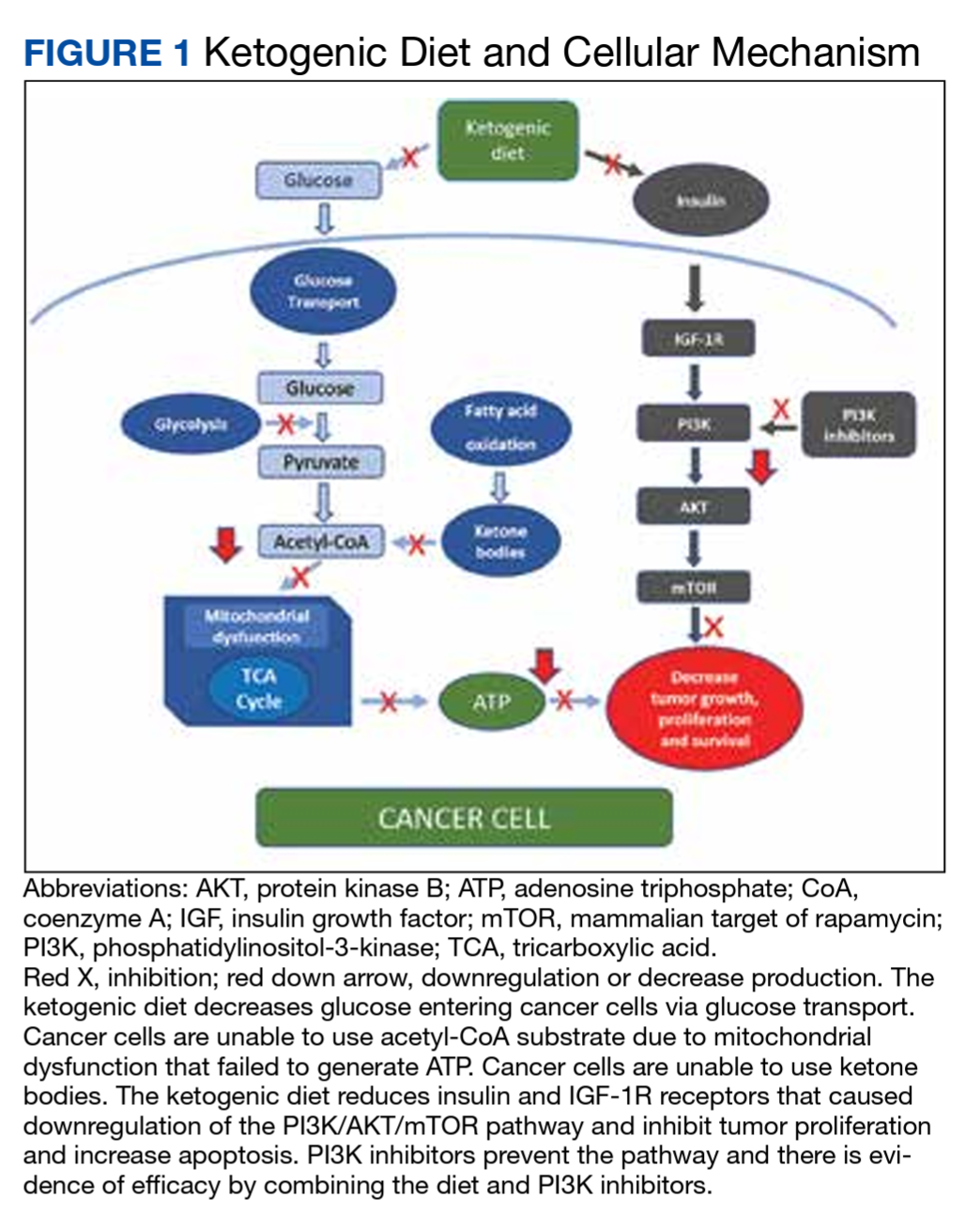
We previously published a safety and feasibility study of the Modified Atkins Diet in metastatic cancer patients after failure of chemotherapy at the US Department of Veterans Affairs (VA) Pittsburgh Healthcare System.1 None of the patients were on chemotherapy at the time of enrollment. The Modified Atkins Diet consists of 60% fat, 30% protein, and 10% carbohydrates and is more tolerable than the ketogenic diet due to higher amounts of protein. Six of 11 patients (54%) had stable disease and partial response on positron emission tomography/computed tomography (PET/CT). Our study showed that patients who lost at least 10% of their body weight had improvement in quality of life (QOL) and cancer response.1 Here we present a case of a veteran with extensive metastatic colon cancer on concurrent ketogenic diet and chemotherapy subsequently followed by concurrent ketogenic diet and immunotherapy at Veterans Affairs Central California Health Care Systems (VACCHCS) in Fresno.
CASE PRESENTATION
A 69-year-old veteran had iron deficiency anemia (hemoglobin, 6.5 g/dL) about 5 years previously. He underwent a colonoscopy that revealed a near circumferential ulcerated mass measuring 7 cm in the transverse colon. Biopsy results showed mucinous adenocarcinoma of the colon with a foci of signet ring cells (Figure 2).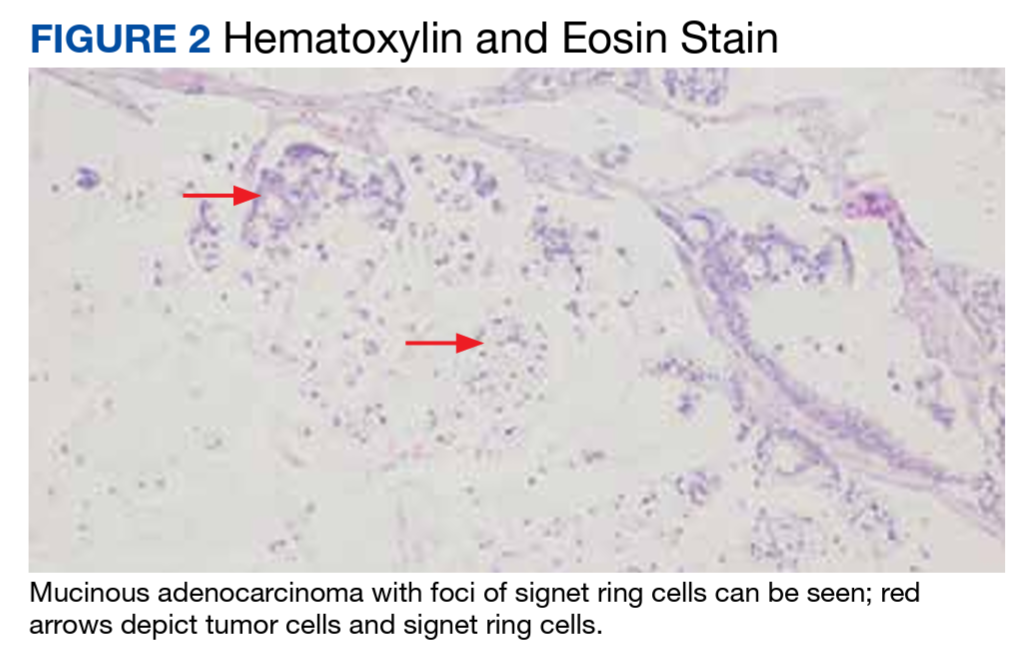
The patient received adjuvant treatment with FOLFOX (fluorouracil, leucovorin calcium, and oxaliplatin), but within several months he developed pancreatic and worsening omental metastasis seen on PET/CT. He was then started on FOLFIRI (fluorouracil, leucovorin calcium, and irinotecan hydrochloride) plus bevacizumab 16 months after his initial diagnosis. He underwent a pancreatic mastectomy that confirmed adenocarcinoma 9 months later. Afterward, he briefly resumed FOLFIRI and bevacizumab. Next-generation sequencing testing with Foundation One CDx revealed a wild-type (WT) KRAS with a high degree of tumor mutation burden of 37 muts/Mb, BRAF V600E mutation, and high microsatellite instability (MSI-H).
Due to disease progression, the patient’s treatment was changed to encorafenib and cetuximab for 4 months before progressing again with new liver mass and mediastinal lymphadenopathy. He then received pembrolizumab for 4 months until PET/CT showed progression and his carcinoembryonic antigen (CEA) increased from 95 to 1031 ng/mL by January 2021 (Figure 4).
The patient was started on trifluridine/tipiracil, and bevacizumab while concurrently initiating the ketogenic diet in January 2021. Laboratory tests drawn after 1 week of strict dietary ketogenic diet adherence showed low-level ketosis with a glucose ketone index (GKI) of 8.2 (Table 1).
A follow-up PET/CT showed disease progression along with a CEA of 94 ng/mL after 10 months of chemotherapy plus the ketogenic diet (Table 2). 
The patient continued to experience excellent QOL based on the QOL Eastern Cooperative Oncology Group (ECOG) core quality of life questionnaire (QLC-C30) forms, which he completed every 3 months. Twenty-two months after starting the ketogenic diet, the patient’s CEA increased to 293 ng/mL although PET/CT continues to show stable disease (Figures 4, 5, and 6).
DISCUSSION
The purpose of this case report is to describe whether a patient receiving active cancer treatment was able to tolerate the ketogenic diet in conjunction with chemotherapy or immunotherapy. Most literature published on the subject evaluated the tolerability and response of the ketogenic diet after the failure of standard therapy. Our patient was diagnosed with stage III mucinous colon adenocarcinoma. He received adjuvant chemotherapy but quickly developed metastatic disease to the pancreas and omentum. We started him on encorafenib and cetuximab based on the BEACON study that showed improvement in response rate and survival when compared with standard chemotherapy for patients with BRAF V600E mutation.5 Unfortunately, his cancer quickly progressed within 4 months and again did not respond to pembrolizumab despite MSI-H, which lasted for another 4 months.
We suggested the ketogenic diet and the patient agreed. He started the diet along with trifluridine/tipiracil, and bevacizumab in January 2021. The patient’s metastatic cancer stabilized for 9 months until his disease progressed again. He was started on doublet immune checkpoint inhibitors ipilimumab and nivolumab based on his MSI-H and high tumor mutation burden with the continuation of the ketogenic diet until now. The CheckMate 142 study revealed that the combination of ipilimumab and nivolumab in patients with MSI-H previously treated for metastatic colon cancer showed some benefit.6
Our patient had the loss of nuclear expression of MLH1 and PMS2 (zero tumor stained) but no evidence of the loss expression of MSH2 and MSH6 genes (99% tumor stained). About 8% to 12% of patients with metastatic colon cancer have BRAF V600E mutations that are usually mucinous type, poorly differentiated, and located in the right side of the colon, which portends to a poor prognosis. Tumor DNA mismatch repair damage results in genetic hypermutability and leads to MSI that is sensitive to treatment with checkpoint inhibitors, as in our patient. Only about 3% of MSI-H tumors are due to germline mutations such as Lynch syndrome (hereditary nonpolyposis colorectal cancer). The presence of both MLH1 hypermethylation and BRAF mutation, as in our patient, is a strong indication of somatic rather than germline mutation.7
GKI, which represents the ratio of glucose to ketone, was developed to evaluate the efficacy of the ketogenic diet. This index measures the degree of metabolic stress on tumor cells through the decrease of glucose levels and increase of ketone bodies. A GKI of ≤ 1.0 has been suggested as the ideal therapeutic goal for cancer management.8 As levels of blood glucose decline, the blood levels of ketone bodies should rise. These 2 lines should eventually intersect at a certain point beyond which one enters the therapeutic zone or therapeutic ketosis zone. This is when tumor growth is expected to slow or cease.9 The patient’s ketone (β-hydroxybutyrate) level was initially high (0.71 mmol/L) with a GKI of 8.2. (low ketotic level), which meant he tolerated a rather strict diet for the first several months. This was also reflected in his 18 lb weight loss (almost 10% of body weight) and cancer stabilization, as in our previous publication.1 Unfortunately, the patient was unable to maintain high ketone and lower GKI levels due to fatigue from depleted carbohydrate intake. He added some carbohydrate snacks in between meals, which improved the fatigue. His ketone level has been < 0.5 mmol/L ever since, albeit his disease continues to be stable. The patient continues his daily work and reports a better QOL, based on the ECOG QLC-C30 form that he completed every 3 months.10 Currently, the patient is still receiving ipilimumab and nivolumab while maintaining the ketogenic diet with stable metastatic disease on PET/CT.
Ketogenic Diet and Cellular Mechanism of Action
PI3K/Akt (phosphatidylinositol-3-kinase) signaling is one of the most important intracellular pathways for tumor cells. It leads to the inhibition of apoptosis and the promotion of cell proliferation, metabolism, and angiogenesis. Deregulation of the PI3K pathway either via amplification of PI3K by tyrosine kinase growth factor receptors or inactivation of the tumor suppressor phosphatase and tensin homolog (PTEN), which is the negative regulator of the PI3K pathway, contributes to the development of cancer cells.11
A study by Goncalves and colleagues revealed an interesting relationship between the PI3K pathway and the benefit of the ketogenic diet to slow tumor growth. PI3K inhibitors inhibit glucose uptake into skeletal muscle and adipose tissue that activate hepatic glycogenolysis. This event results in hyperglycemia due to the pancreas releasing very high levels of insulin into the blood (hyperinsulinemia) that subsequently reactivate PI3K signaling and cause resistance to PI3K inhibitors. The ketogenic diet reportedly minimized the hyperglycemia and hyperinsulinemia induced by the PI3K inhibitor and enhanced the efficacy of PI3K inhibitors in tumor models. Studies combining PI3K inhibitors and ketogenic diet are underway. Hence, combining the ketogenic diet with chemotherapy or other novel treatment should be the focus of ketogenic diet trials.12,13
Ketogenic Diet and Oncology Studies
The impact of the ketogenic diet on the growth of murine pancreatic tumors was evaluated by Yang and colleagues. The ketogenic diet decreased glucose concentration that enters the TCA cycle and increased fatty acid oxidation that produces β-hydroxybutyrate. This event promotes the generation of ATP, although with only modest elevations of NADH with less impact on tumor growth. The combination of ketogenic diet and standard chemotherapy substantially raised tumor NADH and suppressed the growth of murine tumor cells, they noted.14 Furukawa and colleagues compared 10 patients with metastatic colon cancer receiving chemotherapy plus the modified medium-chain triglyceride ketogenic diet for 1 year with 14 patients receiving chemotherapy only. The ketogenic diet group exhibited a response rate of 60% with 5 patients achieving a complete response and a disease control rate of 70%, while the chemotherapy-alone group showed a response rate of only 21% with no complete response and a disease control rate of 64%.15
The ketogenic diet also reportedly stimulates cytokine and CD4+ and CD8+ T-cell production that stimulates T-cell killing activity. The ketogenic diet may overcome several immune escape mechanisms by downregulating the expression of cytotoxic T-lymphocyte-associated protein 4 (CTLA-4) and programmed cell death protein 1 (PD-1) on tumor-infiltrating lymphocytes.16 Our patient tolerated the combination of the ketogenic diet with ipilimumab (CTLA-4 inhibitor) and nivolumab (PD-1 inhibitor) without significant toxicities and stabilization of his disease.
Future Directions
We originally presented the abstract and poster of this case report at the Association of VA Hematology/Oncology annual meeting in San Diego, California, in September 2022.17 Based on our previous experience, we are now using a modified Atkins diet, which is a less strict diet consisting of 60% fat, 30% protein, and 10% carbohydrates combined with chemotherapy and/or immunotherapy. The composition of fat to carbohydrate plus protein in the traditional ketogenic diet is usually 4:1 or 3:1, while in modified Atkins diet the ratio is 1:1 or 2:1. The benefit of the modified Atkins diet is that patients can consume more protein than a strict ketogenic diet and they can be more liberal in carbohydrate allowances. We are about to open a study protocol of combining a modified Atkin diet and chemotherapy and/or immunotherapy as a first-line treatment for veterans with all types of advanced or metastatic solid tumors at VACCHCS. The study protocol was approved by the VA Office of Research and Development and has been submitted to the VACCHCS Institutional Review Board for review. Once approved, we will start patient recruitment. 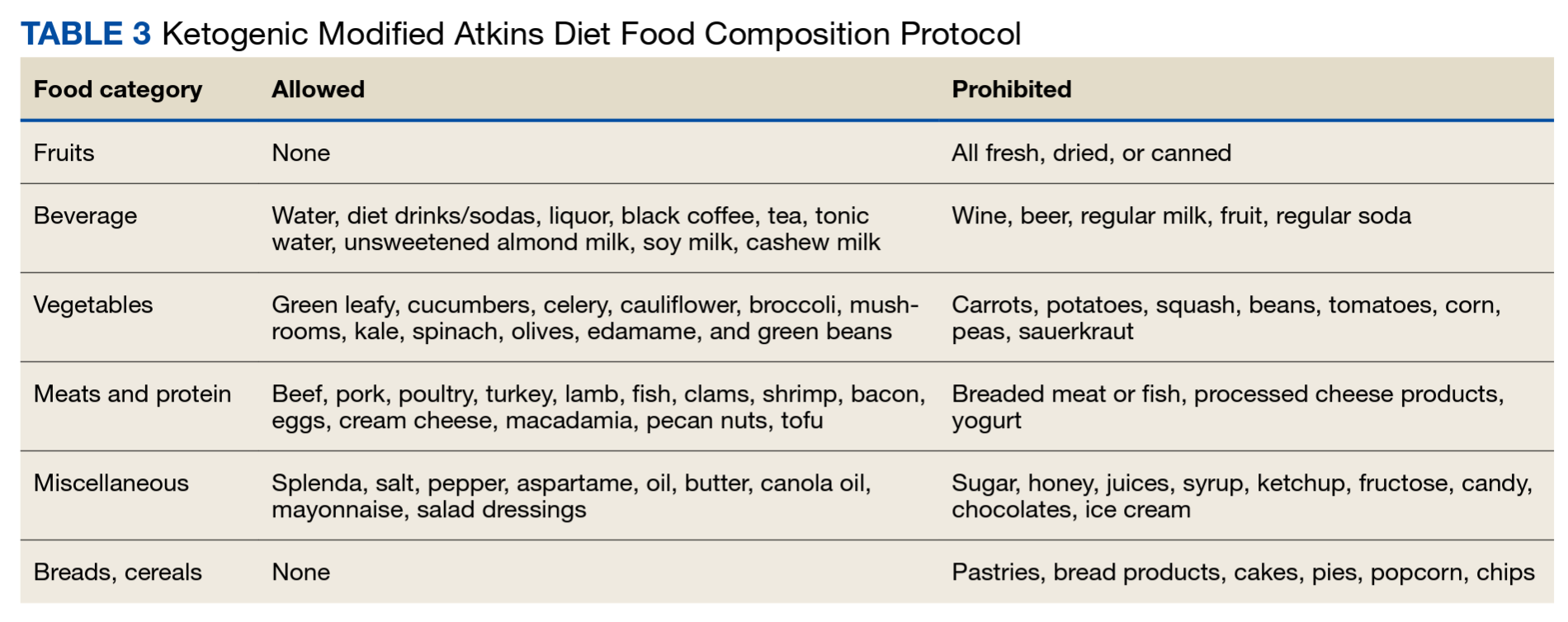
CONCLUSIONS
Cancer cells have defects in their mitochondria that prevent them from generating energy for metabolism in the absence of glucose. They also depend on the PI3K signaling pathway to survive. The ketogenic diet has the advantage of affecting cancer cell growth by exploiting these mitochondrial defects and blocking hyperglycemia. There is growing evidence that the ketogenic diet is feasible, tolerable, and reportedly inhibits cancer growth. Our case report and previous publications suggest that the ketogenic diet can be added to chemotherapy and/or immunotherapy as an adjunct to standard-of-care cancer treatment while maintaining good QOL. We are planning to open a clinical trial using the modified Atkins diet in conjunction with active cancer treatments as first-line therapy for metastatic solid tumors at the VACCHCS. We are also working closely with researchers from several veteran hospitals to do a diet collaborative study. We believe the ketogenic diet is an important part of cancer treatment and has a promising future. More research should be dedicated to this very interesting field.
Acknowledgments
We previously presented this case report in an abstract and poster at the September 2022 AVAHO meeting in San Diego, California.
1. Tan-Shalaby JL, Carrick J, Edinger K, et al. Modified Atkins diet in advanced malignancies-final results of a safety and feasibility trial within the Veterans Affairs Pittsburgh Healthcare System. Nutr Metab (Lond). 2016;13:52. Published 2016 Aug 12. doi:10.1186/s12986-016-0113-y
2. Talib WH, Mahmod AI, Kamal A, et al. Ketogenic diet in cancer prevention and therapy: molecular targets and therapeutic opportunities. Curr Issues Mol Biol. 2021;43(2):558-589. Published 2021 Jul 3. doi:10.3390/cimb43020042
3. Tan-Shalaby J. Ketogenic diets and cancer: emerging evidence. Fed Pract. 2017;34(suppl 1):37S-42S.
4. Cortez NE, Mackenzie GG. Ketogenic diets in pancreatic cancer and associated cachexia: cellular mechanisms and clinical perspectives. Nutrients. 2021;13(9):3202. Published 2021 Sep 15. doi:10.3390/nu13093202
5. Tabernero J, Grothey A, Van Cutsem E, et al. Encorafenib plus cetuximab as a new standard of care for previously treated BRAF V600E-mutant metastatic colorectal cancer: updated survival results and subgroup analyses from the BEACON study. J Clin Oncol. 2021;39(4):273-284. doi:10.1200/JCO.20.02088
6. André T, Lonardi S, Wong KYM, et al. Nivolumab plus low-dose ipilimumab in previously treated patients with microsatellite instability-high/mismatch repair-deficient metastatic colorectal cancer: 4-year follow-up from CheckMate 142. Ann Oncol. 2022;33(10):1052-1060. doi:10.1016/j.annonc.2022.06.008
7. Grassi E, Corbelli J, Papiani G, Barbera MA, Gazzaneo F, Tamberi S. Current therapeutic strategies in BRAF-mutant metastatic colorectal cancer. Front Oncol. 2021;11:601722. Published 2021 Jun 23. doi:10.3389/fonc.2021.601722
8. Seyfried TN, Mukherjee P, Iyikesici MS, et al. Consideration of ketogenic metabolic therapy as a complementary or alternative approach for managing breast cancer. Front Nutr. 2020;7:21. Published 2020 Mar 11. doi:10.3389/fnut.2020.00021
9. Meidenbauer JJ, Mukherjee P, Seyfried TN. The glucose ketone index calculator: a simple tool to monitor therapeutic efficacy for metabolic management of brain cancer. Nutr Metab (Lond). 2015;12:12. Published 2015 Mar 11. doi:10.1186/s12986-015-0009-2
10. Fayers P, Bottomley A; EORTC Quality of Life Group; Quality of Life Unit. Quality of life research within the EORTC-the EORTC QLQ-C30. European Organisation for Research and Treatment of Cancer. Eur J Cancer. 2002;38(suppl 4):S125-S133. doi:10.1016/s0959-8049(01)00448-8
11. Yang J, Nie J, Ma X, Wei Y, Peng Y, Wei X. Targeting PI3K in cancer: mechanisms and advances in clinical trials. Mol Cancer. 2019;18(1):26. Published 2019 Feb 19. doi:10.1186/s12943-019-0954-x
12. Goncalves MD, Hopkins BD, Cantley LC. Phosphatidylinositol 3-kinase, growth disorders, and cancer. N Engl J Med. 2018;379(21):2052-2062. doi:10.1056/NEJMra1704560
13. Weber DD, Aminzadeh-Gohari S, Tulipan J, Catalano L, Feichtinger RG, Kofler B. Ketogenic diet in the treatment of cancer-where do we stand?. Mol Metab. 2020;33:102-121. doi:10.1016/j.molmet.2019.06.026
14. Yang L, TeSlaa T, Ng S, et al. Ketogenic diet and chemotherapy combine to disrupt pancreatic cancer metabolism and growth. Med. 2022;3(2):119-136. doi:10.1016/j.medj.2021.12.008
15. Furukawa K, Shigematus K, Iwase Y, et al. Clinical effects of one year of chemotherapy with a modified medium-chain triglyceride ketogenic diet on the recurrence of stage IV colon cancer. J Clin Oncol. 2018;36(suppl 15):e15709. doi:10.1200/JCO.2018.36.15_suppl.e15709
16. Zhang X, Li H, Lv X, et al. Impact of diets on response to immune checkpoint inhibitors (ICIs) therapy against tumors. Life (Basel). 2022;12(3):409. Published 2022 Mar 11. doi:10.3390/life12030409
17. Liman, A, Hwang A, Means J, Newson J. Ketogenic diet and cancer: a case report and feasibility study at VA Central California Healthcare System. Fed Pract. 2022;39(suppl 4):S18.
Originally developed for the treatment of refractory epilepsy, the ketogenic diet is distinguished by its high-fat, moderate-protein, and low-carbohydrate food program. Preclinical models provide emerging evidence that a ketogenic diet can have therapeutic potential for a broad range of cancers. The Warburg effect is a condition where cancer cells increase the uptake and fermentation of glucose to produce lactate for their metabolism, which is called aerobic glycolysis. Lactate is the key driver of cancer angiogenesis and proliferation.1,2
The ketogenic diet promotes a metabolic shift from glycolysis to mitochondrial metabolism in normal cells while cancer cells have dysfunction in their mitochondria due to damage in cellular respiration. The ketogenic diet creates a metabolic state whereby blood glucose levels are reduced, and blood ketone bodies (D-β-hydroxybutyrate and acetoacetate) are elevated. In normal cells, the ketogenic diet causes a decrease in glucose intake for glycolysis, which makes them unable to produce enough substrate to enter the tricarboxylic acid (TCA) cycle for adenosine triphosphate (ATP) production. Fatty acid oxidation plays a key role in ketone body synthesis as a “super fuel” that enter the TCA cycle as an alternative pathway to generate ATP. On the other hand, cancer cells are unable to use ketone bodies to produce ATP for energy and metabolism due to mitochondrial defects. Lack of energy subsequently leads to the inhibition of proliferation and survival of cancer cells.3,4
We previously published a safety and feasibility study of the Modified Atkins Diet in metastatic cancer patients after failure of chemotherapy at the US Department of Veterans Affairs (VA) Pittsburgh Healthcare System.1 None of the patients were on chemotherapy at the time of enrollment. The Modified Atkins Diet consists of 60% fat, 30% protein, and 10% carbohydrates and is more tolerable than the ketogenic diet due to higher amounts of protein. Six of 11 patients (54%) had stable disease and partial response on positron emission tomography/computed tomography (PET/CT). Our study showed that patients who lost at least 10% of their body weight had improvement in quality of life (QOL) and cancer response.1 Here we present a case of a veteran with extensive metastatic colon cancer on concurrent ketogenic diet and chemotherapy subsequently followed by concurrent ketogenic diet and immunotherapy at Veterans Affairs Central California Health Care Systems (VACCHCS) in Fresno.
CASE PRESENTATION
A 69-year-old veteran had iron deficiency anemia (hemoglobin, 6.5 g/dL) about 5 years previously. He underwent a colonoscopy that revealed a near circumferential ulcerated mass measuring 7 cm in the transverse colon. Biopsy results showed mucinous adenocarcinoma of the colon with a foci of signet ring cells (Figure 2).
The patient received adjuvant treatment with FOLFOX (fluorouracil, leucovorin calcium, and oxaliplatin), but within several months he developed pancreatic and worsening omental metastasis seen on PET/CT. He was then started on FOLFIRI (fluorouracil, leucovorin calcium, and irinotecan hydrochloride) plus bevacizumab 16 months after his initial diagnosis. He underwent a pancreatic mastectomy that confirmed adenocarcinoma 9 months later. Afterward, he briefly resumed FOLFIRI and bevacizumab. Next-generation sequencing testing with Foundation One CDx revealed a wild-type (WT) KRAS with a high degree of tumor mutation burden of 37 muts/Mb, BRAF V600E mutation, and high microsatellite instability (MSI-H).
Due to disease progression, the patient’s treatment was changed to encorafenib and cetuximab for 4 months before progressing again with new liver mass and mediastinal lymphadenopathy. He then received pembrolizumab for 4 months until PET/CT showed progression and his carcinoembryonic antigen (CEA) increased from 95 to 1031 ng/mL by January 2021 (Figure 4).
The patient was started on trifluridine/tipiracil, and bevacizumab while concurrently initiating the ketogenic diet in January 2021. Laboratory tests drawn after 1 week of strict dietary ketogenic diet adherence showed low-level ketosis with a glucose ketone index (GKI) of 8.2 (Table 1).
A follow-up PET/CT showed disease progression along with a CEA of 94 ng/mL after 10 months of chemotherapy plus the ketogenic diet (Table 2).
The patient continued to experience excellent QOL based on the QOL Eastern Cooperative Oncology Group (ECOG) core quality of life questionnaire (QLC-C30) forms, which he completed every 3 months. Twenty-two months after starting the ketogenic diet, the patient’s CEA increased to 293 ng/mL although PET/CT continues to show stable disease (Figures 4, 5, and 6).
DISCUSSION
The purpose of this case report is to describe whether a patient receiving active cancer treatment was able to tolerate the ketogenic diet in conjunction with chemotherapy or immunotherapy. Most literature published on the subject evaluated the tolerability and response of the ketogenic diet after the failure of standard therapy. Our patient was diagnosed with stage III mucinous colon adenocarcinoma. He received adjuvant chemotherapy but quickly developed metastatic disease to the pancreas and omentum. We started him on encorafenib and cetuximab based on the BEACON study that showed improvement in response rate and survival when compared with standard chemotherapy for patients with BRAF V600E mutation.5 Unfortunately, his cancer quickly progressed within 4 months and again did not respond to pembrolizumab despite MSI-H, which lasted for another 4 months.
We suggested the ketogenic diet and the patient agreed. He started the diet along with trifluridine/tipiracil, and bevacizumab in January 2021. The patient’s metastatic cancer stabilized for 9 months until his disease progressed again. He was started on doublet immune checkpoint inhibitors ipilimumab and nivolumab based on his MSI-H and high tumor mutation burden with the continuation of the ketogenic diet until now. The CheckMate 142 study revealed that the combination of ipilimumab and nivolumab in patients with MSI-H previously treated for metastatic colon cancer showed some benefit.6
Our patient had the loss of nuclear expression of MLH1 and PMS2 (zero tumor stained) but no evidence of the loss expression of MSH2 and MSH6 genes (99% tumor stained). About 8% to 12% of patients with metastatic colon cancer have BRAF V600E mutations that are usually mucinous type, poorly differentiated, and located in the right side of the colon, which portends to a poor prognosis. Tumor DNA mismatch repair damage results in genetic hypermutability and leads to MSI that is sensitive to treatment with checkpoint inhibitors, as in our patient. Only about 3% of MSI-H tumors are due to germline mutations such as Lynch syndrome (hereditary nonpolyposis colorectal cancer). The presence of both MLH1 hypermethylation and BRAF mutation, as in our patient, is a strong indication of somatic rather than germline mutation.7
GKI, which represents the ratio of glucose to ketone, was developed to evaluate the efficacy of the ketogenic diet. This index measures the degree of metabolic stress on tumor cells through the decrease of glucose levels and increase of ketone bodies. A GKI of ≤ 1.0 has been suggested as the ideal therapeutic goal for cancer management.8 As levels of blood glucose decline, the blood levels of ketone bodies should rise. These 2 lines should eventually intersect at a certain point beyond which one enters the therapeutic zone or therapeutic ketosis zone. This is when tumor growth is expected to slow or cease.9 The patient’s ketone (β-hydroxybutyrate) level was initially high (0.71 mmol/L) with a GKI of 8.2. (low ketotic level), which meant he tolerated a rather strict diet for the first several months. This was also reflected in his 18 lb weight loss (almost 10% of body weight) and cancer stabilization, as in our previous publication.1 Unfortunately, the patient was unable to maintain high ketone and lower GKI levels due to fatigue from depleted carbohydrate intake. He added some carbohydrate snacks in between meals, which improved the fatigue. His ketone level has been < 0.5 mmol/L ever since, albeit his disease continues to be stable. The patient continues his daily work and reports a better QOL, based on the ECOG QLC-C30 form that he completed every 3 months.10 Currently, the patient is still receiving ipilimumab and nivolumab while maintaining the ketogenic diet with stable metastatic disease on PET/CT.
Ketogenic Diet and Cellular Mechanism of Action
PI3K/Akt (phosphatidylinositol-3-kinase) signaling is one of the most important intracellular pathways for tumor cells. It leads to the inhibition of apoptosis and the promotion of cell proliferation, metabolism, and angiogenesis. Deregulation of the PI3K pathway either via amplification of PI3K by tyrosine kinase growth factor receptors or inactivation of the tumor suppressor phosphatase and tensin homolog (PTEN), which is the negative regulator of the PI3K pathway, contributes to the development of cancer cells.11
A study by Goncalves and colleagues revealed an interesting relationship between the PI3K pathway and the benefit of the ketogenic diet to slow tumor growth. PI3K inhibitors inhibit glucose uptake into skeletal muscle and adipose tissue that activate hepatic glycogenolysis. This event results in hyperglycemia due to the pancreas releasing very high levels of insulin into the blood (hyperinsulinemia) that subsequently reactivate PI3K signaling and cause resistance to PI3K inhibitors. The ketogenic diet reportedly minimized the hyperglycemia and hyperinsulinemia induced by the PI3K inhibitor and enhanced the efficacy of PI3K inhibitors in tumor models. Studies combining PI3K inhibitors and ketogenic diet are underway. Hence, combining the ketogenic diet with chemotherapy or other novel treatment should be the focus of ketogenic diet trials.12,13
Ketogenic Diet and Oncology Studies
The impact of the ketogenic diet on the growth of murine pancreatic tumors was evaluated by Yang and colleagues. The ketogenic diet decreased glucose concentration that enters the TCA cycle and increased fatty acid oxidation that produces β-hydroxybutyrate. This event promotes the generation of ATP, although with only modest elevations of NADH with less impact on tumor growth. The combination of ketogenic diet and standard chemotherapy substantially raised tumor NADH and suppressed the growth of murine tumor cells, they noted.14 Furukawa and colleagues compared 10 patients with metastatic colon cancer receiving chemotherapy plus the modified medium-chain triglyceride ketogenic diet for 1 year with 14 patients receiving chemotherapy only. The ketogenic diet group exhibited a response rate of 60% with 5 patients achieving a complete response and a disease control rate of 70%, while the chemotherapy-alone group showed a response rate of only 21% with no complete response and a disease control rate of 64%.15
The ketogenic diet also reportedly stimulates cytokine and CD4+ and CD8+ T-cell production that stimulates T-cell killing activity. The ketogenic diet may overcome several immune escape mechanisms by downregulating the expression of cytotoxic T-lymphocyte-associated protein 4 (CTLA-4) and programmed cell death protein 1 (PD-1) on tumor-infiltrating lymphocytes.16 Our patient tolerated the combination of the ketogenic diet with ipilimumab (CTLA-4 inhibitor) and nivolumab (PD-1 inhibitor) without significant toxicities and stabilization of his disease.
Future Directions
We originally presented the abstract and poster of this case report at the Association of VA Hematology/Oncology annual meeting in San Diego, California, in September 2022.17 Based on our previous experience, we are now using a modified Atkins diet, which is a less strict diet consisting of 60% fat, 30% protein, and 10% carbohydrates combined with chemotherapy and/or immunotherapy. The composition of fat to carbohydrate plus protein in the traditional ketogenic diet is usually 4:1 or 3:1, while in modified Atkins diet the ratio is 1:1 or 2:1. The benefit of the modified Atkins diet is that patients can consume more protein than a strict ketogenic diet and they can be more liberal in carbohydrate allowances. We are about to open a study protocol of combining a modified Atkin diet and chemotherapy and/or immunotherapy as a first-line treatment for veterans with all types of advanced or metastatic solid tumors at VACCHCS. The study protocol was approved by the VA Office of Research and Development and has been submitted to the VACCHCS Institutional Review Board for review. Once approved, we will start patient recruitment.
CONCLUSIONS
Cancer cells have defects in their mitochondria that prevent them from generating energy for metabolism in the absence of glucose. They also depend on the PI3K signaling pathway to survive. The ketogenic diet has the advantage of affecting cancer cell growth by exploiting these mitochondrial defects and blocking hyperglycemia. There is growing evidence that the ketogenic diet is feasible, tolerable, and reportedly inhibits cancer growth. Our case report and previous publications suggest that the ketogenic diet can be added to chemotherapy and/or immunotherapy as an adjunct to standard-of-care cancer treatment while maintaining good QOL. We are planning to open a clinical trial using the modified Atkins diet in conjunction with active cancer treatments as first-line therapy for metastatic solid tumors at the VACCHCS. We are also working closely with researchers from several veteran hospitals to do a diet collaborative study. We believe the ketogenic diet is an important part of cancer treatment and has a promising future. More research should be dedicated to this very interesting field.
Acknowledgments
We previously presented this case report in an abstract and poster at the September 2022 AVAHO meeting in San Diego, California.
Originally developed for the treatment of refractory epilepsy, the ketogenic diet is distinguished by its high-fat, moderate-protein, and low-carbohydrate food program. Preclinical models provide emerging evidence that a ketogenic diet can have therapeutic potential for a broad range of cancers. The Warburg effect is a condition where cancer cells increase the uptake and fermentation of glucose to produce lactate for their metabolism, which is called aerobic glycolysis. Lactate is the key driver of cancer angiogenesis and proliferation.1,2
The ketogenic diet promotes a metabolic shift from glycolysis to mitochondrial metabolism in normal cells while cancer cells have dysfunction in their mitochondria due to damage in cellular respiration. The ketogenic diet creates a metabolic state whereby blood glucose levels are reduced, and blood ketone bodies (D-β-hydroxybutyrate and acetoacetate) are elevated. In normal cells, the ketogenic diet causes a decrease in glucose intake for glycolysis, which makes them unable to produce enough substrate to enter the tricarboxylic acid (TCA) cycle for adenosine triphosphate (ATP) production. Fatty acid oxidation plays a key role in ketone body synthesis as a “super fuel” that enter the TCA cycle as an alternative pathway to generate ATP. On the other hand, cancer cells are unable to use ketone bodies to produce ATP for energy and metabolism due to mitochondrial defects. Lack of energy subsequently leads to the inhibition of proliferation and survival of cancer cells.3,4
We previously published a safety and feasibility study of the Modified Atkins Diet in metastatic cancer patients after failure of chemotherapy at the US Department of Veterans Affairs (VA) Pittsburgh Healthcare System.1 None of the patients were on chemotherapy at the time of enrollment. The Modified Atkins Diet consists of 60% fat, 30% protein, and 10% carbohydrates and is more tolerable than the ketogenic diet due to higher amounts of protein. Six of 11 patients (54%) had stable disease and partial response on positron emission tomography/computed tomography (PET/CT). Our study showed that patients who lost at least 10% of their body weight had improvement in quality of life (QOL) and cancer response.1 Here we present a case of a veteran with extensive metastatic colon cancer on concurrent ketogenic diet and chemotherapy subsequently followed by concurrent ketogenic diet and immunotherapy at Veterans Affairs Central California Health Care Systems (VACCHCS) in Fresno.
CASE PRESENTATION
A 69-year-old veteran had iron deficiency anemia (hemoglobin, 6.5 g/dL) about 5 years previously. He underwent a colonoscopy that revealed a near circumferential ulcerated mass measuring 7 cm in the transverse colon. Biopsy results showed mucinous adenocarcinoma of the colon with a foci of signet ring cells (Figure 2).
The patient received adjuvant treatment with FOLFOX (fluorouracil, leucovorin calcium, and oxaliplatin), but within several months he developed pancreatic and worsening omental metastasis seen on PET/CT. He was then started on FOLFIRI (fluorouracil, leucovorin calcium, and irinotecan hydrochloride) plus bevacizumab 16 months after his initial diagnosis. He underwent a pancreatic mastectomy that confirmed adenocarcinoma 9 months later. Afterward, he briefly resumed FOLFIRI and bevacizumab. Next-generation sequencing testing with Foundation One CDx revealed a wild-type (WT) KRAS with a high degree of tumor mutation burden of 37 muts/Mb, BRAF V600E mutation, and high microsatellite instability (MSI-H).
Due to disease progression, the patient’s treatment was changed to encorafenib and cetuximab for 4 months before progressing again with new liver mass and mediastinal lymphadenopathy. He then received pembrolizumab for 4 months until PET/CT showed progression and his carcinoembryonic antigen (CEA) increased from 95 to 1031 ng/mL by January 2021 (Figure 4).
The patient was started on trifluridine/tipiracil, and bevacizumab while concurrently initiating the ketogenic diet in January 2021. Laboratory tests drawn after 1 week of strict dietary ketogenic diet adherence showed low-level ketosis with a glucose ketone index (GKI) of 8.2 (Table 1).
A follow-up PET/CT showed disease progression along with a CEA of 94 ng/mL after 10 months of chemotherapy plus the ketogenic diet (Table 2).
The patient continued to experience excellent QOL based on the QOL Eastern Cooperative Oncology Group (ECOG) core quality of life questionnaire (QLC-C30) forms, which he completed every 3 months. Twenty-two months after starting the ketogenic diet, the patient’s CEA increased to 293 ng/mL although PET/CT continues to show stable disease (Figures 4, 5, and 6).
DISCUSSION
The purpose of this case report is to describe whether a patient receiving active cancer treatment was able to tolerate the ketogenic diet in conjunction with chemotherapy or immunotherapy. Most literature published on the subject evaluated the tolerability and response of the ketogenic diet after the failure of standard therapy. Our patient was diagnosed with stage III mucinous colon adenocarcinoma. He received adjuvant chemotherapy but quickly developed metastatic disease to the pancreas and omentum. We started him on encorafenib and cetuximab based on the BEACON study that showed improvement in response rate and survival when compared with standard chemotherapy for patients with BRAF V600E mutation.5 Unfortunately, his cancer quickly progressed within 4 months and again did not respond to pembrolizumab despite MSI-H, which lasted for another 4 months.
We suggested the ketogenic diet and the patient agreed. He started the diet along with trifluridine/tipiracil, and bevacizumab in January 2021. The patient’s metastatic cancer stabilized for 9 months until his disease progressed again. He was started on doublet immune checkpoint inhibitors ipilimumab and nivolumab based on his MSI-H and high tumor mutation burden with the continuation of the ketogenic diet until now. The CheckMate 142 study revealed that the combination of ipilimumab and nivolumab in patients with MSI-H previously treated for metastatic colon cancer showed some benefit.6
Our patient had the loss of nuclear expression of MLH1 and PMS2 (zero tumor stained) but no evidence of the loss expression of MSH2 and MSH6 genes (99% tumor stained). About 8% to 12% of patients with metastatic colon cancer have BRAF V600E mutations that are usually mucinous type, poorly differentiated, and located in the right side of the colon, which portends to a poor prognosis. Tumor DNA mismatch repair damage results in genetic hypermutability and leads to MSI that is sensitive to treatment with checkpoint inhibitors, as in our patient. Only about 3% of MSI-H tumors are due to germline mutations such as Lynch syndrome (hereditary nonpolyposis colorectal cancer). The presence of both MLH1 hypermethylation and BRAF mutation, as in our patient, is a strong indication of somatic rather than germline mutation.7
GKI, which represents the ratio of glucose to ketone, was developed to evaluate the efficacy of the ketogenic diet. This index measures the degree of metabolic stress on tumor cells through the decrease of glucose levels and increase of ketone bodies. A GKI of ≤ 1.0 has been suggested as the ideal therapeutic goal for cancer management.8 As levels of blood glucose decline, the blood levels of ketone bodies should rise. These 2 lines should eventually intersect at a certain point beyond which one enters the therapeutic zone or therapeutic ketosis zone. This is when tumor growth is expected to slow or cease.9 The patient’s ketone (β-hydroxybutyrate) level was initially high (0.71 mmol/L) with a GKI of 8.2. (low ketotic level), which meant he tolerated a rather strict diet for the first several months. This was also reflected in his 18 lb weight loss (almost 10% of body weight) and cancer stabilization, as in our previous publication.1 Unfortunately, the patient was unable to maintain high ketone and lower GKI levels due to fatigue from depleted carbohydrate intake. He added some carbohydrate snacks in between meals, which improved the fatigue. His ketone level has been < 0.5 mmol/L ever since, albeit his disease continues to be stable. The patient continues his daily work and reports a better QOL, based on the ECOG QLC-C30 form that he completed every 3 months.10 Currently, the patient is still receiving ipilimumab and nivolumab while maintaining the ketogenic diet with stable metastatic disease on PET/CT.
Ketogenic Diet and Cellular Mechanism of Action
PI3K/Akt (phosphatidylinositol-3-kinase) signaling is one of the most important intracellular pathways for tumor cells. It leads to the inhibition of apoptosis and the promotion of cell proliferation, metabolism, and angiogenesis. Deregulation of the PI3K pathway either via amplification of PI3K by tyrosine kinase growth factor receptors or inactivation of the tumor suppressor phosphatase and tensin homolog (PTEN), which is the negative regulator of the PI3K pathway, contributes to the development of cancer cells.11
A study by Goncalves and colleagues revealed an interesting relationship between the PI3K pathway and the benefit of the ketogenic diet to slow tumor growth. PI3K inhibitors inhibit glucose uptake into skeletal muscle and adipose tissue that activate hepatic glycogenolysis. This event results in hyperglycemia due to the pancreas releasing very high levels of insulin into the blood (hyperinsulinemia) that subsequently reactivate PI3K signaling and cause resistance to PI3K inhibitors. The ketogenic diet reportedly minimized the hyperglycemia and hyperinsulinemia induced by the PI3K inhibitor and enhanced the efficacy of PI3K inhibitors in tumor models. Studies combining PI3K inhibitors and ketogenic diet are underway. Hence, combining the ketogenic diet with chemotherapy or other novel treatment should be the focus of ketogenic diet trials.12,13
Ketogenic Diet and Oncology Studies
The impact of the ketogenic diet on the growth of murine pancreatic tumors was evaluated by Yang and colleagues. The ketogenic diet decreased glucose concentration that enters the TCA cycle and increased fatty acid oxidation that produces β-hydroxybutyrate. This event promotes the generation of ATP, although with only modest elevations of NADH with less impact on tumor growth. The combination of ketogenic diet and standard chemotherapy substantially raised tumor NADH and suppressed the growth of murine tumor cells, they noted.14 Furukawa and colleagues compared 10 patients with metastatic colon cancer receiving chemotherapy plus the modified medium-chain triglyceride ketogenic diet for 1 year with 14 patients receiving chemotherapy only. The ketogenic diet group exhibited a response rate of 60% with 5 patients achieving a complete response and a disease control rate of 70%, while the chemotherapy-alone group showed a response rate of only 21% with no complete response and a disease control rate of 64%.15
The ketogenic diet also reportedly stimulates cytokine and CD4+ and CD8+ T-cell production that stimulates T-cell killing activity. The ketogenic diet may overcome several immune escape mechanisms by downregulating the expression of cytotoxic T-lymphocyte-associated protein 4 (CTLA-4) and programmed cell death protein 1 (PD-1) on tumor-infiltrating lymphocytes.16 Our patient tolerated the combination of the ketogenic diet with ipilimumab (CTLA-4 inhibitor) and nivolumab (PD-1 inhibitor) without significant toxicities and stabilization of his disease.
Future Directions
We originally presented the abstract and poster of this case report at the Association of VA Hematology/Oncology annual meeting in San Diego, California, in September 2022.17 Based on our previous experience, we are now using a modified Atkins diet, which is a less strict diet consisting of 60% fat, 30% protein, and 10% carbohydrates combined with chemotherapy and/or immunotherapy. The composition of fat to carbohydrate plus protein in the traditional ketogenic diet is usually 4:1 or 3:1, while in modified Atkins diet the ratio is 1:1 or 2:1. The benefit of the modified Atkins diet is that patients can consume more protein than a strict ketogenic diet and they can be more liberal in carbohydrate allowances. We are about to open a study protocol of combining a modified Atkin diet and chemotherapy and/or immunotherapy as a first-line treatment for veterans with all types of advanced or metastatic solid tumors at VACCHCS. The study protocol was approved by the VA Office of Research and Development and has been submitted to the VACCHCS Institutional Review Board for review. Once approved, we will start patient recruitment.
CONCLUSIONS
Cancer cells have defects in their mitochondria that prevent them from generating energy for metabolism in the absence of glucose. They also depend on the PI3K signaling pathway to survive. The ketogenic diet has the advantage of affecting cancer cell growth by exploiting these mitochondrial defects and blocking hyperglycemia. There is growing evidence that the ketogenic diet is feasible, tolerable, and reportedly inhibits cancer growth. Our case report and previous publications suggest that the ketogenic diet can be added to chemotherapy and/or immunotherapy as an adjunct to standard-of-care cancer treatment while maintaining good QOL. We are planning to open a clinical trial using the modified Atkins diet in conjunction with active cancer treatments as first-line therapy for metastatic solid tumors at the VACCHCS. We are also working closely with researchers from several veteran hospitals to do a diet collaborative study. We believe the ketogenic diet is an important part of cancer treatment and has a promising future. More research should be dedicated to this very interesting field.
Acknowledgments
We previously presented this case report in an abstract and poster at the September 2022 AVAHO meeting in San Diego, California.
1. Tan-Shalaby JL, Carrick J, Edinger K, et al. Modified Atkins diet in advanced malignancies-final results of a safety and feasibility trial within the Veterans Affairs Pittsburgh Healthcare System. Nutr Metab (Lond). 2016;13:52. Published 2016 Aug 12. doi:10.1186/s12986-016-0113-y
2. Talib WH, Mahmod AI, Kamal A, et al. Ketogenic diet in cancer prevention and therapy: molecular targets and therapeutic opportunities. Curr Issues Mol Biol. 2021;43(2):558-589. Published 2021 Jul 3. doi:10.3390/cimb43020042
3. Tan-Shalaby J. Ketogenic diets and cancer: emerging evidence. Fed Pract. 2017;34(suppl 1):37S-42S.
4. Cortez NE, Mackenzie GG. Ketogenic diets in pancreatic cancer and associated cachexia: cellular mechanisms and clinical perspectives. Nutrients. 2021;13(9):3202. Published 2021 Sep 15. doi:10.3390/nu13093202
5. Tabernero J, Grothey A, Van Cutsem E, et al. Encorafenib plus cetuximab as a new standard of care for previously treated BRAF V600E-mutant metastatic colorectal cancer: updated survival results and subgroup analyses from the BEACON study. J Clin Oncol. 2021;39(4):273-284. doi:10.1200/JCO.20.02088
6. André T, Lonardi S, Wong KYM, et al. Nivolumab plus low-dose ipilimumab in previously treated patients with microsatellite instability-high/mismatch repair-deficient metastatic colorectal cancer: 4-year follow-up from CheckMate 142. Ann Oncol. 2022;33(10):1052-1060. doi:10.1016/j.annonc.2022.06.008
7. Grassi E, Corbelli J, Papiani G, Barbera MA, Gazzaneo F, Tamberi S. Current therapeutic strategies in BRAF-mutant metastatic colorectal cancer. Front Oncol. 2021;11:601722. Published 2021 Jun 23. doi:10.3389/fonc.2021.601722
8. Seyfried TN, Mukherjee P, Iyikesici MS, et al. Consideration of ketogenic metabolic therapy as a complementary or alternative approach for managing breast cancer. Front Nutr. 2020;7:21. Published 2020 Mar 11. doi:10.3389/fnut.2020.00021
9. Meidenbauer JJ, Mukherjee P, Seyfried TN. The glucose ketone index calculator: a simple tool to monitor therapeutic efficacy for metabolic management of brain cancer. Nutr Metab (Lond). 2015;12:12. Published 2015 Mar 11. doi:10.1186/s12986-015-0009-2
10. Fayers P, Bottomley A; EORTC Quality of Life Group; Quality of Life Unit. Quality of life research within the EORTC-the EORTC QLQ-C30. European Organisation for Research and Treatment of Cancer. Eur J Cancer. 2002;38(suppl 4):S125-S133. doi:10.1016/s0959-8049(01)00448-8
11. Yang J, Nie J, Ma X, Wei Y, Peng Y, Wei X. Targeting PI3K in cancer: mechanisms and advances in clinical trials. Mol Cancer. 2019;18(1):26. Published 2019 Feb 19. doi:10.1186/s12943-019-0954-x
12. Goncalves MD, Hopkins BD, Cantley LC. Phosphatidylinositol 3-kinase, growth disorders, and cancer. N Engl J Med. 2018;379(21):2052-2062. doi:10.1056/NEJMra1704560
13. Weber DD, Aminzadeh-Gohari S, Tulipan J, Catalano L, Feichtinger RG, Kofler B. Ketogenic diet in the treatment of cancer-where do we stand?. Mol Metab. 2020;33:102-121. doi:10.1016/j.molmet.2019.06.026
14. Yang L, TeSlaa T, Ng S, et al. Ketogenic diet and chemotherapy combine to disrupt pancreatic cancer metabolism and growth. Med. 2022;3(2):119-136. doi:10.1016/j.medj.2021.12.008
15. Furukawa K, Shigematus K, Iwase Y, et al. Clinical effects of one year of chemotherapy with a modified medium-chain triglyceride ketogenic diet on the recurrence of stage IV colon cancer. J Clin Oncol. 2018;36(suppl 15):e15709. doi:10.1200/JCO.2018.36.15_suppl.e15709
16. Zhang X, Li H, Lv X, et al. Impact of diets on response to immune checkpoint inhibitors (ICIs) therapy against tumors. Life (Basel). 2022;12(3):409. Published 2022 Mar 11. doi:10.3390/life12030409
17. Liman, A, Hwang A, Means J, Newson J. Ketogenic diet and cancer: a case report and feasibility study at VA Central California Healthcare System. Fed Pract. 2022;39(suppl 4):S18.
1. Tan-Shalaby JL, Carrick J, Edinger K, et al. Modified Atkins diet in advanced malignancies-final results of a safety and feasibility trial within the Veterans Affairs Pittsburgh Healthcare System. Nutr Metab (Lond). 2016;13:52. Published 2016 Aug 12. doi:10.1186/s12986-016-0113-y
2. Talib WH, Mahmod AI, Kamal A, et al. Ketogenic diet in cancer prevention and therapy: molecular targets and therapeutic opportunities. Curr Issues Mol Biol. 2021;43(2):558-589. Published 2021 Jul 3. doi:10.3390/cimb43020042
3. Tan-Shalaby J. Ketogenic diets and cancer: emerging evidence. Fed Pract. 2017;34(suppl 1):37S-42S.
4. Cortez NE, Mackenzie GG. Ketogenic diets in pancreatic cancer and associated cachexia: cellular mechanisms and clinical perspectives. Nutrients. 2021;13(9):3202. Published 2021 Sep 15. doi:10.3390/nu13093202
5. Tabernero J, Grothey A, Van Cutsem E, et al. Encorafenib plus cetuximab as a new standard of care for previously treated BRAF V600E-mutant metastatic colorectal cancer: updated survival results and subgroup analyses from the BEACON study. J Clin Oncol. 2021;39(4):273-284. doi:10.1200/JCO.20.02088
6. André T, Lonardi S, Wong KYM, et al. Nivolumab plus low-dose ipilimumab in previously treated patients with microsatellite instability-high/mismatch repair-deficient metastatic colorectal cancer: 4-year follow-up from CheckMate 142. Ann Oncol. 2022;33(10):1052-1060. doi:10.1016/j.annonc.2022.06.008
7. Grassi E, Corbelli J, Papiani G, Barbera MA, Gazzaneo F, Tamberi S. Current therapeutic strategies in BRAF-mutant metastatic colorectal cancer. Front Oncol. 2021;11:601722. Published 2021 Jun 23. doi:10.3389/fonc.2021.601722
8. Seyfried TN, Mukherjee P, Iyikesici MS, et al. Consideration of ketogenic metabolic therapy as a complementary or alternative approach for managing breast cancer. Front Nutr. 2020;7:21. Published 2020 Mar 11. doi:10.3389/fnut.2020.00021
9. Meidenbauer JJ, Mukherjee P, Seyfried TN. The glucose ketone index calculator: a simple tool to monitor therapeutic efficacy for metabolic management of brain cancer. Nutr Metab (Lond). 2015;12:12. Published 2015 Mar 11. doi:10.1186/s12986-015-0009-2
10. Fayers P, Bottomley A; EORTC Quality of Life Group; Quality of Life Unit. Quality of life research within the EORTC-the EORTC QLQ-C30. European Organisation for Research and Treatment of Cancer. Eur J Cancer. 2002;38(suppl 4):S125-S133. doi:10.1016/s0959-8049(01)00448-8
11. Yang J, Nie J, Ma X, Wei Y, Peng Y, Wei X. Targeting PI3K in cancer: mechanisms and advances in clinical trials. Mol Cancer. 2019;18(1):26. Published 2019 Feb 19. doi:10.1186/s12943-019-0954-x
12. Goncalves MD, Hopkins BD, Cantley LC. Phosphatidylinositol 3-kinase, growth disorders, and cancer. N Engl J Med. 2018;379(21):2052-2062. doi:10.1056/NEJMra1704560
13. Weber DD, Aminzadeh-Gohari S, Tulipan J, Catalano L, Feichtinger RG, Kofler B. Ketogenic diet in the treatment of cancer-where do we stand?. Mol Metab. 2020;33:102-121. doi:10.1016/j.molmet.2019.06.026
14. Yang L, TeSlaa T, Ng S, et al. Ketogenic diet and chemotherapy combine to disrupt pancreatic cancer metabolism and growth. Med. 2022;3(2):119-136. doi:10.1016/j.medj.2021.12.008
15. Furukawa K, Shigematus K, Iwase Y, et al. Clinical effects of one year of chemotherapy with a modified medium-chain triglyceride ketogenic diet on the recurrence of stage IV colon cancer. J Clin Oncol. 2018;36(suppl 15):e15709. doi:10.1200/JCO.2018.36.15_suppl.e15709
16. Zhang X, Li H, Lv X, et al. Impact of diets on response to immune checkpoint inhibitors (ICIs) therapy against tumors. Life (Basel). 2022;12(3):409. Published 2022 Mar 11. doi:10.3390/life12030409
17. Liman, A, Hwang A, Means J, Newson J. Ketogenic diet and cancer: a case report and feasibility study at VA Central California Healthcare System. Fed Pract. 2022;39(suppl 4):S18.