User login
Protein-targeting drug could treat cancers, other diseases

surrounding fused cells
Credit: IRB Barcelona
Experiments in mice suggest the mitochondrial chaperone TRAP-1 is involved in the development of cancers and age-related diseases.
Previous research showed that TRAP-1 is overexpressed in leukemia, lymphoma, and many other cancers.
The new research, published in Cell Reports, clarifies TRAP-1’s role in cancers and age-related conditions. It also suggests gamitrinib, a novel agent targeting TRAP-1, could prove useful in treating these diseases.
TRAP-1 is a member of the heat shock protein 90 (HSP90) family, chaperone proteins that guide the physical formation of other proteins and serve a regulatory function within mitochondria. Tumors use HSP90 proteins like TRAP-1 to help survive therapeutic attack.
To further investigate the effects of TRAP-1, researchers bred TRAP-1 knockout mice. The team found the mice compensate for losing the protein by switching to alternative cellular mechanisms for making energy.
“We see this astounding change in TRAP-1 knockout mice, where they show fewer signs of aging and are less likely to develop cancers,” said Dario C. Altieri, MD, of The Wistar Institute in Philadelphia, Pennsylvania.
“Our findings provide an unexpected explanation for how TRAP-1 and related proteins regulate metabolism within our cells. We usually link the reprogramming of metabolic pathways with human diseases, such as cancer. What we didn’t expect to see were healthier mice with fewer tumors.”
Dr Altieri and his colleagues created the TRAP-1 knockout mice as part of their ongoing investigation into their novel drug, gamitrinib, which targets TRAP-1 in the mitochondria of tumor cells.
“In tumors, the loss of TRAP-1 is devastating, triggering a host of catastrophic defects, including metabolic problems that ultimately result in the death of the tumor cells,” Dr Altieri said. ”Mice that lack TRAP-1 from the start, however, have 3 weeks in the womb to compensate for the loss of the protein.”
The researchers found that, in the knockout mice, the loss of TRAP-1 causes mitochondrial proteins to misfold, which triggers a compensatory response that causes cells to consume more oxygen and metabolize more sugar. This prompts the mitochondria to produce deregulated levels of ATP.
This increased mitochondrial activity actually creates a moderate boost in oxidative stress (free radical damage) and the associated DNA damage. While DNA damage may seem counterproductive to longevity and good health, the low level of DNA damage actually reduces cell proliferation, slowing growth to allow the cell’s natural repair mechanisms to take effect.
According to Dr Altieri, his group’s observations provide a mechanistic foundation for the role of chaperone molecules like HSP90 in the regulation of bioenergetics in mitochondria—how cells produce and use the chemical energy they need to survive and grow.
Their results explain some contradictory findings in the scientific literature regarding the regulation of bioenergetics and show how compensatory mechanisms can arise when these chaperone molecules are taken out of the equation.
“Our findings strengthen the case for targeting HSP90 in tumor cells, but they also open up a fascinating array of questions that may have implications for metabolism and longevity,” Dr Altieri said. “I predict that the TRAP-1 knockout mouse will be a valuable tool for answering these questions.” 
surrounding fused cells
Credit: IRB Barcelona
Experiments in mice suggest the mitochondrial chaperone TRAP-1 is involved in the development of cancers and age-related diseases.
Previous research showed that TRAP-1 is overexpressed in leukemia, lymphoma, and many other cancers.
The new research, published in Cell Reports, clarifies TRAP-1’s role in cancers and age-related conditions. It also suggests gamitrinib, a novel agent targeting TRAP-1, could prove useful in treating these diseases.
TRAP-1 is a member of the heat shock protein 90 (HSP90) family, chaperone proteins that guide the physical formation of other proteins and serve a regulatory function within mitochondria. Tumors use HSP90 proteins like TRAP-1 to help survive therapeutic attack.
To further investigate the effects of TRAP-1, researchers bred TRAP-1 knockout mice. The team found the mice compensate for losing the protein by switching to alternative cellular mechanisms for making energy.
“We see this astounding change in TRAP-1 knockout mice, where they show fewer signs of aging and are less likely to develop cancers,” said Dario C. Altieri, MD, of The Wistar Institute in Philadelphia, Pennsylvania.
“Our findings provide an unexpected explanation for how TRAP-1 and related proteins regulate metabolism within our cells. We usually link the reprogramming of metabolic pathways with human diseases, such as cancer. What we didn’t expect to see were healthier mice with fewer tumors.”
Dr Altieri and his colleagues created the TRAP-1 knockout mice as part of their ongoing investigation into their novel drug, gamitrinib, which targets TRAP-1 in the mitochondria of tumor cells.
“In tumors, the loss of TRAP-1 is devastating, triggering a host of catastrophic defects, including metabolic problems that ultimately result in the death of the tumor cells,” Dr Altieri said. ”Mice that lack TRAP-1 from the start, however, have 3 weeks in the womb to compensate for the loss of the protein.”
The researchers found that, in the knockout mice, the loss of TRAP-1 causes mitochondrial proteins to misfold, which triggers a compensatory response that causes cells to consume more oxygen and metabolize more sugar. This prompts the mitochondria to produce deregulated levels of ATP.
This increased mitochondrial activity actually creates a moderate boost in oxidative stress (free radical damage) and the associated DNA damage. While DNA damage may seem counterproductive to longevity and good health, the low level of DNA damage actually reduces cell proliferation, slowing growth to allow the cell’s natural repair mechanisms to take effect.
According to Dr Altieri, his group’s observations provide a mechanistic foundation for the role of chaperone molecules like HSP90 in the regulation of bioenergetics in mitochondria—how cells produce and use the chemical energy they need to survive and grow.
Their results explain some contradictory findings in the scientific literature regarding the regulation of bioenergetics and show how compensatory mechanisms can arise when these chaperone molecules are taken out of the equation.
“Our findings strengthen the case for targeting HSP90 in tumor cells, but they also open up a fascinating array of questions that may have implications for metabolism and longevity,” Dr Altieri said. “I predict that the TRAP-1 knockout mouse will be a valuable tool for answering these questions.”
surrounding fused cells
Credit: IRB Barcelona
Experiments in mice suggest the mitochondrial chaperone TRAP-1 is involved in the development of cancers and age-related diseases.
Previous research showed that TRAP-1 is overexpressed in leukemia, lymphoma, and many other cancers.
The new research, published in Cell Reports, clarifies TRAP-1’s role in cancers and age-related conditions. It also suggests gamitrinib, a novel agent targeting TRAP-1, could prove useful in treating these diseases.
TRAP-1 is a member of the heat shock protein 90 (HSP90) family, chaperone proteins that guide the physical formation of other proteins and serve a regulatory function within mitochondria. Tumors use HSP90 proteins like TRAP-1 to help survive therapeutic attack.
To further investigate the effects of TRAP-1, researchers bred TRAP-1 knockout mice. The team found the mice compensate for losing the protein by switching to alternative cellular mechanisms for making energy.
“We see this astounding change in TRAP-1 knockout mice, where they show fewer signs of aging and are less likely to develop cancers,” said Dario C. Altieri, MD, of The Wistar Institute in Philadelphia, Pennsylvania.
“Our findings provide an unexpected explanation for how TRAP-1 and related proteins regulate metabolism within our cells. We usually link the reprogramming of metabolic pathways with human diseases, such as cancer. What we didn’t expect to see were healthier mice with fewer tumors.”
Dr Altieri and his colleagues created the TRAP-1 knockout mice as part of their ongoing investigation into their novel drug, gamitrinib, which targets TRAP-1 in the mitochondria of tumor cells.
“In tumors, the loss of TRAP-1 is devastating, triggering a host of catastrophic defects, including metabolic problems that ultimately result in the death of the tumor cells,” Dr Altieri said. ”Mice that lack TRAP-1 from the start, however, have 3 weeks in the womb to compensate for the loss of the protein.”
The researchers found that, in the knockout mice, the loss of TRAP-1 causes mitochondrial proteins to misfold, which triggers a compensatory response that causes cells to consume more oxygen and metabolize more sugar. This prompts the mitochondria to produce deregulated levels of ATP.
This increased mitochondrial activity actually creates a moderate boost in oxidative stress (free radical damage) and the associated DNA damage. While DNA damage may seem counterproductive to longevity and good health, the low level of DNA damage actually reduces cell proliferation, slowing growth to allow the cell’s natural repair mechanisms to take effect.
According to Dr Altieri, his group’s observations provide a mechanistic foundation for the role of chaperone molecules like HSP90 in the regulation of bioenergetics in mitochondria—how cells produce and use the chemical energy they need to survive and grow.
Their results explain some contradictory findings in the scientific literature regarding the regulation of bioenergetics and show how compensatory mechanisms can arise when these chaperone molecules are taken out of the equation.
“Our findings strengthen the case for targeting HSP90 in tumor cells, but they also open up a fascinating array of questions that may have implications for metabolism and longevity,” Dr Altieri said. “I predict that the TRAP-1 knockout mouse will be a valuable tool for answering these questions.”
STAP cell researcher commits suicide

Credit: NIH
An author of the retracted Nature papers on STAP cells (stimulus-triggered acquisition of pluripotency cells) has committed suicide at the age of 52.
Yoshiki Sasai, MD, PhD, was found dead at the RIKEN Center for Developmental Biology in Kobe, Japan, where he was deputy director.
Dr Sasai reportedly hanged himself and left several suicide notes.
Members of the scientific community have expressed shock and sadness upon learning of Dr Sasai’s death.
RIKEN President Ryoji Noyori, PhD, said he was “overcome with grief” when he heard the unfortunate news.
“The scientific world has lost a talented and dedicated researcher, who earned our deep respect for the advanced research he carried out over many years,” Dr Noyori said.
Nature’s editor-in-chief, Phil Campbell, PhD, echoed that sentiment, saying, “Yoshiki Sasai was an exceptional scientist, and he has left an extraordinary legacy of pioneering work across many fields within stem cell and developmental biology.”
Dr Sasai was a respected expert on embryonic stem cells, but the STAP cell scandal damaged his reputation and reportedly took a toll on his health. According to a spokesperson at RIKEN, Dr Sasai was hospitalized for stress and required counseling in the wake of the scandal.
Dr Sasai had worked closely with the lead author of the STAP cell papers, Haruko Obokata, PhD, although he said his main duty was editing the papers.
The papers, an article and a letter, were published in Nature in January. They recounted the creation of STAP cells—inducing pluripotency in somatic cells by exposing them to a low-pH environment.
Not long after the papers were published, members of the scientific community began to question the validity of the research. They voiced concerns about published images, possible plagiarism, and an inability to replicate the experiments described.
So RIKEN launched an investigation. In April, the investigative committee concluded that Dr Obokata was guilty of research misconduct, while Dr Sasai and another author from RIKEN, Teruhiko Wakayama, PhD, were guilty of negligence.
RIKEN also said the researchers would be disciplined, although details were not released.
At a subsequent news conference, Dr Sasai said the Nature papers should be retracted because of the errors and inconsistencies, but the data do indicate the STAP cell phenomenon is real.
Likewise, Dr Obokata insisted the phenomenon is real and appealed the findings of RIKEN’s investigation. But RIKEN said another investigation was not warranted and called for a retraction of the papers. In July, Nature published retractions.
A RIKEN group is still attempting to recreate the STAP cell phenomenon, with Dr Obokata’s help. RIKEN plans to release an interim report on this attempt soon.
Other researchers said they have tried and failed to replicate the STAP cell experiments. One group reported their failed attempt in F1000Research.
Credit: NIH
An author of the retracted Nature papers on STAP cells (stimulus-triggered acquisition of pluripotency cells) has committed suicide at the age of 52.
Yoshiki Sasai, MD, PhD, was found dead at the RIKEN Center for Developmental Biology in Kobe, Japan, where he was deputy director.
Dr Sasai reportedly hanged himself and left several suicide notes.
Members of the scientific community have expressed shock and sadness upon learning of Dr Sasai’s death.
RIKEN President Ryoji Noyori, PhD, said he was “overcome with grief” when he heard the unfortunate news.
“The scientific world has lost a talented and dedicated researcher, who earned our deep respect for the advanced research he carried out over many years,” Dr Noyori said.
Nature’s editor-in-chief, Phil Campbell, PhD, echoed that sentiment, saying, “Yoshiki Sasai was an exceptional scientist, and he has left an extraordinary legacy of pioneering work across many fields within stem cell and developmental biology.”
Dr Sasai was a respected expert on embryonic stem cells, but the STAP cell scandal damaged his reputation and reportedly took a toll on his health. According to a spokesperson at RIKEN, Dr Sasai was hospitalized for stress and required counseling in the wake of the scandal.
Dr Sasai had worked closely with the lead author of the STAP cell papers, Haruko Obokata, PhD, although he said his main duty was editing the papers.
The papers, an article and a letter, were published in Nature in January. They recounted the creation of STAP cells—inducing pluripotency in somatic cells by exposing them to a low-pH environment.
Not long after the papers were published, members of the scientific community began to question the validity of the research. They voiced concerns about published images, possible plagiarism, and an inability to replicate the experiments described.
So RIKEN launched an investigation. In April, the investigative committee concluded that Dr Obokata was guilty of research misconduct, while Dr Sasai and another author from RIKEN, Teruhiko Wakayama, PhD, were guilty of negligence.
RIKEN also said the researchers would be disciplined, although details were not released.
At a subsequent news conference, Dr Sasai said the Nature papers should be retracted because of the errors and inconsistencies, but the data do indicate the STAP cell phenomenon is real.
Likewise, Dr Obokata insisted the phenomenon is real and appealed the findings of RIKEN’s investigation. But RIKEN said another investigation was not warranted and called for a retraction of the papers. In July, Nature published retractions.
A RIKEN group is still attempting to recreate the STAP cell phenomenon, with Dr Obokata’s help. RIKEN plans to release an interim report on this attempt soon.
Other researchers said they have tried and failed to replicate the STAP cell experiments. One group reported their failed attempt in F1000Research.
Credit: NIH
An author of the retracted Nature papers on STAP cells (stimulus-triggered acquisition of pluripotency cells) has committed suicide at the age of 52.
Yoshiki Sasai, MD, PhD, was found dead at the RIKEN Center for Developmental Biology in Kobe, Japan, where he was deputy director.
Dr Sasai reportedly hanged himself and left several suicide notes.
Members of the scientific community have expressed shock and sadness upon learning of Dr Sasai’s death.
RIKEN President Ryoji Noyori, PhD, said he was “overcome with grief” when he heard the unfortunate news.
“The scientific world has lost a talented and dedicated researcher, who earned our deep respect for the advanced research he carried out over many years,” Dr Noyori said.
Nature’s editor-in-chief, Phil Campbell, PhD, echoed that sentiment, saying, “Yoshiki Sasai was an exceptional scientist, and he has left an extraordinary legacy of pioneering work across many fields within stem cell and developmental biology.”
Dr Sasai was a respected expert on embryonic stem cells, but the STAP cell scandal damaged his reputation and reportedly took a toll on his health. According to a spokesperson at RIKEN, Dr Sasai was hospitalized for stress and required counseling in the wake of the scandal.
Dr Sasai had worked closely with the lead author of the STAP cell papers, Haruko Obokata, PhD, although he said his main duty was editing the papers.
The papers, an article and a letter, were published in Nature in January. They recounted the creation of STAP cells—inducing pluripotency in somatic cells by exposing them to a low-pH environment.
Not long after the papers were published, members of the scientific community began to question the validity of the research. They voiced concerns about published images, possible plagiarism, and an inability to replicate the experiments described.
So RIKEN launched an investigation. In April, the investigative committee concluded that Dr Obokata was guilty of research misconduct, while Dr Sasai and another author from RIKEN, Teruhiko Wakayama, PhD, were guilty of negligence.
RIKEN also said the researchers would be disciplined, although details were not released.
At a subsequent news conference, Dr Sasai said the Nature papers should be retracted because of the errors and inconsistencies, but the data do indicate the STAP cell phenomenon is real.
Likewise, Dr Obokata insisted the phenomenon is real and appealed the findings of RIKEN’s investigation. But RIKEN said another investigation was not warranted and called for a retraction of the papers. In July, Nature published retractions.
A RIKEN group is still attempting to recreate the STAP cell phenomenon, with Dr Obokata’s help. RIKEN plans to release an interim report on this attempt soon.
Other researchers said they have tried and failed to replicate the STAP cell experiments. One group reported their failed attempt in F1000Research.
Expediting drug approvals may compromise safety

Credit: CDC
The introduction of expedited drug approvals in the US coincides with an increase in black box warnings and market withdrawals, a new study shows.
The researchers could not establish a causal link between the events, but they still believe physicians and patients should exercise caution when considering the use of drugs approved since 1992.
That’s when Congress passed a law allowing the Food and Drug Administration (FDA) to collect fees to expedite drug approvals.
The researchers found that drugs approved after the law—the Prescription Drug User Fee Act (PDUFA)—was enacted were significantly more likely than previously approved drugs to acquire a black box warning or be withdrawn for safety reasons.
“Our findings raise concern that the FDA is rushing its review of new drugs and allowing potentially unsafe medicines onto the market,” said Karen Lasser, MD, MPH, of Boston University School of Medicine and Boston Medical Center.
“As a primary care doctor, I’m wary of prescribing brand new drugs unless they’re really a breakthrough, since their full risks are often unknown. And patients should be wary too.”
Dr Lasser and her colleagues expressed this viewpoint and described the research supporting it in Health Affairs.
The researchers collected information on new molecular entities (active ingredients that have never before been marketed in the US in any form) approved by the FDA between 1975 and 2009.
Of these 748 drugs, 114 (15.2%) received one or more black box warnings, and 32 (4.3%) were withdrawn from the market for safety reasons.
Very few of the 32 withdrawn drugs had clearly unique benefits at the time of approval, but all had unique risks that eventually led to their withdrawal.
Half of all black box warnings appeared after a drug had been on the market for 12 years, and safety withdrawals have occurred as late as 30 years after a drug’s initial release.
Drugs approved after the enactment of PDUFA were significantly more likely to receive a black box warning or withdrawal than drugs approved before PDUFA’s enactment—26.7 out of 100 drugs vs 21.2 out of 100 drugs (P<0.05) at up to 16 years of follow-up.
Since the law was enacted, the average approval time for all drugs has fallen from 34 months to 16 months.
“Since PDUFA, the review times for the drugs that are eventually banned have decreased enormously,” said study author Sidney Wolfe, MD, founder of Public Citizen’s Health Research Group and author of Worst Pills, Best Pills.
“These shorter review times, combined with increased FDA authority to require further studies after approval—rather than settling safety issues before approval—possibly contributes to the increased rate of withdrawals and black box warnings.”
The researchers noted that they could not determine with certainty whether PDUFA caused the increase in drug withdrawals and black box warnings. It’s possible that other factors caused or contributed to the decrease in safety observed in recent years.
Credit: CDC
The introduction of expedited drug approvals in the US coincides with an increase in black box warnings and market withdrawals, a new study shows.
The researchers could not establish a causal link between the events, but they still believe physicians and patients should exercise caution when considering the use of drugs approved since 1992.
That’s when Congress passed a law allowing the Food and Drug Administration (FDA) to collect fees to expedite drug approvals.
The researchers found that drugs approved after the law—the Prescription Drug User Fee Act (PDUFA)—was enacted were significantly more likely than previously approved drugs to acquire a black box warning or be withdrawn for safety reasons.
“Our findings raise concern that the FDA is rushing its review of new drugs and allowing potentially unsafe medicines onto the market,” said Karen Lasser, MD, MPH, of Boston University School of Medicine and Boston Medical Center.
“As a primary care doctor, I’m wary of prescribing brand new drugs unless they’re really a breakthrough, since their full risks are often unknown. And patients should be wary too.”
Dr Lasser and her colleagues expressed this viewpoint and described the research supporting it in Health Affairs.
The researchers collected information on new molecular entities (active ingredients that have never before been marketed in the US in any form) approved by the FDA between 1975 and 2009.
Of these 748 drugs, 114 (15.2%) received one or more black box warnings, and 32 (4.3%) were withdrawn from the market for safety reasons.
Very few of the 32 withdrawn drugs had clearly unique benefits at the time of approval, but all had unique risks that eventually led to their withdrawal.
Half of all black box warnings appeared after a drug had been on the market for 12 years, and safety withdrawals have occurred as late as 30 years after a drug’s initial release.
Drugs approved after the enactment of PDUFA were significantly more likely to receive a black box warning or withdrawal than drugs approved before PDUFA’s enactment—26.7 out of 100 drugs vs 21.2 out of 100 drugs (P<0.05) at up to 16 years of follow-up.
Since the law was enacted, the average approval time for all drugs has fallen from 34 months to 16 months.
“Since PDUFA, the review times for the drugs that are eventually banned have decreased enormously,” said study author Sidney Wolfe, MD, founder of Public Citizen’s Health Research Group and author of Worst Pills, Best Pills.
“These shorter review times, combined with increased FDA authority to require further studies after approval—rather than settling safety issues before approval—possibly contributes to the increased rate of withdrawals and black box warnings.”
The researchers noted that they could not determine with certainty whether PDUFA caused the increase in drug withdrawals and black box warnings. It’s possible that other factors caused or contributed to the decrease in safety observed in recent years.
Credit: CDC
The introduction of expedited drug approvals in the US coincides with an increase in black box warnings and market withdrawals, a new study shows.
The researchers could not establish a causal link between the events, but they still believe physicians and patients should exercise caution when considering the use of drugs approved since 1992.
That’s when Congress passed a law allowing the Food and Drug Administration (FDA) to collect fees to expedite drug approvals.
The researchers found that drugs approved after the law—the Prescription Drug User Fee Act (PDUFA)—was enacted were significantly more likely than previously approved drugs to acquire a black box warning or be withdrawn for safety reasons.
“Our findings raise concern that the FDA is rushing its review of new drugs and allowing potentially unsafe medicines onto the market,” said Karen Lasser, MD, MPH, of Boston University School of Medicine and Boston Medical Center.
“As a primary care doctor, I’m wary of prescribing brand new drugs unless they’re really a breakthrough, since their full risks are often unknown. And patients should be wary too.”
Dr Lasser and her colleagues expressed this viewpoint and described the research supporting it in Health Affairs.
The researchers collected information on new molecular entities (active ingredients that have never before been marketed in the US in any form) approved by the FDA between 1975 and 2009.
Of these 748 drugs, 114 (15.2%) received one or more black box warnings, and 32 (4.3%) were withdrawn from the market for safety reasons.
Very few of the 32 withdrawn drugs had clearly unique benefits at the time of approval, but all had unique risks that eventually led to their withdrawal.
Half of all black box warnings appeared after a drug had been on the market for 12 years, and safety withdrawals have occurred as late as 30 years after a drug’s initial release.
Drugs approved after the enactment of PDUFA were significantly more likely to receive a black box warning or withdrawal than drugs approved before PDUFA’s enactment—26.7 out of 100 drugs vs 21.2 out of 100 drugs (P<0.05) at up to 16 years of follow-up.
Since the law was enacted, the average approval time for all drugs has fallen from 34 months to 16 months.
“Since PDUFA, the review times for the drugs that are eventually banned have decreased enormously,” said study author Sidney Wolfe, MD, founder of Public Citizen’s Health Research Group and author of Worst Pills, Best Pills.
“These shorter review times, combined with increased FDA authority to require further studies after approval—rather than settling safety issues before approval—possibly contributes to the increased rate of withdrawals and black box warnings.”
The researchers noted that they could not determine with certainty whether PDUFA caused the increase in drug withdrawals and black box warnings. It’s possible that other factors caused or contributed to the decrease in safety observed in recent years.
Mice are suitable models for inflammatory conditions, study suggests

Results of a new study contradict previous research suggesting mice do not make suitable models for human inflammatory conditions.
The original study, published in PNAS in February 2013, indicated that genomic responses to different acute inflammatory stressors—trauma, burns, sepsis, and infection—are highly similar in humans but poorly reproduced in corresponding mouse models.
The new study, published in PNAS yesterday, suggests that is not the case.
The original study was conducted by Junhee Seok, PhD, of Northwestern University, and his colleagues. It garnered a lot of attention from the scientific community and the general public, reigniting the debate over mouse models’ suitability for medical research.
Tsuyoshi Miyakawa, PhD, of Fujita Health University in Japan, was among those who argued that mice are suitable models, and Dr Seok’s findings were likely incorrect.
So Dr Miyakawa and his colleague, Keizo Takao, PhD, of the National Institute for Physiological Sciences in Japan, reanalyzed the data from Dr Seok’s study using the bioinformatics tool NextBio.
Dr Seok’s group had compared the expression levels of genes that were altered in a particular human condition between humans and mice.
A comparison of the genomic response between humans and mice, including those genes altered in one species but not in another, obscures the correlation between homologous genes of humans and mice to nearly 0, as the team showed.
The group’s comparison of the gene expression patterns between human burn victims and mouse models of burns, trauma, sepsis, and infection revealed a Pearson’s correlation coefficient (R) that ranged from 0.14 to 0.28. And the percentage of genes whose expression changed in the same direction was 55% to 61%.
In the new analysis based on the same data, Drs Miyakawa and Takao found the R values ranged from 0.36 to 0.59. And 77% to 93% of the genes changed in the same directions between the human condition and the mouse models.
Non-parametric ranking analysis using NextBio showed the pattern of the gene expression changes in mouse models was highly similar to that in human burn conditions—a significant correlation (P = 6.5 x 10⁻¹¹ to 1.2 x 10⁻³⁵).
Drs Miyakawa and Takao noted that many molecular pathways are commonly dysregulated in human diseases and mouse models. And focusing on the commonalities between human diseases and mouse models will allow us to derive useful information for studying the pathophysiology and pathogenesis of human diseases, as well as aid treatment development.
Results of a new study contradict previous research suggesting mice do not make suitable models for human inflammatory conditions.
The original study, published in PNAS in February 2013, indicated that genomic responses to different acute inflammatory stressors—trauma, burns, sepsis, and infection—are highly similar in humans but poorly reproduced in corresponding mouse models.
The new study, published in PNAS yesterday, suggests that is not the case.
The original study was conducted by Junhee Seok, PhD, of Northwestern University, and his colleagues. It garnered a lot of attention from the scientific community and the general public, reigniting the debate over mouse models’ suitability for medical research.
Tsuyoshi Miyakawa, PhD, of Fujita Health University in Japan, was among those who argued that mice are suitable models, and Dr Seok’s findings were likely incorrect.
So Dr Miyakawa and his colleague, Keizo Takao, PhD, of the National Institute for Physiological Sciences in Japan, reanalyzed the data from Dr Seok’s study using the bioinformatics tool NextBio.
Dr Seok’s group had compared the expression levels of genes that were altered in a particular human condition between humans and mice.
A comparison of the genomic response between humans and mice, including those genes altered in one species but not in another, obscures the correlation between homologous genes of humans and mice to nearly 0, as the team showed.
The group’s comparison of the gene expression patterns between human burn victims and mouse models of burns, trauma, sepsis, and infection revealed a Pearson’s correlation coefficient (R) that ranged from 0.14 to 0.28. And the percentage of genes whose expression changed in the same direction was 55% to 61%.
In the new analysis based on the same data, Drs Miyakawa and Takao found the R values ranged from 0.36 to 0.59. And 77% to 93% of the genes changed in the same directions between the human condition and the mouse models.
Non-parametric ranking analysis using NextBio showed the pattern of the gene expression changes in mouse models was highly similar to that in human burn conditions—a significant correlation (P = 6.5 x 10⁻¹¹ to 1.2 x 10⁻³⁵).
Drs Miyakawa and Takao noted that many molecular pathways are commonly dysregulated in human diseases and mouse models. And focusing on the commonalities between human diseases and mouse models will allow us to derive useful information for studying the pathophysiology and pathogenesis of human diseases, as well as aid treatment development.
Results of a new study contradict previous research suggesting mice do not make suitable models for human inflammatory conditions.
The original study, published in PNAS in February 2013, indicated that genomic responses to different acute inflammatory stressors—trauma, burns, sepsis, and infection—are highly similar in humans but poorly reproduced in corresponding mouse models.
The new study, published in PNAS yesterday, suggests that is not the case.
The original study was conducted by Junhee Seok, PhD, of Northwestern University, and his colleagues. It garnered a lot of attention from the scientific community and the general public, reigniting the debate over mouse models’ suitability for medical research.
Tsuyoshi Miyakawa, PhD, of Fujita Health University in Japan, was among those who argued that mice are suitable models, and Dr Seok’s findings were likely incorrect.
So Dr Miyakawa and his colleague, Keizo Takao, PhD, of the National Institute for Physiological Sciences in Japan, reanalyzed the data from Dr Seok’s study using the bioinformatics tool NextBio.
Dr Seok’s group had compared the expression levels of genes that were altered in a particular human condition between humans and mice.
A comparison of the genomic response between humans and mice, including those genes altered in one species but not in another, obscures the correlation between homologous genes of humans and mice to nearly 0, as the team showed.
The group’s comparison of the gene expression patterns between human burn victims and mouse models of burns, trauma, sepsis, and infection revealed a Pearson’s correlation coefficient (R) that ranged from 0.14 to 0.28. And the percentage of genes whose expression changed in the same direction was 55% to 61%.
In the new analysis based on the same data, Drs Miyakawa and Takao found the R values ranged from 0.36 to 0.59. And 77% to 93% of the genes changed in the same directions between the human condition and the mouse models.
Non-parametric ranking analysis using NextBio showed the pattern of the gene expression changes in mouse models was highly similar to that in human burn conditions—a significant correlation (P = 6.5 x 10⁻¹¹ to 1.2 x 10⁻³⁵).
Drs Miyakawa and Takao noted that many molecular pathways are commonly dysregulated in human diseases and mouse models. And focusing on the commonalities between human diseases and mouse models will allow us to derive useful information for studying the pathophysiology and pathogenesis of human diseases, as well as aid treatment development.
Pathologist Emmanuel Farber dies at 95

Emmanuel Farber, MD, PhD, a renowned pathologist who made fundamental contributions to our understanding of chemical carcinogenesis, passed away on August 3 at the age of 95.
Dr Farber’s studies in experimental pathology demonstrated that chemical carcinogens are capable of binding to nucleic acids, in turn generating specific DNA adducts.
These early studies led to the observation that chemical carcinogenesis is a sequential process.
Dr Farber later proved this theory by showing that cancer could be induced through a series of step-by-step chemical treatments in the liver. He served on the Surgeon General’s first Advisory Committee on Smoking and Health from 1961 to 1964.
The committee was responsible for issuing the 1964 Surgeon General’s Report, which has now done more to prevent tobacco-related disease than any other preventive measure.
Throughout his career, Dr Farber promoted the concept that to understand carcinogenesis, one must also understand the cellular, genetic, metabolic, and molecular changes that are occurring during the process. This mindset, along with Dr Farber’s energy and enthusiasm in exploring the nature of cancer, has served as a source of inspiration and guidance for cancer researchers worldwide.
Dr Farber was born in Toronto, Canada, on October 19, 1918. He obtained his medical degree from the Faculty of Medicine, University of Toronto in 1942.
After completing his residency training in pathology at the Hamilton General Hospital in Ontario, Canada, he served in the Royal Canadian Army Medical Corps and later obtained a doctorate in biochemistry from the University of California, Berkeley.
His academic career began at Tulane University in New Orleans, Louisiana. It continued with his appointment as Professor and Chairman of Pathology and Professor of Biochemistry at the University of Pittsburgh School of Medicine and at the Fels Research Institute, Temple University School of Medicine, in Philadelphia, Pennsylvania, where he was Professor of Pathology and Biochemistry and Director of the Institute.
In 1975, Dr Farber moved back to his native city to take the post of Professor and Chairman of the Department of Pathology and Professor in the Department of Biochemistry at the University of Toronto. At his death, he held the title of Chairman Emeritus and Professor in the Department of Pathology at the University of Toronto.
Dr Farber is survived by his daughter Naomi Farber, son-in-law Steven Grosby, and grandson Samuel Grosby, who wish to extend their sincere appreciation to those who enriched his personal and professional life and joined his tireless search for scientific truth.
Emmanuel Farber, MD, PhD, a renowned pathologist who made fundamental contributions to our understanding of chemical carcinogenesis, passed away on August 3 at the age of 95.
Dr Farber’s studies in experimental pathology demonstrated that chemical carcinogens are capable of binding to nucleic acids, in turn generating specific DNA adducts.
These early studies led to the observation that chemical carcinogenesis is a sequential process.
Dr Farber later proved this theory by showing that cancer could be induced through a series of step-by-step chemical treatments in the liver. He served on the Surgeon General’s first Advisory Committee on Smoking and Health from 1961 to 1964.
The committee was responsible for issuing the 1964 Surgeon General’s Report, which has now done more to prevent tobacco-related disease than any other preventive measure.
Throughout his career, Dr Farber promoted the concept that to understand carcinogenesis, one must also understand the cellular, genetic, metabolic, and molecular changes that are occurring during the process. This mindset, along with Dr Farber’s energy and enthusiasm in exploring the nature of cancer, has served as a source of inspiration and guidance for cancer researchers worldwide.
Dr Farber was born in Toronto, Canada, on October 19, 1918. He obtained his medical degree from the Faculty of Medicine, University of Toronto in 1942.
After completing his residency training in pathology at the Hamilton General Hospital in Ontario, Canada, he served in the Royal Canadian Army Medical Corps and later obtained a doctorate in biochemistry from the University of California, Berkeley.
His academic career began at Tulane University in New Orleans, Louisiana. It continued with his appointment as Professor and Chairman of Pathology and Professor of Biochemistry at the University of Pittsburgh School of Medicine and at the Fels Research Institute, Temple University School of Medicine, in Philadelphia, Pennsylvania, where he was Professor of Pathology and Biochemistry and Director of the Institute.
In 1975, Dr Farber moved back to his native city to take the post of Professor and Chairman of the Department of Pathology and Professor in the Department of Biochemistry at the University of Toronto. At his death, he held the title of Chairman Emeritus and Professor in the Department of Pathology at the University of Toronto.
Dr Farber is survived by his daughter Naomi Farber, son-in-law Steven Grosby, and grandson Samuel Grosby, who wish to extend their sincere appreciation to those who enriched his personal and professional life and joined his tireless search for scientific truth.
Emmanuel Farber, MD, PhD, a renowned pathologist who made fundamental contributions to our understanding of chemical carcinogenesis, passed away on August 3 at the age of 95.
Dr Farber’s studies in experimental pathology demonstrated that chemical carcinogens are capable of binding to nucleic acids, in turn generating specific DNA adducts.
These early studies led to the observation that chemical carcinogenesis is a sequential process.
Dr Farber later proved this theory by showing that cancer could be induced through a series of step-by-step chemical treatments in the liver. He served on the Surgeon General’s first Advisory Committee on Smoking and Health from 1961 to 1964.
The committee was responsible for issuing the 1964 Surgeon General’s Report, which has now done more to prevent tobacco-related disease than any other preventive measure.
Throughout his career, Dr Farber promoted the concept that to understand carcinogenesis, one must also understand the cellular, genetic, metabolic, and molecular changes that are occurring during the process. This mindset, along with Dr Farber’s energy and enthusiasm in exploring the nature of cancer, has served as a source of inspiration and guidance for cancer researchers worldwide.
Dr Farber was born in Toronto, Canada, on October 19, 1918. He obtained his medical degree from the Faculty of Medicine, University of Toronto in 1942.
After completing his residency training in pathology at the Hamilton General Hospital in Ontario, Canada, he served in the Royal Canadian Army Medical Corps and later obtained a doctorate in biochemistry from the University of California, Berkeley.
His academic career began at Tulane University in New Orleans, Louisiana. It continued with his appointment as Professor and Chairman of Pathology and Professor of Biochemistry at the University of Pittsburgh School of Medicine and at the Fels Research Institute, Temple University School of Medicine, in Philadelphia, Pennsylvania, where he was Professor of Pathology and Biochemistry and Director of the Institute.
In 1975, Dr Farber moved back to his native city to take the post of Professor and Chairman of the Department of Pathology and Professor in the Department of Biochemistry at the University of Toronto. At his death, he held the title of Chairman Emeritus and Professor in the Department of Pathology at the University of Toronto.
Dr Farber is survived by his daughter Naomi Farber, son-in-law Steven Grosby, and grandson Samuel Grosby, who wish to extend their sincere appreciation to those who enriched his personal and professional life and joined his tireless search for scientific truth.
Study reveals why HSCs falter with age

in the bone marrow
A new study helps explain how blood production declines with age and why older individuals are not suitable donors for hematopoietic stem cell (HSC) transplant.
The research also reveals a potential approach for mitigating
the negative effects of aging on the blood, which can lead to anemia,
bone marrow failure, and myeloid malignancies.
The study, conducted in mice, suggests HSCs falter with age because they lose the ability to replicate their DNA accurately and efficiently during cell division.
Emmanuelle Passegué, PhD, of the University of California San Francisco, and her colleagues reported this discovery in Nature.
The researchers analyzed old HSCs in mice and found a scarcity of protein components needed to form the mini-chromosome maintenance helicase. This molecular machine unwinds double-stranded DNA so the cell’s genetic material can be duplicated and allocated to daughter cells later in cell division.
The HSCs were stressed by the loss of this machine’s activity. As a result, they had an increased risk for DNA damage and death when forced to divide.
On the other hand, the cells tended to survive unless they were confronted with a “strong replication challenge” like transplantation.
The researchers also discovered that even after the stress associated with DNA replication, old HSCs retained molecular tags on histones, a feature often associated with DNA damage.
However, these old survivors could repair induced DNA damage as efficiently as young stem cells.
“Old stem cells are not just sitting there with damaged DNA ready to develop cancer, as it has long been postulated,” Dr Passegué said.
Of course, not all was well in the old, surviving HSCs. The molecular tags accumulated on genes needed to make ribosomes.
Dr Passegué said she will further explore the consequences of reduced protein production as part of her ongoing research. She hopes it might be possible to prevent declining stem cell populations by developing a drug to prevent the loss of the helicase components needed to unwind and replicate DNA, thereby avoiding immune system failure.
in the bone marrow
A new study helps explain how blood production declines with age and why older individuals are not suitable donors for hematopoietic stem cell (HSC) transplant.
The research also reveals a potential approach for mitigating
the negative effects of aging on the blood, which can lead to anemia,
bone marrow failure, and myeloid malignancies.
The study, conducted in mice, suggests HSCs falter with age because they lose the ability to replicate their DNA accurately and efficiently during cell division.
Emmanuelle Passegué, PhD, of the University of California San Francisco, and her colleagues reported this discovery in Nature.
The researchers analyzed old HSCs in mice and found a scarcity of protein components needed to form the mini-chromosome maintenance helicase. This molecular machine unwinds double-stranded DNA so the cell’s genetic material can be duplicated and allocated to daughter cells later in cell division.
The HSCs were stressed by the loss of this machine’s activity. As a result, they had an increased risk for DNA damage and death when forced to divide.
On the other hand, the cells tended to survive unless they were confronted with a “strong replication challenge” like transplantation.
The researchers also discovered that even after the stress associated with DNA replication, old HSCs retained molecular tags on histones, a feature often associated with DNA damage.
However, these old survivors could repair induced DNA damage as efficiently as young stem cells.
“Old stem cells are not just sitting there with damaged DNA ready to develop cancer, as it has long been postulated,” Dr Passegué said.
Of course, not all was well in the old, surviving HSCs. The molecular tags accumulated on genes needed to make ribosomes.
Dr Passegué said she will further explore the consequences of reduced protein production as part of her ongoing research. She hopes it might be possible to prevent declining stem cell populations by developing a drug to prevent the loss of the helicase components needed to unwind and replicate DNA, thereby avoiding immune system failure.
in the bone marrow
A new study helps explain how blood production declines with age and why older individuals are not suitable donors for hematopoietic stem cell (HSC) transplant.
The research also reveals a potential approach for mitigating
the negative effects of aging on the blood, which can lead to anemia,
bone marrow failure, and myeloid malignancies.
The study, conducted in mice, suggests HSCs falter with age because they lose the ability to replicate their DNA accurately and efficiently during cell division.
Emmanuelle Passegué, PhD, of the University of California San Francisco, and her colleagues reported this discovery in Nature.
The researchers analyzed old HSCs in mice and found a scarcity of protein components needed to form the mini-chromosome maintenance helicase. This molecular machine unwinds double-stranded DNA so the cell’s genetic material can be duplicated and allocated to daughter cells later in cell division.
The HSCs were stressed by the loss of this machine’s activity. As a result, they had an increased risk for DNA damage and death when forced to divide.
On the other hand, the cells tended to survive unless they were confronted with a “strong replication challenge” like transplantation.
The researchers also discovered that even after the stress associated with DNA replication, old HSCs retained molecular tags on histones, a feature often associated with DNA damage.
However, these old survivors could repair induced DNA damage as efficiently as young stem cells.
“Old stem cells are not just sitting there with damaged DNA ready to develop cancer, as it has long been postulated,” Dr Passegué said.
Of course, not all was well in the old, surviving HSCs. The molecular tags accumulated on genes needed to make ribosomes.
Dr Passegué said she will further explore the consequences of reduced protein production as part of her ongoing research. She hopes it might be possible to prevent declining stem cell populations by developing a drug to prevent the loss of the helicase components needed to unwind and replicate DNA, thereby avoiding immune system failure.
Group identifies targets for malaria vaccine
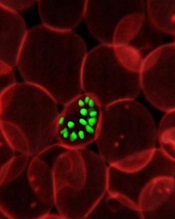
red blood cell; Credit: St Jude
Children’s Research Hospital
Scientists have uncovered a number of potential targets for a blood-stage malaria vaccine.
The team assessed how antibodies from a group of malaria-infected children responded to a library of proteins from the Plasmodium falciparum parasite.
This revealed antigens that had not previously been identified as possible vaccine targets and provided new insight into the ways antigens could be used in combination to increase protection from malaria.
“Resistance to malaria drugs is an increasing problem, so vaccines are desperately needed to battle the Plasmodium falciparum parasite before it has a chance to make people sick,” said Faith Osier, MBChB, of the Kenya Medical Research Institute in Nairobi City.
“This study presents us with a large number of new vaccine candidates that offer real hope for the future.”
Dr Osier and her colleagues described the study in Science Translational Medicine.
The researchers generated a library of correctly folded, full-length proteins from the P falciparum parasite. They then tested antibody reactivity against these proteins in a cohort of Kenyan children who were monitored for clinical episodes of malaria over 6 months.
This revealed antibodies that provide protection against clinical episodes of malaria. Some were equivalent or superior to current leading malaria vaccine candidates.
In fact, combinations consisting of 5 of the 10 top-ranked antigens (PF3D7_1136200, MSP2, RhopH3, P41, MSP11, MSP3, PF3D7_0606800, AMA1, Pf113, and MSRP1) could provide 100% protection against clinical episodes of malaria.
The researchers said these results add further weight to the theory that a successful blood-stage vaccine needs to target multiple antigens.
The team’s next step will be to generate antibodies against all of the proteins in the library and test them in different combinations to see whether combinations that appear to provide protection can directly prevent parasite invasion.
red blood cell; Credit: St Jude
Children’s Research Hospital
Scientists have uncovered a number of potential targets for a blood-stage malaria vaccine.
The team assessed how antibodies from a group of malaria-infected children responded to a library of proteins from the Plasmodium falciparum parasite.
This revealed antigens that had not previously been identified as possible vaccine targets and provided new insight into the ways antigens could be used in combination to increase protection from malaria.
“Resistance to malaria drugs is an increasing problem, so vaccines are desperately needed to battle the Plasmodium falciparum parasite before it has a chance to make people sick,” said Faith Osier, MBChB, of the Kenya Medical Research Institute in Nairobi City.
“This study presents us with a large number of new vaccine candidates that offer real hope for the future.”
Dr Osier and her colleagues described the study in Science Translational Medicine.
The researchers generated a library of correctly folded, full-length proteins from the P falciparum parasite. They then tested antibody reactivity against these proteins in a cohort of Kenyan children who were monitored for clinical episodes of malaria over 6 months.
This revealed antibodies that provide protection against clinical episodes of malaria. Some were equivalent or superior to current leading malaria vaccine candidates.
In fact, combinations consisting of 5 of the 10 top-ranked antigens (PF3D7_1136200, MSP2, RhopH3, P41, MSP11, MSP3, PF3D7_0606800, AMA1, Pf113, and MSRP1) could provide 100% protection against clinical episodes of malaria.
The researchers said these results add further weight to the theory that a successful blood-stage vaccine needs to target multiple antigens.
The team’s next step will be to generate antibodies against all of the proteins in the library and test them in different combinations to see whether combinations that appear to provide protection can directly prevent parasite invasion.
red blood cell; Credit: St Jude
Children’s Research Hospital
Scientists have uncovered a number of potential targets for a blood-stage malaria vaccine.
The team assessed how antibodies from a group of malaria-infected children responded to a library of proteins from the Plasmodium falciparum parasite.
This revealed antigens that had not previously been identified as possible vaccine targets and provided new insight into the ways antigens could be used in combination to increase protection from malaria.
“Resistance to malaria drugs is an increasing problem, so vaccines are desperately needed to battle the Plasmodium falciparum parasite before it has a chance to make people sick,” said Faith Osier, MBChB, of the Kenya Medical Research Institute in Nairobi City.
“This study presents us with a large number of new vaccine candidates that offer real hope for the future.”
Dr Osier and her colleagues described the study in Science Translational Medicine.
The researchers generated a library of correctly folded, full-length proteins from the P falciparum parasite. They then tested antibody reactivity against these proteins in a cohort of Kenyan children who were monitored for clinical episodes of malaria over 6 months.
This revealed antibodies that provide protection against clinical episodes of malaria. Some were equivalent or superior to current leading malaria vaccine candidates.
In fact, combinations consisting of 5 of the 10 top-ranked antigens (PF3D7_1136200, MSP2, RhopH3, P41, MSP11, MSP3, PF3D7_0606800, AMA1, Pf113, and MSRP1) could provide 100% protection against clinical episodes of malaria.
The researchers said these results add further weight to the theory that a successful blood-stage vaccine needs to target multiple antigens.
The team’s next step will be to generate antibodies against all of the proteins in the library and test them in different combinations to see whether combinations that appear to provide protection can directly prevent parasite invasion.
Tool aids analysis of genomic data

Credit: Christoph Bock
Computer scientists have developed a web-based tool that allows researchers to visualize and compare large amounts of genomic information from high-throughput sequencing experiments.
The group described the tool, called Epiviz, in Nature Methods.
“Prior tools limited visualization to presentation and dissemination, rather than a hybrid tool integrating interactive visualization with algorithmic analysis,” said Héctor Corrada Bravo, PhD, of the University of Maryland in College Park.
Dr Corrada Bravo and his colleagues developed Epiviz, a web-based genome browser that integrates with the widely used, open-source Bioconductor analysis software through its Epivizr Bioconductor package.
Epiviz supports many popular next-generation sequencing techniques, such as ChIP-seq, RNA-seq, and DNA methylation analyses.
The tool also implements multiple visualization methods for location-based data (such as genomic regions of interest) and feature-based data (such as gene expression).
For example, because display objects are mapped directly to data elements, Epiviz links data across different visualizations, giving users visual insights of the spatial relationships of multiple data sets. The tool is designed to allow biomedical scientists to easily incorporate their own visualizations.
In the Nature Methods paper, Dr Corrada Bravo and his colleagues describe how they used Epiviz to visualize and analyze DNA methylation and gene expression data in colon cancer.
Using Epiviz and Bioconductor, the team found consistent regions of DNA methylation changes in colon cancer samples generated by the Cancer Genome Atlas project and similar gene expression in these regions of DNA methylation changes in other cancer types.
The results were in agreement with previous experiments showing DNA methylation changes across large regions in the colon cancer genome.
Credit: Christoph Bock
Computer scientists have developed a web-based tool that allows researchers to visualize and compare large amounts of genomic information from high-throughput sequencing experiments.
The group described the tool, called Epiviz, in Nature Methods.
“Prior tools limited visualization to presentation and dissemination, rather than a hybrid tool integrating interactive visualization with algorithmic analysis,” said Héctor Corrada Bravo, PhD, of the University of Maryland in College Park.
Dr Corrada Bravo and his colleagues developed Epiviz, a web-based genome browser that integrates with the widely used, open-source Bioconductor analysis software through its Epivizr Bioconductor package.
Epiviz supports many popular next-generation sequencing techniques, such as ChIP-seq, RNA-seq, and DNA methylation analyses.
The tool also implements multiple visualization methods for location-based data (such as genomic regions of interest) and feature-based data (such as gene expression).
For example, because display objects are mapped directly to data elements, Epiviz links data across different visualizations, giving users visual insights of the spatial relationships of multiple data sets. The tool is designed to allow biomedical scientists to easily incorporate their own visualizations.
In the Nature Methods paper, Dr Corrada Bravo and his colleagues describe how they used Epiviz to visualize and analyze DNA methylation and gene expression data in colon cancer.
Using Epiviz and Bioconductor, the team found consistent regions of DNA methylation changes in colon cancer samples generated by the Cancer Genome Atlas project and similar gene expression in these regions of DNA methylation changes in other cancer types.
The results were in agreement with previous experiments showing DNA methylation changes across large regions in the colon cancer genome.
Credit: Christoph Bock
Computer scientists have developed a web-based tool that allows researchers to visualize and compare large amounts of genomic information from high-throughput sequencing experiments.
The group described the tool, called Epiviz, in Nature Methods.
“Prior tools limited visualization to presentation and dissemination, rather than a hybrid tool integrating interactive visualization with algorithmic analysis,” said Héctor Corrada Bravo, PhD, of the University of Maryland in College Park.
Dr Corrada Bravo and his colleagues developed Epiviz, a web-based genome browser that integrates with the widely used, open-source Bioconductor analysis software through its Epivizr Bioconductor package.
Epiviz supports many popular next-generation sequencing techniques, such as ChIP-seq, RNA-seq, and DNA methylation analyses.
The tool also implements multiple visualization methods for location-based data (such as genomic regions of interest) and feature-based data (such as gene expression).
For example, because display objects are mapped directly to data elements, Epiviz links data across different visualizations, giving users visual insights of the spatial relationships of multiple data sets. The tool is designed to allow biomedical scientists to easily incorporate their own visualizations.
In the Nature Methods paper, Dr Corrada Bravo and his colleagues describe how they used Epiviz to visualize and analyze DNA methylation and gene expression data in colon cancer.
Using Epiviz and Bioconductor, the team found consistent regions of DNA methylation changes in colon cancer samples generated by the Cancer Genome Atlas project and similar gene expression in these regions of DNA methylation changes in other cancer types.
The results were in agreement with previous experiments showing DNA methylation changes across large regions in the colon cancer genome.
System simplifies complex pipetting protocols

Credit: John Correa
Researchers say they’ve developed a simple system that can help scientists perform complex pipetting protocols efficiently and accurately.
The system, called iPipet, allows users to track the transfer of samples and reagents by illuminating well plates on a computer tablet.
In tests, iPipet proved more efficient than a liquid-handling robot.
The researchers have made information on iPipet available online so scientists can use the system in their own labs.
The team also described iPipet in a letter to Nature Methods.
They noted that experiments frequently rely on high-throughput methods that combine large numbers of samples with large-scale, complex pipetting designs. And pipetting errors can lead to experimental failure.
Although liquid-handling robots would seem to be a logical choice for such work, they are also extremely expensive, difficult to program, and require trained personnel. Moreover, they can be plagued by technical snafus, ranging from bent or clogged tips to an inability to capture liquids lying close to the bottoms of individual wells.
“We needed an alternative to costly robots that would allow us to execute complex pipetting protocols,” said Yaniv Erlich, PhD, of the Whitehead Institute in Cambridge, Massachusetts.
So Dr Erlich and his colleagues developed iPipet. The system illuminates individual wells of standard 96- or 384-well plates placed on top of a tablet screen, guiding users through the transfer of samples or reagents from source to destination plates according to specific designs.
Users create their own protocols in Microsoft Excel files in comma-separated format and upload them to the iPipet website, which generates a downloadable link for execution on a tablet computer. Included on the iPipet site are a variety of demos and an instructional video.
In a test of the tool against a liquid-handling robot, iPipet enabled nearly 3000 fixed-volume pipetting steps in approximately 7 hours. After significant time spent on calibration, the robot accomplished only half that number of steps in the same allotted time.
To date, one of the only challenges lab users have encountered is keeping well plates in a fixed position on the tablet screen. For that, Dr Erlich’s team provides a solution: a 3D printed plastic adaptor that users can create with a file accessible via the iPipet website.
“The entire iPipet system is open source,” Dr Erlich said. “We want to maximize the benefit for the community and allow them to further develop this new man-machine interface for biological experiments.”
Credit: John Correa
Researchers say they’ve developed a simple system that can help scientists perform complex pipetting protocols efficiently and accurately.
The system, called iPipet, allows users to track the transfer of samples and reagents by illuminating well plates on a computer tablet.
In tests, iPipet proved more efficient than a liquid-handling robot.
The researchers have made information on iPipet available online so scientists can use the system in their own labs.
The team also described iPipet in a letter to Nature Methods.
They noted that experiments frequently rely on high-throughput methods that combine large numbers of samples with large-scale, complex pipetting designs. And pipetting errors can lead to experimental failure.
Although liquid-handling robots would seem to be a logical choice for such work, they are also extremely expensive, difficult to program, and require trained personnel. Moreover, they can be plagued by technical snafus, ranging from bent or clogged tips to an inability to capture liquids lying close to the bottoms of individual wells.
“We needed an alternative to costly robots that would allow us to execute complex pipetting protocols,” said Yaniv Erlich, PhD, of the Whitehead Institute in Cambridge, Massachusetts.
So Dr Erlich and his colleagues developed iPipet. The system illuminates individual wells of standard 96- or 384-well plates placed on top of a tablet screen, guiding users through the transfer of samples or reagents from source to destination plates according to specific designs.
Users create their own protocols in Microsoft Excel files in comma-separated format and upload them to the iPipet website, which generates a downloadable link for execution on a tablet computer. Included on the iPipet site are a variety of demos and an instructional video.
In a test of the tool against a liquid-handling robot, iPipet enabled nearly 3000 fixed-volume pipetting steps in approximately 7 hours. After significant time spent on calibration, the robot accomplished only half that number of steps in the same allotted time.
To date, one of the only challenges lab users have encountered is keeping well plates in a fixed position on the tablet screen. For that, Dr Erlich’s team provides a solution: a 3D printed plastic adaptor that users can create with a file accessible via the iPipet website.
“The entire iPipet system is open source,” Dr Erlich said. “We want to maximize the benefit for the community and allow them to further develop this new man-machine interface for biological experiments.”
Credit: John Correa
Researchers say they’ve developed a simple system that can help scientists perform complex pipetting protocols efficiently and accurately.
The system, called iPipet, allows users to track the transfer of samples and reagents by illuminating well plates on a computer tablet.
In tests, iPipet proved more efficient than a liquid-handling robot.
The researchers have made information on iPipet available online so scientists can use the system in their own labs.
The team also described iPipet in a letter to Nature Methods.
They noted that experiments frequently rely on high-throughput methods that combine large numbers of samples with large-scale, complex pipetting designs. And pipetting errors can lead to experimental failure.
Although liquid-handling robots would seem to be a logical choice for such work, they are also extremely expensive, difficult to program, and require trained personnel. Moreover, they can be plagued by technical snafus, ranging from bent or clogged tips to an inability to capture liquids lying close to the bottoms of individual wells.
“We needed an alternative to costly robots that would allow us to execute complex pipetting protocols,” said Yaniv Erlich, PhD, of the Whitehead Institute in Cambridge, Massachusetts.
So Dr Erlich and his colleagues developed iPipet. The system illuminates individual wells of standard 96- or 384-well plates placed on top of a tablet screen, guiding users through the transfer of samples or reagents from source to destination plates according to specific designs.
Users create their own protocols in Microsoft Excel files in comma-separated format and upload them to the iPipet website, which generates a downloadable link for execution on a tablet computer. Included on the iPipet site are a variety of demos and an instructional video.
In a test of the tool against a liquid-handling robot, iPipet enabled nearly 3000 fixed-volume pipetting steps in approximately 7 hours. After significant time spent on calibration, the robot accomplished only half that number of steps in the same allotted time.
To date, one of the only challenges lab users have encountered is keeping well plates in a fixed position on the tablet screen. For that, Dr Erlich’s team provides a solution: a 3D printed plastic adaptor that users can create with a file accessible via the iPipet website.
“The entire iPipet system is open source,” Dr Erlich said. “We want to maximize the benefit for the community and allow them to further develop this new man-machine interface for biological experiments.”
FDA aims for tighter regulation of diagnostic tests
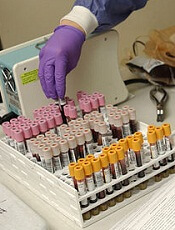
Credit: William Weinert
The US Food and Drug Administration (FDA) is taking steps to ensure better regulation of certain diagnostic tests.
The agency has issued a final guidance on the development, review, and approval of companion diagnostics.
The FDA has also notified Congress of its intention to publish a draft guidance outlining a plan for regulating laboratory-developed tests (LDTs).
The FDA is required to notify Congress before making the draft guidance public. This is mandated by the Food and Drug Administration Safety and Innovation Act of 2012 (FDASIA).
Companion diagnostics guidance
A companion diagnostic is a medical device that provides information essential for the safe and effective use of a corresponding drug or biological product. These tests are commonly used to detect certain types of gene-based cancers.
The FDA’s companion diagnostics guidance is intended to help companies identify the need for these tests during the earliest stages of drug development and to plan for the development of a drug and a companion test at the same time.
The ultimate goal of the final guidance is to stimulate early collaborations that will result in faster access to promising new treatments for patients living with serious and life-threatening diseases. This guidance finalizes and takes into consideration public comments on the draft guidance issued in 2011.
LDT oversight
An LDT is a type of in vitro diagnostic test that is designed, manufactured, and used within a single lab. LDTs include some genetic tests and tests used by healthcare professionals to guide patient treatment.
The FDA already oversees direct-to-consumer tests, regardless of whether they are LDTs or traditional diagnostics.
And while the FDA has historically exercised enforcement discretion over LDTs (generally not enforced applicable regulatory requirements), today, these tests may compete with FDA-approved tests without clinical studies to support their use.
The LDT notification to Congress provides the details of a draft guidance in which the FDA would propose to establish an LDT oversight framework. This would include pre-market review for higher-risk LDTs, such as those that have the same intended use as FDA-approved or cleared companion diagnostics currently on the market.
The draft guidance would also propose to phase in enforcement of pre-market review for other high-risk and moderate-risk LDTs over time.
In addition, the FDA intends to propose that it continue to exercise enforcement discretion for low-risk LDTs, LDTs for rare diseases and, under certain circumstances, LDTs for which there is no FDA-approved or cleared test.
“With today’s notification of the agency’s intent to issue the lab-developed test draft guidance, the FDA is seeking a better balanced approach for all diagnostics,” said Jeffrey Shuren, MD, director of the FDA’s Center for Devices and Radiological Health.
“The agency’s oversight would be based on a test’s level of risk to patients, not on whether it is made by a conventional manufacturer or in a single laboratory, while still providing flexibility to encourage innovation that addresses unmet medical needs.”
Finally, the FDA intends to publish a draft guidance outlining how labs can notify the FDA that they are manufacturing and using LDTs, how to provide information about their LDTs, and how they can comply with the medical device reporting requirements.
A provision in FDASIA requires the FDA to provide at least 60 days’ notice to Congress before the agency publishes for public comment any draft guidance on the regulation of LDTs.
As such, the comment period will open at a later date, when the draft guidances are published in the Federal Register and the public is alerted to the start of the comment period. The agency also intends to hold a public meeting during the comment period to collect additional input.
Credit: William Weinert
The US Food and Drug Administration (FDA) is taking steps to ensure better regulation of certain diagnostic tests.
The agency has issued a final guidance on the development, review, and approval of companion diagnostics.
The FDA has also notified Congress of its intention to publish a draft guidance outlining a plan for regulating laboratory-developed tests (LDTs).
The FDA is required to notify Congress before making the draft guidance public. This is mandated by the Food and Drug Administration Safety and Innovation Act of 2012 (FDASIA).
Companion diagnostics guidance
A companion diagnostic is a medical device that provides information essential for the safe and effective use of a corresponding drug or biological product. These tests are commonly used to detect certain types of gene-based cancers.
The FDA’s companion diagnostics guidance is intended to help companies identify the need for these tests during the earliest stages of drug development and to plan for the development of a drug and a companion test at the same time.
The ultimate goal of the final guidance is to stimulate early collaborations that will result in faster access to promising new treatments for patients living with serious and life-threatening diseases. This guidance finalizes and takes into consideration public comments on the draft guidance issued in 2011.
LDT oversight
An LDT is a type of in vitro diagnostic test that is designed, manufactured, and used within a single lab. LDTs include some genetic tests and tests used by healthcare professionals to guide patient treatment.
The FDA already oversees direct-to-consumer tests, regardless of whether they are LDTs or traditional diagnostics.
And while the FDA has historically exercised enforcement discretion over LDTs (generally not enforced applicable regulatory requirements), today, these tests may compete with FDA-approved tests without clinical studies to support their use.
The LDT notification to Congress provides the details of a draft guidance in which the FDA would propose to establish an LDT oversight framework. This would include pre-market review for higher-risk LDTs, such as those that have the same intended use as FDA-approved or cleared companion diagnostics currently on the market.
The draft guidance would also propose to phase in enforcement of pre-market review for other high-risk and moderate-risk LDTs over time.
In addition, the FDA intends to propose that it continue to exercise enforcement discretion for low-risk LDTs, LDTs for rare diseases and, under certain circumstances, LDTs for which there is no FDA-approved or cleared test.
“With today’s notification of the agency’s intent to issue the lab-developed test draft guidance, the FDA is seeking a better balanced approach for all diagnostics,” said Jeffrey Shuren, MD, director of the FDA’s Center for Devices and Radiological Health.
“The agency’s oversight would be based on a test’s level of risk to patients, not on whether it is made by a conventional manufacturer or in a single laboratory, while still providing flexibility to encourage innovation that addresses unmet medical needs.”
Finally, the FDA intends to publish a draft guidance outlining how labs can notify the FDA that they are manufacturing and using LDTs, how to provide information about their LDTs, and how they can comply with the medical device reporting requirements.
A provision in FDASIA requires the FDA to provide at least 60 days’ notice to Congress before the agency publishes for public comment any draft guidance on the regulation of LDTs.
As such, the comment period will open at a later date, when the draft guidances are published in the Federal Register and the public is alerted to the start of the comment period. The agency also intends to hold a public meeting during the comment period to collect additional input.
Credit: William Weinert
The US Food and Drug Administration (FDA) is taking steps to ensure better regulation of certain diagnostic tests.
The agency has issued a final guidance on the development, review, and approval of companion diagnostics.
The FDA has also notified Congress of its intention to publish a draft guidance outlining a plan for regulating laboratory-developed tests (LDTs).
The FDA is required to notify Congress before making the draft guidance public. This is mandated by the Food and Drug Administration Safety and Innovation Act of 2012 (FDASIA).
Companion diagnostics guidance
A companion diagnostic is a medical device that provides information essential for the safe and effective use of a corresponding drug or biological product. These tests are commonly used to detect certain types of gene-based cancers.
The FDA’s companion diagnostics guidance is intended to help companies identify the need for these tests during the earliest stages of drug development and to plan for the development of a drug and a companion test at the same time.
The ultimate goal of the final guidance is to stimulate early collaborations that will result in faster access to promising new treatments for patients living with serious and life-threatening diseases. This guidance finalizes and takes into consideration public comments on the draft guidance issued in 2011.
LDT oversight
An LDT is a type of in vitro diagnostic test that is designed, manufactured, and used within a single lab. LDTs include some genetic tests and tests used by healthcare professionals to guide patient treatment.
The FDA already oversees direct-to-consumer tests, regardless of whether they are LDTs or traditional diagnostics.
And while the FDA has historically exercised enforcement discretion over LDTs (generally not enforced applicable regulatory requirements), today, these tests may compete with FDA-approved tests without clinical studies to support their use.
The LDT notification to Congress provides the details of a draft guidance in which the FDA would propose to establish an LDT oversight framework. This would include pre-market review for higher-risk LDTs, such as those that have the same intended use as FDA-approved or cleared companion diagnostics currently on the market.
The draft guidance would also propose to phase in enforcement of pre-market review for other high-risk and moderate-risk LDTs over time.
In addition, the FDA intends to propose that it continue to exercise enforcement discretion for low-risk LDTs, LDTs for rare diseases and, under certain circumstances, LDTs for which there is no FDA-approved or cleared test.
“With today’s notification of the agency’s intent to issue the lab-developed test draft guidance, the FDA is seeking a better balanced approach for all diagnostics,” said Jeffrey Shuren, MD, director of the FDA’s Center for Devices and Radiological Health.
“The agency’s oversight would be based on a test’s level of risk to patients, not on whether it is made by a conventional manufacturer or in a single laboratory, while still providing flexibility to encourage innovation that addresses unmet medical needs.”
Finally, the FDA intends to publish a draft guidance outlining how labs can notify the FDA that they are manufacturing and using LDTs, how to provide information about their LDTs, and how they can comply with the medical device reporting requirements.
A provision in FDASIA requires the FDA to provide at least 60 days’ notice to Congress before the agency publishes for public comment any draft guidance on the regulation of LDTs.
As such, the comment period will open at a later date, when the draft guidances are published in the Federal Register and the public is alerted to the start of the comment period. The agency also intends to hold a public meeting during the comment period to collect additional input.