User login
Groups investigate malaria complications in children
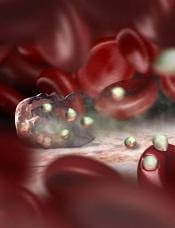
Credit: Peter H. Seeberger
Two studies published in PLOS Pathogens provide new insight into the malaria-related complications that can occur in children.
One study revealed how the immune system manages to prevent malaria fever in children infected with Plasmodium falciparum.
And with the other study, researchers identified proteins that can help them distinguish children with complicated malaria syndromes from those with uncomplicated malaria.
Analyzing immune response
In the first study, Peter Crompton, MD, of the US National Institute of Allergy and Infectious Diseases in Rockville, Maryland, and his colleagues analyzed immune cells from healthy children before the malaria season and from the same children after their first bout of malaria fever during the ensuing malaria season.
The researchers exposed both sets of immune cells to parasite-infected red blood cells and found that their responses were different.
When confronted with parasites before the malaria season, the children’s immune cells produced large amounts of molecules that promote inflammation—such as IL-1b, IL-6, and IL-8—which results in fever and other malaria symptoms.
But after a malaria fever episode, the immune cells responded by producing more anti-inflammatory molecules—such as IL-10 and TGF-b—and showed evidence of an enhanced ability to recognize and destroy parasites.
The ability of the immune cells to mount this response—somewhat effective in controlling the parasites but avoiding systemic inflammation and fever—seems to depend on the continued exposure to parasites through bites of infected mosquitoes.
When the researchers took blood again from the same children after the subsequent dry season (when there are few or no new infections) and exposed the immune cells to parasite-infected red blood cells, the anti-inflammatory response had returned to baseline, leaving children susceptible again to malaria-induced inflammation and fever.
The researchers said these findings shed new light on the notion of premunition, an immune response that protects against illness and high numbers of parasites in the blood without completely eliminating the infection.
They suggested that it evolved as an appropriate immune response to at least partially protect young children from potentially life-threatening inflammation and unchecked parasite replication before they acquire antibodies that protect against the onset of malaria symptoms.
Proteins provide answers
In the second study, Peter Nilsson, PhD, of SciLifeLab in Stockholm, Sweden, and his colleagues used a systematic proteomics approach to distinguish children who develop malaria-related complications from those who do not.
The researchers compared proteins in the blood of uninfected children with proteins in malaria-infected children. And they compared proteins in children with severe malaria syndromes to proteins in uncomplicated cases.
The team analyzed 1015 proteins in blood samples from more than 719 children. They divided the samples into “discovery” and “verification” sets, and only associations found in both sets were reported.
The researchers identified 41 proteins that distinguished malaria patients from uninfected children from the same community. Most of these were components of the inflammatory response.
Thirteen proteins helped the team distinguish uncomplicated malaria from severe malaria syndromes. They identified proteins specific to the 2 most deadly complicated malaria syndromes in children—severe malarial anemia and cerebral malaria.
Markers of oxidative stress were related to severe malarial anemia. And markers of endothelial activation, platelet adhesion, and muscular damage were identified in children with cerebral malaria.
The researchers said their study could aid the discovery of distinct mechanisms in the human response to malaria infection between the 2 most fatal syndromes of childhood malaria. 
Credit: Peter H. Seeberger
Two studies published in PLOS Pathogens provide new insight into the malaria-related complications that can occur in children.
One study revealed how the immune system manages to prevent malaria fever in children infected with Plasmodium falciparum.
And with the other study, researchers identified proteins that can help them distinguish children with complicated malaria syndromes from those with uncomplicated malaria.
Analyzing immune response
In the first study, Peter Crompton, MD, of the US National Institute of Allergy and Infectious Diseases in Rockville, Maryland, and his colleagues analyzed immune cells from healthy children before the malaria season and from the same children after their first bout of malaria fever during the ensuing malaria season.
The researchers exposed both sets of immune cells to parasite-infected red blood cells and found that their responses were different.
When confronted with parasites before the malaria season, the children’s immune cells produced large amounts of molecules that promote inflammation—such as IL-1b, IL-6, and IL-8—which results in fever and other malaria symptoms.
But after a malaria fever episode, the immune cells responded by producing more anti-inflammatory molecules—such as IL-10 and TGF-b—and showed evidence of an enhanced ability to recognize and destroy parasites.
The ability of the immune cells to mount this response—somewhat effective in controlling the parasites but avoiding systemic inflammation and fever—seems to depend on the continued exposure to parasites through bites of infected mosquitoes.
When the researchers took blood again from the same children after the subsequent dry season (when there are few or no new infections) and exposed the immune cells to parasite-infected red blood cells, the anti-inflammatory response had returned to baseline, leaving children susceptible again to malaria-induced inflammation and fever.
The researchers said these findings shed new light on the notion of premunition, an immune response that protects against illness and high numbers of parasites in the blood without completely eliminating the infection.
They suggested that it evolved as an appropriate immune response to at least partially protect young children from potentially life-threatening inflammation and unchecked parasite replication before they acquire antibodies that protect against the onset of malaria symptoms.
Proteins provide answers
In the second study, Peter Nilsson, PhD, of SciLifeLab in Stockholm, Sweden, and his colleagues used a systematic proteomics approach to distinguish children who develop malaria-related complications from those who do not.
The researchers compared proteins in the blood of uninfected children with proteins in malaria-infected children. And they compared proteins in children with severe malaria syndromes to proteins in uncomplicated cases.
The team analyzed 1015 proteins in blood samples from more than 719 children. They divided the samples into “discovery” and “verification” sets, and only associations found in both sets were reported.
The researchers identified 41 proteins that distinguished malaria patients from uninfected children from the same community. Most of these were components of the inflammatory response.
Thirteen proteins helped the team distinguish uncomplicated malaria from severe malaria syndromes. They identified proteins specific to the 2 most deadly complicated malaria syndromes in children—severe malarial anemia and cerebral malaria.
Markers of oxidative stress were related to severe malarial anemia. And markers of endothelial activation, platelet adhesion, and muscular damage were identified in children with cerebral malaria.
The researchers said their study could aid the discovery of distinct mechanisms in the human response to malaria infection between the 2 most fatal syndromes of childhood malaria.
Credit: Peter H. Seeberger
Two studies published in PLOS Pathogens provide new insight into the malaria-related complications that can occur in children.
One study revealed how the immune system manages to prevent malaria fever in children infected with Plasmodium falciparum.
And with the other study, researchers identified proteins that can help them distinguish children with complicated malaria syndromes from those with uncomplicated malaria.
Analyzing immune response
In the first study, Peter Crompton, MD, of the US National Institute of Allergy and Infectious Diseases in Rockville, Maryland, and his colleagues analyzed immune cells from healthy children before the malaria season and from the same children after their first bout of malaria fever during the ensuing malaria season.
The researchers exposed both sets of immune cells to parasite-infected red blood cells and found that their responses were different.
When confronted with parasites before the malaria season, the children’s immune cells produced large amounts of molecules that promote inflammation—such as IL-1b, IL-6, and IL-8—which results in fever and other malaria symptoms.
But after a malaria fever episode, the immune cells responded by producing more anti-inflammatory molecules—such as IL-10 and TGF-b—and showed evidence of an enhanced ability to recognize and destroy parasites.
The ability of the immune cells to mount this response—somewhat effective in controlling the parasites but avoiding systemic inflammation and fever—seems to depend on the continued exposure to parasites through bites of infected mosquitoes.
When the researchers took blood again from the same children after the subsequent dry season (when there are few or no new infections) and exposed the immune cells to parasite-infected red blood cells, the anti-inflammatory response had returned to baseline, leaving children susceptible again to malaria-induced inflammation and fever.
The researchers said these findings shed new light on the notion of premunition, an immune response that protects against illness and high numbers of parasites in the blood without completely eliminating the infection.
They suggested that it evolved as an appropriate immune response to at least partially protect young children from potentially life-threatening inflammation and unchecked parasite replication before they acquire antibodies that protect against the onset of malaria symptoms.
Proteins provide answers
In the second study, Peter Nilsson, PhD, of SciLifeLab in Stockholm, Sweden, and his colleagues used a systematic proteomics approach to distinguish children who develop malaria-related complications from those who do not.
The researchers compared proteins in the blood of uninfected children with proteins in malaria-infected children. And they compared proteins in children with severe malaria syndromes to proteins in uncomplicated cases.
The team analyzed 1015 proteins in blood samples from more than 719 children. They divided the samples into “discovery” and “verification” sets, and only associations found in both sets were reported.
The researchers identified 41 proteins that distinguished malaria patients from uninfected children from the same community. Most of these were components of the inflammatory response.
Thirteen proteins helped the team distinguish uncomplicated malaria from severe malaria syndromes. They identified proteins specific to the 2 most deadly complicated malaria syndromes in children—severe malarial anemia and cerebral malaria.
Markers of oxidative stress were related to severe malarial anemia. And markers of endothelial activation, platelet adhesion, and muscular damage were identified in children with cerebral malaria.
The researchers said their study could aid the discovery of distinct mechanisms in the human response to malaria infection between the 2 most fatal syndromes of childhood malaria.
Patient perception of control affects satisfaction

patient and her father
Credit: Rhoda Baer
Feeling as though they play an active role in their treatment decisions increases satisfaction among cancer patients undergoing radiotherapy (RT), according to research published in Cancer.
In a study of more than 300 RT patients, those who were involved in their treatment decisions—or perceived they had some control over their treatment—were more satisfied than their peers.
On the other hand, patients who wanted control over their treatment but did not feel they had any were more likely than their peers to experience anxiety, depression, and fatigue.
“Our findings emphasize the value of patient-physician relationships and communication, specifically in radiation oncology, and their impact on patient experience in a way that hasn’t been shown before,” said study author Neha Vapiwala, MD, of the Perelman School of Medicine at the University of Pennsylvania.
Dr Vapiwala and her colleagues noted that past studies of shared decision-making (SDM)—in which patients and providers make healthcare decisions together, taking into account scientific evidence and patient preferences—have shown an association between patient satisfaction and quality of life.
However, none of these studies has evaluated the impact of SDM on patients undergoing RT. Often, radiation oncology is seen as a treatment avenue that is ultimately left to the physician to dictate. But there are tailored options, decisions, and discussions that can apply to individual patients.
With this in mind, the researchers conducted a survey of SDM in 305 patients undergoing RT. In all, 31% of patients said they experienced SDM, 32% perceived control in their treatment decisions, and 76% reported feeling very satisfied with their radiation treatment course overall.
Patient satisfaction was significantly higher among those who perceived SDM than among those who did not—84.4% and 71.4%, respectively (P<0.02).
And satisfaction was higher among patients who perceived control over their treatment than among those who did not—89.7% and 69.2%, respectively (P<0.001).
Patients who expressed a desire for control over their treatment decisions but did not perceive having any control were significantly more likely than their peers to experience symptoms tied to psychological distress.
Anxiety was reported in 44% and 20% of patients, respectively (P<0.02). Depression was reported in 44% and 15%, respectively (P<0.01). And fatigue was reported in 68% and 39.2%, respectively (P<0.01).
The researchers said one of this study’s strengths is the diverse group of patients enrolled. Ages ranged from 18 to 87 years, and a variety of ethnic/racial groups were represented. Patients had a range of cancers at all stages, and could participate in the study as long as they were well enough.
The team said the next step for this research is to determine both physician and patient barriers to SDM and identify methods to break down these barriers.
“As providers, it doesn’t matter what treatment you are offering, or how complicated it is, or how busy you may be,” Dr Vapiwala said. “It’s worth taking even a few minutes to talk to patients about seemingly minor decisions in which they can provide some input.”
“It’s not only critical in today’s healthcare setting, where both information and misinformation are rampant, but will very likely lead to the patient feeling positively about the encounter.”
patient and her father
Credit: Rhoda Baer
Feeling as though they play an active role in their treatment decisions increases satisfaction among cancer patients undergoing radiotherapy (RT), according to research published in Cancer.
In a study of more than 300 RT patients, those who were involved in their treatment decisions—or perceived they had some control over their treatment—were more satisfied than their peers.
On the other hand, patients who wanted control over their treatment but did not feel they had any were more likely than their peers to experience anxiety, depression, and fatigue.
“Our findings emphasize the value of patient-physician relationships and communication, specifically in radiation oncology, and their impact on patient experience in a way that hasn’t been shown before,” said study author Neha Vapiwala, MD, of the Perelman School of Medicine at the University of Pennsylvania.
Dr Vapiwala and her colleagues noted that past studies of shared decision-making (SDM)—in which patients and providers make healthcare decisions together, taking into account scientific evidence and patient preferences—have shown an association between patient satisfaction and quality of life.
However, none of these studies has evaluated the impact of SDM on patients undergoing RT. Often, radiation oncology is seen as a treatment avenue that is ultimately left to the physician to dictate. But there are tailored options, decisions, and discussions that can apply to individual patients.
With this in mind, the researchers conducted a survey of SDM in 305 patients undergoing RT. In all, 31% of patients said they experienced SDM, 32% perceived control in their treatment decisions, and 76% reported feeling very satisfied with their radiation treatment course overall.
Patient satisfaction was significantly higher among those who perceived SDM than among those who did not—84.4% and 71.4%, respectively (P<0.02).
And satisfaction was higher among patients who perceived control over their treatment than among those who did not—89.7% and 69.2%, respectively (P<0.001).
Patients who expressed a desire for control over their treatment decisions but did not perceive having any control were significantly more likely than their peers to experience symptoms tied to psychological distress.
Anxiety was reported in 44% and 20% of patients, respectively (P<0.02). Depression was reported in 44% and 15%, respectively (P<0.01). And fatigue was reported in 68% and 39.2%, respectively (P<0.01).
The researchers said one of this study’s strengths is the diverse group of patients enrolled. Ages ranged from 18 to 87 years, and a variety of ethnic/racial groups were represented. Patients had a range of cancers at all stages, and could participate in the study as long as they were well enough.
The team said the next step for this research is to determine both physician and patient barriers to SDM and identify methods to break down these barriers.
“As providers, it doesn’t matter what treatment you are offering, or how complicated it is, or how busy you may be,” Dr Vapiwala said. “It’s worth taking even a few minutes to talk to patients about seemingly minor decisions in which they can provide some input.”
“It’s not only critical in today’s healthcare setting, where both information and misinformation are rampant, but will very likely lead to the patient feeling positively about the encounter.”
patient and her father
Credit: Rhoda Baer
Feeling as though they play an active role in their treatment decisions increases satisfaction among cancer patients undergoing radiotherapy (RT), according to research published in Cancer.
In a study of more than 300 RT patients, those who were involved in their treatment decisions—or perceived they had some control over their treatment—were more satisfied than their peers.
On the other hand, patients who wanted control over their treatment but did not feel they had any were more likely than their peers to experience anxiety, depression, and fatigue.
“Our findings emphasize the value of patient-physician relationships and communication, specifically in radiation oncology, and their impact on patient experience in a way that hasn’t been shown before,” said study author Neha Vapiwala, MD, of the Perelman School of Medicine at the University of Pennsylvania.
Dr Vapiwala and her colleagues noted that past studies of shared decision-making (SDM)—in which patients and providers make healthcare decisions together, taking into account scientific evidence and patient preferences—have shown an association between patient satisfaction and quality of life.
However, none of these studies has evaluated the impact of SDM on patients undergoing RT. Often, radiation oncology is seen as a treatment avenue that is ultimately left to the physician to dictate. But there are tailored options, decisions, and discussions that can apply to individual patients.
With this in mind, the researchers conducted a survey of SDM in 305 patients undergoing RT. In all, 31% of patients said they experienced SDM, 32% perceived control in their treatment decisions, and 76% reported feeling very satisfied with their radiation treatment course overall.
Patient satisfaction was significantly higher among those who perceived SDM than among those who did not—84.4% and 71.4%, respectively (P<0.02).
And satisfaction was higher among patients who perceived control over their treatment than among those who did not—89.7% and 69.2%, respectively (P<0.001).
Patients who expressed a desire for control over their treatment decisions but did not perceive having any control were significantly more likely than their peers to experience symptoms tied to psychological distress.
Anxiety was reported in 44% and 20% of patients, respectively (P<0.02). Depression was reported in 44% and 15%, respectively (P<0.01). And fatigue was reported in 68% and 39.2%, respectively (P<0.01).
The researchers said one of this study’s strengths is the diverse group of patients enrolled. Ages ranged from 18 to 87 years, and a variety of ethnic/racial groups were represented. Patients had a range of cancers at all stages, and could participate in the study as long as they were well enough.
The team said the next step for this research is to determine both physician and patient barriers to SDM and identify methods to break down these barriers.
“As providers, it doesn’t matter what treatment you are offering, or how complicated it is, or how busy you may be,” Dr Vapiwala said. “It’s worth taking even a few minutes to talk to patients about seemingly minor decisions in which they can provide some input.”
“It’s not only critical in today’s healthcare setting, where both information and misinformation are rampant, but will very likely lead to the patient feeling positively about the encounter.”
Team finds Achilles’ heel in malaria parasite protein

Credit: Ute Frevert
and Margaret Shear
Changing the administration of chloroquine might prevent resistance to the antimalarial agent, according to a study published in PNAS.
Investigators found the parasite protein that causes chloroquine resistance—the Plasmodium falciparum chloroquine resistance transporter (PfCRT)—has an Achilles’ heel.
“We studied diverse versions of this protein and, in all cases, found that it is limited in its capacity to remove the drug from the parasite,” said Rowena Martin, PhD, of The Australian National University in Canberra.
“This means malaria could once again be treated with chloroquine if it is administered twice-daily, rather than just once a day.”
Dr Martin and her colleagues noted that a number of distinct PfCRT haplotypes, containing between 4 and 10 mutations, have given rise to chloroquine resistance.
So they set out to characterize these forms of PfCRT and determine the number of mutations, as well as the order of their addition, required to confer chloroquine transport activity.
The investigators analyzed more than 100 variants of PfCRT, measuring their ability to transport chloroquine.
The team identified multiple mutational pathways that led to chloroquine transport via PfCRT but divided these pathways into 2 main lineages.
“We found that the protein gains the ability to move chloroquine out of the parasite through 1 of 2 evolutionary pathways but that this process is rigid,” Dr Martin said. “One wrong turn, and the protein is rendered useless.”
In fact, the investigators found that, if mutations did not occur in a precise order, chloroquine transport activity decreased.
The number of mutations played a key role as well. A minimum of 2 mutations was sufficient for chloroquine transport activity, but as few as 4 conferred full activity.
“This indicates that the protein is under conflicting pressures, which is a weakness that could be exploited in future antimalarial strategies,” Dr Martin said.
She also noted that these findings might not apply only to chloroquine. They might apply to several chloroquine-like drugs that are also becoming less effective as the malaria parasite builds up resistance.
Credit: Ute Frevert
and Margaret Shear
Changing the administration of chloroquine might prevent resistance to the antimalarial agent, according to a study published in PNAS.
Investigators found the parasite protein that causes chloroquine resistance—the Plasmodium falciparum chloroquine resistance transporter (PfCRT)—has an Achilles’ heel.
“We studied diverse versions of this protein and, in all cases, found that it is limited in its capacity to remove the drug from the parasite,” said Rowena Martin, PhD, of The Australian National University in Canberra.
“This means malaria could once again be treated with chloroquine if it is administered twice-daily, rather than just once a day.”
Dr Martin and her colleagues noted that a number of distinct PfCRT haplotypes, containing between 4 and 10 mutations, have given rise to chloroquine resistance.
So they set out to characterize these forms of PfCRT and determine the number of mutations, as well as the order of their addition, required to confer chloroquine transport activity.
The investigators analyzed more than 100 variants of PfCRT, measuring their ability to transport chloroquine.
The team identified multiple mutational pathways that led to chloroquine transport via PfCRT but divided these pathways into 2 main lineages.
“We found that the protein gains the ability to move chloroquine out of the parasite through 1 of 2 evolutionary pathways but that this process is rigid,” Dr Martin said. “One wrong turn, and the protein is rendered useless.”
In fact, the investigators found that, if mutations did not occur in a precise order, chloroquine transport activity decreased.
The number of mutations played a key role as well. A minimum of 2 mutations was sufficient for chloroquine transport activity, but as few as 4 conferred full activity.
“This indicates that the protein is under conflicting pressures, which is a weakness that could be exploited in future antimalarial strategies,” Dr Martin said.
She also noted that these findings might not apply only to chloroquine. They might apply to several chloroquine-like drugs that are also becoming less effective as the malaria parasite builds up resistance.
Credit: Ute Frevert
and Margaret Shear
Changing the administration of chloroquine might prevent resistance to the antimalarial agent, according to a study published in PNAS.
Investigators found the parasite protein that causes chloroquine resistance—the Plasmodium falciparum chloroquine resistance transporter (PfCRT)—has an Achilles’ heel.
“We studied diverse versions of this protein and, in all cases, found that it is limited in its capacity to remove the drug from the parasite,” said Rowena Martin, PhD, of The Australian National University in Canberra.
“This means malaria could once again be treated with chloroquine if it is administered twice-daily, rather than just once a day.”
Dr Martin and her colleagues noted that a number of distinct PfCRT haplotypes, containing between 4 and 10 mutations, have given rise to chloroquine resistance.
So they set out to characterize these forms of PfCRT and determine the number of mutations, as well as the order of their addition, required to confer chloroquine transport activity.
The investigators analyzed more than 100 variants of PfCRT, measuring their ability to transport chloroquine.
The team identified multiple mutational pathways that led to chloroquine transport via PfCRT but divided these pathways into 2 main lineages.
“We found that the protein gains the ability to move chloroquine out of the parasite through 1 of 2 evolutionary pathways but that this process is rigid,” Dr Martin said. “One wrong turn, and the protein is rendered useless.”
In fact, the investigators found that, if mutations did not occur in a precise order, chloroquine transport activity decreased.
The number of mutations played a key role as well. A minimum of 2 mutations was sufficient for chloroquine transport activity, but as few as 4 conferred full activity.
“This indicates that the protein is under conflicting pressures, which is a weakness that could be exploited in future antimalarial strategies,” Dr Martin said.
She also noted that these findings might not apply only to chloroquine. They might apply to several chloroquine-like drugs that are also becoming less effective as the malaria parasite builds up resistance.
FDA approves dressing to control bleeding

The US Food and Drug Administration (FDA) has approved marketing of an expandable, multi-sponge wound dressing to control bleeding from certain types of wounds inflicted in battle.
The dressing, called XSTAT, is for military use only. It is intended for use on gunshot or shrapnel wounds in areas where a tourniquet cannot be placed, such as the groin or armpit.
The dressing can be used for up to 4 hours, which could allow time for a patient to receive surgical care.
XSTAT consists of 3 syringe-style applicators containing 92 compressed cellulose sponges that have an absorbent coating.
The sponges expand and swell to fill the wound cavity, after approximately 20 seconds upon contact with water from blood or bodily fluid. This creates a temporary physical barrier to blood flow.
The number of sponges needed for effective hemorrhage control will vary depending on the size and depth of the wound. Up to 3 applicators may be used on a patient.
The tablet-shaped sponges are each 9.8 mm in diameter and 4 mm to 5 mm in height. They can absorb 3 mL of blood or body fluid. An applicator filled with 92 sponges, therefore, can absorb about 300 mL of fluid.
The sponges cannot be absorbed by the body, and all sponges must be removed before a wound is closed. For ease of visualization and to confirm removal of every sponge, each sponge contains a marker that is visible via X-ray.
The FDA reviewed XSTAT through its de novo classification process, a regulatory pathway for some novel, low-to-moderate-risk medical devices that are the first of their kind.
Before approving XSTAT, the FDA reviewed data from animal studies demonstrating the product’s ability to stop bleeding and its absorption capacity. The agency also reviewed non-clinical biocompatibility data and results of human factors testing.
XSTAT is manufactured by RevMedX, Inc., in Wilsonville, Oregon. For more information on XSTAT, see the company’s website.
The US Food and Drug Administration (FDA) has approved marketing of an expandable, multi-sponge wound dressing to control bleeding from certain types of wounds inflicted in battle.
The dressing, called XSTAT, is for military use only. It is intended for use on gunshot or shrapnel wounds in areas where a tourniquet cannot be placed, such as the groin or armpit.
The dressing can be used for up to 4 hours, which could allow time for a patient to receive surgical care.
XSTAT consists of 3 syringe-style applicators containing 92 compressed cellulose sponges that have an absorbent coating.
The sponges expand and swell to fill the wound cavity, after approximately 20 seconds upon contact with water from blood or bodily fluid. This creates a temporary physical barrier to blood flow.
The number of sponges needed for effective hemorrhage control will vary depending on the size and depth of the wound. Up to 3 applicators may be used on a patient.
The tablet-shaped sponges are each 9.8 mm in diameter and 4 mm to 5 mm in height. They can absorb 3 mL of blood or body fluid. An applicator filled with 92 sponges, therefore, can absorb about 300 mL of fluid.
The sponges cannot be absorbed by the body, and all sponges must be removed before a wound is closed. For ease of visualization and to confirm removal of every sponge, each sponge contains a marker that is visible via X-ray.
The FDA reviewed XSTAT through its de novo classification process, a regulatory pathway for some novel, low-to-moderate-risk medical devices that are the first of their kind.
Before approving XSTAT, the FDA reviewed data from animal studies demonstrating the product’s ability to stop bleeding and its absorption capacity. The agency also reviewed non-clinical biocompatibility data and results of human factors testing.
XSTAT is manufactured by RevMedX, Inc., in Wilsonville, Oregon. For more information on XSTAT, see the company’s website.
The US Food and Drug Administration (FDA) has approved marketing of an expandable, multi-sponge wound dressing to control bleeding from certain types of wounds inflicted in battle.
The dressing, called XSTAT, is for military use only. It is intended for use on gunshot or shrapnel wounds in areas where a tourniquet cannot be placed, such as the groin or armpit.
The dressing can be used for up to 4 hours, which could allow time for a patient to receive surgical care.
XSTAT consists of 3 syringe-style applicators containing 92 compressed cellulose sponges that have an absorbent coating.
The sponges expand and swell to fill the wound cavity, after approximately 20 seconds upon contact with water from blood or bodily fluid. This creates a temporary physical barrier to blood flow.
The number of sponges needed for effective hemorrhage control will vary depending on the size and depth of the wound. Up to 3 applicators may be used on a patient.
The tablet-shaped sponges are each 9.8 mm in diameter and 4 mm to 5 mm in height. They can absorb 3 mL of blood or body fluid. An applicator filled with 92 sponges, therefore, can absorb about 300 mL of fluid.
The sponges cannot be absorbed by the body, and all sponges must be removed before a wound is closed. For ease of visualization and to confirm removal of every sponge, each sponge contains a marker that is visible via X-ray.
The FDA reviewed XSTAT through its de novo classification process, a regulatory pathway for some novel, low-to-moderate-risk medical devices that are the first of their kind.
Before approving XSTAT, the FDA reviewed data from animal studies demonstrating the product’s ability to stop bleeding and its absorption capacity. The agency also reviewed non-clinical biocompatibility data and results of human factors testing.
XSTAT is manufactured by RevMedX, Inc., in Wilsonville, Oregon. For more information on XSTAT, see the company’s website.
ASCO releases guidelines for managing cancer survivors

with a cancer patient
NCI/Mathews Media Group
The American Society of Clinical Oncology (ASCO) has issued 3 practice guidelines for preventing and managing symptoms that can affect adult cancer survivors—neuropathy, fatigue, and depression/anxiety.
The guideline on chemotherapy-induced peripheral neuropathy (CIPN) lists a few options for treating the condition but discourages interventions to prevent CIPN, as there is insufficient evidence that these interventions benefit patients.
The guideline on fatigue recommends that healthcare providers start screening cancer patients for the condition at diagnosis and emphasizes the importance of educating patients about fatigue.
The guideline on depression and anxiety recommends periodic evaluations for symptoms of depression and anxiety in all cancer patients. It also suggests that all patients be offered supportive care services.
All 3 of these guidelines are published in the Journal of Clinical Oncology.
Treating and preventing CIPN
ASCO’s guideline on CIPN lists a handful of drugs that may be helpful in diminishing the symptoms of CIPN, but it does not recommend any agents for preventing the condition.
In fact, the guideline provides a list of agents that should not be offered for the prevention of CIPN, including acetyl-L-carnitine, amifostine, amitriptyline, CaMg, diethyldithio-carbamate, glutathione, nimodipine, Org 2766, all-trans retinoic acid, rhuLIF, and vitamin E.
“There is no clear panacea for neuropathy,” said Gary Lyman, MD, MPH, co-chair of the ASCO Survivorship Guidelines Advisory Group.
“Some of the drugs used for prevention or treatment of neuropathy may cause side effects or interfere with other drugs. We want to be clear that if there is no evidence of benefit from those drugs, it’s probably best not to take them.”
As for treatment, the guideline states that data support a “moderate” recommendation for duloxetine.
It also notes that there is no strong evidence of benefit for the use of tricyclic antidepressants, gabapentin, and a topical gel containing baclofen, amitriptyline, and ketamine. However, it may be reasonable to try those agents in select patients.
To develop this guideline, an ASCO panel conducted a systematic review of relevant medical literature. They analyzed data from 48 randomized, clinical trials focused on managing CIPN.
Screening and managing fatigue
ASCO’s guideline on fatigue recommends that all patients be screened for fatigue from the point of diagnosis onward. Healthcare providers should assess fatigue history, disease status, and treatable contributing factors.
All patients should be educated about the differences between normal and cancer-related fatigue, causes of fatigue, and contributing factors.
Healthcare providers should discuss with patients strategies to manage fatigue, including physical activity, psychosocial interventions (such as cognitive and behavioral therapies or psycho-educational therapies), and mind-body interventions (such as yoga or acupuncture).
To develop this guideline, an ASCO panel conducted a systematic review of clinical practice guideline databases and relevant medical literature. The adaptation is based on a Pan-Canadian guideline on fatigue and 2 National Comprehensive Cancer Network guidelines on cancer-related fatigue and survivorship.
Handling anxiety and depression
ASCO’s guideline on anxiety and depression recommends that healthcare providers periodically evaluate all cancer patients for symptoms of depression and anxiety. The assessments should be performed using validated, published measures and procedures.
All patients should have the option of receiving supportive care services, such as education about the normalcy of stress in the context of cancer, signs and symptoms of distress, and stress reduction strategies.
Patients who display moderate or severe symptoms of anxiety and depression should be referred for the appropriate psychological, psychosocial, or psychiatric interventions.
“Doctors sometimes don’t give these symptoms much attention because they think it’s normal that their patients are a little anxious or depressed about their disease,” Dr Lyman said. “But it’s important to keep an eye on the symptoms and step in when they start to interfere with the patients’ quality of life.”
To develop this guideline, an ASCO panel conducted a systematic review of clinical practice guideline databases and relevant medical literature. The adaptation is based on a Pan-Canadian practice guideline on psychological distress in adults with cancer.
with a cancer patient
NCI/Mathews Media Group
The American Society of Clinical Oncology (ASCO) has issued 3 practice guidelines for preventing and managing symptoms that can affect adult cancer survivors—neuropathy, fatigue, and depression/anxiety.
The guideline on chemotherapy-induced peripheral neuropathy (CIPN) lists a few options for treating the condition but discourages interventions to prevent CIPN, as there is insufficient evidence that these interventions benefit patients.
The guideline on fatigue recommends that healthcare providers start screening cancer patients for the condition at diagnosis and emphasizes the importance of educating patients about fatigue.
The guideline on depression and anxiety recommends periodic evaluations for symptoms of depression and anxiety in all cancer patients. It also suggests that all patients be offered supportive care services.
All 3 of these guidelines are published in the Journal of Clinical Oncology.
Treating and preventing CIPN
ASCO’s guideline on CIPN lists a handful of drugs that may be helpful in diminishing the symptoms of CIPN, but it does not recommend any agents for preventing the condition.
In fact, the guideline provides a list of agents that should not be offered for the prevention of CIPN, including acetyl-L-carnitine, amifostine, amitriptyline, CaMg, diethyldithio-carbamate, glutathione, nimodipine, Org 2766, all-trans retinoic acid, rhuLIF, and vitamin E.
“There is no clear panacea for neuropathy,” said Gary Lyman, MD, MPH, co-chair of the ASCO Survivorship Guidelines Advisory Group.
“Some of the drugs used for prevention or treatment of neuropathy may cause side effects or interfere with other drugs. We want to be clear that if there is no evidence of benefit from those drugs, it’s probably best not to take them.”
As for treatment, the guideline states that data support a “moderate” recommendation for duloxetine.
It also notes that there is no strong evidence of benefit for the use of tricyclic antidepressants, gabapentin, and a topical gel containing baclofen, amitriptyline, and ketamine. However, it may be reasonable to try those agents in select patients.
To develop this guideline, an ASCO panel conducted a systematic review of relevant medical literature. They analyzed data from 48 randomized, clinical trials focused on managing CIPN.
Screening and managing fatigue
ASCO’s guideline on fatigue recommends that all patients be screened for fatigue from the point of diagnosis onward. Healthcare providers should assess fatigue history, disease status, and treatable contributing factors.
All patients should be educated about the differences between normal and cancer-related fatigue, causes of fatigue, and contributing factors.
Healthcare providers should discuss with patients strategies to manage fatigue, including physical activity, psychosocial interventions (such as cognitive and behavioral therapies or psycho-educational therapies), and mind-body interventions (such as yoga or acupuncture).
To develop this guideline, an ASCO panel conducted a systematic review of clinical practice guideline databases and relevant medical literature. The adaptation is based on a Pan-Canadian guideline on fatigue and 2 National Comprehensive Cancer Network guidelines on cancer-related fatigue and survivorship.
Handling anxiety and depression
ASCO’s guideline on anxiety and depression recommends that healthcare providers periodically evaluate all cancer patients for symptoms of depression and anxiety. The assessments should be performed using validated, published measures and procedures.
All patients should have the option of receiving supportive care services, such as education about the normalcy of stress in the context of cancer, signs and symptoms of distress, and stress reduction strategies.
Patients who display moderate or severe symptoms of anxiety and depression should be referred for the appropriate psychological, psychosocial, or psychiatric interventions.
“Doctors sometimes don’t give these symptoms much attention because they think it’s normal that their patients are a little anxious or depressed about their disease,” Dr Lyman said. “But it’s important to keep an eye on the symptoms and step in when they start to interfere with the patients’ quality of life.”
To develop this guideline, an ASCO panel conducted a systematic review of clinical practice guideline databases and relevant medical literature. The adaptation is based on a Pan-Canadian practice guideline on psychological distress in adults with cancer.
with a cancer patient
NCI/Mathews Media Group
The American Society of Clinical Oncology (ASCO) has issued 3 practice guidelines for preventing and managing symptoms that can affect adult cancer survivors—neuropathy, fatigue, and depression/anxiety.
The guideline on chemotherapy-induced peripheral neuropathy (CIPN) lists a few options for treating the condition but discourages interventions to prevent CIPN, as there is insufficient evidence that these interventions benefit patients.
The guideline on fatigue recommends that healthcare providers start screening cancer patients for the condition at diagnosis and emphasizes the importance of educating patients about fatigue.
The guideline on depression and anxiety recommends periodic evaluations for symptoms of depression and anxiety in all cancer patients. It also suggests that all patients be offered supportive care services.
All 3 of these guidelines are published in the Journal of Clinical Oncology.
Treating and preventing CIPN
ASCO’s guideline on CIPN lists a handful of drugs that may be helpful in diminishing the symptoms of CIPN, but it does not recommend any agents for preventing the condition.
In fact, the guideline provides a list of agents that should not be offered for the prevention of CIPN, including acetyl-L-carnitine, amifostine, amitriptyline, CaMg, diethyldithio-carbamate, glutathione, nimodipine, Org 2766, all-trans retinoic acid, rhuLIF, and vitamin E.
“There is no clear panacea for neuropathy,” said Gary Lyman, MD, MPH, co-chair of the ASCO Survivorship Guidelines Advisory Group.
“Some of the drugs used for prevention or treatment of neuropathy may cause side effects or interfere with other drugs. We want to be clear that if there is no evidence of benefit from those drugs, it’s probably best not to take them.”
As for treatment, the guideline states that data support a “moderate” recommendation for duloxetine.
It also notes that there is no strong evidence of benefit for the use of tricyclic antidepressants, gabapentin, and a topical gel containing baclofen, amitriptyline, and ketamine. However, it may be reasonable to try those agents in select patients.
To develop this guideline, an ASCO panel conducted a systematic review of relevant medical literature. They analyzed data from 48 randomized, clinical trials focused on managing CIPN.
Screening and managing fatigue
ASCO’s guideline on fatigue recommends that all patients be screened for fatigue from the point of diagnosis onward. Healthcare providers should assess fatigue history, disease status, and treatable contributing factors.
All patients should be educated about the differences between normal and cancer-related fatigue, causes of fatigue, and contributing factors.
Healthcare providers should discuss with patients strategies to manage fatigue, including physical activity, psychosocial interventions (such as cognitive and behavioral therapies or psycho-educational therapies), and mind-body interventions (such as yoga or acupuncture).
To develop this guideline, an ASCO panel conducted a systematic review of clinical practice guideline databases and relevant medical literature. The adaptation is based on a Pan-Canadian guideline on fatigue and 2 National Comprehensive Cancer Network guidelines on cancer-related fatigue and survivorship.
Handling anxiety and depression
ASCO’s guideline on anxiety and depression recommends that healthcare providers periodically evaluate all cancer patients for symptoms of depression and anxiety. The assessments should be performed using validated, published measures and procedures.
All patients should have the option of receiving supportive care services, such as education about the normalcy of stress in the context of cancer, signs and symptoms of distress, and stress reduction strategies.
Patients who display moderate or severe symptoms of anxiety and depression should be referred for the appropriate psychological, psychosocial, or psychiatric interventions.
“Doctors sometimes don’t give these symptoms much attention because they think it’s normal that their patients are a little anxious or depressed about their disease,” Dr Lyman said. “But it’s important to keep an eye on the symptoms and step in when they start to interfere with the patients’ quality of life.”
To develop this guideline, an ASCO panel conducted a systematic review of clinical practice guideline databases and relevant medical literature. The adaptation is based on a Pan-Canadian practice guideline on psychological distress in adults with cancer.
How mechanical forces affect T cells

used for T-cell force research,
with 3 glass micropipettes
shown under green light.
Georgia Tech/Rob Felt
Investigators say they’ve discovered how T-cell receptors (TCRs) use mechanical contact to decide if the cells they encounter
pose a threat to the body.
The team made their discovery using a sensor based on a red blood cell and a technique for detecting calcium ions emitted by T cells as part of the signaling process.
The researchers studied the binding of antigens to more than a hundred T cells, measuring the forces involved in the binding and the lifetimes of the bonds.
Results revealed that force prolongs TCR bonds for agonists but shortens them for antagonists. And the signaling outcome of an interaction between an antigen and a TCR depends on the magnitude, duration, frequency, and timing of the force application.
“This is the first systematic study of how T-cell recognition is affected by mechanical force, and it shows that forces play an important role in the functions of T cells,” said study author Cheng Zhu, PhD, of Georgia Tech and Emory University in Atlanta. “We think that mechanical force plays a role in almost every step of T-cell biology.”
Dr Zhu and his colleagues described this research in Cell.
The team used a biomembrane force probe to measure the strength and longevity of bonds between T cells and antigens. The probe consists, in part, of a red blood cell aspirated to a micropipette.
Attached to the red blood cell is a bead on which the investigators placed the antigen under study. Using a delicate mechanism that precisely controls motion, they moved the bead into contact with a TCR, allowing binding to take place.
To test the strength of the bond formed between an antigen and the TCR, the researchers applied piconewton forces to separate the bead holding the antigen from the TCR. The red blood cell then acted as a spring, stretching and allowing a measurement of the forces needed to separate the TCR and antigen.
To assess the impact of the binding on intracellular signaling, the investigators injected a dye into the cells that fluoresces when exposed to calcium signaling ions. Detecting the fluorescence allowed the team to determine when the mechanical force triggered T-cell signaling.
In this way, the researchers learned that interactions between the TCRs and agonist peptide-major histocompatibility complexes (MHCs) form catch bonds that become stronger with the application of additional force to initiate intracellular signaling.
And less active MHC complexes form slip bonds that weaken with force and don’t initiate signaling.
Overall, the investigators found that the signaling outcome of an interaction between an antigen and a TCR depends on the magnitude, duration, frequency, and timing of the force application.
“Force adds another dimension to interactions with T cells,” Dr Zhu explained. “Antigens that have a bond lifetime that is prolonged by force would have a higher likelihood of triggering signaling. Repeat engagements and lifetime accumulations play a role, and the decision to signal is usually made based on the accumulation of actions, not a single action.”
Researchers already have examples of how mechanical force can affect the operation of cellular systems. For instance, mechanical stress created by blood flow acting on the endothelial cells that line blood vessel walls plays a role in atherosclerosis.
So it isn’t surprising that mechanical forces play a role in the immune system, according to Dr Zhu.
“We now have a broader recognition that the physical environment and mechanical environment regulate many of the biological phenomena in the body,” he said. “When you exert a force on the TCR bonds, some of them dissociate faster, while others come off more slowly. This has an effect on the response of the T-cell receptor.”
As a next step, Dr Zhu’s team would like to explore the effects of force on T-cell development using the new experimental techniques. Evidence suggests the forces to which the cells are exposed while in a juvenile stage may affect the fates of their development.
used for T-cell force research,
with 3 glass micropipettes
shown under green light.
Georgia Tech/Rob Felt
Investigators say they’ve discovered how T-cell receptors (TCRs) use mechanical contact to decide if the cells they encounter
pose a threat to the body.
The team made their discovery using a sensor based on a red blood cell and a technique for detecting calcium ions emitted by T cells as part of the signaling process.
The researchers studied the binding of antigens to more than a hundred T cells, measuring the forces involved in the binding and the lifetimes of the bonds.
Results revealed that force prolongs TCR bonds for agonists but shortens them for antagonists. And the signaling outcome of an interaction between an antigen and a TCR depends on the magnitude, duration, frequency, and timing of the force application.
“This is the first systematic study of how T-cell recognition is affected by mechanical force, and it shows that forces play an important role in the functions of T cells,” said study author Cheng Zhu, PhD, of Georgia Tech and Emory University in Atlanta. “We think that mechanical force plays a role in almost every step of T-cell biology.”
Dr Zhu and his colleagues described this research in Cell.
The team used a biomembrane force probe to measure the strength and longevity of bonds between T cells and antigens. The probe consists, in part, of a red blood cell aspirated to a micropipette.
Attached to the red blood cell is a bead on which the investigators placed the antigen under study. Using a delicate mechanism that precisely controls motion, they moved the bead into contact with a TCR, allowing binding to take place.
To test the strength of the bond formed between an antigen and the TCR, the researchers applied piconewton forces to separate the bead holding the antigen from the TCR. The red blood cell then acted as a spring, stretching and allowing a measurement of the forces needed to separate the TCR and antigen.
To assess the impact of the binding on intracellular signaling, the investigators injected a dye into the cells that fluoresces when exposed to calcium signaling ions. Detecting the fluorescence allowed the team to determine when the mechanical force triggered T-cell signaling.
In this way, the researchers learned that interactions between the TCRs and agonist peptide-major histocompatibility complexes (MHCs) form catch bonds that become stronger with the application of additional force to initiate intracellular signaling.
And less active MHC complexes form slip bonds that weaken with force and don’t initiate signaling.
Overall, the investigators found that the signaling outcome of an interaction between an antigen and a TCR depends on the magnitude, duration, frequency, and timing of the force application.
“Force adds another dimension to interactions with T cells,” Dr Zhu explained. “Antigens that have a bond lifetime that is prolonged by force would have a higher likelihood of triggering signaling. Repeat engagements and lifetime accumulations play a role, and the decision to signal is usually made based on the accumulation of actions, not a single action.”
Researchers already have examples of how mechanical force can affect the operation of cellular systems. For instance, mechanical stress created by blood flow acting on the endothelial cells that line blood vessel walls plays a role in atherosclerosis.
So it isn’t surprising that mechanical forces play a role in the immune system, according to Dr Zhu.
“We now have a broader recognition that the physical environment and mechanical environment regulate many of the biological phenomena in the body,” he said. “When you exert a force on the TCR bonds, some of them dissociate faster, while others come off more slowly. This has an effect on the response of the T-cell receptor.”
As a next step, Dr Zhu’s team would like to explore the effects of force on T-cell development using the new experimental techniques. Evidence suggests the forces to which the cells are exposed while in a juvenile stage may affect the fates of their development.
used for T-cell force research,
with 3 glass micropipettes
shown under green light.
Georgia Tech/Rob Felt
Investigators say they’ve discovered how T-cell receptors (TCRs) use mechanical contact to decide if the cells they encounter
pose a threat to the body.
The team made their discovery using a sensor based on a red blood cell and a technique for detecting calcium ions emitted by T cells as part of the signaling process.
The researchers studied the binding of antigens to more than a hundred T cells, measuring the forces involved in the binding and the lifetimes of the bonds.
Results revealed that force prolongs TCR bonds for agonists but shortens them for antagonists. And the signaling outcome of an interaction between an antigen and a TCR depends on the magnitude, duration, frequency, and timing of the force application.
“This is the first systematic study of how T-cell recognition is affected by mechanical force, and it shows that forces play an important role in the functions of T cells,” said study author Cheng Zhu, PhD, of Georgia Tech and Emory University in Atlanta. “We think that mechanical force plays a role in almost every step of T-cell biology.”
Dr Zhu and his colleagues described this research in Cell.
The team used a biomembrane force probe to measure the strength and longevity of bonds between T cells and antigens. The probe consists, in part, of a red blood cell aspirated to a micropipette.
Attached to the red blood cell is a bead on which the investigators placed the antigen under study. Using a delicate mechanism that precisely controls motion, they moved the bead into contact with a TCR, allowing binding to take place.
To test the strength of the bond formed between an antigen and the TCR, the researchers applied piconewton forces to separate the bead holding the antigen from the TCR. The red blood cell then acted as a spring, stretching and allowing a measurement of the forces needed to separate the TCR and antigen.
To assess the impact of the binding on intracellular signaling, the investigators injected a dye into the cells that fluoresces when exposed to calcium signaling ions. Detecting the fluorescence allowed the team to determine when the mechanical force triggered T-cell signaling.
In this way, the researchers learned that interactions between the TCRs and agonist peptide-major histocompatibility complexes (MHCs) form catch bonds that become stronger with the application of additional force to initiate intracellular signaling.
And less active MHC complexes form slip bonds that weaken with force and don’t initiate signaling.
Overall, the investigators found that the signaling outcome of an interaction between an antigen and a TCR depends on the magnitude, duration, frequency, and timing of the force application.
“Force adds another dimension to interactions with T cells,” Dr Zhu explained. “Antigens that have a bond lifetime that is prolonged by force would have a higher likelihood of triggering signaling. Repeat engagements and lifetime accumulations play a role, and the decision to signal is usually made based on the accumulation of actions, not a single action.”
Researchers already have examples of how mechanical force can affect the operation of cellular systems. For instance, mechanical stress created by blood flow acting on the endothelial cells that line blood vessel walls plays a role in atherosclerosis.
So it isn’t surprising that mechanical forces play a role in the immune system, according to Dr Zhu.
“We now have a broader recognition that the physical environment and mechanical environment regulate many of the biological phenomena in the body,” he said. “When you exert a force on the TCR bonds, some of them dissociate faster, while others come off more slowly. This has an effect on the response of the T-cell receptor.”
As a next step, Dr Zhu’s team would like to explore the effects of force on T-cell development using the new experimental techniques. Evidence suggests the forces to which the cells are exposed while in a juvenile stage may affect the fates of their development.
Predicting risk of death in childhood cancer survivors

Logan Tuttle
Factors other than cancer treatment or chronic health conditions can influence the risk of death among survivors of childhood cancers, according to a study published in the Journal of Cancer Survivorship.
The researchers found an increased risk of death among cancer survivors who rarely exercised, were underweight, visited the doctor 5 or more times a year, considered themselves in “fair” or “poor” health, and had concerns about their future health.
Cheryl Cox, PhD, of the St Jude Children’s Research Hospital in Memphis, Tennessee, and her colleagues conducted this research using data from the Childhood Cancer Survivor Study.
The team compared 7162 childhood cancer survivors to 445 subjects who survived childhood cancer but ultimately died from causes other than cancer or non-health-related events (such as accidents).
The researchers matched subjects according to their primary diagnosis, age at the time of baseline questionnaire, and the time from diagnosis to baseline questionnaire.
Among the 445 subjects who died, the median age at death was 37.6 years. Malignant neoplasms (42%), cardiac conditions (20%), and pulmonary conditions (7%) caused the most deaths.
Subjects who died were slightly older than living subjects and more often of black race (vs white, Hispanic, or “other”). They were less likely to have a post-high school education or to be married. And they were more likely to have a household income below $20,000 or have an existing grade 3 or 4 chronic health condition.
When the researchers adjusted their analyses for sociodemographic characteristics, exposure to chemotherapy and/or radiation, and the number and severity of chronic health conditions, they identified a number of factors associated with an increased risk for all-cause mortality.
One of these factors was a lack of exercise—specifically, not exercising at all (odds ratio [OR]=1.72, P<0.001) or exercising 1 to 2 days a week (OR=1.65, P=0.004), compared to exercising 3 or more days a week.
On the other hand, being overweight or obese did not significantly increase a subject’s risk of death, but being underweight did (OR=2.58, P<0.001).
As one might expect, increased use of medical care was associated with an increased risk of mortality.
Subjects who reported 5 to 6 doctor visits per year had twice the risk of death as subjects who reported 1 to 2 visits (OR=2.07, P<0.001). And subjects who reported more than 20 annual doctor visits had a nearly 4-fold greater risk of death than subjects who reported 1 to 2 visits (OR=3.87, P<0.001).
Similarly, subjects had an increased risk of mortality if they described their general health as being “poor” or “fair” (OR=1.98, P<0.001). And being “concerned” or “very concerned” about future health was associated with an increased risk of mortality as well (OR=1.54, P=0.01)
On the other hand, smoking did not have a significant impact on the risk of death, and alcohol consumption appeared to have a positive impact on life expectancy.
Subjects who reported consuming 5 or more drinks per month had a lower risk of mortality than subjects who said they did not consume alcohol at all (OR=0.75, P=0.05).
Dr Cox and her colleagues said this research has revealed novel predictors of mortality not associated with a cancer survivor’s primary disease, treatment, or late effects. And continued observation could point to interventions for reducing the risk of death in these patients.
Logan Tuttle
Factors other than cancer treatment or chronic health conditions can influence the risk of death among survivors of childhood cancers, according to a study published in the Journal of Cancer Survivorship.
The researchers found an increased risk of death among cancer survivors who rarely exercised, were underweight, visited the doctor 5 or more times a year, considered themselves in “fair” or “poor” health, and had concerns about their future health.
Cheryl Cox, PhD, of the St Jude Children’s Research Hospital in Memphis, Tennessee, and her colleagues conducted this research using data from the Childhood Cancer Survivor Study.
The team compared 7162 childhood cancer survivors to 445 subjects who survived childhood cancer but ultimately died from causes other than cancer or non-health-related events (such as accidents).
The researchers matched subjects according to their primary diagnosis, age at the time of baseline questionnaire, and the time from diagnosis to baseline questionnaire.
Among the 445 subjects who died, the median age at death was 37.6 years. Malignant neoplasms (42%), cardiac conditions (20%), and pulmonary conditions (7%) caused the most deaths.
Subjects who died were slightly older than living subjects and more often of black race (vs white, Hispanic, or “other”). They were less likely to have a post-high school education or to be married. And they were more likely to have a household income below $20,000 or have an existing grade 3 or 4 chronic health condition.
When the researchers adjusted their analyses for sociodemographic characteristics, exposure to chemotherapy and/or radiation, and the number and severity of chronic health conditions, they identified a number of factors associated with an increased risk for all-cause mortality.
One of these factors was a lack of exercise—specifically, not exercising at all (odds ratio [OR]=1.72, P<0.001) or exercising 1 to 2 days a week (OR=1.65, P=0.004), compared to exercising 3 or more days a week.
On the other hand, being overweight or obese did not significantly increase a subject’s risk of death, but being underweight did (OR=2.58, P<0.001).
As one might expect, increased use of medical care was associated with an increased risk of mortality.
Subjects who reported 5 to 6 doctor visits per year had twice the risk of death as subjects who reported 1 to 2 visits (OR=2.07, P<0.001). And subjects who reported more than 20 annual doctor visits had a nearly 4-fold greater risk of death than subjects who reported 1 to 2 visits (OR=3.87, P<0.001).
Similarly, subjects had an increased risk of mortality if they described their general health as being “poor” or “fair” (OR=1.98, P<0.001). And being “concerned” or “very concerned” about future health was associated with an increased risk of mortality as well (OR=1.54, P=0.01)
On the other hand, smoking did not have a significant impact on the risk of death, and alcohol consumption appeared to have a positive impact on life expectancy.
Subjects who reported consuming 5 or more drinks per month had a lower risk of mortality than subjects who said they did not consume alcohol at all (OR=0.75, P=0.05).
Dr Cox and her colleagues said this research has revealed novel predictors of mortality not associated with a cancer survivor’s primary disease, treatment, or late effects. And continued observation could point to interventions for reducing the risk of death in these patients.
Logan Tuttle
Factors other than cancer treatment or chronic health conditions can influence the risk of death among survivors of childhood cancers, according to a study published in the Journal of Cancer Survivorship.
The researchers found an increased risk of death among cancer survivors who rarely exercised, were underweight, visited the doctor 5 or more times a year, considered themselves in “fair” or “poor” health, and had concerns about their future health.
Cheryl Cox, PhD, of the St Jude Children’s Research Hospital in Memphis, Tennessee, and her colleagues conducted this research using data from the Childhood Cancer Survivor Study.
The team compared 7162 childhood cancer survivors to 445 subjects who survived childhood cancer but ultimately died from causes other than cancer or non-health-related events (such as accidents).
The researchers matched subjects according to their primary diagnosis, age at the time of baseline questionnaire, and the time from diagnosis to baseline questionnaire.
Among the 445 subjects who died, the median age at death was 37.6 years. Malignant neoplasms (42%), cardiac conditions (20%), and pulmonary conditions (7%) caused the most deaths.
Subjects who died were slightly older than living subjects and more often of black race (vs white, Hispanic, or “other”). They were less likely to have a post-high school education or to be married. And they were more likely to have a household income below $20,000 or have an existing grade 3 or 4 chronic health condition.
When the researchers adjusted their analyses for sociodemographic characteristics, exposure to chemotherapy and/or radiation, and the number and severity of chronic health conditions, they identified a number of factors associated with an increased risk for all-cause mortality.
One of these factors was a lack of exercise—specifically, not exercising at all (odds ratio [OR]=1.72, P<0.001) or exercising 1 to 2 days a week (OR=1.65, P=0.004), compared to exercising 3 or more days a week.
On the other hand, being overweight or obese did not significantly increase a subject’s risk of death, but being underweight did (OR=2.58, P<0.001).
As one might expect, increased use of medical care was associated with an increased risk of mortality.
Subjects who reported 5 to 6 doctor visits per year had twice the risk of death as subjects who reported 1 to 2 visits (OR=2.07, P<0.001). And subjects who reported more than 20 annual doctor visits had a nearly 4-fold greater risk of death than subjects who reported 1 to 2 visits (OR=3.87, P<0.001).
Similarly, subjects had an increased risk of mortality if they described their general health as being “poor” or “fair” (OR=1.98, P<0.001). And being “concerned” or “very concerned” about future health was associated with an increased risk of mortality as well (OR=1.54, P=0.01)
On the other hand, smoking did not have a significant impact on the risk of death, and alcohol consumption appeared to have a positive impact on life expectancy.
Subjects who reported consuming 5 or more drinks per month had a lower risk of mortality than subjects who said they did not consume alcohol at all (OR=0.75, P=0.05).
Dr Cox and her colleagues said this research has revealed novel predictors of mortality not associated with a cancer survivor’s primary disease, treatment, or late effects. And continued observation could point to interventions for reducing the risk of death in these patients.
Study reveals how cells keep from bursting

The Scripps Research Institute
Researchers have identified a protein that regulates cells’ volume to keep them from swelling excessively, according to a paper published in Cell.
The identification of this protein, dubbed SWELL1, solves a decades-long mystery of cell biology and could prompt further discoveries about its roles in health and disease, the researchers said.
“Knowing the identity of this protein and its gene opens up a broad new avenue of research,” said study author Ardem Patapoutian, PhD, of The Scripps Research Institute in La Jolla, California.
Unraveling the mystery
Dr Patapoutian and his colleagues noted that water passes through the membrane of most cells with relative ease and tends to flow in a direction that evens out the concentration of dissolved molecules, or solutes.
“Any decrease in the solute concentration outside a cell or an increase within the cell will make the cell swell with water,” explained study author Zhaozhu Qiu, PhD, a member of the Patapoutian lab.
For decades, experiments have demonstrated the existence of a key relief valve for this swelling: an unidentified ion channel in the cell membrane called the volume-regulated anion channel (VRAC).
VRAC opens in response to cell swelling and permits an outflow of chloride ions and other negatively charged molecules, which water molecules follow, thus reducing the swelling.
“For the past 30 years, scientists have known that there is this VRAC channel, and yet they haven’t known its molecular identity,” Dr Patapoutian said.
Finding the proteins that make VRAC and their genes was a goal that had eluded researchers because of the technical hurdles involved.
However, Dr Patapoutian and his colleagues were able to set up a rapid, high-throughput screening test based on fluorescence. They engineered human cells to produce a fluorescent protein whose glow would be quenched when the cells became swollen and VRAC channels opened.
The team cultured large arrays of the cells and, using RNA interference, blocked the activity of a different gene for each clump of cells. The idea was to watch for the groups of cells that continued to glow, indicating that the gene inactivation had disrupted VRAC.
In this way, with several rounds of tests, the researchers sifted through the human genome and ultimately found 1 gene whose disruption reliably terminated VRAC activity.
It was a gene that had been discovered in 2003 and catalogued as “LRRC8.” Although it appeared to code for a cell-membrane-spanning protein—as one would expect for an ion channel—almost nothing else was known about it. The team renamed it SWELL1.
Potential roles in disease
Investigating further, the researchers found that SWELL1 does localize to the cell membrane as an ion channel protein would. Experiments showed that certain mutations of SWELL1 alter the VRAC channel’s ion-passing properties, indicating that SWELL1 is a central feature of the ion channel itself.
“It is at least a major part of the VRAC channel for which cell biologists have been searching all this time,” Dr Patapoutian said.
The researchers now plan to study SWELL1 further, in particular, examining what happens to lab mice that lack the protein in various cell types.
Curiously, the gene for SWELL1 was first noted by scientists because a mutant, dysfunctional form of it causes agammaglobulinemia—a lack of B cells that leaves a person unusually vulnerable to infections. That suggests SWELL1 is somehow required for normal B-cell development.
“There also have been suggestions from prior studies that this volume-sensitive ion channel is involved in stroke because of the brain-tissue swelling associated with stroke and that it may be involved as well in the secretion of insulin by pancreatic cells,” Dr Patapoutian said.
“So there are lots of hints out there about its relevance to disease. We just have to go and figure it all out now.”
The Scripps Research Institute
Researchers have identified a protein that regulates cells’ volume to keep them from swelling excessively, according to a paper published in Cell.
The identification of this protein, dubbed SWELL1, solves a decades-long mystery of cell biology and could prompt further discoveries about its roles in health and disease, the researchers said.
“Knowing the identity of this protein and its gene opens up a broad new avenue of research,” said study author Ardem Patapoutian, PhD, of The Scripps Research Institute in La Jolla, California.
Unraveling the mystery
Dr Patapoutian and his colleagues noted that water passes through the membrane of most cells with relative ease and tends to flow in a direction that evens out the concentration of dissolved molecules, or solutes.
“Any decrease in the solute concentration outside a cell or an increase within the cell will make the cell swell with water,” explained study author Zhaozhu Qiu, PhD, a member of the Patapoutian lab.
For decades, experiments have demonstrated the existence of a key relief valve for this swelling: an unidentified ion channel in the cell membrane called the volume-regulated anion channel (VRAC).
VRAC opens in response to cell swelling and permits an outflow of chloride ions and other negatively charged molecules, which water molecules follow, thus reducing the swelling.
“For the past 30 years, scientists have known that there is this VRAC channel, and yet they haven’t known its molecular identity,” Dr Patapoutian said.
Finding the proteins that make VRAC and their genes was a goal that had eluded researchers because of the technical hurdles involved.
However, Dr Patapoutian and his colleagues were able to set up a rapid, high-throughput screening test based on fluorescence. They engineered human cells to produce a fluorescent protein whose glow would be quenched when the cells became swollen and VRAC channels opened.
The team cultured large arrays of the cells and, using RNA interference, blocked the activity of a different gene for each clump of cells. The idea was to watch for the groups of cells that continued to glow, indicating that the gene inactivation had disrupted VRAC.
In this way, with several rounds of tests, the researchers sifted through the human genome and ultimately found 1 gene whose disruption reliably terminated VRAC activity.
It was a gene that had been discovered in 2003 and catalogued as “LRRC8.” Although it appeared to code for a cell-membrane-spanning protein—as one would expect for an ion channel—almost nothing else was known about it. The team renamed it SWELL1.
Potential roles in disease
Investigating further, the researchers found that SWELL1 does localize to the cell membrane as an ion channel protein would. Experiments showed that certain mutations of SWELL1 alter the VRAC channel’s ion-passing properties, indicating that SWELL1 is a central feature of the ion channel itself.
“It is at least a major part of the VRAC channel for which cell biologists have been searching all this time,” Dr Patapoutian said.
The researchers now plan to study SWELL1 further, in particular, examining what happens to lab mice that lack the protein in various cell types.
Curiously, the gene for SWELL1 was first noted by scientists because a mutant, dysfunctional form of it causes agammaglobulinemia—a lack of B cells that leaves a person unusually vulnerable to infections. That suggests SWELL1 is somehow required for normal B-cell development.
“There also have been suggestions from prior studies that this volume-sensitive ion channel is involved in stroke because of the brain-tissue swelling associated with stroke and that it may be involved as well in the secretion of insulin by pancreatic cells,” Dr Patapoutian said.
“So there are lots of hints out there about its relevance to disease. We just have to go and figure it all out now.”
The Scripps Research Institute
Researchers have identified a protein that regulates cells’ volume to keep them from swelling excessively, according to a paper published in Cell.
The identification of this protein, dubbed SWELL1, solves a decades-long mystery of cell biology and could prompt further discoveries about its roles in health and disease, the researchers said.
“Knowing the identity of this protein and its gene opens up a broad new avenue of research,” said study author Ardem Patapoutian, PhD, of The Scripps Research Institute in La Jolla, California.
Unraveling the mystery
Dr Patapoutian and his colleagues noted that water passes through the membrane of most cells with relative ease and tends to flow in a direction that evens out the concentration of dissolved molecules, or solutes.
“Any decrease in the solute concentration outside a cell or an increase within the cell will make the cell swell with water,” explained study author Zhaozhu Qiu, PhD, a member of the Patapoutian lab.
For decades, experiments have demonstrated the existence of a key relief valve for this swelling: an unidentified ion channel in the cell membrane called the volume-regulated anion channel (VRAC).
VRAC opens in response to cell swelling and permits an outflow of chloride ions and other negatively charged molecules, which water molecules follow, thus reducing the swelling.
“For the past 30 years, scientists have known that there is this VRAC channel, and yet they haven’t known its molecular identity,” Dr Patapoutian said.
Finding the proteins that make VRAC and their genes was a goal that had eluded researchers because of the technical hurdles involved.
However, Dr Patapoutian and his colleagues were able to set up a rapid, high-throughput screening test based on fluorescence. They engineered human cells to produce a fluorescent protein whose glow would be quenched when the cells became swollen and VRAC channels opened.
The team cultured large arrays of the cells and, using RNA interference, blocked the activity of a different gene for each clump of cells. The idea was to watch for the groups of cells that continued to glow, indicating that the gene inactivation had disrupted VRAC.
In this way, with several rounds of tests, the researchers sifted through the human genome and ultimately found 1 gene whose disruption reliably terminated VRAC activity.
It was a gene that had been discovered in 2003 and catalogued as “LRRC8.” Although it appeared to code for a cell-membrane-spanning protein—as one would expect for an ion channel—almost nothing else was known about it. The team renamed it SWELL1.
Potential roles in disease
Investigating further, the researchers found that SWELL1 does localize to the cell membrane as an ion channel protein would. Experiments showed that certain mutations of SWELL1 alter the VRAC channel’s ion-passing properties, indicating that SWELL1 is a central feature of the ion channel itself.
“It is at least a major part of the VRAC channel for which cell biologists have been searching all this time,” Dr Patapoutian said.
The researchers now plan to study SWELL1 further, in particular, examining what happens to lab mice that lack the protein in various cell types.
Curiously, the gene for SWELL1 was first noted by scientists because a mutant, dysfunctional form of it causes agammaglobulinemia—a lack of B cells that leaves a person unusually vulnerable to infections. That suggests SWELL1 is somehow required for normal B-cell development.
“There also have been suggestions from prior studies that this volume-sensitive ion channel is involved in stroke because of the brain-tissue swelling associated with stroke and that it may be involved as well in the secretion of insulin by pancreatic cells,” Dr Patapoutian said.
“So there are lots of hints out there about its relevance to disease. We just have to go and figure it all out now.”
Cases of ‘misconduct’ were really mistakes, STAP cell researcher says

Associated Press
The scientist who led the research on STAP cells (stimulus-triggered acquisition of pluripotency cells) has apologized for the errors in her published work but maintains that she is not guilty of misconduct.
She offered additional explanations for the errors and argued that they do not change the conclusion of the research—that the STAP phenomenon is real.
Earlier this month, Haruko Obokata, PhD, was accused of research misconduct by her institution, the RIKEN Center for Developmental Biology in Kobe, Japan.
RIKEN had launched an investigation into the STAP cell research (published in an article and a letter to Nature) after members of the scientific community began questioning its validity.
The researchers had claimed they could induce pluripotency in somatic cells by introducing them to a low-pH environment.
RIKEN investigated 6 issues with the research and ruled that there were 2 cases of data mishandling, 2 unintentional errors, and 2 cases of misconduct in the form of data manipulation.
In the first case of data manipulation, Dr Obokata switched 1 lane of a diagram for another. In the second, she used an image of a teratoma from her doctoral thesis.
Dr Obokata said the first manipulation was for the purpose of image clarity and not made with an intent to deceive readers. And the second “manipulation” was the result of a mix up in Power Point slides.
Dr Obokata also maintained that STAP cells do exist, and she has produced them more than 200 times. She added that she is willing to help scientists trying to replicate her experiments.
Furthermore, the notes that RIKEN reviewed in their investigation—2 notebooks that detail the STAP cell experiments—are not the complete set of notes Dr Obokata made. She said she has at least 4 or 5 other notebooks in different labs.
Dr Obokata has filed an appeal with RIKEN, asking the institute to reconsider its judgment. If RIKEN upholds the allegations of misconduct, Dr Obokata and 2 of her co-authors—Yoshiki Sasai, MD, PhD, and Teruhiko Wakayama, PhD—will face disciplinary action.
Meanwhile, a group of RIKEN investigators is conducting research to determine if STAP cells can be created, but they expect the process to take up to a year.
Associated Press
The scientist who led the research on STAP cells (stimulus-triggered acquisition of pluripotency cells) has apologized for the errors in her published work but maintains that she is not guilty of misconduct.
She offered additional explanations for the errors and argued that they do not change the conclusion of the research—that the STAP phenomenon is real.
Earlier this month, Haruko Obokata, PhD, was accused of research misconduct by her institution, the RIKEN Center for Developmental Biology in Kobe, Japan.
RIKEN had launched an investigation into the STAP cell research (published in an article and a letter to Nature) after members of the scientific community began questioning its validity.
The researchers had claimed they could induce pluripotency in somatic cells by introducing them to a low-pH environment.
RIKEN investigated 6 issues with the research and ruled that there were 2 cases of data mishandling, 2 unintentional errors, and 2 cases of misconduct in the form of data manipulation.
In the first case of data manipulation, Dr Obokata switched 1 lane of a diagram for another. In the second, she used an image of a teratoma from her doctoral thesis.
Dr Obokata said the first manipulation was for the purpose of image clarity and not made with an intent to deceive readers. And the second “manipulation” was the result of a mix up in Power Point slides.
Dr Obokata also maintained that STAP cells do exist, and she has produced them more than 200 times. She added that she is willing to help scientists trying to replicate her experiments.
Furthermore, the notes that RIKEN reviewed in their investigation—2 notebooks that detail the STAP cell experiments—are not the complete set of notes Dr Obokata made. She said she has at least 4 or 5 other notebooks in different labs.
Dr Obokata has filed an appeal with RIKEN, asking the institute to reconsider its judgment. If RIKEN upholds the allegations of misconduct, Dr Obokata and 2 of her co-authors—Yoshiki Sasai, MD, PhD, and Teruhiko Wakayama, PhD—will face disciplinary action.
Meanwhile, a group of RIKEN investigators is conducting research to determine if STAP cells can be created, but they expect the process to take up to a year.
Associated Press
The scientist who led the research on STAP cells (stimulus-triggered acquisition of pluripotency cells) has apologized for the errors in her published work but maintains that she is not guilty of misconduct.
She offered additional explanations for the errors and argued that they do not change the conclusion of the research—that the STAP phenomenon is real.
Earlier this month, Haruko Obokata, PhD, was accused of research misconduct by her institution, the RIKEN Center for Developmental Biology in Kobe, Japan.
RIKEN had launched an investigation into the STAP cell research (published in an article and a letter to Nature) after members of the scientific community began questioning its validity.
The researchers had claimed they could induce pluripotency in somatic cells by introducing them to a low-pH environment.
RIKEN investigated 6 issues with the research and ruled that there were 2 cases of data mishandling, 2 unintentional errors, and 2 cases of misconduct in the form of data manipulation.
In the first case of data manipulation, Dr Obokata switched 1 lane of a diagram for another. In the second, she used an image of a teratoma from her doctoral thesis.
Dr Obokata said the first manipulation was for the purpose of image clarity and not made with an intent to deceive readers. And the second “manipulation” was the result of a mix up in Power Point slides.
Dr Obokata also maintained that STAP cells do exist, and she has produced them more than 200 times. She added that she is willing to help scientists trying to replicate her experiments.
Furthermore, the notes that RIKEN reviewed in their investigation—2 notebooks that detail the STAP cell experiments—are not the complete set of notes Dr Obokata made. She said she has at least 4 or 5 other notebooks in different labs.
Dr Obokata has filed an appeal with RIKEN, asking the institute to reconsider its judgment. If RIKEN upholds the allegations of misconduct, Dr Obokata and 2 of her co-authors—Yoshiki Sasai, MD, PhD, and Teruhiko Wakayama, PhD—will face disciplinary action.
Meanwhile, a group of RIKEN investigators is conducting research to determine if STAP cells can be created, but they expect the process to take up to a year.
Doc groups say Medicare payment data need context

Credit: NIH
In an effort to make the US healthcare system more transparent, the Centers for Medicare & Medicaid Services (CMS) released data on Medicare payments made to healthcare providers in 2012.
The CMS said the data provide the public with new insight into healthcare spending and physician practice patterns.
But physician groups argued that releasing the data without context—such as specific drivers of cost—could lead to misinterpretation.
The data set includes information for more than 880,000 distinct healthcare providers who collectively received $77 billion in Medicare payments in 2012, under the Medicare Part B Fee-For-Service program.
The CMS said these data make it possible to conduct a wide range of analyses that compare 6000 different types of services and procedures provided, as well as payments received by individual healthcare providers.
The information allows comparisons by physician, specialty, location, the types of medical service and procedures delivered, Medicare payment, and submitted charges.
“Currently, consumers have limited information about how physicians and other healthcare professionals practice medicine,” said Health and Human Services Secretary Kathleen Sebelius. “This data will help fill that gap by offering insight into the Medicare portion of a physician’s practice.”
The presidents of the American Society of Hematology (ASH) and the American Medical Association (AMA) expressed less positive views about the data.
“While ASH supports greater transparency about Medicare physician payment and its potential to enhance the quality of the US healthcare system, the society strongly believes that this incredibly complex data must be released with appropriate disclosures and explanatory statements that will encourage and facilitate value-based consumer decision making,” said ASH President Linda J. Burns, MD.
“Specifically, the numbers alone will not explain quality of care or account for specific drivers of cost such as specialty, location, supply costs, and support staff. The release of data without placing these aspects of care and others into context may result in inaccurate and misleading information for consumers.”
For example, the data show that the highest-paid cardiologist (a physician in Ocala, Florida) received more than $18 million in Medicare payments, or nearly $23 million when totaling the amount Medicare pays, the deductible and co-insurance amounts the beneficiary pays, and any amounts a third party pays. And that $23 million figure is nearly 80 times higher than the average payment for a cardiologist in 2012.
While this high figure could be a result of improper billing, it might also be explained by a number of other factors. For instance, the physician might specialize in geriatric care and therefore receive nearly all his payments from Medicare, or the figure might include payments for staff, medical devices, tests, medications, and supplies.
“We believe that [CMS’s data set] has significant shortcomings regarding the accuracy and value of the medical services rendered by physicians,” said AMA President Ardis Dee Hoven, MD.
“Releasing the data without context will likely lead to inaccuracies, misinterpretations, false conclusions, and other unintended consequences. The AMA is disappointed that CMS did not include reasonable safeguards that would help the public understand the limitations of this data.”
The CMS did compile a document that lists the limitations of the data (eg, they might not be representative of a physician’s entire practice). This document and the complete data set are available for download from the CMS website.
Credit: NIH
In an effort to make the US healthcare system more transparent, the Centers for Medicare & Medicaid Services (CMS) released data on Medicare payments made to healthcare providers in 2012.
The CMS said the data provide the public with new insight into healthcare spending and physician practice patterns.
But physician groups argued that releasing the data without context—such as specific drivers of cost—could lead to misinterpretation.
The data set includes information for more than 880,000 distinct healthcare providers who collectively received $77 billion in Medicare payments in 2012, under the Medicare Part B Fee-For-Service program.
The CMS said these data make it possible to conduct a wide range of analyses that compare 6000 different types of services and procedures provided, as well as payments received by individual healthcare providers.
The information allows comparisons by physician, specialty, location, the types of medical service and procedures delivered, Medicare payment, and submitted charges.
“Currently, consumers have limited information about how physicians and other healthcare professionals practice medicine,” said Health and Human Services Secretary Kathleen Sebelius. “This data will help fill that gap by offering insight into the Medicare portion of a physician’s practice.”
The presidents of the American Society of Hematology (ASH) and the American Medical Association (AMA) expressed less positive views about the data.
“While ASH supports greater transparency about Medicare physician payment and its potential to enhance the quality of the US healthcare system, the society strongly believes that this incredibly complex data must be released with appropriate disclosures and explanatory statements that will encourage and facilitate value-based consumer decision making,” said ASH President Linda J. Burns, MD.
“Specifically, the numbers alone will not explain quality of care or account for specific drivers of cost such as specialty, location, supply costs, and support staff. The release of data without placing these aspects of care and others into context may result in inaccurate and misleading information for consumers.”
For example, the data show that the highest-paid cardiologist (a physician in Ocala, Florida) received more than $18 million in Medicare payments, or nearly $23 million when totaling the amount Medicare pays, the deductible and co-insurance amounts the beneficiary pays, and any amounts a third party pays. And that $23 million figure is nearly 80 times higher than the average payment for a cardiologist in 2012.
While this high figure could be a result of improper billing, it might also be explained by a number of other factors. For instance, the physician might specialize in geriatric care and therefore receive nearly all his payments from Medicare, or the figure might include payments for staff, medical devices, tests, medications, and supplies.
“We believe that [CMS’s data set] has significant shortcomings regarding the accuracy and value of the medical services rendered by physicians,” said AMA President Ardis Dee Hoven, MD.
“Releasing the data without context will likely lead to inaccuracies, misinterpretations, false conclusions, and other unintended consequences. The AMA is disappointed that CMS did not include reasonable safeguards that would help the public understand the limitations of this data.”
The CMS did compile a document that lists the limitations of the data (eg, they might not be representative of a physician’s entire practice). This document and the complete data set are available for download from the CMS website.
Credit: NIH
In an effort to make the US healthcare system more transparent, the Centers for Medicare & Medicaid Services (CMS) released data on Medicare payments made to healthcare providers in 2012.
The CMS said the data provide the public with new insight into healthcare spending and physician practice patterns.
But physician groups argued that releasing the data without context—such as specific drivers of cost—could lead to misinterpretation.
The data set includes information for more than 880,000 distinct healthcare providers who collectively received $77 billion in Medicare payments in 2012, under the Medicare Part B Fee-For-Service program.
The CMS said these data make it possible to conduct a wide range of analyses that compare 6000 different types of services and procedures provided, as well as payments received by individual healthcare providers.
The information allows comparisons by physician, specialty, location, the types of medical service and procedures delivered, Medicare payment, and submitted charges.
“Currently, consumers have limited information about how physicians and other healthcare professionals practice medicine,” said Health and Human Services Secretary Kathleen Sebelius. “This data will help fill that gap by offering insight into the Medicare portion of a physician’s practice.”
The presidents of the American Society of Hematology (ASH) and the American Medical Association (AMA) expressed less positive views about the data.
“While ASH supports greater transparency about Medicare physician payment and its potential to enhance the quality of the US healthcare system, the society strongly believes that this incredibly complex data must be released with appropriate disclosures and explanatory statements that will encourage and facilitate value-based consumer decision making,” said ASH President Linda J. Burns, MD.
“Specifically, the numbers alone will not explain quality of care or account for specific drivers of cost such as specialty, location, supply costs, and support staff. The release of data without placing these aspects of care and others into context may result in inaccurate and misleading information for consumers.”
For example, the data show that the highest-paid cardiologist (a physician in Ocala, Florida) received more than $18 million in Medicare payments, or nearly $23 million when totaling the amount Medicare pays, the deductible and co-insurance amounts the beneficiary pays, and any amounts a third party pays. And that $23 million figure is nearly 80 times higher than the average payment for a cardiologist in 2012.
While this high figure could be a result of improper billing, it might also be explained by a number of other factors. For instance, the physician might specialize in geriatric care and therefore receive nearly all his payments from Medicare, or the figure might include payments for staff, medical devices, tests, medications, and supplies.
“We believe that [CMS’s data set] has significant shortcomings regarding the accuracy and value of the medical services rendered by physicians,” said AMA President Ardis Dee Hoven, MD.
“Releasing the data without context will likely lead to inaccuracies, misinterpretations, false conclusions, and other unintended consequences. The AMA is disappointed that CMS did not include reasonable safeguards that would help the public understand the limitations of this data.”
The CMS did compile a document that lists the limitations of the data (eg, they might not be representative of a physician’s entire practice). This document and the complete data set are available for download from the CMS website.