User login
DETERRED trial: Concurrent atezolizumab, CRT shows promise in LA-NSCLC
TORONTO – (LA-NSCLC) in the phase 2 DETERRED trial.
In part 1 of the single-institution study, 10 patients underwent chemoradiation therapy (CRT) with low-dose carboplatin/paclitaxel followed by high-dose consolidation chemotherapy plus atezolizumab and atezolizumab maintenance for 1 year. Six patients in this group (60%) experienced grade 3 or higher adverse events (AEs). In part 2 of the study, 30 patients received concurrent atezolizumab and CRT followed by the same consolidation and maintenance used in part 1, and 17 (57%) experienced grade 3 or higher AEs, Steven H. Lin, MD, reported at the World Conference on Lung Cancer.
Grade 3 or higher AEs were associated with atezolizumab in 30% and 23% of patients in part 1 and part 2, respectively. In part 1 these included dyspnea, arthralgia, and a grade 5 tracheoesophageal fistula, and in part 2 included diarrhea, pneumonitis, nephritis, fatigue, respiratory failure, and heart failure in one patient each, and fatigue in three patients.
Grade 2 radiation pneumonitis was seen in two patients in each group, Dr. Lin of the University of Texas MD Anderson Cancer Center, Houston, said at the meeting, which was sponsored by the International Association for the Study of Lung Cancer.
Withdrawals caused by toxicity occurred in three and four patients in part 1 and 2, respectively.
Four patients in part 1 progressed with disease during atezolizumab maintenance and five have died from either tracheoesophageal fistula or grade 5 toxicity. In part 2, six have progressed and five have died, most caused by cancer progression, he said.
Preliminary survival data show a median progression-free survival of 20.1 months in part 1, whereas progression-free survival was not reached in part 2. Median overall survival at 1 year was 60% versus 77% in parts 1 and 2, respectively.
Consolidation immunotherapy with durvalumab after CRT has been the standard of care for LA-NSCLC as established by the phase 3 PACIFIC trial, but evidence from that trial also suggested timing of the start of immunotherapy may be important.
“If patients were randomized less than 14 days after starting durvalumab there was a trend, or suggestion, that there was potentially an improvement in progression-free survival, compared with patients who started durvalumab outside of this window,” Dr. Lin said, noting that this is also supported by some preclinical evidence showing that the effectiveness of immunotherapies may be enhanced when combined with concurrent CRT.
The DETERRED trial evaluated the safety and preliminary efficacy of this approach followed by consolidation full-dose carboplatin/paclitaxel with atezolizumab and maintenance atezolizumab for up to 1 year for LA-NSCLC.
Patients, who had a median age of 66.5 years, were enrolled between February 2016 and April 2018; 15% had stage II disease, 50% had stage IIIA, and 35% had stage IIIB. Most (58%) had adenocarcinoma.
In part 1, standard chemoradiation including low-dose carboplatin/paclitaxel was given for 6 weeks. After CRT completion, patients were given consolidated high-dose chemotherapy with carboplatin/paclitaxel and intravenous atezolizumab was started at that point at a dose of 1,200 mg every 3 weeks for up to 1 year from the first dose. Part 2 was initiated based on the safety data in part 1 showing no concerning toxicities. In part 2, atezolizumab was given concurrently with CRT followed by the same consolidated regimen and maintenance.
“So the take-home message from this study is that the concurrent immunotherapy with atezolizumab and chemoradiation therapy can be administered safely,” Dr. Lin said, adding that grade 3+ pneumonitis is low and not significantly increased with the addition of concurrent atezolizumab with CRT.
Early efficacy analyses also show promising results, but further follow-up is needed, he said.
Trials now being planned include a phase 3 trial comparing the DETERRED and PACIFIC regimens, a phase 1 study comparing durvalumab with radiation to replace chemotherapy in programmed death–ligand 1–high locoregionally advanced NSCLC, and a phase 1 study of nivolumab with radiation to replace chemotherapy in locoregionally advanced NSCLC, he noted.
The DETERRED trial was supported by Genentech. Dr. Lin has received research grants from STCube Pharmaceuticals, Hitachi Chemical Diagnostics, Genentech, New River Labs, and BeyondSpring Pharmaceuticals, and is an advisory board member for AstraZeneca and New River Labs.
SOURCE: Lin SH et al. WCLC 2018, Abstract OA01.06.
TORONTO – (LA-NSCLC) in the phase 2 DETERRED trial.
In part 1 of the single-institution study, 10 patients underwent chemoradiation therapy (CRT) with low-dose carboplatin/paclitaxel followed by high-dose consolidation chemotherapy plus atezolizumab and atezolizumab maintenance for 1 year. Six patients in this group (60%) experienced grade 3 or higher adverse events (AEs). In part 2 of the study, 30 patients received concurrent atezolizumab and CRT followed by the same consolidation and maintenance used in part 1, and 17 (57%) experienced grade 3 or higher AEs, Steven H. Lin, MD, reported at the World Conference on Lung Cancer.
Grade 3 or higher AEs were associated with atezolizumab in 30% and 23% of patients in part 1 and part 2, respectively. In part 1 these included dyspnea, arthralgia, and a grade 5 tracheoesophageal fistula, and in part 2 included diarrhea, pneumonitis, nephritis, fatigue, respiratory failure, and heart failure in one patient each, and fatigue in three patients.
Grade 2 radiation pneumonitis was seen in two patients in each group, Dr. Lin of the University of Texas MD Anderson Cancer Center, Houston, said at the meeting, which was sponsored by the International Association for the Study of Lung Cancer.
Withdrawals caused by toxicity occurred in three and four patients in part 1 and 2, respectively.
Four patients in part 1 progressed with disease during atezolizumab maintenance and five have died from either tracheoesophageal fistula or grade 5 toxicity. In part 2, six have progressed and five have died, most caused by cancer progression, he said.
Preliminary survival data show a median progression-free survival of 20.1 months in part 1, whereas progression-free survival was not reached in part 2. Median overall survival at 1 year was 60% versus 77% in parts 1 and 2, respectively.
Consolidation immunotherapy with durvalumab after CRT has been the standard of care for LA-NSCLC as established by the phase 3 PACIFIC trial, but evidence from that trial also suggested timing of the start of immunotherapy may be important.
“If patients were randomized less than 14 days after starting durvalumab there was a trend, or suggestion, that there was potentially an improvement in progression-free survival, compared with patients who started durvalumab outside of this window,” Dr. Lin said, noting that this is also supported by some preclinical evidence showing that the effectiveness of immunotherapies may be enhanced when combined with concurrent CRT.
The DETERRED trial evaluated the safety and preliminary efficacy of this approach followed by consolidation full-dose carboplatin/paclitaxel with atezolizumab and maintenance atezolizumab for up to 1 year for LA-NSCLC.
Patients, who had a median age of 66.5 years, were enrolled between February 2016 and April 2018; 15% had stage II disease, 50% had stage IIIA, and 35% had stage IIIB. Most (58%) had adenocarcinoma.
In part 1, standard chemoradiation including low-dose carboplatin/paclitaxel was given for 6 weeks. After CRT completion, patients were given consolidated high-dose chemotherapy with carboplatin/paclitaxel and intravenous atezolizumab was started at that point at a dose of 1,200 mg every 3 weeks for up to 1 year from the first dose. Part 2 was initiated based on the safety data in part 1 showing no concerning toxicities. In part 2, atezolizumab was given concurrently with CRT followed by the same consolidated regimen and maintenance.
“So the take-home message from this study is that the concurrent immunotherapy with atezolizumab and chemoradiation therapy can be administered safely,” Dr. Lin said, adding that grade 3+ pneumonitis is low and not significantly increased with the addition of concurrent atezolizumab with CRT.
Early efficacy analyses also show promising results, but further follow-up is needed, he said.
Trials now being planned include a phase 3 trial comparing the DETERRED and PACIFIC regimens, a phase 1 study comparing durvalumab with radiation to replace chemotherapy in programmed death–ligand 1–high locoregionally advanced NSCLC, and a phase 1 study of nivolumab with radiation to replace chemotherapy in locoregionally advanced NSCLC, he noted.
The DETERRED trial was supported by Genentech. Dr. Lin has received research grants from STCube Pharmaceuticals, Hitachi Chemical Diagnostics, Genentech, New River Labs, and BeyondSpring Pharmaceuticals, and is an advisory board member for AstraZeneca and New River Labs.
SOURCE: Lin SH et al. WCLC 2018, Abstract OA01.06.
TORONTO – (LA-NSCLC) in the phase 2 DETERRED trial.
In part 1 of the single-institution study, 10 patients underwent chemoradiation therapy (CRT) with low-dose carboplatin/paclitaxel followed by high-dose consolidation chemotherapy plus atezolizumab and atezolizumab maintenance for 1 year. Six patients in this group (60%) experienced grade 3 or higher adverse events (AEs). In part 2 of the study, 30 patients received concurrent atezolizumab and CRT followed by the same consolidation and maintenance used in part 1, and 17 (57%) experienced grade 3 or higher AEs, Steven H. Lin, MD, reported at the World Conference on Lung Cancer.
Grade 3 or higher AEs were associated with atezolizumab in 30% and 23% of patients in part 1 and part 2, respectively. In part 1 these included dyspnea, arthralgia, and a grade 5 tracheoesophageal fistula, and in part 2 included diarrhea, pneumonitis, nephritis, fatigue, respiratory failure, and heart failure in one patient each, and fatigue in three patients.
Grade 2 radiation pneumonitis was seen in two patients in each group, Dr. Lin of the University of Texas MD Anderson Cancer Center, Houston, said at the meeting, which was sponsored by the International Association for the Study of Lung Cancer.
Withdrawals caused by toxicity occurred in three and four patients in part 1 and 2, respectively.
Four patients in part 1 progressed with disease during atezolizumab maintenance and five have died from either tracheoesophageal fistula or grade 5 toxicity. In part 2, six have progressed and five have died, most caused by cancer progression, he said.
Preliminary survival data show a median progression-free survival of 20.1 months in part 1, whereas progression-free survival was not reached in part 2. Median overall survival at 1 year was 60% versus 77% in parts 1 and 2, respectively.
Consolidation immunotherapy with durvalumab after CRT has been the standard of care for LA-NSCLC as established by the phase 3 PACIFIC trial, but evidence from that trial also suggested timing of the start of immunotherapy may be important.
“If patients were randomized less than 14 days after starting durvalumab there was a trend, or suggestion, that there was potentially an improvement in progression-free survival, compared with patients who started durvalumab outside of this window,” Dr. Lin said, noting that this is also supported by some preclinical evidence showing that the effectiveness of immunotherapies may be enhanced when combined with concurrent CRT.
The DETERRED trial evaluated the safety and preliminary efficacy of this approach followed by consolidation full-dose carboplatin/paclitaxel with atezolizumab and maintenance atezolizumab for up to 1 year for LA-NSCLC.
Patients, who had a median age of 66.5 years, were enrolled between February 2016 and April 2018; 15% had stage II disease, 50% had stage IIIA, and 35% had stage IIIB. Most (58%) had adenocarcinoma.
In part 1, standard chemoradiation including low-dose carboplatin/paclitaxel was given for 6 weeks. After CRT completion, patients were given consolidated high-dose chemotherapy with carboplatin/paclitaxel and intravenous atezolizumab was started at that point at a dose of 1,200 mg every 3 weeks for up to 1 year from the first dose. Part 2 was initiated based on the safety data in part 1 showing no concerning toxicities. In part 2, atezolizumab was given concurrently with CRT followed by the same consolidated regimen and maintenance.
“So the take-home message from this study is that the concurrent immunotherapy with atezolizumab and chemoradiation therapy can be administered safely,” Dr. Lin said, adding that grade 3+ pneumonitis is low and not significantly increased with the addition of concurrent atezolizumab with CRT.
Early efficacy analyses also show promising results, but further follow-up is needed, he said.
Trials now being planned include a phase 3 trial comparing the DETERRED and PACIFIC regimens, a phase 1 study comparing durvalumab with radiation to replace chemotherapy in programmed death–ligand 1–high locoregionally advanced NSCLC, and a phase 1 study of nivolumab with radiation to replace chemotherapy in locoregionally advanced NSCLC, he noted.
The DETERRED trial was supported by Genentech. Dr. Lin has received research grants from STCube Pharmaceuticals, Hitachi Chemical Diagnostics, Genentech, New River Labs, and BeyondSpring Pharmaceuticals, and is an advisory board member for AstraZeneca and New River Labs.
SOURCE: Lin SH et al. WCLC 2018, Abstract OA01.06.
REPORTING FROM WCLC 2018
Key clinical point: Concurrent atezolizumab and chemoradiation therapy is safe and shows promising efficacy in locally advanced non–small cell lung cancer.
Major finding: A total of 60% and 57% of part 1 and 2 patients, respectively, experienced grade 3 or higher adverse events.
Study details: The phase 2 DETERRED trial of 40 patients.
Disclosures: The DETERRED trial was supported by Genentech. Dr. Lin has received research grants from STCube Pharmaceuticals, Hitachi Chemical Diagnostics, Genentech, New River Labs, and BeyondSpring Pharmaceuticals, and is an advisory board member for AstraZeneca and New River Labs.
Source: Lin SH et al. WCLC 2018, Abstract OA01.06.
ALTA-1L: Brigatinib beats crizotinib for PFS in ALK-positive NSCLC
TORONTO – in the first interim results from the multicenter, open-label, phase 3 ALTA-1L trial.

In fact, the primary endpoint of the study – blinded independent review committee–assessed progression-free survival (PFS) – was met at this first analysis. The next-generation ALK inhibitor brigatinib reduced the chance of progression or death by 51% as compared with crizotinib – the current first-line standard of care in this population, D. Ross Camidge, MD, reported at the World Conference on Lung Cancer.
“At a median follow-up of 9-11 months, 26% [of 137 patients] on the brigatinib arm and 46% [of 138 patients] on the crizotinib arm had experienced a PFS event. Median PFS was not reached for the brigatinib arm and was 9.8 months for the crizotinib arm; the hazard ratio for progression or death was 0.49 and highly statistically significant,” said Dr. Camidge, director of thoracic oncology and the Joyce Zeff Chair in Lung Cancer Research at the University of Colorado Cancer Center, Aurora, at the meeting sponsored by the International Association for the Study of Lung Cancer.
The findings were published simultaneously in the New England Journal of Medicine.
The 12-month PFS rate estimate was 67% for brigatinib and 43% for crizotinib, and the investigator-assessed hazard ratio for PFS was 0.45. Overall survival data are immature, Dr. Camidge added, noting that the PFS hazard ratios for those with versus those without prior chemotherapy were 0.35 and 0.55, respectively.
“PFS consistently favored brigatinib across all other subgroups,” he said. “Although the confidence intervals overlap, the effect size appears greater among those with baseline [CNS] disease than among those without [HR, 0.2 vs. 0.72].”
Data suggest that CNS progression among those with CNS disease at baseline tends to be an earlier event than either extra-CNS progression in general or CNS progression in those without baseline CNS disease. “Consequently, this first interim analysis may be preferentially emphasizing drug efficacy differences within the subgroup in whom the earlier progression events are occurring,” Dr. Camidge said.
As for overall objective responses, the rates were numerically higher with brigatinib versus crizotinib (70% vs. 60%), but were not statistically different in the two groups. “However, the median duration of confirmed responses was not reached for brigatinib and [was] 11.1 months with crizotinib, with the 12-month [probability] of sustained response being 75% for brigatinib and 41% for crizotinib,” he added.
Further, among those with measurable CNS lesions, brigatinib demonstrated a significantly higher intracranial response rate of 78% versus 29% (odds ratio, 10.42), and when those with nonmeasurable CNS disease were included in the intracranial response assessment, the odds ratio was 13.
Median intracranial PFS among those with CNS involvement at baseline was not reached in the brigatinib arm versus 5.6 months with crizotinib, for a highly statistically significant hazard ratio of 0.27. “Which, given that the median PFS for crizotinib in the overall population ... was 9.8 months, again emphasizes how CNS events in this subgroup tend to occur early,” he noted.
Study subjects had stage IIIB/IV ALK-positive non–small cell lung cancer (NSCLC) based on local ALK testing, Eastern Cooperative Oncology Group performance status of 0-2, no more than one prior systemic therapy for locally advanced/metastatic NSCLC, and no prior ALK inhibitor therapy, Dr. Camidge said, noting that asymptomatic, untreated brain metastases were allowed and crossover to the brigatinib arm was permitted for those with blinded independent review committee–assessed progression on crizotinib.
Those randomized to the brigatinib arm had a median age of 58 years and received 180 mg daily with a 7-day lead-in at 90 mg. Those randomized to the crizotinib group had a median age of 60 years and received 250 mg twice daily. Prior chemotherapy for advanced disease was received by 26% and 27% and brain metastasis was present in 29% and 30% of patients in the arms, respectively.
The most common treatment-emergent adverse events of grade 3 or higher in the brigatinib patients were laboratory abnormalities such as creatinine phosphokinase, lipase, and amylase increases, and the most common in the crizotinib group were gastrointestinal effects, transaminitis, bradycardia, peripheral edema, and vision disturbances.
Discontinuations caused by adverse events occurred in 12% and 9% of the brigatinib and crizotinib patients, respectively, he said. No clinical cases of pancreatitis occurred in either arm, there was no difference in the incidence of any grade myalgia or musculoskeletal pain between arms, and there was no grade 3 or greater myalgia or musculoskeletal pain reported.
Early-onset interstitial lung disease, however, “appears to be a unique side effect of brigatinib,” Dr. Camidge noted.
Although interstitial lung disease/pneumonitis occurred in both groups, onset at days 3-8 after treatment initiation occurred only with brigatinib, he said, adding that “it only occurred in 3% of cases – half the rate seen in the postcrizotinib setting.”
The PROFILE 1014 study established crizotinib as the standard first-line therapy for advanced ALK-rearranged NSCLC, showing superior PFS versus pemetrexed doublet chemotherapy (HR, 0.45), but median PFS with crizotinib in that trial was only 10.9 months, Dr. Camidge said.
The next-generation ALK inhibitor brigatinib, however, has demonstrated broad preclinical activity against ALK resistance mutations, has excellent CNS penetration, and is the only ALK inhibitor with marked activity against multiple epidermal growth factor receptor–mutant cell lines, he said. “It has already shown significant activity both within the CNS and extracranially in the postcrizotinib setting, where it has consistently demonstrated the longest reported median PFS [up to 16.7 months] of any licensed or experimental ALK inhibitor.”
The ALTA-1L study provides a head-to-head comparison of brigatinib and crizotinib in a real-world setting, and the findings demonstrate that “brigatinib represents a promising new treatment for inhibitor-naive, ALK-rearranged NSCLC,” he said.
In a press statement, Dr. Camidge further stated that, based on these findings, brigatinib is set to become a first-line treatment option for ALK-positive lung cancer, adding that, “even with only 9-11 months of follow-up, the efficacy of brigatinib is clearly superior to crizotinib. A lot of the initial difference is driven by an effect on brain metastases, which tend to be an earlier progression event. However, once differences in control of disease outside the brain have time to manifest, it is possible the PFS improvement may increase.”
Both Dr. Camidge and invited discussant Fiona Blackhall, PhD, noted that the tolerability of brigatinib may be “even better in the real world,” as most of the 29% of patients on the brigatinib arm with adverse event–related dose reductions had “paper toxicities” for which the clinical impact is not well understood.
The rate of dose reductions for adverse events with brigatinib was higher in ALTA-1L than that seen in earlier studies of the second-generation ALK inhibitor alectinib, said Dr. Blackhall, professor and chair in thoracic oncology at the University of Manchester (England).
“We need to be sure that these dose reductions are appropriate and not potentially compromising efficacy,” she added.
Dr. Blackhall also suggested that sequential use of crizotinib and other ALK inhibitors like brigatinib should be evaluated and that the potential impact of ALK inhibitor selection “on the spectrum and type of resistance mutations and mechanisms” should be considered.
“Brigatinib is a new first-line treatment option for patients with ALK-positive non–small cell lung cancer. ... But in the absence of direct comparison of next-generation ALK inhibitors, it is going to take some time before we can determine whether there is indeed – if there ever will be – a ‘best’ ALK inhibitor for our patients,” she said.
Dr. Camidge has received honoraria from Arrys/Kyn, AstraZeneca, Biothera, Celgene, Clovis Oncology, Daiichi Sankyo, G1 Therapeutics, Genoptix, Hansoh, Ignyta, Lycera, Mersana Therapeutics, Novartis, Orion, Revolution Medicines, Roche/Genentech, and Takeda, and has received research funding from ARIADTakeda. Dr. Blackhall reported research funding from Amgen, AstraZeneca, Novartis, and Pfizer, and has served has an advisory board member, consultant, or speaker for AbbVie, Boehringer Ingelheim, Cell Medica, Medivation, Merck, Regeneron, Roche, and Takeda.
SOURCE: Camidge DR et al. WCLC 2018, Abstract PL02.03.
TORONTO – in the first interim results from the multicenter, open-label, phase 3 ALTA-1L trial.
In fact, the primary endpoint of the study – blinded independent review committee–assessed progression-free survival (PFS) – was met at this first analysis. The next-generation ALK inhibitor brigatinib reduced the chance of progression or death by 51% as compared with crizotinib – the current first-line standard of care in this population, D. Ross Camidge, MD, reported at the World Conference on Lung Cancer.
“At a median follow-up of 9-11 months, 26% [of 137 patients] on the brigatinib arm and 46% [of 138 patients] on the crizotinib arm had experienced a PFS event. Median PFS was not reached for the brigatinib arm and was 9.8 months for the crizotinib arm; the hazard ratio for progression or death was 0.49 and highly statistically significant,” said Dr. Camidge, director of thoracic oncology and the Joyce Zeff Chair in Lung Cancer Research at the University of Colorado Cancer Center, Aurora, at the meeting sponsored by the International Association for the Study of Lung Cancer.
The findings were published simultaneously in the New England Journal of Medicine.
The 12-month PFS rate estimate was 67% for brigatinib and 43% for crizotinib, and the investigator-assessed hazard ratio for PFS was 0.45. Overall survival data are immature, Dr. Camidge added, noting that the PFS hazard ratios for those with versus those without prior chemotherapy were 0.35 and 0.55, respectively.
“PFS consistently favored brigatinib across all other subgroups,” he said. “Although the confidence intervals overlap, the effect size appears greater among those with baseline [CNS] disease than among those without [HR, 0.2 vs. 0.72].”
Data suggest that CNS progression among those with CNS disease at baseline tends to be an earlier event than either extra-CNS progression in general or CNS progression in those without baseline CNS disease. “Consequently, this first interim analysis may be preferentially emphasizing drug efficacy differences within the subgroup in whom the earlier progression events are occurring,” Dr. Camidge said.
As for overall objective responses, the rates were numerically higher with brigatinib versus crizotinib (70% vs. 60%), but were not statistically different in the two groups. “However, the median duration of confirmed responses was not reached for brigatinib and [was] 11.1 months with crizotinib, with the 12-month [probability] of sustained response being 75% for brigatinib and 41% for crizotinib,” he added.
Further, among those with measurable CNS lesions, brigatinib demonstrated a significantly higher intracranial response rate of 78% versus 29% (odds ratio, 10.42), and when those with nonmeasurable CNS disease were included in the intracranial response assessment, the odds ratio was 13.
Median intracranial PFS among those with CNS involvement at baseline was not reached in the brigatinib arm versus 5.6 months with crizotinib, for a highly statistically significant hazard ratio of 0.27. “Which, given that the median PFS for crizotinib in the overall population ... was 9.8 months, again emphasizes how CNS events in this subgroup tend to occur early,” he noted.
Study subjects had stage IIIB/IV ALK-positive non–small cell lung cancer (NSCLC) based on local ALK testing, Eastern Cooperative Oncology Group performance status of 0-2, no more than one prior systemic therapy for locally advanced/metastatic NSCLC, and no prior ALK inhibitor therapy, Dr. Camidge said, noting that asymptomatic, untreated brain metastases were allowed and crossover to the brigatinib arm was permitted for those with blinded independent review committee–assessed progression on crizotinib.
Those randomized to the brigatinib arm had a median age of 58 years and received 180 mg daily with a 7-day lead-in at 90 mg. Those randomized to the crizotinib group had a median age of 60 years and received 250 mg twice daily. Prior chemotherapy for advanced disease was received by 26% and 27% and brain metastasis was present in 29% and 30% of patients in the arms, respectively.
The most common treatment-emergent adverse events of grade 3 or higher in the brigatinib patients were laboratory abnormalities such as creatinine phosphokinase, lipase, and amylase increases, and the most common in the crizotinib group were gastrointestinal effects, transaminitis, bradycardia, peripheral edema, and vision disturbances.
Discontinuations caused by adverse events occurred in 12% and 9% of the brigatinib and crizotinib patients, respectively, he said. No clinical cases of pancreatitis occurred in either arm, there was no difference in the incidence of any grade myalgia or musculoskeletal pain between arms, and there was no grade 3 or greater myalgia or musculoskeletal pain reported.
Early-onset interstitial lung disease, however, “appears to be a unique side effect of brigatinib,” Dr. Camidge noted.
Although interstitial lung disease/pneumonitis occurred in both groups, onset at days 3-8 after treatment initiation occurred only with brigatinib, he said, adding that “it only occurred in 3% of cases – half the rate seen in the postcrizotinib setting.”
The PROFILE 1014 study established crizotinib as the standard first-line therapy for advanced ALK-rearranged NSCLC, showing superior PFS versus pemetrexed doublet chemotherapy (HR, 0.45), but median PFS with crizotinib in that trial was only 10.9 months, Dr. Camidge said.
The next-generation ALK inhibitor brigatinib, however, has demonstrated broad preclinical activity against ALK resistance mutations, has excellent CNS penetration, and is the only ALK inhibitor with marked activity against multiple epidermal growth factor receptor–mutant cell lines, he said. “It has already shown significant activity both within the CNS and extracranially in the postcrizotinib setting, where it has consistently demonstrated the longest reported median PFS [up to 16.7 months] of any licensed or experimental ALK inhibitor.”
The ALTA-1L study provides a head-to-head comparison of brigatinib and crizotinib in a real-world setting, and the findings demonstrate that “brigatinib represents a promising new treatment for inhibitor-naive, ALK-rearranged NSCLC,” he said.
In a press statement, Dr. Camidge further stated that, based on these findings, brigatinib is set to become a first-line treatment option for ALK-positive lung cancer, adding that, “even with only 9-11 months of follow-up, the efficacy of brigatinib is clearly superior to crizotinib. A lot of the initial difference is driven by an effect on brain metastases, which tend to be an earlier progression event. However, once differences in control of disease outside the brain have time to manifest, it is possible the PFS improvement may increase.”
Both Dr. Camidge and invited discussant Fiona Blackhall, PhD, noted that the tolerability of brigatinib may be “even better in the real world,” as most of the 29% of patients on the brigatinib arm with adverse event–related dose reductions had “paper toxicities” for which the clinical impact is not well understood.
The rate of dose reductions for adverse events with brigatinib was higher in ALTA-1L than that seen in earlier studies of the second-generation ALK inhibitor alectinib, said Dr. Blackhall, professor and chair in thoracic oncology at the University of Manchester (England).
“We need to be sure that these dose reductions are appropriate and not potentially compromising efficacy,” she added.
Dr. Blackhall also suggested that sequential use of crizotinib and other ALK inhibitors like brigatinib should be evaluated and that the potential impact of ALK inhibitor selection “on the spectrum and type of resistance mutations and mechanisms” should be considered.
“Brigatinib is a new first-line treatment option for patients with ALK-positive non–small cell lung cancer. ... But in the absence of direct comparison of next-generation ALK inhibitors, it is going to take some time before we can determine whether there is indeed – if there ever will be – a ‘best’ ALK inhibitor for our patients,” she said.
Dr. Camidge has received honoraria from Arrys/Kyn, AstraZeneca, Biothera, Celgene, Clovis Oncology, Daiichi Sankyo, G1 Therapeutics, Genoptix, Hansoh, Ignyta, Lycera, Mersana Therapeutics, Novartis, Orion, Revolution Medicines, Roche/Genentech, and Takeda, and has received research funding from ARIADTakeda. Dr. Blackhall reported research funding from Amgen, AstraZeneca, Novartis, and Pfizer, and has served has an advisory board member, consultant, or speaker for AbbVie, Boehringer Ingelheim, Cell Medica, Medivation, Merck, Regeneron, Roche, and Takeda.
SOURCE: Camidge DR et al. WCLC 2018, Abstract PL02.03.
TORONTO – in the first interim results from the multicenter, open-label, phase 3 ALTA-1L trial.
In fact, the primary endpoint of the study – blinded independent review committee–assessed progression-free survival (PFS) – was met at this first analysis. The next-generation ALK inhibitor brigatinib reduced the chance of progression or death by 51% as compared with crizotinib – the current first-line standard of care in this population, D. Ross Camidge, MD, reported at the World Conference on Lung Cancer.
“At a median follow-up of 9-11 months, 26% [of 137 patients] on the brigatinib arm and 46% [of 138 patients] on the crizotinib arm had experienced a PFS event. Median PFS was not reached for the brigatinib arm and was 9.8 months for the crizotinib arm; the hazard ratio for progression or death was 0.49 and highly statistically significant,” said Dr. Camidge, director of thoracic oncology and the Joyce Zeff Chair in Lung Cancer Research at the University of Colorado Cancer Center, Aurora, at the meeting sponsored by the International Association for the Study of Lung Cancer.
The findings were published simultaneously in the New England Journal of Medicine.
The 12-month PFS rate estimate was 67% for brigatinib and 43% for crizotinib, and the investigator-assessed hazard ratio for PFS was 0.45. Overall survival data are immature, Dr. Camidge added, noting that the PFS hazard ratios for those with versus those without prior chemotherapy were 0.35 and 0.55, respectively.
“PFS consistently favored brigatinib across all other subgroups,” he said. “Although the confidence intervals overlap, the effect size appears greater among those with baseline [CNS] disease than among those without [HR, 0.2 vs. 0.72].”
Data suggest that CNS progression among those with CNS disease at baseline tends to be an earlier event than either extra-CNS progression in general or CNS progression in those without baseline CNS disease. “Consequently, this first interim analysis may be preferentially emphasizing drug efficacy differences within the subgroup in whom the earlier progression events are occurring,” Dr. Camidge said.
As for overall objective responses, the rates were numerically higher with brigatinib versus crizotinib (70% vs. 60%), but were not statistically different in the two groups. “However, the median duration of confirmed responses was not reached for brigatinib and [was] 11.1 months with crizotinib, with the 12-month [probability] of sustained response being 75% for brigatinib and 41% for crizotinib,” he added.
Further, among those with measurable CNS lesions, brigatinib demonstrated a significantly higher intracranial response rate of 78% versus 29% (odds ratio, 10.42), and when those with nonmeasurable CNS disease were included in the intracranial response assessment, the odds ratio was 13.
Median intracranial PFS among those with CNS involvement at baseline was not reached in the brigatinib arm versus 5.6 months with crizotinib, for a highly statistically significant hazard ratio of 0.27. “Which, given that the median PFS for crizotinib in the overall population ... was 9.8 months, again emphasizes how CNS events in this subgroup tend to occur early,” he noted.
Study subjects had stage IIIB/IV ALK-positive non–small cell lung cancer (NSCLC) based on local ALK testing, Eastern Cooperative Oncology Group performance status of 0-2, no more than one prior systemic therapy for locally advanced/metastatic NSCLC, and no prior ALK inhibitor therapy, Dr. Camidge said, noting that asymptomatic, untreated brain metastases were allowed and crossover to the brigatinib arm was permitted for those with blinded independent review committee–assessed progression on crizotinib.
Those randomized to the brigatinib arm had a median age of 58 years and received 180 mg daily with a 7-day lead-in at 90 mg. Those randomized to the crizotinib group had a median age of 60 years and received 250 mg twice daily. Prior chemotherapy for advanced disease was received by 26% and 27% and brain metastasis was present in 29% and 30% of patients in the arms, respectively.
The most common treatment-emergent adverse events of grade 3 or higher in the brigatinib patients were laboratory abnormalities such as creatinine phosphokinase, lipase, and amylase increases, and the most common in the crizotinib group were gastrointestinal effects, transaminitis, bradycardia, peripheral edema, and vision disturbances.
Discontinuations caused by adverse events occurred in 12% and 9% of the brigatinib and crizotinib patients, respectively, he said. No clinical cases of pancreatitis occurred in either arm, there was no difference in the incidence of any grade myalgia or musculoskeletal pain between arms, and there was no grade 3 or greater myalgia or musculoskeletal pain reported.
Early-onset interstitial lung disease, however, “appears to be a unique side effect of brigatinib,” Dr. Camidge noted.
Although interstitial lung disease/pneumonitis occurred in both groups, onset at days 3-8 after treatment initiation occurred only with brigatinib, he said, adding that “it only occurred in 3% of cases – half the rate seen in the postcrizotinib setting.”
The PROFILE 1014 study established crizotinib as the standard first-line therapy for advanced ALK-rearranged NSCLC, showing superior PFS versus pemetrexed doublet chemotherapy (HR, 0.45), but median PFS with crizotinib in that trial was only 10.9 months, Dr. Camidge said.
The next-generation ALK inhibitor brigatinib, however, has demonstrated broad preclinical activity against ALK resistance mutations, has excellent CNS penetration, and is the only ALK inhibitor with marked activity against multiple epidermal growth factor receptor–mutant cell lines, he said. “It has already shown significant activity both within the CNS and extracranially in the postcrizotinib setting, where it has consistently demonstrated the longest reported median PFS [up to 16.7 months] of any licensed or experimental ALK inhibitor.”
The ALTA-1L study provides a head-to-head comparison of brigatinib and crizotinib in a real-world setting, and the findings demonstrate that “brigatinib represents a promising new treatment for inhibitor-naive, ALK-rearranged NSCLC,” he said.
In a press statement, Dr. Camidge further stated that, based on these findings, brigatinib is set to become a first-line treatment option for ALK-positive lung cancer, adding that, “even with only 9-11 months of follow-up, the efficacy of brigatinib is clearly superior to crizotinib. A lot of the initial difference is driven by an effect on brain metastases, which tend to be an earlier progression event. However, once differences in control of disease outside the brain have time to manifest, it is possible the PFS improvement may increase.”
Both Dr. Camidge and invited discussant Fiona Blackhall, PhD, noted that the tolerability of brigatinib may be “even better in the real world,” as most of the 29% of patients on the brigatinib arm with adverse event–related dose reductions had “paper toxicities” for which the clinical impact is not well understood.
The rate of dose reductions for adverse events with brigatinib was higher in ALTA-1L than that seen in earlier studies of the second-generation ALK inhibitor alectinib, said Dr. Blackhall, professor and chair in thoracic oncology at the University of Manchester (England).
“We need to be sure that these dose reductions are appropriate and not potentially compromising efficacy,” she added.
Dr. Blackhall also suggested that sequential use of crizotinib and other ALK inhibitors like brigatinib should be evaluated and that the potential impact of ALK inhibitor selection “on the spectrum and type of resistance mutations and mechanisms” should be considered.
“Brigatinib is a new first-line treatment option for patients with ALK-positive non–small cell lung cancer. ... But in the absence of direct comparison of next-generation ALK inhibitors, it is going to take some time before we can determine whether there is indeed – if there ever will be – a ‘best’ ALK inhibitor for our patients,” she said.
Dr. Camidge has received honoraria from Arrys/Kyn, AstraZeneca, Biothera, Celgene, Clovis Oncology, Daiichi Sankyo, G1 Therapeutics, Genoptix, Hansoh, Ignyta, Lycera, Mersana Therapeutics, Novartis, Orion, Revolution Medicines, Roche/Genentech, and Takeda, and has received research funding from ARIADTakeda. Dr. Blackhall reported research funding from Amgen, AstraZeneca, Novartis, and Pfizer, and has served has an advisory board member, consultant, or speaker for AbbVie, Boehringer Ingelheim, Cell Medica, Medivation, Merck, Regeneron, Roche, and Takeda.
SOURCE: Camidge DR et al. WCLC 2018, Abstract PL02.03.
REPORTING FROM WCLC 2018
Key clinical point: Brigatinib improves progression-free survival versus crizotinib in anaplastic lymphoma kinase–positive non–small cell lung cancer.
Major finding: Brigatinib reduced the chance of progression or death by 51% versus crizotinib.
Study details: The multicenter, open-label, phase 3 ALTA-1L trial of 275 patients.
Disclosures: Dr. Camidge has received honoraria from Arrys/Kyn, AstraZeneca, Biothera, Celgene, Clovis Oncology, Daiichi Sankyo, G1 Therapeutics, Genoptix, Hansoh, Ignyta, Lycera, Mersana Therapeutics, Novartis, Orion, Revolution Medicines, Roche/Genentech, and Takeda, and has received research funding from ARIAD/Takeda. Dr. Blackhall reported research funding from Amgen, AstraZeneca, Novartis, and Pfizer, and has served has an advisory board member, consultant, or speaker for AbbVie, Boehringer Ingelheim, Cell Medica, Medivation, Merck, Regeneron, Roche, and Takeda.
Source: Camidge DR et al. WCLC 2018, Abstract PL02.03.
Epacadostat plus pembrolizumab shows promise in advanced solid tumors
Epacadostat, a highly selective oral inhibitor of the indoleamine 2,3-dioxygenase 1 (IDO1) enzyme, was well tolerated when combined with pembrolizumab and demonstrated encouraging antitumor activity in multiple types of advanced solid tumors, according to the results of a phase l/ll trial.
Tumors may evade immunosurveillance through upregulation of the IDO1 enzyme, and thus there is a great interest in developing combination therapies that can target various immune evasion pathways to improve therapeutic response and outcomes. In this study, the authors evaluated the investigational agent epacadostat combined with pembrolizumab in 62 patients with advanced solid tumors.
In the dose escalation phase, patents received increasing doses of oral epacadostat (25, 50, 100, or 300 mg) twice per day plus intravenous pembrolizumab 2 mg/kg or 200 mg every 3 weeks. During the safety expansion, epacadostat at 50, 100, or 300 mg was given twice per day, plus pembrolizumab 200 mg every 3 weeks. The maximum tolerated dose of epacadostat in combination with pembrolizumab was not reached.
Objective responses (per Response Evaluation Criteria in Solid Tumors [RECIST] version 1.1) occurred in 12 (55%) of 22 patients with melanoma and in patients with non–small-cell lung cancer, renal cell carcinoma, endometrial adenocarcinoma, urothelial carcinoma, and squamous cell carcinoma of the head and neck, reported Tara C. Mitchell, MD, of the Abramson Cancer Center, University of Pennsylvania, Philadelphia, and her colleagues. The report is in the Journal of Clinical Oncology.
The authors observed that there was antitumor activity at all epacadostat doses and in several tumor types. A complete response was achieved by 8 patients (treatment naive melanoma [5 patients] and previously treated for advanced/ metastatic melanoma, endometrial adenocarcinoma [EA], or urothelial carcinoma [UC] [1 patient each]), while 17 patients achieved a partial response (treatment-naive melanoma [6 patients], non–small cell lung cancer [NSCLC] [5 patients], renal cell carcinoma [RCC] and UC [2 patients each], and EA and squamous cell carcinoma of the head and neck [1 patient each]).
Most patients (n = 52, 84%) experienced treatment-related adverse events (TRAEs), the most frequently observed being fatigue (36%), rash (36%), arthralgia (24%), pruritus (23%), and nausea (21%). Grade 3/4 TRAEs occurred in 24% of patients, and 7 patients (11%) discontinued their treatment because of TRAEs. There were no deaths associated with TRAEs.
“The safety profile observed with epacadostat plus pembrolizumab compares favorably with studies of other combination immunotherapies,” wrote Dr. Mitchell and her colleagues. “Although not powered to evaluate efficacy, the phase I portion of this study showed that epacadostat plus pembrolizumab had encouraging and durable antitumor activity,” they said.
SOURCE: Mitchell TC et al. J Clin Oncol. 2018 Sep 28. doi: 10.1200/JCO.2018.78.9602.
Epacadostat, a highly selective oral inhibitor of the indoleamine 2,3-dioxygenase 1 (IDO1) enzyme, was well tolerated when combined with pembrolizumab and demonstrated encouraging antitumor activity in multiple types of advanced solid tumors, according to the results of a phase l/ll trial.
Tumors may evade immunosurveillance through upregulation of the IDO1 enzyme, and thus there is a great interest in developing combination therapies that can target various immune evasion pathways to improve therapeutic response and outcomes. In this study, the authors evaluated the investigational agent epacadostat combined with pembrolizumab in 62 patients with advanced solid tumors.
In the dose escalation phase, patents received increasing doses of oral epacadostat (25, 50, 100, or 300 mg) twice per day plus intravenous pembrolizumab 2 mg/kg or 200 mg every 3 weeks. During the safety expansion, epacadostat at 50, 100, or 300 mg was given twice per day, plus pembrolizumab 200 mg every 3 weeks. The maximum tolerated dose of epacadostat in combination with pembrolizumab was not reached.
Objective responses (per Response Evaluation Criteria in Solid Tumors [RECIST] version 1.1) occurred in 12 (55%) of 22 patients with melanoma and in patients with non–small-cell lung cancer, renal cell carcinoma, endometrial adenocarcinoma, urothelial carcinoma, and squamous cell carcinoma of the head and neck, reported Tara C. Mitchell, MD, of the Abramson Cancer Center, University of Pennsylvania, Philadelphia, and her colleagues. The report is in the Journal of Clinical Oncology.
The authors observed that there was antitumor activity at all epacadostat doses and in several tumor types. A complete response was achieved by 8 patients (treatment naive melanoma [5 patients] and previously treated for advanced/ metastatic melanoma, endometrial adenocarcinoma [EA], or urothelial carcinoma [UC] [1 patient each]), while 17 patients achieved a partial response (treatment-naive melanoma [6 patients], non–small cell lung cancer [NSCLC] [5 patients], renal cell carcinoma [RCC] and UC [2 patients each], and EA and squamous cell carcinoma of the head and neck [1 patient each]).
Most patients (n = 52, 84%) experienced treatment-related adverse events (TRAEs), the most frequently observed being fatigue (36%), rash (36%), arthralgia (24%), pruritus (23%), and nausea (21%). Grade 3/4 TRAEs occurred in 24% of patients, and 7 patients (11%) discontinued their treatment because of TRAEs. There were no deaths associated with TRAEs.
“The safety profile observed with epacadostat plus pembrolizumab compares favorably with studies of other combination immunotherapies,” wrote Dr. Mitchell and her colleagues. “Although not powered to evaluate efficacy, the phase I portion of this study showed that epacadostat plus pembrolizumab had encouraging and durable antitumor activity,” they said.
SOURCE: Mitchell TC et al. J Clin Oncol. 2018 Sep 28. doi: 10.1200/JCO.2018.78.9602.
Epacadostat, a highly selective oral inhibitor of the indoleamine 2,3-dioxygenase 1 (IDO1) enzyme, was well tolerated when combined with pembrolizumab and demonstrated encouraging antitumor activity in multiple types of advanced solid tumors, according to the results of a phase l/ll trial.
Tumors may evade immunosurveillance through upregulation of the IDO1 enzyme, and thus there is a great interest in developing combination therapies that can target various immune evasion pathways to improve therapeutic response and outcomes. In this study, the authors evaluated the investigational agent epacadostat combined with pembrolizumab in 62 patients with advanced solid tumors.
In the dose escalation phase, patents received increasing doses of oral epacadostat (25, 50, 100, or 300 mg) twice per day plus intravenous pembrolizumab 2 mg/kg or 200 mg every 3 weeks. During the safety expansion, epacadostat at 50, 100, or 300 mg was given twice per day, plus pembrolizumab 200 mg every 3 weeks. The maximum tolerated dose of epacadostat in combination with pembrolizumab was not reached.
Objective responses (per Response Evaluation Criteria in Solid Tumors [RECIST] version 1.1) occurred in 12 (55%) of 22 patients with melanoma and in patients with non–small-cell lung cancer, renal cell carcinoma, endometrial adenocarcinoma, urothelial carcinoma, and squamous cell carcinoma of the head and neck, reported Tara C. Mitchell, MD, of the Abramson Cancer Center, University of Pennsylvania, Philadelphia, and her colleagues. The report is in the Journal of Clinical Oncology.
The authors observed that there was antitumor activity at all epacadostat doses and in several tumor types. A complete response was achieved by 8 patients (treatment naive melanoma [5 patients] and previously treated for advanced/ metastatic melanoma, endometrial adenocarcinoma [EA], or urothelial carcinoma [UC] [1 patient each]), while 17 patients achieved a partial response (treatment-naive melanoma [6 patients], non–small cell lung cancer [NSCLC] [5 patients], renal cell carcinoma [RCC] and UC [2 patients each], and EA and squamous cell carcinoma of the head and neck [1 patient each]).
Most patients (n = 52, 84%) experienced treatment-related adverse events (TRAEs), the most frequently observed being fatigue (36%), rash (36%), arthralgia (24%), pruritus (23%), and nausea (21%). Grade 3/4 TRAEs occurred in 24% of patients, and 7 patients (11%) discontinued their treatment because of TRAEs. There were no deaths associated with TRAEs.
“The safety profile observed with epacadostat plus pembrolizumab compares favorably with studies of other combination immunotherapies,” wrote Dr. Mitchell and her colleagues. “Although not powered to evaluate efficacy, the phase I portion of this study showed that epacadostat plus pembrolizumab had encouraging and durable antitumor activity,” they said.
SOURCE: Mitchell TC et al. J Clin Oncol. 2018 Sep 28. doi: 10.1200/JCO.2018.78.9602.
FROM THE JOURNAL OF CLINICAL ONCOLOGY
Key clinical point: Epacadostat plus pembrolizumab showed antitumor activity and tolerability in patients with advanced solid tumors.
Major finding: Among 62 patients, 25 achieved an objective response.
Study details: Phase l/ll clinical trial of 62 patients with advanced solid tumors.
Disclosures: Incyte and Merck funded the study. All of the authors have disclosed relationships with industry, including the study sponsor.
Source: Mitchell TC et al. J Clin Oncol. 2018 Sep 28. doi: 10.1200/JCO.2018.78.9602.
IMPower132 trial: Atezolizumab improves PFS in advanced nonsquamous NSCLC
TORONTO – Adding the programmed death-ligand 1 (PD-L1) inhibitor atezolizumab to standard first-line chemotherapy and maintenance therapy in patients with advanced nonsquamous non–small-cell lung cancer significantly improved progression-free survival (PFS), in the randomized, open-label IMpower132 trial.
At a minimum follow-up of 11.7 months (median, 14.8 months), investigator-assessed median PFS in 292 patients enrolled in the atezolizumab arm of the global study was 7.6 months, compared with 5.2 months – a 40% reduction in risk of disease progression – in 286 patients who received only first-line carboplatin plus pemetrexed and pemetrexed maintenance therapy (hazard ratio, 0.60), Vassiliki A Papadimitrakopoulou, MD, reported at the World Conference on Lung Cancer.
“The landmark PFS at 12-months showed almost a doubling for the investigational arm [at] 33.7% vs. 17%,” said Dr. Papadimitrakopoulou, professor of medicine and chief of the section of thoracic medical oncology at MD Anderson Cancer Center in Houston. “PFS benefit was seen across all key subgroups, [and was] especially pronounced for female patients (HR, 0.51), Asian patients (HR, 0.42), never-smokers (HR, 0.49), and patients who didn’t have liver metastases (HR, 0.56).”
PFS was also looked at – as an exploratory endpoint – by PD-L1 status in biomarker-evaluable patients, and “again, benefit was seen across all PD-L1-defined subgroups with a consistent trend for most benefit among the highest expressers,” she noted.
Median PFS was 10.8 months in 25 atezolizumab-treated patients with high PD-L1 expression, vs. 6.5 months in 20 control group patients with high PD-L1 expression; 6.2 vs. 5.7 months in 63 and 73 patients with low-PD-L1 expression in the groups, respectively; and 8.5 vs. 4.9 months in 88 and 75 PD-L1-negative patients in the groups, respectively, she reported at the conference, which was sponsored by the International Association for the Study of Lung Cancer.
Interim analyses also showed a numerically superior improvement in median and 12-month overall survival in the atezolizumab vs. control group (median, 18.1 vs. 13.6 months; HR, 0.813; P = .0797; 12-month, 59.6% vs. 55.4%), she said, adding that overall survival will be looked at again at the final analysis of the data, which is anticipated some time in the first half of 2019.
Study participants were chemotherapy-naive patients with measurable stage IV nonsquamous NSCLC and Eastern Cooperative Oncology Group Performance Status 0-1. Those with tumors known to harbor epidermal growth factor receptor or anaplastic lymphoma kinase driver mutations were excluded, as were those with untreated central nervous system metastases, autoimmune disease, and prior exposure to immunotherapy.
All patients received four or six cycles of carboplatin at a dose of area under the curve 6 mg/mL/min or cisplatin at a dose of 75 mg/m2 plus 500 mg/m2 of pemetrexed every 3 weeks, and those in the experimental arm also received 1,200 mg of atezolizumab every 3 weeks. Maintenance therapy included pemetrexed alone in the control arm, and atezolizumab plus pemetrexed in the experimental arm.
Treatment was well tolerated, and no new safety signals emerged, Dr. Papadimitrakopoulou said, noting that adverse events were similar in the groups, but more common in the atezolizumab-treated patients. Grade 3-4 treatment-related adverse events occurred in 54% of patients receiving atezolizumab vs. 39% of those in the control group, and serious adverse events occurred in 33% vs. 16%.
“The findings from IMpower132 indicate that the addition of atezolizumab to a backbone of carboplatin and pemetrexed chemotherapy provides better clinical efficacy than carboplatin and pemetrexed alone,” Dr. Papadimitrakopoulou said in a press statement. “By inhibiting the interaction of PD-L1 with its receptors PD-1 and B7.1, atezolizumab restores tumor-specific T-cell immunity, offering a valuable treatment option that prolongs survival for patients with stage IV nonsquamous NSCLC.”
IMpower132 is sponsored by F. Hoffmann–La Roche Ltd. Dr. Papadimitrakopoulou has received research support from, and/or is an advisory board member for numerous companies including F. Hoffmann–La Roche.
SOURCE: Papadimitrakopoulou V et al. WCLC 2018 Abstract OA05.07.
TORONTO – Adding the programmed death-ligand 1 (PD-L1) inhibitor atezolizumab to standard first-line chemotherapy and maintenance therapy in patients with advanced nonsquamous non–small-cell lung cancer significantly improved progression-free survival (PFS), in the randomized, open-label IMpower132 trial.
At a minimum follow-up of 11.7 months (median, 14.8 months), investigator-assessed median PFS in 292 patients enrolled in the atezolizumab arm of the global study was 7.6 months, compared with 5.2 months – a 40% reduction in risk of disease progression – in 286 patients who received only first-line carboplatin plus pemetrexed and pemetrexed maintenance therapy (hazard ratio, 0.60), Vassiliki A Papadimitrakopoulou, MD, reported at the World Conference on Lung Cancer.
“The landmark PFS at 12-months showed almost a doubling for the investigational arm [at] 33.7% vs. 17%,” said Dr. Papadimitrakopoulou, professor of medicine and chief of the section of thoracic medical oncology at MD Anderson Cancer Center in Houston. “PFS benefit was seen across all key subgroups, [and was] especially pronounced for female patients (HR, 0.51), Asian patients (HR, 0.42), never-smokers (HR, 0.49), and patients who didn’t have liver metastases (HR, 0.56).”
PFS was also looked at – as an exploratory endpoint – by PD-L1 status in biomarker-evaluable patients, and “again, benefit was seen across all PD-L1-defined subgroups with a consistent trend for most benefit among the highest expressers,” she noted.
Median PFS was 10.8 months in 25 atezolizumab-treated patients with high PD-L1 expression, vs. 6.5 months in 20 control group patients with high PD-L1 expression; 6.2 vs. 5.7 months in 63 and 73 patients with low-PD-L1 expression in the groups, respectively; and 8.5 vs. 4.9 months in 88 and 75 PD-L1-negative patients in the groups, respectively, she reported at the conference, which was sponsored by the International Association for the Study of Lung Cancer.
Interim analyses also showed a numerically superior improvement in median and 12-month overall survival in the atezolizumab vs. control group (median, 18.1 vs. 13.6 months; HR, 0.813; P = .0797; 12-month, 59.6% vs. 55.4%), she said, adding that overall survival will be looked at again at the final analysis of the data, which is anticipated some time in the first half of 2019.
Study participants were chemotherapy-naive patients with measurable stage IV nonsquamous NSCLC and Eastern Cooperative Oncology Group Performance Status 0-1. Those with tumors known to harbor epidermal growth factor receptor or anaplastic lymphoma kinase driver mutations were excluded, as were those with untreated central nervous system metastases, autoimmune disease, and prior exposure to immunotherapy.
All patients received four or six cycles of carboplatin at a dose of area under the curve 6 mg/mL/min or cisplatin at a dose of 75 mg/m2 plus 500 mg/m2 of pemetrexed every 3 weeks, and those in the experimental arm also received 1,200 mg of atezolizumab every 3 weeks. Maintenance therapy included pemetrexed alone in the control arm, and atezolizumab plus pemetrexed in the experimental arm.
Treatment was well tolerated, and no new safety signals emerged, Dr. Papadimitrakopoulou said, noting that adverse events were similar in the groups, but more common in the atezolizumab-treated patients. Grade 3-4 treatment-related adverse events occurred in 54% of patients receiving atezolizumab vs. 39% of those in the control group, and serious adverse events occurred in 33% vs. 16%.
“The findings from IMpower132 indicate that the addition of atezolizumab to a backbone of carboplatin and pemetrexed chemotherapy provides better clinical efficacy than carboplatin and pemetrexed alone,” Dr. Papadimitrakopoulou said in a press statement. “By inhibiting the interaction of PD-L1 with its receptors PD-1 and B7.1, atezolizumab restores tumor-specific T-cell immunity, offering a valuable treatment option that prolongs survival for patients with stage IV nonsquamous NSCLC.”
IMpower132 is sponsored by F. Hoffmann–La Roche Ltd. Dr. Papadimitrakopoulou has received research support from, and/or is an advisory board member for numerous companies including F. Hoffmann–La Roche.
SOURCE: Papadimitrakopoulou V et al. WCLC 2018 Abstract OA05.07.
TORONTO – Adding the programmed death-ligand 1 (PD-L1) inhibitor atezolizumab to standard first-line chemotherapy and maintenance therapy in patients with advanced nonsquamous non–small-cell lung cancer significantly improved progression-free survival (PFS), in the randomized, open-label IMpower132 trial.
At a minimum follow-up of 11.7 months (median, 14.8 months), investigator-assessed median PFS in 292 patients enrolled in the atezolizumab arm of the global study was 7.6 months, compared with 5.2 months – a 40% reduction in risk of disease progression – in 286 patients who received only first-line carboplatin plus pemetrexed and pemetrexed maintenance therapy (hazard ratio, 0.60), Vassiliki A Papadimitrakopoulou, MD, reported at the World Conference on Lung Cancer.
“The landmark PFS at 12-months showed almost a doubling for the investigational arm [at] 33.7% vs. 17%,” said Dr. Papadimitrakopoulou, professor of medicine and chief of the section of thoracic medical oncology at MD Anderson Cancer Center in Houston. “PFS benefit was seen across all key subgroups, [and was] especially pronounced for female patients (HR, 0.51), Asian patients (HR, 0.42), never-smokers (HR, 0.49), and patients who didn’t have liver metastases (HR, 0.56).”
PFS was also looked at – as an exploratory endpoint – by PD-L1 status in biomarker-evaluable patients, and “again, benefit was seen across all PD-L1-defined subgroups with a consistent trend for most benefit among the highest expressers,” she noted.
Median PFS was 10.8 months in 25 atezolizumab-treated patients with high PD-L1 expression, vs. 6.5 months in 20 control group patients with high PD-L1 expression; 6.2 vs. 5.7 months in 63 and 73 patients with low-PD-L1 expression in the groups, respectively; and 8.5 vs. 4.9 months in 88 and 75 PD-L1-negative patients in the groups, respectively, she reported at the conference, which was sponsored by the International Association for the Study of Lung Cancer.
Interim analyses also showed a numerically superior improvement in median and 12-month overall survival in the atezolizumab vs. control group (median, 18.1 vs. 13.6 months; HR, 0.813; P = .0797; 12-month, 59.6% vs. 55.4%), she said, adding that overall survival will be looked at again at the final analysis of the data, which is anticipated some time in the first half of 2019.
Study participants were chemotherapy-naive patients with measurable stage IV nonsquamous NSCLC and Eastern Cooperative Oncology Group Performance Status 0-1. Those with tumors known to harbor epidermal growth factor receptor or anaplastic lymphoma kinase driver mutations were excluded, as were those with untreated central nervous system metastases, autoimmune disease, and prior exposure to immunotherapy.
All patients received four or six cycles of carboplatin at a dose of area under the curve 6 mg/mL/min or cisplatin at a dose of 75 mg/m2 plus 500 mg/m2 of pemetrexed every 3 weeks, and those in the experimental arm also received 1,200 mg of atezolizumab every 3 weeks. Maintenance therapy included pemetrexed alone in the control arm, and atezolizumab plus pemetrexed in the experimental arm.
Treatment was well tolerated, and no new safety signals emerged, Dr. Papadimitrakopoulou said, noting that adverse events were similar in the groups, but more common in the atezolizumab-treated patients. Grade 3-4 treatment-related adverse events occurred in 54% of patients receiving atezolizumab vs. 39% of those in the control group, and serious adverse events occurred in 33% vs. 16%.
“The findings from IMpower132 indicate that the addition of atezolizumab to a backbone of carboplatin and pemetrexed chemotherapy provides better clinical efficacy than carboplatin and pemetrexed alone,” Dr. Papadimitrakopoulou said in a press statement. “By inhibiting the interaction of PD-L1 with its receptors PD-1 and B7.1, atezolizumab restores tumor-specific T-cell immunity, offering a valuable treatment option that prolongs survival for patients with stage IV nonsquamous NSCLC.”
IMpower132 is sponsored by F. Hoffmann–La Roche Ltd. Dr. Papadimitrakopoulou has received research support from, and/or is an advisory board member for numerous companies including F. Hoffmann–La Roche.
SOURCE: Papadimitrakopoulou V et al. WCLC 2018 Abstract OA05.07.
REPORTING FROM WCLC 2018
Key clinical point: Atezolizumab added to first-line chemotherapy and maintenance improved PFS in advanced nonsquamous NSCLC
Major finding: Median PFS was 7.6 months vs. 5.2 months (HR, 0.60).
Study details: A global, randomized, open-label trial of 578 patients.
Disclosures: IMpower132 is sponsored by F. Hoffmann–La Roche Ltd. Dr. Papadimitrakopoulou has received research support from, and/or is an advisory board member for numerous companies including F. Hoffmann–La Roche.
Source: Papadimitrakopoulou V et al. WCLC 2018 Abstract OA05.07.
IMpower133: Atezolizumab plus standard chemotherapy boosted survival in ES-SCLC
TORONTO – Adding the humanized monoclonal programmed death-ligand 1 (PD-L1) antibody atezolizumab to standard first-line treatment of extensive-stage small cell lung cancer (ES-SCLC) significantly improved overall and progression-free survival in the phase 1/3 IMpower133 trial.
The combination may represent a new standard-of-care regimen for patients with untreated ES-SCLC, which is highly lethal – with 5-year survival of about 1%-3% – and represents about 13% of all lung cancers, Stephen V. Liu, MD, reported at the World Conference on Lung Cancer.
The findings were published simultaneously in the New England Journal of Medicine.
The median overall survival in 201 patients randomized to receive atezolizumab in addition to carboplatin and etoposide was 12.3 months, compared with 10.3 months in 202 patients who received placebo plus carboplatin and etoposide (hazard ratio, 0.7), Dr. Liu of Georgetown University, Washington, and a member of the trial steering committee said at the meeting, sponsored by the International Association for the Study of Lung Cancer.
“That translates to a 30% reduction in the risk of patient death,” he said at a press briefing during the conference. “Patients receiving atezolizumab had a much greater likelihood of being alive at 1 year, with a 1-year survival rate of 51.7% versus 38.2%.”
Median progression-free survival(PFS) also improved with atezolizumab (5.2 months vs. 4.3 months with placebo; HR, 0.77), as did 6-month PFS. At 12 months there was more than a doubling of PFS in the atezolizumab group (5.0% vs. 12.6%), he said.
Participants in the double-blind trial were treatment-naive all-comers with measurable ES-SCLC and good performance status. They received four 21-day cycles of intravenous carboplatin (area under the curve, 5 mg/mL per minute) on day 1 plus intravenous etoposide (100 mg/m2) on days 1-3 with either concurrent 1,200 mg of atezolizumab on day 1 or placebo, followed by maintenance therapy with atezolizumab or placebo until intolerable toxicity or disease progression.
The treatment benefits were seen across many patient subgroups and regardless of tumor mutational burden.
The atezolizumab safety profile was as expected with no new safety signals and did not compromise patients’ ability to complete four treatment cycles, Dr. Liu noted.
The findings are exciting in that they represent the first in decades to show a significant improvement in survival in patients with ES-SCLC, he said. Although most patients have an initial response to standard-of-care chemotherapy, that response isn’t durable. “As much as we expect a response, we also know that it’s transient; we expect a response, we expect relapse. There hasn’t been a change really in the past 20 years, at least, with this regimen that we’ve been using since the 1980s.”
That’s not for lack of trying, he added, noting that more than 40 phase 3 studies have looked at more than 60 different drugs since the 1970s and have “failed to move the needle.”
Immunotherapy, however, has dramatically improved the therapeutic landscape in non–small cell lung cancer, and preclinical data and clinical experience suggest “a possible synergy between checkpoint inhibition and chemotherapy,” which led to this global study, he explained.
“This is the first study in over 20 years to show a significant improvement in survival and progression-free survival in initial treatment of small cell lung cancer. The concurrent administration of atezolizumab with chemotherapy helped people live longer, compared to chemotherapy alone,” Dr. Liu concluded, adding in a press statement that “this is an exciting time in oncology, and we are thrilled to finally see real progress in the SCLC space.”
When questioned about the role of PD-L1 in this population and the possibility of identifying a subgroup in which this treatment may be more cost effective, he noted that tissue samples weren’t required at enrollment in this study, but were collected from some patients, and future analyses will assess those samples to try to determine if there are subsets of patients who derive particular benefit from immunotherapy in this setting.
“But today, in an all-comer population, this combination has improved survival,” he said.
IMpower133 was sponsored by F. Hoffman–La Roche. Dr. Liu is a speaker or advisory board member for Genentech, Pfizer, Takeda, Celgene, Eli Lilly, Taiho Pharmaceutical, Bristol-Myers Squibb, AstraZeneca, and Ignyta, and has received research or grant support from Genentech, Pfizer, Threshold Pharmaceuticals, Clovis Oncology, Corvus Pharmaceuticals, Esanex, Bayer, OncoMed Pharmaceuticals, Ignyta, Merck, Lycera, AstraZeneca, and Molecular Partners.
SOURCE: Liu SV et al. WCLC 2018, Abstract PL02.07.
Invited discussant Natasha B. Leighl, MD, said that, while many questions remain, the IMpower133 findings do present a new standard of care for extensive-stage small cell lung cancer given the hazard ratio of 0.70 for survival, the unmet need in this population, and the 4 decades without progress.
“We have a long way to go to catch up with non–small cell lung cancer, and it starts today,” she said, noting, however, that uptake will vary depending on regulatory and economic thresholds in different areas. “I think that really highlights the urgent need for progress in patient selection, biomarker research, and the need to change our culture to one of tissue collection at trial.
“Finally, small cell lung cancer ... is a preventable disease and we need urgent steps in tobacco control to help us eradicate this killer,” she concluded.
Dr. Leighl is a medical oncologist at Princess Margaret Cancer Centre in Toronto. She has received research, grant, or other support from Novartis, AstraZeneca, Bristol-Myers Squibb, Merck, Pfizer, and the Canadian Agency for Drugs and Technologies in Health.
Invited discussant Natasha B. Leighl, MD, said that, while many questions remain, the IMpower133 findings do present a new standard of care for extensive-stage small cell lung cancer given the hazard ratio of 0.70 for survival, the unmet need in this population, and the 4 decades without progress.
“We have a long way to go to catch up with non–small cell lung cancer, and it starts today,” she said, noting, however, that uptake will vary depending on regulatory and economic thresholds in different areas. “I think that really highlights the urgent need for progress in patient selection, biomarker research, and the need to change our culture to one of tissue collection at trial.
“Finally, small cell lung cancer ... is a preventable disease and we need urgent steps in tobacco control to help us eradicate this killer,” she concluded.
Dr. Leighl is a medical oncologist at Princess Margaret Cancer Centre in Toronto. She has received research, grant, or other support from Novartis, AstraZeneca, Bristol-Myers Squibb, Merck, Pfizer, and the Canadian Agency for Drugs and Technologies in Health.
Invited discussant Natasha B. Leighl, MD, said that, while many questions remain, the IMpower133 findings do present a new standard of care for extensive-stage small cell lung cancer given the hazard ratio of 0.70 for survival, the unmet need in this population, and the 4 decades without progress.
“We have a long way to go to catch up with non–small cell lung cancer, and it starts today,” she said, noting, however, that uptake will vary depending on regulatory and economic thresholds in different areas. “I think that really highlights the urgent need for progress in patient selection, biomarker research, and the need to change our culture to one of tissue collection at trial.
“Finally, small cell lung cancer ... is a preventable disease and we need urgent steps in tobacco control to help us eradicate this killer,” she concluded.
Dr. Leighl is a medical oncologist at Princess Margaret Cancer Centre in Toronto. She has received research, grant, or other support from Novartis, AstraZeneca, Bristol-Myers Squibb, Merck, Pfizer, and the Canadian Agency for Drugs and Technologies in Health.
TORONTO – Adding the humanized monoclonal programmed death-ligand 1 (PD-L1) antibody atezolizumab to standard first-line treatment of extensive-stage small cell lung cancer (ES-SCLC) significantly improved overall and progression-free survival in the phase 1/3 IMpower133 trial.
The combination may represent a new standard-of-care regimen for patients with untreated ES-SCLC, which is highly lethal – with 5-year survival of about 1%-3% – and represents about 13% of all lung cancers, Stephen V. Liu, MD, reported at the World Conference on Lung Cancer.
The findings were published simultaneously in the New England Journal of Medicine.
The median overall survival in 201 patients randomized to receive atezolizumab in addition to carboplatin and etoposide was 12.3 months, compared with 10.3 months in 202 patients who received placebo plus carboplatin and etoposide (hazard ratio, 0.7), Dr. Liu of Georgetown University, Washington, and a member of the trial steering committee said at the meeting, sponsored by the International Association for the Study of Lung Cancer.
“That translates to a 30% reduction in the risk of patient death,” he said at a press briefing during the conference. “Patients receiving atezolizumab had a much greater likelihood of being alive at 1 year, with a 1-year survival rate of 51.7% versus 38.2%.”
Median progression-free survival(PFS) also improved with atezolizumab (5.2 months vs. 4.3 months with placebo; HR, 0.77), as did 6-month PFS. At 12 months there was more than a doubling of PFS in the atezolizumab group (5.0% vs. 12.6%), he said.
Participants in the double-blind trial were treatment-naive all-comers with measurable ES-SCLC and good performance status. They received four 21-day cycles of intravenous carboplatin (area under the curve, 5 mg/mL per minute) on day 1 plus intravenous etoposide (100 mg/m2) on days 1-3 with either concurrent 1,200 mg of atezolizumab on day 1 or placebo, followed by maintenance therapy with atezolizumab or placebo until intolerable toxicity or disease progression.
The treatment benefits were seen across many patient subgroups and regardless of tumor mutational burden.
The atezolizumab safety profile was as expected with no new safety signals and did not compromise patients’ ability to complete four treatment cycles, Dr. Liu noted.
The findings are exciting in that they represent the first in decades to show a significant improvement in survival in patients with ES-SCLC, he said. Although most patients have an initial response to standard-of-care chemotherapy, that response isn’t durable. “As much as we expect a response, we also know that it’s transient; we expect a response, we expect relapse. There hasn’t been a change really in the past 20 years, at least, with this regimen that we’ve been using since the 1980s.”
That’s not for lack of trying, he added, noting that more than 40 phase 3 studies have looked at more than 60 different drugs since the 1970s and have “failed to move the needle.”
Immunotherapy, however, has dramatically improved the therapeutic landscape in non–small cell lung cancer, and preclinical data and clinical experience suggest “a possible synergy between checkpoint inhibition and chemotherapy,” which led to this global study, he explained.
“This is the first study in over 20 years to show a significant improvement in survival and progression-free survival in initial treatment of small cell lung cancer. The concurrent administration of atezolizumab with chemotherapy helped people live longer, compared to chemotherapy alone,” Dr. Liu concluded, adding in a press statement that “this is an exciting time in oncology, and we are thrilled to finally see real progress in the SCLC space.”
When questioned about the role of PD-L1 in this population and the possibility of identifying a subgroup in which this treatment may be more cost effective, he noted that tissue samples weren’t required at enrollment in this study, but were collected from some patients, and future analyses will assess those samples to try to determine if there are subsets of patients who derive particular benefit from immunotherapy in this setting.
“But today, in an all-comer population, this combination has improved survival,” he said.
IMpower133 was sponsored by F. Hoffman–La Roche. Dr. Liu is a speaker or advisory board member for Genentech, Pfizer, Takeda, Celgene, Eli Lilly, Taiho Pharmaceutical, Bristol-Myers Squibb, AstraZeneca, and Ignyta, and has received research or grant support from Genentech, Pfizer, Threshold Pharmaceuticals, Clovis Oncology, Corvus Pharmaceuticals, Esanex, Bayer, OncoMed Pharmaceuticals, Ignyta, Merck, Lycera, AstraZeneca, and Molecular Partners.
SOURCE: Liu SV et al. WCLC 2018, Abstract PL02.07.
TORONTO – Adding the humanized monoclonal programmed death-ligand 1 (PD-L1) antibody atezolizumab to standard first-line treatment of extensive-stage small cell lung cancer (ES-SCLC) significantly improved overall and progression-free survival in the phase 1/3 IMpower133 trial.
The combination may represent a new standard-of-care regimen for patients with untreated ES-SCLC, which is highly lethal – with 5-year survival of about 1%-3% – and represents about 13% of all lung cancers, Stephen V. Liu, MD, reported at the World Conference on Lung Cancer.
The findings were published simultaneously in the New England Journal of Medicine.
The median overall survival in 201 patients randomized to receive atezolizumab in addition to carboplatin and etoposide was 12.3 months, compared with 10.3 months in 202 patients who received placebo plus carboplatin and etoposide (hazard ratio, 0.7), Dr. Liu of Georgetown University, Washington, and a member of the trial steering committee said at the meeting, sponsored by the International Association for the Study of Lung Cancer.
“That translates to a 30% reduction in the risk of patient death,” he said at a press briefing during the conference. “Patients receiving atezolizumab had a much greater likelihood of being alive at 1 year, with a 1-year survival rate of 51.7% versus 38.2%.”
Median progression-free survival(PFS) also improved with atezolizumab (5.2 months vs. 4.3 months with placebo; HR, 0.77), as did 6-month PFS. At 12 months there was more than a doubling of PFS in the atezolizumab group (5.0% vs. 12.6%), he said.
Participants in the double-blind trial were treatment-naive all-comers with measurable ES-SCLC and good performance status. They received four 21-day cycles of intravenous carboplatin (area under the curve, 5 mg/mL per minute) on day 1 plus intravenous etoposide (100 mg/m2) on days 1-3 with either concurrent 1,200 mg of atezolizumab on day 1 or placebo, followed by maintenance therapy with atezolizumab or placebo until intolerable toxicity or disease progression.
The treatment benefits were seen across many patient subgroups and regardless of tumor mutational burden.
The atezolizumab safety profile was as expected with no new safety signals and did not compromise patients’ ability to complete four treatment cycles, Dr. Liu noted.
The findings are exciting in that they represent the first in decades to show a significant improvement in survival in patients with ES-SCLC, he said. Although most patients have an initial response to standard-of-care chemotherapy, that response isn’t durable. “As much as we expect a response, we also know that it’s transient; we expect a response, we expect relapse. There hasn’t been a change really in the past 20 years, at least, with this regimen that we’ve been using since the 1980s.”
That’s not for lack of trying, he added, noting that more than 40 phase 3 studies have looked at more than 60 different drugs since the 1970s and have “failed to move the needle.”
Immunotherapy, however, has dramatically improved the therapeutic landscape in non–small cell lung cancer, and preclinical data and clinical experience suggest “a possible synergy between checkpoint inhibition and chemotherapy,” which led to this global study, he explained.
“This is the first study in over 20 years to show a significant improvement in survival and progression-free survival in initial treatment of small cell lung cancer. The concurrent administration of atezolizumab with chemotherapy helped people live longer, compared to chemotherapy alone,” Dr. Liu concluded, adding in a press statement that “this is an exciting time in oncology, and we are thrilled to finally see real progress in the SCLC space.”
When questioned about the role of PD-L1 in this population and the possibility of identifying a subgroup in which this treatment may be more cost effective, he noted that tissue samples weren’t required at enrollment in this study, but were collected from some patients, and future analyses will assess those samples to try to determine if there are subsets of patients who derive particular benefit from immunotherapy in this setting.
“But today, in an all-comer population, this combination has improved survival,” he said.
IMpower133 was sponsored by F. Hoffman–La Roche. Dr. Liu is a speaker or advisory board member for Genentech, Pfizer, Takeda, Celgene, Eli Lilly, Taiho Pharmaceutical, Bristol-Myers Squibb, AstraZeneca, and Ignyta, and has received research or grant support from Genentech, Pfizer, Threshold Pharmaceuticals, Clovis Oncology, Corvus Pharmaceuticals, Esanex, Bayer, OncoMed Pharmaceuticals, Ignyta, Merck, Lycera, AstraZeneca, and Molecular Partners.
SOURCE: Liu SV et al. WCLC 2018, Abstract PL02.07.
REPORTING FROM WCLC 2018
Key clinical point: Immunotherapy added to standard chemotherapy improves survival outcomes in extensive-stage small cell lung cancer.
Major finding: Median overall survival was 12.3 months with atezolizumab versus 10.3 months with placebo (HR, 0.7).
Study details: A global phase 1/3 study of 403 extensive-stage small cell lung cancer patients.
Disclosures: IMpower 133 was sponsored by F. Hoffman–La Roche. Dr. Liu is a speaker or advisory board member for Genentech, Pfizer, Takeda, Celgene, Eli Lilly, Taiho Pharmaceutical, Bristol-Myers Squibb, AstraZeneca, and Ignyta, and has received research or grant support from Genentech, Pfizer, Threshold Pharmaceuticals, Clovis Oncology, Corvus Pharmaceuticals, Esanex, Bayer, OncoMed Pharmaceuticals, Ignyta, Merck, Lycera, AstraZeneca, and Molecular Partners.
Source: Liu SV et al. WCLC 2018, Abstract PL02.07.
Adherence to follow-up lung cancer screening not optimal
Former smokers’ adherence to annual follow-up screening for lung cancer was found to be less than optimal, according to a study to be presented at the CHEST 2018 annual meeting.
Paul B. Brasher, MD, and his colleagues from the Thoracic Oncology Research Group at the Medical University of South Carolina in Charleston studied adherence to recommended low-dose computed tomography (LDCT) among Veterans Affairs patients who were at high risk for lung cancer and whose baseline LDCTs were negative.
A total of 2,106 veterans aged 55-80 years who had at least a 30-pack year smoking history were initially screened within the Veterans Health Administration Lung Cancer Screening Demonstration Project. The study tracked 1,120 of these patients for 18 months to determine their adherence to annual LDCT screening; the rate of adherence was 77.6%.
View the abstract here: https://journal.chestnet.org/article/S0012-3692(18)31772-0/fulltext
The study will be presented in the session Lung Cancer Screening: New Questions and New Answers, Tuesday, Oct. 9, 8:45 a.m., Convention Center 207A.
Former smokers’ adherence to annual follow-up screening for lung cancer was found to be less than optimal, according to a study to be presented at the CHEST 2018 annual meeting.
Paul B. Brasher, MD, and his colleagues from the Thoracic Oncology Research Group at the Medical University of South Carolina in Charleston studied adherence to recommended low-dose computed tomography (LDCT) among Veterans Affairs patients who were at high risk for lung cancer and whose baseline LDCTs were negative.
A total of 2,106 veterans aged 55-80 years who had at least a 30-pack year smoking history were initially screened within the Veterans Health Administration Lung Cancer Screening Demonstration Project. The study tracked 1,120 of these patients for 18 months to determine their adherence to annual LDCT screening; the rate of adherence was 77.6%.
View the abstract here: https://journal.chestnet.org/article/S0012-3692(18)31772-0/fulltext
The study will be presented in the session Lung Cancer Screening: New Questions and New Answers, Tuesday, Oct. 9, 8:45 a.m., Convention Center 207A.
Former smokers’ adherence to annual follow-up screening for lung cancer was found to be less than optimal, according to a study to be presented at the CHEST 2018 annual meeting.
Paul B. Brasher, MD, and his colleagues from the Thoracic Oncology Research Group at the Medical University of South Carolina in Charleston studied adherence to recommended low-dose computed tomography (LDCT) among Veterans Affairs patients who were at high risk for lung cancer and whose baseline LDCTs were negative.
A total of 2,106 veterans aged 55-80 years who had at least a 30-pack year smoking history were initially screened within the Veterans Health Administration Lung Cancer Screening Demonstration Project. The study tracked 1,120 of these patients for 18 months to determine their adherence to annual LDCT screening; the rate of adherence was 77.6%.
View the abstract here: https://journal.chestnet.org/article/S0012-3692(18)31772-0/fulltext
The study will be presented in the session Lung Cancer Screening: New Questions and New Answers, Tuesday, Oct. 9, 8:45 a.m., Convention Center 207A.
ALEX: Alectinib showed superior CNS efficacy in ALK+ NSCLC
For patients with treatment-naive anaplastic lymphoma kinase–positive (ALK+) non–small cell lung cancer (NSCLC), twice-daily oral treatment with alectinib (600 mg) was associated with significantly greater activity in the CNS and significantly delayed CNS progression, compared with crizotinib (200 mg), based on secondary analyses from the pivotal phase 3 ALEX trial.
Time to CNS progression was significantly longer with alectinib versus crizotinib (hazard ratio, 0.18; 95% confidence interval, 0.09-0.36) regardless of whether patients had asymptomatic baseline CNS metastases or a prior history of radiotherapy. For patients with baseline asymptomatic CNS metastases, the 12-month cumulative incidence of CNS progression was 16% with alectinib versus 58.3% with crizotinib. Among patients without asymptomatic CNS metastases at baseline, these rates were 4.6% versus 31.5%, respectively.
The findings “consolidate alectinib as the standard of care for untreated, advanced ALK+ NSCLC, irrespective of the presence or absence of baseline CNS metastases,” Shirish M. Gadgeel, MD, of the University of Michigan, Ann Arbor, and his associates wrote in Annals of Oncology.
ALEX was the first study of an ALK inhibitor to include a prospective, standardized intention-to-treat analysis of CNS lesions, regardless of whether patients had these lesions at baseline. All patients underwent brain imaging at baseline and every 8 weeks thereafter. In the primary analysis of 303 patients, alectinib significantly improved progression-free survival in patients with and without baseline CNS disease and showed a significantly higher intracranial overall response rate, irrespective of whether patients had previously received radiotherapy.
Based on these results, National Comprehensive Cancer Network guidelines were updated to include a category 1 recommendation for the first-line use of alectinib in patients with ALK+ NSCLC.
The current analysis focused on CNS efficacy. In all, 122 patients had CNS metastases at baseline. Progression-free survival was similar regardless of whether patients had these lesions (HR, 0.40; 95% CI, 0.25-0.64) or not (HR, 0.51; 95% CI, 0.33-0.80; P = .36). History of radiotherapy also did not significantly affect overall CNS response or progression-free survival.
“Our data are in agreement with a pooled analysis of alectinib phase 2 trials, which demonstrated that central nervous system efficacy of alectinib is maintained regardless of radiotherapy history in crizotinib-pretreated patients,” the investigators wrote.
Because ALEX excluded patients with symptomatic CNS disease, its effects in this population remain unclear, they noted. “ALEX data strongly suggest that in asymptomatic patients, treating CNS metastases with alectinib alone may result in a reduced or delayed need for local CNS treatment.”
F. Hoffman-La Roche funded the study. Dr. Gadgeel reported honoraria and consultancy fees from Roche/Genentech, ARIAD Pharmaceuticals, AstraZeneca, Bristol-Myers Squibb, and Pfizer.
SOURCE: Gadgeel SM et al. Ann Oncol. 2018 Sep 12. doi: 10.1093/annonc/mdy405.
The results of the phase 3 ALEX trial provide strong rationale for the first-line use of alectinib in patients with non–small cell lung cancer (NSCLC) harboring anaplastic lymphoma kinase (ALK) gene rearrangements.
Alectinib showed robust evidence of intracranial and extracranial efficacy, not only eliciting responses in existing brain metastases but also helping prevent new ones. These results likely translate into significant improvements in quality of life, function, and survival for patients, and reduce the well-documented health economic burden associated with the development of CNS metastases.
Newer-generation ALK inhibitors, such as brigatinib and lorlatinib, also show CNS activity and are currently in phase 3 trials. It will be important to assess their effects on brain metastases to help determine their role in managing patients with ALK-positive NSCLC.
Alesha A. Thai, MD, is with the Peter MacCallum Cancer Centre in Melbourne and Benjamin J. Solomon, MD, is with the University of Melbourne. Dr. Thai disclosed no conflicts of interest. Dr. Solomon disclosed advisory board relationships with Roche-Genentech, Pfizer, Novartis, AstraZeneca, Merck, and Bristol-Myers Squibb. These comments are from their editorial (Ann Oncol. 2018 Sep 18. doi: 10.1093/annonc/mdy415).
The results of the phase 3 ALEX trial provide strong rationale for the first-line use of alectinib in patients with non–small cell lung cancer (NSCLC) harboring anaplastic lymphoma kinase (ALK) gene rearrangements.
Alectinib showed robust evidence of intracranial and extracranial efficacy, not only eliciting responses in existing brain metastases but also helping prevent new ones. These results likely translate into significant improvements in quality of life, function, and survival for patients, and reduce the well-documented health economic burden associated with the development of CNS metastases.
Newer-generation ALK inhibitors, such as brigatinib and lorlatinib, also show CNS activity and are currently in phase 3 trials. It will be important to assess their effects on brain metastases to help determine their role in managing patients with ALK-positive NSCLC.
Alesha A. Thai, MD, is with the Peter MacCallum Cancer Centre in Melbourne and Benjamin J. Solomon, MD, is with the University of Melbourne. Dr. Thai disclosed no conflicts of interest. Dr. Solomon disclosed advisory board relationships with Roche-Genentech, Pfizer, Novartis, AstraZeneca, Merck, and Bristol-Myers Squibb. These comments are from their editorial (Ann Oncol. 2018 Sep 18. doi: 10.1093/annonc/mdy415).
The results of the phase 3 ALEX trial provide strong rationale for the first-line use of alectinib in patients with non–small cell lung cancer (NSCLC) harboring anaplastic lymphoma kinase (ALK) gene rearrangements.
Alectinib showed robust evidence of intracranial and extracranial efficacy, not only eliciting responses in existing brain metastases but also helping prevent new ones. These results likely translate into significant improvements in quality of life, function, and survival for patients, and reduce the well-documented health economic burden associated with the development of CNS metastases.
Newer-generation ALK inhibitors, such as brigatinib and lorlatinib, also show CNS activity and are currently in phase 3 trials. It will be important to assess their effects on brain metastases to help determine their role in managing patients with ALK-positive NSCLC.
Alesha A. Thai, MD, is with the Peter MacCallum Cancer Centre in Melbourne and Benjamin J. Solomon, MD, is with the University of Melbourne. Dr. Thai disclosed no conflicts of interest. Dr. Solomon disclosed advisory board relationships with Roche-Genentech, Pfizer, Novartis, AstraZeneca, Merck, and Bristol-Myers Squibb. These comments are from their editorial (Ann Oncol. 2018 Sep 18. doi: 10.1093/annonc/mdy415).
For patients with treatment-naive anaplastic lymphoma kinase–positive (ALK+) non–small cell lung cancer (NSCLC), twice-daily oral treatment with alectinib (600 mg) was associated with significantly greater activity in the CNS and significantly delayed CNS progression, compared with crizotinib (200 mg), based on secondary analyses from the pivotal phase 3 ALEX trial.
Time to CNS progression was significantly longer with alectinib versus crizotinib (hazard ratio, 0.18; 95% confidence interval, 0.09-0.36) regardless of whether patients had asymptomatic baseline CNS metastases or a prior history of radiotherapy. For patients with baseline asymptomatic CNS metastases, the 12-month cumulative incidence of CNS progression was 16% with alectinib versus 58.3% with crizotinib. Among patients without asymptomatic CNS metastases at baseline, these rates were 4.6% versus 31.5%, respectively.
The findings “consolidate alectinib as the standard of care for untreated, advanced ALK+ NSCLC, irrespective of the presence or absence of baseline CNS metastases,” Shirish M. Gadgeel, MD, of the University of Michigan, Ann Arbor, and his associates wrote in Annals of Oncology.
ALEX was the first study of an ALK inhibitor to include a prospective, standardized intention-to-treat analysis of CNS lesions, regardless of whether patients had these lesions at baseline. All patients underwent brain imaging at baseline and every 8 weeks thereafter. In the primary analysis of 303 patients, alectinib significantly improved progression-free survival in patients with and without baseline CNS disease and showed a significantly higher intracranial overall response rate, irrespective of whether patients had previously received radiotherapy.
Based on these results, National Comprehensive Cancer Network guidelines were updated to include a category 1 recommendation for the first-line use of alectinib in patients with ALK+ NSCLC.
The current analysis focused on CNS efficacy. In all, 122 patients had CNS metastases at baseline. Progression-free survival was similar regardless of whether patients had these lesions (HR, 0.40; 95% CI, 0.25-0.64) or not (HR, 0.51; 95% CI, 0.33-0.80; P = .36). History of radiotherapy also did not significantly affect overall CNS response or progression-free survival.
“Our data are in agreement with a pooled analysis of alectinib phase 2 trials, which demonstrated that central nervous system efficacy of alectinib is maintained regardless of radiotherapy history in crizotinib-pretreated patients,” the investigators wrote.
Because ALEX excluded patients with symptomatic CNS disease, its effects in this population remain unclear, they noted. “ALEX data strongly suggest that in asymptomatic patients, treating CNS metastases with alectinib alone may result in a reduced or delayed need for local CNS treatment.”
F. Hoffman-La Roche funded the study. Dr. Gadgeel reported honoraria and consultancy fees from Roche/Genentech, ARIAD Pharmaceuticals, AstraZeneca, Bristol-Myers Squibb, and Pfizer.
SOURCE: Gadgeel SM et al. Ann Oncol. 2018 Sep 12. doi: 10.1093/annonc/mdy405.
For patients with treatment-naive anaplastic lymphoma kinase–positive (ALK+) non–small cell lung cancer (NSCLC), twice-daily oral treatment with alectinib (600 mg) was associated with significantly greater activity in the CNS and significantly delayed CNS progression, compared with crizotinib (200 mg), based on secondary analyses from the pivotal phase 3 ALEX trial.
Time to CNS progression was significantly longer with alectinib versus crizotinib (hazard ratio, 0.18; 95% confidence interval, 0.09-0.36) regardless of whether patients had asymptomatic baseline CNS metastases or a prior history of radiotherapy. For patients with baseline asymptomatic CNS metastases, the 12-month cumulative incidence of CNS progression was 16% with alectinib versus 58.3% with crizotinib. Among patients without asymptomatic CNS metastases at baseline, these rates were 4.6% versus 31.5%, respectively.
The findings “consolidate alectinib as the standard of care for untreated, advanced ALK+ NSCLC, irrespective of the presence or absence of baseline CNS metastases,” Shirish M. Gadgeel, MD, of the University of Michigan, Ann Arbor, and his associates wrote in Annals of Oncology.
ALEX was the first study of an ALK inhibitor to include a prospective, standardized intention-to-treat analysis of CNS lesions, regardless of whether patients had these lesions at baseline. All patients underwent brain imaging at baseline and every 8 weeks thereafter. In the primary analysis of 303 patients, alectinib significantly improved progression-free survival in patients with and without baseline CNS disease and showed a significantly higher intracranial overall response rate, irrespective of whether patients had previously received radiotherapy.
Based on these results, National Comprehensive Cancer Network guidelines were updated to include a category 1 recommendation for the first-line use of alectinib in patients with ALK+ NSCLC.
The current analysis focused on CNS efficacy. In all, 122 patients had CNS metastases at baseline. Progression-free survival was similar regardless of whether patients had these lesions (HR, 0.40; 95% CI, 0.25-0.64) or not (HR, 0.51; 95% CI, 0.33-0.80; P = .36). History of radiotherapy also did not significantly affect overall CNS response or progression-free survival.
“Our data are in agreement with a pooled analysis of alectinib phase 2 trials, which demonstrated that central nervous system efficacy of alectinib is maintained regardless of radiotherapy history in crizotinib-pretreated patients,” the investigators wrote.
Because ALEX excluded patients with symptomatic CNS disease, its effects in this population remain unclear, they noted. “ALEX data strongly suggest that in asymptomatic patients, treating CNS metastases with alectinib alone may result in a reduced or delayed need for local CNS treatment.”
F. Hoffman-La Roche funded the study. Dr. Gadgeel reported honoraria and consultancy fees from Roche/Genentech, ARIAD Pharmaceuticals, AstraZeneca, Bristol-Myers Squibb, and Pfizer.
SOURCE: Gadgeel SM et al. Ann Oncol. 2018 Sep 12. doi: 10.1093/annonc/mdy405.
FROM ANNALS OF ONCOLOGY
Key clinical point: Alectinib showed superior CNS activity and significantly delayed CNS progression over crizotinib in patients with treatment-naive anaplastic lymphoma kinase–positive non–small cell lung cancer.
Major finding: Time to CNS progression was significantly longer with alectinib versus crizotinib (hazard ratio, 0.18; 95% confidence interval, 0.09-0.36) and was comparable among patients with and without baseline CNS metastases or prior radiotherapy.
Study details: A phase 3 trial of 303 patients receiving alectinib (600 mg) or crizotinib (250 mg) twice daily.
Disclosures: F. Hoffman-La Roche funded the study. Dr. Gadgeel disclosed honoraria and consultancy fees from Roche/Genentech, ARIAD Pharmaceuticals, AstraZeneca, Bristol-Myers Squibb, and Pfizer.
Source: Gadgeel SM et al. Ann Oncol. 2018 Sep 12. doi: 10.1093/annonc/mdy405.
Small Cell Lung Cancer
INTRODUCTION
Small cell lung cancer (SCLC) is an aggressive cancer of neuroendocrine origin that accounts for approximately 15% of all lung cancer cases, with approximately 33,000 patients diagnosed annually.1 The incidence of SCLC in the United States has steadily declined over the past 30 years, presumably because of a decrease in the number of smokers and a change to low-tar filter cigarettes.2 Although the overall incidence of SCLC has been decreasing, the incidence in women is increasing and the male-to-female incidence ratio is now 1:1.3 Nearly all cases of SCLC are associated with heavy tobacco exposure, making it a heterogeneous disease with a complex genomic landscape consisting of thousands of mutations.4,5 Despite recent advances in the treatment of non-small cell lung cancer, the therapeutic options for SCLC remain limited, with a median overall survival (OS) of 9 months in patients with advanced disease.
DIAGNOSIS AND STAGING
CASE PRESENTATION
A 61-year-old man presents to the emergency department with progressive shortness of breath and cough over the past 6 weeks. He also reports a 20-lb weight loss over the same period. He is a current smoker and has been smoking 1 pack of cigarettes per day since the age of 18 years. A chest radiograph obtained in the emergency department shows a right hilar mass. Computed tomography (CT) scan confirms the presence of a 4.5-cm right hilar mass and enlarged mediastinal lymph nodes bilaterally.
• What are the next steps in diagnosis?
SCLC is characterized by rapid growth and early hematogenous metastasis. Consequently, only 25% of patients have limited-stage disease at the time of diagnosis. According to the Veterans Administration Lung Study Group (VALSG) staging system, limited-stage disease is defined as tumor that is confined to 1 hemithorax and can be encompassed within 1 radiation field. This typically includes mediastinal lymph nodes and ipsilateral supraclavicular lymph nodes. Approximately 75% of patients present with extensive-stage disease, which is defined as disease that cannot be classified as limited, including disease that extends beyond 1 hemithorax. Extensive-stage disease includes the presence of malignant pleural effusion and/or distant metastasis.6 The VALSG classification and staging system is more commonly used in clinical practice than the American Joint Committee on Cancer TNM staging system because it is less complex and directs treatment decisions, as most of the literature on SCLC classifies patients based on the VALSG system.7
Given SCLC’s propensity to metastasize quickly, none of the currently available screening methods have proven successful in early detection of SCLC. In the National Lung Cancer Screening Trial, 86% of the 125 patients who were diagnosed with SCLC while undergoing annual low-dose chest CT scans had advanced disease at diagnosis.8,9 These results highlight the fact that most cases of SCLC develop in the interval between annual screening imaging.
SCLC frequently presents with a large hilar mass that is symptomatic. Common symptoms include shortness of breath and cough. In addition, patients with SCLC usually have bulky mediastinal adenopathy at presentation. SCLC is commonly located submucosally in the bronchus, and therefore hemoptysis is not a very common symptom at the time of presentation. Patients may present with superior vena cava syndrome from local compression by the tumor. Not infrequently, SCLC is associated with paraneoplastic syndromes that arise due to ectopic secretion of hormones or antibodies by the tumor cells. The paraneoplastic syndromes can be broadly categorized as endocrine or neurologic (Table 1). The presence of a paraneoplastic syndrome is often a clue to the potential diagnosis of SCLC in the presence of a hilar mass. Additionally, some paraneoplastic syndromes, more specifically endocrine paraneoplastic syndromes, follow the pattern of disease response and relapse, and therefore can sometimes serve as an early marker of disease relapse or progression.
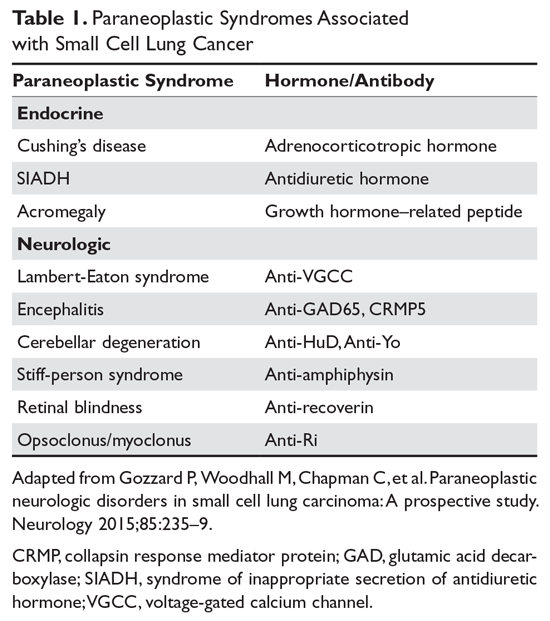
The common sites of metastases include brain, liver, and bone. Therefore, the staging workup should include fluorodeoxyglucose (FDG) positron emission tomography (PET)/CT scan. Contrast-enhanced CT scan of the chest and abdomen and bone scan can be obtained for staging in lieu of PET scan. Due to the physiologic FDG uptake, cerebral metastases cannot be assessed with sufficient certainty using PET-CT.10 Therefore, brain imaging with contrast-enhanced CT or magnetic resonance imaging (MRI) is also necessary. Although the incidence of metastasis to bone marrow is less than 10%, bone marrow aspiration and biopsy are warranted in patients with unexplained cytopenias, especially when the cytopenia is associated with teardrop-shaped red cells or nucleated red cells on peripheral blood smear, findings indicative of a marrow infiltrative process.7 The tissue diagnosis is established by obtaining a biopsy of the primary tumor or 1 of the metastatic sites. In localized disease, bronchoscopy (with endobronchial ultrasound, if necessary) with biopsy of the centrally located tumor and/or lymph node is required. Histologically, SCLC consists of monomorphic cells, a high nuclear-cytoplasmic ratio, and confluent necrosis. The tumor cells are positive for chromogranin, synaptophysin, and CD56 by immunohistochemistry, and very frequently are also positive for thyroid transcription factor 1.11 Although serum tumor markers, including neuron-specific enolase and progastrin-releasing peptide, are frequently elevated in patients with SCLC, these markers are of limited value in clinical practice because they lack sensitivity and specificity.12
MANAGEMENT OF LIMITED-STAGE DISEASE
CASE CONTINUED
The patient undergoes FDG PET scan, which shows the presence of a hypermetabolic right hilar mass in addition to enlarged and hypermetabolic bilateral mediastinal lymph nodes. There are no other areas of FDG avidity. Brain MRI does not show any evidence of brain metastasis. Thus, the patient is confirmed to have limited-stage SCLC.
• What is the standard of care treatment for limited-stage SCLC?
SCLC is exquisitely sensitive to both chemotherapy and radiation, especially at the time of initial presentation. The standard of care treatment of limited-stage SCLC is 4 cycles of platinum-based chemotherapy in combination with thoracic radiation started within the first 2 cycles of chemotherapy (Figure 1). 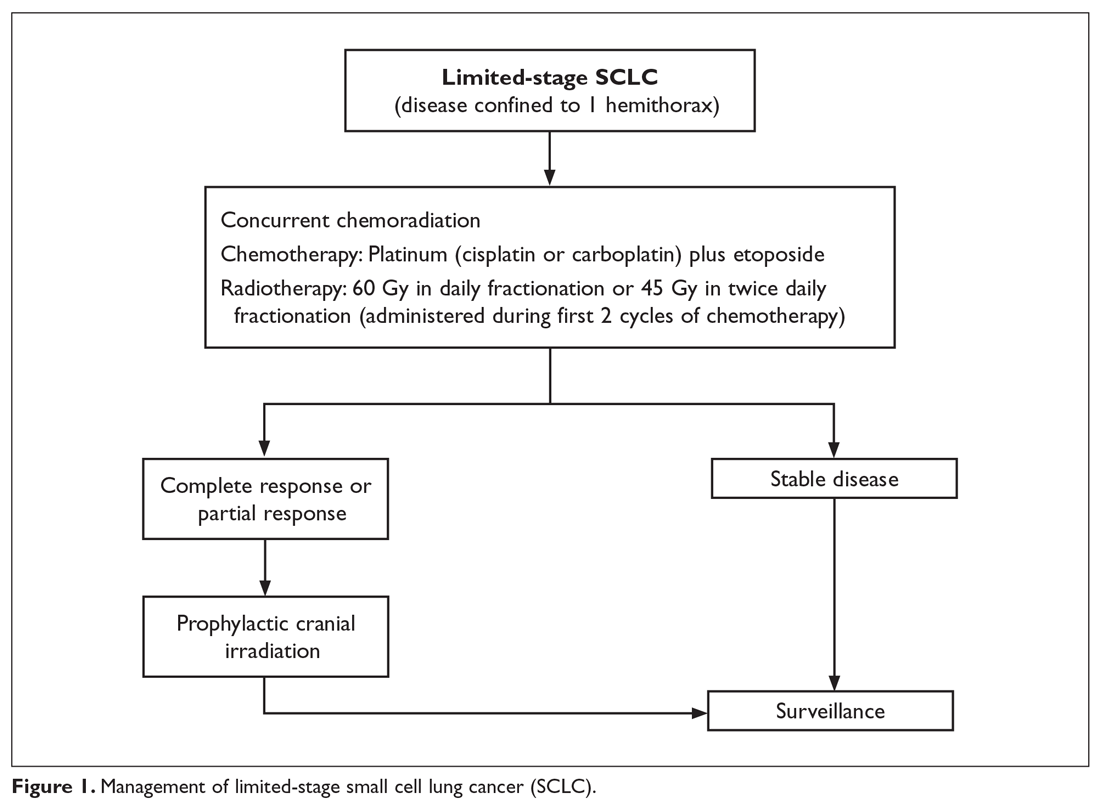
CHOICE OF CHEMOTHERAPY
Etoposide and cisplatin is the most commonly used initial combination chemotherapy regimen in limited-stage SCLC.14 This combination has largely replaced anthracycline-based regimens given its favorable efficacy and toxicity profile.15–17 Several small randomized trials have shown comparable efficacy of carboplatin and etoposide in extensive-stage SCLC.18–20 A meta-analysis of 4 randomized trials comparing cisplatin-based versus carboplatin-based regimens in 663 patients with SCLC (32% had limited-stage disease and 68% had extensive-stage disease) showed no statistically significant difference in response rate, progression-free survival (PFS), or OS between the 2 regimens.21 Therefore, in clinical practice carboplatin is frequently used instead of cisplatin in patients with extensive-stage disease. In patients with limited-stage disease, cisplatin is still the drug of choice. However, the toxicity profile of the 2 regimens is different. Cisplatin-based regimens are more commonly associated with neuropathy, nephrotoxicity, and chemotherapy-induced nausea/vomiting,18 while carboplatin-based regimens are more myelosuppressive.22 In addition, the combination of thoracic radiation with either of these regimens is associated with a higher risk of esophagitis, pneumonitis, and myelosuppression.23 The use of myeloid growth factors is not recommended in patients undergoing concurrent chemoradiation.24 Of note, intravenous etoposide is always preferred over oral etoposide, especially in the curative setting given the unreliable absorption and bioavailability of oral formulations.
THORACIC RADIOTHERAPY
Adding thoracic radiotherapy to platinum-etoposide chemotherapy improves local control and OS. Two meta-analyses of 13 trials including more than 2000 patients have shown a 25% to 30% decrease in local failure and a 5% to 7% increase in 2-year OS with chemoradiation compared to chemotherapy alone in limited-stage SCLC.25,26 Early (within the first 2 cycles) concurrent thoracic radiation is superior to delayed and/or sequential radiation in terms of local control and OS.23,27,28 The dose and fractionation of thoracic radiation in limited-stage SCLC has remained a controversial issue. The Eastern Cooperative Oncology Group/Radiation Therapy Oncology Group randomized trial compared 45 Gy of radiotherapy delivered twice daily over a period of 3 weeks to 45 Gy once daily over 5 weeks concurrently with chemotherapy. The twice daily regimen led to a 10% improvement in 5-year OS (26% versus 16%), but a higher incidence of grade 3 and 4 adverse events.13 Despite the survival advantage demonstrated by hyperfractionated radiotherapy, the results need to be interpreted with caution because the radiation doses are not biologically equivalent. In addition, the difficult logistics of patients receiving radiation twice a day has limited the routine implementation of this strategy. Subsequently, another randomized phase 3 trial (CONVERT) compared 45 Gy radiotherapy twice daily with 66 Gy radiotherapy once daily in limited-stage SCLC.29 This trial did not show any difference in OS. The patients in the twice daily arm had a higher incidence of grade 4 neutropenia. Considering the results of these trials, both strategies—45 Gy fractionated twice daily or 60 Gy fractionated once daily, delivered concurrently with chemotherapy—are acceptable in the setting of limited-stage SCLC. However, quite often a hyperfractionated regimen is not feasible for patients and many radiation oncology centers. Hopefully, the ongoing CALGB 30610 study will clarify the optimal radiation schedule for limited-stage disease.
PROPHYLACTIC CRANIAL IRRADIATION
Approximately 75% of patients with limited-stage disease experience disease recurrence, and brain is the site of recurrence in approximately half of these patients.30 Prophylactic cranial irradiation (PCI) consisting of 25 Gy radiotherapy delivered in 10 fractions has been shown to be effective in decreasing the incidence of cerebral metastases.30–32 Although individual small studies have not shown a survival benefit of PCI because of small sample size and limited power, a meta-analysis of these studies has shown a 25% decrease in the 3-year incidence of brain metastasis and 5.4% increase in 3-year OS.30 Most patients included in these studies had limited-stage disease. Therefore, PCI is the standard of care for patients with limited-stage disease who attain a partial or complete response to chemoradiation.
ROLE OF SURGERY
Surgical resection may be an acceptable choice in a very limited subset of patients with peripherally located small (< 5 cm) tumors where mediastinal lymph nodes have been confirmed to be uninvolved with complete mediastinal staging.33,34 Most of the data in this setting are derived from retrospective studies.35,36 A 5-year OS between 40% and 60% has been reported with this strategy in patients with clinical stage I disease. In general, when surgery is considered, lobectomy with mediastinal lymph node dissection followed by chemotherapy (if there is no nodal involvement) or chemoradiation (if nodal involvement) is recommended.37,38 Wedge or segmental resections are not considered to be optimal surgical options.
MANAGEMENT OF EXTENSIVE-STAGE DISEASE
CASE CONTINUED
The patient receives 4 cycles of cisplatin and etoposide along with 70 Gy radiotherapy concurrently with the first 2 cycles of chemotherapy. His post-treatment CT scans show a partial response. He undergoes PCI 6 weeks after completion of treatment. At routine follow-up 18 months later, he is doing generally well except for mildly decreased appetite and an unintentional weight loss of 5 lb. CT scans demonstrate multiple hypodense liver lesions ranging from 7 mm to 2 cm in size and a 2-cm left adrenal gland lesion highly concerning for metastasis. FDG PET scan confirms that the adrenal and liver lesions are hypermetabolic. In addition, the PET scan shows multiple FDG-avid bone lesions throughout the spine. Brain MRI is negative for brain metastasis.
• What is the standard of care for treatment of extensive-stage disease?
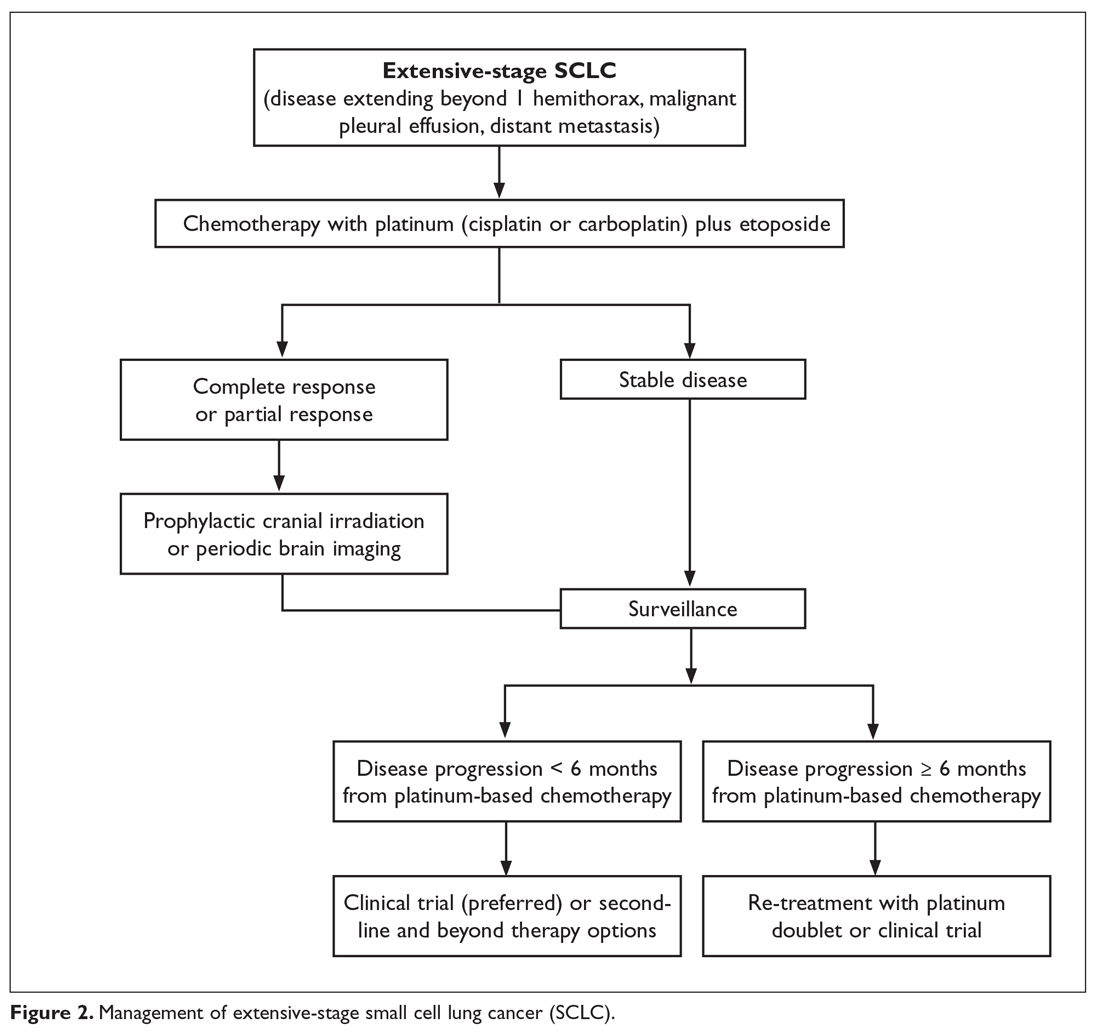
Chemotherapy is the mainstay of treatment for extensive-stage SCLC; the goals of treatment are prolongation of survival, prevention or alleviation of cancer-related symptoms, and improvement in quality of life. The combination of etoposide with a platinum agent (carboplatin or cisplatin) is the preferred first-line treatment option. Carboplatin is more commonly used in clinical practice in this setting because of its comparable efficacy and better tolerability compared to cisplatin (Figure 2).21 A Japanese phase 3 trial comparing cisplatin plus irinotecan with cisplatin plus etoposide in the first-line setting in extensive-stage SCLC showed improvement in median and 2-year OS with the cisplatin/irinotecan regimen; however, 2 subsequent phase 3 trials conducted in the United States comparing these 2 regimens did not show any difference in OS. In addition, the cisplatin/irinotecan regimen was more toxic than the etoposide-based regimen.39,40 Therefore, 4 to 6 cycles of platinum/etoposide remains the standard of care first-line treatment for extensive-stage SCLC in the United States. The combination yields a 60% to 70% response rate, but the majority of patients invariably experience disease progression, with a median OS of 9 to 11 months.41 Maintenance chemotherapy beyond the initial 4 to 6 cycles does not improve survival and is associated with higher cumulative toxicity.42
Multiple attempts at improving first-line chemotherapy in extensive-stage disease have failed to show any meaningful difference in OS. For example, the addition of ifosfamide, palifosfamide, cyclophosphamide, taxane, or anthracycline to platinum doublet failed to show improvement in OS and led to more toxicity.43–46 Additionally, the use of alternating or cyclic chemotherapies in an attempt to curb drug resistance has also failed to show survival benefit.47–49 The addition of the antiangiogenic agent bevacizumab to standard platinum-based doublet has not prolonged OS in SCLC and has led to an unacceptably higher rate of tracheoesophageal fistula when used in conjunction with chemoradiation in limited-stage disease.50–55 Finally, the immune checkpoint inhibitor ipilimumab in combination with platinum plus etoposide failed to improve PFS or OS compared to platinum plus etoposide alone in a recent phase 3 trial, and maintenance pembrolizumab after completion of platinum-based chemotherapy did not improve PFS.56,57
More recently, a phase 2 study of pembrolizumab in extensive-stage SCLC (KEYNOTE 158) reported an overall response rate of 35.7%, median PFS of 2.1 months, and median OS of 14.6 months in patients who tested positive for programmed death ligand-1 (PD-L1) expression (which was defined as a PD-L1 Combined Positive Score ≥ 1).58 The median duration of response has not been reached in this study, indicating that pembrolizumab may be a promising approach in patients with extensive-stage SCLC, especially for those with PD-L1–positive tumors.
Patients with extensive-stage disease who have brain metastasis at the time of diagnosis can be treated with systemic chemotherapy first if the brain metastases are asymptomatic and there is significant extracranial disease burden. In that case, whole brain radiotherapy should be given after completion of systemic therapy.
SECOND-LINE CHEMOTHERAPY
Despite being exquisitely chemosensitive, SCLC is associated with a very poor prognosis largely because of invariable disease progression following first-line therapy and lack of effective second-line treatment options that can lead to appreciable disease control. The choice of second-line treatment is predominantly determined by the time of disease relapse after first-line platinum-based therapy. If this interval is 6 months or longer, re-treatment utilizing the same platinum doublet is appropriate. However, if the interval is 6 months or less, second-line systemic therapy options should be explored. Unfortunately, the response rate tends to be less than 10% with most of the second-line therapies in platinum-resistant disease (defined as disease progression within 3 months of receiving platinum-based therapy). If disease progression occurs between 3 and 6 months after completion of platinum-based therapy, the response rate with second-line chemotherapy is in the range of 25%.59,60
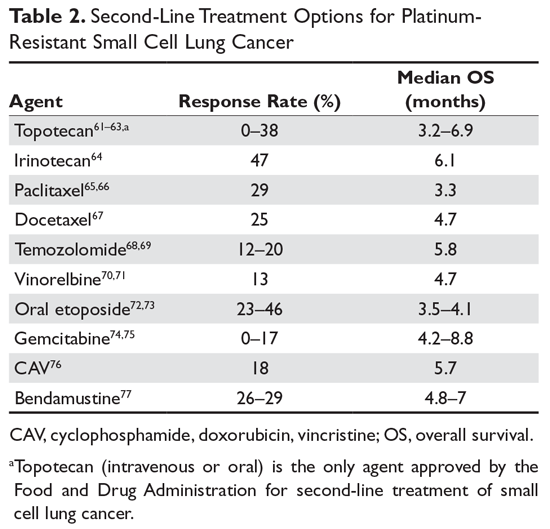
A number of second-line chemotherapy options have been explored in small studies, including topotecan, irinotecan, paclitaxel, docetaxel, temozolomide, vinorelbine, oral etoposide, gemcitabine, bendamustine, and CAV (
IMMUNOTHERAPY
The role of immune checkpoint inhibitors in the treatment of SCLC is evolving, and currently there are no FDA-approved immunotherapy agents for treating SCLC. A recently conducted phase 1/2 trial (CheckMate 032) studied the anti-programmed death(PD)-1 antibody nivolumab with or without the anti-cytotoxic T-lymphocyte–associated antigen (CTLA) -4 antibody ipilimumab in patients with relapsed SCLC. The authors reported response rates of 10% with nivolumab 3 mg/kg and 21% with nivolumab 1 mg/kg plus ipilimumab 3 mg/kg.78,79 The 2-year OS was 26% with the combination and 14% with single-agent nivolumab. Only 18% of patients had PD-L1 expression of ≥ 1%, and the response rate did not correlate with PD-L1 status. The rate of grade 3 or 4 adverse events was approximately 20%, and only 10% of patients discontinued treatment because of toxicity. Based on these data, nivolumab plus ipilimumab is now included in the National Comprehensive Cancer Network guidelines as an option for patients with SCLC who experience disease relapse within 6 months of receiving platinum-based therapy;7 however, it is questionable whether routine use of this combination is justified based on currently available data. The evidence for the combination of nivolumab and ipilimumab remains limited. The efficacy and toxicity data from both randomized and nonrandomized cohorts were presented together, making it hard to interpret the results.
Another phase 1b study (KEYNOTE-028) evaluated the anti-PD-1 antibody pembrolizumab (10 mg/kg intravenously every 2 weeks) in patients with relapsed SCLC who had received 1 or more prior lines of therapy and had PD-L1 expression of ≥ 1%. This study showed a response rate of 33%, with a median duration of response of 19 months and 1-year OS of 38%.80 Although only 28% of screened patients had PD-L1 expression of ≥ 1%, these results indicated that at least a subset of SCLC patients are able to achieve durable responses with immune checkpoint inhibition. A number of clinical trials utilizing immune checkpoint inhibitors in various combinations and settings are currently underway.
ROLE OF PROPHYLACTIC CRANIAL IRRADIATION
The role of PCI in extensive-stage SCLC is not clearly defined. A randomized phase 3 trial conducted by the European Organization for Research and Treatment of Cancer (EORTC) comparing PCI with no PCI in patients with extensive-stage SCLC who had a partial or complete response to initial platinum-based chemotherapy showed a decrease in the incidence of symptomatic brain metastasis and improvement in 1-year OS with PCI.81 However, this trial did not require mandatory brain imaging prior to PCI, and thus it is unclear if some patients in the PCI group had asymptomatic brain metastasis prior to enrollment and therefore received therapeutic benefit from brain radiation. Additionally, the dose and fractionation of PCI was not standardized across patient groups.
A more recent phase 3 study conducted in Japan that compared PCI (25 Gy in 10 fractions) with no PCI reported no difference in survival between the 2 groups.82 As opposed to the EORTC study, the Japanese study did require baseline brain imaging to confirm the absence of brain metastasis prior to enrollment. In addition, the control patients underwent periodic brain MRI to allow early detection of brain metastasis. Given the emergence of the new data, the impact of PCI on survival in patients with extensive-stage SCLC is unproven, and PCI likely has a role in a highly selected small group of patients with extensive-stage SCLC. PCI is not recommended for patients with poor performance status (ECOG performance score of 3 or 4) or underlying neurocognitive disorders.34,83
The NMDA-receptor antagonist memantine can be used in patients undergoing PCI to delay the occurrence of cognitive dysfunction.61 Memantine 20 mg daily delayed time to cognitive decline and reduced the rate of decline in memory, executive function, and processing speed compared to placebo in patients receiving whole brain radiotherapy.84
ROLE OF RADIOTHERAPY
A subset of patients with extensive-stage SCLC may benefit from consolidative thoracic radiotherapy after completion of platinum-based chemotherapy. A randomized trial that enrolled patients who achieved complete or near complete response after 3 cycles of cisplatin plus etoposide compared thoracic radiotherapy in combination with continued chemotherapy versus chemotherapy alone.85 The median OS was longer with the addition of thoracic radiotherapy compared to chemotherapy alone. Another phase 3 trial did not show improvement in 1-year OS with consolidative thoracic radiotherapy, but 2-year OS and 6-month PFS were longer.86 In general, consolidative thoracic radiotherapy benefits patients who have residual thoracic disease and low-bulk extrathoracic disease that has responded to systemic therapy.87 In addition, patients who initially presented with bulky symptomatic thoracic disease should also be considered for consolidative radiation.
Similar to other solid tumors, radiotherapy should be utilized for palliative purposes in patients with painful bone metastasis, spinal cord compression, or brain metastasis. Surgery is generally not recommended for spinal cord compression given the short life expectancy of patients with extensive-stage disease. Whole brain radiotherapy is preferred over stereotactic radiosurgery because micrometastasis is frequently present even in the setting of 1 or 2 radiographically evident brain metastasis.
NOVEL THERAPIES
The very complex genetic landscape of SCLC accounts for its resistance to conventional therapy and high recurrence rate; however, at the same time this complexity can form the basis for effective targeted therapy for the disease. One of the major factors hindering the development of targeted therapies in SCLC is limited availability of tissue due to small tissue samples and the frequent presence of significant necrosis in the samples. In recent years, several different therapeutic strategies and targeted agents have been investigated for their potential role in SCLC. Several of them, including EGFR tyrosine kinase inhibitors (TKIs), BCR-ABL TKIs, mTOR inhibitors, and VEGF inhibitors, have not been shown to provide a survival advantage in this disease. Several others, including PARP inhibitors, cellular developmental pathway inhibitors, and antibody-drug conjugates, are being tested. A phase 1 study of veliparib combined with cisplatin and etoposide in patients with previously untreated extensive-stage SCLC demonstrated a complete response in 14.3%, a partial response in 57.1%, and stable disease in 28.6% of patients with an acceptable safety profile.88 So far, none of these agents are approved for use in SCLC, and the majority are in early- phase clinical trials.89
One of the emerging targets in the treatment of SCLC is delta-like protein 3 (DLL3). DLL3 is expressed on more than 80% of SCLC tumor cells and cancer stem cells. Rovalpituzumab tesirine is an antibody-drug conjugate consisting of humanized anti-DLL3 monoclonal antibody linked to SC-DR002, a DNA-crosslinking agent. A phase 1 trial of rovalpituzumab in patients with relapsed SCLC after 1 or 2 prior lines of therapy reported a response rate of 31% in patients with DLL3 expression of ≥ 50%. The median duration of response and median PFS were both 4.6 months.90 Rovalpituzumab is currently in later phases of clinical trials and has a potential to serve as an option for patients with extensive-stage disease after disease progression on platinum-based therapy.
SUMMARY
Four to 6 cycles of carboplatin and etoposide remain the standard of care first-line treatment for patients with extensive stage SCLC. The only FDA-approved second-line treatment option is topotecan. Re-treatment with the original platinum doublet is a reasonable option for patients who have disease progression 6 months or longer after completion of platinum-based therapy. The immune checkpoint inhibitors pembrolizumab and combination nivolumab and ipilimumab have shown promising results in the second-line setting and beyond. The role of PCI has become more controversial in recent years, and periodic brain MRI in lieu of PCI is now an acceptable approach.
RESPONSE ASSESSMENT/SURVEILLANCE
For patients undergoing treatment for limited-stage SCLC, response assessment with contrast-enhanced CT of the chest/abdomen should be performed after completion of 4 cycles of chemotherapy and thoracic radiation.7 The surveillance guidelines consist of history, physical exam, and imaging every 3 months during the first 2 years, every 6 months during the third year, and annually thereafter. If PCI is not performed, brain MRI or contrast-enhanced CT scan should be performed every 3 or 4 months during the first 2 years of follow up. For extensive-stage disease, response assessment should be performed after every 2 cycles of therapy. After completion of therapy, history, physical exam, and imaging should be done every 2 months during the first year, every 3 or 4 months during years 2 and 3, every 6 months during years 4 and 5, and annually thereafter. Routine use of PET scan for surveillance is not recommended. Any new pulmonary nodule should prompt evaluation for a second primary lung malignancy. Finally, smoking cessation counseling is an integral part of management of any patient with SCLC and should be included with every clinic visit.
CONCLUSION
SCLC is a heterogeneous and genetically complex disease with a very high mortality rate. The current standard of care includes concurrent chemoradiation with cisplatin and etoposide for limited-stage SCLC and the combination of platinum and etoposide for extensive SCLC. A number of novel treatment approaches, including immune checkpoint inhibitors and antibody-drug conjugates, have had promising results in early clinical trials. Given the limited treatment options and large unmet need for new treatment options, enrollment in clinical trials is strongly recommended for patients with SCLC.
1. American Cancer Society. Cancer Facts & Figures 2017. American Cancer Society website. https://www.cancer.org/content/dam/cancer-org/research/cancer-facts-and-statistics/annual-cancer-facts-and-figures/2017/cancer-facts-and-figures-2017.pdf. Published 2017. Accessed July 11, 2018.
2. Govindan R, Page N, Morgensztern D, et al. Changing epidemiology of small-cell lung cancer in the United States over the last 30 years: analysis of the surveillance, epidemiologic, and end results database. J Clin Oncol 2006;24:4539–44.
3. Howlader N, Noone AM, Krapcho M, et al. SEER Cancer Statistics Review, 1975-2014. National Cancer Institute website. https://seer.cancer.gov/csr/1975_2014/. Updated April 2, 2018. Accessed July 11, 2018.
4. Varghese AM, Zakowski MF, Yu HA, et al. Small-cell lung cancers in patients who never smoked cigarettes. J Thorac Oncol 2014;9:892–6.
5. Pleasance ED, Stephens PJ, O’Meara S, et al. A small-cell lung cancer genome with complex signatures of tobacco exposure. Nature 2010;463:184–90.
6. Green RA, Humphrey E, Close H, Patno ME. Alkylating agents in bronchogenic carcinoma. Am J Med 1969;46:516–25.
7. National Comprehensive Cancer Network. NCCN Clinical Practice Guidelines in Oncology for small cell lung cancer (Version 2.2018). www.nccn.org/professionals/physician_gls/pdf/sclc.pdf. Accessed August 12, 2018.
8. National Lung Screening Trial Research Team, Aberle DR, Adams AM, et al. Reduced lung-cancer mortality with low-dose computed tomographic screening. N Engl J Med 2011;365:395–409.
9. Aberle DR, DeMello S, Berg CD, et al. Results of the two incidence screenings in the National Lung Screening Trial. N Engl J Med 2013;369:920–31.
10. Kitajima K, Nakamoto Y, Okizuka H, et al. Accuracy of whole-body FDG-PET/CT for detecting brain metastases from non-central nervous system tumors. Ann Nucl Med 2008;22:595–602.
11. Ordonez NG. Value of thyroid transcription factor-1 immunostaining in distinguishing small cell lung carcinomas from other small cell carcinomas. Am J Surg Pathol 2000;24:1217–23.
12. Karnak D, Beder S, Kayacan O, et al. Neuron-specific enolase and lung cancer. Am J Clin Oncol 2005;28:586–90.
13. Turrisi AT 3rd, Kim K, Blum R, et al. Twice-daily compared with once-daily thoracic radiotherapy in limited small-cell lung cancer treated concurrently with cisplatin and etoposide. N Engl J Med 1999;340:265–71.
14. Evans WK, Shepherd FA, Feld R, et al. VP-16 and cisplatin as first-line therapy for small-cell lung cancer. J Clin Oncol 1985;3:1471–7.
15. Pujol JL, Carestia L, Daurés JP. Is there a case for cisplatin in the treatment of small-cell lung cancer? A meta-analysis of randomized trials of a cisplatin-containing regimen versus a regimen without this alkylating agent. Br J Cancer 2000;83:8–15.
16. Mascaux C, Paesmans M, Berghmans T, et al; European Lung Cancer Working Party (ELCWP). A systematic review of the role of etoposide and cisplatin in the chemotherapy of small cell lung cancer with methodology assessment and meta-analysis. Lung Cancer 2000;30:23–36.
17. Sundstrøm S, Bremnes RM, Kaasa S, et al; Norwegian Lung Cancer Study Group. Cisplatin and etoposide regimen is superior to cyclophosphamide, epirubicin, and vincristine regimen in small-cell lung cancer: results from a randomized phase III trial with 5 years’ follow-up. J Clin Oncol 2002;20:4665–72.
18. Hatfield LA, Huskamp HA, Lamont EB. Survival and toxicity after cisplatin plus etoposide versus carboplatin plus etoposide for extensive-stage small-cell lung cancer in elderly patients. J Oncol Pract 2016;12:666–73.
19. Okamoto H, Watanabe K, Kunikane H, et al. Randomised phase III trial of carboplatin plus etoposide vs split doses of cisplatin plus etoposide in elderly or poor-risk patients with extensive disease small-cell lung cancer: JCOG 9702. Br J Cancer 2007;97:162–9.
20. Skarlos DV, Samantas E, Kosmidis P, et al. Randomized comparison of etoposide-cisplatin vs. etoposide-carboplatin and irradiation in small-cell lung cancer. A Hellenic Co-operative Oncology Group study. Ann Oncol 1994;5:601–7.
21. Rossi A, Di Maio M, Chiodini P, et al. Carboplatin- or cisplatin-based chemotherapy in first-line treatment of small-cell lung cancer: the COCIS meta-analysis of individual patient data J Clin Oncol 2012;30:1692–8.
22. Bishop JF, Raghavan D, Stuart-Harris R, et al. Carboplatin (CBDCA, JM-8) and VP-16-213 in previously untreated patients with small-cell lung cancer. J Clin Oncol 1987;5:1574–8.
23. Takada M, Fukuoka M, Kawahara M, et al. Phase III study of concurrent versus sequential thoracic radiotherapy in combination with cisplatin and etoposide for limited-stage small-cell lung cancer: results of the Japan Clinical Oncology Group Study 9104. J Clin Oncol 2002;20:3054–60.
24. Bunn PA Jr, Crowley J, Kelly K, et al. Chemoradiotherapy with or without granulocyte-macrophage colony-stimulating factor in the treatment of limited-stage small-cell lung cancer: a prospective phase III randomized study of the Southwest Oncology Group. J Clin Oncol 1995;13:1632–41.
25. Pignon JP, Arriagada R, Ihde DC, et al. A meta-analysis of thoracic radiotherapy for small-cell lung cancer. N Engl J Med 1992;327:1618–24.
26. Warde P, Payne D. Does thoracic irradiation improve survival and local control in limited-stage small-cell carcinoma of the lung? A meta-analysis. J Clin Oncol 1992;10:890–5.
27. Murray N, Coy P, Pater JL, et al. Importance of timing for thoracic irradiation in the combined modality treatment of limited-stage small-cell lung cancer. The National Cancer Institute of Canada Clinical Trials Group. J Clin Oncol 1993;11:336–44.
28. De Ruysscher D, Lueza B, Le Péchoux C, et al. Impact of thoracic radiotherapy timing in limited-stage small-cell lung cancer: usefulness of the individual patient data meta-analysis. Ann Oncol 2016;27:1818–28.
29. Faivre-Finn C, Snee M, Ashcroft L, et al. Concurrent once-daily versus twice-daily chemoradiotherapy in patients with limited-stage small-cell lung cancer (CONVERT): an open-label, phase 3, randomised, superiority trial. Lancet Oncol 2017;18:1116–25.
30. Aupérin A, Arriagada R, Pignon JP, et al. Prophylactic cranial irradiation for patients with small-cell lung cancer in complete remission. Prophylactic Cranial Irradiation Overview Collaborative Group. N Engl J Med 1999;341:476–84.
31. Arriagada R, Le Chevalier T, Borie F, et al. Prophylactic cranial irradiation for patients with small-cell lung cancer in complete remission. J Natl Cancer Inst 1995;87:183–90.
32. Le Péchoux C, Dunant A, Senan S, et al; Prophylactic Cranial Irradiation (PCI) Collaborative Group. Standard-dose versus higher-dose prophylactic cranial irradiation (PCI) in patients with limited-stage small-cell lung cancer in complete remission after chemotherapy and thoracic radiotherapy (PCI 99-01, EORTC 22003-08004, RTOG 0212, and IFCT 99-01): a randomised clinical trial. Lancet Oncol 2009;10:467–74.
33. Schneider BJ, Saxena A, Downey RJ. Surgery for early-stage small cell lung cancer. J Natl Compr Canc Netw 2011;9:1132–9.
34. Inoue M, Nakagawa K, Fujiwara K, et al. Results of preoperative mediastinoscopy for small cell lung cancer. Ann Thorac Surg 2000;70:1620–3.
35. Lim E, Belcher E, Yap YK, et al. The role of surgery in the treatment of limited disease small cell lung cancer: time to reevaluate. J Thorac Oncol 2008;3:1267–71.
36. Inoue M, Miyoshi S, Yasumitsu T, et al. Surgical results for small cell lung cancer based on the new TNM staging system. Thoracic Surgery Study Group of Osaka University, Osaka, Japan. Ann Thorac Surg 2000;70:1615–9.
37. Yang CF, Chan DY, Speicher PJ, et al. Role of adjuvant therapy in a population-based cohort of patients with early-stage small-cell lung cancer. J Clin Oncol 2016;34:1057–64.
38. Shepherd FA, Evans WK, Feld R, et al. Adjuvant chemotherapy following surgical resection for small-cell carcinoma of the lung. J Clin Oncol 1988;6:832–8.
39. Noda K, Nishiwaki Y, Kawahara M, et al; Japan Clinical Oncology Group. Irinotecan plus cisplatin compared with etoposide plus cisplatin for extensive small-cell lung cancer. N Engl J Med 2002;346:85–91.
40. Lara PN Jr, Natale R, Crowley J, et al. Phase III trial of irinotecan/cisplatin compared with etoposide/cisplatin in extensive-stage small-cell lung cancer: clinical and pharmacogenomic results from SWOG S0124. J Clin Oncol 2009;27:2530–5.
41. Chute JP, Chen T, Feigal E, et al. Twenty years of phase III trials for patients with extensive-stage small-cell lung cancer: perceptible progress. J Clin Oncol 1999;17:1794–801.
42. Zhou H, Zeng C, Wei Y, et al. Duration of chemotherapy for small cell lung cancer: a meta-analysis. PloS One 2013;8:e73805.
43. Loehrer PJ Sr, Ansari R, Gonin R, et al. Cisplatin plus etoposide with and without ifosfamide in extensive small-cell lung cancer: a Hoosier Oncology Group study. J Clin Oncol;13:2594–9.
44. Pujol JL, Daurés JP, Riviére A, et al. Etoposide plus cisplatin with or without the combination of 4’-epidoxorubicin plus cyclophosphamide in treatment of extensive small-cell lung cancer: a French Federation of Cancer Institutes multicenter phase III randomized study. J Natl Cancer Inst 2001;93:300–8.
45. Berghmans T, Scherpereel A, Meert AP, et al; European Lung Cancer Working Party (ELCWP). A phase III randomized study comparing a chemotherapy with cisplatin and etoposide to a etoposide regimen without cisplatin for patients with extensive small-cell lung cancer. Front Oncol 2017;7:217.
46. Jalal SI, Lavin P, Lo G, et al. Carboplatin and etoposide with or without palifosfamide in untreated extensive-stage small-cell lung cancer: a Multicenter, Adaptive, Randomized Phase III Study (MATISSE). J Clin Oncol 2017;35:2619–23.
47. Fukuoka M, Furuse K, Saijo N, et al. Randomized trial of cyclophosphamide, doxorubicin, and vincristine versus cisplatin and etoposide versus alternation of these regimens in small-cell lung cancer. J Natl Cancer Inst 1991;83:855–61.
48. Roth BJ, Johnson DH, Einhorn LH, et al. Randomized study of cyclophosphamide, doxorubicin, and vincristine versus etoposide and cisplatin versus alternation of these two regimens in extensive small-cell lung cancer: a phase III trial of the Southeastern Cancer Study Group. J Clin Oncol 1992;10:282–91.
49. Miles DW, Earl HM, Souhami RL, et al. Intensive weekly chemotherapy for good-prognosis patients with small-cell lung cancer. J Clin Oncol 1991;9:280–5.
50. Petrioli R, Roviello G, Laera L, et al. Cisplatin, etoposide, and bevacizumab regimen followed by oral etoposide and bevacizumab maintenance treatment in patients with extensive-stage small cell lung cancer: a single-institution experience. Clin Lung Cancer 2015;16:e229–34.
51. Spigel DR, Greco FA, Zubkus JD, et al. Phase II trial of irinotecan, carboplatin, and bevacizumab in the treatment of patients with extensive-stage small-cell lung cancer. J Thorac Oncol 2009;4:1555–60.
52. Spigel DR, Townley PM, Waterhouse DM, et al. Randomized phase II study of bevacizumab in combination with chemotherapy in previously untreated extensive-stage small-cell lung cancer: results from the SALUTE trial. J Clin Oncol 2011;29:2215–22.
53. Horn L, Dahlberg SE, Sandler AB, et al. Phase II study of cisplatin plus etoposide and bevacizumab for previously untreated, extensive-stage small-cell lung cancer: Eastern Cooperative Oncology Group Study E3501. J Clin Oncol 2009;27:6006–11.
54. Tiseo M, Boni L, Ambrosio F, et al. Italian, multicenter, phase III, randomized study of cisplatin plus etoposide with or without bevacizumab as first-line treatment in extensive-disease small-cell lung cancer: the GOIRC-AIFA FARM6PMFJM trial. J Clin Oncol 2017;35:1281–7.
55. Pujol JL, Lavole A, Quoix E, et al. Randomized phase II-III study of bevacizumab in combination with chemotherapy in previously untreated extensive small-cell lung cancer: results from the IFCT-0802 trial. Ann Oncol 2015;26:908–14.
56. Gadgeel SM, Ventimiglia J, Kalemkerian GP, et al. Phase II study of maintenance pembrolizumab (pembro) in extensive stage small cell lung cancer (ES-SCLC) patients (pts) [abstract]. J Clin Oncol 2017;35(15_suppl):8504.
57. Reck M, Luft A, Szczesna A, et al. Phase III randomized trial of ipilimumab plus etoposide and platinum versus placebo plus etoposide and platinum in extensive-stage small-cell lung cancer. J Clin Oncol 2016;34:3740–8.
58. Chung HC, Lopez-Martin JA, Kao SC, et al. Phase 2 study of pembrolizumab in advanced small-cell lung cancer (SCLC): KEYNOTE-158 [abstract]. J Clin Oncol 2018;36(suppl):8506.
59. Owonikoko TK, Behera M, Chen Z, et al. A systematic analysis of efficacy of second-line chemotherapy in sensitive and refractory small-cell lung cancer. J Thorac Oncol 2012;7:866–72.
60. Postmus PE, Berendsen HH, van Zandwijk N, et al. Retreatment with the induction regimen in small cell lung cancer relapsing after an initial response to short term chemotherapy. Eur J Cancer Clin Oncol 1987;23:1409–11.
61. von Pawel J, Schiller JH, Shepherd FA, et al. Topotecan versus cyclophosphamide, doxorubicin, and vincristine for the treatment of recurrent small-cell lung cancer. J Clin Oncol 1999;17:658–667.
62. O’Brien ME, Ciuleanu TE, Tsekov H, et al. Phase III trial comparing supportive care alone with supportive care with oral topotecan in patients with relapsed small-cell lung cancer. J Clin Oncol 2006;24:5441–7.
63. Eckardt JR, von Pawel J, Pujol JL, et al. Phase III study of oral compared with intravenous topotecan as second-line therapy in small-cell lung cancer. J Clin Oncol 2007;25:2086–92.
64. Masuda N, Fukuoka M, Kusunoki Y, et al. CPT-11: a new derivative of camptothecin for the treatment of refractory or relapsed small-cell lung cancer. J Clin Oncol 1992;10:1225–9.
65. Smit EF, Fokkema E, Biesma B, et al. A phase II study of paclitaxel in heavily pretreated patients with small-cell lung cancer. Br J Cancer 1998;77:347–51.
66. Yamamoto N, Tsurutani J, Yoshimura N, et al. Phase II study of weekly paclitaxel for relapsed and refractory small cell lung cancer. Anticancer Res 2006;26:777–81.
67. Smyth JF, Smith IE, Sessa C, et al. Activity of docetaxel (Taxotere) in small cell lung cancer. Eur J Cancer 1994;30A:1058–60.
68. Pietanza MC, Kadota K, Huberman K, et al. Phase II trial of temozolomide with relapsed sensitive or refractory small cell lung cancer, with assessment of methylguanine-DNA methyltransferase as a potential biomarker. Clin Cancer Res 2012;18:1138–45.
69. Zauderer MG, Drilon A, Kadota K, et al. Trial of a 5-day dosing regimen of temozolomide in patients with relapsed small cell lung cancers with assessment of methylguanine-DNA methyltransferase. Lung Cancer 2014;86:237–40.
70. Jassem J, Karnicka-Mlodkowska H, van Pottelsberghe C, et al. Phase II study of vinorelbine (Navelbine) in previously treated small cell lung cancer patients. Eur J Cancer 1993;29A:1720–2.
71. Furuse K, Kuboa K, Kawahara M, et al. Phase II study of vinorelbine in heavily previously treated small cell lung cancer. Oncology 1996;53:169–72.
72. Einhorn LH, Pennington K, McClean J. Phase II trial of daily oral VP-16 in refractory small cell lung cancer. Semin Oncol 1990;17:32–5.
73. Johnson DH, Greco FA, Strupp J, et al. Prolonged administration of oral etoposide in patients with relapsed or refractory small-cell lung cancer: a phase II trial. J Clin Oncol 1990;8:1613–7.
74. Van der Lee I, Smit EF, van Putten JW, et al. Single-agent gemcitabine in patients with resistant small-cell lung cancer. Ann Oncol 2001;12:557–61.
75. Masters GA, Declerck L, Blanke C, et al. Phase II trial of gemcitabine in refractory or relapsed small-cell lung cancer. J Clin Oncol 2003;21:1550–5.
76. von Pawel J, Schiller JH, Shepherd FA, et al. Topotecan versus cyclophosphamide, doxorubicin, and vincristine for the treatment of recurrent small-cell lung cancer. J Clin Oncol 1999;17:658–67.
77. Lammers PE, Shyr Y, Li CI, et al. Phase II study of bendamustine in relapsed chemotherapy sensitive or resistant small-cell lung cancer. J Thorac Oncol 2014;9:559–62.
78. Hellmann MD, Ott PA, Zugazagoitia J, et al. Nivolumab (nivo) ± ipilimumab (ipi) in advanced small-cell lung cancer (SCLC): First report of a randomized expansion cohort from CheckMate 032 [abstract]. J Clin Oncol 2017;35(15_suppl):8503.
79. Antonia SJ, López-Martin JA, Bendell J, et al. Nivolumab alone and nivolumab plus ipilimumab in recurrent small-cell lung cancer (CheckMate 032): a multicentre, open-label, phase 1/2 trial. Lancet Oncol 2016;17:883–95.
80. Ott PA, Elez E, Hiret S, et al. Pembrolizumab in patients with extensive-stage small-cell lung cancer: results from the Phase Ib KEYNOTE-028 study. J Clin Oncol 2017;35:3823–9.
81. Slotman B, Faivre-Finn C, Kramer G, et al. Prophylactic cranial irradiation in extensive small-cell lung cancer. N Engl J Med 2007;357:664–72.
82. Takahashi T, Yamanaka T, Seto T, et al. Prophylactic cranial irradiation versus observation in patients with extensive-disease small-cell lung cancer: a multicentre, randomised, open-label, phase 3 trial. Lancet Oncol 2017;18:663–71.
83. Slotman BJ, Mauer ME, Bottomley A, et al. Prophylactic cranial irradiation in extensive disease small-cell lung cancer: short-term health-related quality of life and patient reported symptoms: results of an international Phase III randomized controlled trial by the EORTC Radiation Oncology and Lung Cancer Groups. J Clin Oncol 2009;27:78–84.
84. Brown PD, Pugh S, Laack NN, et al; Radiation Therapy Oncology Group (RTOG). Memantine for the prevention of cognitive dysfunction in patients receiving whole-brain radiotherapy: a randomized, double-blind, placebo-controlled trial. Neuro Oncol 2013;15:1429–37.
85. Jeremic B, Shibamoto Y, Nikolic N, et al. Role of radiation therapy in the combined-modality treatment of patients with extensive disease small-cell lung cancer: a randomized study. J Clin Oncol 1999;17:2092–9.
86. Slotman BJ, van Tinteren H, Praag JO, et al. Use of thoracic radiotherapy for extensive stage small-cell lung cancer: a phase 3 randomised controlled trial. Lancet 2015;385:36–42.
87. Slotman BJ, van Tinteren H, Praag JO, et al. Radiotherapy for extensive stage small-cell lung cancer - authors’ reply. Lancet 2015;385:1292–3.
88. Owonikoko TK, Dahlberg SE, Khan SA, et al. A phase 1 safety study of veliparib combined with cisplatin and etoposide in extensive stage small cell lung cancer: A trial of the ECOG-ACRIN Cancer Research Group (E2511). Lung Cancer 2015;89:66–70.
89. Mamdani H, Induru R, Jalal SI. Novel therapies in small cell lung cancer. Transl Lung Cancer Res 2015;4:533–44.
90. Rudin CM, Pietanza MC, Bauer TM, et al. Rovalpituzumab tesirine, a DLL3-targeted antibody-drug conjugate, in recurrent small-cell lung cancer: a first-in-human, first-in-class, open-label, phase 1 study. Lancet Oncol 2017;18:42–51.
INTRODUCTION
Small cell lung cancer (SCLC) is an aggressive cancer of neuroendocrine origin that accounts for approximately 15% of all lung cancer cases, with approximately 33,000 patients diagnosed annually.1 The incidence of SCLC in the United States has steadily declined over the past 30 years, presumably because of a decrease in the number of smokers and a change to low-tar filter cigarettes.2 Although the overall incidence of SCLC has been decreasing, the incidence in women is increasing and the male-to-female incidence ratio is now 1:1.3 Nearly all cases of SCLC are associated with heavy tobacco exposure, making it a heterogeneous disease with a complex genomic landscape consisting of thousands of mutations.4,5 Despite recent advances in the treatment of non-small cell lung cancer, the therapeutic options for SCLC remain limited, with a median overall survival (OS) of 9 months in patients with advanced disease.
DIAGNOSIS AND STAGING
CASE PRESENTATION
A 61-year-old man presents to the emergency department with progressive shortness of breath and cough over the past 6 weeks. He also reports a 20-lb weight loss over the same period. He is a current smoker and has been smoking 1 pack of cigarettes per day since the age of 18 years. A chest radiograph obtained in the emergency department shows a right hilar mass. Computed tomography (CT) scan confirms the presence of a 4.5-cm right hilar mass and enlarged mediastinal lymph nodes bilaterally.
• What are the next steps in diagnosis?
SCLC is characterized by rapid growth and early hematogenous metastasis. Consequently, only 25% of patients have limited-stage disease at the time of diagnosis. According to the Veterans Administration Lung Study Group (VALSG) staging system, limited-stage disease is defined as tumor that is confined to 1 hemithorax and can be encompassed within 1 radiation field. This typically includes mediastinal lymph nodes and ipsilateral supraclavicular lymph nodes. Approximately 75% of patients present with extensive-stage disease, which is defined as disease that cannot be classified as limited, including disease that extends beyond 1 hemithorax. Extensive-stage disease includes the presence of malignant pleural effusion and/or distant metastasis.6 The VALSG classification and staging system is more commonly used in clinical practice than the American Joint Committee on Cancer TNM staging system because it is less complex and directs treatment decisions, as most of the literature on SCLC classifies patients based on the VALSG system.7
Given SCLC’s propensity to metastasize quickly, none of the currently available screening methods have proven successful in early detection of SCLC. In the National Lung Cancer Screening Trial, 86% of the 125 patients who were diagnosed with SCLC while undergoing annual low-dose chest CT scans had advanced disease at diagnosis.8,9 These results highlight the fact that most cases of SCLC develop in the interval between annual screening imaging.
SCLC frequently presents with a large hilar mass that is symptomatic. Common symptoms include shortness of breath and cough. In addition, patients with SCLC usually have bulky mediastinal adenopathy at presentation. SCLC is commonly located submucosally in the bronchus, and therefore hemoptysis is not a very common symptom at the time of presentation. Patients may present with superior vena cava syndrome from local compression by the tumor. Not infrequently, SCLC is associated with paraneoplastic syndromes that arise due to ectopic secretion of hormones or antibodies by the tumor cells. The paraneoplastic syndromes can be broadly categorized as endocrine or neurologic (Table 1). The presence of a paraneoplastic syndrome is often a clue to the potential diagnosis of SCLC in the presence of a hilar mass. Additionally, some paraneoplastic syndromes, more specifically endocrine paraneoplastic syndromes, follow the pattern of disease response and relapse, and therefore can sometimes serve as an early marker of disease relapse or progression.
The common sites of metastases include brain, liver, and bone. Therefore, the staging workup should include fluorodeoxyglucose (FDG) positron emission tomography (PET)/CT scan. Contrast-enhanced CT scan of the chest and abdomen and bone scan can be obtained for staging in lieu of PET scan. Due to the physiologic FDG uptake, cerebral metastases cannot be assessed with sufficient certainty using PET-CT.10 Therefore, brain imaging with contrast-enhanced CT or magnetic resonance imaging (MRI) is also necessary. Although the incidence of metastasis to bone marrow is less than 10%, bone marrow aspiration and biopsy are warranted in patients with unexplained cytopenias, especially when the cytopenia is associated with teardrop-shaped red cells or nucleated red cells on peripheral blood smear, findings indicative of a marrow infiltrative process.7 The tissue diagnosis is established by obtaining a biopsy of the primary tumor or 1 of the metastatic sites. In localized disease, bronchoscopy (with endobronchial ultrasound, if necessary) with biopsy of the centrally located tumor and/or lymph node is required. Histologically, SCLC consists of monomorphic cells, a high nuclear-cytoplasmic ratio, and confluent necrosis. The tumor cells are positive for chromogranin, synaptophysin, and CD56 by immunohistochemistry, and very frequently are also positive for thyroid transcription factor 1.11 Although serum tumor markers, including neuron-specific enolase and progastrin-releasing peptide, are frequently elevated in patients with SCLC, these markers are of limited value in clinical practice because they lack sensitivity and specificity.12
MANAGEMENT OF LIMITED-STAGE DISEASE
CASE CONTINUED
The patient undergoes FDG PET scan, which shows the presence of a hypermetabolic right hilar mass in addition to enlarged and hypermetabolic bilateral mediastinal lymph nodes. There are no other areas of FDG avidity. Brain MRI does not show any evidence of brain metastasis. Thus, the patient is confirmed to have limited-stage SCLC.
• What is the standard of care treatment for limited-stage SCLC?
SCLC is exquisitely sensitive to both chemotherapy and radiation, especially at the time of initial presentation. The standard of care treatment of limited-stage SCLC is 4 cycles of platinum-based chemotherapy in combination with thoracic radiation started within the first 2 cycles of chemotherapy (Figure 1).
CHOICE OF CHEMOTHERAPY
Etoposide and cisplatin is the most commonly used initial combination chemotherapy regimen in limited-stage SCLC.14 This combination has largely replaced anthracycline-based regimens given its favorable efficacy and toxicity profile.15–17 Several small randomized trials have shown comparable efficacy of carboplatin and etoposide in extensive-stage SCLC.18–20 A meta-analysis of 4 randomized trials comparing cisplatin-based versus carboplatin-based regimens in 663 patients with SCLC (32% had limited-stage disease and 68% had extensive-stage disease) showed no statistically significant difference in response rate, progression-free survival (PFS), or OS between the 2 regimens.21 Therefore, in clinical practice carboplatin is frequently used instead of cisplatin in patients with extensive-stage disease. In patients with limited-stage disease, cisplatin is still the drug of choice. However, the toxicity profile of the 2 regimens is different. Cisplatin-based regimens are more commonly associated with neuropathy, nephrotoxicity, and chemotherapy-induced nausea/vomiting,18 while carboplatin-based regimens are more myelosuppressive.22 In addition, the combination of thoracic radiation with either of these regimens is associated with a higher risk of esophagitis, pneumonitis, and myelosuppression.23 The use of myeloid growth factors is not recommended in patients undergoing concurrent chemoradiation.24 Of note, intravenous etoposide is always preferred over oral etoposide, especially in the curative setting given the unreliable absorption and bioavailability of oral formulations.
THORACIC RADIOTHERAPY
Adding thoracic radiotherapy to platinum-etoposide chemotherapy improves local control and OS. Two meta-analyses of 13 trials including more than 2000 patients have shown a 25% to 30% decrease in local failure and a 5% to 7% increase in 2-year OS with chemoradiation compared to chemotherapy alone in limited-stage SCLC.25,26 Early (within the first 2 cycles) concurrent thoracic radiation is superior to delayed and/or sequential radiation in terms of local control and OS.23,27,28 The dose and fractionation of thoracic radiation in limited-stage SCLC has remained a controversial issue. The Eastern Cooperative Oncology Group/Radiation Therapy Oncology Group randomized trial compared 45 Gy of radiotherapy delivered twice daily over a period of 3 weeks to 45 Gy once daily over 5 weeks concurrently with chemotherapy. The twice daily regimen led to a 10% improvement in 5-year OS (26% versus 16%), but a higher incidence of grade 3 and 4 adverse events.13 Despite the survival advantage demonstrated by hyperfractionated radiotherapy, the results need to be interpreted with caution because the radiation doses are not biologically equivalent. In addition, the difficult logistics of patients receiving radiation twice a day has limited the routine implementation of this strategy. Subsequently, another randomized phase 3 trial (CONVERT) compared 45 Gy radiotherapy twice daily with 66 Gy radiotherapy once daily in limited-stage SCLC.29 This trial did not show any difference in OS. The patients in the twice daily arm had a higher incidence of grade 4 neutropenia. Considering the results of these trials, both strategies—45 Gy fractionated twice daily or 60 Gy fractionated once daily, delivered concurrently with chemotherapy—are acceptable in the setting of limited-stage SCLC. However, quite often a hyperfractionated regimen is not feasible for patients and many radiation oncology centers. Hopefully, the ongoing CALGB 30610 study will clarify the optimal radiation schedule for limited-stage disease.
PROPHYLACTIC CRANIAL IRRADIATION
Approximately 75% of patients with limited-stage disease experience disease recurrence, and brain is the site of recurrence in approximately half of these patients.30 Prophylactic cranial irradiation (PCI) consisting of 25 Gy radiotherapy delivered in 10 fractions has been shown to be effective in decreasing the incidence of cerebral metastases.30–32 Although individual small studies have not shown a survival benefit of PCI because of small sample size and limited power, a meta-analysis of these studies has shown a 25% decrease in the 3-year incidence of brain metastasis and 5.4% increase in 3-year OS.30 Most patients included in these studies had limited-stage disease. Therefore, PCI is the standard of care for patients with limited-stage disease who attain a partial or complete response to chemoradiation.
ROLE OF SURGERY
Surgical resection may be an acceptable choice in a very limited subset of patients with peripherally located small (< 5 cm) tumors where mediastinal lymph nodes have been confirmed to be uninvolved with complete mediastinal staging.33,34 Most of the data in this setting are derived from retrospective studies.35,36 A 5-year OS between 40% and 60% has been reported with this strategy in patients with clinical stage I disease. In general, when surgery is considered, lobectomy with mediastinal lymph node dissection followed by chemotherapy (if there is no nodal involvement) or chemoradiation (if nodal involvement) is recommended.37,38 Wedge or segmental resections are not considered to be optimal surgical options.
MANAGEMENT OF EXTENSIVE-STAGE DISEASE
CASE CONTINUED
The patient receives 4 cycles of cisplatin and etoposide along with 70 Gy radiotherapy concurrently with the first 2 cycles of chemotherapy. His post-treatment CT scans show a partial response. He undergoes PCI 6 weeks after completion of treatment. At routine follow-up 18 months later, he is doing generally well except for mildly decreased appetite and an unintentional weight loss of 5 lb. CT scans demonstrate multiple hypodense liver lesions ranging from 7 mm to 2 cm in size and a 2-cm left adrenal gland lesion highly concerning for metastasis. FDG PET scan confirms that the adrenal and liver lesions are hypermetabolic. In addition, the PET scan shows multiple FDG-avid bone lesions throughout the spine. Brain MRI is negative for brain metastasis.
• What is the standard of care for treatment of extensive-stage disease?
Chemotherapy is the mainstay of treatment for extensive-stage SCLC; the goals of treatment are prolongation of survival, prevention or alleviation of cancer-related symptoms, and improvement in quality of life. The combination of etoposide with a platinum agent (carboplatin or cisplatin) is the preferred first-line treatment option. Carboplatin is more commonly used in clinical practice in this setting because of its comparable efficacy and better tolerability compared to cisplatin (Figure 2).21 A Japanese phase 3 trial comparing cisplatin plus irinotecan with cisplatin plus etoposide in the first-line setting in extensive-stage SCLC showed improvement in median and 2-year OS with the cisplatin/irinotecan regimen; however, 2 subsequent phase 3 trials conducted in the United States comparing these 2 regimens did not show any difference in OS. In addition, the cisplatin/irinotecan regimen was more toxic than the etoposide-based regimen.39,40 Therefore, 4 to 6 cycles of platinum/etoposide remains the standard of care first-line treatment for extensive-stage SCLC in the United States. The combination yields a 60% to 70% response rate, but the majority of patients invariably experience disease progression, with a median OS of 9 to 11 months.41 Maintenance chemotherapy beyond the initial 4 to 6 cycles does not improve survival and is associated with higher cumulative toxicity.42
Multiple attempts at improving first-line chemotherapy in extensive-stage disease have failed to show any meaningful difference in OS. For example, the addition of ifosfamide, palifosfamide, cyclophosphamide, taxane, or anthracycline to platinum doublet failed to show improvement in OS and led to more toxicity.43–46 Additionally, the use of alternating or cyclic chemotherapies in an attempt to curb drug resistance has also failed to show survival benefit.47–49 The addition of the antiangiogenic agent bevacizumab to standard platinum-based doublet has not prolonged OS in SCLC and has led to an unacceptably higher rate of tracheoesophageal fistula when used in conjunction with chemoradiation in limited-stage disease.50–55 Finally, the immune checkpoint inhibitor ipilimumab in combination with platinum plus etoposide failed to improve PFS or OS compared to platinum plus etoposide alone in a recent phase 3 trial, and maintenance pembrolizumab after completion of platinum-based chemotherapy did not improve PFS.56,57
More recently, a phase 2 study of pembrolizumab in extensive-stage SCLC (KEYNOTE 158) reported an overall response rate of 35.7%, median PFS of 2.1 months, and median OS of 14.6 months in patients who tested positive for programmed death ligand-1 (PD-L1) expression (which was defined as a PD-L1 Combined Positive Score ≥ 1).58 The median duration of response has not been reached in this study, indicating that pembrolizumab may be a promising approach in patients with extensive-stage SCLC, especially for those with PD-L1–positive tumors.
Patients with extensive-stage disease who have brain metastasis at the time of diagnosis can be treated with systemic chemotherapy first if the brain metastases are asymptomatic and there is significant extracranial disease burden. In that case, whole brain radiotherapy should be given after completion of systemic therapy.
SECOND-LINE CHEMOTHERAPY
Despite being exquisitely chemosensitive, SCLC is associated with a very poor prognosis largely because of invariable disease progression following first-line therapy and lack of effective second-line treatment options that can lead to appreciable disease control. The choice of second-line treatment is predominantly determined by the time of disease relapse after first-line platinum-based therapy. If this interval is 6 months or longer, re-treatment utilizing the same platinum doublet is appropriate. However, if the interval is 6 months or less, second-line systemic therapy options should be explored. Unfortunately, the response rate tends to be less than 10% with most of the second-line therapies in platinum-resistant disease (defined as disease progression within 3 months of receiving platinum-based therapy). If disease progression occurs between 3 and 6 months after completion of platinum-based therapy, the response rate with second-line chemotherapy is in the range of 25%.59,60
A number of second-line chemotherapy options have been explored in small studies, including topotecan, irinotecan, paclitaxel, docetaxel, temozolomide, vinorelbine, oral etoposide, gemcitabine, bendamustine, and CAV (
IMMUNOTHERAPY
The role of immune checkpoint inhibitors in the treatment of SCLC is evolving, and currently there are no FDA-approved immunotherapy agents for treating SCLC. A recently conducted phase 1/2 trial (CheckMate 032) studied the anti-programmed death(PD)-1 antibody nivolumab with or without the anti-cytotoxic T-lymphocyte–associated antigen (CTLA) -4 antibody ipilimumab in patients with relapsed SCLC. The authors reported response rates of 10% with nivolumab 3 mg/kg and 21% with nivolumab 1 mg/kg plus ipilimumab 3 mg/kg.78,79 The 2-year OS was 26% with the combination and 14% with single-agent nivolumab. Only 18% of patients had PD-L1 expression of ≥ 1%, and the response rate did not correlate with PD-L1 status. The rate of grade 3 or 4 adverse events was approximately 20%, and only 10% of patients discontinued treatment because of toxicity. Based on these data, nivolumab plus ipilimumab is now included in the National Comprehensive Cancer Network guidelines as an option for patients with SCLC who experience disease relapse within 6 months of receiving platinum-based therapy;7 however, it is questionable whether routine use of this combination is justified based on currently available data. The evidence for the combination of nivolumab and ipilimumab remains limited. The efficacy and toxicity data from both randomized and nonrandomized cohorts were presented together, making it hard to interpret the results.
Another phase 1b study (KEYNOTE-028) evaluated the anti-PD-1 antibody pembrolizumab (10 mg/kg intravenously every 2 weeks) in patients with relapsed SCLC who had received 1 or more prior lines of therapy and had PD-L1 expression of ≥ 1%. This study showed a response rate of 33%, with a median duration of response of 19 months and 1-year OS of 38%.80 Although only 28% of screened patients had PD-L1 expression of ≥ 1%, these results indicated that at least a subset of SCLC patients are able to achieve durable responses with immune checkpoint inhibition. A number of clinical trials utilizing immune checkpoint inhibitors in various combinations and settings are currently underway.
ROLE OF PROPHYLACTIC CRANIAL IRRADIATION
The role of PCI in extensive-stage SCLC is not clearly defined. A randomized phase 3 trial conducted by the European Organization for Research and Treatment of Cancer (EORTC) comparing PCI with no PCI in patients with extensive-stage SCLC who had a partial or complete response to initial platinum-based chemotherapy showed a decrease in the incidence of symptomatic brain metastasis and improvement in 1-year OS with PCI.81 However, this trial did not require mandatory brain imaging prior to PCI, and thus it is unclear if some patients in the PCI group had asymptomatic brain metastasis prior to enrollment and therefore received therapeutic benefit from brain radiation. Additionally, the dose and fractionation of PCI was not standardized across patient groups.
A more recent phase 3 study conducted in Japan that compared PCI (25 Gy in 10 fractions) with no PCI reported no difference in survival between the 2 groups.82 As opposed to the EORTC study, the Japanese study did require baseline brain imaging to confirm the absence of brain metastasis prior to enrollment. In addition, the control patients underwent periodic brain MRI to allow early detection of brain metastasis. Given the emergence of the new data, the impact of PCI on survival in patients with extensive-stage SCLC is unproven, and PCI likely has a role in a highly selected small group of patients with extensive-stage SCLC. PCI is not recommended for patients with poor performance status (ECOG performance score of 3 or 4) or underlying neurocognitive disorders.34,83
The NMDA-receptor antagonist memantine can be used in patients undergoing PCI to delay the occurrence of cognitive dysfunction.61 Memantine 20 mg daily delayed time to cognitive decline and reduced the rate of decline in memory, executive function, and processing speed compared to placebo in patients receiving whole brain radiotherapy.84
ROLE OF RADIOTHERAPY
A subset of patients with extensive-stage SCLC may benefit from consolidative thoracic radiotherapy after completion of platinum-based chemotherapy. A randomized trial that enrolled patients who achieved complete or near complete response after 3 cycles of cisplatin plus etoposide compared thoracic radiotherapy in combination with continued chemotherapy versus chemotherapy alone.85 The median OS was longer with the addition of thoracic radiotherapy compared to chemotherapy alone. Another phase 3 trial did not show improvement in 1-year OS with consolidative thoracic radiotherapy, but 2-year OS and 6-month PFS were longer.86 In general, consolidative thoracic radiotherapy benefits patients who have residual thoracic disease and low-bulk extrathoracic disease that has responded to systemic therapy.87 In addition, patients who initially presented with bulky symptomatic thoracic disease should also be considered for consolidative radiation.
Similar to other solid tumors, radiotherapy should be utilized for palliative purposes in patients with painful bone metastasis, spinal cord compression, or brain metastasis. Surgery is generally not recommended for spinal cord compression given the short life expectancy of patients with extensive-stage disease. Whole brain radiotherapy is preferred over stereotactic radiosurgery because micrometastasis is frequently present even in the setting of 1 or 2 radiographically evident brain metastasis.
NOVEL THERAPIES
The very complex genetic landscape of SCLC accounts for its resistance to conventional therapy and high recurrence rate; however, at the same time this complexity can form the basis for effective targeted therapy for the disease. One of the major factors hindering the development of targeted therapies in SCLC is limited availability of tissue due to small tissue samples and the frequent presence of significant necrosis in the samples. In recent years, several different therapeutic strategies and targeted agents have been investigated for their potential role in SCLC. Several of them, including EGFR tyrosine kinase inhibitors (TKIs), BCR-ABL TKIs, mTOR inhibitors, and VEGF inhibitors, have not been shown to provide a survival advantage in this disease. Several others, including PARP inhibitors, cellular developmental pathway inhibitors, and antibody-drug conjugates, are being tested. A phase 1 study of veliparib combined with cisplatin and etoposide in patients with previously untreated extensive-stage SCLC demonstrated a complete response in 14.3%, a partial response in 57.1%, and stable disease in 28.6% of patients with an acceptable safety profile.88 So far, none of these agents are approved for use in SCLC, and the majority are in early- phase clinical trials.89
One of the emerging targets in the treatment of SCLC is delta-like protein 3 (DLL3). DLL3 is expressed on more than 80% of SCLC tumor cells and cancer stem cells. Rovalpituzumab tesirine is an antibody-drug conjugate consisting of humanized anti-DLL3 monoclonal antibody linked to SC-DR002, a DNA-crosslinking agent. A phase 1 trial of rovalpituzumab in patients with relapsed SCLC after 1 or 2 prior lines of therapy reported a response rate of 31% in patients with DLL3 expression of ≥ 50%. The median duration of response and median PFS were both 4.6 months.90 Rovalpituzumab is currently in later phases of clinical trials and has a potential to serve as an option for patients with extensive-stage disease after disease progression on platinum-based therapy.
SUMMARY
Four to 6 cycles of carboplatin and etoposide remain the standard of care first-line treatment for patients with extensive stage SCLC. The only FDA-approved second-line treatment option is topotecan. Re-treatment with the original platinum doublet is a reasonable option for patients who have disease progression 6 months or longer after completion of platinum-based therapy. The immune checkpoint inhibitors pembrolizumab and combination nivolumab and ipilimumab have shown promising results in the second-line setting and beyond. The role of PCI has become more controversial in recent years, and periodic brain MRI in lieu of PCI is now an acceptable approach.
RESPONSE ASSESSMENT/SURVEILLANCE
For patients undergoing treatment for limited-stage SCLC, response assessment with contrast-enhanced CT of the chest/abdomen should be performed after completion of 4 cycles of chemotherapy and thoracic radiation.7 The surveillance guidelines consist of history, physical exam, and imaging every 3 months during the first 2 years, every 6 months during the third year, and annually thereafter. If PCI is not performed, brain MRI or contrast-enhanced CT scan should be performed every 3 or 4 months during the first 2 years of follow up. For extensive-stage disease, response assessment should be performed after every 2 cycles of therapy. After completion of therapy, history, physical exam, and imaging should be done every 2 months during the first year, every 3 or 4 months during years 2 and 3, every 6 months during years 4 and 5, and annually thereafter. Routine use of PET scan for surveillance is not recommended. Any new pulmonary nodule should prompt evaluation for a second primary lung malignancy. Finally, smoking cessation counseling is an integral part of management of any patient with SCLC and should be included with every clinic visit.
CONCLUSION
SCLC is a heterogeneous and genetically complex disease with a very high mortality rate. The current standard of care includes concurrent chemoradiation with cisplatin and etoposide for limited-stage SCLC and the combination of platinum and etoposide for extensive SCLC. A number of novel treatment approaches, including immune checkpoint inhibitors and antibody-drug conjugates, have had promising results in early clinical trials. Given the limited treatment options and large unmet need for new treatment options, enrollment in clinical trials is strongly recommended for patients with SCLC.
INTRODUCTION
Small cell lung cancer (SCLC) is an aggressive cancer of neuroendocrine origin that accounts for approximately 15% of all lung cancer cases, with approximately 33,000 patients diagnosed annually.1 The incidence of SCLC in the United States has steadily declined over the past 30 years, presumably because of a decrease in the number of smokers and a change to low-tar filter cigarettes.2 Although the overall incidence of SCLC has been decreasing, the incidence in women is increasing and the male-to-female incidence ratio is now 1:1.3 Nearly all cases of SCLC are associated with heavy tobacco exposure, making it a heterogeneous disease with a complex genomic landscape consisting of thousands of mutations.4,5 Despite recent advances in the treatment of non-small cell lung cancer, the therapeutic options for SCLC remain limited, with a median overall survival (OS) of 9 months in patients with advanced disease.
DIAGNOSIS AND STAGING
CASE PRESENTATION
A 61-year-old man presents to the emergency department with progressive shortness of breath and cough over the past 6 weeks. He also reports a 20-lb weight loss over the same period. He is a current smoker and has been smoking 1 pack of cigarettes per day since the age of 18 years. A chest radiograph obtained in the emergency department shows a right hilar mass. Computed tomography (CT) scan confirms the presence of a 4.5-cm right hilar mass and enlarged mediastinal lymph nodes bilaterally.
• What are the next steps in diagnosis?
SCLC is characterized by rapid growth and early hematogenous metastasis. Consequently, only 25% of patients have limited-stage disease at the time of diagnosis. According to the Veterans Administration Lung Study Group (VALSG) staging system, limited-stage disease is defined as tumor that is confined to 1 hemithorax and can be encompassed within 1 radiation field. This typically includes mediastinal lymph nodes and ipsilateral supraclavicular lymph nodes. Approximately 75% of patients present with extensive-stage disease, which is defined as disease that cannot be classified as limited, including disease that extends beyond 1 hemithorax. Extensive-stage disease includes the presence of malignant pleural effusion and/or distant metastasis.6 The VALSG classification and staging system is more commonly used in clinical practice than the American Joint Committee on Cancer TNM staging system because it is less complex and directs treatment decisions, as most of the literature on SCLC classifies patients based on the VALSG system.7
Given SCLC’s propensity to metastasize quickly, none of the currently available screening methods have proven successful in early detection of SCLC. In the National Lung Cancer Screening Trial, 86% of the 125 patients who were diagnosed with SCLC while undergoing annual low-dose chest CT scans had advanced disease at diagnosis.8,9 These results highlight the fact that most cases of SCLC develop in the interval between annual screening imaging.
SCLC frequently presents with a large hilar mass that is symptomatic. Common symptoms include shortness of breath and cough. In addition, patients with SCLC usually have bulky mediastinal adenopathy at presentation. SCLC is commonly located submucosally in the bronchus, and therefore hemoptysis is not a very common symptom at the time of presentation. Patients may present with superior vena cava syndrome from local compression by the tumor. Not infrequently, SCLC is associated with paraneoplastic syndromes that arise due to ectopic secretion of hormones or antibodies by the tumor cells. The paraneoplastic syndromes can be broadly categorized as endocrine or neurologic (Table 1). The presence of a paraneoplastic syndrome is often a clue to the potential diagnosis of SCLC in the presence of a hilar mass. Additionally, some paraneoplastic syndromes, more specifically endocrine paraneoplastic syndromes, follow the pattern of disease response and relapse, and therefore can sometimes serve as an early marker of disease relapse or progression.
The common sites of metastases include brain, liver, and bone. Therefore, the staging workup should include fluorodeoxyglucose (FDG) positron emission tomography (PET)/CT scan. Contrast-enhanced CT scan of the chest and abdomen and bone scan can be obtained for staging in lieu of PET scan. Due to the physiologic FDG uptake, cerebral metastases cannot be assessed with sufficient certainty using PET-CT.10 Therefore, brain imaging with contrast-enhanced CT or magnetic resonance imaging (MRI) is also necessary. Although the incidence of metastasis to bone marrow is less than 10%, bone marrow aspiration and biopsy are warranted in patients with unexplained cytopenias, especially when the cytopenia is associated with teardrop-shaped red cells or nucleated red cells on peripheral blood smear, findings indicative of a marrow infiltrative process.7 The tissue diagnosis is established by obtaining a biopsy of the primary tumor or 1 of the metastatic sites. In localized disease, bronchoscopy (with endobronchial ultrasound, if necessary) with biopsy of the centrally located tumor and/or lymph node is required. Histologically, SCLC consists of monomorphic cells, a high nuclear-cytoplasmic ratio, and confluent necrosis. The tumor cells are positive for chromogranin, synaptophysin, and CD56 by immunohistochemistry, and very frequently are also positive for thyroid transcription factor 1.11 Although serum tumor markers, including neuron-specific enolase and progastrin-releasing peptide, are frequently elevated in patients with SCLC, these markers are of limited value in clinical practice because they lack sensitivity and specificity.12
MANAGEMENT OF LIMITED-STAGE DISEASE
CASE CONTINUED
The patient undergoes FDG PET scan, which shows the presence of a hypermetabolic right hilar mass in addition to enlarged and hypermetabolic bilateral mediastinal lymph nodes. There are no other areas of FDG avidity. Brain MRI does not show any evidence of brain metastasis. Thus, the patient is confirmed to have limited-stage SCLC.
• What is the standard of care treatment for limited-stage SCLC?
SCLC is exquisitely sensitive to both chemotherapy and radiation, especially at the time of initial presentation. The standard of care treatment of limited-stage SCLC is 4 cycles of platinum-based chemotherapy in combination with thoracic radiation started within the first 2 cycles of chemotherapy (Figure 1).
CHOICE OF CHEMOTHERAPY
Etoposide and cisplatin is the most commonly used initial combination chemotherapy regimen in limited-stage SCLC.14 This combination has largely replaced anthracycline-based regimens given its favorable efficacy and toxicity profile.15–17 Several small randomized trials have shown comparable efficacy of carboplatin and etoposide in extensive-stage SCLC.18–20 A meta-analysis of 4 randomized trials comparing cisplatin-based versus carboplatin-based regimens in 663 patients with SCLC (32% had limited-stage disease and 68% had extensive-stage disease) showed no statistically significant difference in response rate, progression-free survival (PFS), or OS between the 2 regimens.21 Therefore, in clinical practice carboplatin is frequently used instead of cisplatin in patients with extensive-stage disease. In patients with limited-stage disease, cisplatin is still the drug of choice. However, the toxicity profile of the 2 regimens is different. Cisplatin-based regimens are more commonly associated with neuropathy, nephrotoxicity, and chemotherapy-induced nausea/vomiting,18 while carboplatin-based regimens are more myelosuppressive.22 In addition, the combination of thoracic radiation with either of these regimens is associated with a higher risk of esophagitis, pneumonitis, and myelosuppression.23 The use of myeloid growth factors is not recommended in patients undergoing concurrent chemoradiation.24 Of note, intravenous etoposide is always preferred over oral etoposide, especially in the curative setting given the unreliable absorption and bioavailability of oral formulations.
THORACIC RADIOTHERAPY
Adding thoracic radiotherapy to platinum-etoposide chemotherapy improves local control and OS. Two meta-analyses of 13 trials including more than 2000 patients have shown a 25% to 30% decrease in local failure and a 5% to 7% increase in 2-year OS with chemoradiation compared to chemotherapy alone in limited-stage SCLC.25,26 Early (within the first 2 cycles) concurrent thoracic radiation is superior to delayed and/or sequential radiation in terms of local control and OS.23,27,28 The dose and fractionation of thoracic radiation in limited-stage SCLC has remained a controversial issue. The Eastern Cooperative Oncology Group/Radiation Therapy Oncology Group randomized trial compared 45 Gy of radiotherapy delivered twice daily over a period of 3 weeks to 45 Gy once daily over 5 weeks concurrently with chemotherapy. The twice daily regimen led to a 10% improvement in 5-year OS (26% versus 16%), but a higher incidence of grade 3 and 4 adverse events.13 Despite the survival advantage demonstrated by hyperfractionated radiotherapy, the results need to be interpreted with caution because the radiation doses are not biologically equivalent. In addition, the difficult logistics of patients receiving radiation twice a day has limited the routine implementation of this strategy. Subsequently, another randomized phase 3 trial (CONVERT) compared 45 Gy radiotherapy twice daily with 66 Gy radiotherapy once daily in limited-stage SCLC.29 This trial did not show any difference in OS. The patients in the twice daily arm had a higher incidence of grade 4 neutropenia. Considering the results of these trials, both strategies—45 Gy fractionated twice daily or 60 Gy fractionated once daily, delivered concurrently with chemotherapy—are acceptable in the setting of limited-stage SCLC. However, quite often a hyperfractionated regimen is not feasible for patients and many radiation oncology centers. Hopefully, the ongoing CALGB 30610 study will clarify the optimal radiation schedule for limited-stage disease.
PROPHYLACTIC CRANIAL IRRADIATION
Approximately 75% of patients with limited-stage disease experience disease recurrence, and brain is the site of recurrence in approximately half of these patients.30 Prophylactic cranial irradiation (PCI) consisting of 25 Gy radiotherapy delivered in 10 fractions has been shown to be effective in decreasing the incidence of cerebral metastases.30–32 Although individual small studies have not shown a survival benefit of PCI because of small sample size and limited power, a meta-analysis of these studies has shown a 25% decrease in the 3-year incidence of brain metastasis and 5.4% increase in 3-year OS.30 Most patients included in these studies had limited-stage disease. Therefore, PCI is the standard of care for patients with limited-stage disease who attain a partial or complete response to chemoradiation.
ROLE OF SURGERY
Surgical resection may be an acceptable choice in a very limited subset of patients with peripherally located small (< 5 cm) tumors where mediastinal lymph nodes have been confirmed to be uninvolved with complete mediastinal staging.33,34 Most of the data in this setting are derived from retrospective studies.35,36 A 5-year OS between 40% and 60% has been reported with this strategy in patients with clinical stage I disease. In general, when surgery is considered, lobectomy with mediastinal lymph node dissection followed by chemotherapy (if there is no nodal involvement) or chemoradiation (if nodal involvement) is recommended.37,38 Wedge or segmental resections are not considered to be optimal surgical options.
MANAGEMENT OF EXTENSIVE-STAGE DISEASE
CASE CONTINUED
The patient receives 4 cycles of cisplatin and etoposide along with 70 Gy radiotherapy concurrently with the first 2 cycles of chemotherapy. His post-treatment CT scans show a partial response. He undergoes PCI 6 weeks after completion of treatment. At routine follow-up 18 months later, he is doing generally well except for mildly decreased appetite and an unintentional weight loss of 5 lb. CT scans demonstrate multiple hypodense liver lesions ranging from 7 mm to 2 cm in size and a 2-cm left adrenal gland lesion highly concerning for metastasis. FDG PET scan confirms that the adrenal and liver lesions are hypermetabolic. In addition, the PET scan shows multiple FDG-avid bone lesions throughout the spine. Brain MRI is negative for brain metastasis.
• What is the standard of care for treatment of extensive-stage disease?
Chemotherapy is the mainstay of treatment for extensive-stage SCLC; the goals of treatment are prolongation of survival, prevention or alleviation of cancer-related symptoms, and improvement in quality of life. The combination of etoposide with a platinum agent (carboplatin or cisplatin) is the preferred first-line treatment option. Carboplatin is more commonly used in clinical practice in this setting because of its comparable efficacy and better tolerability compared to cisplatin (Figure 2).21 A Japanese phase 3 trial comparing cisplatin plus irinotecan with cisplatin plus etoposide in the first-line setting in extensive-stage SCLC showed improvement in median and 2-year OS with the cisplatin/irinotecan regimen; however, 2 subsequent phase 3 trials conducted in the United States comparing these 2 regimens did not show any difference in OS. In addition, the cisplatin/irinotecan regimen was more toxic than the etoposide-based regimen.39,40 Therefore, 4 to 6 cycles of platinum/etoposide remains the standard of care first-line treatment for extensive-stage SCLC in the United States. The combination yields a 60% to 70% response rate, but the majority of patients invariably experience disease progression, with a median OS of 9 to 11 months.41 Maintenance chemotherapy beyond the initial 4 to 6 cycles does not improve survival and is associated with higher cumulative toxicity.42
Multiple attempts at improving first-line chemotherapy in extensive-stage disease have failed to show any meaningful difference in OS. For example, the addition of ifosfamide, palifosfamide, cyclophosphamide, taxane, or anthracycline to platinum doublet failed to show improvement in OS and led to more toxicity.43–46 Additionally, the use of alternating or cyclic chemotherapies in an attempt to curb drug resistance has also failed to show survival benefit.47–49 The addition of the antiangiogenic agent bevacizumab to standard platinum-based doublet has not prolonged OS in SCLC and has led to an unacceptably higher rate of tracheoesophageal fistula when used in conjunction with chemoradiation in limited-stage disease.50–55 Finally, the immune checkpoint inhibitor ipilimumab in combination with platinum plus etoposide failed to improve PFS or OS compared to platinum plus etoposide alone in a recent phase 3 trial, and maintenance pembrolizumab after completion of platinum-based chemotherapy did not improve PFS.56,57
More recently, a phase 2 study of pembrolizumab in extensive-stage SCLC (KEYNOTE 158) reported an overall response rate of 35.7%, median PFS of 2.1 months, and median OS of 14.6 months in patients who tested positive for programmed death ligand-1 (PD-L1) expression (which was defined as a PD-L1 Combined Positive Score ≥ 1).58 The median duration of response has not been reached in this study, indicating that pembrolizumab may be a promising approach in patients with extensive-stage SCLC, especially for those with PD-L1–positive tumors.
Patients with extensive-stage disease who have brain metastasis at the time of diagnosis can be treated with systemic chemotherapy first if the brain metastases are asymptomatic and there is significant extracranial disease burden. In that case, whole brain radiotherapy should be given after completion of systemic therapy.
SECOND-LINE CHEMOTHERAPY
Despite being exquisitely chemosensitive, SCLC is associated with a very poor prognosis largely because of invariable disease progression following first-line therapy and lack of effective second-line treatment options that can lead to appreciable disease control. The choice of second-line treatment is predominantly determined by the time of disease relapse after first-line platinum-based therapy. If this interval is 6 months or longer, re-treatment utilizing the same platinum doublet is appropriate. However, if the interval is 6 months or less, second-line systemic therapy options should be explored. Unfortunately, the response rate tends to be less than 10% with most of the second-line therapies in platinum-resistant disease (defined as disease progression within 3 months of receiving platinum-based therapy). If disease progression occurs between 3 and 6 months after completion of platinum-based therapy, the response rate with second-line chemotherapy is in the range of 25%.59,60
A number of second-line chemotherapy options have been explored in small studies, including topotecan, irinotecan, paclitaxel, docetaxel, temozolomide, vinorelbine, oral etoposide, gemcitabine, bendamustine, and CAV (
IMMUNOTHERAPY
The role of immune checkpoint inhibitors in the treatment of SCLC is evolving, and currently there are no FDA-approved immunotherapy agents for treating SCLC. A recently conducted phase 1/2 trial (CheckMate 032) studied the anti-programmed death(PD)-1 antibody nivolumab with or without the anti-cytotoxic T-lymphocyte–associated antigen (CTLA) -4 antibody ipilimumab in patients with relapsed SCLC. The authors reported response rates of 10% with nivolumab 3 mg/kg and 21% with nivolumab 1 mg/kg plus ipilimumab 3 mg/kg.78,79 The 2-year OS was 26% with the combination and 14% with single-agent nivolumab. Only 18% of patients had PD-L1 expression of ≥ 1%, and the response rate did not correlate with PD-L1 status. The rate of grade 3 or 4 adverse events was approximately 20%, and only 10% of patients discontinued treatment because of toxicity. Based on these data, nivolumab plus ipilimumab is now included in the National Comprehensive Cancer Network guidelines as an option for patients with SCLC who experience disease relapse within 6 months of receiving platinum-based therapy;7 however, it is questionable whether routine use of this combination is justified based on currently available data. The evidence for the combination of nivolumab and ipilimumab remains limited. The efficacy and toxicity data from both randomized and nonrandomized cohorts were presented together, making it hard to interpret the results.
Another phase 1b study (KEYNOTE-028) evaluated the anti-PD-1 antibody pembrolizumab (10 mg/kg intravenously every 2 weeks) in patients with relapsed SCLC who had received 1 or more prior lines of therapy and had PD-L1 expression of ≥ 1%. This study showed a response rate of 33%, with a median duration of response of 19 months and 1-year OS of 38%.80 Although only 28% of screened patients had PD-L1 expression of ≥ 1%, these results indicated that at least a subset of SCLC patients are able to achieve durable responses with immune checkpoint inhibition. A number of clinical trials utilizing immune checkpoint inhibitors in various combinations and settings are currently underway.
ROLE OF PROPHYLACTIC CRANIAL IRRADIATION
The role of PCI in extensive-stage SCLC is not clearly defined. A randomized phase 3 trial conducted by the European Organization for Research and Treatment of Cancer (EORTC) comparing PCI with no PCI in patients with extensive-stage SCLC who had a partial or complete response to initial platinum-based chemotherapy showed a decrease in the incidence of symptomatic brain metastasis and improvement in 1-year OS with PCI.81 However, this trial did not require mandatory brain imaging prior to PCI, and thus it is unclear if some patients in the PCI group had asymptomatic brain metastasis prior to enrollment and therefore received therapeutic benefit from brain radiation. Additionally, the dose and fractionation of PCI was not standardized across patient groups.
A more recent phase 3 study conducted in Japan that compared PCI (25 Gy in 10 fractions) with no PCI reported no difference in survival between the 2 groups.82 As opposed to the EORTC study, the Japanese study did require baseline brain imaging to confirm the absence of brain metastasis prior to enrollment. In addition, the control patients underwent periodic brain MRI to allow early detection of brain metastasis. Given the emergence of the new data, the impact of PCI on survival in patients with extensive-stage SCLC is unproven, and PCI likely has a role in a highly selected small group of patients with extensive-stage SCLC. PCI is not recommended for patients with poor performance status (ECOG performance score of 3 or 4) or underlying neurocognitive disorders.34,83
The NMDA-receptor antagonist memantine can be used in patients undergoing PCI to delay the occurrence of cognitive dysfunction.61 Memantine 20 mg daily delayed time to cognitive decline and reduced the rate of decline in memory, executive function, and processing speed compared to placebo in patients receiving whole brain radiotherapy.84
ROLE OF RADIOTHERAPY
A subset of patients with extensive-stage SCLC may benefit from consolidative thoracic radiotherapy after completion of platinum-based chemotherapy. A randomized trial that enrolled patients who achieved complete or near complete response after 3 cycles of cisplatin plus etoposide compared thoracic radiotherapy in combination with continued chemotherapy versus chemotherapy alone.85 The median OS was longer with the addition of thoracic radiotherapy compared to chemotherapy alone. Another phase 3 trial did not show improvement in 1-year OS with consolidative thoracic radiotherapy, but 2-year OS and 6-month PFS were longer.86 In general, consolidative thoracic radiotherapy benefits patients who have residual thoracic disease and low-bulk extrathoracic disease that has responded to systemic therapy.87 In addition, patients who initially presented with bulky symptomatic thoracic disease should also be considered for consolidative radiation.
Similar to other solid tumors, radiotherapy should be utilized for palliative purposes in patients with painful bone metastasis, spinal cord compression, or brain metastasis. Surgery is generally not recommended for spinal cord compression given the short life expectancy of patients with extensive-stage disease. Whole brain radiotherapy is preferred over stereotactic radiosurgery because micrometastasis is frequently present even in the setting of 1 or 2 radiographically evident brain metastasis.
NOVEL THERAPIES
The very complex genetic landscape of SCLC accounts for its resistance to conventional therapy and high recurrence rate; however, at the same time this complexity can form the basis for effective targeted therapy for the disease. One of the major factors hindering the development of targeted therapies in SCLC is limited availability of tissue due to small tissue samples and the frequent presence of significant necrosis in the samples. In recent years, several different therapeutic strategies and targeted agents have been investigated for their potential role in SCLC. Several of them, including EGFR tyrosine kinase inhibitors (TKIs), BCR-ABL TKIs, mTOR inhibitors, and VEGF inhibitors, have not been shown to provide a survival advantage in this disease. Several others, including PARP inhibitors, cellular developmental pathway inhibitors, and antibody-drug conjugates, are being tested. A phase 1 study of veliparib combined with cisplatin and etoposide in patients with previously untreated extensive-stage SCLC demonstrated a complete response in 14.3%, a partial response in 57.1%, and stable disease in 28.6% of patients with an acceptable safety profile.88 So far, none of these agents are approved for use in SCLC, and the majority are in early- phase clinical trials.89
One of the emerging targets in the treatment of SCLC is delta-like protein 3 (DLL3). DLL3 is expressed on more than 80% of SCLC tumor cells and cancer stem cells. Rovalpituzumab tesirine is an antibody-drug conjugate consisting of humanized anti-DLL3 monoclonal antibody linked to SC-DR002, a DNA-crosslinking agent. A phase 1 trial of rovalpituzumab in patients with relapsed SCLC after 1 or 2 prior lines of therapy reported a response rate of 31% in patients with DLL3 expression of ≥ 50%. The median duration of response and median PFS were both 4.6 months.90 Rovalpituzumab is currently in later phases of clinical trials and has a potential to serve as an option for patients with extensive-stage disease after disease progression on platinum-based therapy.
SUMMARY
Four to 6 cycles of carboplatin and etoposide remain the standard of care first-line treatment for patients with extensive stage SCLC. The only FDA-approved second-line treatment option is topotecan. Re-treatment with the original platinum doublet is a reasonable option for patients who have disease progression 6 months or longer after completion of platinum-based therapy. The immune checkpoint inhibitors pembrolizumab and combination nivolumab and ipilimumab have shown promising results in the second-line setting and beyond. The role of PCI has become more controversial in recent years, and periodic brain MRI in lieu of PCI is now an acceptable approach.
RESPONSE ASSESSMENT/SURVEILLANCE
For patients undergoing treatment for limited-stage SCLC, response assessment with contrast-enhanced CT of the chest/abdomen should be performed after completion of 4 cycles of chemotherapy and thoracic radiation.7 The surveillance guidelines consist of history, physical exam, and imaging every 3 months during the first 2 years, every 6 months during the third year, and annually thereafter. If PCI is not performed, brain MRI or contrast-enhanced CT scan should be performed every 3 or 4 months during the first 2 years of follow up. For extensive-stage disease, response assessment should be performed after every 2 cycles of therapy. After completion of therapy, history, physical exam, and imaging should be done every 2 months during the first year, every 3 or 4 months during years 2 and 3, every 6 months during years 4 and 5, and annually thereafter. Routine use of PET scan for surveillance is not recommended. Any new pulmonary nodule should prompt evaluation for a second primary lung malignancy. Finally, smoking cessation counseling is an integral part of management of any patient with SCLC and should be included with every clinic visit.
CONCLUSION
SCLC is a heterogeneous and genetically complex disease with a very high mortality rate. The current standard of care includes concurrent chemoradiation with cisplatin and etoposide for limited-stage SCLC and the combination of platinum and etoposide for extensive SCLC. A number of novel treatment approaches, including immune checkpoint inhibitors and antibody-drug conjugates, have had promising results in early clinical trials. Given the limited treatment options and large unmet need for new treatment options, enrollment in clinical trials is strongly recommended for patients with SCLC.
1. American Cancer Society. Cancer Facts & Figures 2017. American Cancer Society website. https://www.cancer.org/content/dam/cancer-org/research/cancer-facts-and-statistics/annual-cancer-facts-and-figures/2017/cancer-facts-and-figures-2017.pdf. Published 2017. Accessed July 11, 2018.
2. Govindan R, Page N, Morgensztern D, et al. Changing epidemiology of small-cell lung cancer in the United States over the last 30 years: analysis of the surveillance, epidemiologic, and end results database. J Clin Oncol 2006;24:4539–44.
3. Howlader N, Noone AM, Krapcho M, et al. SEER Cancer Statistics Review, 1975-2014. National Cancer Institute website. https://seer.cancer.gov/csr/1975_2014/. Updated April 2, 2018. Accessed July 11, 2018.
4. Varghese AM, Zakowski MF, Yu HA, et al. Small-cell lung cancers in patients who never smoked cigarettes. J Thorac Oncol 2014;9:892–6.
5. Pleasance ED, Stephens PJ, O’Meara S, et al. A small-cell lung cancer genome with complex signatures of tobacco exposure. Nature 2010;463:184–90.
6. Green RA, Humphrey E, Close H, Patno ME. Alkylating agents in bronchogenic carcinoma. Am J Med 1969;46:516–25.
7. National Comprehensive Cancer Network. NCCN Clinical Practice Guidelines in Oncology for small cell lung cancer (Version 2.2018). www.nccn.org/professionals/physician_gls/pdf/sclc.pdf. Accessed August 12, 2018.
8. National Lung Screening Trial Research Team, Aberle DR, Adams AM, et al. Reduced lung-cancer mortality with low-dose computed tomographic screening. N Engl J Med 2011;365:395–409.
9. Aberle DR, DeMello S, Berg CD, et al. Results of the two incidence screenings in the National Lung Screening Trial. N Engl J Med 2013;369:920–31.
10. Kitajima K, Nakamoto Y, Okizuka H, et al. Accuracy of whole-body FDG-PET/CT for detecting brain metastases from non-central nervous system tumors. Ann Nucl Med 2008;22:595–602.
11. Ordonez NG. Value of thyroid transcription factor-1 immunostaining in distinguishing small cell lung carcinomas from other small cell carcinomas. Am J Surg Pathol 2000;24:1217–23.
12. Karnak D, Beder S, Kayacan O, et al. Neuron-specific enolase and lung cancer. Am J Clin Oncol 2005;28:586–90.
13. Turrisi AT 3rd, Kim K, Blum R, et al. Twice-daily compared with once-daily thoracic radiotherapy in limited small-cell lung cancer treated concurrently with cisplatin and etoposide. N Engl J Med 1999;340:265–71.
14. Evans WK, Shepherd FA, Feld R, et al. VP-16 and cisplatin as first-line therapy for small-cell lung cancer. J Clin Oncol 1985;3:1471–7.
15. Pujol JL, Carestia L, Daurés JP. Is there a case for cisplatin in the treatment of small-cell lung cancer? A meta-analysis of randomized trials of a cisplatin-containing regimen versus a regimen without this alkylating agent. Br J Cancer 2000;83:8–15.
16. Mascaux C, Paesmans M, Berghmans T, et al; European Lung Cancer Working Party (ELCWP). A systematic review of the role of etoposide and cisplatin in the chemotherapy of small cell lung cancer with methodology assessment and meta-analysis. Lung Cancer 2000;30:23–36.
17. Sundstrøm S, Bremnes RM, Kaasa S, et al; Norwegian Lung Cancer Study Group. Cisplatin and etoposide regimen is superior to cyclophosphamide, epirubicin, and vincristine regimen in small-cell lung cancer: results from a randomized phase III trial with 5 years’ follow-up. J Clin Oncol 2002;20:4665–72.
18. Hatfield LA, Huskamp HA, Lamont EB. Survival and toxicity after cisplatin plus etoposide versus carboplatin plus etoposide for extensive-stage small-cell lung cancer in elderly patients. J Oncol Pract 2016;12:666–73.
19. Okamoto H, Watanabe K, Kunikane H, et al. Randomised phase III trial of carboplatin plus etoposide vs split doses of cisplatin plus etoposide in elderly or poor-risk patients with extensive disease small-cell lung cancer: JCOG 9702. Br J Cancer 2007;97:162–9.
20. Skarlos DV, Samantas E, Kosmidis P, et al. Randomized comparison of etoposide-cisplatin vs. etoposide-carboplatin and irradiation in small-cell lung cancer. A Hellenic Co-operative Oncology Group study. Ann Oncol 1994;5:601–7.
21. Rossi A, Di Maio M, Chiodini P, et al. Carboplatin- or cisplatin-based chemotherapy in first-line treatment of small-cell lung cancer: the COCIS meta-analysis of individual patient data J Clin Oncol 2012;30:1692–8.
22. Bishop JF, Raghavan D, Stuart-Harris R, et al. Carboplatin (CBDCA, JM-8) and VP-16-213 in previously untreated patients with small-cell lung cancer. J Clin Oncol 1987;5:1574–8.
23. Takada M, Fukuoka M, Kawahara M, et al. Phase III study of concurrent versus sequential thoracic radiotherapy in combination with cisplatin and etoposide for limited-stage small-cell lung cancer: results of the Japan Clinical Oncology Group Study 9104. J Clin Oncol 2002;20:3054–60.
24. Bunn PA Jr, Crowley J, Kelly K, et al. Chemoradiotherapy with or without granulocyte-macrophage colony-stimulating factor in the treatment of limited-stage small-cell lung cancer: a prospective phase III randomized study of the Southwest Oncology Group. J Clin Oncol 1995;13:1632–41.
25. Pignon JP, Arriagada R, Ihde DC, et al. A meta-analysis of thoracic radiotherapy for small-cell lung cancer. N Engl J Med 1992;327:1618–24.
26. Warde P, Payne D. Does thoracic irradiation improve survival and local control in limited-stage small-cell carcinoma of the lung? A meta-analysis. J Clin Oncol 1992;10:890–5.
27. Murray N, Coy P, Pater JL, et al. Importance of timing for thoracic irradiation in the combined modality treatment of limited-stage small-cell lung cancer. The National Cancer Institute of Canada Clinical Trials Group. J Clin Oncol 1993;11:336–44.
28. De Ruysscher D, Lueza B, Le Péchoux C, et al. Impact of thoracic radiotherapy timing in limited-stage small-cell lung cancer: usefulness of the individual patient data meta-analysis. Ann Oncol 2016;27:1818–28.
29. Faivre-Finn C, Snee M, Ashcroft L, et al. Concurrent once-daily versus twice-daily chemoradiotherapy in patients with limited-stage small-cell lung cancer (CONVERT): an open-label, phase 3, randomised, superiority trial. Lancet Oncol 2017;18:1116–25.
30. Aupérin A, Arriagada R, Pignon JP, et al. Prophylactic cranial irradiation for patients with small-cell lung cancer in complete remission. Prophylactic Cranial Irradiation Overview Collaborative Group. N Engl J Med 1999;341:476–84.
31. Arriagada R, Le Chevalier T, Borie F, et al. Prophylactic cranial irradiation for patients with small-cell lung cancer in complete remission. J Natl Cancer Inst 1995;87:183–90.
32. Le Péchoux C, Dunant A, Senan S, et al; Prophylactic Cranial Irradiation (PCI) Collaborative Group. Standard-dose versus higher-dose prophylactic cranial irradiation (PCI) in patients with limited-stage small-cell lung cancer in complete remission after chemotherapy and thoracic radiotherapy (PCI 99-01, EORTC 22003-08004, RTOG 0212, and IFCT 99-01): a randomised clinical trial. Lancet Oncol 2009;10:467–74.
33. Schneider BJ, Saxena A, Downey RJ. Surgery for early-stage small cell lung cancer. J Natl Compr Canc Netw 2011;9:1132–9.
34. Inoue M, Nakagawa K, Fujiwara K, et al. Results of preoperative mediastinoscopy for small cell lung cancer. Ann Thorac Surg 2000;70:1620–3.
35. Lim E, Belcher E, Yap YK, et al. The role of surgery in the treatment of limited disease small cell lung cancer: time to reevaluate. J Thorac Oncol 2008;3:1267–71.
36. Inoue M, Miyoshi S, Yasumitsu T, et al. Surgical results for small cell lung cancer based on the new TNM staging system. Thoracic Surgery Study Group of Osaka University, Osaka, Japan. Ann Thorac Surg 2000;70:1615–9.
37. Yang CF, Chan DY, Speicher PJ, et al. Role of adjuvant therapy in a population-based cohort of patients with early-stage small-cell lung cancer. J Clin Oncol 2016;34:1057–64.
38. Shepherd FA, Evans WK, Feld R, et al. Adjuvant chemotherapy following surgical resection for small-cell carcinoma of the lung. J Clin Oncol 1988;6:832–8.
39. Noda K, Nishiwaki Y, Kawahara M, et al; Japan Clinical Oncology Group. Irinotecan plus cisplatin compared with etoposide plus cisplatin for extensive small-cell lung cancer. N Engl J Med 2002;346:85–91.
40. Lara PN Jr, Natale R, Crowley J, et al. Phase III trial of irinotecan/cisplatin compared with etoposide/cisplatin in extensive-stage small-cell lung cancer: clinical and pharmacogenomic results from SWOG S0124. J Clin Oncol 2009;27:2530–5.
41. Chute JP, Chen T, Feigal E, et al. Twenty years of phase III trials for patients with extensive-stage small-cell lung cancer: perceptible progress. J Clin Oncol 1999;17:1794–801.
42. Zhou H, Zeng C, Wei Y, et al. Duration of chemotherapy for small cell lung cancer: a meta-analysis. PloS One 2013;8:e73805.
43. Loehrer PJ Sr, Ansari R, Gonin R, et al. Cisplatin plus etoposide with and without ifosfamide in extensive small-cell lung cancer: a Hoosier Oncology Group study. J Clin Oncol;13:2594–9.
44. Pujol JL, Daurés JP, Riviére A, et al. Etoposide plus cisplatin with or without the combination of 4’-epidoxorubicin plus cyclophosphamide in treatment of extensive small-cell lung cancer: a French Federation of Cancer Institutes multicenter phase III randomized study. J Natl Cancer Inst 2001;93:300–8.
45. Berghmans T, Scherpereel A, Meert AP, et al; European Lung Cancer Working Party (ELCWP). A phase III randomized study comparing a chemotherapy with cisplatin and etoposide to a etoposide regimen without cisplatin for patients with extensive small-cell lung cancer. Front Oncol 2017;7:217.
46. Jalal SI, Lavin P, Lo G, et al. Carboplatin and etoposide with or without palifosfamide in untreated extensive-stage small-cell lung cancer: a Multicenter, Adaptive, Randomized Phase III Study (MATISSE). J Clin Oncol 2017;35:2619–23.
47. Fukuoka M, Furuse K, Saijo N, et al. Randomized trial of cyclophosphamide, doxorubicin, and vincristine versus cisplatin and etoposide versus alternation of these regimens in small-cell lung cancer. J Natl Cancer Inst 1991;83:855–61.
48. Roth BJ, Johnson DH, Einhorn LH, et al. Randomized study of cyclophosphamide, doxorubicin, and vincristine versus etoposide and cisplatin versus alternation of these two regimens in extensive small-cell lung cancer: a phase III trial of the Southeastern Cancer Study Group. J Clin Oncol 1992;10:282–91.
49. Miles DW, Earl HM, Souhami RL, et al. Intensive weekly chemotherapy for good-prognosis patients with small-cell lung cancer. J Clin Oncol 1991;9:280–5.
50. Petrioli R, Roviello G, Laera L, et al. Cisplatin, etoposide, and bevacizumab regimen followed by oral etoposide and bevacizumab maintenance treatment in patients with extensive-stage small cell lung cancer: a single-institution experience. Clin Lung Cancer 2015;16:e229–34.
51. Spigel DR, Greco FA, Zubkus JD, et al. Phase II trial of irinotecan, carboplatin, and bevacizumab in the treatment of patients with extensive-stage small-cell lung cancer. J Thorac Oncol 2009;4:1555–60.
52. Spigel DR, Townley PM, Waterhouse DM, et al. Randomized phase II study of bevacizumab in combination with chemotherapy in previously untreated extensive-stage small-cell lung cancer: results from the SALUTE trial. J Clin Oncol 2011;29:2215–22.
53. Horn L, Dahlberg SE, Sandler AB, et al. Phase II study of cisplatin plus etoposide and bevacizumab for previously untreated, extensive-stage small-cell lung cancer: Eastern Cooperative Oncology Group Study E3501. J Clin Oncol 2009;27:6006–11.
54. Tiseo M, Boni L, Ambrosio F, et al. Italian, multicenter, phase III, randomized study of cisplatin plus etoposide with or without bevacizumab as first-line treatment in extensive-disease small-cell lung cancer: the GOIRC-AIFA FARM6PMFJM trial. J Clin Oncol 2017;35:1281–7.
55. Pujol JL, Lavole A, Quoix E, et al. Randomized phase II-III study of bevacizumab in combination with chemotherapy in previously untreated extensive small-cell lung cancer: results from the IFCT-0802 trial. Ann Oncol 2015;26:908–14.
56. Gadgeel SM, Ventimiglia J, Kalemkerian GP, et al. Phase II study of maintenance pembrolizumab (pembro) in extensive stage small cell lung cancer (ES-SCLC) patients (pts) [abstract]. J Clin Oncol 2017;35(15_suppl):8504.
57. Reck M, Luft A, Szczesna A, et al. Phase III randomized trial of ipilimumab plus etoposide and platinum versus placebo plus etoposide and platinum in extensive-stage small-cell lung cancer. J Clin Oncol 2016;34:3740–8.
58. Chung HC, Lopez-Martin JA, Kao SC, et al. Phase 2 study of pembrolizumab in advanced small-cell lung cancer (SCLC): KEYNOTE-158 [abstract]. J Clin Oncol 2018;36(suppl):8506.
59. Owonikoko TK, Behera M, Chen Z, et al. A systematic analysis of efficacy of second-line chemotherapy in sensitive and refractory small-cell lung cancer. J Thorac Oncol 2012;7:866–72.
60. Postmus PE, Berendsen HH, van Zandwijk N, et al. Retreatment with the induction regimen in small cell lung cancer relapsing after an initial response to short term chemotherapy. Eur J Cancer Clin Oncol 1987;23:1409–11.
61. von Pawel J, Schiller JH, Shepherd FA, et al. Topotecan versus cyclophosphamide, doxorubicin, and vincristine for the treatment of recurrent small-cell lung cancer. J Clin Oncol 1999;17:658–667.
62. O’Brien ME, Ciuleanu TE, Tsekov H, et al. Phase III trial comparing supportive care alone with supportive care with oral topotecan in patients with relapsed small-cell lung cancer. J Clin Oncol 2006;24:5441–7.
63. Eckardt JR, von Pawel J, Pujol JL, et al. Phase III study of oral compared with intravenous topotecan as second-line therapy in small-cell lung cancer. J Clin Oncol 2007;25:2086–92.
64. Masuda N, Fukuoka M, Kusunoki Y, et al. CPT-11: a new derivative of camptothecin for the treatment of refractory or relapsed small-cell lung cancer. J Clin Oncol 1992;10:1225–9.
65. Smit EF, Fokkema E, Biesma B, et al. A phase II study of paclitaxel in heavily pretreated patients with small-cell lung cancer. Br J Cancer 1998;77:347–51.
66. Yamamoto N, Tsurutani J, Yoshimura N, et al. Phase II study of weekly paclitaxel for relapsed and refractory small cell lung cancer. Anticancer Res 2006;26:777–81.
67. Smyth JF, Smith IE, Sessa C, et al. Activity of docetaxel (Taxotere) in small cell lung cancer. Eur J Cancer 1994;30A:1058–60.
68. Pietanza MC, Kadota K, Huberman K, et al. Phase II trial of temozolomide with relapsed sensitive or refractory small cell lung cancer, with assessment of methylguanine-DNA methyltransferase as a potential biomarker. Clin Cancer Res 2012;18:1138–45.
69. Zauderer MG, Drilon A, Kadota K, et al. Trial of a 5-day dosing regimen of temozolomide in patients with relapsed small cell lung cancers with assessment of methylguanine-DNA methyltransferase. Lung Cancer 2014;86:237–40.
70. Jassem J, Karnicka-Mlodkowska H, van Pottelsberghe C, et al. Phase II study of vinorelbine (Navelbine) in previously treated small cell lung cancer patients. Eur J Cancer 1993;29A:1720–2.
71. Furuse K, Kuboa K, Kawahara M, et al. Phase II study of vinorelbine in heavily previously treated small cell lung cancer. Oncology 1996;53:169–72.
72. Einhorn LH, Pennington K, McClean J. Phase II trial of daily oral VP-16 in refractory small cell lung cancer. Semin Oncol 1990;17:32–5.
73. Johnson DH, Greco FA, Strupp J, et al. Prolonged administration of oral etoposide in patients with relapsed or refractory small-cell lung cancer: a phase II trial. J Clin Oncol 1990;8:1613–7.
74. Van der Lee I, Smit EF, van Putten JW, et al. Single-agent gemcitabine in patients with resistant small-cell lung cancer. Ann Oncol 2001;12:557–61.
75. Masters GA, Declerck L, Blanke C, et al. Phase II trial of gemcitabine in refractory or relapsed small-cell lung cancer. J Clin Oncol 2003;21:1550–5.
76. von Pawel J, Schiller JH, Shepherd FA, et al. Topotecan versus cyclophosphamide, doxorubicin, and vincristine for the treatment of recurrent small-cell lung cancer. J Clin Oncol 1999;17:658–67.
77. Lammers PE, Shyr Y, Li CI, et al. Phase II study of bendamustine in relapsed chemotherapy sensitive or resistant small-cell lung cancer. J Thorac Oncol 2014;9:559–62.
78. Hellmann MD, Ott PA, Zugazagoitia J, et al. Nivolumab (nivo) ± ipilimumab (ipi) in advanced small-cell lung cancer (SCLC): First report of a randomized expansion cohort from CheckMate 032 [abstract]. J Clin Oncol 2017;35(15_suppl):8503.
79. Antonia SJ, López-Martin JA, Bendell J, et al. Nivolumab alone and nivolumab plus ipilimumab in recurrent small-cell lung cancer (CheckMate 032): a multicentre, open-label, phase 1/2 trial. Lancet Oncol 2016;17:883–95.
80. Ott PA, Elez E, Hiret S, et al. Pembrolizumab in patients with extensive-stage small-cell lung cancer: results from the Phase Ib KEYNOTE-028 study. J Clin Oncol 2017;35:3823–9.
81. Slotman B, Faivre-Finn C, Kramer G, et al. Prophylactic cranial irradiation in extensive small-cell lung cancer. N Engl J Med 2007;357:664–72.
82. Takahashi T, Yamanaka T, Seto T, et al. Prophylactic cranial irradiation versus observation in patients with extensive-disease small-cell lung cancer: a multicentre, randomised, open-label, phase 3 trial. Lancet Oncol 2017;18:663–71.
83. Slotman BJ, Mauer ME, Bottomley A, et al. Prophylactic cranial irradiation in extensive disease small-cell lung cancer: short-term health-related quality of life and patient reported symptoms: results of an international Phase III randomized controlled trial by the EORTC Radiation Oncology and Lung Cancer Groups. J Clin Oncol 2009;27:78–84.
84. Brown PD, Pugh S, Laack NN, et al; Radiation Therapy Oncology Group (RTOG). Memantine for the prevention of cognitive dysfunction in patients receiving whole-brain radiotherapy: a randomized, double-blind, placebo-controlled trial. Neuro Oncol 2013;15:1429–37.
85. Jeremic B, Shibamoto Y, Nikolic N, et al. Role of radiation therapy in the combined-modality treatment of patients with extensive disease small-cell lung cancer: a randomized study. J Clin Oncol 1999;17:2092–9.
86. Slotman BJ, van Tinteren H, Praag JO, et al. Use of thoracic radiotherapy for extensive stage small-cell lung cancer: a phase 3 randomised controlled trial. Lancet 2015;385:36–42.
87. Slotman BJ, van Tinteren H, Praag JO, et al. Radiotherapy for extensive stage small-cell lung cancer - authors’ reply. Lancet 2015;385:1292–3.
88. Owonikoko TK, Dahlberg SE, Khan SA, et al. A phase 1 safety study of veliparib combined with cisplatin and etoposide in extensive stage small cell lung cancer: A trial of the ECOG-ACRIN Cancer Research Group (E2511). Lung Cancer 2015;89:66–70.
89. Mamdani H, Induru R, Jalal SI. Novel therapies in small cell lung cancer. Transl Lung Cancer Res 2015;4:533–44.
90. Rudin CM, Pietanza MC, Bauer TM, et al. Rovalpituzumab tesirine, a DLL3-targeted antibody-drug conjugate, in recurrent small-cell lung cancer: a first-in-human, first-in-class, open-label, phase 1 study. Lancet Oncol 2017;18:42–51.
1. American Cancer Society. Cancer Facts & Figures 2017. American Cancer Society website. https://www.cancer.org/content/dam/cancer-org/research/cancer-facts-and-statistics/annual-cancer-facts-and-figures/2017/cancer-facts-and-figures-2017.pdf. Published 2017. Accessed July 11, 2018.
2. Govindan R, Page N, Morgensztern D, et al. Changing epidemiology of small-cell lung cancer in the United States over the last 30 years: analysis of the surveillance, epidemiologic, and end results database. J Clin Oncol 2006;24:4539–44.
3. Howlader N, Noone AM, Krapcho M, et al. SEER Cancer Statistics Review, 1975-2014. National Cancer Institute website. https://seer.cancer.gov/csr/1975_2014/. Updated April 2, 2018. Accessed July 11, 2018.
4. Varghese AM, Zakowski MF, Yu HA, et al. Small-cell lung cancers in patients who never smoked cigarettes. J Thorac Oncol 2014;9:892–6.
5. Pleasance ED, Stephens PJ, O’Meara S, et al. A small-cell lung cancer genome with complex signatures of tobacco exposure. Nature 2010;463:184–90.
6. Green RA, Humphrey E, Close H, Patno ME. Alkylating agents in bronchogenic carcinoma. Am J Med 1969;46:516–25.
7. National Comprehensive Cancer Network. NCCN Clinical Practice Guidelines in Oncology for small cell lung cancer (Version 2.2018). www.nccn.org/professionals/physician_gls/pdf/sclc.pdf. Accessed August 12, 2018.
8. National Lung Screening Trial Research Team, Aberle DR, Adams AM, et al. Reduced lung-cancer mortality with low-dose computed tomographic screening. N Engl J Med 2011;365:395–409.
9. Aberle DR, DeMello S, Berg CD, et al. Results of the two incidence screenings in the National Lung Screening Trial. N Engl J Med 2013;369:920–31.
10. Kitajima K, Nakamoto Y, Okizuka H, et al. Accuracy of whole-body FDG-PET/CT for detecting brain metastases from non-central nervous system tumors. Ann Nucl Med 2008;22:595–602.
11. Ordonez NG. Value of thyroid transcription factor-1 immunostaining in distinguishing small cell lung carcinomas from other small cell carcinomas. Am J Surg Pathol 2000;24:1217–23.
12. Karnak D, Beder S, Kayacan O, et al. Neuron-specific enolase and lung cancer. Am J Clin Oncol 2005;28:586–90.
13. Turrisi AT 3rd, Kim K, Blum R, et al. Twice-daily compared with once-daily thoracic radiotherapy in limited small-cell lung cancer treated concurrently with cisplatin and etoposide. N Engl J Med 1999;340:265–71.
14. Evans WK, Shepherd FA, Feld R, et al. VP-16 and cisplatin as first-line therapy for small-cell lung cancer. J Clin Oncol 1985;3:1471–7.
15. Pujol JL, Carestia L, Daurés JP. Is there a case for cisplatin in the treatment of small-cell lung cancer? A meta-analysis of randomized trials of a cisplatin-containing regimen versus a regimen without this alkylating agent. Br J Cancer 2000;83:8–15.
16. Mascaux C, Paesmans M, Berghmans T, et al; European Lung Cancer Working Party (ELCWP). A systematic review of the role of etoposide and cisplatin in the chemotherapy of small cell lung cancer with methodology assessment and meta-analysis. Lung Cancer 2000;30:23–36.
17. Sundstrøm S, Bremnes RM, Kaasa S, et al; Norwegian Lung Cancer Study Group. Cisplatin and etoposide regimen is superior to cyclophosphamide, epirubicin, and vincristine regimen in small-cell lung cancer: results from a randomized phase III trial with 5 years’ follow-up. J Clin Oncol 2002;20:4665–72.
18. Hatfield LA, Huskamp HA, Lamont EB. Survival and toxicity after cisplatin plus etoposide versus carboplatin plus etoposide for extensive-stage small-cell lung cancer in elderly patients. J Oncol Pract 2016;12:666–73.
19. Okamoto H, Watanabe K, Kunikane H, et al. Randomised phase III trial of carboplatin plus etoposide vs split doses of cisplatin plus etoposide in elderly or poor-risk patients with extensive disease small-cell lung cancer: JCOG 9702. Br J Cancer 2007;97:162–9.
20. Skarlos DV, Samantas E, Kosmidis P, et al. Randomized comparison of etoposide-cisplatin vs. etoposide-carboplatin and irradiation in small-cell lung cancer. A Hellenic Co-operative Oncology Group study. Ann Oncol 1994;5:601–7.
21. Rossi A, Di Maio M, Chiodini P, et al. Carboplatin- or cisplatin-based chemotherapy in first-line treatment of small-cell lung cancer: the COCIS meta-analysis of individual patient data J Clin Oncol 2012;30:1692–8.
22. Bishop JF, Raghavan D, Stuart-Harris R, et al. Carboplatin (CBDCA, JM-8) and VP-16-213 in previously untreated patients with small-cell lung cancer. J Clin Oncol 1987;5:1574–8.
23. Takada M, Fukuoka M, Kawahara M, et al. Phase III study of concurrent versus sequential thoracic radiotherapy in combination with cisplatin and etoposide for limited-stage small-cell lung cancer: results of the Japan Clinical Oncology Group Study 9104. J Clin Oncol 2002;20:3054–60.
24. Bunn PA Jr, Crowley J, Kelly K, et al. Chemoradiotherapy with or without granulocyte-macrophage colony-stimulating factor in the treatment of limited-stage small-cell lung cancer: a prospective phase III randomized study of the Southwest Oncology Group. J Clin Oncol 1995;13:1632–41.
25. Pignon JP, Arriagada R, Ihde DC, et al. A meta-analysis of thoracic radiotherapy for small-cell lung cancer. N Engl J Med 1992;327:1618–24.
26. Warde P, Payne D. Does thoracic irradiation improve survival and local control in limited-stage small-cell carcinoma of the lung? A meta-analysis. J Clin Oncol 1992;10:890–5.
27. Murray N, Coy P, Pater JL, et al. Importance of timing for thoracic irradiation in the combined modality treatment of limited-stage small-cell lung cancer. The National Cancer Institute of Canada Clinical Trials Group. J Clin Oncol 1993;11:336–44.
28. De Ruysscher D, Lueza B, Le Péchoux C, et al. Impact of thoracic radiotherapy timing in limited-stage small-cell lung cancer: usefulness of the individual patient data meta-analysis. Ann Oncol 2016;27:1818–28.
29. Faivre-Finn C, Snee M, Ashcroft L, et al. Concurrent once-daily versus twice-daily chemoradiotherapy in patients with limited-stage small-cell lung cancer (CONVERT): an open-label, phase 3, randomised, superiority trial. Lancet Oncol 2017;18:1116–25.
30. Aupérin A, Arriagada R, Pignon JP, et al. Prophylactic cranial irradiation for patients with small-cell lung cancer in complete remission. Prophylactic Cranial Irradiation Overview Collaborative Group. N Engl J Med 1999;341:476–84.
31. Arriagada R, Le Chevalier T, Borie F, et al. Prophylactic cranial irradiation for patients with small-cell lung cancer in complete remission. J Natl Cancer Inst 1995;87:183–90.
32. Le Péchoux C, Dunant A, Senan S, et al; Prophylactic Cranial Irradiation (PCI) Collaborative Group. Standard-dose versus higher-dose prophylactic cranial irradiation (PCI) in patients with limited-stage small-cell lung cancer in complete remission after chemotherapy and thoracic radiotherapy (PCI 99-01, EORTC 22003-08004, RTOG 0212, and IFCT 99-01): a randomised clinical trial. Lancet Oncol 2009;10:467–74.
33. Schneider BJ, Saxena A, Downey RJ. Surgery for early-stage small cell lung cancer. J Natl Compr Canc Netw 2011;9:1132–9.
34. Inoue M, Nakagawa K, Fujiwara K, et al. Results of preoperative mediastinoscopy for small cell lung cancer. Ann Thorac Surg 2000;70:1620–3.
35. Lim E, Belcher E, Yap YK, et al. The role of surgery in the treatment of limited disease small cell lung cancer: time to reevaluate. J Thorac Oncol 2008;3:1267–71.
36. Inoue M, Miyoshi S, Yasumitsu T, et al. Surgical results for small cell lung cancer based on the new TNM staging system. Thoracic Surgery Study Group of Osaka University, Osaka, Japan. Ann Thorac Surg 2000;70:1615–9.
37. Yang CF, Chan DY, Speicher PJ, et al. Role of adjuvant therapy in a population-based cohort of patients with early-stage small-cell lung cancer. J Clin Oncol 2016;34:1057–64.
38. Shepherd FA, Evans WK, Feld R, et al. Adjuvant chemotherapy following surgical resection for small-cell carcinoma of the lung. J Clin Oncol 1988;6:832–8.
39. Noda K, Nishiwaki Y, Kawahara M, et al; Japan Clinical Oncology Group. Irinotecan plus cisplatin compared with etoposide plus cisplatin for extensive small-cell lung cancer. N Engl J Med 2002;346:85–91.
40. Lara PN Jr, Natale R, Crowley J, et al. Phase III trial of irinotecan/cisplatin compared with etoposide/cisplatin in extensive-stage small-cell lung cancer: clinical and pharmacogenomic results from SWOG S0124. J Clin Oncol 2009;27:2530–5.
41. Chute JP, Chen T, Feigal E, et al. Twenty years of phase III trials for patients with extensive-stage small-cell lung cancer: perceptible progress. J Clin Oncol 1999;17:1794–801.
42. Zhou H, Zeng C, Wei Y, et al. Duration of chemotherapy for small cell lung cancer: a meta-analysis. PloS One 2013;8:e73805.
43. Loehrer PJ Sr, Ansari R, Gonin R, et al. Cisplatin plus etoposide with and without ifosfamide in extensive small-cell lung cancer: a Hoosier Oncology Group study. J Clin Oncol;13:2594–9.
44. Pujol JL, Daurés JP, Riviére A, et al. Etoposide plus cisplatin with or without the combination of 4’-epidoxorubicin plus cyclophosphamide in treatment of extensive small-cell lung cancer: a French Federation of Cancer Institutes multicenter phase III randomized study. J Natl Cancer Inst 2001;93:300–8.
45. Berghmans T, Scherpereel A, Meert AP, et al; European Lung Cancer Working Party (ELCWP). A phase III randomized study comparing a chemotherapy with cisplatin and etoposide to a etoposide regimen without cisplatin for patients with extensive small-cell lung cancer. Front Oncol 2017;7:217.
46. Jalal SI, Lavin P, Lo G, et al. Carboplatin and etoposide with or without palifosfamide in untreated extensive-stage small-cell lung cancer: a Multicenter, Adaptive, Randomized Phase III Study (MATISSE). J Clin Oncol 2017;35:2619–23.
47. Fukuoka M, Furuse K, Saijo N, et al. Randomized trial of cyclophosphamide, doxorubicin, and vincristine versus cisplatin and etoposide versus alternation of these regimens in small-cell lung cancer. J Natl Cancer Inst 1991;83:855–61.
48. Roth BJ, Johnson DH, Einhorn LH, et al. Randomized study of cyclophosphamide, doxorubicin, and vincristine versus etoposide and cisplatin versus alternation of these two regimens in extensive small-cell lung cancer: a phase III trial of the Southeastern Cancer Study Group. J Clin Oncol 1992;10:282–91.
49. Miles DW, Earl HM, Souhami RL, et al. Intensive weekly chemotherapy for good-prognosis patients with small-cell lung cancer. J Clin Oncol 1991;9:280–5.
50. Petrioli R, Roviello G, Laera L, et al. Cisplatin, etoposide, and bevacizumab regimen followed by oral etoposide and bevacizumab maintenance treatment in patients with extensive-stage small cell lung cancer: a single-institution experience. Clin Lung Cancer 2015;16:e229–34.
51. Spigel DR, Greco FA, Zubkus JD, et al. Phase II trial of irinotecan, carboplatin, and bevacizumab in the treatment of patients with extensive-stage small-cell lung cancer. J Thorac Oncol 2009;4:1555–60.
52. Spigel DR, Townley PM, Waterhouse DM, et al. Randomized phase II study of bevacizumab in combination with chemotherapy in previously untreated extensive-stage small-cell lung cancer: results from the SALUTE trial. J Clin Oncol 2011;29:2215–22.
53. Horn L, Dahlberg SE, Sandler AB, et al. Phase II study of cisplatin plus etoposide and bevacizumab for previously untreated, extensive-stage small-cell lung cancer: Eastern Cooperative Oncology Group Study E3501. J Clin Oncol 2009;27:6006–11.
54. Tiseo M, Boni L, Ambrosio F, et al. Italian, multicenter, phase III, randomized study of cisplatin plus etoposide with or without bevacizumab as first-line treatment in extensive-disease small-cell lung cancer: the GOIRC-AIFA FARM6PMFJM trial. J Clin Oncol 2017;35:1281–7.
55. Pujol JL, Lavole A, Quoix E, et al. Randomized phase II-III study of bevacizumab in combination with chemotherapy in previously untreated extensive small-cell lung cancer: results from the IFCT-0802 trial. Ann Oncol 2015;26:908–14.
56. Gadgeel SM, Ventimiglia J, Kalemkerian GP, et al. Phase II study of maintenance pembrolizumab (pembro) in extensive stage small cell lung cancer (ES-SCLC) patients (pts) [abstract]. J Clin Oncol 2017;35(15_suppl):8504.
57. Reck M, Luft A, Szczesna A, et al. Phase III randomized trial of ipilimumab plus etoposide and platinum versus placebo plus etoposide and platinum in extensive-stage small-cell lung cancer. J Clin Oncol 2016;34:3740–8.
58. Chung HC, Lopez-Martin JA, Kao SC, et al. Phase 2 study of pembrolizumab in advanced small-cell lung cancer (SCLC): KEYNOTE-158 [abstract]. J Clin Oncol 2018;36(suppl):8506.
59. Owonikoko TK, Behera M, Chen Z, et al. A systematic analysis of efficacy of second-line chemotherapy in sensitive and refractory small-cell lung cancer. J Thorac Oncol 2012;7:866–72.
60. Postmus PE, Berendsen HH, van Zandwijk N, et al. Retreatment with the induction regimen in small cell lung cancer relapsing after an initial response to short term chemotherapy. Eur J Cancer Clin Oncol 1987;23:1409–11.
61. von Pawel J, Schiller JH, Shepherd FA, et al. Topotecan versus cyclophosphamide, doxorubicin, and vincristine for the treatment of recurrent small-cell lung cancer. J Clin Oncol 1999;17:658–667.
62. O’Brien ME, Ciuleanu TE, Tsekov H, et al. Phase III trial comparing supportive care alone with supportive care with oral topotecan in patients with relapsed small-cell lung cancer. J Clin Oncol 2006;24:5441–7.
63. Eckardt JR, von Pawel J, Pujol JL, et al. Phase III study of oral compared with intravenous topotecan as second-line therapy in small-cell lung cancer. J Clin Oncol 2007;25:2086–92.
64. Masuda N, Fukuoka M, Kusunoki Y, et al. CPT-11: a new derivative of camptothecin for the treatment of refractory or relapsed small-cell lung cancer. J Clin Oncol 1992;10:1225–9.
65. Smit EF, Fokkema E, Biesma B, et al. A phase II study of paclitaxel in heavily pretreated patients with small-cell lung cancer. Br J Cancer 1998;77:347–51.
66. Yamamoto N, Tsurutani J, Yoshimura N, et al. Phase II study of weekly paclitaxel for relapsed and refractory small cell lung cancer. Anticancer Res 2006;26:777–81.
67. Smyth JF, Smith IE, Sessa C, et al. Activity of docetaxel (Taxotere) in small cell lung cancer. Eur J Cancer 1994;30A:1058–60.
68. Pietanza MC, Kadota K, Huberman K, et al. Phase II trial of temozolomide with relapsed sensitive or refractory small cell lung cancer, with assessment of methylguanine-DNA methyltransferase as a potential biomarker. Clin Cancer Res 2012;18:1138–45.
69. Zauderer MG, Drilon A, Kadota K, et al. Trial of a 5-day dosing regimen of temozolomide in patients with relapsed small cell lung cancers with assessment of methylguanine-DNA methyltransferase. Lung Cancer 2014;86:237–40.
70. Jassem J, Karnicka-Mlodkowska H, van Pottelsberghe C, et al. Phase II study of vinorelbine (Navelbine) in previously treated small cell lung cancer patients. Eur J Cancer 1993;29A:1720–2.
71. Furuse K, Kuboa K, Kawahara M, et al. Phase II study of vinorelbine in heavily previously treated small cell lung cancer. Oncology 1996;53:169–72.
72. Einhorn LH, Pennington K, McClean J. Phase II trial of daily oral VP-16 in refractory small cell lung cancer. Semin Oncol 1990;17:32–5.
73. Johnson DH, Greco FA, Strupp J, et al. Prolonged administration of oral etoposide in patients with relapsed or refractory small-cell lung cancer: a phase II trial. J Clin Oncol 1990;8:1613–7.
74. Van der Lee I, Smit EF, van Putten JW, et al. Single-agent gemcitabine in patients with resistant small-cell lung cancer. Ann Oncol 2001;12:557–61.
75. Masters GA, Declerck L, Blanke C, et al. Phase II trial of gemcitabine in refractory or relapsed small-cell lung cancer. J Clin Oncol 2003;21:1550–5.
76. von Pawel J, Schiller JH, Shepherd FA, et al. Topotecan versus cyclophosphamide, doxorubicin, and vincristine for the treatment of recurrent small-cell lung cancer. J Clin Oncol 1999;17:658–67.
77. Lammers PE, Shyr Y, Li CI, et al. Phase II study of bendamustine in relapsed chemotherapy sensitive or resistant small-cell lung cancer. J Thorac Oncol 2014;9:559–62.
78. Hellmann MD, Ott PA, Zugazagoitia J, et al. Nivolumab (nivo) ± ipilimumab (ipi) in advanced small-cell lung cancer (SCLC): First report of a randomized expansion cohort from CheckMate 032 [abstract]. J Clin Oncol 2017;35(15_suppl):8503.
79. Antonia SJ, López-Martin JA, Bendell J, et al. Nivolumab alone and nivolumab plus ipilimumab in recurrent small-cell lung cancer (CheckMate 032): a multicentre, open-label, phase 1/2 trial. Lancet Oncol 2016;17:883–95.
80. Ott PA, Elez E, Hiret S, et al. Pembrolizumab in patients with extensive-stage small-cell lung cancer: results from the Phase Ib KEYNOTE-028 study. J Clin Oncol 2017;35:3823–9.
81. Slotman B, Faivre-Finn C, Kramer G, et al. Prophylactic cranial irradiation in extensive small-cell lung cancer. N Engl J Med 2007;357:664–72.
82. Takahashi T, Yamanaka T, Seto T, et al. Prophylactic cranial irradiation versus observation in patients with extensive-disease small-cell lung cancer: a multicentre, randomised, open-label, phase 3 trial. Lancet Oncol 2017;18:663–71.
83. Slotman BJ, Mauer ME, Bottomley A, et al. Prophylactic cranial irradiation in extensive disease small-cell lung cancer: short-term health-related quality of life and patient reported symptoms: results of an international Phase III randomized controlled trial by the EORTC Radiation Oncology and Lung Cancer Groups. J Clin Oncol 2009;27:78–84.
84. Brown PD, Pugh S, Laack NN, et al; Radiation Therapy Oncology Group (RTOG). Memantine for the prevention of cognitive dysfunction in patients receiving whole-brain radiotherapy: a randomized, double-blind, placebo-controlled trial. Neuro Oncol 2013;15:1429–37.
85. Jeremic B, Shibamoto Y, Nikolic N, et al. Role of radiation therapy in the combined-modality treatment of patients with extensive disease small-cell lung cancer: a randomized study. J Clin Oncol 1999;17:2092–9.
86. Slotman BJ, van Tinteren H, Praag JO, et al. Use of thoracic radiotherapy for extensive stage small-cell lung cancer: a phase 3 randomised controlled trial. Lancet 2015;385:36–42.
87. Slotman BJ, van Tinteren H, Praag JO, et al. Radiotherapy for extensive stage small-cell lung cancer - authors’ reply. Lancet 2015;385:1292–3.
88. Owonikoko TK, Dahlberg SE, Khan SA, et al. A phase 1 safety study of veliparib combined with cisplatin and etoposide in extensive stage small cell lung cancer: A trial of the ECOG-ACRIN Cancer Research Group (E2511). Lung Cancer 2015;89:66–70.
89. Mamdani H, Induru R, Jalal SI. Novel therapies in small cell lung cancer. Transl Lung Cancer Res 2015;4:533–44.
90. Rudin CM, Pietanza MC, Bauer TM, et al. Rovalpituzumab tesirine, a DLL3-targeted antibody-drug conjugate, in recurrent small-cell lung cancer: a first-in-human, first-in-class, open-label, phase 1 study. Lancet Oncol 2017;18:42–51.
FDA approves oral dacomitinib for some metastatic NSCLC
The Food and Drug Administration has approved dacomitinib tablets (VIZIMPRO) for the first-line treatment of metastatic non-small cell lung cancer in patients with epidermal growth factor receptor (EGFR) exon 19 deletion or exon 21 L858R substitution mutations.

The second-generation, irreversible EGFR tyrosine kinase inhibitor (TKI) has a recommended dose of 45 mg once daily with or without food.
The approval is based on the randomized, active-controlled 452-patient ARCHER 1050 trial, in which the drug showed improvement in progression-free survival (PFS) versus gefitinib. The median PFS was 14.7 in the dacomitinib arm, compared with 9.2 months in the gefitinib arm (hazard ratio 0.59).
ARCHER 1050 trial participants had good performance status, no prior therapy for metastatic disease or recurrent disease and were disease-free for at least 12 months following systemic non-EGFR TKI-containing therapy. Dacomitinib and gefitinib were given once-daily at 45 mg and 250 mg oral doses, respectively, until disease progression or unacceptable toxicity.
No improvement was seen in overall response rate or overall survival with dacomitinib vs. gefitinib.
Of 394 patients who received dacomitinib, 27% experienced serious adverse reactions – most often diarrhea, rash, paronychia, stomatitis, decreased appetite, dry skin, decreased weight, alopecia, cough, and pruritus, according to the FDA. Those that most often lead to discontinuation were diarrhea and interstitial lung disease. Prescribing information for dacomitinib contains warnings and precautions for interstitial lung disease, diarrhea, and dermatologic adverse reactions.
The Food and Drug Administration has approved dacomitinib tablets (VIZIMPRO) for the first-line treatment of metastatic non-small cell lung cancer in patients with epidermal growth factor receptor (EGFR) exon 19 deletion or exon 21 L858R substitution mutations.
The second-generation, irreversible EGFR tyrosine kinase inhibitor (TKI) has a recommended dose of 45 mg once daily with or without food.
The approval is based on the randomized, active-controlled 452-patient ARCHER 1050 trial, in which the drug showed improvement in progression-free survival (PFS) versus gefitinib. The median PFS was 14.7 in the dacomitinib arm, compared with 9.2 months in the gefitinib arm (hazard ratio 0.59).
ARCHER 1050 trial participants had good performance status, no prior therapy for metastatic disease or recurrent disease and were disease-free for at least 12 months following systemic non-EGFR TKI-containing therapy. Dacomitinib and gefitinib were given once-daily at 45 mg and 250 mg oral doses, respectively, until disease progression or unacceptable toxicity.
No improvement was seen in overall response rate or overall survival with dacomitinib vs. gefitinib.
Of 394 patients who received dacomitinib, 27% experienced serious adverse reactions – most often diarrhea, rash, paronychia, stomatitis, decreased appetite, dry skin, decreased weight, alopecia, cough, and pruritus, according to the FDA. Those that most often lead to discontinuation were diarrhea and interstitial lung disease. Prescribing information for dacomitinib contains warnings and precautions for interstitial lung disease, diarrhea, and dermatologic adverse reactions.
The Food and Drug Administration has approved dacomitinib tablets (VIZIMPRO) for the first-line treatment of metastatic non-small cell lung cancer in patients with epidermal growth factor receptor (EGFR) exon 19 deletion or exon 21 L858R substitution mutations.
The second-generation, irreversible EGFR tyrosine kinase inhibitor (TKI) has a recommended dose of 45 mg once daily with or without food.
The approval is based on the randomized, active-controlled 452-patient ARCHER 1050 trial, in which the drug showed improvement in progression-free survival (PFS) versus gefitinib. The median PFS was 14.7 in the dacomitinib arm, compared with 9.2 months in the gefitinib arm (hazard ratio 0.59).
ARCHER 1050 trial participants had good performance status, no prior therapy for metastatic disease or recurrent disease and were disease-free for at least 12 months following systemic non-EGFR TKI-containing therapy. Dacomitinib and gefitinib were given once-daily at 45 mg and 250 mg oral doses, respectively, until disease progression or unacceptable toxicity.
No improvement was seen in overall response rate or overall survival with dacomitinib vs. gefitinib.
Of 394 patients who received dacomitinib, 27% experienced serious adverse reactions – most often diarrhea, rash, paronychia, stomatitis, decreased appetite, dry skin, decreased weight, alopecia, cough, and pruritus, according to the FDA. Those that most often lead to discontinuation were diarrhea and interstitial lung disease. Prescribing information for dacomitinib contains warnings and precautions for interstitial lung disease, diarrhea, and dermatologic adverse reactions.
PACIFIC trial: Durvalumab improves both OS and PFS in stage III NSCLC
TORONTO – The programmed death-ligand 1 (PD-L1) inhibitor durvalumab significantly improves overall survival in patients with stage III unresectable non–small-cell lung cancer without progression after chemoradiotherapy, according to updated results from the global phase 3 PACIFIC study.

The findings, presented at the World Conference on Lung Cancer, follow a prior report from the study showing improved progression-free survival (PFS) in durvalumab-treated patients (stratified hazard ratio, 0.52), and together these survival benefits mark the first major advance in this disease setting in decades,” Scott J. Antonia, MD, reported at the conference, sponsored by the International Association for the Study of Lung Cancer (IASLC).
“The fact is this is a new standard of care treatment for the patients with this disease,” he said, adding that “in all likelihood we are improving the cure rate for the patients with this disease.”
The findings were published simultaneously in the New England Journal of Medicine.
Overall survival at a median follow-up of 25.2 months in 473 patients randomized to receive durvalumab was significantly greater than among 236 who received placebo (stratified HR, 0.68; median survival not reached vs. 28.7 months in the groups, respectively), said Dr. Antonia of the H. Lee Moffitt Cancer Center and Research Institute, and professor of oncologic sciences at the University of South Florida, Tampa.
Durvalumab also improved overall survival in all prespecified subgroups, and PFS was similar to that in previous reports (stratified HR 0.51; median of 17.2 vs. 5.6 months with durvalumab and placebo, respectively), he said, noting that “interestingly, patients who were nonsmokers did benefit from durvalumab.”
This is notable because prior research suggests that never-smokers with advanced stage cancer have less of a chance of responding to immunotherapy (although they should still be offered immunotherapy), he explained.
“Also interestingly, it appears as if cisplatin was the better drug to use in the conventional therapy portion of the treatment,” he said.
Durvalumab also provided continued improvement vs. placebo in time to death or distant metastasis (stratified HR, 0.53), time to second progression (stratified HR, 0.58), time to first subsequent therapy or death (stratified HR, 0.58), and time to second subsequent therapy or death (stratified HR, 0.63).
Study subjects were patients with World Health Organization Performance Status scores of 0 or 1 with any PD-L1 tumor status, who received at least two cycles of conventional standard-of-care platinum-based chemoradiotherapy (CRT). They were randomized between May 2014 and April 2016 – at 1-42 days after CRT – to receive intravenous durvalumab at a dose of 10 mg/kg given intravenously every 2 weeks or placebo, and were stratified by age, gender, and smoking history.
Durvalumab was well tolerated; 30.5% and 26.1% of treatment and placebo patients, respectively, had grade 3/4 adverse events, and 15.4% and 9.8%, respectively, discontinued because of adverse events.
“There were no new safety signals with this longer follow-up,” Dr. Antonia said.
After study treatment ended, 41% and 54% in the groups, respectively, received additional anticancer therapy, and 8% and 22.4%, respectively, received additional immunotherapy, he noted.
The results are not only statistically significant, but clinically meaningful, and they offer new hope for patients with a disease that, in those who receive chemoradiotherapy, has a 3-year survival rate of only about 27%, he said.
During a press briefing at the conference, moderator Frances Shepherd, MD, a medical oncologist at Princess Margaret Cancer Centre in Toronto and a past president of the International Association for the Study of Lung Cancer, called the results “very exciting” given that this type of cancer represents about a third of all lung cancers and therefore affects an “enormous number of patients in Canada and globally.”
The PACIFIC trial was sponsored by AstraZeneca. Dr. Antonia reported being a speaker or advisory board member or receiving funding support from AstraZeneca and numerous other companies. Dr. Shepherd reported receiving honoraria and support from AstraZeneca and others. She is a speaker or advisory board member for Eli Lilly, AstraZeneca, and Merck, and she has ownership Interest in Eli Lilly and AstraZeneca.
SOURCE: Antonia S et al., WCLC 2018 Abstract PL02.01.
TORONTO – The programmed death-ligand 1 (PD-L1) inhibitor durvalumab significantly improves overall survival in patients with stage III unresectable non–small-cell lung cancer without progression after chemoradiotherapy, according to updated results from the global phase 3 PACIFIC study.
The findings, presented at the World Conference on Lung Cancer, follow a prior report from the study showing improved progression-free survival (PFS) in durvalumab-treated patients (stratified hazard ratio, 0.52), and together these survival benefits mark the first major advance in this disease setting in decades,” Scott J. Antonia, MD, reported at the conference, sponsored by the International Association for the Study of Lung Cancer (IASLC).
“The fact is this is a new standard of care treatment for the patients with this disease,” he said, adding that “in all likelihood we are improving the cure rate for the patients with this disease.”
The findings were published simultaneously in the New England Journal of Medicine.
Overall survival at a median follow-up of 25.2 months in 473 patients randomized to receive durvalumab was significantly greater than among 236 who received placebo (stratified HR, 0.68; median survival not reached vs. 28.7 months in the groups, respectively), said Dr. Antonia of the H. Lee Moffitt Cancer Center and Research Institute, and professor of oncologic sciences at the University of South Florida, Tampa.
Durvalumab also improved overall survival in all prespecified subgroups, and PFS was similar to that in previous reports (stratified HR 0.51; median of 17.2 vs. 5.6 months with durvalumab and placebo, respectively), he said, noting that “interestingly, patients who were nonsmokers did benefit from durvalumab.”
This is notable because prior research suggests that never-smokers with advanced stage cancer have less of a chance of responding to immunotherapy (although they should still be offered immunotherapy), he explained.
“Also interestingly, it appears as if cisplatin was the better drug to use in the conventional therapy portion of the treatment,” he said.
Durvalumab also provided continued improvement vs. placebo in time to death or distant metastasis (stratified HR, 0.53), time to second progression (stratified HR, 0.58), time to first subsequent therapy or death (stratified HR, 0.58), and time to second subsequent therapy or death (stratified HR, 0.63).
Study subjects were patients with World Health Organization Performance Status scores of 0 or 1 with any PD-L1 tumor status, who received at least two cycles of conventional standard-of-care platinum-based chemoradiotherapy (CRT). They were randomized between May 2014 and April 2016 – at 1-42 days after CRT – to receive intravenous durvalumab at a dose of 10 mg/kg given intravenously every 2 weeks or placebo, and were stratified by age, gender, and smoking history.
Durvalumab was well tolerated; 30.5% and 26.1% of treatment and placebo patients, respectively, had grade 3/4 adverse events, and 15.4% and 9.8%, respectively, discontinued because of adverse events.
“There were no new safety signals with this longer follow-up,” Dr. Antonia said.
After study treatment ended, 41% and 54% in the groups, respectively, received additional anticancer therapy, and 8% and 22.4%, respectively, received additional immunotherapy, he noted.
The results are not only statistically significant, but clinically meaningful, and they offer new hope for patients with a disease that, in those who receive chemoradiotherapy, has a 3-year survival rate of only about 27%, he said.
During a press briefing at the conference, moderator Frances Shepherd, MD, a medical oncologist at Princess Margaret Cancer Centre in Toronto and a past president of the International Association for the Study of Lung Cancer, called the results “very exciting” given that this type of cancer represents about a third of all lung cancers and therefore affects an “enormous number of patients in Canada and globally.”
The PACIFIC trial was sponsored by AstraZeneca. Dr. Antonia reported being a speaker or advisory board member or receiving funding support from AstraZeneca and numerous other companies. Dr. Shepherd reported receiving honoraria and support from AstraZeneca and others. She is a speaker or advisory board member for Eli Lilly, AstraZeneca, and Merck, and she has ownership Interest in Eli Lilly and AstraZeneca.
SOURCE: Antonia S et al., WCLC 2018 Abstract PL02.01.
TORONTO – The programmed death-ligand 1 (PD-L1) inhibitor durvalumab significantly improves overall survival in patients with stage III unresectable non–small-cell lung cancer without progression after chemoradiotherapy, according to updated results from the global phase 3 PACIFIC study.
The findings, presented at the World Conference on Lung Cancer, follow a prior report from the study showing improved progression-free survival (PFS) in durvalumab-treated patients (stratified hazard ratio, 0.52), and together these survival benefits mark the first major advance in this disease setting in decades,” Scott J. Antonia, MD, reported at the conference, sponsored by the International Association for the Study of Lung Cancer (IASLC).
“The fact is this is a new standard of care treatment for the patients with this disease,” he said, adding that “in all likelihood we are improving the cure rate for the patients with this disease.”
The findings were published simultaneously in the New England Journal of Medicine.
Overall survival at a median follow-up of 25.2 months in 473 patients randomized to receive durvalumab was significantly greater than among 236 who received placebo (stratified HR, 0.68; median survival not reached vs. 28.7 months in the groups, respectively), said Dr. Antonia of the H. Lee Moffitt Cancer Center and Research Institute, and professor of oncologic sciences at the University of South Florida, Tampa.
Durvalumab also improved overall survival in all prespecified subgroups, and PFS was similar to that in previous reports (stratified HR 0.51; median of 17.2 vs. 5.6 months with durvalumab and placebo, respectively), he said, noting that “interestingly, patients who were nonsmokers did benefit from durvalumab.”
This is notable because prior research suggests that never-smokers with advanced stage cancer have less of a chance of responding to immunotherapy (although they should still be offered immunotherapy), he explained.
“Also interestingly, it appears as if cisplatin was the better drug to use in the conventional therapy portion of the treatment,” he said.
Durvalumab also provided continued improvement vs. placebo in time to death or distant metastasis (stratified HR, 0.53), time to second progression (stratified HR, 0.58), time to first subsequent therapy or death (stratified HR, 0.58), and time to second subsequent therapy or death (stratified HR, 0.63).
Study subjects were patients with World Health Organization Performance Status scores of 0 or 1 with any PD-L1 tumor status, who received at least two cycles of conventional standard-of-care platinum-based chemoradiotherapy (CRT). They were randomized between May 2014 and April 2016 – at 1-42 days after CRT – to receive intravenous durvalumab at a dose of 10 mg/kg given intravenously every 2 weeks or placebo, and were stratified by age, gender, and smoking history.
Durvalumab was well tolerated; 30.5% and 26.1% of treatment and placebo patients, respectively, had grade 3/4 adverse events, and 15.4% and 9.8%, respectively, discontinued because of adverse events.
“There were no new safety signals with this longer follow-up,” Dr. Antonia said.
After study treatment ended, 41% and 54% in the groups, respectively, received additional anticancer therapy, and 8% and 22.4%, respectively, received additional immunotherapy, he noted.
The results are not only statistically significant, but clinically meaningful, and they offer new hope for patients with a disease that, in those who receive chemoradiotherapy, has a 3-year survival rate of only about 27%, he said.
During a press briefing at the conference, moderator Frances Shepherd, MD, a medical oncologist at Princess Margaret Cancer Centre in Toronto and a past president of the International Association for the Study of Lung Cancer, called the results “very exciting” given that this type of cancer represents about a third of all lung cancers and therefore affects an “enormous number of patients in Canada and globally.”
The PACIFIC trial was sponsored by AstraZeneca. Dr. Antonia reported being a speaker or advisory board member or receiving funding support from AstraZeneca and numerous other companies. Dr. Shepherd reported receiving honoraria and support from AstraZeneca and others. She is a speaker or advisory board member for Eli Lilly, AstraZeneca, and Merck, and she has ownership Interest in Eli Lilly and AstraZeneca.
SOURCE: Antonia S et al., WCLC 2018 Abstract PL02.01.
REPORTING FROM WCLC 2018
Key clinical point: Durvalumab improves survival in stage III unresectable NSCLC patients without progression after CRT.
Major finding: Median overall survival not reached vs. 28.7 months for durvalumab compared with placebo (stratified HR, 0.58).
Study details: The global, randomized, placebo-controlled phase 3 PACIFIC trial of 709 patients.
Disclosures: The PACIFIC trial was sponsored by AstraZeneca. Dr. Antonia reported being a speaker or advisory board member or receiving funding support from AstraZeneca and numerous other companies. Dr. Shepherd reported receiving honoraria and support from AstraZeneca and others. She is a speaker or advisory board member for Eli Lilly, AstraZeneca, and Merck, and she has ownership Interest in Eli Lilly and AstraZeneca.
Source: Antonia S et al. WCLC 2018 Abstract PL02.01.